Tuesday, 7 June 2016

interview: Robert Pratten (2004)

Robert Pratten wrote, directed and produced one of the best British horror films of recent years, London Voodoo. I spoke with him by phone on 16th April 2004; part of this interview appeared in Fangoria but most of it has not been seen before. (Two years later, I interviewed Rob again as he prepared his second feature, MindFlesh.)


Where did the original idea for London Voodoo come from?
"I think the original idea came from the murders in the Thames. They dragged up a young boy’s body who was the victim of a ritualistic killing. That got me interested in investigating bit more. As I looked into voodoo, which people were saying it was first off, I found not the religion that’s often shown in films as being nasty and evil, but a religion that provides comfort to a lot of people. And I thought, maybe I can take a look at this and do something different with it."

Were you looking for a subject for a horror film at the time?
"Yes, I wanted to make a horror film."

Something that you could do without a lot of effects and make-up?
"Yes, exactly. I was thinking in terms of the development of the genre, and some of the earliest films I like are by Roman Polanski like Rosemary’s Baby. If you look at it, the genre went through the slasher period of the 1980s and then we were getting these comedy parodies and so on. So I thought: where do I go? I don’t want to keep making stuff more and more violent, so why don’t I go back and try and do something that looks back, with a bit of suspense and intrigue, rather than have all the gore and violence right in your face."

Is there a bit of a Val Lewton influence there?
"I don’t know. We went travelling. We went to Miami, to New Orleans obviously and to Cuba. What we found in Cuba and Miami particularly was Santaria, which is a kind of offshoot of voodoo. People have integrated it as part of their lives. I thought, well, this is the voodoo that I want to show; not the voodoo of The Serpent and the Rainbow. I didn’t want to do that kind of thing because it was set in London and I couldn’t have people rushing around cutting the heads off chickens. I needed to find a new way in. I tried to find the spiritual side of voodoo, rather than the shock tactic of voodoo."

How long did you spend researching voodoo before you wrote the script?
"It went on in conjunction to be honest. It started off with just the few bits I knew, with a little bit of web research. Then I continued to write it as we went travelling and investigated, and in the first draft of the script, which was probably after about three or four months, one of the people who reviewed the script said, ‘It reads like a voodoo handbook’! So I had to cut back a bit on the voodoo and stick more with the plot and the main characters. So in total it took about nine months to finish the script and sixteen drafts."

The people with knowledge of voodoo that you spoke to, what did they think about their beliefs being the basis for a horror movie? Were they a bit cautious?
"Oh yes! Absolutely, because as a group they feel much maligned. Every voodoo film that comes out shows them as these evil types. When we got talking, we actually interviewed a white voodoo priest called Ross Hagen. He’s quite well-known in voodoo circles! In fact he’s the only properly initiated voodoo priest in Britain and he’s been very supportive of the project. In fact on the DVD there’s a twenty-minute interview with him. We went to interview him, the documentary unit, and then we’ve intercut his interview with bits from the film. In the film we don’t really explain the voodoo as such, we just get on with the story. then if you look at this interview, the significance of some of the things they do is revealed in that. He’s been quite supportive, particularly because we are showing it to be a religion that gives people comfort in their lives."

Where did you get your funding?
"It’s financed privately. We mortgaged our house to provide the bulk of it. My wife is a chartered accountant and she’s quite well connected with different people. We put together the script and a selection of the short films I’ve made as a package, then we went and got that. Once we had Steven Severin on board things moved a lot faster because he was somebody outside our circle of friends that had faith in the project. To be honest, it really gathered momentum from that moment on."

How did you get Steve Severin on board?
"I used to be a punk before I went into corporate life, so I’ve always been a Siouxsie fan. I was listening to the Join Hands album; there’s a track on there called ‘Icons’ with pounding drums and I was listening to that as I was writing the script. I thought, what about Steven Severin - this is right up his street, if you look at the different themes which are explored in Siouxsie and the Banshees’ music. So I e-mailed him via his website, just a four-line thing saying, ‘I’m doing this film about love and sacrifice and it involves voodoo in London.’ It was a long while because they were touring at the time, but he got back to me - I was amazed he even responded. I’d forgotten about it and got on with the script. He said, ‘Oh yes, I might be interested. Send me the script.’ So I sent him the script and he got back to me and said, ‘It’s refreshingly clear of all the usual clichés. I’m interested - let’s meet up.’ Then when we met up we found we both liked the films of Nicolas Roeg and David Lynch so we had stuff to talk about. Then what we did: in the film there’s a couple of montage sequences and Steven wrote the music before we did any filming on those. Then I was able to listen to that and think of different images before we went into filming, so it’s been quite a collaborative thing in that regard."


Where did you find your cast and crew?
"The crew is mainly friends of mine from film school and other people we’ve worked with on short films together. The cast, some of the supporting roles like Roy Hollett who plays one of the builders, Steve Halloran who plays the boss, they were the best actors from the short films that I’ve made. But the leads - Doug, Sara, Vonda - we auditioned them. We went through the Spotlight casting directory, looking for people with film experience and then had them in for an audition."

What sort of short films had you done?
"A mix really, because I was at the London Film School for two years so I’ve made seven in total. Three at the film school as part of the curriculum and then another four afterwards on DV or super-16. They’re a mix, they’re not really out and out horror films but there’s a couple there that look at spirituality, life and death and suchlike. But nothing that you could stick on the DVD! I treated those really as training exercises because when I gave up work, I gave it up to make a feature film. I knew that was what I was getting into so I just tried to make as many films as possible and explore different things each time I made one."

Did you shoot the feature on DV or film?
"We shot on super-16 then all our rushes were telecine-ed and put in the computer at home here. What we did was we edited in Avid Xpress DV and we output the cut film onto DVD and VHS in order to do the test screenings. Then we output the EDL, the edit decision list, the negative was cut and that was scanned at high def into a computer in Switzerland, professionally graded and then printed back to 35mm. So now what you see doesn’t resemble DV, now it looks like we definitely shot on film, thank goodness."

There’s a lot of night-time stuff where the cinematography is crucial.
"Exactly. It looks really nice now and we’ve got a Dolby digital surround track - so when the bass comes in, you really feel it! It’s a different experience in the theatre!"


There’s a British horror film revival. Do you feel part of that?
"Yes, I do. I think it’s good to be part of that. I’ve already started writing my next one and that’s going to be a British horror. I think it’s good and I hope that the revival continues."

Did you want this to be a distinctly British film?
"Yes, I did. I’m from London obviously and I think one of the ways that film-makers make their films original is by drawing on things from their past experience. Sometimes I think people try to be original but their stuff is so quirky, so original that no-one can relate to it. So I think just drawing on your own personal experience, that makes it original enough - to have stuff in there that audiences can relate to and yet still use the genre framework. Bodies in the basement, possession - they’re things that followers of horror films look forward to seeing and they want to see how you’ve done it different this time. So that’s what I tried to mix in."

What reaction have you had from screenings?
"It’s been really good. The best thing we did was a test screening back in September. There was 160 people, mainly horror fans with a mixture of goths and Swedes thrown in as well. They anonymously filled out questionnaires and we asked them about the pacing, which scenes they liked, and so on. We cut about another five to seven minutes from the film, mainly from the start of the film, before we committed to the final edit. And that helped no end! The last screening we did was in Phoenix at the World Horror Convention last weekend and people were coming up and shaking my hand going, ‘Outstanding!’ We’ve mainly showed it in the States and they really like it."

Is that because it’s so British?
"I think it’s partly that. We thought that the reaction would be good because 28 Days Later had done so well. But the reaction we’re getting is not so much because it’s British but because it’s - to quote one reviewer - ‘going back to the glory days.’ People in Phoenix, what they said they liked is that it credits the viewer with some intelligence. That’s what they really like about it; somebody taking their genre seriously and not tongue-in-cheek with a little wink at the camera: ‘Of course this is all nonsense.’ That’s really the type of film I wanted to make. I wanted to make a serious film, although there’s light-hearted moments in it, but I wanted to try to be as realistic as possible - like the Polanski ones."

You’ve got this deal with Heretic. What other deals have you got?
"No-one else as yet. We started the screenings in America then we’re spiralling out. We’ve had a good reaction in the UK but we’ve not signed with anyone yet. We’re still talking with different people. And the same is true with international sales. Bearing in mind that we only printed the 35mm at the end of January so it’s literally hot off the press."

What’s your next film?
"I don’t want to say too much about the plot yet because I know from before that when you’re developing the idea it changes quite a lot. But it’s definitely a horror movie with a little bit of science fiction, and it’s set in England again; not London but the green belt somewhere. At the moment I’ve done about 90% of the script - but it’s the other 10% which takes 90% of the work. What happens is you find a lot of half-baked ideas; some get thrown out and some get baked through fully!"

website: www.conducttr.com
interview originally posted 9th August 2005

Saturday, 4 June 2016

My Little Sister

Directors. Maurizio and Roberto del Piccolo
Writer. Roberto del Piccolo
Producers: Maurizio del Piccolo, Elenoroa Turri
Cast: Holli Dillon, David White, Saverio Percudani
Country: Italy
Year of release: 2015
Reviewed from: Online screener
Website: www.moviedel.com

This is the third feature from the del Piccolo brothers who previously brought us the British The Hounds and the Anglo-Italian Evil Souls. This one is solely Italian although the dialogue is all in English (with a variety of accents).

As such, we can count this as part of the Italian Horror Revival, a reinvention of traditional cinematic conventions as groundbreaking – and as consistently ignored – as the more familiar (to readers of this site) British Horror Revival. Just as 21st century British horror film-makers have reacted against the gothic tradition, refusing to slavishly copy creaky old Hammer tropes, themes and imagery, so too have their Italian counterparts marked out new territory, unbeholden to the works of Argento, Bava et al.

To put it simply, we don’t need any new Argento films because we already have the old Argento films, just like we don’t need any new Hammer films because we already have all the old Hammer films. And yet vast amounts of print and pixels are devoted to each new feature from Dario (with Alan Jones inevitably touting it as a return to form, apparently assuming people will forget he said the same thing about the previous flops…) just like the press fell over themselves to lavish attention and praise on The Woman in Black, hailing it as some sort of rebirth of British horror cinema when it was actually an anachronistic throwback artificially bolstered with a stuntcast leading man.

To put it even more simply: film-makers in Italy are making terrific movies that you’ve never heard of, just like film-makers over here are. Principal among these are of course the films of my pal Ivan Zuccon but he’s absolutely not a lone voice. There are a lot of horror movies being made in Italy right now, many of which have little or no impact outside of their home territory. You have to search for these things.

(The IMDB lists 129 Italian horror features released between 2011 and 2016 but of course some of those are international co-productions that aren’t strictly speaking Italian while others are unfinished and possibly unstarted. Nevertheless I’d love to see Domiziano Christopharo’s Hyde’s Secret Nightmare, Luciano Onetti’s Francesca, Lorenzo Bianchini’s Across the River, Luca Boni and Marco Ristori’s Eaters, Raffaele Picchio’s Morituris, Anotonio Micciulli’s Tempo di Reazione, Tommaso Agnese and Gabriele Albanesi’s Italian Ghost Stories, Domi Cutrona’s Dark Red Blood, Brando Impota’s 46 Wounds, Alessio Nencioni’s Possessione Demoniaca, Lucas Pavetto’s Lui Non Esiste, and of course Alan Cossettini’s Sharracuda. Viva la rinascita dell'horror Italiano!)

The Brothers del Piccolo certainly have an advantage over many of their compatriots in how their British connections increase their visibility on the global horror stage. I’ve still not seen The Hounds but I enjoyed Evil Souls and I enjoyed My Little Sister also. Here’s why.

Truth be told, there’s not a great deal of story in this taut, 75-minute slasher. There’s not exactly a huge amount of characterisation and really very little dialogue indeed (even if your definition of dialogue includes screams). What you will find here is lashings of tension, some real horror and a refreshing attitude towards the clichés that bedevil so many similar films.

One image in particular stands out. You may remember (or you may not; on the balance of probability the latter is more likely) that in my review of The Other Side of the Door I bemoaned the tendency of horror film soundtracks to emphasise spooky imagery with music stings. As a monster scuttles across the corridor in the background, a massive chord always seems to crash onto the soundtrack, ostensibly underlining the horror but actually robbing the imagery of its intended effect. Well, there is a shot in My Little Sister, inside a tent, in which we see an unidentified silhouette, carrying an axe, cross the rear canvas. It’s only brief, the characters don’t notice it and thankfully neither does the composer. And the very absence of any sort of musical recognition makes it much, much more frightening than it would be if there was an accompanying orchestral “D’naaaaa!” Horror movie soundtracks: less is more, folks. Less. Is. More.

So: a young couple go camping in the woods. They are expecting to meet three friends in the selected clearing but, though the tents are there, the folks are not. A creepy guy with an axe warns them to pack and leave because of a local (male) psycho named ‘Little Sister’ but they dismiss his concerns. They have also spotted (and laughed at) a mad woman with bandaged wrists wandering around the forest.

Those three friends, we may reasonably surmise, were the three folks whom we saw tortured by a nutter in the prologue. He wears a padded anorak and a mask made of human skin and likes to peel people’s faces off. His name is Igor, and he is our protagonist.

Well, before too long, Igor/Little Sister has the boyfriend trussed up, ready for a face-slicing. The middle act is a very well handled game of cat and mouse as the girlfriend creeps around Igor’s house and outbuildings, trying to avoid him while staying close enough that she might be able to effect a rescue.

Igor’s back-story is revealed in some convenient home movies which are being watched by a silent figure in a wheelchair. Over the course of the film we gradually learn more about Igor’s family and background, without any need for dialogue or explanation. The whole thing culminates in one of his victims taking a gamble on doing something utterly horrific in an attempt to trick Igor, taking advantage of his diminished mental faculties. It’s an audacious move for both character and film-makers which helps, along with other clever twists, to distinguish this from the many generic rent-a-slasher features out there.

The solid cast includes David White (Apocalypse Z, Zombie Massacre 2) and Holli Dillon (who was in Evil Souls and Steve Look’s 2011 zombie short Night of the Loving Dead). The brothers’ regular DP Tommaso Borgstrom does his usual fine work. The make-up effects are by someone named Chiara MechanicDoll!

My Little Sister is a superior slasher and a fine addition to the brothers' steadily building body of work, as well as to the Italian Horror Revival. If your idea of Italian horror is some creaky old giallo from the 1970s, here is a chance to see what modern spaghetti nightmares are really like.

No distribution has been announced yet.

MJS rating: B+

Friday, 27 May 2016

Scarab

Director: Steven-Charles Jaffe
Writer: Steven-Charles Jaffe, Robert Jaffe, Ned Miller, Jim Block
Producer: Luis Calvo
Cast: Rip Torn, Robert Ginty, Cristina Hachuel
Year of release: 1982
Country: Spain
Reviewed from: UK video (Xtasy)

Long before he was Zed in Men in Black or Artie in The Larry Sanders Show, a very young-looking Rip Torn starred in this bizarre Spanish film (shot in English) as Professor Manz, an Egyptologist who summons and assumes the powers of the Egyptian scarab god Khepera. Robert Ginty (The Exterminator, and now director of shows like Charmed and Xena) is Murphy, an American reporter who spots something odd going on when the French Prime Minister, mid-speech, grabs a gun, shoots at his audience then commits suicide.

Murphy follows a nurse with mysterious psychic powers, Elena (Cristina Hachuel aka Cristina Sanchez Pascuel) whom he saw retrieving a scarab beetle from the dead man. His investigations bring him trouble as a mysterious man (who can vanish at will) causes explosions, gunfire and accidents around him.

Turns out Elena is Manz’s daughter. She and Murphy infiltrate the castle where ‘Khepera’ and his followers are holding a sacrificial ritual. Murphy is captured and placed in a sarcophagus and Elena is hypnotised into stabbing him, but remembers when she was forced to commit the same act against her own brother (something you stand no chance of realising unless you read it on the video sleeve) and stabs Khepera instead.

It’s an odd film, that’s for sure. The script is reasonable and Murphy is a likable character if not a terribly competent one (we’re introduced to him when the Swedish Ambassador catches his wife in bed with Murphy at a diplomatic reception!). Hachuel looks a bit like Sally Phillips from Smack the Pony. Khepera’s followers dance wildly in a mixture of masks and body paint while waving flaming torches, in scenes reminiscent of the later Darklands. And Donald Pickering (Zulu Dawn, Executive Stress) has a completely inexplicable role as, well, your guess is as good as mine. Curiously, Torn appears to have been filmed separately as he is never in the same shot as anyone else unless he is wearing a mask or has his back to camera - until the last ten minutes when he’s on screen with both the other leads and twenty extras.

Scarab (Escarabajos Asesinos in its home country) isn’t terribly bad or terribly good. It’s competently made and quite exciting if somewhat incomprehensible in places. Stephen Jones’ Essential Monster Movie Guide (there are no monsters in Scarab) says it has “plenty of naked women” but he’s seen a different movie to me because this just has a few body-painted topless dancers.

This was the only directorial credit for Steven-Charles Jaffe, who had been Associate Producer on Time After Time and Demon Seed (written by his brother and co-writer here, Robert, who also wrote and produced Nightflyers) and who went on to produce the likes of Ghost, Strange Days and Star Trek VI!

MJS rating: C+
Review originally posted 16th January 2005

Scars of Youth

Director: John R Hand
Writer: John R Hand
Producer: John R Hand
Cast: Jeremy Hosbein, Amanda Edington, Bruce Culpepper
Country: USA
Year of release: 2008
Reviewed from: screener
Website: www.jrhfilms.com/soy

This is the second feature from John R Hand whose first film, Frankensteins (sic) Bloody Nightmare, is one of the strangest that I have ever reviewed: an avant-garde horror film with a deliberately (I think) impenetrable narrative. The most distinctive thing about Frankensteins Bloody Nightmare - and one of the few things that can be said about it with any degree of certainty - is that many of the shots were extreme close-ups, often lit from unlikely angles, rendering the whole film into a feature-length version of one of those ‘can you tell what this everyday object is?’ photo puzzles.

One of the few things which can be said with any degree of certainty about Scars of Youth is that Hand has at least now decided to move the camera further back so we can see who’s who and what’s what, although some scenes take place in deep, black, impenetrable shadows with only one item - usually a face - clearly lit. And nearly all the other scenes are shot with gels so that there’s a red shot or a blue shot or whatever.

Unfortunately, while the visuals are clearer here, the sound falls down badly. There is not a great deal of dialogue but much of what there is has been distorted so it sounds like an intercom or dodgy microphone. And fairly lengthy stretches of speech are consequently rendered incoherent. This may be deliberate - Hand breaking up the audio just as he broke up the visuals last time out - but I somehow doubt it. And while I’m not sure the film would be any easier to follow if I could hear the dialogue, I would at least have liked to give it a try.

You will undoubtedly have noticed, because you’re an intelligent person, that I have so far completely avoided any mention of what Scars of Youth is actually, you know, about. And that is because I haven’t a damn clue. I can tell you who is in this film, who made it, how long it is. I can even tell you that it is set 200 years in the future, thanks to the opening caption. But the plot? The characters? Hand is as obtuse and avant-garde as he was before.

Unless one is a pretentious wanker who spouts pseudo-intellectual rubbish and believes that every word is true, it is extraordinarily difficult to review avant-garde films. High-concept ones like Phone Sex are slightly easier but this is a film which definitely has a plot and characters, it just doesn’t want to take the easy option of revealing them to the audience.

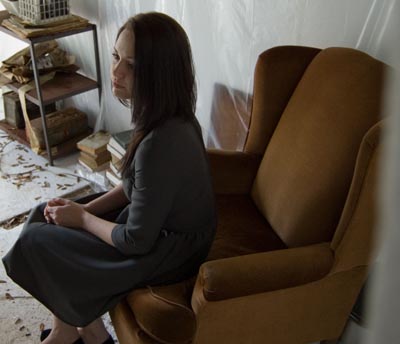
The central character is called Paul (Jeremy Hosbein). His mother (Amanda Edington) has become addicted to some sort of drug which prevents her from ageing but makes her skin photo-sensitive and she now lives in a derelict building on the other side of a checkpoint. There are walls and fences which were erected a few decades ago by some figures wearing white protection suits (aliens? soldiers? Government agents?). Paul has a friend called Harold (Bruce Culpepper) who regularly smuggles across the checkpoint a small cylinder containing a recording of Paul counting or reciting the alphabet (because it is his voice that his mother needs so it doesn’t matter what he says). Paul lives in some sort of plastic tent with lots of old hardback books. We see flashbacks to when he was young, played by Hosbein’s own son Donovan (his mother, of course, played by the same actress without need for special make-up), and a photographer (John R Hand himself) took a picture of the two of them.

I think.

And most of that I gleaned from the first 15-20 minutes, after which it all becomes hopelessly - but I believe, deliberately - entangled and bizarre. For example, the recording cylinder never seems to be mentioned again. I would be lying if I said I had the slightest clue what is going on.

Let’s see what the synopsis on the JRH Films website says: “In a post-apocalyptic world 200 years in the future, society has broken down into fragmented groups who now dwell within a tangled wood, completely unaware of any civilization that exists beyond and governed by the white-suited agents of some ominous force, which could perhaps be nothing more than a high-tech manifestation of their own guilt and suffering. In this world, a young man living in a decaying wreck of a dwelling struggles to come to terms with his bleak existence while trying to save his mother from the grip of a strange black fluid which seems to prolong life but at the same time leaves it's users in a drug-like haze and causes scar-like tissue to cover their bodies.”

Well, er, that’s pretty much what I said. But that’s the first 15-20 minutes and this runs 82. What actually, you know, happens?

Very little happens, frankly, and it happens at extremely slow speed. There are long stretches where Paul or someone else simply stands still, pausing for a really long time. Maybe they’re thinking deeply.

But you know, all credit to John R Hand. He makes defiantly individualistic, personal, artistic films. The things that set his movies apart from the mainstream, from our conventional definition of a ‘good’ film, are things which he has created deliberately. Every image, every sound (well, maybe not the overly distorted voices), every edit, every bit of this film is Hand making a statement. I don’t know what that statement is, but I would rather sit through a John R Hand film, however incomprehensible (and consequently, it must be admitted, soporific) that might be, than suffer some of the don’t-know-don’t-care amateur rubbish I’ve reviewed on this site.

A few of the cast were also in Frankensteins Bloody Nightmare and one, Evan Block, was also in Drew Bell's Freaks remake Freakshow. Block is credited as ‘thief’ here but I honestly couldn’t tell you what that involved or where he appeared. I don’t recall anyone stealing anything in the film. But maybe they did.

Three years ago I didn’t give Frankensteins Bloody Nightmare a rating because I honestly had no way to judge it, no reference points, no appropriate criteria. I’m going to do the same with Scars of Youth, I’m afraid. How can I possibly give any sort of quantitative rating to a film which I didn’t understand? All I can say is that I think this is an improvement on the last one.

Review originally posted 14th February 2009

Wednesday, 25 May 2016

47 Meters Down

Director: Johannes Roberts
Writers: Johannes Roberts, Ernest Fiera
Producers: James Harris, Mark Lane
Cast: Claire Holt, Mandy Moore, Matthew Modine
Country: UK
Year of release: 2016
Reviewed from: trade screening

Following hot on the heels of The Other Side of the Door (due to the vagaries of distribution schedules) comes Johannes Roberts’ tenth feature, and arguably his best. 47 Meters Down takes a very simple premise and runs with it, to genuinely terrifying effect.

Claire Holt (The Vampire Diaries) and Mandy Moore (Tangled) are sisters Kate and Lisa. The former is the wild, free-living, risk-taking, not-settling-down type; the latter is the sensible one in a long-term relationship. Which has just ended unhappily, the unseen Stuart accusing Lisa of being boring. A holiday in Mexico with her sister should offer some solace but also a chance for Lisa to show Stuart that she’s more free-spirited than he gave her credit for.

Which is why, after a night of drinking and dancing with two local lads, the girls agree to a trip out to sea for a shark cage-based close encounter. Matthew Modine (The Haunting of Radcliffe House) is Taylor, skipper of the unprepossessing boat with its rusty cage and creaking winch. This is very much not an approved, certificated tourist excursion and Lisa has qualms about both the sharks and the operation, which Kate allays through sisterly – but irresponsible – persuasion.

Inside the cage, lowered to a depth of five metres, the sisters have some stunning but scary views of great whites, attracted by a chum bucket of offal. And thus we come to the end of act one and the predictable cable snap, sending the cage down to the titular depth.

So here’s the predicament. Kate (an experienced scuba diver) and Lisa (new to the underwater realm) are in a rusty cage, surrounded by assorted pieces of broken winch, with a limited air supply – reducing even faster than normal because of their panicked state. The blue water above them has at least two enormous sharks swimming around in it, and a dash for the surface is out of the question because they would get the bends. You don’t really want a slow ascent with a five-minute pause halfway when huge predators are circling.

Can Taylor and his Mexican crew get to them? Can they even be trusted to try, given the dodgy nature of the enterprise? No-one else knows the girls even went out on this boat. Also, they are just out of radio range, which means intermittent communication with Taylor is only possible by briefly swimming up a few metres. So if the boat did decide to leave, they wouldn’t even know.

Roberts and his regular co-writer Ernest Riera wring every ounce of nerve-shredding tension out of this situation. The ticking clock of the air supply, the uncertain reliability of the boat crew and their equipment, the ever-present threat of the great whites. This is an extraordinarily scary, claustrophobic film and one that will have you on the edge of your seat, alternately gasping and whimpering.

The relationship between the sisters is well-defined and it’s to the film’s credit that Ernest and Jo felt no need to include any sort of “I slept with your boyfriend” revelation. There’s enough going on here without adding relationship woes, and besides the sisters’ only chance of survival is working together and helping each other.

And yet, in a sense, there’s relatively little going on here. There are several action sequences, such as a trip across the ocean floor to retrieve a flashlight, but it is surprising at the end of the film to realise quite how few and far between are the actual appearances by any sharks. And that’s a Good Thing. It is the threat of the sharks that drives the terror of both characters and audience. When a shark does appear it’s swift and sudden and terrifying but much, much more than a simple, cheesy cat-scare. That’s what sharks do – they swim fast through the opaque water, suddenly appearing with mouths full of “many teeth, dear”. (Although, despite what that song claims, sharks are not known for their dental hygiene. They don’t really need to, given that they have multiple rows of teeth, constantly moving forward to replace lost ones.)

Putting today’s marine biology lesson aside, what impresses – really impresses – is Jo’s direction. For most of the film he has only two characters, in a single tight location, their faces partially obscured (fortunately they have different hair colours and outfits), their surrounding environment an amorphous haze and no actual sharks on screen. Yet the film remains visually gripping, a situation greatly assisted by the frankly awesome cinematography of underwater specialist Mark Silk.

Now, there have been a lot of dumb shark films made in recent years. If you’re not sure quite how many, take a look at the three-part blog I wrote for Hemlock Books last year here, here and here – and bear in mind that this is already out-of-date, failing to include such low-grade tripe as Shark Exorcist, Sharkenstein and Sharkansas Women’s Prison Massacre (no, seriously). 47 Meters Down belongs to that much rarer cinematic subgenre, the intelligent shark movie. This is a film that doesn’t have to actually show the sharks to be scary; not because of any fear of audiences seeing through the effects, it should be stressed. The great whites seen here (and indeed all other passing fish) are completely credible, authentic-looking CGI creations.

47 Meters Down proves that it is possible to make a genuinely frightening, serious, intelligently plotted, shark-based horror movie. In fact, I would venture to suggest that this is probably the best shark movie since Jaws – and certainly the scariest. There have been a handful of other intelligent shark movies but none of those have milked the horror potential of the subgenre as successfully as this picture.

Interestingly, the film this most closely resembles isn’t a shark film, it’s The Descent – and not just because of the female cast (discussion of the errant ex-boyfriend notwithstanding, this has no problem passing the Bechdel test). In a review of The Descent in Video Watchdog, which I quoted in my book Urban Terrors, it was noted that the film featured hot actresses in skin-tight outfits yet pointedly refused to objectify them. 47 Meters Down achieves the same laudable goal, avoiding the same easy win.

More than its gender credentials, Roberts’ film resembles Neil Marshall’s in its claustrophobia – the cage is a tiny haven of safety among the blue – and in the way that the situation gets progressively worse, danger piling on additional danger as vestiges of hope are dashed away in gut-wrenching succession. Marshall’s six women were trapped underground by a cave-in and nobody knew they were there and there were subhuman crawlers hunting them down. Jo’s two sisters are trapped at the bottom of the sea and nobody knows they’re there (except Matthew Modine and his crew of questionable honesty) and there are some 20-feet long specimens of Carcharodon carcharias prowling around.

There is also, like The Descent, [spoilers on] a ‘false rescue’, somewhat unsubtly presaged with a Chekhov’s gun comment from Taylor about the danger of nitrogen narcosis-induced hallucination. While it’s apparent, as we watch the sisters make it back to the boat with a good 20 minutes to run, that this isn’t real (unless the film has an extraordinarily lengthy credit crawl…), that doesn’t in any way distract from the very real terror of their ascent and their struggle to make it on board, which is one of the most seat-grippingly scary sequences in the whole movie. A coda of Mexican coastguard divers finally arriving provides the sort of upbeat ending that US audiences (or at least, US distributors) demand. But by fading to black before the surface is reached, Jo allows us to retain the very real possibility that this too is inside our heroine’s mind and no more real than the previous escape. Thus the film offers both the ‘real world trap condenses into mind trap’ existentialist nihilism of The Descent’s original ending, and also the pat ‘with one bound she was free’ resolution of The Descent’s American ending [spoilers off] for those who want it.

And, like The Descent, one watches this film thinking: “Why in God’s name would you even do that?” Why would anyone in their right mind go potholing? Why would anyone with any sense get into a shark cage, even a good one booked through a legitimate tour operator? I mean, I love sharks as much as the next man (a shout out here to Bite-Back, the shark conservation charity which thoroughly deserves your support) but if I want to get up close to them I can do that at the Sea Life Centre, thank you very much. Their glass tunnel is completely safe, requires no specialised equipment or training – and there’s a gift shop at the far end of it. That’s the sensible option right there.

Of course, if Kate and Lisa had sensibly decided not to go out on Taylor’s boat, there would have been no movie. Or, looked at another way, the movie would have been 90 minutes of Mandy Moore and Claire Holt sunning themselves by a pool. Which, now I think about, you know, would also have worked for me…

Produced by the ‘Tea Shop and Film Company’ duo of James Harris and Mark Lane (Tower Block, Cockneys vs Zombies) for Dimension Films, some of the underwater scenes were shot in a big tank at Pinewood Studios. Exteriors and surface shots were filmed in July/August 2015 in the more glamorous locale of the Dominican Republic where this was the first production in the big new water tank facility there. Although one might assume that the nominal stars don't actually appear too much after act one, aside from close-ups where you can see their faces, and perhaps spent much of the shoot warm and dry in an ADR studio. in fact both actresses spent a lot of time in the water, for which props should undoubtedly be given. Nevertheless, credit where it’s due so a tip of the hat also to ‘dive doubles’ Zoe Masters, Elspeth Rodgers and Jenny Stock (I think there was a fourth dive double, but only those three are listed on the IMDB). Only in a couple of shots are the 'actors' as CGI as the sharks and you won't spot those.

Tower Block director James Nunn was first AD, a duty he also performed on F (as well as numerous other BHR titles) and also shot second unit. A terrific score by North American duo tomanandy (Sinister 2, Resident Evil sequels) keeps the atmosphere charged throughout, abetted by corking sound design by Alex Joseph (Tower Block, Green Street 3). Production design by David Bryan (The Other Side of the Door), make-up effects by Kristyan Mallett (Howl), editing by Martin Brinkler (Storage 24) – all top-notch. Outpost FX were responsible for the absolutely enormous amounts of visual effects; basically everything underwater except actors, cage and props is created in a computer while lots of other CGI disguises the fact that this was all shot in, effectively, a big swimming pool.

During post-production the title was briefly changed to In the Deep and that was on the print which was screened (twice) at Cannes in May 2016 (actually it was Johannes Roberts’ In the Deep, but who could begrudge him the possessory credit?). However it has subsequently been confirmed that the film will revert to the shooting title (with that American spelling) on release, probably to avoid confusion with a US-Aussie film called Into the Deep, set for a UK DVD release in September. That is also about people trapped in a shark cage but it looks like a found footage movie (yawn) and so probably not something we need to concern ourselves with and certainly no real competition except among that key audience demographic, people who don’t pay attention when buying DVDs in Asda. The IMDB currently lists a Dutch release date of September 2016 for 47 Meters Down but who knows where they got that from or how accurate it is.

MJS rating: A