Showing posts with label Australia. Show all posts

Wednesday, 6 July 2016

Seventh Victim

Director: Andrew Kutzer
Writer: Russell Devlin
Producer: Russell Devlin
Cast: Darren Maxwell, Audrey Lamont, Geoff Tilley
Country: Australia
Year of release: 2005
Reviewed from: screener disc

I’m not normally a one for watching completely amateur (in a non-judgemental sense) movies - fanfilms in other words. They’re all very well and good for those who like them, but I have enough films to watch already, thank you very kindly. But I’ll make an exception for this 17-minute Aussie short, partly because it’s not a fanboy love poem to some big-budget cinematic franchise, but mostly because it has been written and produced by my old mate Russell.

‘The Seventh Victim’ is a famous short story by one of the great SF writers, Robert Sheckley, who sadly passed away last December. He tended to write SF that bordered on, or toppled over into, satire. (Sheckley’s influence on the works of Douglas Adams was something that Adams himself tended to gloss over.)

‘The Seventh Victim’ itself has quite a history. First published in Galaxy magazine in 1953, it was filmed in Italy in 1965 as The Tenth Victim, starring Marcello Mastroianni and Ursula Andress (the title possibly changed to avoid confusion with the 1943 Val Lewton picture). There was allegedly an Italian TV version in 1979 too and there was a radio dramatisation in 1957 as part of the series X Minus One. Sheckley himself novelised the 1965 film and wrote two lacklustre sequels to it in the late 1980s, by which time his copious and rather notorious consumption of certain substances had severely dulled his literary edge. A new version, also called The Tenth Victim, was was announced in 2001, allegedly to star Catherine Zeta Jones; Brendan Fraser was reported to be aboard the project two years later. Although this never came to anything, when I interviewed producer Ed Pressman last month on the set of Mutant Chronicles, The Tenth Victim was still very much part of his portfolio of in-development projects.

The actual plot is relatively simple; most of the science fictional aspects are in the setting. In the future, war and crime have been eradicated by the introduction of legalised murder, co-ordinated by the Emotional Catharsis Bureau (ECB) which pairs up killers and victims. About one third of the population take part, but very few killers make it into ‘the tens’ - kills in double figures. There are also gladiatorial combats and ‘death races’ to entertain the populace.

Stanton Frelaine (Darren Maxwell, director of Alone and The Psychology of Killing) is assigned his seventh victim and is shocked to discover that it’s a woman, Janet Patzig (Audrey Lamont). He can’t back down or refuse the assignment. Well, actually he can but that would mean that he would be reclassified as a victim. (We learn at this point, as an aside, that killing innocent bystanders, even accidentally, carries the death penalty).

Frelaine has a ‘spotter’, Ed Morrow (Geoff Tilley), who tracks down his victims for him and the two are soon parked in a car watching Patzig drink tea at a cafe table, seemingly oblivious to her status as a victim. Unable to carry out the hit for both practical and emotional reasons, Frelaine instead approaches Patzig and the two strike up a nascent romance. But when they go back to her flat, Stanton finds out that this ‘unsuccessful actress’ is not all she says.

It’s a fairly corny plot with a twist ending that can be spotted miles away but it was probably fresh and original in 1953. Russell Devlin’s script does a good job of sticking to Sheckley’s story, embellishing it with TV clips including a show which interviews successful killers and a TV debate in which one of the pundits is played by director Andrew Kutzer (who also provide an announcer’s voice). The script's weak point is towards the end, when Frelaine is momentarily left alone and indulges in an entirely unnecessary voice-over monologue in which he voices his contradictory feelings towards Patzig. We are told about the character’s predicament instead of being shown it. Actually, we are shown it as well, in the form of a montage, and the scene would work perfectly well with just images and music. (The film’s music is variously lifted from episodes of The Twilight Zone and The Outer Limits plus Holst’s Planets Suite.)

Devlin worked hard on this short, racking up credits as not only writer and producer but also DP, props, sound, lighting gaffer and title sequence. He shot the film on video and it shows, and some of the interior scenes suffer from bad sound, as so often with this level of film-making. There is not really anything by way of special effects. The acting is surprisingly good, especially from Maxwell whose character undergoes a complete transformation during the film’s short running time.

Sheckley’s works were the basis of several other films and TV shows, notably Freejack and Condorman, and towards the end of his life he wrote spin-off novels based on Deep Space Nine, Babylon 5 and Aliens as well as an unpublished (allegedly unpublishable) novelisation of the computer game Starship Titanic. Back at the start of his career he wrote episodes of Captain Video! Ideas from ’The Seventh Victim’ can be seen in the excellent Series 7: The Contenders but it can be argued that the subgenre extends all the way back to The Most Dangerous Game.

Russell sent me two discs, one with the director’s version, one with the producer’s version. There is relatively little difference, just a couple of bits of dialogue and some different takes in certain shots. I slightly preferred the former but that may just be because I watched it first. Also on the discs was a trailer, a stills gallery (which include innumerable posters, one of which announces that ‘nobody will be admitted after the first 17 minutes’), a spoof music video, various out-takes and a half-hour ‘scrapbook’ of rehearsals and behind-the-scenes footage in lieu of a proper Making Of. Also included is the (public domain) X Minus One radio version, the opening announcement of which forms the start of this film.

Seventh Victim is not an authorised adaptation. It was produced shortly before Sheckley died but he was not aware of it (mind you, he probably wasn’t aware of his slippers for most of his last decade). It has been screened at a couple of festivals/conventions to considerable acclaim and the team behind it are now working on larger and more ambitious projects.

MJS rating: B+
review originally posted 6th July 2006

Sunday, 30 November 2014

Reign in Darkness

Directors: Kel Dolen, David Allen
Writers: Kel Dolen, David Allen
Producers: Kel Dolen, David Allen
Cast: Kel Dolen, David Allen, David No
Country: Australia
Year of release: 2002
Reviewed from: UK DVD (Screen Entertainment)

You may have heard the phrase 'Show, don’t tell.' If you have, you’re probably not David W Allen or Kel Dolen, the guys who made this dull Australian vampire film, set (for no apparent reason) in South Africa. That’s the bit of South Africa where everyone has a strong Aussie accent, apparently.

Kel Dolen himself stars as Michael Dorn (an homage to the Star Trek actor?) who is part of a “small team of molecular biologists” researching a possible cure for HIV. In fact there are only two biologists in this team: Dorn and Scottie (Scott Tyack), plus one bureaucrat, Alex (co-writer, co-director David Allen who has subsequently added his middle initial to his screen name, presumably to distinguish himself from the legendary special effects artist who directed Puppet Master II) and a gun-toting heavy called Lance (Chris Kerrison) who has a Southern United States accent and sometimes wears a Confederate flag bandana. Because, you know, molecular biology research programmes often require firepower.

Reign in Darkness has three big problems (well, four if you count the fact that it all takes place in bright sunshine). It’s boring, it’s packed with inconsistencies and stuff that just doesn’t fit together in any conceivable way - and it’s narrated to death. For most of the movie, wooden actor Dolen drones on in a flat, lifeless monotone, explaining what his character is feeling, what he’s thinking, what he has just done, what he plans to do next and occasionally what he is actually doing while we’re watching him doing it. This is not some sort of film noir-style narration that a (good) film might get away with, it’s just somebody reading out a (fairly rubbish) story while we see it acted.

Dorn and his three colleagues are studying a virus called K-17 (which an opening caption tells us is believed to genuinely exist...) only their version is called RVK-17 for some reason. They’re not sure who they’re working for and their test subjects are tramps and hobos, whom they inject with the latest batch of RVK-17 to see what happens.

Dorn and Lance drag a tramp out of his cardboard home and inject him, instantly turning the ‘gentleman of the road’ into a maniac who attacks Dorn. Meanwhile narrator-Dorn tells us that these people are “like lab rats”. Well, no, not really. Lab rats are usually found in the controlled environment of, you know, a lab. They’re not just wild rats picked up on the street and injected with stuff. As Dorn tries to fight off the tramp, Lance saves him by blasting several shots from his automatic pistol into the man - while he is lying on top of the struggling Dorn!

Now here’s a tricky one: which of these is dumber? The idea that you can shoot someone (at point blank range) and the bullets will not continue through their body into the poor sod lying directly underneath them. Or the experimental procedure of Dorn’s team which is to find a homeless person, inject them with a virus which causes them to turn into a maniac (this is already known, it’s no surprise), do so without any way of restraining the person and then shoot them before they can be studied, thus rendering the whole thing pointless. This scene is typical of the film in having ideas that might sound good, might even work in isolation, but simply don’t make anything approaching sense when put together.

Despite miraculously escaping Lance’s bullets, Dorn has been stabbed by his own hypodermic needle which apparently still contained some RVK-17 and this turns him into a vampire. For some reason and in some way. Not a maniacal vampire who wants to kill and eat the first person he sees, but a haemavore nonetheless. Why the virus should affect him differently to the tramp is never explained. But he runs off, uses his new vampire superstrength to kill some anonymous goons sent to catch him and resigns himself to life as a fugitive. Oh, and there’s some back story about how one of the earlier test subjects went renegade and killed Dorn’s wife, back at the start of the project.

Now, Lance has some unseen masters with whom he converses while standing in a fuzzy spotlight surrounded by darkness (they call him ‘bounty hunter’ although we have already established that he is no such thing). These masters (actually it’s just one voice which not only is even more flat and lifeless than the narration but which constantly fades in and out of audibility) tell Lance that he must track down Dorn, helped by someone called Gage.

This turns out to be a tall guy with short hair died a sort of greenish-yellow and it must be said that Korean-Australian David No stands out not so much by his distinctive barnet, more by virtue of being the only person in the cast who can act. Lance and Gage can’t stand each other but have to work together to hunt Dorn. Gage is called a ‘half-breed’ but this is never explained and makes no sense if this form of vampirism is caused by a virus (not that the film-makers seem to have much clue what a virus actually is...) No’s other work includes Subterano, The Matrix Reloaded and Mr Nice Guy, in which he fought one-on-one with Jackie Chan.

Much of the film then consists of these two tracking down Dorn who returns to his flat (which has a Metropolis poster on the wall - the sure sign of a film-maker using his own home) where everything has been turned over by someone searching for something. They didn’t find his gun because he cleverly hid it under his CD player but they have taken his sword. Dorn also retrieves a photo of himself and the late Mrs Dorn. He sets himself up in some shed or room or building or I don’t know, it’s never explained, where he makes himself some kevlar body armour and a long trench coat lined with kevlar. Again, we have a choice. Is the dumbest thing here the idea that one person, without any specialist knowledge or equipment, could run up state of the art bullet-proof clothing in a dingy room virtually overnight? Or is it that bullet-proof body armour is completely superfluous for a character who has already discovered that he has amazing healing powers. Make him able to survive being shot or give him bullet-proof clothes, but why do both?

While rarely bad enough to be entertaining (or even interesting), Reign in Darkness does occasionally provide some unintentional laughs, mostly in scenes where someone blasts away at someone else at point blank range while the other person simply runs away unscathed. There is also the world’s least exciting car-chase in which two expensive sports cars are driven at reasonable speeds because they must be returned unscratched to the dealer who lent them after filming wraps. Although credit where credit is due, the film-makers do make the red car look like it has crashed by tilting it to one side, popping the bonnet open and sticking a smoke machine under it.


There are good moments in this film - there is for example an almost Kubrickian shot of a guy blasted in the head while framed in a doorway - but they are few and far between and fail to compensate for the ludicrous plot, terrible dialogue, lousy acting and relentless bloody narration. It all ends with a confrontation between Dorn and a sort of master vampire called Raphael Ravenscroft, one of the people who were commanding Lance. Apparently there indeed are real vampires and the development of RVK-17 really was an attempt to cure AIDS but only to ensure a plentiful supply of uncontaminated blood for the vampires. Or something. This goes on forever. I mean, I didn’t time it but I would estimate 10-15 minutes of just two people talking. The whole structure of the film is out of whack with what seems like a climax about halfway through. It’s only 90 minutes but it drags and drags and drags. It took me three evenings to sit through it all because I kept falling asleep.

Anyway, Dorn despatches Ravenscroft and his shadowy, hooded cohorts with a gun that they initially scorn until he announces that it is loaded with silver bullets.

Silver bullets? Dude, that’s werewolves not vampires.

Dorn then blows up some building and drives off.

On their website, Dolen and Allen explain that they had no training or experience in film-making when they shot Reign in Darkness. They’re actually marketing executives who decided that the tricky part of film-making is selling the thing so they applied themselves to raising the money and then, it seems, made the film itself almost as an afterthought. It shows, it really does. Despite their claims to have read some books on the subject, this is what a film looks like when it’s made by people whose only knowledge of films comes from watching the things. I mean, all credit to them for creating something from nothing, for getting up off their backsides and actually making a feature-length film. But it didn’t have to be this poor.

At heart, Reign in Darkness is a very cheap Blade knock-off and its emphasis on ‘genetically created vampires’ puts it in the same sub-subgenre as The Witches Hammer but the Aussie film has none of the charm of the British one, none of the fun, none of the excitement. It’s just a heavy slog through illogical, over-narrated drama, devoid of anything that could reasonably be called thrills, horror or action. It doesn’t help that, aside from David No, pretty much nobody in the cast has any acting experience. In fact the only other person with any sort of credits to speak of is stunt co-ordinator George Novak whose career goes right back to Mad Max. He is credited as ‘Bum’ so he may be the guy who gets shot while lying on top of Dorn, but somebody else is credited as ‘Homeless man’ so who knows (or indeed, cares)?

Actually there is one funny thing in the credits (two if you include the misspelling of ‘criminal’ in the copyright notice). There are separate credits for the people who animated the thoroughly over-the-top ‘RapidFire Productions’ logo - even though this is only used on the trailer, not the film itself.

Also on the R2 Screen Entertainment DVD are original trailers for I Spit on Your Grave and Don’t Mess with My Sister, both more interesting than the main feature. There is also a trailer for Andreas Schnaas’ Demonium, a very short teaser trailer for Nutbag and a trailer for Bangkok Hell which is in Thai and unsubtitled!

According to the RapidFire website, Reign in Darkness was shot for A$49,000, sold to 27 territories and “won numerous awards.” Dolen and Allen have also made The Industry, a black comedy about the Australian film industry plus two short films, Snap and Time II Die. Their most recent work is a Star Wars fan film called Wrath of the Mandalorian (dear Lord...) and they have a feature called The Gates of Hell in post-production. Perhaps they have learned about film-making since they made Reign in Darkness. Hopefully, they have at least learned the principle of ‘Show, don’t tell.’

I know I’m being very down on this film and really it’s not terrible, I’ll admit that, but it is massively Not Very Good.

MJS rating: D+

Saturday, 3 May 2014

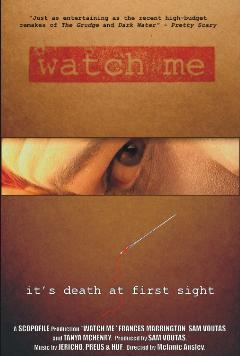
Watch Me

Director: Melanie Ainsley
Writers: Melanie Ainsley, Sam Voutas
Producer: Sam Voutas
Cast: Frances Marrington, Sam Voutas, Katrina J Kiely
Country: Australia
Year of release: 2006
Reviewed from: screener disc

It would be pretty cool if a DVD turned up in the post with nothing to indicate what it was except that somebody had written on it ‘watch me’. As it happens, I had already been contacted by producer Sam Voutas and checked out the movie’s website so I had some idea what I was in for.

Voutas and director Melanie Ainsley are both Australians who were raised in China (although Ainsley was actually born in Canada) but the biggest influence on this movie isn’t Aussie or Chinese cinema, it’s the post-Ring vogue for Japanese horror. The film-makers cite Dario Argento as an influence too, although that’s less apparent.

Instead of a cursed video tape, Watch Me concerns an e-mail attachment, a video file depicting sickeningly horrific sexual violence which spreads from computer to computer like a virus, albeit a lot slower. Anyone who opens and views the file receives a fatal visit from a spooky young woman with red hair and a yellow dress, who walks backwards for some reason.

Jill (Katrina J Kiely, also in the bonkers sci-fi spoof Atomic Spitballs) and Tess (Frances Marrington: Purge, A Nocturne) are taking a film studies course at some unspecified Aussie university. Their thesis on the role of the voyeur requires Jill to rent three films from Taku, a fellow student nicknamed Freakboy who finances his studies through a library of hardcore porn amassed over many years. Played by producer Voutas, Taku is a connoisseur of filth, inured to its effects yet still enthusiastic about it as a genre. So when Jill mysteriously dies as a result of watching an e-mail attachment, Tess seeks Taku’s help to solve the mystery.

Along the way more people die including fellow students and two cops investigating Jill’s death. Eventually Tess and Taku - who have both watched the video clip and survived - manage to track down a recipient before he watches it (the e-mail only travels to one computer at a time) and confront the ghost.

Watch Me is an enthusiastic and commendable indie horror feature with some good set pieces but which suffers from the curse of low budget film-making - over-ambition. The story isn’t cohesive enough to fully satisfy the viewer and the impression given is that Ainsley and Voutas were more concerned with the parts of the film than the whole. As I have observed before, a ghost story needs to be constructed as a mystery and we need to find out at the end what has been happening and why, the pieces falling into place for the audience and whichever characters we are empathising with.

In Ring, this film’s most obvious antecedent, we eventually found out who the spooky girl was, why she was on a video tape and why she crawled out of people’s TVs. The explanation may have been enigmatic and debatable, but it was there. The ghost story in Watch Me doesn’t have an explanation per se, only the realisation by Taku and Tess as to why they both - and they alone - survived viewing the clip. This ties in to Taku’s extensive experience of hardcore porn and a traumatic event in Tess’ past but to be honest the explanation doesn’t really hold water; it makes a kind of sense but it’s not satisfying.

There are certainly some great scenes in Watch Me but their strength comes from characterisation more than plot, the most notable being Taku’s experiment on Tess, forcing her to watch the clip and videoing the process in the hope of finding out what kills her - except it doesn’t. But these scenes are strung together in a story which meanders somewhat. For example, it takes quite some time before we realise that Tess is our main protagonist, in fact before we even meet her. Before that the film concentrates on Jill and introduces us to Taku. It’s an imbalanced plot structure which a more carefully worked out script might have solved.

That’s the problem. This script has been filmed before it was ready. It needed a few more drafts to iron out the narrative structure and better establish the backstory behind the spookiness which otherwise comes across as somewhat arbitrary in places. The red-haired ghost girl is undeniably frightening, both in her conception and her execution, but we never find out her motives and her methods seems inconsistent. Some victims are found dead with their eyes sewn shut, others simply disappear. Some die while watching the clip, others succumb shortly afterwards.

That said, these criticisms should not detract from the film’s successes. We really care about these characters (once we know which ones we’re meant to care about) and the threat, the danger is keenly felt. I don’t mind ghosts being slightly derivative when they’re as spooky as this one. The acting is good and the production values throughout are highly commendable. The direction is snappy when it needs to be, languorous when languor is required. In technical terms, the two things that let the film down slightly are the flat video quality and the use of what look like genuine, unaltered homes as sets. I would never recommend making your lead characters film students simply because it makes the film inevitably look like a student production (which this is not).

So in a sense the film is overambitious in terms of story but sells itself short in terms of mise-en-scene, using found locations that don’t tell us about the characters because the characters haven’t created those homes. But I’m sounding unduly critical here. I really enjoyed Watch Me and I was genuinely scared by parts of it - and you can’t ask for too much more than that.

Ainsley and Voutas have previously collaborated on the sci-fi feature film Crash Test - about an escaped crash test dummy - adapted from Voutas’ short student project, and on the Beijing-set documentary The Last Breadbox. Ainsley’s previous film was the horror short Butcher which, like Crash Test, also featured Katrina J Kiely.

Also in the cast are Tanya McHenry (as the ghost), Steve Van Spall (who played the lead role in Crash Test), Glen Hancox (who was the Dean of a film school in Neighbours!), Celeste Barry and Dave Peterson (both also in Crash Test), Thomas Lim (Marco Polo, Son of the Dragon), Sharn Treloar (Magnificent Deed) and George Ivanoff who provided a voice for I, Rocket (a short animated film by Russell Devlin who also made Seventh Victim - everyone in Australia is ultimately connected to my mate Russell, it seems).

Make-up and effects are credited to Louise Monnington (who worked on a Star Wars fan film) and Justin Dix (who directed a Star Wars fan film and then got to work on the real Star Wars prequels!). Xue Feng was the cinematographer while the DV cinematography is the work of Brett Anstey, director of Damned by Dawn.

Watch Me is a decent, well-crafted, scary slice of Down Under indie horror (filmed in both Oz and China) although it does make you want to see the same people make something more Australian. The thing about J-horror is that no-one does it as well as the Japanese. I would like to see Voutas and Ainsley make a thoroughly Australian (or even Sino-Australian) horror film, with a script that has been rewritten to within an inch of its life and deep, rich cinematography. That could be bloody great.

MJS rating: B

Saturday, 22 February 2014

Lorca and the Outlaws

Director: Roger Christian
Writer: Roger Christian, Matthew Jacobs
Producer: Michael Guest
Cast: John Tarrant, Donogh Rees, Deep Roy
Country: UK/Australia
Year of release: 1985
Reviewed from: UK VHS


Dear Lord, this is poor. This is really, really bad. What’s worse, it’s British. Oh, the national shame. A pisspoor, sub-sub-Star Wars piece of semi-juvenile rubbish which is nothing more than a scrappily assembled mishmash of clichés and lazy film-making.

I didn’t enjoy it. No, sir.

Right from the start, we know we’re in trouble because the very first shot is of a communications satellite which has the words ‘Communications Satellite’ painted in big red letters on the side. A caption tells us this is ‘El Jadida - The 21st Century’ but what is El Jadida? One would naturally assume, since we are looking at a planet, that it is the name of said planet.

However, we then get a very brief aerial shot of a settlement at night and another caption: ‘A mining station on the planet Ordessa.’ So if the planet is called Ordessa, what is El Jadida? Is it the town? Why have we got a caption telling us the town’s name on a shot of the planet and a caption of the planet’s name on a shot of the town?

Because this film is a big stinking pile of crap.

Despite the word being plainly spelled ‘Ordessa’ with an R, an incoming spaceship which identifies itself in a voice-over radio communication as ‘Police Transport Zebra’ speaks to a ground controller called ‘Odessa 5.’ So is it Odessa or Ordessa? Who knows? Who cares? What is more interesting is that the spaceship looks very much like the one from Nightflyers. I don’t know if it’s the same model or a revamped model or just my memory playing tricks, but it doesn’t half look similar.

Captain Jowitt (Ralph Cotterill, one of the few British actors in the cast, though he has evidently been based in Australia for some time, where he has appeared in the Australian Ultraman series and Howling III: The Marsupials) has come to quash a rebellion on behalf of the ‘Droid Government’ using squads of robot soldiers or ‘droids’, one of whom asks another what Jowitt is like and is told: “He’s more like one of us than human.”

El Jadida, if that is the town’s name, is represented by various graffiti-covered alleys down which wander a lot of extras in awful 1980s fashions. Someone with a loudhailer starts chanting pro-human, anti-droid slogans and this is taken up by the crowd, led by a young blonde lady who is named, we shall discover, Abbie (Donogh Rees, who played three different roles in various episodes of Xena and Hercules). Lorca himself is a young chap who isn’t actually blonde, he just has blonde highlights in his hair - so it’s good to know that this remote mining colony still has functioning hair salons. He is woodenly played by the astoundingly uncharismatic John Tarrant from Aussie soap A Country Practice.

Beyond the basic principle of ‘human rebels’ there is very little attempt to explain what is actually going on, either politically or personally. There is no indication of whether this ‘rebellion’ is some sort of organised movement or just a simmering discontent. If there is actually a rebel organisation, where do Lorca and Abbie fit into it? How do they know each other? Do the authorities know about them? In what way are humans actually being oppressed? Who or what is the Droid Government? Where does Ordessa fit into the galactic economy? Who is Captain Jowitt? None of this is explained, none of these basic questions are answered.

Because this film is a big stinking pile of crap.

This is a chaotic and inept movie which seems to think that in a science fiction film it’s enough to say people are ‘rebels’ without indicating what they are rebelling against. Badly lit scenes are cobbled together in an almost random order and we never learn anything at all about our protagonists or their situation. For example, early on there is a scene in which ‘the children’ are hidden anyway. But who are these children (and whose are these children) and why must they be hidden? Where are they hidden? Why are they never seen or referred to again?

The children are being told stories about Earth by a short robot named Grid, played by Indian midget actor Deep Roy. He is Lorca’s sidekick though it is puzzling quite what use a midget robot would be to anyone - Lorca is constantly having to lift him up to reach things. Roy occasionally remembers to exhibit a slight stiffness to his movements but for the most part he just looks like a midget in a helmet.

Let me pause here to describe the expensive special effects techniques which are used to bring both Grid and the Droid Police to life. Each of the police wears a jumpsuit and a crash helmet and has, over his face, an immobile human mask, a creepy black metal mask apparently modelled on a black man (which gives the film an intriguing subtext). They look like dolls, frankly - Grid even more so since his mask is more cherubic and hence more creepy. Aside from their immobile faces, no attempt at all is made to give them any sort of robotic appearance. They don’t even carry ray guns, being armed instead with M16 automatic rifles, which are obviously still a popular weapon in the spacefaring 21st century.

I’m not saying that these are the crappiest, cheapest, stupidest robots in cinematic history. But they certainly rank up there with the worst.

Anyway, stuff happens but it is impossible to tell what or why, partly because everything is really badly lit but mostly because this was obviously made from a script where a lot of explanation was in the stage directions, leaving those of us with nothing to go on except dialogue and action scratching our heads. About half an hour in I wondered whether it was just me. Was I being thick and not following a simple plot? No, it really was a nonsensical jumble of ideas and scenes. I challenge anyone to work out what is happening without first reading a plot synopsis. (I didn’t even read the back of the video box - I wanted to come to this story with an open mind.)

Somehow - don’t ask me how - Lorca and Grid end up at a big open-cast mine with giant lorries, the sort that have tyres 20 feet in diameter. This futuristic setting with its futuristic vehicles is represented by a big open-cast mine with giant lorries, the sort that have tyres 20 feet in diameter. There is no attempt whatsoever to disguise this cool but badly-used location.

For some reason, Lorca’s mother is here. How? Why? Christ only knows. There has been some talk of Lorca’s father who may have been a rebel leader or something. Anyway, from behind a giant lorry Lorca sees some Droid Police shoot his mother. He responds by lobbing a hand grenade. The resulting explosion very impressively reduces to neat piles of cloth and metal about a dozen droids standing around over an area of 40 or 50 square metres, while leaving his mother’s body entirely untouched. Lorca puts his mother - and another body, whose identity escaped me - into the back of a normal-sized truck and takes them into the desert where he buries them.

On returning, he is captured by Danny (Hugh Keays-Byrne: Mad Max, Les Patterson Saves the World, Farscape: The Peacekeeper Wars and the 1999 version of Journey to the Centre of the Earth), a grimacing, unkempt bounty hunter employed by Captain Jowitt (tick another cliché box, folks; heck, tick a bunch of them) who has already captured Grid and uses him as bait. The two rebels are thrown into the back of a giant truck with a single droid guard who is easily overcome. There follows a deeply unthrilling ‘fight’ between Lorca and Danny which ends with the truck rolling gently into a wall of earth with a small explosion to suggest that it has crashed in some way (they couldn’t actually damage the thing of course, on account of how much those trucks cost). Danny is thrown into the earthbank but we later see his hand emerge so he’s - gasp - not dead. Lorca repairs Grid, whose head has come off.

Back in El Jadida, Abbie (whom Lorca believes to be dead, for some reason) has hooked up with a cute brunette room-mate named Suzi (Home and Away actress Cassandra Webb, who gets an ‘And introducing’ credit). After the sequence in the open-cast mine, which was rubbish but at least could be followed, the scenes back in the township plunge us once again into random actions by unidentified characters. Lorca and Grid come back to town, Lorca meets Suzi who hides him by stripping to her undies and pretending to snog him in some sort of sex cubicle when the Droid Police come looking for him. There is also a girl with very blonde hair (blonder than Abbie) and a red leather jacket who is a friend or comrade of Abbie and/or Suzi but I don't know who she is or what she does.

For some reason, Abbie and co have to get aboard a spaceship called the Redwing which looks like the one from the start of the film (Police Transport Zebra) but that may just be the production saving on effects footage. This used to belong to Lorca’s father (I think) but the significance of this ship, though clearly important, is never explained.

Because this film is a big stinking pile of crap.

Grid has his own little adventures, frequently being referred to as a ‘Nissan model’ (well, that’s what it sounds like) and we learn very late in the day that he is an SDU, a Sentinel Defence Unit, designed to protect a spaceship while the pilot is away doing other stuff.

Lorca, Abbie, Grid and Suzi somehow get aboard the Redwing, although Suzi isn’t in the actual boarding scenes, she just magically appears when they’re on the bridge. Then it turns out that there is another SDU aboard, also played by Roy, who kills Abbie. Let me stress that everything I’m writing here should be taken with a great big dose of ‘I think this is it but I can’t tell.’ Abbie’s death scene is not shown, only Suzi screaming from behind a window in a door, which she makes no attempt to open, and frankly it looks at first like it’s Suzi being attacked.

Grid stands over Abbie’s body, covered in blood, while the other SDU seems to be completely spotless - which is confusing. but no more confusing than anything else in this plotless, sci-fi-by-numbers mess - and he begs Suzi to activate his attack mode. This evidently involves tapping a five-digit code into a previously unmentioned keypad on the side of his head. We then have the extraordinary spectacle of two midgets in crash helmets and doll masks throwing each other around a spaceship corridor. In fact, they throw each other through various walls, which are clearly made from painted sheets of expanded polystyrene and then they throw each other through the floor! What sort of spaceship has walls and floors that flimsy?

A spaceship in a film which is a big stinking pile of crap.

The massive overhead doors of the docking bay where the Redwing was parked are locked, but Lorca and friends break out by repeatedly banging their spaceship against the doors until they break open. They then fly off, just as another spaceship is coming in. Some sort of bomb is activated and there is a series of explosions, culminating in aerial shots of mining blasts at the previously seen open cast mine. Wait a minute, are we expected to think that blasts in an open cast mine are actually a township, complete with massive spaceship docking bays, blowing up? Quite possibly. Nothing about this piece of crap can surprise me any more.

Grid tells Lorca and Suzi that Abbie did not die in vain and a radio voice from somewhere says that Abbie’s mission has been accomplished and all that is needed now is a transport, but it looks like the inhabitants of El Jadida - if any of them survived those explosions - are out of luck because the Redwing is heading off into space.

I don’t think I have ever been so relieved to see the words ‘The End’ appear.

So who was responsible for this pile of dross which is badly directed and staggeringly badly written with pathetic production design and laughable special effects (although the spaceship shots aren’t bad)? Step forward, Roger Christian. This chap is sometimes referred to as ‘Academy Award winner Roger Christian' but don’t let that fool you. He was part of the team which received the Oscar for Best Set Design for Star Wars; he hasn’t won any awards for his direction apart from a big fat Razzie which he won for Battlefield Earth. Oh yes, it’s that Roger Christian. (There is another one, a musician, who released a few records in the early 1990s. He was the brother of the guys who were actually in The Christians.) This Roger Christian also directed Second Unit on The Phantom Menace, which possibly says even more about him than Battlefield Earth.

Co-writer Matthew Jacobs hasn’t got much to be proud of either, his greatest hit being the 1996 Doctor Who TV movie, which he also co-produced. To be fair, he also wrote Paperhouse, the enjoyable Jim Henson TV special Monster Maker, Disney’s The Emperor’s New Groove and a number of episodes of The Young Indiana Jones Chronicles. But let’s face it, if somebody asked you to imagine a sci-fi movie directed by the guy who made Battlefield Earth, written by the guy who wrote the Paul McGann Doctor Who movie, what sort of film would you conjure up?

A big stinking pile of crap?

Also in the cast are Rod Zuanic (Mad Max Beyond Thunderdome) as ‘Lorca’s friend’, Tylor Copin (Mad Max 2, Peter Benchley’s The Beast) as a ‘Detective Droid’, Rebekah Elamaloglou (Home and Away, Paradise Beach, Mad Max Beyond Thunderdome) as one of the children and John Rees (Raiders of the Lost Ark, Sky Bandits) as a holographic priest. But among all the soap actors and Mad Max bit parts the only interesting member of the cast is Deep Roy.

Roy is one of those incredibly busy short actors, like Warwick Davis or Phil Fondacaro, who seems to turn up everywhere. He was Droopy McCool in Return of the Jedi, the Tin Man in Return to Oz, Princess Aura’s pet in Flash Gordon and all the Oompa Loompas in Charlie and the Chocolate Factory. In fact he has become part of Tim Burton’s rep company, appearing in Big Fish and the dire Planet of the Apes remake and even lending his voice to one of the characters in Corpse Bride. He has also acted, or performed stunts, in Freaked, The Grinch, Howling VI, Alien from LA, Greystoke, The Dark Crystal, Poltergeist II, Van Helsing,Matilda, the brilliant Retroactive, Hook and Leprechaun. He is certainly not the only person to have appeared in both Doctor Who and Blake’s 7 but he could well be the only person to have done both those shows and The X-Files.

Reading this review back, I may have been unfairly harsh to a relatively harmless little film, but the hell with it. This is an inept piece of movie-making and if Roger Christian’s career had been nipped in the bud he would never have inflicted Battlefield Earth on us. There’s a lesson there for us all. It’s not even clear who this is aimed at. The packaging makes it look like a kids’ film but there’s no entertainment value to it that might interest kids: no whooshing spaceships, no zapping ray-guns, no chases and only one really, really crap fight (between two doll-faced midgets surrounded by polystyrene walls).

I really doubt that producer Michael Guest is the actor from the 1960s and 1970s who appeared in Doctor Who, Dixon of Dock Green and Pathfinders in Space, but I suppose he could be. He has produced a few other films including Codename: Kyril and recent British horror flick The Toybox. Effects man John Cox, now the creator of animatronic monsters for films like The Host, Pitch Black and Rogue, worked on this film when he was just starting out.

Many sites list Tony Banks (from Genesis) as composer of the score for this film. Although Banks did contribute some music, the main composer is actually Craig Huxley, who started out as a child actor - he was in two episodes of Star Trek - before becoming a composer (he invented a massive musical device called the Blaster Beam which allegedly caused women in the audience to have spontaneous orgasms and which was used for the sound of V'Ger in Star Trek: The Motion Picture). But the score by a Star Trek child actor who gave women orgasms with a musical instrument isn't the oddest thing about this film's soundtrack. The oddest thing is a holographic music video machine on the street of El Jadida; at one point this plays a Peter Gabriel video and on another occasion a Toyah video is briefly seen. Wow, their careers must have really taken off over the decades...

(Apparently, Banks did indeed record a soundtrack for this film, using music from his rejected score from 2010. The Lorca music and his score for another film called Quicksilver were released on an album imaginatively titled Soundtracks. The odd nature of the film credits here would suggest that Banks' music was removed at a very late stage. My thanks to Insiders director Steve Lawson for this information.)

This pile of tosh is also variously known as 2084 and Starship. Quite hilariously, the movie’s page at the Inaccurate Movie Database is illustrated with a video sleeve featuring the rock band Starship! However, even the IMDB cannot be blamed for the extraordinary cock-up in the film credits, where the character of Grid is listed as ‘Kid’ (or possibly Xid, as the video transfer is abysmal - no, I think it’s ‘Kid’).

That sums up perfectly, for me, this awful piece of junk. There really is almost nothing to recommend here. I’ll try, I really will. The spaceship effects aren’t bad and Cassandra Webb is quite cute (and can act, which is a rarity among this cast). But these plus points are not enough to make up for one of the most amateurish, hopeless scripts ever filmed, awful direction, crappy production design, those staggeringly rubbish robots and a wooden leading man. And frankly the inclusion of a Peter Gabriel music video is the final nail in the coffin.

MJS rating: D-

13th November 2005

Saturday, 7 December 2013

A Journey to the Centre of the Earth (1977)

Director: Richard Slapczynski
Writer: John Palmer
Producer: Walter J Hucker
Cast: Ron Haddrick, Alastair Duncan, Bevan Wilson
Country: Australia
Year of release: 1977
Reviewed from: UK DVD (Pegasus)


This is the third animated version of Jules Verne’s subterranean classic that I’ve watched in the past two months. Like the 1996 Canadian version and the 2001 Franco-Belgian version, this runs about three quarters of an hour and consequently has to rather skim through the story.

In actual fact, this version takes a long time to actually get underground. Set in Hamburg in what seems to be the late 19th century (though no specific date is given), we are introduced to Professor Lindenbrock and his nephew Alex (described in the sleeve blurb as his “friend”) as the Prof conducts a dangerous experiment. In his coach-house he has constructed a large metal globe, marked out with the continents, into which he pours a quantity of molten metal. The idea is that, if the globe breaks, it will prove that theories about the centre of the Earth being extremely hot must be false and so there is a chance that life exists down there.

Hm, yes. Not sure about that, to be honest.

The globe explodes slightly more violently than expected but Lindenbrock manages to save an old book by Icelandic explorer Arne Saknussem which has has been studying. While the Prof goes to a meeting of the Scientific Society to explain his theory, which is roundly poohpoohed by snide Professor Kippner and his slimy compatriot Professor Benz, Alex is set the job of scouring Saknussem’s manuscript for clues. He eventually finds two pages stuck together with a loose leaf between the two which reveals in invisible ink, when held near a candle, the name of a place in Iceland where Saknussem was on the last day of June.

The two explorers bid farewell to Lindenbrock’s long-suffering housekeeper Martha (who gets a bigger role here than in other versions, or indeed in the book) and to Alex’s fiancee, and they set sail for Iceland. Kippner and Benz follow them in secret for some reason.

Landing in Iceland, Lindenbrock finds that no-one dares climb the extinct volcano which is his goal, believing it to be haunted because of a legend of an expedition centuries earlier which climbed the mountain and vanished. Fortunately, a strong young fellow named Hans agrees to guide the German. On the last day of June, a particular shadow point to a particular hole, down which the three men clamber. then a rock fall seals the hole, Kippner and Benz assume that the expedition is lost and return to Hamburg, where they break the bad news to the ladies.

But of course Lindenbrock, Alex and Hans are safe in an underground system of caves. However, with only about 20 minutes of this 46-minute cartoon left, they had better get a hurry on if they’re going to reach the centre of the Earth.

They soon start to run out of water, but discover an underground stream behind a rock wall and then follow the trickle of H2O into the depths. At one point they reach a chasm and spot skeletons on the other side, evidently the remains of the legendary expedition which disappeared. Fortunately Lindenbrock has a rocket-propelled grappling hook - which we earlier saw him testing up the stairs in his home - and this enables the party to get across.

They find a vast underground sea, which they resist naming, and Arne Saknussem’s raft, still intact, on which they set sail. From the raft they see all manner of dinosaurs on land, at sea and flying through the air, but they crash over a waterfall and the raft is wrecked. (This is a rather odd sequence as about a minute of footage of the trio watching dinosaurs and hurtling towards the waterfall precedes the opening title, acting as a teaser/prologue. Some, but not all, of the prologue footage is missing from this sequence in the film proper, making the action seem slightly truncated. How odd.)

Anyway, they find a pterodactyl nest and Alex helps himself to one of the large eggs. Then, avoiding the mother pterodactyl, they find themselves threatened by a number of giant arthropods (which have eight legs but look more like ants or beetles than spiders). Fortunately a wall breaks, the sea floods in and the explorers are carried aloft on a jet of water which ejects them through the Italian volcano Stromboli. Back in Hamburg, Kippner dismisses their adventure as nonsense and says the ‘egg’ is a fake, whereupon the thing hatches and a baby pterodactyl emerges, clamping its beak on the scientist’s nose, to general amusement.

So a very truncated version of the story which takes a long time to get going but is nevertheless reasonably faithful, albeit with some unnecessary additions. The simple but fluid animation, occasionally artistic use of silhouettes and sketchy design style instantly marks this out as coming from Air Programmes International (API) who also produced the 1969 animated version of A Christmas Carol. Walter J Hucker produced both films and Ron Haddrick once again supplies the lead voice.

Ex-pat Pole Richard Slapczynski is a prolific director of animated classics. His CV includes versions of: The Adventures of Sinbad, Oliver Twist, Alice in Wonderland, The Emperor’s New Clothes, Goldilocks and the Three Bears, The First Christmas, Pocahontas, Beauty and the Beast, Cinderella, The Hunchback of Notre Dame, Hercules, Hansel and Gretel, Anastasia, Camelot, Prince of the Nile: The Story of Moses, The Three Little Pigs and Ali Baba. In 2001 he directed a series of ‘Animated Classics’ for Burbank Animation Studios including Silent Night: The Story of the First Christmas, Joseph and the Coat of Many Colours, Easter in Bunnyland, The Canterville Ghost, Anna and the King and something called D4: The Trojan Dog. Slapczynski made one other Verne-ian adaptation, Off On a Comet, in 1979. (Burbank Animation Studios list a version of Journey to the Centre of the Earth on their website but that is a different cartoon, with animal characters, not Slapczynski’s API one.)

Writer John Palmer wrote some of Slapczynski’s cartoons as well as the very successful Australian series of semi-animated features (drawn characters on live-action backgrounds) about a little girl named Dot, beginning with Dot and the Kangaroo in 1977. He also scripted the 1992 Blinky Bill movie and episodes of API’s 1966 TV series King Arthur and the Square Knights of the Round Table.

In addition to the ubiquitous Ron Haddrick, the cast includes Barbara Frawley (the voice of Dot in at least some of the above-mentioned movies), Alastair Duncan (also in the API versions of A Christmas Carol, Mysterious Island and Around the World in 80 Days, he is now the voice of Alfred the butler in The Batman and its feature-length spin-off The Batman vs Dracula), Bevan Wilson (Peter Bedford in Home and Away) and Lynette Curran (who starred with Kylie in The Delinquents).

This 2002 DVD from Pegasus, who have a lot of 45-minute animated classics in their catalogue, has an abominably amateurish picture on the front which bears no relation whatsoever to the designs in the actual film (and a sort of slimy mud-man-monster on the back which has no connection with anything).

MJS rating: B-
review originally posted 1st October 2005

Thursday, 9 May 2013

Five Weeks in a Balloon

Director: Chris Cuddington
Writer: Kimmer Ringwald
Producer: Neil Balnaves
Cast: Booker Bradshaw, Johnny Hayner, Laurie Main
Country: Australia
Year of release: 1977
Reviewed from: UK VHS (Tring Video)


One of the reasons that I love reviewing these less-than-an-hour animated adaptations is that pretty much nobody else ever looks at them in depth. A lot of them are uncatalogued and those that are often fall prey to false information: someone makes an assumption somewhere and everybody else repeats it as fact because no-one has ever sat down and actually discussed the damn thing.

This is a case in point. Various lists of Jules Verne adaptations and animated movies will tell you that this is a Hanna-Barbera production. Some then assume that it is an American cartoon while others who realise that, like most of these 45-minute mini-movies, it’s Australian, ascribe it to the Aussie division of H-B. The fact is that neither William Hanna nor Joseph Barbera are credited on this film, either as producers or just through their company. They certainly did make at least one Verne animation (20,000 Leagues Under the Sea) but Five Weeks in a Balloon was produced by a company called Southern Star (or Southern Star Operations Pty Limited to give it its full title), clearly identified both on-screen and on the sleeve. If Southern Star is/was related in any way to Hanna-Barbera, there is no indication of such anywhere here. (But... there may be a connection. Read on.)

The story opens in London in 1852 where Dr Samuel Ferguson (Laurie Main: Hammer’s Phantom of the Opera, Munster Go Home, Freaky Friday, Dr Watson in Basil the Great Mouse Detective and narrator of numerous Winnie the Pooh cartoons) is visited by his 14-year-old nephew Oliver (Loren Lester: Dick Grayson in Batman: The Animated Series and assorted spin-offs), who now lives in Texas, dresses as a cowboy, speaks with an American accent and idiom and calls himself Buck. Ferguson has been summoned to meet Queen Victoria (Cathleen Cordell: Return of the Living Dead!) at Windsor Castle and takes Oliver along with him.

A Bantu named Irumu (Booker Bradshaw, who was in two episodes of the original Star Trek) has come to tell the Queen that his king has made her a present of ‘the Eye of the Cat’, the largest diamond in Africa. However, the Eye resides on the side of a volcano named Devil’s Peak and legend tells that if it is removed by anyone except its rightful owner the volcano will erupt. Since it has been granted to the Queen, she is its rightful owner and only her emissary can remove it. She gives this task to Ferguson, despite the entreaties of the slimy Duke of Salisbury (also voiced by Main) that he would like to do it. Oh, and the diamond can also only be removed on a certain day, seven weeks hence,

Ferguson, Oliver, Irumu and Irumu’s pet monkey set off to cross Africa from North to South by hot air balloon, although their flight is delayed by a fortnight when their balloon is ‘accidentally’ shot down by soldiers acting on the Duke’s instructions. The Duke meanwhile is on a boat for Africa where he teams up with an evil chappie named Le Griffe (Johnny Haymer - numerous voices for Transformers and a recurring guest role in M*A*S*H - miscredited as ‘Johnny Hayner’). He plans to reach Bantuland first, claiming to be Ferguson, and take the diamond for himself. To this end he has spread word among African tribes to stop the real Ferguson.

One can’t help thinking that all this could have been avoided if the Bantu king had simply waited until he could pick up the diamond from Devil’s Peak himself, then given it to Irumu to take to England. Ah well...

A caption tells us when the balloon reaches Egypt, but there are no more captions after that and the shots of pyramids make even that one rather unnecessary. The narrative follows a typically linear Verne-ian path (although I haven’t read the book so I can’t swear to its fidelity to the source material) with the three men encountering various adventures on their journey. They stop at an oasis where Arabs set fire to their anchor rope; they fend off a flock of vultures; they meet a tribe who worship the Moon and believe that the balloon - named ‘The Victoria’ - is the Moon captured. At one point, when all the ballast has gone, Irumu leaps over the side to save his friends and is captured by Salisbury and Le Griffe. Later, the balloon is cut free but Oliver retrieves it with his lariat. Eventually, Salisbury helps himself to the diamond but, as the mountain rumbles, Oliver swipes it from him.

This is a nicely animated little film with realistic characters (only the pointy-chinned Salisbury comes close to caricature) and nice depictions of Africa, including the obligatory lions, elephants, giraffes, zebras etc. There is a message about how the most beautiful things are found in the most inaccessible places - because inaccessibility limits man’s ability to spoil stuff. Two other voice actors are credited: Gene Whittington, who had small roles in Psycho II and Escape from the Planet of the Apes, and John Stephenson whose enormous CV includes virtually every cartoon show you can name: Scooby-Doo Where are You?, The Jetsons, Secret Squirrel, Top Cat, Jonny Quest, Josie and the Pussycats, Help! It’s the Hair Bear Bunch, Speed Buggy, The Partridge Family in Outer Space(!), Spider-Man, The Smurfs yada yada yada. Arguably his most famous and memorable role is Mr Slate in not only the original Flintstones series but in an endless succession of specials and spin-offs right into the 21st century.

To return to Five Weeks in a Balloon, Kimmer Ringwald is credited with ‘story adaptation’ although it’s rather sad that nowhere in the film’s credits, or on the packaging of this 1997 video, is there a mention of Jules Verne. However, a more recent British DVD which double bills this with an animated version of Gilbert and Sullivan’s Gentlemen of Titipu does give Verne a proprietary credit on the sleeve (but not Gilbert or Sullivan!). Ringwald’s other animation credits include The Mighty Orbots and The New Archies but he/she has also written for live-action shows including Baywatch and short-lived M*A*S*H spin-off Trapper John.

Animation director Chris Cuddington worked on King Arthur and the Square Knights of the Round Table (as did, seemingly, every animation director in Australia) and various middle period Scooby-Doo shows as well as the Beatles and Addams Family cartoon series. His name crops up on other shows too including The Drac Pack, Captain Planet and the Planeteers and at least one Flintstones special. He also directed a 1978 animated version of Black Beauty. Two other directors are credited: recording director Alan Dinehart (Battle of the Planets) and production director Doug Paterson.

No producer is listed but the executive producer is Neil Balnaves - and here is where the mystery of the Hanna-Barbera credit is solved. By coincidence, Balnaves retired as managing director of Southern Star exactly one week before I purchased this eight-year-old video tape and his biography was handily included in a press release. Balnaves was appointed MD of Hanna-Barbera Australia in 1974 and led a management buy-out in 1988, when the company name was changed to Southern Star (which went on to become the largest film and video production company in Oz). Presumably this version of Five Weeks in a Balloon has been edited to remove any reference to Hanna-Barbera Australia, or possibly Southern Star already existed as a subdivision of HBA in 1977. The answer to the question ‘Is this a Hanna-Barbera production?’ is: yes and no. Probably.

MJS rating: B+
review originally posted 10th October 2005

Monday, 18 February 2013

A Christmas Carol [1969]

Director: Zoran Janjic
Writer: Michael Robinson
Producer: Walter J Hucker
Cast: Ron Haddrick, B Montague, J Llewellyn
Year of release: 1969
Country: Australia
Reviewed from: UK video (Pegasus)

You see them in bargain bins and cheapo shops everywhere - those anonymous cartoon adaptations of public domain stories. They are often stories which have been filmed by Disney (and I’ve known people be daft enough to buy them by mistake), they never have any cast or crew credits on the sleeve, and they’re always 47 or 48 minutes long.

In the spirit of (a) research, and (b) the festive season, I splashed out three quid down Poundstretcher to see what this version of Dickens’ timeless classic actually was. It turns out to be not bad. The animation is for the most part smooth and full, not the limited animation of a typical 1960s/1970s TV cartoon. It is imaginatively directed, using silhouettes effectively for some scenes, for examples. Nothing Oscar-threatening, but considerably better than what one might expect. And the painted backgrounds (by Ann Williams) are colourful and artistic.

The story is very faithful to Dickens, using almost entirely the story’s original dialogue (something that later, bigger animated versions would do well to note). There have been a few scenes snipped for time, so that Scrooge’s nephew Fred appears early on to wish his uncle a merry Christmas, but is not visited during the ghostly sequences. There is also, oddly, one song (sung by Scrooge and Fred). The short running time (47 minutes, though it cheekily says 60 on the sleeve!) means that the film does not outstay its welcome, though the pacing is hampered by the Scrooge/Marley scene which is way too long and too static.

My point (and I do have one) is that what one might assume to be a recent cheap-jack knock-off from the Far East is actually a well-made 1969 Australian TV special, worth three quid of any animation fan’s money. The animation betrays a very obvious East European influence, which is no surprise as director Zoran Janjic worked in Zagreb before moving to Australia in 1960 where he worked on, among other things, the short-lived cartoon adventures of the Beatles.

A Christmas Carol is one of many TV cartoons which Janjic made for API Productions, most notably the series King Arthur and the Square Knights of the Round Table. In 1972 he joined Hanna-Barbera’s Australian studio, working on shows such as The New Scooby Doo Movies and Wait Till Your Father Gets Home.

Scrooge’s voice is supplied by Ron Haddrick, a busy and acclaimed actor on Aussie stage and screen (Quigley Down Under, Shirley Thompson vs the Aliens) who performed with the RSC in the early 1960s. He was also the lead voice in API's 1977 version of A Journey to the Centre of the Earth.

MJS rating: B
review originally posted before November 2004