Showing posts with label fairy tale. Show all posts

Wednesday, 1 January 2014

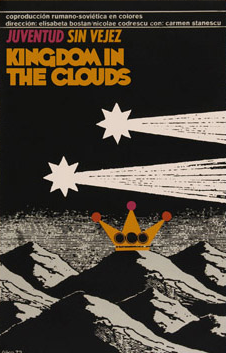
Kingdom in the Clouds

Directors: Elisabeta Bostan, Nicolae Codrescu
Writer: Elisabeta Bostan
Producer: Nicolae Codrescu
Cast: Mirceau Breazu, Ana Szeles, Ion Tugearu
Year of release: 1968
Country: Romania
Reviewed from: UK festival screening


There was no way that I was going to miss the first ever British screening (from a 16mm print, courtesy of Gerald Price) of a 1968 Romanian children’s fantasy. Fortunately, when Gerald showed this on Sunday morning at the 2003 Festival of Fantastic Films, the other rooms were showing Kiki’s Delivery Service (sorry but anime leaves me stone cold, and this is not an invitation to try and convert me - the only thing I hate more than anime is evangelical anime fans) and the truly execrable Supernova.

Actually this is the 1971 American dubbed version of the film, copyrighted to - bizarrely - the Xerox Corporation. How close it is to the original Romanian script I don’t know - but it’s probably an exact copy! (Please yourselves...)

A young man - who is never given a name so let’s call him Kevin (Mirceau Breazu) - sets out to seek his fortune, specifically to find the Kingdom of Eternal Youth which is high above the clouds. This is because he has often heard of people in stories living ‘happily ever after’ and he likes the sound of the ‘ever’ bit. The first person he encounters on his travels is an old giant, Father Time, who constantly winds an infinitely long rope onto a wooden wheel. This is the Wheel of Time, and he cannot slow it down. but he wishes Kevin good luck on his quest.
In a forest, Kevin encounters a talking sunflower which begs for a drop of water. This the young man kindly gives and the flower turns into a beautiful princess (Ana Szeles) who thanks the young man for his kindness by giving him a horn, on which he may blow to summon her when he needs help, but no more than three times. He wastes the first blow, using it to summon her back immediately so that he can see her face again.

Further into the forest he encounters the Queen of the Forest Birds, a large white dove, who is pleading for mercy from the Prince of Liars (Ion Tugearu), a half-man-half-crow being who has imprisoned all her subjects in a large cage. Here I’m sure that the English sub divulges from the original because the Queen says that she has been turned into a ‘mechanical dove’ but I think she’s just meant to be a large, magical bird. (She is animated in a few shots through stop-motion.) Kevin fights and defeats the Prince of Liars, pulling off his mask and saying, “You’re not a bird! You’re a man!” The caged doves are set free and Kevin pushes the evil prince into the cage instead, which he then drags to to edge of a nearby cliff before pushing it over. On hitting the rocks below, the cage explodes! (I half expected to see a single wheel come bouncing out of the pillar of black smoke.) The Queen of the Forest Birds gives Kevin a magical feather in gratitude.

Eventually he reaches the Kingdom of Eternal Youth where he must complete three tasks before being allowed entry. First he must retrieve the ‘golden rod’ (actually a large ear of corn) which is held by a witch so consumed with jealousy that she has turned green. The witch lives in the Land of Fire and Decay and demands of Kevin that he turn the place into an oasis, which he manages to do surprisingly quickly, clearing the rubbish, dousing the fires and sprucing up the witch’s cottage and windmill. At the same time, he fetches water for a nearly-dead magic horse which belonged to a previous unsuccessful applicant.

The witch reneges on her word, but Kevin uses his magic feather, which turns into a flute which, when played, causes the witch to dance uncontrollably and so somehow releases the golden rod from her possession.

Next is a quest to retrieve the golden apple from the Kingdom of Liars, the location of which is revealed to Kevin by the princess when he summons her. This land turns out to be inhabited by lots of really scary looking men in black costumes and oversize masks who dance around and eventually ensnare Kevin. They are led by the Prince of Liars who somehow survived the exploding cage. Kevin uses a magic leaf to lull his guards to sleep, steals the King of Liars’ magic ring and uses it to open up a wall in a cave wherein lies the golden apple, while fighting off a small army of black-clad soldiers.

The final quest is to retrieve the golden key (the film’s French title was Le Clef d’Or) which will unlock the book of wisdom owned by the King and Queen of the Kingdom of Eternal Youth, who for some reason throw their daughter’s hand in marriage into the reward - a daughter who turns out to be none other than the princess with whom Kevin is in love. The key is in a tower on the edge of the sea, but the Prince of Liars overhears this and sets off for the tower too. Once there, he claims to have repented his evil ways as the only way up the doorless, windowless tower is for him to work with Kevin. However, once he has the key - boo! hiss! - he leaves Kevin stranded inside the well of the tower with no rope while he hightails it back to the Kingdom of Eternal Youth. But Kevin escapes by answering three riddles posed by the old giant from the start of the film, and also obtains the genuine key which he brings back to the King and Queen just in time.

While that bad old Prince of Liars is suitably punished, Kevin weds the Princess but is warned by the Queen never to drink from the magical brook or he will lose his new-found immortality. Of course, this is the first thing he does but the Princess loves him so much that she drinks too so that they will grow old together. Ah, bless.

What a magical film! Did I mention that the Kevin’s steed which he acquires in the Land of Fire and Decay can not only talk but also fly? Or that the Kingdom of Eternal Youth is reachable only by crossing a rainbow bridge. All the effects, whether physical or created using blue-screen, are excellent for the age and origin of the film. It looks quite expensive with big sets, plenty of extras and an exciting horseback chase as the King of Liars’ soldiers attempt to retrieve his magic ring.

People leaving the screening were heard to compare this to The Singing Ringing Tree but that’s only because most people have never seen any other East European fairy tale movies and have no idea of how prolific a genre it is. The story this most resembles is actually the Monty Python tale about Prince Walter and Princess Mitzi Gaynor which was included in the 1972 German episode. It’s clear that the Pythons were spoofing not fairy tales in general but specifically East European film versions (The Singing Ringing Tree was East German, but Kingdom in the Clouds is Romanian and there was a long tradition of such films throughout the Soviet Bloc).

Writer/director Elisebete/Elisabete/Elisabeta/Elizabet Bostan made 25 films from 1956 to 1991 including The Hoopoe on the Lime Tree and Recollections from Childhood (both based, like this film, on stories by 19th century Romanian writer Ion Creanga). Her short silent films about an eight-year-old peasant boy called ‘Naica’ were edited together into a feature entitled The Adventures of Naica which won her a Silver Lion at the Venice Film Festival and a special mention at Cannes.

Of course, Romania is now a popular location for western film crews and one of the other cast members, Emanoil Petrut, recently appeared in Donald F Glut’s softcore monster flick The Mummy’s Kiss! The original Romanian title of Kingdom in the Clouds is apparently Tinerete fara Batrinete which roughly translates as ‘eternal youth’.

MJS rating: B+
review originally posted 29th November 2004

Sunday, 22 December 2013

Wolfskin

Director: Richard Mansfield
Writer: Richard Mansfield
Producer: Richard Mansfield
Country: UK
Year of release: 2013
Reviewed from: online
Website: www.mansfielddark.com

Many people still think that the first ever feature-length animated film was Snow White and the Seven Dwarves, but tonto toon fans know that it was actually Lotte Reiniger’s shadow animation The Adventures of Prince Achmed, made in Germany in 1926. (Wikipedia reckons there were two earlier films made in Argentina, now lost.) Richard Mansfield’s extraordinary and poetic Wolfskin owes an obvious debt to Reiniger’s work and indeed is dedicated to her memory.

Whereas Prince Achmed was animated frame by frame, Mansfield’s technique - which he has developed across a number of short films - is more like traditional southeast Asian shadow puppetry with his figures animated in real time using wires. Just occasionally a real 3D object is used when necessary, such as a hand or a bottle. Modern video capabilities enhance this antique technique, providing Mansfield with a depth of field which Reiniger never had.

Wolfskin runs a full 71 minutes and is an amalgam of classical European fairy tales. Thus there are specific references to Sleeping Beauty (pricking the finger, city falls asleep), Cinderella (glass slipper, and chopping up feet to fit into it) and Rapunzel (really, really long hair). Plus there are mermaids, clockwork servants and, of course, wolves. While there are human-wolf interactions and relationships, including a human phoetus and a lupine phoetus developing in the womb as twins, there are no actual, traditional, common or garden werewolves. Nevertheless, anyone compiling a list of British werewolf pictures which didn’t include Wolfskin would be selling themselves short. There is certainly enough grim death and Grimm violence here to peg this on the fringes of the British Horror Revival.

Having said all of the above, I would be lying if I said that I could actually follow precisely what was going on. Not that I think it matters. This is a film that’s more about imagery than plot. It’s presented silent, as was Prince Achmed (albeit that was more forced on Reiniger by virtue of sound films not having yet been invented) with a pleasing, mellifluous score composed and performed by Anglo-Turkish singer/harpist/therimin-player Ozlem Simsek. Mansfield’s earlier shorts are mostly either music videos or narrated ghost stories, thus he is used to working without dialogue. The latter include versions of Amelia B Edwards' 1864 tale ‘The Phantom Coach’ and Francis Marion Crawford’s 1894 classic ‘The Upper Berth’, both available on the Mansfield’s Mucky Puppets blog.

It is this experience in matching imagery to sound that has led to Wolfskin where, ironically, the process has reversed with Simsek matching her music to Mansfield’s visuals. The whole film has taken three years to produce and is a quite singular achievement for all concerned. Wolfskin is a captivating, enigmatic, lyrical film - magical in a number of ways - which will repay you your 70 minutes many-fold as the imagery and visual ideas linger in your memory. The only contemporary comparison to Mansfield’s work would be Ashley Thorpe’s quasi-animated films: the intention is similar, though the techniques are different.

Mansfield is now expanding his creative work beyond animation and is currently in post on his first live-action feature, Who is Coming aka Owlman, partially inspired by MR James’ classic story ‘Oh Whistle and I’ll Come to You My Lad’ (you may recall that written on the whistle in that story is ‘Quis est iste qui uenit’ which the narrator translates as ‘Who is this who is coming?’) [This was eventually released as The Mothman Curse - MJS]. A second live action feature, The Secret Path, is also in production.

Wolfskin is a unique film, one of those oddities of the BHR which make the entire subgenre so fascinating and diverse. I really, really enjoyed The Phantom Coach and The Upper Berth too. Perhaps Mansfield’s next animated feature could be an anthology of classic Victorian ghost tales. In the meantime, take a look at Wolfskin. Lotte Reiniger would be proud.

MJS rating: A-

Saturday, 26 January 2013

Bremenskie Muzikanty

Director. Inessa Kovalevskaya
Writer: Vasili Livanov
Producer: Inessa Kovalevskaya
Cast: Oleg Anofriyev, Anatoli Gorokhov, Elmira Zherzdeva
Year of release: 1969
Country: USSR
Reviewed from: Russian VHS(!)


One of the advantages of having an Estonian sister-in-law is the chance to occasionally watch movies which I would be otherwise unlikely to view, and one such is this perennially popular Russian cartoon.

The story of 'The Bremen Town Musicians' comes from the tales of the Brothers Grimm (it was first published in English in 1884). Although this particular tales enjoys widespread popularity in Europe it is largely unknown in the UK. All that the cartoon keeps from the story is the basic set-up - a donkey, a dog, a cat and a cockerel who together form a musical troupe - plus the idea of a bunch of dim bandits.

The animals (who don't have names, as far as I can tell) are travelling along with their human friend, identified as 'the Troubadour', in a cart pulled by the donkey. They arrive at a city (Bremen?) where they perform for the populace and the Troubadour falls in love with the King's daughter. But he is only a lowly strolling player and the King, who for some reason spends a lot of his time eating hard-boiled eggs, prohibits the marriage. The Troubadour and his four musical animal friends leave the city somewhat dejected.

Out in the countryside, in a little hut, sit three rather useless-looking bandits whom my sister-in-law tells me are actually caricatures of a popular 1960s Russian comedy trio, a sort of Larryvich, Curlyvich and Mo-ski. With them is a statuesque lady who may be the leader of the gang or may just be 'entertaining' them. The animals work together to scare off the bandits - this much comes from Grimm - and then hatch a clever plot as the King approaches in his carriage. They all done bandit-style masks - disguises so surprising in their unlikely effectiveness as to put one in mind of Feathers McGraw with a rubber glove on his head ("Good grief. It's you.") - and ambush the King's party, tying the hapless monarch to a tree.

The five friends then remove their masks, reappear and 'rescue' the king who is of course so grateful that he immediately sanctions a Troubadour-daughter wedding. After much joyful celebration, the animals depart the city, sad that they have lost their human friend - but the Troubadout and his new bride run after them, leap aboard the cart and off they all go.

It says something for the film that I was able to follow what was happening, despite not speaking a word of Russian. There isn't a spoken word in the cartoon, with everything sung to tunes that sound like a mix of 1960s pop and traditional East European folk music. Although apparently set in some medieval milieu, the Troubadour wears flares, the King's daughter wears a mini-dress and the donkey wears a baseball cap! The animation is simplistic with extensive use of repeated movement but there is an undeniable charm to the production.

All the music is credited to Gennadi Gladkov with lyrics by Yuri Entin (who also wrote a 1979 TV version of The Adventures of Baron Munchausen). The actual credited scriptwriter is Vasili Livanov who is also an actor and starred as Sherlock Holmes in a series of Russian TV-movies in the early 1980s. Oleg Anofriyev, who provides most of the voices, was most recently seen in the 1996 US comedy Back in the USSR which was filmed in Russia with an eclectic cast that included Brian Blessed, Andrew (Wishmaster) Divoff and Roman Polanski!

Some sources list Bremenskie Muzikanty as a feature but in fact it runs only about 20-25 minutes. The Inaccurate Movie Database cites a running time of 64 minutes but that is probably the complete length of this VHS, which also includes the 1973 sequel Po Sledam Bremenskih Muzykantov and another tales from the Brothers Grimm, 'Puss in Boots', as Kot v Sapogah.

'The Musicians of Bremen' has been adapted numerous times for the screen, mostly in animated form for obvious reaons. The earliest version seems to be a 1922 Disney short, The Four Musicians of Bremen, followed by an Ub Iwerks cartoon from 1935 called The Brementown Musicians (this is available in a beautifully restored version on a DVD called Extreme Fairy Tales, along with two other Iwerks toons, Jiri Trnka's Karloff-narrated The Emperor's Nightingale and a version of Rapunzel made by Ray Harryhausen!). A 1959 German feature, Die Bremer Stadtmusikanten, used actors in costumes to represent the animals and the Muppets presented the tale as part of their Tales from Muppetland series in 1972. The IMDB lists a 1981 German TV version and a 1989 Spanish feature (Los 4 Musicos de Bremen) and the story was the basis of the very first episode of the 1987 Japanese TV series Grimm Meisaku Gekijo (Grimm Masterpiece Theatre). Finally the Russians had another go in 2000 with Novye Bremenskiye, a remake of this 1969 picture.

MJS rating: B
Review originally posted 2nd July 2005

Thursday, 17 January 2013

Beauty and the Beast

Director: Timothy Forder
Writers: Paul Levinson, Nathalie Harrison
Producer: Mary Swindale
Cast: Michael Hordern, Christopher Lee, Jason Connery
Country: UK
Year of release: 1992
Reviewed from: UK VHS (Braveworld)


How unlikely is this? An all British, feature-length, animated fantasy movie starring Christopher Lee which was made less than 15 years ago and yet remains completely unknown. You won't find this in Lee's filmog on the Inaccurate Movie Database; nor, remarkably, is there any specific mention of it on the normally very reliable British animation website Toonhound, though they do acknowledge that production company Bevanfield made some 'fairy tale specials'. A Google search turned up only a very few sites which mention this film and most of those are Dutch or German.

Michael Hordern plays Monsieur Du Bois, a jeweller in 17th century France who has fallen on hard times after losing much of his work when robbed by a highwayman. He has three daughters: the snobbish Prunella (Susan Sheridan, Trillian in the radio version of The Hitchhiker's Guide to the Galaxy) and Lucinda (Kate O'Mara) and the kind-hearted Beauty (Kellie Bright: Kate Aldridge in The Archers). Christopher Lee is Du Bois' cousin, Monsieur Renard who is accompanied by a rat-like flunky, Monsieur Rodent (Geoffrey Matthews).

The oleaginous Renard, who is independently wealthy, is prepared to go into partnership with Du Bois on condition that he is allowed to marry Beauty. However this potential arrangement is scuppered by the traditional story of Beauty's father spending a night in a mysterious chateau, plucking a rose for his daughter who then volunteers to live at the chateau in order to save her father from the owner's wrath.

I have to confess that, frustratingly, I was only able to watch the very beginning and the last 10-15 minute of this 67-minute feature because the tape I found in a charity shop wouldn't play properly, so most of the story is inferred from the bits I did see and also some stuff I was able to watch on fast forward.

The Beast himself (voiced by sometime Robin Hood Jason Connery) looks like a large tabby cat, and a pretty friendly one too. It is always summer in the grounds of his chateau where he is attended by a cook/housekeeper, Madame Bombec (Penelope Keith) and two short footmen (uncredited). There is a subplot about Du Bois and Renard, and both stories are wrapped up extraordinarily quickly and unsatisfactorily at the end, which I was able to watch, the tape having settled down by then.

Beauty tells the Beast that although she likes him and enjoys his company, she doesn't love him. Madame Bombec explains to Beauty that the roses in the chateau grounds are linked to the Beast and that each time a rose dies it takes a month off his life, which is why her father picking a bloom was so serious. Beauty asks the Beast to be allowed to see her father, whom she misses and he makes it clear that she can see him but not speak with him and must ask for nothing more.

They use a magic mirror to see that Du Bois is ill in bed, following a visit to Renard's shop. Renard and Rodent were away at a jewellery exhibition in Paris and Du Bois expresses amazement because his cousin is a good businessman but has never shown any skill at designing and manufacturing jewellery. The snooty shop manager shows Du Bois some of Renard's jewellery and of course he recognises it as the stuff that was stolen from him by the highwayman (we were told right back at the start that the highwayman's action was odd as only Renard and Rodent knew about that particular journey by Du Bois).

Anyway, Beauty asks to be allowed to visit her father and care for him until he is better and the Beast, despite having instructed her to not ask any more favours, agrees. She steps through the mirror to her father's bedside and explains to him that she can return when he is recovered using a magic ring.

Lucinda and Prunella, who are living it up as socialites while their father is both poor and poorly, overhear this and see that Beauty is wearing a fabulous dress so they resolve to take the magic ring (and the dress) and transport themselves to the castle of this mysterious Monsieur Beast, who is sure to choose one of them in favour of their younger sister.

In quick succession the sisters use the ring to transport themselves to the Beast's chateau but faint in horror when they see him. He comes running, recognising the dress and thinking that Beauty has returned but then collapsing in anguish when he sees it's someone else. Beauty sits up in bed, sensing that the Beast is in pain, and somehow returns to his chateau where she tells him that she realises now how much she cares for him. A tear falls on the Beast who transforms into a handsome prince.

Beauty and the Prince get married and live happily ever after. There is absolutely no explanation of how the Du Bois/Renard plot winds up but the former is shown to be happy, healthy and wealthy once again while Renard and Rodent are seen working in the Prince's kitchen where Madame Bombec chides them for being lazy. This all happens so fast that it almost seems like someone checked the film and said, "Right, we're over 60 minutes. That's as near feature-length as makes no odds. Wrap it all up now."

This is an entirely British production; there are no Korean names in these end credits but maybe they should have considered farming this out to Seoul because the animation is awful. Very crude and basic and not helped by frankly poor character designs by Paul Gunson (credited as designer on a semi-animated feature called The Magic 7 which has been in development so long that the star-studded voice cast includes Madeline Kahn and John Candy!) and Gerard Kenny (not the bloke who wrote the theme to Minder?). Gunson - who is not the New Zealand animator Paul Gunson - was subsequnetly involved with both Yoko! Jakamoko! Toto! and the best pre-school series ever made, Tiny Planets.

Though the characters are awful and their movements basic and repetitive, there is some consolation in well-painted backgrounds by Ian Henderson who also worked on both Watership Down and The Plague Dogs. There are two songs by Danny Schogger (who has also written for Celine Dion and has played with or produced just about everybody) and Linda Taylor.

The opening titles and the sleeve call this obscure film, which was released the year after Disney’s justifiably acclaimed version, Bevanfield Presents Beauty and the Beast and the closing credits give the copyright to Foxbridge Ltd. The executive producers are Paul and Mark Levinson. Now, there is a Paul Levinson who writes SF novels and is a Professor of Communication and Media Studies, and there is a Mark Levinson who makes high quality audio products, but they both seem to be American and surely they're different guys, but if so, who are these two? There are two credited directors: 'director of animation' David Thwaytes (who also worked on the 1970s Addams Family cartoon) and 'supervisor director' Timothy Forder.

Bevanfield seems to have been Forder and Swindale's company; according to Toonhound they were responsible for the cartoon series Bill the Minder, What-a-Mess and (the very odd and frankly disturbing) Murun Buchstansangur. They also made The Greedysaurus Gang in 1993 and more recently they produced a TV series based on the Just So Stories, narrated by Geoffrey Matthews.

The company made several other animated fantasy films in the early 1990s. Aladdin (from the same writing team) is also feature-length and stars Edward Woodward and Derek Jacobi as well as Penelope Keith and Kate O'Mara again. Thumpkin and the Easter Bunnies (script by Jolen L Victor and Shannon Carney) stars Bill Roberts (presumably the one who was the voice of Rosy's father in Balto and dubs the Patlabor anime movies), Geoffrey Matthews and my old pal Lorelei King (24 Hours in London) but it runs under half an hour, as does a Roberts-narrated version of 'Twas the Night Before Christmas. Toonhound mentions Little Red Riding Hood but I don't have any details on that (they may be referring to an episode of the Forder-directed Tell Me a Story) and there seems to have been a one-hour version of Cinderella.

Forder and Swindale have also made two live-action films, a 1987 drama called Indian Summer and a 1993 version of The Mystery of Edwin Drood starring Robert Powell with Gemma Craven, Barry Evans, Nanette Newman, Glyn Houston and Freddie Jones. Nathalie Harrison, co-writer of Beauty and the Beast, also worked on that film - as production accountant.

MJS rating: C
Review originally posted 17th June 2005