Showing posts with label post-apocalypse. Show all posts

Thursday, 4 April 2013

Ditching

Director: Factotum
Writer: Factotum
Producer: Factotum
Cast: Lalor Roddy, Mary Lindsay, Jonathan Harden
Country: UK
Year of release: 2010
Reviewed from: screener


I have just finished watching the new Northern Irish independent science fiction film Ditching and, truth be told, I have no real idea what I have just watched. It was extremely well done but it wasn’t what I expected and I’ve slightly been caught on the back foot.

This is an utterly picaresque post-apocalyptic movie, following a couple as they traipse across the countryside, pushing their possessions in what appears to be a jury-rigged combination of shopping trolley and pram. Along the way they meet various people, some of whom join them on their travels.

And, um, that’s about it as far as narrative goes. But this isn’t a narrative film. Everything about it, from the absence of plot (which is not the same as a lack of plot) to the music to the production design screams ‘art collective’. And indeed, this is the first feature film from a Belfast art collective called Factotum.

Factotum have been going for about a decade and have produced or staged a huge variety of things from choirs to photography exhibitions. Their website proudly proclaims that their 2002 stage production Bog Feature and Dance Jammin was “described by one Arts Council official as his 'worst ever night in the theatre'.” If, like me, you have ever been involved with the arts funding bureaucracy of the UK, you will understand quite how magnificent a claim that is.

Factotum produced a short, non-narrative film called Bottletops back in 2001. More recently they staged an exhibition of posters of unmade or forgotten Northern Irish films which, even in this info-dense, web-savvy day and age managed to divide opinion about whether the movies were genuine or not. Stephen Hackett and Richard West, the guys behind Factotum, assured everyone that the posters - for things like Dafty Wains Go Buck Mental and An Ulster American Folk Park in London - were all historical items produced for genuine projects. But as Factotum have a reputation for straight-faced, pomposity-puncturing spoofery, many doubted the truth of this claim.

And yet, and yet. If you were to tell people that back in the mid-1990s, there was a Northern Irish feature film about secret paramilitary operations, a state-of-the-art supercar, a cyborg Vietnam vet with a switchable robotic arm and a climactic fight against hordes of the undead summed up on-screen by Saint Patrick himself as “a brilliant zombie battle”, most people would doubt your sanity. But I have seen Enda Hughes’ The Eliminator. I still have the one-sheet poster somewhere with its emphatic claim: ‘Madder than Max, Dirtier than Harry’ (to which, one wag suggested, could have been added ‘And Harder than Dai’!). So if The Eliminator was real, why not Cannibal Begorah or King Billy’s Pink Adventure?

For all Factotum’s japery, Ditching is relatively restrained. In post-apocalyptic cinematic terms, a close comparison might be The Bed Sitting Room, but without the dadaism of that classic work. The wry, never-forced humour of Ditching stems from the characters’ complete acceptance of their world.

This is a future where a plague has wiped away most of humanity’s memories (by, it is suggested, temporarily taking away the power of speech, although that’s not a theory that stands up under close scrutiny). So people remember what things are but not necessarily what they were used for.

No-one is trying to restore civilisation, no-one is particularly bothered about retaining what was left, and everyone has got long past the scavenging-from-looted shops level of immediate self-preservation. There is also, interestingly, no sign of children or pregnancy in this world, although no-one seems to be bothered one way or the other about that. The future of the human race is not a concern.

In all the preceding text, there is one word which sums up Ditching more than all the rest put together and that is ‘traipse’. This is a film where no-one walks, no-one saunters, no-one strolls, no-one marches (although we do see someone running, very briefly). Everyone traipses. Everyone is just resigned to slogging ever onwards towards an indeterminate nothing. They’re not driven by hope - there is no real quest to be completed here, as in the equally picaresque Bleak Future - but nor are they driven by fear or desperation. Nothing pushes them forward and nothing pulls them either. Our protagonists (if such a non-narrative film could be said to have protagonists) travel as much through a very, very slow momentum as anything else. And the people they meet along the way seem to exist in their particular places through a comparable inertia.

There’s a passport office. It’s not clear what role a passport might have in this world although traditional place-names still exist and their is some talk of how the King of Armagh justifies his sovereignty through a closely guarded holy relic which is actual a mutant combination of a duck and a rabbit, melded into a three-dimensional reality of a classic optical illusion.

Or something.

There are some ‘soldiers’, a self-appointed military grouping in a compound who challenge any travellers that pass. This sequence features a bizarre entertainment/contest in which two men ask each other riddles and then take turns throwing pre-apocalypse items at each other over a sheet. Elsewhere, there are some faceless characters dressed in all-covering, knitted red outfits and an old, crippled guy who collects lightbulbs and powers them using a rowing machine.

None of this really means anything, as far as I can tell, unless you want it to mean something. There is a resigned Irish fatalism to the whole film. If it has a message, the only one I took away from the movie was ‘life is a bit shit, but we might as well get on with it.’ Which seems like a reasonable philosophy.

The sparsity of action and almost complete absence of conflict renders the characters muted and not as interesting as they perhaps should have been. Because nobody ever does anything, or even shows any great interest in doing anything (except traipsing) we don’t really care what they do.

But this is art (or possibly anti-art, maybe quasi-art) and, approached correctly, can be very much enjoyed. The cinematography by Michael Lennox (director of Rip and the Preacher) is good; some scenes are too dark but this is a dark world where only one character owns lightbulbs and even he doesn’t care about them (because, he points out, they’re everywhere). The sound is clear and the accents never problematic except when people mumble. But as people don’t speak much, there is proportionately little mumbling. And the treacle-slow, Beckett-ian pace of the dialogue actually lets you work out what someone has said (if it’s not clear) before anyone else speaks.

The music by David Baxter is great: authentically and defiantly Irish without being all twiddly-twaddly nonsense and yet suitably futuristic to match the dystopia on view. But in fact, this isn’t really a dystopia, is it? It’s certainly not a utopia either though. This could be the first future-set film to take place in a topia. An utterly ambivalent post-civilisation society where humanity continues to exist as one enormous shrug.

But really, what I loved most about the film was the visuals. The costumes are glorious, with most people wrapped up like tramps who have recently been through a charity shop’s bins after a particularly comprehensive, but largely unsaleable, donation of goods. This is a long way away from the leather and studs of Mad Max 2 and yet it makes as much sense, considering the difference between the Australian outback and the damp bogs of Ulster. The final scenes are set in some sort of hospital or convent or something where women wear glorious (but gloriously faded) 19th century-style dresses. Harriet Johnson is credited but it’s not clear whether this is the same Harriet Johnson who has helped out in the costume departments of such lavish productions as Clash of the Titans, The Golden Compass and Disney’s forthcoming John Carter film.

Above all, Ditching boasts probably the most marvellous collection of locations of any independent film I can remember seeing. A series of derelict buildings, ranging from 17th to 20 century in date, all long past their useful life. The Factotum guys obviously know that these found locations are their trump card because the opening titles bring us static shots of one building after another: farmhouses and cottages and warehouses, empty and forgotten, home to only the crows and an occasional horse. Buildings so forgotten that no-one remembered to knock them down even while a civilisation existed which could still operate bulldozers.

Ditching functions as much as a travelogue as a science fiction film, a video journey around a forgotten Ulster that most people outside the province never even knew. We never see a town, we never even see a metalled road. Muddy paths, grass tracks and dry ditches are the thoroughfares of this sparsely distributed society, linking half-hearted attempts to inhabit buildings in various states of disrepair. Every building is a character in its own right, as much as any of the people, and displays the same fatalistic approach to carrying on with existence because there isn’t much else to do. If these buildings could traipse, they would traipse (if they could be bothered to traipse). This is definitely a film where you come out of the cinema whistling the locations.

In the small, quirky recent history of UK science fiction films, Ditching stands proudly alongside all the other oddities. It is what it is and it does what it does and, inasmuch as I can fathom what it sets out to do, I believe it achieves that magnificently.

The cast, many of whom were also in serious drama Five Minutes of Heaven, includes Lalor Roddy (Boy Eats Girl, Summer of the Flying Saucer), Niall Cusack (The Railway Station Man), Jonathan Harden (Ghost Machine) and professional storyteller Fra Gunn.

MJS rating: A-
review originally posted 4th April 2010

Wednesday, 3 April 2013

Devil's Crossing

Director: James Ryan Gary
Writer: James Ryan Gary
Producer: Paul Streiner
Cast: Michael Sharpe, Patrick G Keenan, Kevin L Johnson
Country: USA
Year of release: 2011
Reviewed from: screener (Left Films)
Website:
www.devilscrossingmovie.com

About an hour into Devil’s Crossing I finally realised why this is such a terrific film and why I had been so utterly engrossed in it. Devil’s Crossing is a zombie film that is about people, not zombies.

Far too many zombie films are about zombies. We’ll have the zombies do this, then a zombie can do that, let’s have zombies doing all sorts of things. Enough with the zombies already! Take a look at the granddaddy of the genre. What do the zombies do in Night of the Living Dead? They lurch towards the house and try to get in. They’re a threat, not characters. For most of the film, they’re off-screen.

Same with Dawn of the Dead (and the excellent remake) and to a lessening extent with Day and Land too, although by then Romero was starting to experiment with individual zombies as characters (fair enough - you can’t keep making the same film). I haven’t seen any of Romero’s more recent pictures so can’t judge those.

There are other zombie films which concentrate on human characters rather than zombies. It’s a strength of Shaun of the Dead, for example. And Colin works precisely because it absolutely concentrates on a single zombie character. But in a lot of zombie pictures, the zombies dominate proceedings to the detriment of the movie as a whole; either because too much attention is paid to the undead or (more often) because not enough attention is paid to the living humans.

Which for some folk is fine. There are hordes of zombie fanboys (and fangirls) out there who just want to see pasty-faced cadavers eating people’s guts in new and original ways before having their brains blasted out of the back of their cranium, roll credits, the end. If that’s what floats your boat, good for you. But I like characters in my zombie films. I like to see a siege. I like the zombies to be a relentless, almost inexhaustible army of malevolent but unintelligent savages, wave after wave of them. Devil’s Crossing delivers what I want, in spades.

In the Wild West. Sort of.

It’s ironic that the American screener sent to me by Helen at Left Films carries the sleeve copy ‘The zombie western’ because Helen also released the does-what-it-says-on-the-tin Cowboys and Zombies. So not only is Devil’s Crossing not strictly the zombie western, it’s not even the zombie-western-released-by-Left-Films. And much as I enjoyed Cowboys and Zombies, I thought Devil’s Crossing was even better. Therein lies one of the pitfalls of grading films on a relatively detailed scale. See, I really enjoyed Cowboys and Zombies and gave it an A, but I think Devil’s Crossing is actually slightly better, only it’s not A+ level because I reserve that for only the most extreme films and Devil’s Crossing isn’t actually perfect.

If I did what a lot of places do and simply used a five-star rating, both would merit five stars, no problem. And so would many other films. That, incidentally, is why SFX changed its rating system. In the early days, when I was there, we rated books, films, TV shows and comics from A+ to D-; that’s why I use that system for my MJS ratings. But obviously very, very few things got rated A+. I think in three years the only A+s I gave were for Apollo 13 and (in an ironic way) for a video release of Plan Nine from Outer Space. If grades were evenly distributed, only 8.3% of things would merit A+, but given that distribution should be normal, that means a Gaussian curve so far fewer would merit the top mark, maybe one per cent or so.

But with a five-star system, even distribution would give 20% of items reviewed the top grade and even on a bell-shaped curve, about ten per cent will still make it. And in the case of SFX, as with all those other mags and websites, the more stuff you rate as the top grade, the more often you get your name on the poster or sleeve. Anyway, I stick with my 12-point system but I rate each film individually on my gut feeling. I don’t have some master-list somewhere that lets me calculate this stuff: it’s a bit better than this but not so great as that, so it must have an MJS rating of... aha!

I seem to have wandered off my point somewhat. I do that. I’m old. Where are my slippers? Who are you?

Devil’s Crossing is set in the wild west but the ‘western town’ tourist attraction where it was filmed has things like telegraph poles and other 20th/21st century items which would spoil the illusion. Rather cleverly, the makers have just said, let’s make this a post-apocalyptic setting which has basically reverted to being like the wild west. And you know what? That works. It’s not foregrounded, there’s just a couple of mentions of some terrible war where many of the population were killed. It not only excuses any chronological anomalies in the background, it also allows greater freedom of things like costumes.

Nevertheless, for all intents and purposes, this is the wild west.

The zombies don’t even appear until well into the film. There’s a prologue about a bounty hunter shooting a gang which, we assume, will become relevant later (it does) after which the action is entirely confined to the interior and exterior of a saloon in a one-horse town. There’s a few regulars, laughing and drinking with the good-time girls, plus an English barman, a largely ineffectual Sheriff and a stranger - the bounty hunter - sitting in the corner. Drinking milk.

Upstairs, local bastard ‘Big Dermot’ is drunkenly taking out his inadequacies on one of the girls. When he comes down to the bar, he starts causing serious trouble until the stranger cleans his clock with some smart moves and throws him out.

The stranger is Shadrach and he knows bad things are coming. Bad dead things that have got up again. But first, another man appears in the bar, with a natty brown derby and a Southern accent thick as molasses which acks ent you ates ev er ee syll ah bull. This is Louis, and Shadrach works for him, killing people. And tonight Shadrach has finally taken a stand and refused to carry out a killing. And for that the whole town is going to pay.

After an initial attack, the survivors barricade themselves into the saloon but those wooden planks won’t keep the zombie hoardes out for ever. The third act is a simply magnificent siege as the barman, the sheriff and one of the girls fight off wave after wave of zombies while upstairs Shadrach is dealing with those trying to enter by alternative routes (the rest of the survivors are in the cellar). It’s a frightening, exciting, tense, extended sequence, perfectly edited to move between the two levels. It really reminded me of Zulu, and I can think of no higher praise.

These are real people that we care about, doing their best to survive against a threat they can barely understand. This is that rare zombie film where people don’t believe that what they’re facing are reanimated corpses who want to eat them because that is so obviously bullshit.

Wave after wave they come. Again and again the humans fight them back. With rifles and pistols and then with swords and knives and fists, just managing to stay out of reach of those hungry teeth. Front rank, fire! Second rank, fire! Third rank, fire! It’s great, I tell you. It’s storming.

The cast are uniformly great. Michael Sharpe (Palmetto Haunting, Scarecrow at Midnight) is the Clint Eastwood-style solid rock around which the action revolves, while Patrick G Keenan (Dark Remains, Remnants) clearly has a ball as the deliciously evil Louis. Andy Boswell (Cold Storage, Night Feeders) provides the gruesome effects which support, rather than dominate, the story and characters. And writer-director James Ryan Gary demonstrates that he understands both genres - horror and western - by effectively combining the two without losing anything of either.

Too many people think all you need for a western are stetsons and horses but a good western isn’t about where or when, it’s about how and why, it’s about the people and the situations they face in a modern world that hasn’t finished building itself yet, a frontier both geographical and temporal.

Devil’s Crossing captures this perfectly while also being an enormously enjoyable, exciting, thrilling zombie film of the sort that so rarely gets made nowadays. Top notch stuff!

MJS rating: A
review originally posted 18th January 2012

Sunday, 20 January 2013

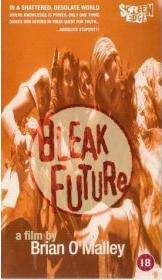
Bleak Future

Director: Brian S O’Malley
Writers: Brian S O’Malley, Steven Darancette
Producer: Steve Darancette
Cast: Frank Kowal, Brad Rockhold, Wendie Newcomb
Country: USA
Year of release: 1997
Reviewed from: US DVD
Website:
www.bleakfuture.com

The DVD of Bleak Future arrives bedecked with praise. “This movie is awesome,” says Aint It Cool News. Well, they say that about almost everything (although to be fair, the entire budget for this film was probably less than some studio publicists spend on promoting crappy blockbusters through Aint It Complete Nonsense).

“The energy and enthusiasm of Peter Jackson’s Bad Taste,” says Nathan Shumate at Cold Fusion Video Reviews. Well, I know Nathan slightly through discussion boards and I find his reviews to be accurate and insightful (and entertaining). I trust this guy’s judgement.

But hey, what’s this third quote? “Funniest sci-fi film in years,” says ‘Mike Simpson, SFX magazine’. What the heck does he know about anything?

Ah, I love DVDs that have quotes from me on the back! And I love even more films which, when rejigged and rejogged for a super-wicko DVD release actually include me in the ‘thank you’s at the end! I do recall reviewing Bleak Future when it was released on VHS in the UK by the old Screen Edge label in 1998. And I did indeed write that quote and, having watched the film again nine years later, I stand by every word of it (all five of ‘em). Bleak Future really is one of the funniest science fiction films of recent years. What is more, I’ll go further. This isn’t just comedy for comedy’s sake, this is actually one of the best post-apocalypse movies ever made.

It’s always tempting with post-apocalypse films to compare them to Mad Max (or Mad Max 2) but two titles jumped into my head while watching the Bleak Future DVD and they refused to go away. If I had to stop writing now and sum this film up in one sentence, I would say: ‘Bleak Future is Beneath the Planet of the Apes meets The Bed Sitting Room.’

But I don’t have to stop writing now. I can go into some detail about why this movie is so damn good.

In a world of ruins and deserts, Slangman (Frank Kowal) wanders across the land. Possessor of a large dictionary, he makes his living by selling definitions of words (I particularly like the idea that the exchangeable currency in this world is batteries). Self-styled ‘most intelligent man in the known world’, Slangman is irritable, self-confident and often exasperated. Searching for the mythical ‘Source’, said to be a repository of knowledge from before the great cataclysm, he gathers around him a small coterie of acolytes. There’s Atlatl (Brad Rockhold), a mute Scottish warrior; Femme (Wendie Newcomb), a bimbo actress; and Brother Alfonze (Steven A Kowal - Frank’s brother) a hippy hermit.

Standing in his way are a range of ‘mutants’ including Doctor Obvious (Rob Cunningham) who also believes himself to be the smartest man in the world; King Malice (played by a guy credited only as Bones) and his mutant court; and the terrible Malathion Man (Tom Johnson) armed with what appears to be highly acidic urine.

As Slangman and co. stumble across the patchy desert towards the Source, we break off occasionally for documentary footage of what happened to the world. An era of unprecedented peace and prosperity led to the development of the Pangaea Project, an attempt to move the planet’s tectonic plates to create one super-continent without countries or borders. The film’s climax is both the end of Slangman’s journey and the culmination of the documentary, the latter explaining the circumstances of the former. In this respect it reminded me of a terrific SF novel I once read, The End of the World News by Anthony Burgess, which used a similar structure but with three narrative strands.

The thing about post-apocalypse movies is that, their setting generally being a featureless desert, it’s the characters that make them. And Bleak Future has great characters. It’s a wonderfully restrained film that doesn’t try to go overboard on ‘clever’ dialogue but instead lets us learn about the characters through their reactions to the world around them.

And it’s a marvellously constructed world, a credible, crumbling fin-de-civilisation wilderness which has created its own rules and its own society from the remnants of what was once there. You can believe that there are still actors staging crappy fringe theatre - and that in a world without TV or radio, people might actually watch such stuff. You can equally believe that hordes of insane warriors charge around with swords and sticks. You can believe anything if it’s presented with an intelligent, satirical bent.

When I first saw Bleak Future on that Screen Edge VHS, in those far-off days when ‘DVD’ was still a sexually transmitted infection, it was a rough and ready thing. It was clearly a labour of love. Shot on Super-8, the grainy, sometimes wobbly image looked like a real, grown-up film. There was nothing digital in those days except watches and alarm clocks so you either shot on 16mm if you could afford it or Betacam if you couldn’t. The former looked polished and left you unfairly compared with the 35mm big boys, the latter invariably looked like a wedding video. But there was a grittiness to Bleak Future that marked it out as something special, something that somebody really, really cared about.

Well, God bless Brian O’Malley because he has managed to upgrade Bleak Future into a minor masterpiece - without losing that same rough and ready feel. For three years he used modern technology to make the old film look like it would have done when new if today’s technology had been available back then but had worked like the old technology did when the film was made. D’you see?

The film has been re-edited and digitally doodah-ed; tints and tones have been added; pick-up shots have been filmed in the same locations and seamlessly integrated; the entire dialogue track (so often the Achilles' heel of enthusiastic low-budget movies) has been recorded with all but one of the original cast looping their own lines. I no longer have that old VHS so I can’t make direct comparisons, not that I need to. The new version of Bleak Future is a thing of beauty - that’s all you need to know.

And what a package on the DVD: literally hundreds of stills, designs, pieces of artwork and publicity materials. Stacks of behind the scenes footage and commentaries which document the incredible story behind the film. The scenes with the stuck truck are priceless. This is one of the best value DVDs I have ever seen, packed with so much stuff it would take you weeks to get through it all. Sometimes a multiplicity of extras masks a shoddy feature but not in this case. On the Bleak Future DVD, the extras complement the feature magnificently, creating an all-round entertainment package that means you may never have to leave your armchair again.

But what of the cast and crew of Bleak Future? Where did life take them after making this film? Frank Kowal was set decorator on some of Steve Oedekerk’s ‘thumb’ spoofs and was production secretary on Roger Corman’s Black Scorpion TV series. Wendie Newcomb worked on the digital effects on Black Scorpion and a few other pictures. Steven A Kowal was a runner on Black Scorpion (I sense a pattern developing here). Producer/co-writer Steve Darancette went on to pen episodes of Krypto the Superdog and Biker Mice from Mars. Most of the cast and crew simply returned to normal life. As for O’Malley himself, he made one more feature, Minimum Wage, and worked for Roger Corman for a while, including a stint as script co-ordinator on, unsurprisingly, Black Scorpion.

In a way, the fact that Bleak Future has not been followed by a string of other indie movies makes this all the more special. O’Malley seems to have dedicated most of his life to Bleak Future in one form or another and it shows, the love shows, the passion shows. I mean, yes, the guy really needs to put this behind him now and get out of the house a bit more, maybe kick a ball about in the yard or something, but you can’t fault his dedication. This is the sort of feature film that you get to make only once, before you realise how much ridiculously hard work is involved - which is ironic because in a sense he has made it twice.

Are you getting the impression that I rate Bleak Future highly? You’re damn right I do. This was one of my favourite films even before O’Malley stuck my name in the end credits. A brilliant piece of fantasy storytelling, a hilarious comedy, a penetrating satire on the human condition - and that’s just the Making Of featurette. The movie itself is all this and more. In fact, this deserves something that I have almost never handed out in all the years I have been running this website. Brian Scott O’Malley, I award you...

MJS rating: A+
Review originally posted 16th April 2007