Showing posts with label voodoo. Show all posts

Monday, 3 November 2014

The Zombie King

Director: Aidan Belizaire
Writers: Rebecca-Clare Evans, Jennifer Chippindale, George McCluskey
Producers: Rebecca-Clare Evans, Jennifer Chippindale
Cast: Edward Furlong, Corey Feldman, David McClelland
Country: UK
Year of release: 2013
Reviewed from: Festival of Fantastic Films 2014
Website: www.facebook.com/TheZombieKingUk

The Zombie King starts out promisingly with some fine, understated, character-based British black humour but ultimately trips itself up with an impenetrably complex back-story and too many characters. Its main selling point is the inclusion of two American actors with some name value based on, let’s face it, very old credits. You’ve seen far worse zombie films than this, but you have also seen many better ones (often of comparable budget). And, unless you live in Germany, you’ve probably not seen this one at all.

The zombie apocalypse has happened very recently – within the past day or so - and the survivors are still struggling to cope with, and understand, the situation. The first group we meet are psychotic postie Ed (George McCluskey – General Killgarth from Catalina: A New Kind of Superhero!), cynical milkman Munch (David McClelland: Emmerdale, Corrie and a holographic priest in Lexx!) and cowardly traffic warden Boris (Brazilian Michael Gamarano: Backslasher). Any audience will immediately warm to these three, especially Munch whose white coat and cap, not to mention his penchant for despatching the undead with well-aimed glass milk bottles, marks him out as one of the great comic characters of British horror. (McClelland’s voice, spectacles and performance put me in mind of his fellow Yorkshireman, poet Ian McMillan.)

Before too long, our hapless trio meet three other survivors: Simo (Seb Castang: Lost Boys 3, Ibiza Undead and daytime soap Family Affairs), Neville (Timothy Owen, also credited as casting director and fight choreographer) and Scott (Leo Horsfield: The Dead Outside and all three Outpost films). I was particularly surprised at a character named ‘Simo’ (spelt with one M but pronounced as ‘Simmo’) since that was my nickname at school and indeed I’m still called ‘Simo’ by most of my friends in sci-fi fandom. But that aside, already a problem presents itself, in that these three characters have no real character. Nothing defines them. I could not describe them to you in any way (except maybe ‘young’) and they are pretty much interchangeable. Which is a problem with the script, not a reflection of the actors’ performances.

And some time after this, these six men find a barn where they meet up with four women. But only elderly, rotund, randy Vera (Jane Foufas from Mamma Mia!, obviously having great fun) has a character. Danny (Rebecca-Clare Evans: Plan Z, Tash Force), Tara (Jennifer Chippindale: Chronoslexia) and Tabitha (Anabel Barnston, who was Mona Hallow in The New Worst Witch) are as indistinguishable and hence unmemorable (and hence, sadly, uninteresting) as Simo, Neville and Scott. This is particularly surprising given that Evans and Chippindale not only produced this film but co-wrote it with McCluskey. You would think they would have given themselves plum roles, but instead they play two of the six characters who totally fail to register and towards whom I could not apply a single adjective.

Even if all were distinct and identifiable, ten characters is simply way too many for a film like this (unless a bundle of them are going to become zombie fodder almost immediately). In fact there are eleven protagonists as the gang head for a church where they meet unkempt, drunken vicar Father Lawrence. Sometime Death Eater Jon Campling (also in The Witching Tree, Apocalypse Z, Penetration Angst, Steven M Smith’s Tales of the Supernatural and Melanie Light’s disturbing short The Herd) does the best he can with the lines he’s given, but his function is almost entirely expository and there’s no depth to Father Lawrence beyond his omnipresent bottle of wine.

Conflicted priests can make for intriguing characters in horror movies (cf. High Stakes, Bram Stoker’s Shadowbuilder) but this reverend is distinctly one-note. He doesn’t seem to have lost his faith, just his sobriety, which simply isn’t interesting. I had great difficult buying his almost immediate descent into alcohol-fuelled fatality after the zombies show up – how the heck did anyone that useless ever get a job with the C of E? – but even more than that I didn’t for a moment believe that any vicar would ever have hair that long, even if it was tidied up.

So that’s eleven characters, and we still haven’t encountered token name-value imports Edward ‘used to be in The Terminator’ Furlong and Corey ‘used to be in The Lost Boys’ Feldman.

Furlong is seen in some intercut monochrome scenes, caring for his dying wife (Tanya Katarina), with Sebastian Street (Stag Night of the Dead, Airborne) as the doctor unable to save her. Actually, these aren’t 'scenes', it’s pretty much the same scene over and over again. There are also (colour) shots of Furlong roaring around country lanes on a motortrike and pulling up amid a group of zombies who have no interest in attacking him.

But then the zombies here actually seem to have little interest in attacking anyone. They are the traditional slow, shuffling type. We never see more than a few together and they don’t seem to seriously impede our main characters. A couple of people get bitten towards the end but any gorehounds looking for serious zombie action will be sorely disappointed. That includes anti-zombie action; most of the zombie ‘kills’ are simply whacks to the head with something heavy. Furthermore, no real attempt has been made to make-up the zombies, either as rotting corpses or bloodied victims of zombie attacks. They’re just morose, slow-moving people, presenting no real threat to our protagonists.

Eventually, via Father Lawrence, we learn what is going on. Well, sort of. It’s clear that Furlong’s character, Samuel Peters, wants to resurrect his wife. To this end he has called on the (real) voodoo god Kalfu, played by Feldman in a curious make-up that covers his face with raised markings. Of course, most voodoo gods – including Kalfu – are generally depicted as black and one can’t help feeling that a more Caribbean-looking actor might have worked better in the (very brief) role. Nevertheless, props to the movie for drawing on the voodoo origins of the zombie concept, something which few modern films have done (Boy Eats Girl is the only one that comes to mind).

The question is: what are Peters and Kalfu cooking up? And the answer is: damdifino. It’s something to do with seven souls and seven steps and seven days (and possibly seven dwarfs or seven samurai or 7-Up) and Peters has a glowing blue thing on a string round his neck but I would be lying to you if I said I knew what the hell was going on. I think – and this is largely a guess – that Peters somehow created/raised seven zombies and those zombies munched down on other people but if the seven originals can be destroyed before seven days is up, then everything works out all right and the survivors live happily ever after. But if not, then zombies take over the world, and Peters becomes the Zombie King. Or maybe he already is the Zombie King. Or perhaps Kalfu is the Zombie King. Who the hell knows?

The film’s biggest problem is that it tries to create this entirely original mythology from scratch, then convey it to us through the expository ramblings of a drunken priest. But it’s too much to deal with, bearing too little relation to the standard tropes of the zombie genre. We don’t know who/what a ‘Zombie King’ is. We don’t know how/why these seven souls, or first seven zombies, if that’s what they are, came to be. We don’t know why Peters is not regarded as prey by the zombies. If anybody ever explained that blue glowing thing, then I missed it. There’s simply no cultural handholds for us – and in an 85-minute B-movie, we need those handholds.

It’s what Ted Elliot and Terry Rossio call ‘mental real estate’: stuff that we all already know which the movie can build on. It’s just not here. Consequently (and unfortunately, and ironically) The Zombie King doesn’t work in the way that many lesser zombie films do. Pictures like Decay or Zombie Undead or Zombies from Ireland may be in many respects thoroughly generic but what originality they do present, however fleeting, is at least based on the shared cultural currency of the zombie genre, rather than trying to create an entirely new zombie genre. To make things even less recognisable, there is some schtick here about how zombies can be killed using salt, but I’m not sure where that came from, what it meant or why it was there, to be honest. I also have absolutely no clue what the difference is between the seven significant zombies (credited as ‘Soul #1’ etc) and the other shuffling undead, or how our heroes are able to find and recognise the former.

In a nutshell, what we have here – milkie and postie and parking regulations enforcement officer aside – is a group of people we neither know nor care about trying to do something we don’t understand for reasons that aren’t clear. And sadly that’s never going to fly.

Which is a real shame because what this promises to be at the start would make a great movie. Ed, Munch and Boris are interesting, sympathetic characters. They are given back stories (which the others don’t get) and there is some terrific character conflict between Ed and Munch and between Munch and Boris. Furthermore, to get slightly pretentious for a moment, the use of three uniformed but non-authoritarian figures works brilliantly as a remnant of the old world among the new. These guys are not the emergency services, they don’t have any authority and represent no leadership or Government (despite Boris’ steadfast maintenance that he is in fact there to uphold the law). A picaresque feature about these three arguing as they wander through a post-apocalyptic, zombie-ridden world on some arbitrary and ultimateless hopeless quest could have been terrific, like some sort of cross between Kevin Costner’s The Postman and Spike Milligan’s The Bed Sitting Room. Or that would be brilliant as an ongoing web series. But here they are just a small part of a larger, less interesting group whose goals are unclear, facing a threat that rarely seems threatening.

Also, the implication seems to be that this zombie outbreak, centring as it does on Samuel Peters (or possibly on Father Lawrence’s church – once again it’s not clear), is very localised. There are numerous references to the army having isolated the area and having shot many of the survivors in case they might be infected (a comparison to the 2007 foot and mouth epidemic is the closest the film ever gets to social commentary). But we never, ever see any soldiers, not even in the very final scene (an unsubtle nod to Night of the Living Dead) when some of our characters actually meet some soldiers.

An epilogue halfway through the credits makes (if such a thing is possible) even less sense than the main feature.

I can’t in all honesty recommend The Zombie King, despite some nice performances and a fair number of good jokes. Yes, it’s the debut feature from Evans and Chippindale’s company Northern Girl Productions, but director Aidan Belizaire has plenty of experience helming shorts, corporates and music videos. Then again, the film’s failure is not directorial, it’s logistical. And those logistics are determined by the script. It should be obvious that in 85 minutes (less titles and credits) there simply isn’t room to get to know 14 named characters (including Mrs Peters), especially while also explaining a completely new rationale behind the creation and destruction of zombies.

What of Messrs Furlong and Feldman? Do they add anything to the production? In all honesty, no. Their presence is part of a recent trend for importing US names into British genre pictures, including Zach Galligan in Cut, Robert Englund in Strippers vs Werewolves, Mark Hamill in Airborne, Tony Todd in Dead of the Nite, C Thomas Howell in Siren Song and Jason Mewes in Devil’s Tower (plus, from a European angle, Rutger Hauer in The Reverend and JCVD in UFO). This all harks back to the 1950s/'60s trend for sticking washed-up Hollywood actors into British B-movies to give them the veneer of respectability, and I suppose it gives any production a hook when competing for attention among the crowded exhibition stands of the AFM or Cannes.

But consider the best titles of the British Horror Revival. I watched Zombie King at its belated UK premiere at the 2014 Festival of Fantastic Films, just after conducting a survey of film-makers and fans to find the best British horror of the 21st century. Take a look at that top 20. If we ignore Let Me In which, although a Hammer picture, was made in the USA, only two of those films have an imported star: Melissa George in Triangle (who is Australian) and Laura Harris in Severance (who is Canadian, and very much part of an ensemble cast). There’s no token Yank name in Shaun of the Dead. Or The Descent. Or 28 Days Later. Or Dead Man’s Shoes. Or Eden Lake or The Children or Attack the Block or Colin or The Borderlands… I remain unconvinced that the practice adds anything to a movie beyond cheap publicity. And really, not that cheap.

In this instance, Feldman and Furlong are recognisable names but hardly genre icons like Englund or Todd. Furlong’s recent genre credits include The Green Hornet, The Mortician, the remake of Night of the Demons, a Star Trek Voyager TV movie and Arachnoquake. Feldman has been in Six Degrees of Hell, non-Band franchise mash-up Puppet Master vs Demonic Toys, the two Lost Boys sequels that no-one either wanted or noticed, and something called Zombex. Both still have their fangirl followers but so does anyone who once appeared in a hit movie and still has a pulse.

One can’t help feeling that the money spent on flying in John Connor and Edgar Frog could have been spent better elsewhere. On some army uniforms, or some zombie make-up, or some gruesome prosthetics. Or just on taking the time to polish the script and remove some of the extraneous characters. It also wouldn’t have hurt to pay a little more attention during the editing process. In one shot a white car can clearly be seen driving around this supposedly deserted area. I know that's picky but I noticed it, someone on IMDB noticed it; you’ve got to ask why no-one involved with the film noticed it. That’s just careless.

Recognisable faces among the supporting cast include Forbes KB (Jack Says, Kung Fu Flid, A Day of Violence, Game of Thrones, Shame the Devil) and Nathan Head (Legacy of Thorn, Theatre of Fear, The Eschatrilogy) plus Brendan McCoy (Gasoline Blood, Bronson), Ebony-Rae Michaelson (Zombie Women of Satan), Colin Murtagh (Slaughter is the Best Medicine) and Scott Stevenson (assorted background gigs on Doctor Who).

A few production credits because people work hard on a film, even when the end result isn't up to scratch. Ismael Issa (Deranged) was the DP and Andrew McKee (The Turing Enigma) was the editor. Tabby Quitman (Soldiers of the Damned) handled production design, the ever-reliable Mike Peel (The Zombie Diaries, The Scar Crow, Red Kingdom Rising) was rather underused in the special make-up effects, and Steven Clarkson supervised the visual effects. BHR regulars Neil Jones and Stuart Brennan are among the executive producers of the film which was a co-production between Northern Girl and Templeheart Films in association with Burn Hand Films. Jones also directed second unit. Andrew Phillips composed the score.

Filmed at the tail end of 2011, The Zombie King eventually saw the light of day in April 2013 on Deutsche DVD courtesy of Splendid Film. Japanese and Dutch releases followed but it was only in November 2014 that the first British audience saw the film, at the FFF where it was paired with Trauma, a 2013 half-hour short by Natalie Kennedy starring Rebecca-Claire Evans and with Aidan Belizaire on camera.

MJS rating: C

Saturday, 9 August 2014

Voodoo Academy

Director: David DeCoteau
Writer: Eric Black
Producer: Kirk Edward Hansen
Cast: Debra Mayer, Riley Smith, Kevin Calisher
Country: USA
Year of release: 2000
Reviewed from: UK DVD (Prism)

It doesn’t take long to spot that this is a David DeCoteau film (from his later period). Six young men, all of whom look like they are auditioning for the lead role in a TV movie called The Jude Law Story and who spend a considerable amount of time shirtless. Hey, why not? If it was a half dozen young ladies wandering around in their skimpies, no-one would bat an eyelid - but the film would be indistinguishable from a million others.

Besides, there’s the gorgeous Debra Mayer (Prison of the Dead, Hell Asylum, Decadent Evil) to distract those not interested in the masculine eye candy.

Riley Smith (Alien Arsenal, Eight Legged Freaks) stars as Christopher Sawyer, a young man who enrols in the mysterious Carmichael Bible School which has a maximum of six students and two staff: glamorous thirtysomething widow Mrs Bouvier (Mayer) and the eponymous Reverend Carmichael (Chad Burris, not a great actor and apparently now working as an agent). Her late husband, we learn, investigated zombies in Haiti and discovered the scientific basis behind them. The Rev has founded his own weird church and has devised a form of confessional booth which draws out its occupants’ sin by some pseudoscientific means.

Sawyer joins his five almost identical room-mates in the small dorm which they share. (Frequent stock establishing shots show the building to be very large, so you have to wonder what goes on in the parts that aren’t the dorm, the classroom/chapel, the dining room and Mrs B’s quarters. Carmichael, we are told, lives down the road.) Anyway, we have hunky Rusty Sankervitch (Huntley Ritter: Wishcraft), blonde, rebellious joker Billy Parker (Kevin Calisher, who seems to have no other screen credits apart from an episode of Roswell), plus Mike McCready (Ben Indra: Raising Dad), Paul St.Clair (Drew Fuller: Vampire Clan, Charmed) and Sam Vollero (Travis Sher) who are somewhat short on identifying characteristics but make up for it by being abnormally good-looking.

The previous sixth student was Blake Godfrey (Rhett Jordan: Crocodile) whom we saw in a lengthy prologue being seduced by Mrs B while Carmichael looked on, rubbing his chest in lustful excitement (he’s not that much older than the boys in his charge). Some sort of weird magical ritual was attempted but it evidently failed, Blake was ‘disposed of’ and his schoolmates were told that he had been summarily dismissed after being found smoking a joint.

During class, Rusty is invited into the confessional booth. At dinner that night, he appears wearing a white vest, straining somewhat to contain his pecs, instead of the customary shirt and tie. Mrs Bouvier doesn’t seem to mind and allows the boys to drink a glass of wine each, which Christopher declines. That night Christopher sees the others tossing and turning and then moaning as, still asleep, they rub their hands all over their firm young torsos.

This goes on for some time.

Apparently the VHS version is about 20 minutes shorter than this 92 minute DVD, most of the missing material (snipped by executive producer Charlie Band for being too homoerotic) being from the prologue and this very, very long sequence. To be honest, even if nubile young nymphets had been doing exactly the same thing I would have got bored after, I don’t know, eleven or twelve minutes of it.

While Sam, Paul, Billy and Mike are writhing semi-naked on their beds, Rusty stands up and sleepwalks upstairs to Mrs B’s apartment, furtively followed by Chris who witnesses the unholy and weird ritual that the school’s only two staff are perpetrating. The next morning, Rusty has disappeared and the others have adopted his ultra-casual look. Can Chris save his friends from succumbing to the satanic practices of the Reverend and Mrs B?

Voodoo Academy was shot in four days (even quicker than Decadent Evil) and that shows in the limited cast, limited sets and lengthy scenes. There is a half-decent story buried in there and DeCoteau’s direction (under his own name) cannot be faulted; most of the acting is good too. The story doesn’t make an enormous amount of sense, completely ignores huge questions (there is, for example, only one passing reference to the boys’ parents) and requires great leaps of logic. But there is some sort of sense there: it seems that Mrs Bouvier requires six completely pure souls in order to achieve... whatever it is she’s attempting to achieve. I think she mentions at one point that if she is successful she will have the power to raise a zombie army and rule the world. Or something. The script is by Eric Black who also wrote Bikini Goddesses and co-wrote and co-directed (with Matthew Jason Walsh) The Witching.

Opening with a ‘Cult Video presents’ caption, this is nevertheless identified in the closing credits as a Full Moon film although curiously the only appearance of Charlie Band’s name is the credit for Bennah Burton-Burtt (“assistant to...”). DeCoteau went on to direct more homoerotic horrors for his own Rapid Heart company and used his ‘Richard Chasen’ pseudonym on the shortened version of this which, according to some sources, was retitled Subhuman. This was one of the last credits for producer Kirk Edward Hansen (The Vampire Journals, Frankenstein Reborn!, Witchouse, Totem, The Dead Hate the Living).

Cinematographer Howard Wexler also lit Ancient Evil: Scream of the Mummy, The Brotherhood, Totem and Leather Jacket Love Story for DeCoteau and now spends most of his time working on ‘erotic thrillers’ such as Sapphire Girls, Visions of Passion and Model Lust. (‘Model Lust’? ‘Sapphire Girls’? It’s like they’ve run out of sensible two-word titles and now just open the dictionary at two random pages). Though the photography is good, the image itself is incredibly grainy in many places though this may be a transfer fault. There are also some noticeable scratches on the print which is unusual for a straight to video movie!

Regular Charlie Band effects guy Christopher Bergschneider (Totem, Witchouse, Blood Dolls, Leeches) and Jeffrey S Farley (Babylon 5, Leeches, Scanner Cop II and the Red Dwarf US pilot) together provide ‘prosthetic and puppet effects’ - and yes, they do involve dolls. David Lange (Ozone, Jigsaw, Bad Movie Police) is credited with ‘special visual effects’. All the significant effect shots are featured heavily in the trailer which should probably be seen after the film. However, one cannot avoid knowing that Mrs Bouvier turns into a sexy horned demon because that is how she is depicted on the front of the bloody DVD sleeve.

Not a terrible film by any means, Voodoo Academy is a brave attempt to subvert the genre by substituting gorgeous guys for sexy gals. It raises the questions of what the film would have been like if the students were female. The seducer would probably still have been female and there might have been some actual lesbian fondlings whereas, for all its homoeroticism this movie’s hunks are as pure as driven snow and limit themselves to fondling their own muscles, never even sneaking a hand inside their bulging Calvin Kleins. Nevertheless, you can kind of see why Band snipped the film down to 70-odd minutes: not just to reduce the homoerotic content but also to give the thing some pace and stop it getting bogged down in endless (well lit, well shot) sequences of young men rubbing their chests.

MJS rating: B-

Friday, 21 February 2014

London Voodoo

Director: Robert Pratten
Writer: Robert Pratten
Producer: Robert Pratten
Cast: Doug Cockle, Sara Stewart, Trisha Mortimer
Year of release: 2003
Country: UK
Reviewed from: screener VHS
Official website:
www.londonvoodoo.com

The British horror revival continues apace with this well-produced, stylish, unnerving supernatural thriller. And though its tale of African voodoo in the streets of London may seem fanciful, don’t forget that this was produced the same year that the Metropolitan police recovered an unidentified black child’s limbless body from the Thames, identified as the victim of a ritual murder.

Lincoln and Sarah Mathers (Doug Cockle: Reign of Fire, The Second Coming; and Sara Stewart: Mrs Brown, Drop the Dead Donkey) are an American couple who relocate from New York to Greenwich with their two-year-old Beth (Grace Sprott). Lincoln works for some hideous faceless corporation in Docklands, burning the midnight oil to put together a project for a Swedish client. Former auctioneer Sarah (it’s not relevant but it is mentioned!) lives at home in their expensive townhouse with Beth and a nanny, Halle Berry lookalike Kelly (Vonda Barnes from girl group Madasun).

In the basement, workmen uncover a stone slab, and when Sarah cracks it open she finds two mummified corpses and a variety of religious artefacts - and we briefly see something possess her. Houseboat-dwelling local history buff Fiona (Trisha Mortimer: Frightmare, Schizo) reveals that a couple were believed killed in a house fire at the address in 1902, and her friends, voodoo practitioners Ray and Ruth (David Webber: 51st State, the Uma Thurman Avengers movie; and Jacqueline Boatswain, a stage/TV actress who was one of the dancers in the video for Red Dwarf spin-off hit single ‘Tongue-Tied’!) try to help the Mathers but are rejected.

Gradually, strange things start happening, and gradually they build. Sarah is forgetting things, and then starts behaving provocatively towards the workmen, while also creating concentric heart-shapes in sugar and flour. Or is this really happening? Kelly has her own agenda which involves self-mutilation, steering Beth away from her mother, and a growing obsession with Lincoln - is this related to what else is going on in the house, or is it just one more thing for the couple to worry about? How much of Sarah’s behaviour can be blamed on Lincoln’s workaholic approach? (This is the only horror film in history where a fax machine assumes the status of evil icon!) How much on Kelly’s attempts to undermine her? And how much on whatever escaped from that hidden grave?

When Sarah starts speaking French and becoming violent, even Lincoln starts to realise that something supernatural is going on, and seeks help from Fiona and her associates. The film culminates in full-on voodoo weirdness as Lincoln struggles to release his wife from the restless spirit of a 19th century Beninese warrior which possesses her. Corking stuff!

London Voodoo is an unusual and thoroughly enjoyable movie: slickly directed, nicely designed and exhibiting a bunch of terrific performances (especially from Sara Stewart). This is a genuinely gripping horror flick, using the subtleties of growing menace rather than special effects (such as they are, these are provided by Bob Smoke: Love is the Devil). Voodoo is accurately depicted as a working minority religion - albeit with mystical powers - not just supernatural hocus-pocus. There are also, it should be stressed, no zombies of any sort. This isn’t that kind of voodoo. It is also, somewhat unusually for these days, deadly serious. The closest thing to humour are the meeting scenes at Lincoln’s company; his presentations to the Scandinavian clients (Swedish megastars Sven-Bertil Taube - The Eagle Has Landed - and Michael Nyqvist, recently voted the sexiest man in Sweden!) are full of corporate bollockspeak which is as scarily accurate as it is utterly meaningless.

Exhibiting a deft directorial hand, writer-director Pratten ensures that the growing tension never flags. For 98 minutes I couldn’t tear myself away from this film because I had to know what was going on. What was Fiona up to? Or Kelly? Or Ray and Ruth? There are a lot of agendas at work among these characters, and though I’m not sure everything is resolved by the end, nevertheless there is an effective climax as good and evil battle for possession of Sarah’s body.

Pratten is a mature graduate of the London Film School with seven short films under his belt, including Army of Clowns (which may or may not be the same as Clown But Not Out aka Rediscovery...) and Waste Disposal (“an Avengers-style film about the end of an affair between a hitman and a hitwoman”). Swedish cinematographer Patrick Jackson also studied at the LFS and here makes the transition from directing shorts (Before It All Ends, Vigilante) to photographing features. Shot on super-16 over seven weeks in February and March 2003 on an unspecified (but clearly low-ish) budget, London Voodoo is a very promising debut feature and well worth checking out.

MJS rating: A-
review originally posted 9th August 2005

Wednesday, 3 April 2013

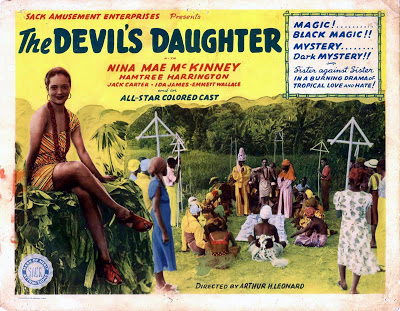
The Devil's Daughter

Director: Arthur Leonard
Writer: George W Terwilliger
Producer: Harry M Popkin
Cast: Nina Mae McKinney, Ida James, Emmett Wallace
Country: USA
Year of release: 1939
Reviewed from: US DVD (Alpha)


There is a tendency to think of early zombie films and voodoo movies as one and the same thing. There are plenty of books and websites and magazine articles which mention White Zombie, Zombies on Broadway and Revolt of the Zombies but which skip over the fact that such films tended to be the more extreme versions of a larger subgenre of Caribbean-set mystery and horror.

Actually, calling The Devil’s Daughter ‘horror’ would be a bit strong but it is a full-blooded voodoo movie (sort of). It is also less than an hour long and features an all-black cast, topped off by 26-year-old Nina Mae McKinney as Miss Isabelle, who has grown up in Harlem but now returns to Jamaica to inherit her father’s plantation. Known as ‘the Black Garbo’, McKinney was never the huge star she deserved to be but she made about 20 movies in the 1930s and 1940s, including Sanders of the River with Paul Robeson, and toured North America and Europe extensively. From this film, two things are evident: first, she was a pretty good actress, and second, she was stunningly beautiful. Apparently McKinney was cast in the 1938 musical The Duke is Tops but had to drop out for health reasons and the part went instead to Lena Horne, setting her on the way to becoming America’s first glamorous black star, a position which could so easily have been McKinney's.

Miss Isabelle’s half-sister, Miss Sylvia (Ida James) has been running the plantation since their father died and has now disappeared. In fact, she is plotting to kidnap Isabelle and subject her to a voodoo ceremony which will scare her so much that she leaves Jamaica entirely, allowing Sylvia to regain control of the plantation. There is a four-sided love triangle between the sisters and two men, Philip Ramsay (Jack Carter: Charlie Chan’s Courage) and John Lowden (Emmett Wallace, whose amazing career included singing with Ella Fitzgerald’s band, writing literally hundreds of songs and starring in Guys and Dolls in the mid-1970s - and he is still alive in his mid-nineties), one of whom turns out to be a bad’un...

Contrasting with this is a comic relief romance between Sylvia’s maid Elvira (Willa Mae Lang) and Isabelle’s servant Percy Jackson, a delightful performance from Hamtree Harrington who manages to play the part as broad comedy without descending into Stepin Fetchit-style grimaces and stupidity. Elvira persuades Percy that, in order to prevent his soul being stolen, he should let Sylvia transfer it into a piglet, which then disappears, much to his consternation.

Throughout the film, which features some lovely shots of 1930s Jamaican scenery, the sound of drums is building, although the sound quality on this disc is very poor and you would be forgiven for thinking it was just a juddery soundtrack. The Devil’s Daughter kicks off with a fairly lengthy sequence of the plantation workers singing and dancing joyfully but by the movie’s end the same workers are singing voodoo anthems and wearing masks as a drugged Isabelle is forced to participate in - well, it’s not exactly clear. But it’s black magic in every sense. (Except, as Sylvia eventually admits, it’s no such thing. There is no actual supernatural activity in this film.)

The short running time means that the story clips along at a fast pace and truth be told the film is rather enjoyable, not just for its novelty value either. The characters are mostly well-drawn and the comic relief is not only not irritating, at times it’s genuinely funny. “Will you come and see me soon?” asks a coquettish Elvira. “Soon?” exclaims Percy. “Sugar, I’m practically there already!”

Director (and associate producer) Arthur Leonard’s other films include crime drama Straight to Heaven (with Carter and McKinney) and musicals Boy! What a Girl! and Sepia Cinderella (with Carter). This seems to be the final credit for gloriously named writer George W Terwilliger whose career started around 1910 and encompassed nearly a hundred films including a 1911 version of Little Red Riding Hood with Mary Pickford and another 1930s voodoo picture, Ouanga. Producer Harry M Popkin also produced both the 1945 version of And Then There Were None (with Walter Huston and Mischa Auer) and the 1965 version (with Shirley Eaton and Stanley Holloway).

Alpha’s version of The Devil’s Daughter (allegedly also known as Pocomania although I have no idea why) is in pretty poor shape, both visually and aurally but the mere fact that such a rare film survives at all and is commercially available is a wonder. In any case, one can hardly complain when the disc costs less than ten bucks and includes a whole other film, Chloe.

However, one caveat - despite all the above this isn’t strictly a voodoo movie. It’s an obeah movie. Voodoo is of course native to Haiti - Sylvia emphasises several times in the film that her mother was Haitian - but apparently in the English-speaking Caribbean, such as Jamaica, the equivalent religion is obeah. There are probably punters who would feel a bit annoyed, even after shelling out a mere five or six dollars - to find that they had a voodoo movie which not only lacks zombies but also has no mention of the word ‘voodoo’. But the hell with such pedants - The Devil’s Daughter is a fascinating and very watchable picture.

MJS rating: B
review originally posted 9th December 2005