Showing posts with label 2013. Show all posts

Sunday, 18 June 2017

Grave Tales

Director: Don Fearney
Writers: John Hamilton, Mike Murphy
Producer: Don Fearney
Cast: Brian Murphy, Edward de Souza, Damien Thomas
Country: UK
Year of release: 2013
Reviewed from: DVD

“This British, feature-length, anthology horror film is the first one of its kind in over twenty years” says the DVD blurb of this exercise in cinematic nostalgia, which obviously isn’t true. Shot in 2011, copyrighted 2012, released (sort of) in 2013, this was preceded (albeit not by much admittedly) by Bordello Death Tales, Nazi Zombie Death Tales and Little Deaths. Even if Don Fearney wasn’t aware of those movies, and assuming that he had no knowledge of the work of Jason Impey, Kemal Yildirim or Tom Rutter (not many folk do, to be fair) he has still contrived to pretend that Cradle of Fear doesn’t exist.

What this tells us is that this is a film made by – and for – people whose knowledge of British horror movies kind of peters out after To the Devil a Daughter. Which is fair enough, I suppose. Know your audience and all that. But it does contrive to make Grave Tales a curiously anachronistic film of very limited appeal.

There are four stories, plus a linking tale in which a young woman (Heather Darcy: Till Sunset) exploring a graveyard meets an aged gravedigger (or is he? da-da-dum!) played by the somehow still living legend that is George Roper, the one and only Brian Murphy. Murphy was 79 when he made this and he shows no sign of slowing down. His actual horror credits are pretty much limited to a small role in The Devils and, um, this… although the feature film version of Man About the House was a Hammer production of course (and remains one of the most enjoyable sitcom spin-off features of the 1970s). More recently Murphy was in the brilliant, long-gestating Room 36, which shares several cast and crew with this film. He is a national institution and we love him and why isn’t he at least an OBE?

Anyway, the gravedigger tells the young woman the stories behind four nearby graves. The first of these, 'One Man’s Meat', stars the sadly missed Frank Scantori (Witchcraft X, Kill Keith, May I Kill U?, Room 36) at his oleaginous best. He plays Norman Elliot, an alcoholic butcher who accidentally murders a homeless girl (Johanna Stanton: Nightmare Box). Riven with guilt, he disposes of the body in the obvious way, putting down to the booze the vampire fangs which seem to appear briefly in the girl’s mouth as he chops her up.

A family who bought this meat – who seem to be his only ever customers – come back for more, but they have become infected and want something a little rarer. Miles Gallant (who does a one-man show about Stan Laurel), Darby Hawker (Stardust, Room 36) and Chloe Ann Withey play the family, and Clifford Allison (Landis’ Burke and Hare) is a doctor from a local institution who comes looking for the girl, an escaped patient who believed she was a vampire.

There is simply too much crammed into these 20 minutes for the story to work, despite Frank’s sterling performance. It would have been better without the doctor, who delivers no useful info and basically just bleats on the same “Have you seen her?” schtick for five minutes. But Frank is great because Frank was Frank, and the neck wound after the first cleaver chop is an impressive prosthetic.

The second story (and they’re none of them particularly memorable so it’s a good job I made notes) is called 'Callistro’s Mirror'. Damien Thomas (Twins of Evil, Sinbad and the Eye of the Tiger) stars as Mr Baxter, a collector who spots a mirror in an antique shop, instantly identifying it as having once belonged to a notable sorcerer, four centuries earlier. It’s not for sale so he kills the shopkeeper (Edward de Souza: The Phantom of the Opera, Kiss of the Vampire) and sneaks back to his flat where he discovers – quelle surprise – that he can see something in the mirror.

What he sees is a bald guy (Ric Truman) being pawed by two topless lovelies (Katie Langford and blogger/poet Jade Moira Lawrence). Baxter is pulled into the mirror and, after some tussle, the previous incumbent escapes, taking over Baxter’s body, leaving the poor bloke to face centuries of torment at the hands of the two young ladies (who are vampires, apparently, possibly because there were some spare teeth left over from the first story).

It’s another pretty obvious and basic story, which is at least in keeping with the Amicus tradition towards which Grave Tales aspires. There’s some irrelevant stuff about Baxter’s late wife, and Don Fearney himself plays a tramp outside the shop. The highlight of this story – and arguably the whole film – is Kiki Kendrick (Sanitarium, The Stomach) having a ball as Baxter’s blousy landlady. It’s a rare moment of enjoyable characterisation in a film which is for the most part pedestrian and prosaic. More Kiki Kendrick in stuff, that’s what we need.

Tale number three, 'The Hand', is slightly shorter than the others, giving the whole film a running time of 75 minutes. Porn actor Mark Sloan (who also played a barman in the first story) is Stanton, a prisoner on the run who has legged it while handcuffed to another jailbird, Duggan (composer/pianist Marc Forde). Peter Irving (moderator of the Kiss of the Vampire DVD commentary) is a nightwatchman – though it’s not clear what he’s actually nightwatching – among whose equipment Stanton finds an axe. And when the handcuffs prove impermeable to the axe blade, an alternative solution presents itself.

Stanton heads off through some woods and hides in a small lake, for some reason. Four police officers (one of whom looks about 12) spot him from a summer house, but he goes underwater and doesn’t come up. Subsequent investigation by a police frogman finds Stanton’s drowned body chained to Duggan’s hand. Is it gripping that underwater branch, or just wedged? (It’s gripping the branch. There’s nothing subtle here.) For the record, the coppers are played by Marcus Taylor, Russell Barnett (Whatever Happened to Pete Blaggit?), Adrian Annis  (Dark Rage, Survivors, My Guardian Angel) and Josh Parris; the frogman is Ross Ericson (writer of The Unknown Soldier, a play which was a  big hit at Edinburgh in 2016).

The final segment is 'Dead Kittens', starring British horror favourite Marysia Kay (who gets an ‘And…’ in the opening credits). She plays Vicky, who is (without explanation) selected to be the new lead singer of pop trio the Dead Kittens. Louise Houghton (Wilby Park) and Nieve Hearity (whose name is spelled wrong in the credits) are the other two. Celia Carron (who sidelines as a Pilates coach) is record producer Sadie and Aubrey Wakeling (apparently now in the States making things like Jurassic Wars(?)) is Mr Varley, the talent scout – or manager or something – who finds Vicky.

After a quick bash in the recording studio, they all head off to Varley’s massive country house to shoot a pop video, directed by none other than dear old Norman J Warren, helmer of Satan’s Slave, Prey etc. Rhiannon Ellison Sayer (who had a bit part in Burton’s Sweeney Todd) is Varley’s posh daughter, who tries to warn Vicky that something is up. The video involves Vicky lying down on a stone altar while everyone else pretends to be Satanists. Wait a minute…

A coda suggests it was all a plot to sell more records because dead pop stars shift units. Which doesn’t make sense because Vicky hasn’t had a chance to become a pop star, has she? Marysia turns in her usual reliable performance but, like most of the actors in this movie, she doesn’t exactly have a lot to work with. Scripter John Hamilton is one of the Satanists, along with George Hilton (Beyond the Rave, Cockneys vs Zombies), Moyb Ullah and Tom Levin.

One of the strengths of 21st century British horror is its diversity and the scope for every sort of movie, however unlikely. So I suppose it’s only fair that there should be a movie which tries to recreate the days of old. But that’s the film’s biggest problem: it is a recreation. It’s not an old 1970s Amicus anthology, just a pastiche of one. Technically it’s competent, though the sound recording (also credited to John Hamilton) isn’t consistently brilliant. But there’s nothing special here, nothing celebratory, nothing to impress (unless you’re enough of an oldtime Brit horror fanboy to just get wet at the thought of a new Edward de Souza movie – there are people like that). Grave Tales is the cinematic equivalent of a pub band playing 1960s covers, featuring a guy who used to be in Herman’s Hermits.

Don Fearney, the motive force behind this film (as well as producing and directing, he is also credited as production designer) is a name in Hammer fan circles. He has organised numerous fan events and also produced several DVD documentaries, often narrated by de Souza. The script is jointly credited to Mike Murphy (editor of the excellent Dark Terrors Hammer fanzine back in the 1990s) and John Hamilton, author of such hugely impressive horror history tomes as Beasts in the Cellar: The Exploitation Films of Tony Tenser and X-Cert: The British Independent Horror Film 1951-1970. Murphy wrote the first tale, Hamilton wrote the other three plus the framing story.

Except that’s not strictly true, is it?

'One Man’s Meat', 'Callistro’s Mirror' and 'The Hand' all started life as Van Helsing’s Terror Tales, the back-up comic strip that ran in most issues of House of Hammer magazine in the 1970s, a fact which goes completely unacknowledged in the credits of Grave Tales. Which is odd, because the very specific audience this is aimed at – ageing Hammer fanboys – are precisely the sort of people likely to own old copies of House of Hammer, and quite possibly have an encyclopaedic knowledge of the magazine’s content. If you don’t have any old copies of House of Hammer lying around, fear not. You can find digitised versions of all 30 issues on archive.org. 'One Man’s Meat', written and drawn by Martin Asbury, was published in issue 5. 'Malvoisin’s Mirror', written by Chris Lowder, art by Brian Lewis, was in issue 6. 'The Hand of Fate', written by Parkhouse, art by Goudenzi, was in issue 22. The settings and other details are different, but the basic stories are identical.

Whatever else one might say about the strengths or shortcomings of this film, for Fearney, Murphy and Hamilton (all of whom I believe to be honest gents) to simply lift someone else’s creative work wholesale and base their own on it without any hint of acknowledgement is reprehensible.

Martin Asbury drew strips for TV Century 21, Countdown, Look-In and TV Comic, and took over Garth in the Daily Mirror after Frank Bellamy died in 1976, drawing and occasionally writing that strip until it ended in 1997 (the current version, running since 2012, is a reprint of Asbury’s strips). Nowadays he is one of the UK’s top storyboarders with credits that include Bonds, Potters and Batmans. I wonder whether he has any idea that his IMDB page should also list a ‘story by’ credit on this obscure indie flick.

Chris Lowder wrote for Action, Tornado, Starlord and 2000AD under various pseudonyms. He also edited several anthologies of dark fiction and even wrote some Sexton Blake stories. Nowadays he’s a freelance editor/writer/bibliographer and seems happy pottering about in amateur theatricals and running his local parish council. Again, I wonder if he knows anything about this film and his uncredited contribution to it.

Parkhouse is Steve Parkhouse, another prolific name in British comics with extensive credits in 2000AD and Doctor Who Comic, for whom he wrote Fourth, Fifth and Sixth Doctor adventures. He has also worked for Marvel and, slightly bizarrely, wrote a graphic novel about the Sex Pistols. It’s probably safe to assume he is likewise in the dark about one of his old stories having been adapted for film.

Given the minuscule budget of Grave Tales and the nature of British comics – which, historically, paid writers and artists a flat fee with no rights and fuck you – I’m not for a moment suggesting that any of the above three writers have been ripped off and should have been recompensed. Who knows who owns the rights to the original comic-strip content from House of Hammer? If indeed anyone does. But it does seem very remiss not to acknowledge the source material and the original writers. (Slightly complicating matters, there was a short-lived horror anthology comic called Grave Tales in the early 1990s, published by Hamilton Comics. However that was Bruce Hamilton, not John, and has no connection with this film.)

Among those whose contributions do get acknowledged on screen are editor Jim Groom (director of Revenge of Billy the Kid, Room 36 and various Hammer DVD extras), composer Scott Benzie (Room 36, Soul Searcher, Ten Dead Men, Fear Eats the Seoul) and DP Jon Nash. Make-up is credited to Gemma Sutton, now one of the top wedding make-up artists in the UK, with ‘special FX make-up’ by Ben Brown. Richard Dudley and Don Fearney are listed as executive producers in the credit block but only Dudley gets name-checked on screen.

Grave Tales was first screened at the Cine Lumiere in South Kensington just before Halloween 2010 and had an official festival premiere at Southend-on-Sea the following April. At both those screenings, there was a clip of Christopher Lee (as himself) included in 'Dead Kittens' but this was removed before the film appeared on (uncertificated) DVD.

In June 2013 Grave Tales was made available from Hemlock Books, where I was employed as a monthly blogger. I bought a copy with part of my pay-cheque but have only just got round to watching it.

It’s just a curio really, of principal interest for its ageing cast list (and a nice role for the late Mr Scantori), but loses a point for not crediting Asbury, Lowder, Parkhouse and House of Hammer.

MJS rating: B-

Thursday, 16 March 2017

Di Gal Bite Mi

Director: Jc Money
Writer: Jc Money
Producer: Jc Money
Cast: Jc Money, Sharan B, Roll Out
Country: UK
Year of release: 2013
Reviewed from: YouTube

When I came across – quite by chance – this amateur, feature-length, British vampire movie I thought I had found something completely unknown and unrecorded. I subsequently discovered a review on specialist bloodsucker website Taliesin Meets the Vampires but this is still a staggeringly obscure film. There’s no IMDB page, no mention of this anywhere except YouTube, plus that one review and now this one.

In North London, a seductive young woman is actually a vampire, preying on flirtatious, cocksure men. A young man whose friend was killed by the vampire is told by his grandmother (who raised him) the truth about what happened to his parents. He always believed they left when he was eight but actually they were killed by vampires, sacrificing themselves to save their baby (shades of Harry Potter). Grandma says the man who can tell him about vampires is a wheeler-dealing Rastafarian who wears a permanent oxygen mask and reads from (I assume) the Holy Piby. At the end of the film, our hero and a friend discover the house where the vampire sleeps, sneak in and destroy her with a combination of stake through the heart and ripping down the curtains to let the sunlight in.

On an objective level, the film is solidly amateur. Camera work is wobbly and handheld with no real attempt at grading or anything fancy like that. There are lots of characters, many in only one scene. Actors wear their own clothes, improvise their dialogue, and for the most part can't act. Outside scenes are shot guerrilla-style so that quite a few people are in this movie without realising it. The whole thing is either a home movie or a dogme masterpiece – you decide.

But listen, I absolutely don’t care about the lack of basic film-making elements like script, acting, make-up or ‘vampire fang effects that weren’t bought at Poundland’. Di Gal Bite Mi has one big thing going for it, which makes it (I believe) unique in the history of British horror cinema, and the clue is in the title. Under the Shadow was in Persian, The Passing was in Welsh, and this, my friend, is a British horror movie with dialogue in Jamaican Patois.

Filmed in, by, among and for the African-Caribbean community in North London, most of the film is delivered in a Patois – and with accents – so impenetrable to this white Midlander as to be effectively unintelligible. But not to worry because the film is subtitled. Admittedly the subtitles have their own curious take on grammar and syntax, and frustratingly they stop 15 minutes from the end of this 69-minute feature (although by then you’ll have the gist of what’s happening), but nevertheless they make the narrative (such as it is) understandable. And hence they make this film hugely enjoyable.

Some characters do speak more clearly and there are a few white folks, notably a young (Polish?) woman who has a scene where she implores the vampire to come and bite her. She is fed up with her miserable life and wants to become a glamorous immortal. However, a mysterious male voice explains that the vampire (spelled ‘vampier’ throughout the film) only ever bites men. Thirty years ago, she was wronged by a man who cheated on her, and now she returns every three decades to take revenge on arrogant, sexist men. (This of course slightly contradicts the bit about that guy’s parents being killed by vampires, although to be fair his grandma doesn’t say it was this vampire who killed them, just a vampire).

There is a (literally) running gag about a Rasta who sees his friend killed in the prologue, runs off – and keeps running. Every so often we cut to shots of him running along assorted pavements, and characters sometimes mention that they saw a scared Rasta-man haring along the road. Eventually, as the final gag of a light-hearted movie, he reaches Manchester(!) where he sees another vampire and starts running back down south again.

Apart from the above and a couple of vampire attack scenes – surprisingly well-shot with judicious use of fake blood – most of the rest of the film is simply two or more characters discussing the recent vampire attacks. There’s not really what you might call narrative development.

But none of that matters a jot. This is something strange and special. Here we have a horror film, made by people with a basic awareness of the standard genre tropes, but set within a distinctive community: genuine, indigenous black British horror film-making. I’ve never seen anything like it.

Notwithstanding that this is a horror-fantasy romp, this film reflects the community where it’s set and where it was made in a genuine, unforced way. This is not some right-on, Lottery-funded, serious exploration of London Jamaicans by a pretentious, if well-meaning, film school graduate. This is real. This one movie can tell external audiences far more about this community than a dozen serious dramas with budgets and trained actors and proper equipment – and it does so precisely because it was not made for external audiences.

What Di Gal Bite Mi reminds me of most is Nollywood. Though clearly British – and identified on YouTube as Jamaican (which it is, in an ex-pat sort of way) – this feels very much like a West African film. There is the same focus on reflecting the real lives of the audience, but within a fantastic storyline full of action, thrills and laughs. There is the same defiant determination to simply not worry about limitations or restrictions, to just plough ahead and make the film. But whereas such determination in a European or North American context can often be self-indulgent, this is not a self-indulgent film. This movie has been made to be seen. It has been made for audiences. Audiences beyond the amateur actors on screen and their immediate friends and families, but audiences like these actors, who identify with the characters, the settings, the attitudes, the dialogue, the jokes, the sex, the beliefs, the haircuts.

If you enjoy Nollywood films that were never meant to be seen outside of Nigeria, if you love old Mexploitation movies that were never expected to play North of Guadalajara, if you get a genuine thrill from discovering some Thai or Filipino obscurity that has never been subbed or dubbed into English, if you somehow combine this international eclecticism with a determination to seek out the most obscure and esoteric elements of 21st century British horror - so if you're me, basically - then you will derive great pleasure from watching Di Gal Bite Mi.

The man behind this movie is Jc Money whose YouTube channel is full of music videos, short films, animation, trailers and a couple of other features, all produced under the banner of Wah Gwan Family Entertainment (I don't speak Patois but even I know what 'Wah gwan?' means). His ‘ghetto action movie’ Murder Job and ‘ghetto movie’ 135 D Street were posted to YouTube in April 2013 and January 2014 respectively; Di Gal Bite Mi was posted between them in July 2013.

Money is a one-man band: writing, directing, producing, photographing and editing as well as playing the nominal hero whose gran sends him on a quest that ends in the eventual destruction of the vampire. Judging by the order of the cast list, in which everyone uses either a single name or a nickname, I would guess that Sharan B plays the vampire (under a selection of wigs) and Roll Out is probably the running Rasta-man.

While it’s pretty much impossible to google anyone involved in this film – and they’re certainly not on the old IMDB! – I have managed to dig up a little bit of info on Jc Money, or Devon Spence to use his real name. His primary interest is music: he studied music engineering at CONEL (The College of Haringey, Enfield and North East London) and has been performing since 1995. When Jamaican dancehall stars visit London he sometimes gets support gigs and has appeared on bills with the likes of Beenie Man, Bounty Killer and Mavado. As a film-maker, Money is entirely self-taught. He watched other people making videos and hence learned how to shoot and edit, leading eventually to his three (so far) feature-length films.

I was absolutely amazed and delighted to discover Di Gal Bite Mi and can definitely recommend it for anyone who is (a) open-minded and (b) bored with sitting through formulaic horror films.

If you want something different, try a vampire with a reggae beat.

MJS rating: B+

Thursday, 21 July 2016

Weaverfish

Director: Harrison Wall
Writers: Harrison Wall, Mark Maltby
Producer: Mark Maltby
Cast: Shane O’Meara, Lucy-Jane Quinlan, Ripeka Templeton
Country: UK
Year of release: 2013
Website: www.weaverfishmovie.co.uk

Weaverfish is a pleasant surprise. It is largely unknown, probably because it has only been released as VOD, and its basic premise is hardly inspiring. A group of horny teenagers go somewhere remote to spend the night partying, drinking, smoking and perhaps getting lucky. Many, many horror films have started out that way and the vast majority of them have turned out to be awful.

The secret lies in the characters. Normally the young people in these films are just awful. Self-entitled millennials or sweary, lary chavs. In far too many films the viewer can identify with no-one on screen and basically wants them all to die as soon (and as painfully) as possible.

The six main characters in Weaverfish are all believable and mostly sympathetic. Reece (Shane O’Meara: Waterloo Road) is a sensitive, introspective guy with a camera around his neck. He takes a bit of persuading to let his hair down and party, but he’s up for a drink when offered so he’s not some stick-up-the-arse buzzkill. Matt (Josh Ockenden: The Underwater Realm, Arthur and Merlin) was his best mate at school although they’re not quite as close now. Matt can be a bit of a prick but he’s not a bad lad. He is dating the very cute Charlotte (Lucy-Jane Quinlan: The Cutting Room) for whom Reece has long carried a torch. Quinlan gives a particularly fine performance, balancing Charlotte on a fine line between vulnerability and resilience.

Abi (Jessie Morrell) is Charlotte’s blousy pal. Shannon (Ripeka Templeton) is Reece’s younger sister who is more keen on partying than her brother. Rounding up the sextet is Mike (John Doughty: The Hounds) a slightly older guy with white dreadlocks who is in a band. He could potentially be an arsehole but actually comes across, once we get to know him, like the others, as a rounded, believable, sympathetic character. All of these are people you could quite happily spend some time with. None of them ever do anything inexcusably dumb.

Do you see, other film-makers? It is possible.

The set-up is that there is an area of water, Fountainhead Creek, which has been sealed off both landwards and riverwards since a small child went missing there several years earlier. There is a disused oil refinery behind the fence. Mike and his bandmate Chris (Dusty Rhodes) – who is either bi or just uses that as a way of getting laid – have discovered a gap in the fence across the mouth of the creek through which they squeeze a small inflatable, twice. As well as those mentioned, there are four or five other teenagers, plus plenty of booze, a few pills, some tents and some music equipment.

Among a litany of strong points, Weaverfish’s big weakness is that we spend a long, long time getting to know the characters. They are well-defined, both in themselves and their relationships, but we signed up for a horror movie not a teen drama. The 95-minute film is nearly halfway through before anything unnerving happens, by which time it’s the morning after the night before and people are waking up. There’s a great deal of puking, but that can be put down to last night’s pills and Pilsner – or can it? When half the group disappear along with the boat, presumably ferried back to the town by Chris, the poorly state of Abi and Shannon persuades the remaining six to set off across land, hoping to find a stretch of fence with a road alongside which might allow them to contact someone who can alert the police and call an ambulance. (There is the traditional, brief hold-up-the-phone-got-no-signal scene.)

As it happens, these six are the most clearly developed characters from the original dozen but we didn’t know that until now so we’ve been trying to become familiar with more characters than we needed to. A shorter first act, with fewer secondary characters, would definitely have benefitted the film. It’s good that we have got to know these characters so well and can fully sympathise and empathise with them. It’s good that we can see the Matt/Charlotte relationship coming apart as he surreptitiously targets Shannon, and that we can see that Charlotte really should be with Reese (plus we can see a relationship developing between Abi and Mike). But Act One could have been tightened up without losing that, I think.

So, the problem they face is that Shannon and Abi, as well as feeling sick, have each developed a large patch of distorted skin on their torsos. An attempt to clean this results in a quite startling and disturbing effects shot which is really where the horror kicks in. Once Mike and Matt also admit to having this symptom, it becomes clear that it has been caused by yesterday afternoon’s dip in the creek, which Reece and Charlotte both passed up. Something from that old oil refinery is still floating about in the water, and it’s not good. (Someone comments that they’ve seen no fish. There is also a complete absence of ducks, swans, gulls, herons or any other sort of aquatic wildlife.)

Comparatively little actually happens in the second act, apart from the group moving forward and people feeling worse, so it is tremendously to the credit of film-makers Harrison Wall and Mark Matlby – and their talented cast – that we remain gripped as the film inches inexorably into horror territory before finally tipping over into a full-on sci-fi conspiracy thriller in the short third act. Commendably, the film ends at exactly the right point, a denouement which is both enjoyably bleak and satisfyingly vague. The (partial) revelation of what is going on is utterly startling, but in a jaw-dropping way, not a jump-out-of-your-seat way.

That’s actually another feather in the film’s cap; it never goes for a cat-scare or other cheap horror gags. Everything here is characterisation and narrative.

Wall and Maltby came out of university and went into TV post-production where they saved their salaries in order to fund this £10,000 production. Wall has done editorial gigs on the likes of Dickensian, Humans and Poirot, while Maltby has worked on The Fades, South Riding and Whitechapel. Wall previously directed two shorts on which Maltby provided special effects: sci-fi musical CyberBeat and a horror called The Snatching which has some similarities to Weaverfish. More recently, Maltby has worked as a colourist on features including Blood Moon, Howl and The Haunting of Radcliffe House. Their script was based on an idea (initially much more of an action/sci-fi story) by their friend Thomas Shawcroft who was DP on Weaverfish and whose various camera operator gigs have included Community, Doctor Who and Galavant (meaning he could potentially have worked with Weird Al!).

Shot near Southampton over 15 days in June 2011, the film premiered at the Bootleg Film Festival in Toronto in May 2012 where it picked up the Audience Award and Quinlan won Best Actor (Female). That version ran 100 minutes and although five of those have subsequently been cut, it could stand to lose another ten or so from that first act. There was a private UK screening for cast and crew the following month at the Prince Charles Cinema and the film also screened in Luxembourg in September that year as part of a 'British and Irish' season. Weaverfish was released in this country through Vimeo on Demand in October 2013 while Continuum Motion Pictures (whose other UK titles include Any Minute Now, Survivors and Bikini Girls vs Dinosaurs) handled the American VOD release in September 2014.

I was really genuinely impressed by Weaverfish. It’s not perfect but as a first feature from two young film-makers shot for tuppence ha’penny it’s a very fine piece of work indeed and a step above many comparable indie horrors. It has good casting and acting, good direction, good production values, good technical values and above all a fine script that prioritises characterisation over cheap exploitation. Well done, all involved. I hope this gets a proper DVD release so more people can discover it.

MJS rating: B+

Saturday, 16 July 2016

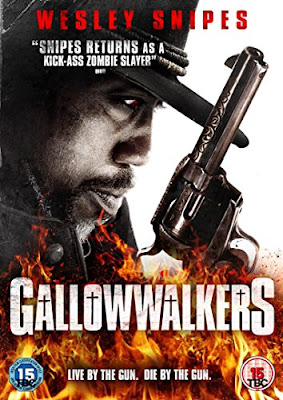
Gallowwalkers

Director: Andrew Goth
Writers: Andrew Goth, Joanne Reay
Producers: Brandon Burrows, Courtney Lauren Penn
Cast: Wesley Snipes, Kevin Howarth, Riley Smith
Country: UK/USA
Year of release: 2013 (eventually…)
Reviewed from: UK DVD

Gallowwalkers does not come with a good reputation. Eleven per cent on Rotten Tomatoes. Average 3.6/10 on IMDB. Average 2.5 stars on Amazon. Most people who have expressed an opinion on it seemed to have been pretty negative. Received opinion is that the film is a clunker.

Well, I’m here to fly in the face of received opinion. I’ve watched Gallowwalkers and while even I hesitate to say it’s great, nevertheless it has undeniable elements of greatness. It also has undeniable flaws – what those are and why they exist I’ll come to in due course – but they are more than compensated for by the film’s positive aspects. I enjoyed it enormously.

Bear in mind that I also appreciated Andrew Goth and Joanne Reay’s previous film, Cold and Dark, which I described in Urban Terrors as “a curious but not unenjoyable melding of police procedural with weird horror.” That film has also been poorly regarded by most critics and punters. Maybe I’m just in tune with what these guys are trying to do.

Gallowwalkers has been described as a ‘zombie western’ but that’s misleading. Films like Cowboys and Zombies and Devil’s Crossing simply place a standard zombie scenario into a Wild West setting. Gallowwalkers is set in something approaching the 19th century American frontier and features characters who return to life, but there any similarities end. This isn’t just a horror film, certainly not just a western. It’s a mystical film, playing on the tropes of the more extreme end of the western genre, beyond Sergio Leone, beyond the old Django movies. Where some westerns are defined simply by iconography – Stetsons, six-shooters, steers and saloons – the real heart of the western genre lies in the themes it explores. Divorced from both the urban and the rural, divorced from both history and modernity, the best westerns are about isolation, struggle, identity, a quest for something undefined, perhaps even unreachable. Great westerns use the frontier of civilisation as a metaphor for the frontiers inside the protagonist’s mind and soul. All great westerns have a mystical element to them, however low it may be in the mix.

Occasionally a western comes along which ramps up the mystical element to eleven. The most famous example of that – and the most obvious comparison for Gallowwalkers, just in terms of its startling imagery and adamant non-realism – would be El Topo. Like Jodorowsky, Andrew Goth uses the western genre and some of its tropes to explore bigger, weirder, stranger ideas – just as he used the police procedural genre in Cold and Dark.

Does it always work? We’ll come to that.

So here’s the surprisingly straightforward plot, as eventually revealed through assorted flashbacks and revelations. Yer man Wesley Snipes is Aman (“a man” = everyman?), who swore revenge on the bastards who raped and murdered the girl he loved. He tracked them down to a jail and shot them in their cells but, in escaping, was himself shot by one of the jailers. His adopted mother called on the Devil to save her son and was granted her wish. But in returning Aman to life, the Devil decreed that those he killed would also return to life.

So those particular bastards are once again walking and talking, led by the thoroughly amoral Kansa (my old mate Kevin Howarth: The Last Horror Movie, The Seasoning House). Or at least, most of them are. Kansa doesn’t know how or why he and his men were reanimated, and hence he doesn’t know why his son wasn’t. Aman is on a quest to kill Kansa and his men, aiming to make sure they stay dead by ripping their fucking heads off. Kansa meanwhile is on a quest to find some mystical nuns whom he believes will be able to restore his son to life.

That’s it in a nutshell but there are all sorts of excursions to the plot, not all of which go anywhere in particular. What matters, more than the plot, are the individual scenes and the truly extraordinary imagery within those scenes. A combination of Goth’s direction, Goth and Reay’s screenplay, Henner Hofmann’s cinematography, Laurence Borman’s production design, Pierre Viening’s costumes and a make-up department overseen by the hugely experienced Jackie Fowler (with designs by the legendary Paul Hyett) – all of this creates a film for which the phrase ‘visually stunning’ would seem a tad half-hearted. Gallowwalkers will blow your mind visually. Christ alone knows what this would be like if watched on drugs. You’d never come down.

Snipes has dreadlocks, a dab of grew in his beard, a black hat and flared trousers. Kansa, whom we initially meet bereft of skin like Hellraiser’s Uncle Frank, takes the face and hair of an albino man and then favours a long, purple coat. One of his men wears a sack on his head, another has a heavy metal helmet covered in spikes, a third prefers grafting lizards’ skins onto his head. His dead son is carried everywhere, swaddled in a wickerwork crucifix. As a child, Aman lived in an orphanage until sent out into the world aged 12, whereupon he was adopted by a lady who singlehandedly runs a slaughterhouse. That woman’s daughter was the lover who was raped and murdered. The slaughterhouse and its owner are still there, with a new child apprentice, also an albino. In fact there is a whole community of albinos…

There are a lot of extreme long-shots in this film, emphasising the emptiness of the desert within which this all takes place. There are no ‘western streets’, no saloons and undertakers. Buildings stand in isolation, and sometimes individual figures do too. In an early scene, a long, straight, single-track, narrow-gauge railway leads from nowhere to nowhere. Three static figures dressed in red (looking distractingly like any one of them could shout “No-one expects the Spanish Inquisition!”) approach from far, far away on a hand-trolley powered by a single Chinese coolie. They take a while to arrive, to even become identifiable for what they are. It’s very David Lean.

The closest that Gallowwalkers gets to a town is that small settlement of albinos, though it’s little more than a few randomly arranged huts and a large, newly built gallows where a row of criminals are collectively hanged with a single pull of a lever. There are tall, somewhat wobbly, horse-drawn prison carts. There are cages on the sand. Everything in this film is ‘real’ in the sense of being raw, wooden, hand-built – but equally unreal in seeming a little arch, a tad deliberate, and deliberately so. These sets, these props, these costumes, this make-up – everything has been designed and created for visual effect and the ideas it provokes, artistically designed for both reality and unreality but certainly not for realism. Therein lies much of the film’s power.

To be honest, it’s not even clear if we’re actually mean to be in the Old West; there’s certainly no reference to any real locations in the dialogue. Gallowwalkers was filmed in Namibia (specifically just outside Swakopmund) where there are great expanses of desert that don’t really look like the southern USA. Huge sweeping dunes are an African thing more than an American one and, after El Topo, the next most obvious visual reference is probably Dust Devil. The one cow we ever see in the slaughterhouse – pretty much the only animal on screen apart from horses and a few goats – is very obviously an African zebu, not a North American steer. There is even a brief cutaway shot of a sidewinder at one point, and you certainly don’t get those in Nevada! Such inclusion of anomalous fauna must be deliberate and serves, like the famous armadillo in the 1931 Dracula, to emphasise the otherworldliness of the setting. Dracula couldn’t actually be set in Europe, despite all the evidence, and Gallowwalkers can’t actually be set in North America.

There’s also maybe something of a Japanese influence in the film. Characters spend a lot of time standing still, eventually moving suddenly, like in the best samurai films. Parallels between the western genre and the samurai genre are legion, so perhaps this sort of comparison is almost inevitable in a film this stylised. While we’re at it, Kansa and his cohorts will put you in mind of the Mad Max films. So that’s an Australian influence too. All this in a British film with an American star shot in a former German colony in southern Africa. Gallowwalkers really is set everywhere and nowhere.

In respect of all the above Andrew Goth’s third feature is a truly cinematic experience. Some people, suckered in by the ‘zombie western’ idea, might understandably have been disappointed to find that this isn’t just Dawn of the Dead with spurs. That’s fair enough. But what surprised me the most when leafing through online reviews and comments was how many people complained that they couldn’t follow what was going on. Some people apparently didn’t realise that the scenes of Aman killing Kansa and his gang in jail are flashbacks. Even though Snipes looks completely different (no dreads, no beard, no hair, with tribal markings painted on his face) and the cinematography is notably different too.

This really isn’t a hard film to follow. As evidence of that: I can follow it, and I’m not renowned for grasping the intricacies of multi-level plots. Yes, there are flashbacks. Yes, the story is revealed to us piecemeal instead of in a linear, chronological fashion (or a walloping infodump). That’s cinema folks. If you can’t follow this, good luck with Memento or Pulp Fiction…

More justifiable are complaints from some who have seen this that chunks of the film don’t seem to make sense, serve a purpose or connect to anything else. It’s full of dead ends and unexplained introductions (not necessarily in that order). As criticisms go, this is entirely justified.

For example, there’s a group of prisoners whose guards are shot. Aman takes one young man on as a sidekick. But among the other prisoners are a feisty showgirl/thief and a presumably corrupt priest. These two make other appearances but don’t seem to tie in to the main narrative in any significant way. It’s like they’re meant to be major characters, but aren’t. The opening scenes with the railway, the three guys in red and a guy with a distinctive neck-brace, don’t really make much sense, even after we discover much later that the three ‘cardinals’ are part of Kansa’s gang and Neck-brace was the guard who shot Aman. Did I mention that the lead cardinal has his lips sewn together, but is somehow still able to talk? I suspect some of the ADR on this film may not match with what the characters were originally saying (or attempting to say)…

In fact, if there is one thing that is abundantly clear when watching this film, it’s that the movie has had some serious changes made in post-production. Numerous reviewers have complained that the ‘script’ doesn’t make sense but this is so obviously not what was originally written. Full disclosure: from previous correspondence with Joanne Reay I am aware that the finished film is not what Goth and Reay intended and they’re not exactly happy with what was released. But Jesus, even if I didn’t have that email, I’d be able to work it out. Even allowing for the hallucinatory, trippy nature of the story, settings and characters, there are so many anomalies here – so many things missing and so many things present but in the wrong order – that this simply can’t have been what was intended. Like Strippers vs Werewolves, like The Haunting of Ellie Rose, what you see when you sit down to watch Gallowwalkers is very definitely not the director’s cut.

Yet, while this is evident (to anyone reasonably awake who has seen more than three films in their life), it doesn’t matter as much as some reviewers (and possibly the film-makers) believe. The nature of the film, the stylish, stylistic and symbolic, the mystical, metaphorical and metaphysical, the non-realistic, non-linear but non-arbitrary nature of the artwork that pins our eyes open (and ears: music by Stephen Warbeck and Adrian Glen) is sufficiently ‘out there’ that these lacunae and non-sequiturs blend right in. We don’t really need an explanation for the albino colony any more than we need justification for the anomalous snake and cow. This is a film that wants you to free your mind.

The quality of a really good movie can shine through a lesser cut. Even the shortest edit of The Wicker Man is still a classic. The imposition of narration on Blade Runner didn’t stop it from being instantly recognised by many people as a brilliant film. Even the BBFC-trimmed version of Curse of the Werewolf can be seen for the superior Hammer chiller that it is. The fact that the censors chopped so much out of the ending doesn’t lessen the quality of what precedes that butchery, and the fact that it is externally mandated butchery of the film is screamingly obvious. One would be a fool to blame Terence Fisher or Anthony Hinds for the sudden, arbitrary ending of that cut of Werewolf, just as one would be foolish to blame Anthony Shaffer or Robin Hardy for apparently not establishing Sgt Howie’s character with some sort of prologue. (Or indeed lambasting David Peoples, Hampton Fancher or Ridley Scott – or even Philip K Dick! – for relying too much on the crutch of film noir-style narration and tacking on a happy ending.) Christopher Lee always maintained there was a much better version of The Wicker Man in landfill under a motorway somewhere. Maybe there is, but it must be bloody fantastic because what we have is pretty damn good to start with.

How far does the released version of Gallowwalkers deviate from what Goth and Reay wrote and set out to make?  We just don’t know. They have been understandably reluctant to discuss the film. Does a finished version of what we might term ‘The Director’s Cut’ actually exist? Might we ever see it and make a comparison? To be honest, that seems unlikely. People clamoured for a more artistically true, less obviously commercial version of Blade Runner and The Wicker Man, creating a market for revisions and reversions. I’d love to watch Goth’s prefered cut of Gallowwalkers but not many people have seen the film in the first place and I suspect very few of those are hankering to see it again. Which is a shame.

Gallowwalkers wasn’t always called Gallowwalkers. It started life as a script called The Wretched which was set to star Chow Yun-Fat of all people! Which is interesting because the use of a Chinese protagonist in a Wild West setting harks back to – no, not Shanghai Noon! – back to 1970s TV series Kung Fu. You recall: David Carradine played Kwai Chang Caine, a shaolin warrior travelling through the Wild West, back in the days when you could cast a Caucasian actor as an Asian character and nobody batted an eyelid  (except all the Asian actors who couldn’t get decent parts). In terms of the ‘mystical western’ subgenre, Kung Fu is definitely the original text and its (indirect) influence on Gallowwalkers is clear.

On the subject of race, it’s interesting that absolutely no reference is made in the film to Aman being black. It’s immaterial. That in itself contributes to the non-realism and other-worldliness of the setting. For a more historically accurate depiction of how race was viewed in that time and place, try watching Blazing Saddles. (Aside from Snipes and the actor playing young Aman in flashbacks, there is one other black actor in the film although he is so heavily made-up that you probably won’t recognise him. Mosca, the guy working for Kansa who prefers to cover his head with lizard skin, is played by the living legend that is Derek Griffiths! He’s come a long way since Play School…)

The promotional website for The Wretched still exists, including a detailed synopsis. Chow Yun-Fat’s character is named Rellik and the sidekick he takes on (called Fabulos in the finished film, played by Riley Smith: Voodoo Academy) is named Twenty-One. (Although not stated in the synopsis, this is because he has six fingers on one hand.) Remember what I said about how difficult I find it to follow complex storylines? Well, the synopsis for The Wretched has me beat. I’ve no idea what’s going on. What is obvious, however, is that not only is it very, very different to the released version of Gallowwalkers, it’s so utterly different that it must also be very different to Andrew Goth’s intended cut of the film. There are a handful of recognisable moments/elements and one consistent character name (Skullbucket, the guy with the big metal helmet) but apart from the basic premise – gunman hunts down resurrected dead bad guys in the Old West – The Wretched and Gallowwalkers are essentially different films.

Under the shooting title Gallowwalker (singular) the film was shot in the Namib Desert in October 2006 with an announced budget of $14 million. Snipes was a big star at the time, just a couple of years on from Blade: Trinity, so it was quite a shock when he was charged with tax evasion. The production had to be put on hold for a while so that he could fly back to the States and arrange his bail. The film wrapped just before Christmas and all the props and costumes were sold off. Somebody in Namibia got Kevin Howarth’s awesome purple coat.

…which was slightly inconvenient because in May 2009 the production restarted for pick-ups and some reshoots in America (either Mexico or the southern USA). Snipes was trying to cram all his various acting commitments into a limited time before heading off to pokey for three years so there was only a couple of weeks to get everything together. Fortunately production manager Carol Muller was able to track down all the required props and costumes and either buy them back or rent them.

I would imagine that these reshoots are where the film diverged from Goth and Reay’s original vision as the press report I’ve seen doesn’t mention Goth at all. So it’s entirely possible he didn’t even direct these bits (whatever they are). Interestingly, this press story is also the only mention I’ve come across of Gallowwalker(s) being conceived as the first part of a trilogy. Although Rudolf Buttendach is the credited editor, Peter Hollywood (Elfie Hopkins) gets an 'Additional Editor' credit which looks suspiciously like an acknowledgement that he was hired to cut together the new version, especially as on his FilmandTVPro page he cites the production company as Boundless Pictures. (Boundless, headed by Brandon Burrows and Courtney Lauren Penn is credited prodco on the film, although the credit block just reads 'Jack Bowyer presents...'.)

Before these reshoots there had been talk of a 2008 release, with Tim Bradstreet allegedly creating a prequel comic-book. A trailer was released in 2008 using comic-book-style graphics to link images. I think all the trailer footage is in the finished film but the lips-sewn-together guy definitely has a different voice. Note that the credited prodcos are not Boundless or Jack Bowyer but Sheer Films (Goth and Reay's own company) and Intandem Films. The absence of Intandem's Gary Smith from the final list of executive producers on the film is quite telling.)

Eventually, six years after it was made, Gallowwalkers finally - and very suddenly - appeared. Its world premiere was on 6th October 2012 at Grimmfest in Manchester (not Frightfest as the Inaccurate Movie Database claims, although it was screened as part of a Frightfest all-nighter in October 2014). I’d like to quote the Grimmfest synopsis here because this guy hits the nail right on the head and should have been plastered all over the DVD sleeve:

The Bastard Love Child Of… BLADE and DUSTDEVIL
Achieving a degree of infamy as the film Wesley Snipes was shooting when he was busted for Tax Evasion, this startling, surreal, supernatural Spaghetti Western combines the visual panache of Sergios Leone and Corbucci with a wild, weird and woolly narrative that plays like something Garth Ennis, Alejandro Jodorowsky and Joe R. Lansdale might dream up between them over several bottles of mescal. Part violent revenge drama, part metaphysical quest, with its tongue partly in its cheek, a morbid quip on its lips and a gun always at the ready, this is destined to become a massive cult favourite. And you saw it here first.

The first home release was the US DVD from Lions Gate in August 2013, followed by discs in Germany (August 2013), the UK (May 2014), then France, Japan, Italy, Mexico, Brazil and maybe some other territories too. What looked like it might become a ‘lost film’ is now widely available.

But people look at this movie and think well gee, if it took six or seven years to get released straight to DVD then it must be terrible. Especially if the star got arrested halfway through production. So viewers are prejudiced before they even put the disc in the machine. They don’t know what to expect, they don’t know the background or the context. Hopefully this review will go a little way towards re-evaluating Gallowwalkers in the perception of horror fans.

Alongside those actors already mentioned, the cast includes Tanit Phoenix (no relation to River) as Aman’s lover, Patrick Bergin as a lawman, Steven Elder (also in Cold and Dark) as the priest, Simona Behlikova (also in werewolf-free British werewolf picture Lycanthropy) as Kansa’s woman, wrestler ‘Diamond' Dallas Page as Skullbucket and hell yeah, Derek Griffiths. DG is The Man as far as I’m concerned. Give him an honorary Bafta right now.

Goth and Reay followed this with the science fiction movie DxM (previously Deus Ex Machina) which likewise premiered at Grimmfest. After finishing his sentence for tax evasion, Snipes set about picking up his acting career including a gig on The Expendables 3.

I’ll wrap up with the only words I can find from Andrew Goth about his film, which were quoted on a poster that said the film was in post (so presumably 2007):

“With Gallowwalker [sic] we are creating a new hero in a mythic western world. Like the best of the spaghetti westerns, Aman’s story is one of blood and vengeance, but his nemesis is unlike any that we have seen before. Kansa was a bad man when he was alive and now he’s back from the dead and relishing his supernatural prowess. Their story plays out against vast desert landscapes that underscore the epic state of their battle. We shot on 2-perf, as Sergio Leone did, which gives  super-wide scope. This retro feel is being enhanced by the latest digital capabilities, which allows us to colour the film in a surreal way and creates a graphic novel feel.” – Andrew Goth, director

MJS rating: A-

Wednesday, 22 July 2015

Rise of the Zombie

Directors: Devaki Singh, Luke Kenny
Writers: Devaki Singh
Producers: Devaki Singh, Luke Kenny, Reshma Mehta, Abhijit Mehta, Om Sawant
Cast: Luke Kenny, Kirti Kulhari, Ashwin Mushran
Country: India
Year of release: 2013
Reviewed from: online version

Now here’s something utterly bizarre.

Indian films sometimes copy the plots of western films. I’m not talking about shameless, copyright-busting cheapo clones like the old Turkish stuff. Just a tendency for Bollywood producers to use the plots of successful American (and sometimes European) films with an Indian setting and an Indian spin. There are Indian versions of When Harry Met Sally and My Best Friend’s Wedding and Hitch and Clueless.

Anjaane: The Unknown is an Indian version of The Others. The first half of Koi... Mil Gaya is an Indian version of Close Encounters of the Third Kind and the second half is an Indian version of ET. Why bother coming up with an original storyline when there are proven plots out there which can be easily reworked to make them attractive to a huge domestic audience?

The thing is: the source material for these films is usually well-known, successful movies – not obscure little British indies. Yet here we have Rise of the Zombie – an unofficial, unacknowledged Indian remake of Andrew Parkinson’s 1998 indie feature I, Zombie: The Chronicles of Pain!

Luke Kenny (Indian born to Irish and Italian parents) stars as wildlife photographer Neil Parker who splits up with his girlfriend Vinny (Kirti Kulhari: Shaitan, Jal) and seeks solace in a trek into the woods. He hires a tent and has a local man bring him hot food every day. He cycles around the mountains and sometimes goes down into a local town for provisions.

Things start to go wrong when he is bitten by a strange bug. The bite on his arm spreads, the flesh rotting away, and his body starts to reject cooked food. Instead he takes to eating bugs, and then lizards and birds, ripping the raw meat from the bones. Unkempt and bloodied, he staggers around the woods, increasingly unaware of what is going on. Eventually he starts attacking people that he meets, ripping into them and eating their flesh. Meanwhile Vinny is worried about Neil and teams up with his best friend Anish (Ashwin Mushran, who was in supernatural comedy Hum Tum Aur Ghost) to try and find what has happened to him. Benjamin Gilani (Alaap, Mirch Masala) plays Neil’s father, a hospital consultant with the very un-Indian name of Dave Parker.

There are a lot of differences from I, Zombie, obviously. A bug bite rather than a crazy lady. The couple split up before he disappears. He’s a wildlife photographer rather than a biology student. The setting is rural rather than urban. And he doesn’t kill himself at the end with chloroform. (Nor does he have a wank over a photo of the girlfriend he can never see again.)

But… I could come up with a similar list of differences between The Others and Anjaane. So what? The derivation is obvious. The basic story here is clearly modelled on I, Zombie. A young man, isolated from his previous life, becoming more and more ill from an infectious bite which rots his flesh and gives him a desperate hunger for human flesh - cannibalistic necrosis – while his family and friends are concerned about, and mystified by, his disappearance. Andy Parkinson’s film is completely distinct and utterly unlike any other zombie picture (even Colin, which shares the basic concept of a zombie as the central character but is otherwise utterly dissimilar). Somehow Luke Kenny - or more likely, writer/co-director Devaki Singh - has seen a copy of Parkinson’s film, or maybe just read a review of it, and decided to make an Indian version.

I’m not criticising. Unofficial remakes happen. Julian Richards took the basic concept of The Wicker Man and turned it into Darklands. Jason Impey took Andreas Schnaas’ Violent Shit and turned it into Sick Bastard. Even if this was a clone, there are enough differences to make it worthwhile: not just the geographical switch but the passage of 20 years (no digital cameras or Blackberries in the 1990s). I bet the budget for Rise of the Zombie was not dissimilar to what Andy P spent on I, Zombie but that much money buys you a lot more nowadays – in India or England – in terms of technology. No grainy 16mm here; just crisp, clean digital video.

Ritu Jhanjani has the main make-up credit and was cited in publicity as responsible for the zombie make-up, although Saved Ismaile gets the actual credit for ‘prosthetic make-up’. Whoever did it, I’d be lying if I said it was particularly good. Pranab Lahkar is credited as ‘Creative VFX Supervisor’; his previous credits include Dhoom-2, Rocket Singh and even 28 Weeks Later.

Luke Kenny, who considers himself thoroughly Indian despite his parentage, came to prominence in the 1990s as a VJ on a video music channel. He now fronts a rock band (called Luke Kenny LIVE) and DJs as well as making films. Since Rise of the Zombie he has shot a short film called Stephen King, I am Your Biggest Fan. Devaki Singh, who was described in publicity as the first woman to direct a zombie film (hmm, possibly...) is an artist whose first exhibition was in 2009.

In 2013 three films vied to be ‘India’s first zombie film’: Kenny and Singh’s angst-ridden drama; Goa Goa Gone (a fun action-horror-comedy which screened in Leicester last year); and Rock the Shaadi, a rom-zom-com set at a Punjabi-zombie wedding(!). Kenny’s film was originally going to just be called Zombie but the makers of Rock the Shaadi had registered that title so he went for Rise… instead and somehow avoided confusion with the contemporary Danny Trejo picture Rise of the Zombies. Ironically, Rock the Shaadi hit problems during post-production and looks unlikely to ever be finished.

Rise of the Zombie was originally announced for release to cinemas on 22nd February 2013, a date which appeared on a number of posters including one that was produced for PETA promoting vegetarianism. Despite having a clear opportunity to steal a march over Goa Goa Gone, Rise… was bumped to 5 April meaning that both films were released on the same day. So theoretically either can claim to be the country’s first zombie picture. What is more Murzy Pagdiwala, who was DP and executive producer on this film, also DP-ed the second unit on Goa Goa Gone!

V One Entertainment picked up the film for international distribution and there is an English-subtitled version on Amazon Prime. The version I watched was on the VOneEnt channel of DailyMotion which is free but has adverts every few minutes. That wasn't subtitled but there's really very little dialogue in the film and half of that is in English anyway.

The end of Rise of the Zombie promises a sequel in 2014, Land of the Zombie, and includes shots of numerous zombies shuffling around, implying that the virus has spread beyond its initial host. Kenny had plans for a trilogy but Land… has not yet appeared.

Truth be told, Rise of the Zombie isn’t a bad movie. Kenny gives a spirited performance and Pagdiwala’s camera-work captures both urban and rural locations well. The film runs 86 minutes and has a few songs on the soundtrack (but no dance numbers). What’s missing is the bleak nihilism of the original, and there’s not really anything to replace it. Instead of cutaway talking heads of the people he left behind, the film simply lurches into Vinny and Anish’s story in the third act, which goes nowhere. Instead of social comment or character development, we’re treated to lots of fast-edited flashbacks and dream sequences which look flashy but don’t give the movie any substance.

Nevertheless, one must grudgingly admire Kenny for taking such a non-commercial tack on his zombie film. It would have been easy to just go for a standard zombie siege and throw in a few culturally specific gags. The story of one man’s lonely descent into a zombie state was radical when Andrew Parkinson made it nearly 20 years ago and it’s still pretty radical now.

In March 2013, when promoting the film, Luke Kenny was interviewed by Bollywood Life. This is what he told them: “If we were telling a zombie survival story, there are 40 years of zombie survival films to see who did what, and what we could try to do differently. ... In this case, there was no precedent; there has been no zombie origin film ever been made. There is no story that has ever been written that tells you the story of this one human being and what happens.” Now, that’s not strictly true, is it?

MJS rating: B-

[Update. Devaki Singh may be the first woman to direct a zombie feature, but Isabelle Defaut directed The Long Night, the 2002 short which inspired Devil's Playground. - MJS] 
[Update 2: I just realised that Kerry Anne Mullaney directed The Dead Outside in March 2008. So Devaki Singh's claim falls to piece. - MJS[

Saturday, 21 February 2015

Zombie Resurrection

Directors: Jake Hawkins, Andy Phelps
Writers: Jake Hawkins, Andy Phelps
Producers: Jake Hawkins, Andy Phelps
Cast: Jim Sweeney, Joe Rainbow, Rachel Nottingham
Country: UK
Year of release: 2013
Reviewed from: screener
Website: www.charmed-apocalypse.com

Every week there’s a new zombie film. Many of them are pretty much identical. Some of them are completely new and take the subgenre in different directions. Others are the standard zombie picture but with one distinct selling point. Zombie Resurrection falls into the third category, in that the bulk of the film is yet another motley collection of survivors trying to continue surviving, who then discover something new, but what they discover is something original that you won’t have seen in any previous zombie film (I think).

In any movie like this, the strength of the picture is the characters and the relationships between them. Zombie Resurrection does a great job here, somehow managing to introduce us to eight characters at the start of the film without leaving us confused. (There is a pre-credits sequence but it’s kind of dark and what I could see didn’t seem to relate to the main story so I’d skip over that if I were you.)

So: roll call. The nominal leader of the group is Major Gibson (Joe Rainbow: Stag Night of the Dead, Sisters Grimm, Night Junkies), a young officer in the TA (or whatever the Terriers are called now) who is, not to beat about the bush, an officious little twat. Outranked, but far more practical and pragmatic is foul-mouthed Glaswegian brick shit-house Sergeant MacTavish (Jim Sweeney: Idol of Evil).

Beaumont (Danny Brown) is a respectable middle-class family man with taped spectacles and a handy golf club, who keeps a protective eye on his teenage daughter Becca (Rachel Nottingham). As well he should because opportunist wet blanket Gandhi (Simon Burbage: Extinction, Tear Me Apart, Torn: A Shock Youmentary) has his eye on Becca too. Harden (Jade Colucci aka Jade Gatrell) is a potty-mouthed chav with a positive attitude who has formed an unlikely alliance with Beaumont and is therefore a sort of surrogate mother to Becca.

Then there’s Esther (diminutive, Zimbabwean Shamiso Mushambi), a heavily pregnant evangelical Christian given to explaining the apocalypse by spouting scripture (which, you know, almost makes sense). Finally there is Dr Sykes (Eric Colvin: ‘The Man’ in Adam Mason’s Broken), one of the scientists who created the virus that caused the zombies in the first place. He is being transported as a prisoner, in orange jumpsuit and chains.

This group of unlikely bedfellows are making their way across Britain on foot, heading for ‘Imperium’, the largest of the protected settlements which have been built up since the zombie virus destroyed civilisation about 15 months ago. Gibson is convinced that once they get there, Sykes will hang.

The zombies themselves are pathetic, in a literal sense. Emaciated, shuffling things which can be fairly easily destroyed with a well-aimed blow to the head, they don’t present much problem to the team and are colloquially referred to as ‘shitsacks’. A bite from one is still fatal, but it's pretty easy to avoid that bite under most circumstances.

When one of the group sustains a serious injury, they take temporary refuge in an abandoned school, which is where they encounter the first ‘fresh’ zombie – fast-moving and deadly – that they have seen for a long time. Sykes estimates it was turned less than a day ago. Further investigation reveals a large crowd of zombies, milling around a single male zombie who is some sort of zombie Jesus (Rupert Phelps), capable of bringing people back from the undead.

Now, truth be told this whole ‘zombie resurrection’ schtick (hence the title, which you might otherwise assume was just a generic phrase) is explained much more clearly in the synopsis on the film’s website than it ever is in the movie itself. I could get that the special zombie was special, and that some of the team witness a zombie turning back into a person, but the details are a bit vague. A female survivor located within the school (Georgina Winters, who had a bit part in Jupiter Ascending) is, I guess, supposed to fill us in on what’s happening but, again, what I learned about her from the online publicity was significantly more than I got from the actual film.

It’s clear that Jake Hawkins and Andy Phelps have worked out something clever and original here, but they’ve been a little too obtuse in showing that to the audience. Not to worry, because Zombie Resurrection is nevertheless a tremendously entertaining picture. The first half is darkly comic with some genuine laugh-out-loud moments. Later on, as members of the team start to fall away, things get a bit more serious, but the transition is smooth and effective.

Solid acting from all concerned makes us care about these people (even Gibson) and skilful direction keeps the story flowing as the character development, ah, develops. We are told enough about the post-apocalyptic world to understand what is going on, but not so much that we get laden down with back story.

Zombie Resurrection is the debut of Phelps and Hawkins who share ‘directed, produced and written by’ although Phelps alone is credited with ‘screenplay’. Hawkins was the DP, a role he previously handled on a micro-short called Zombeez. Robbie Drake (The Seasoning House, Cockneys vs Zombies, Evil Calls) designed the prosthetic make-up which was applied by Heidi Clarke. The cast also includes Kate Korbel (File Box, Piggy) and Ian McIntyre (who was in an episode of Red Dwarf) plus P&H themselves among the zombies. Several BHR names get thanked in the credits including Johannes Roberts and Jim Eaves.

Filmed back in September 2011, Zombie Resurrection had a brace of cast and crew screenings in November 2012. The movie emerged onto DVD in October of 2013 – but only in Japan. It took until March 2015 to find a UK release through Left Films. (Confusingly, a film called Zombie Resurrection has already been released in Germany, which is actually the 2010 Danish picture Opstandelsen. That was released in the USA as A Zombie Exorcism and in the Netherlands as The Resurrection. There is also an unrelated online game called Zombie Resurrection)

I can honestly say that I really enjoyed Zombie Resurrection. In this day and age one tends to have low expectations for zombie pictures, especially if they have such seemingly generic titles. Consequently, when one encounters a well-written, well-directed, well-produced feature with some original ideas, interesting characters and a solid mixture of fun and thrills, it’s a pleasant surprise.

MJS rating: A-