Director: Richard Mansfield
Writer: Richard Mansfield
Producers: Richard Mansfield, Daniel Mansfield
Cast: Darren Munn, Alice Keedwell, Daniel Mansfield
Country: UK
Year of release: 2017
Reviewed from: online screener
Website: www.mansfielddark.com
The title, the brief POV prologue and the logline (“In 2007 a series of tapes were found in the basement of a London home”) all suggest this could be more found footage rubbish but, Jove be praised, it’s not. What it is instead is a genuinely terrifying ghost story in the true James-ian tradition. Which should come as no surprise because this is the latest feature from Richard Mansfield, card-carrying MR James fan and one of the UK’s most consistently impressive horror film-makers.
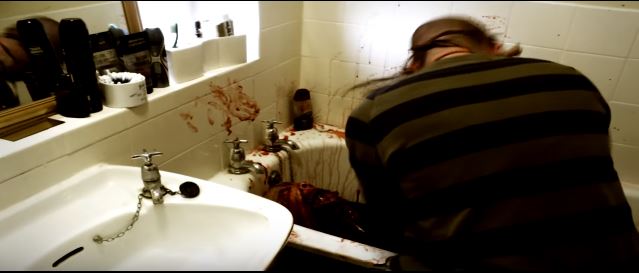
Darren Munn gives a largely solo, largely wordless, completely engrossing performance as the unnamed lead (we’ll call him The Man), spending Christmas alone in an old Victorian townhouse. His two flatmates have headed off for Chrimbo so there’s just him and the cat. There are a few one-sided phone conversations and a brief scene about an hour into the 72-minute feature with a visitor, but for the most part this is Munn on his tod, reacting to things. Subtle reactions to subtle things.
The titular tapes are a box of microcassettes, plus a Dictaphone, which The Man finds in the cellar and listens to out of interest. What he finds are recordings of a medium visiting the house in 2003 in response to the then tenant’s request for help. So in a sense the story largely plays out as an audio drama, except that creepy things start happening on screen. A door opens. A shrouded figure appears briefly.
The tapes include both the medium’s comments and occasional distorted horror voices, on the cusp of intelligibility. Sometimes the tape audio is diegetic, as The Man listens to what we hear, but often it’s a counterpoint, visual story and audio story perfectly complementing each other as Mansfield uses his impeccable understanding of cinematic horror pacing to incrementally ramp up the terror.
A little diligent research on the web reveals that the medium has died but her twin sister is accessible, so The Man invites her round and offers her the box of tapes, leading to the single two-hander scene. (Both sisters are ably played by Alice Keedwell.) On two other occasions the story wisely escapes the confines of the house as The Man sets out into London for a montage of fairground rides, Christmas markets and tube trains. Otherwise, this is basically Darren Munn wandering around a house looking puzzled, and it is a testament to the man’s acting that he conveys so much credible emotion. The Man becomes unnerved, but only very slowly and slightly. Most of what we see, he doesn’t.
What really, really, really makes this work – and it’s something obvious which regular readers will know is a frequent bugbear of mine – is the soundtrack. Specifically that when something spooky appears or happens there isn’t an accompanying music sting. I’ve written before, at length (not least in my review of the otherwise generally very good The Other Side of the Door) about how a crashing chord every time a ghost appears makes things less scary. Richard Mansfield, student of the MR James School of Unnervingly Ambiguous Horror, understand this perfectly. The fact that neither the character on screen nor the film itself acknowledges what we just saw (or think we saw) makes what we saw (and what we might see next) far more terrifying than anything with a blaring, jarring ‘look at the scary thing’ leitmotif. Our attention is focused on the whole screen, not just young Mr Munn, as we scan the rooms and doorways behind him for unnaturally moving shadows or a hint of a white sheet.
This is Munn’s third collaboration with Richard Mansfield, having previously appeared in The Mothman Curse and Video Killer. He was also in two films directed by Richard Mansfield’s husband Daniel, who provides additional tape voices here. (Munn’s other horror credit is the very odd Paranormal Sex Tape which is structurally similar in featuring lots of wordless scenes. I don’t think either of the Mansfields was involved with that, although perhaps one of them could be the pseudonymous director ‘Dick Van Dark’…?) As for Alice Keedwell, making her film debut here, she is half of award-winning cabaret duo House of Blakewell. Back in 2013 Richard Mansfield used his distinctive shadow puppet style to animate a video for House of Blakewell’s morbidly witty song ‘The Truth is…’ which you can find on YouTube.
The effective soundtrack is credited to Pig7, an “experimental, improv electronics duo” whose music, according to their Facebook page “can be described as soundscape, dronescape, filmatic, ambient horror, spacerack, hambient, sconescrape, stonecrop with a hint of Cronenberg.”
Shot in late 2016, in a few days for a few hundred quid, The Demonic Tapes was given a VOD release on Amazon Prime in May 2017, making it Richard Mansfield’s fifth live-action horror feature in three years (The Secret Path and Scare Bear are the other two, plus he’s still making his shadow-puppet shorts). The working title was Fright Christmas and it was briefly known as House of Christmas Evil before Mansfield settled on a less festive but more commercial and direct title. The film is set at Christmas but that's largely incidental. Fright Christmas would still be an awesome title for something though!
A little less avant-garde than his previous movies, The Demonic Tapes shows a maturing of the director's style and an increased, well-deserved confidence. It is also – and I really should stress this point before you tootle off to Amazon and watch the movie – extremely scary. Really very, very frightening indeed. I watched it early one morning, sun shining in through the windows of my own large, Victorian house. I was seriously creeped out. Had I saved my viewing for the evening when I was alone (Madame at her mother’s, young Sir at his theatre club) I would have been crapping myself and would certainly have had great difficulty sleeping that night.
This is a dreadful film – literally. In that it is absolutely jam-packed full of dread. No fancy special effects, no stupid cat-scares (though there is a cat), no plot-hole riddled script, no big budget hype, just unexplained supernatural imagery and ideas woven into a quietly terrifying tale of a man spending Christmas alone in an old house. The implicit horror revealed by the tapes plays on The Man’s mind as it plays on the viewer’s. He doesn’t know he’s in a horror film, we know we’re not, but in both cases there’s a dread of what might be happening just beyond the mortal realm.
Powerful, gripping, expertly crafted, The Demonic Tapes is, in this viewer’s humble opinion, the scariest British haunted house film since Ghostwatch. I can give no higher praise. As I have said before in relation to other of my favourite indie film-makers, the only reason I’m not giving this A+ is because I want to see what Richard Mansfield makes next.
MJS rating: A
MJ Simpson presents: the longest-running single-author film site on the web, est.2002.
Showing posts with label demons. Show all posts
Saturday, 3 June 2017
Saturday, 7 January 2017
The Vampires of Bloody Island
Director: Allin Kempthorne
Writers: Allin Kempthorne, Pamela Kempthorne
Producers: Allin Kempthorne, Pamela Kempthorne
Cast: Pamela Kempthorne, Allin Kempthorne, Leon Hamilton
Country: UK
Year of release: 2010
Reviewed from DVD
Website: www.bloodyisland.co.uk
Since it was originally released, a full seven years ago, I have been meaning to watch this film, just to see for myself quite how awful it is. Self-released and self-promoted, the movie’s marketing screams ‘terrible’. The film’s website refers to it as a “hilarious cult vampire comedy movie” and “a vamptastically entertaining send-up of every vampire film you've ever loved!” Such hyperbole sets off a klaxon to any would-be viewer (or reviewer).
Comedy, as I think has been well-established over the years, is very difficult to do on a low budget. A few films have managed it - Stalled, Kill Keith, Evil Aliens, Take Me to Your Leader – but plenty more have crashed and burned: Le Fear 2, Stag Night of the Dead, Whatever Happened to Pete Blaggit, Zorg and Andy and many others so desperately short on laughs that I can’t even bring myself to review them. Here’s one thing I’ve noticed over the years though: genuinely good comedies rarely feel the need to tell people how ‘entertaining’ or ‘hilarious’ they are.
The film’s website has lots of laudatory, unlinked review quotes from sources I’ve never heard of. To be fair, it did get a positive review in Fortean Times, but that’s not really a journal of cinematic record. There are no external review links on the IMDB (except this one). All but two of the Amazon reviews are five-star raves; the remaining pair are one-star excoriations. The signs are not good.
Everything about The Vampires of Bloody Island just looks terrible. The website, the DVD sleeve, the trailer, everything designed to appeal to a potential audience has the absolute opposite effect. Even the character names on the IMDB page suggest this will be about as humorous as a root canal. Unless you’re an obsessive goth who thinks anything with a vampire in is an instant classic, one’s instinct is to stay away.
But my job (well, it’s hardly a job…) is to watch these things so you don’t have to. Cover me – I’m going in…
Thus, after seven years, I finally picked up a copy and watched it. And, because I write these reviews in a spirit of absolute honesty, I’ll tell you this. The Vampires of Bloody Island is nowhere near as bad as I expected. The cringeworthy marketing does this film a disservice. It’s not the worst comedy ever made. Not even the worst horror comedy ever made. Heck, it’s not even the worst British horror comedy about vampires ever made. A few minor aspects of it are moderately clever.
Let me be clear: in no way am I saying that this is A Good Film. The Vampires of Bloody Island is painfully unfunny amateur rubbish and I cannot with a straight face recommend it to you in any way unless you are obsessively completist about vampires and/or British horror. It’s awful. Just not as barrel-scrapingly awful as I previously assumed.
Hey, credit where credit’s due is my motto.
The set-up is this. Morticia de’Ath (Pamela Kempthorne) is a centuries-old vampire living in a castle on an obscure Cornish island, tended to by her mute zombie manservant Grunt. Her goal is to be able to go outside in sunlight, towards which end neighbouring mad scientist Dr N Sane is working on an elixir. The one remaining ingredient is the blood of a mortal, born of vampire, who has returned to their birthplace of their own free will.
To this end, some decades ago Morticia had a daughter by a mortal man, who then took the baby away and raised it alone. In London we meet Susan Swallows (also Pamela Kempthorne), a clutzy employee at a soft drink company which produces, among other disgusting flavours, Garlic Cola. Grunt surreptitiously arranges for Susan to be sent off as a sales rep to Bloody Island, Cornwall. She is accompanied by her colleague Kevin Smallcock (Allin Kempthorne) who maintains that his surname is pronounced ‘Smelkirk’.
On arrival at the island, Kevin and Susan are welcomed as guests by Morticia but after a dinner party incident they are thrown into a dungeon along with tweed-wearing parapsychologist Professor Van Rental. Dr N Sane completes the elixir, then Morticia uses it to raise a small army of vampires, but Kevin, Susan and Van Rental escape and defeat the undead using water pistols filled with Garlic Cola. Susan spends most of the third act parading around in her underwear, adding a fur coat to her costume partway through.
You can see that there is some attempt at an original plot here, bolstered out by Kevin and Susan’s journey to Bloody Island. This includes a stop at a prehistoric monument where they first encounter Van Rental, an overnight stay in a guest house where Kevin gets vampirised by a topless Morticia, and an encounter with a ferryman who is terrified by the name ‘Bloody Island’ and refuses to row them across ‘Sheet Creek’.
There are some genuine attempts at humour on show, including unamusing, vaguely rude, sub-sub-sub-Carry On character names. The Garlic Cola stuff is original and justifies the denouement as assorted vampires disappear in a puff of computer graphics. The scene with the ferryman meanwhile is a self-contained sub-sub-sub-Python sketch, the sort of thing that might raise a smile in a village pantomime. You know, some ‘comedies’ I’ve sat through have been so bad that I genuinely couldn’t work out where the jokes were. All due credit to The Vampires of Bloody Island: it is very obvious where the jokes are. That’s because they are old, weak, laboured and for the most part desperately unfunny (and kind of have a metaphorical neon sign above them saying ‘comedy bit’). But at least there are jokes.
The attempted humour, as you can tell, is very broad and unsubtle. If I was asked to sum the movie up in one sentence, it would be thus: this is a film that wants to be Carry On Screaming but ends up as Carry On England.
Still, could have been worse. Could have ended up as Carry On Emannuelle. Anyway…
Speaking of things which are unsubtly labelled, Allin Kempthorne is one of those film-makers who feels the need to put a typewriter caption at the start of every scene telling us where it is, what day it is and the precise time. The first two are always obvious from context (assuming we haven’t got bored and started checking our emails) and the last doesn’t matter. The most extreme example is on the journey when Susan tells Kevin she wants to stop off at somewhere called Devil’s Lookout. We get a close-up of a map, Susan’s finger pointing to something clearly labelled ‘Devil’s Lookout’. Then we see the car pulling up next to a sign reading ‘Devil’s Lookout’. Kevin gets out of the car saying: “Here we are, Devil’s Lookout.”
And a typewriter caption clatters across screen to tell us that this specific location is… Devil’s Lookout!
Last time I saw anything like this was in Summer of the Massacre. And while The Vampires of Bloody Island isn’t anywhere near as bad as Bryn Hammond’s classic tale of ball pein hammers and rubber masks, these typewriter captions are another red flag that we’re dealing with people who don’t really understand how film narrative works.
This is a shame as Allin Kempthorne clearly does know how to make a film. The direction is perfectly competent here. The actual camera-work isn’t great but I’ve seen worse. The editing is actually rather good, particularly in scenes where Morticia and Susan appear together. Through judicious use of stand-ins, the director is able to make us completely forget that these are the same woman. Or nearly forget anyway. Probably the biggest hole in the plot, one that cannot be excused just because this is a low-budget silly comedy, is that that when Kevin and Susan meet Morticia they completely ignore the fact that (a) she looks exactly like Susan and (b) she has bloody great fangs sticking out of her mouth.
All the above notwithstanding, let’s get to the elephant in the room, which is Pamela Kempthorne herself. And I don’t mean that in a personal way, but some of what I’m about to type will seem very personal indeed. That is, I’m afraid, unavoidable. If you take the lead role (actually two lead roles) in a feature film and promote it heavily, and if you spend much of that film in a state of undress, you must expect people to comment on your physical appearance. And the simple truth is that Mrs Kempthorne has neither the figure nor the face to play either of these roles. When she gets undressed, flashing her boobs and her bum, frankly it’s more frightening than the last half-dozen serious vampire films I watched put together.
Morticia is supposed to be a seductive, sexy vampire. And for Allin Kempthorne to cast his wife in the role is pure vanity. If my wife decided she was going to make a film about Ancient Rome and cast me in the lead role as a gladiator, it would be utterly ridiculous. It would make me, and her – and by association anyone else involved with the movie – look like idiots. Because I’m an overweight, underheight, 48-year-old nerd with bad skin, a large nose, overgrown eyebrows, a speech impediment and a haircut that has barely changed since 1973. Kirk Douglas I ain’t. And Ingrid Pitt she ain’t, sorry.
Under her husband’s direction, Pamela Kempthorne swans through the film like she’s some sort of cross between Barbara Steele and Barbara Shelley. When in fact she’s somewhere on a line between Barbara Bush and Barbara Cartland. She thinks she’s Madeline Smith but she looks more like Madeleine Albright. And nobody ever wanted to see the Secretary of State’s tits, not even Bill Clinton.
Nor does Pamela Kempthorne convince as Susan Swallows (hoho, very amusing). Frankly, the daughter looks even older than the mother (which, to be fair, given that the latter is an ageless vampire, doesn’t actually break any narrative rules). While Mrs Kempthorne as Morticia is waving her bazongas about in one scene, seducing Kevin Smallcock (god, that’s funny) in the guest house, the sequence is intercut with Mrs Kempthorne as Susan in another room, curled up on the bed, squeezed into a pair of pink panties emblazoned with the phrase ‘Pretty princess’. I actually had to rewind and pause to work out what it said. I never, ever want to do that again.
We are supposed to accept that, after initial hostility at the soft drink firm office, Kevin keeps making moves on Susan and eventually they fall in love. I’ve no doubt that the Kempthornes are happily married (since October 1998) and blissfully in love with each other, and that’s lovely and wonderful and all. But this is cinema, not real life. And when you see them on screen together, honestly you’d assume they were mother and son.
Compounding the problem (yet somehow also ameliorating it) is that Allin Kempthorne himself is a good-looking guy, with his floppy hair and cheeky smile. When I watched this movie, I kept thinking: well, I wouldn’t climb over him to get to her. Look, when a male viewer who ticks the ‘straight’ box on diversity forms finds your male romantic lead more attractive than your female romantic lead, there’s something wrong with your casting. (Unless of course the male lead is Johnny Depp or Brad Pitt, in which case hell yeah! You know where you can stick your diversity forms then. Don’t try to deny it, you’ve all thought the same.)
On top of which, Allin Kempthorne is also a good actor, especially impressive given that he’s directing himself which always makes life harder. He’s had a few walk-on parts in things like The Colour of Magic, Pride and Prejudice and Zombies and episodes of Black Mirror, Horrible Histories, EastEnders (as a clown) and Doctor Who (as a mime artist). He has also been a stand-in several times, including doubling for Rowan Atkinson on Johnny English, plus Cronenberg’s Spider, Julian Richards’ Silent Cry and a brace of Harry Potters.
Mrs Kempthorne, on the other hand, is simply one of the worst actors who has ever crossed my TV screen. I know I’ll never win a Bafta (not for playing a gladiator, anyway) but that doesn’t mean I can’t spot an absence of acting ability in other people. And honestly, it’s embarrassing how awful she is. Especially when she’s on screen with her husband. The overall cast of the film range right across the acting spectrum from terrible to quite good. Leon Hamilton mimes his way through a fine wordless performance as Grunt, while John Snelling as Dr N Sane is like a plank of wood. Oliver Gray as Professor Van Rental is somewhere inbetween.
It’s ironic that the best actor on screen is Mr A Kempthorne and the worst is Mrs P Kempthorne, but that’s the way it is. She was also a stand-in on Silent Cry, actually appears on screen as a witch in Harry Potter and the Chamber of Secrets, and was a zombie in Shaun of the Dead. I suspect she can carry off non-speaking witch and zombie roles, but two lead roles, both supposedly sexily seductive – no, not a chance. Maybe, just maybe, if cast as some sort of crumbling, cobweb-covered, ancient vampire matriarch who spends the whole movie sat on a throne (and fully dressed), Pamela Kempthorne could have pulled off a bloodsucker role. But that’s not what we get here.
This is what happens when you make a vanity project. And make no mistake, The Vampires of Bloody Island is a vanity project. Allin Kempthorne made it for his wife. He manages his wife’s acting career. He marketed and distributed this film starring his wife. It’s commendable how much he does for her. But it would be untrue and unkind to suggest that the result is anything except a self-indulgent home movie. Keep your wife’s flabby arse in the bedroom Mr Kempthorne because no-one in their right mind wants it on their telly.
When not being film stand-ins, the Kempthornes run a mail order business selling goth/vampire ephemera (and signed copies of their DVD) from their home in the little town of Mountain Ash near Merthyr Tydfil. Which means that they know their audience and their market. If you’re the sort of person who will happily shell out £1.90 for a sachet of ‘Astral Cleansing Ritual Bath’ (“Remove astral debris picked up in everyday life, breaks minor curses and strengthens the auric field.” Which, incidentally, is a funnier line than anything in the script of this movie…) then you will probably freaking love The Vampires of Bloody Island and can safely ignore everything I’ve written here.
Since making The Vampires of Bloody Island, Mrs Kempthorne doesn’t seem to have troubled the screen again, concentrating on such challenging stage roles as Sally Skull in Skull and Crossbones, the Potty Pirates and Ping Pong in Santa’s Naughtiest Elves. Two of Ibsen’s lesser known works there.
A little digging reveals that these pirates and elves are part of a whole cornucopia of characters which the Kempthornes offer for children’s parties, corporate events, walkabouts etc. Allin does close-up magic, both family-friendly and more sophisticated (plus stand-up comedy as ‘Eddie Twist’). Pamela does tarot and palm reading. They both make balloon animals. Walkabout characters on offer include Baron Blood the Vampire, Wizzall the Wizard, Wanda the Wacky Witch, Runefungle the Sorcerer, the Giggling Ghost, Midshipman Arnold Poop-Decker, Jack Frost, the Mad Hatter, Sparkie the Clown, Ditzy the Clown, the Andromedans, the Space Tourists and a frankly terrifying giant humanoid rabbit.
There is also Lord Two-Head, a monstrous character whose second head sits upside-down on top of his regular head. (It’s creepy, but still better than the shitty version of Zaphod Beeblebrox in the Hitchhiker’s Guide movie.) This explains one of the mysteries of The Vampires of Bloody Island, which is that when we first met Dr N Sane he is treating a patient who has this curious double head and is never explained. It is a very good full-head mask and really one of the highlights (if such a term can be used) of the movie.
The other bit of the film that I really liked was when Morticia raises her vampire army and they all announce what year they were turned. Two of them were vampirised in the late 1960s so are hippy vampires, sticking to their principals of peace and love. When the big fight breaks out, they refuse to get involved, sitting on a blanket and waving placards (although that doesn’t save them from a deadly blast of Garlic Cola). The actors are Rebecca Finley-Hall (you may remember her as ‘Skank Hippy Crack Bitch’ in obscure 2006 social drama The Plague) and the surely pseudonymous Caspar De La Mare. This is a clever and original idea, well handled, and probably the closest the film ever comes to being genuinely entertaining.
The leader of the vampire army, played under impressive make-up with a plummy English accent, is a ‘war demon’ named General Valkazar. This is Marcus Fernando (also credited as fight director) whose stage career includes puppeteering for the RSC. It’s another good performance that veers towards entertaining. Also in the cast are Carl Thomas and Paul Ewen as ‘Catering Demons', serving at the dinner party scene. Ewen (also credited as key prosthetic artist) is a British horror regular with bit-parts in Cockneys vs Zombies, Zombie Undead, Three’s a Shroud, Blaze of Gory, Seize the Night, The Vicious Dead and Kim Wilde’s legendary goth-horror video Every Time I See You I Go Wild (google it!).
Tacye Lynette who plays the boss of the soft drinks firm (another good performance) does audio descriptions for Sky TV. There’s actually a borderline funny bit in the office sequence when three Chinese ladies are assumed to be customers from China but take offence because they’re actually Irish. Kaila Lee, Amy Ip and Carolyn Seet are ‘Miss Chang’, ‘Miss Wang’ and ‘Miss O’Leary’. Three sexy female vampires who make a move on Kevin (and these ones are genuinely sexy, even though they keep their clothes on) are credited as ‘Mina’, ‘Lucy’ and ‘Morgana’ and played by Sadie Sims, Lisa Pobereskin and Jennifer Grace.
There are also two werewolves chained up in Morticia’s dungeon. One is played by an actor hiding behind the pseudonym ‘Fritz Aardvark Bragpuss’ (sic) and the other is – crikey! – Mick Barber. You may recall Barber's recurring role as a non-speaking, bubble-permed background copper in Ashes to Ashes but you will definitely recall his most famous role as squeaky-voiced, bubble-permed foreground lunatic Tommy in Richard Driscoll’s Eldorado.
Of final note is the film's soundtrack which features a number of goth beat combos including Inkubus Sukkubus, Fever, Theatres des Vampires, The Suburban Vamps and Corpse Nocturna. The opening titles play under a song by Vampire Division called ‘Place of the Dead’ and you’ll have the catchy chorus stuck in your head for days after you watch the film. It goes:
Place of the dead! Place of the dead! Place of the dead! Place of the dead!
Ah, they don’t write ‘em like that any more…
So that’s The Vampires of Bloody Island, a film I watched in order to tick it off my list, which proved that you can’t judge a DVD by its sleeve. Although you can get a pretty good idea. The Kempthornes self-released it on their Weird World of Wibbell label in January 2010 with an NTSC version following in August. There was a cast and crew screening back in 2007 and it was shown at the first Horror-on-Sea in January 2013 but seems to have otherwise largely left the big screen untroubled.
Now you might expect this vanity project to be the only Wibbell release but you’d be wrong. They also released something called Learning Hebrew: A Gothsploitation Movie which is synopsised thus:
"When criticism of faith and the freedom to offend is outlawed by the Politically Correct Militia, Bella and her gang of idealistic cyberpunks push Darwinism door-to-door. But with agnostic thugs in the street and the Atheist Revolutionary Army attacking the liberal establishment, Bella and her friends are driven underground into a dark fetish existence, where the future and past collide, allegiances are strained and old scores must be settled."
That was written and directed by someone named Louis Joon and released by the Kempthornes on DVD in 2012. It played Horror-on-Sea in 2014 although it’s not on my masterlist because I’m not convinced (yet) that it’s actually a horror film. Wibbell Productions has also given us Twisted Britain, a phone-shot web series with Allin Kempthorne in his Eddie Twist guise visiting various towns. Currently under development is The First Stars of Vaudeville, a compilation of archive footage of obscure music hall acts.
I absolutely love old music hall acts so if that ever gets finished I will be first in the queue to buy a copy. Seriously.
Just so long as I never have to watch The Vampires of Bloody Island again.
MJS rating: C-
Writers: Allin Kempthorne, Pamela Kempthorne
Producers: Allin Kempthorne, Pamela Kempthorne
Cast: Pamela Kempthorne, Allin Kempthorne, Leon Hamilton
Country: UK
Year of release: 2010
Reviewed from DVD
Website: www.bloodyisland.co.uk
Since it was originally released, a full seven years ago, I have been meaning to watch this film, just to see for myself quite how awful it is. Self-released and self-promoted, the movie’s marketing screams ‘terrible’. The film’s website refers to it as a “hilarious cult vampire comedy movie” and “a vamptastically entertaining send-up of every vampire film you've ever loved!” Such hyperbole sets off a klaxon to any would-be viewer (or reviewer).
Comedy, as I think has been well-established over the years, is very difficult to do on a low budget. A few films have managed it - Stalled, Kill Keith, Evil Aliens, Take Me to Your Leader – but plenty more have crashed and burned: Le Fear 2, Stag Night of the Dead, Whatever Happened to Pete Blaggit, Zorg and Andy and many others so desperately short on laughs that I can’t even bring myself to review them. Here’s one thing I’ve noticed over the years though: genuinely good comedies rarely feel the need to tell people how ‘entertaining’ or ‘hilarious’ they are.
The film’s website has lots of laudatory, unlinked review quotes from sources I’ve never heard of. To be fair, it did get a positive review in Fortean Times, but that’s not really a journal of cinematic record. There are no external review links on the IMDB (except this one). All but two of the Amazon reviews are five-star raves; the remaining pair are one-star excoriations. The signs are not good.
Everything about The Vampires of Bloody Island just looks terrible. The website, the DVD sleeve, the trailer, everything designed to appeal to a potential audience has the absolute opposite effect. Even the character names on the IMDB page suggest this will be about as humorous as a root canal. Unless you’re an obsessive goth who thinks anything with a vampire in is an instant classic, one’s instinct is to stay away.
But my job (well, it’s hardly a job…) is to watch these things so you don’t have to. Cover me – I’m going in…
Thus, after seven years, I finally picked up a copy and watched it. And, because I write these reviews in a spirit of absolute honesty, I’ll tell you this. The Vampires of Bloody Island is nowhere near as bad as I expected. The cringeworthy marketing does this film a disservice. It’s not the worst comedy ever made. Not even the worst horror comedy ever made. Heck, it’s not even the worst British horror comedy about vampires ever made. A few minor aspects of it are moderately clever.
Let me be clear: in no way am I saying that this is A Good Film. The Vampires of Bloody Island is painfully unfunny amateur rubbish and I cannot with a straight face recommend it to you in any way unless you are obsessively completist about vampires and/or British horror. It’s awful. Just not as barrel-scrapingly awful as I previously assumed.
Hey, credit where credit’s due is my motto.
The set-up is this. Morticia de’Ath (Pamela Kempthorne) is a centuries-old vampire living in a castle on an obscure Cornish island, tended to by her mute zombie manservant Grunt. Her goal is to be able to go outside in sunlight, towards which end neighbouring mad scientist Dr N Sane is working on an elixir. The one remaining ingredient is the blood of a mortal, born of vampire, who has returned to their birthplace of their own free will.
To this end, some decades ago Morticia had a daughter by a mortal man, who then took the baby away and raised it alone. In London we meet Susan Swallows (also Pamela Kempthorne), a clutzy employee at a soft drink company which produces, among other disgusting flavours, Garlic Cola. Grunt surreptitiously arranges for Susan to be sent off as a sales rep to Bloody Island, Cornwall. She is accompanied by her colleague Kevin Smallcock (Allin Kempthorne) who maintains that his surname is pronounced ‘Smelkirk’.
On arrival at the island, Kevin and Susan are welcomed as guests by Morticia but after a dinner party incident they are thrown into a dungeon along with tweed-wearing parapsychologist Professor Van Rental. Dr N Sane completes the elixir, then Morticia uses it to raise a small army of vampires, but Kevin, Susan and Van Rental escape and defeat the undead using water pistols filled with Garlic Cola. Susan spends most of the third act parading around in her underwear, adding a fur coat to her costume partway through.
You can see that there is some attempt at an original plot here, bolstered out by Kevin and Susan’s journey to Bloody Island. This includes a stop at a prehistoric monument where they first encounter Van Rental, an overnight stay in a guest house where Kevin gets vampirised by a topless Morticia, and an encounter with a ferryman who is terrified by the name ‘Bloody Island’ and refuses to row them across ‘Sheet Creek’.
There are some genuine attempts at humour on show, including unamusing, vaguely rude, sub-sub-sub-Carry On character names. The Garlic Cola stuff is original and justifies the denouement as assorted vampires disappear in a puff of computer graphics. The scene with the ferryman meanwhile is a self-contained sub-sub-sub-Python sketch, the sort of thing that might raise a smile in a village pantomime. You know, some ‘comedies’ I’ve sat through have been so bad that I genuinely couldn’t work out where the jokes were. All due credit to The Vampires of Bloody Island: it is very obvious where the jokes are. That’s because they are old, weak, laboured and for the most part desperately unfunny (and kind of have a metaphorical neon sign above them saying ‘comedy bit’). But at least there are jokes.
The attempted humour, as you can tell, is very broad and unsubtle. If I was asked to sum the movie up in one sentence, it would be thus: this is a film that wants to be Carry On Screaming but ends up as Carry On England.
Still, could have been worse. Could have ended up as Carry On Emannuelle. Anyway…
Speaking of things which are unsubtly labelled, Allin Kempthorne is one of those film-makers who feels the need to put a typewriter caption at the start of every scene telling us where it is, what day it is and the precise time. The first two are always obvious from context (assuming we haven’t got bored and started checking our emails) and the last doesn’t matter. The most extreme example is on the journey when Susan tells Kevin she wants to stop off at somewhere called Devil’s Lookout. We get a close-up of a map, Susan’s finger pointing to something clearly labelled ‘Devil’s Lookout’. Then we see the car pulling up next to a sign reading ‘Devil’s Lookout’. Kevin gets out of the car saying: “Here we are, Devil’s Lookout.”
And a typewriter caption clatters across screen to tell us that this specific location is… Devil’s Lookout!
Last time I saw anything like this was in Summer of the Massacre. And while The Vampires of Bloody Island isn’t anywhere near as bad as Bryn Hammond’s classic tale of ball pein hammers and rubber masks, these typewriter captions are another red flag that we’re dealing with people who don’t really understand how film narrative works.
This is a shame as Allin Kempthorne clearly does know how to make a film. The direction is perfectly competent here. The actual camera-work isn’t great but I’ve seen worse. The editing is actually rather good, particularly in scenes where Morticia and Susan appear together. Through judicious use of stand-ins, the director is able to make us completely forget that these are the same woman. Or nearly forget anyway. Probably the biggest hole in the plot, one that cannot be excused just because this is a low-budget silly comedy, is that that when Kevin and Susan meet Morticia they completely ignore the fact that (a) she looks exactly like Susan and (b) she has bloody great fangs sticking out of her mouth.
All the above notwithstanding, let’s get to the elephant in the room, which is Pamela Kempthorne herself. And I don’t mean that in a personal way, but some of what I’m about to type will seem very personal indeed. That is, I’m afraid, unavoidable. If you take the lead role (actually two lead roles) in a feature film and promote it heavily, and if you spend much of that film in a state of undress, you must expect people to comment on your physical appearance. And the simple truth is that Mrs Kempthorne has neither the figure nor the face to play either of these roles. When she gets undressed, flashing her boobs and her bum, frankly it’s more frightening than the last half-dozen serious vampire films I watched put together.
Morticia is supposed to be a seductive, sexy vampire. And for Allin Kempthorne to cast his wife in the role is pure vanity. If my wife decided she was going to make a film about Ancient Rome and cast me in the lead role as a gladiator, it would be utterly ridiculous. It would make me, and her – and by association anyone else involved with the movie – look like idiots. Because I’m an overweight, underheight, 48-year-old nerd with bad skin, a large nose, overgrown eyebrows, a speech impediment and a haircut that has barely changed since 1973. Kirk Douglas I ain’t. And Ingrid Pitt she ain’t, sorry.
Under her husband’s direction, Pamela Kempthorne swans through the film like she’s some sort of cross between Barbara Steele and Barbara Shelley. When in fact she’s somewhere on a line between Barbara Bush and Barbara Cartland. She thinks she’s Madeline Smith but she looks more like Madeleine Albright. And nobody ever wanted to see the Secretary of State’s tits, not even Bill Clinton.
Nor does Pamela Kempthorne convince as Susan Swallows (hoho, very amusing). Frankly, the daughter looks even older than the mother (which, to be fair, given that the latter is an ageless vampire, doesn’t actually break any narrative rules). While Mrs Kempthorne as Morticia is waving her bazongas about in one scene, seducing Kevin Smallcock (god, that’s funny) in the guest house, the sequence is intercut with Mrs Kempthorne as Susan in another room, curled up on the bed, squeezed into a pair of pink panties emblazoned with the phrase ‘Pretty princess’. I actually had to rewind and pause to work out what it said. I never, ever want to do that again.
We are supposed to accept that, after initial hostility at the soft drink firm office, Kevin keeps making moves on Susan and eventually they fall in love. I’ve no doubt that the Kempthornes are happily married (since October 1998) and blissfully in love with each other, and that’s lovely and wonderful and all. But this is cinema, not real life. And when you see them on screen together, honestly you’d assume they were mother and son.
Compounding the problem (yet somehow also ameliorating it) is that Allin Kempthorne himself is a good-looking guy, with his floppy hair and cheeky smile. When I watched this movie, I kept thinking: well, I wouldn’t climb over him to get to her. Look, when a male viewer who ticks the ‘straight’ box on diversity forms finds your male romantic lead more attractive than your female romantic lead, there’s something wrong with your casting. (Unless of course the male lead is Johnny Depp or Brad Pitt, in which case hell yeah! You know where you can stick your diversity forms then. Don’t try to deny it, you’ve all thought the same.)
On top of which, Allin Kempthorne is also a good actor, especially impressive given that he’s directing himself which always makes life harder. He’s had a few walk-on parts in things like The Colour of Magic, Pride and Prejudice and Zombies and episodes of Black Mirror, Horrible Histories, EastEnders (as a clown) and Doctor Who (as a mime artist). He has also been a stand-in several times, including doubling for Rowan Atkinson on Johnny English, plus Cronenberg’s Spider, Julian Richards’ Silent Cry and a brace of Harry Potters.
Mrs Kempthorne, on the other hand, is simply one of the worst actors who has ever crossed my TV screen. I know I’ll never win a Bafta (not for playing a gladiator, anyway) but that doesn’t mean I can’t spot an absence of acting ability in other people. And honestly, it’s embarrassing how awful she is. Especially when she’s on screen with her husband. The overall cast of the film range right across the acting spectrum from terrible to quite good. Leon Hamilton mimes his way through a fine wordless performance as Grunt, while John Snelling as Dr N Sane is like a plank of wood. Oliver Gray as Professor Van Rental is somewhere inbetween.
It’s ironic that the best actor on screen is Mr A Kempthorne and the worst is Mrs P Kempthorne, but that’s the way it is. She was also a stand-in on Silent Cry, actually appears on screen as a witch in Harry Potter and the Chamber of Secrets, and was a zombie in Shaun of the Dead. I suspect she can carry off non-speaking witch and zombie roles, but two lead roles, both supposedly sexily seductive – no, not a chance. Maybe, just maybe, if cast as some sort of crumbling, cobweb-covered, ancient vampire matriarch who spends the whole movie sat on a throne (and fully dressed), Pamela Kempthorne could have pulled off a bloodsucker role. But that’s not what we get here.
This is what happens when you make a vanity project. And make no mistake, The Vampires of Bloody Island is a vanity project. Allin Kempthorne made it for his wife. He manages his wife’s acting career. He marketed and distributed this film starring his wife. It’s commendable how much he does for her. But it would be untrue and unkind to suggest that the result is anything except a self-indulgent home movie. Keep your wife’s flabby arse in the bedroom Mr Kempthorne because no-one in their right mind wants it on their telly.
When not being film stand-ins, the Kempthornes run a mail order business selling goth/vampire ephemera (and signed copies of their DVD) from their home in the little town of Mountain Ash near Merthyr Tydfil. Which means that they know their audience and their market. If you’re the sort of person who will happily shell out £1.90 for a sachet of ‘Astral Cleansing Ritual Bath’ (“Remove astral debris picked up in everyday life, breaks minor curses and strengthens the auric field.” Which, incidentally, is a funnier line than anything in the script of this movie…) then you will probably freaking love The Vampires of Bloody Island and can safely ignore everything I’ve written here.
Since making The Vampires of Bloody Island, Mrs Kempthorne doesn’t seem to have troubled the screen again, concentrating on such challenging stage roles as Sally Skull in Skull and Crossbones, the Potty Pirates and Ping Pong in Santa’s Naughtiest Elves. Two of Ibsen’s lesser known works there.
A little digging reveals that these pirates and elves are part of a whole cornucopia of characters which the Kempthornes offer for children’s parties, corporate events, walkabouts etc. Allin does close-up magic, both family-friendly and more sophisticated (plus stand-up comedy as ‘Eddie Twist’). Pamela does tarot and palm reading. They both make balloon animals. Walkabout characters on offer include Baron Blood the Vampire, Wizzall the Wizard, Wanda the Wacky Witch, Runefungle the Sorcerer, the Giggling Ghost, Midshipman Arnold Poop-Decker, Jack Frost, the Mad Hatter, Sparkie the Clown, Ditzy the Clown, the Andromedans, the Space Tourists and a frankly terrifying giant humanoid rabbit.
There is also Lord Two-Head, a monstrous character whose second head sits upside-down on top of his regular head. (It’s creepy, but still better than the shitty version of Zaphod Beeblebrox in the Hitchhiker’s Guide movie.) This explains one of the mysteries of The Vampires of Bloody Island, which is that when we first met Dr N Sane he is treating a patient who has this curious double head and is never explained. It is a very good full-head mask and really one of the highlights (if such a term can be used) of the movie.
The other bit of the film that I really liked was when Morticia raises her vampire army and they all announce what year they were turned. Two of them were vampirised in the late 1960s so are hippy vampires, sticking to their principals of peace and love. When the big fight breaks out, they refuse to get involved, sitting on a blanket and waving placards (although that doesn’t save them from a deadly blast of Garlic Cola). The actors are Rebecca Finley-Hall (you may remember her as ‘Skank Hippy Crack Bitch’ in obscure 2006 social drama The Plague) and the surely pseudonymous Caspar De La Mare. This is a clever and original idea, well handled, and probably the closest the film ever comes to being genuinely entertaining.
The leader of the vampire army, played under impressive make-up with a plummy English accent, is a ‘war demon’ named General Valkazar. This is Marcus Fernando (also credited as fight director) whose stage career includes puppeteering for the RSC. It’s another good performance that veers towards entertaining. Also in the cast are Carl Thomas and Paul Ewen as ‘Catering Demons', serving at the dinner party scene. Ewen (also credited as key prosthetic artist) is a British horror regular with bit-parts in Cockneys vs Zombies, Zombie Undead, Three’s a Shroud, Blaze of Gory, Seize the Night, The Vicious Dead and Kim Wilde’s legendary goth-horror video Every Time I See You I Go Wild (google it!).
Tacye Lynette who plays the boss of the soft drinks firm (another good performance) does audio descriptions for Sky TV. There’s actually a borderline funny bit in the office sequence when three Chinese ladies are assumed to be customers from China but take offence because they’re actually Irish. Kaila Lee, Amy Ip and Carolyn Seet are ‘Miss Chang’, ‘Miss Wang’ and ‘Miss O’Leary’. Three sexy female vampires who make a move on Kevin (and these ones are genuinely sexy, even though they keep their clothes on) are credited as ‘Mina’, ‘Lucy’ and ‘Morgana’ and played by Sadie Sims, Lisa Pobereskin and Jennifer Grace.
There are also two werewolves chained up in Morticia’s dungeon. One is played by an actor hiding behind the pseudonym ‘Fritz Aardvark Bragpuss’ (sic) and the other is – crikey! – Mick Barber. You may recall Barber's recurring role as a non-speaking, bubble-permed background copper in Ashes to Ashes but you will definitely recall his most famous role as squeaky-voiced, bubble-permed foreground lunatic Tommy in Richard Driscoll’s Eldorado.
Of final note is the film's soundtrack which features a number of goth beat combos including Inkubus Sukkubus, Fever, Theatres des Vampires, The Suburban Vamps and Corpse Nocturna. The opening titles play under a song by Vampire Division called ‘Place of the Dead’ and you’ll have the catchy chorus stuck in your head for days after you watch the film. It goes:
Place of the dead! Place of the dead! Place of the dead! Place of the dead!
Ah, they don’t write ‘em like that any more…
So that’s The Vampires of Bloody Island, a film I watched in order to tick it off my list, which proved that you can’t judge a DVD by its sleeve. Although you can get a pretty good idea. The Kempthornes self-released it on their Weird World of Wibbell label in January 2010 with an NTSC version following in August. There was a cast and crew screening back in 2007 and it was shown at the first Horror-on-Sea in January 2013 but seems to have otherwise largely left the big screen untroubled.
Now you might expect this vanity project to be the only Wibbell release but you’d be wrong. They also released something called Learning Hebrew: A Gothsploitation Movie which is synopsised thus:
"When criticism of faith and the freedom to offend is outlawed by the Politically Correct Militia, Bella and her gang of idealistic cyberpunks push Darwinism door-to-door. But with agnostic thugs in the street and the Atheist Revolutionary Army attacking the liberal establishment, Bella and her friends are driven underground into a dark fetish existence, where the future and past collide, allegiances are strained and old scores must be settled."
That was written and directed by someone named Louis Joon and released by the Kempthornes on DVD in 2012. It played Horror-on-Sea in 2014 although it’s not on my masterlist because I’m not convinced (yet) that it’s actually a horror film. Wibbell Productions has also given us Twisted Britain, a phone-shot web series with Allin Kempthorne in his Eddie Twist guise visiting various towns. Currently under development is The First Stars of Vaudeville, a compilation of archive footage of obscure music hall acts.
I absolutely love old music hall acts so if that ever gets finished I will be first in the queue to buy a copy. Seriously.
Just so long as I never have to watch The Vampires of Bloody Island again.
MJS rating: C-
Labels:
2010,
British Horror Revival,
comedy,
demons,
UK,
vampires,
werewolves,
zombies
Sunday, 25 September 2016
Video Killer
Director: Richard Mansfield
Writer: Richard Mansfield
Producers: Daniel Mansfield, Richard Mansfield
Cast: Victoria Falls, Darren Munn, Michael Lieber
Country: UK
Year of release: 2016
Reviewed from: online screener
Website: www.mansfielddark.com
The latest feature from the director of The Secret Path, The Mothman Curse and Wolfskin is as idiosyncratic, distinctive and downright creepy as one would expect. An actress named Victoria Falls (really?!) stars as Amy, a young woman living alone who receives an anonymous gift of a manky old VHS tape. She gets her old VCR out of the loft (by standing on a Workmate adjustable bench, which you are explicitly not supposed to do!) and watches this.
It turns out to contain simply animated child-like drawings (think Charlie and Lola, but a bit rougher) which show a boy dying horribly when his kite hits power lines – after he is distracted by a dark figure with bleeding eyes.
Amy receives further tapes with similar unpleasant animations and also starts to glimpse an unnerving figure – who may be the one depicted in the cartoons – on the periphery of her vision. More disturbing still is that the tapes include brief live action clips which seem to show someone being killed.
We also meet Michael (Darren Munn: The Mothman Curse, Paranormal Sex Tape and vampire feature Drink Me, produced by Richard but directed by his husband, Daniel), who has evidently been receiving these tapes for some time and believes that the answers lie in a local country park (the same one where The Secret Path was filmed). Both Amy and Michael record their thoughts on their iPhones although this is thankfully not found footage. Mansfield adroitly cuts between the characters’ video selfies and more conventional camera-work.
By uploading her videos onto the web, Amy establishes contact with Michael. We have also met some other people who are similarly haunted by this dark figure, also filming themselves. Gradually our understanding of what is happening in these people’s lives deepens until Amy and Michael meet – briefly – and he gives her a bag of tapes, leading to a powerfully ambiguous (if slightly predictable) conclusion.
Our glimpses of the figure throughout (or perhaps there’s more than one) just show us a hooded anorak or parka and a creepy mask. (It’s actually a face for a Resusci-Anne CPR training mannequin. Richard reckons that the cost of this mask, plus a can of spray paint, constituted the film’s entire budget.) There are also a couple of very effective dream sequences in which someone is attacked by a big bundle of loose video tape, crawling across the floor like a giant amoeba then wrapping itself around the victim, smothering them. This effect has of course been achieved by pulling the tape away then reversing the footage but it is amazing how good it looks, even with that knowledge at the back of one’s head.
Mansfield hasn’t skimped on genuine film-making techniques, with plenty of establishing shots, different angles and cuts, the sort of camera-work and editing that distinguishes a real film from something lazily cobbled together. Care has been taken to tell a story, albeit one that raises as many questions as it answers. The result is genuinely creepy, a fascinatingly unnerving tale of justified paranoia (helped by an absolutely cracking performance by 'Falls', full of credibly wide-eyed terror). You may occasionally wonder: well, why doesn’t she go to the police, but what is there to report? “Someone rang my doorbell and left a VHS tape of strange cartoons on my doorstep, and now I think I am catching glimpses of some sort of supernatural entity.” Not much to go on, is it?
There’s something of an unavoidable J-horror influence in Video Killer but there’s much more at work here. If forced to sum this up as a high concept ‘X meets Y’ idea, I’d say it’s a four-way mash-up between Ringu, The Last Horror Movie, The Blair Witch Project and Whistle and I’ll Come to You. Richard Mansfield is of course a huge MR James fan and the monstrous entity here is definitely James-ian, while the scene of Michael giving Amy his bag of tapes has a certain ‘passing the runes’ quality to it.
The cast also includes Henry Regan (Theo in The Secret Path and narrator of some of Mansfield’s animated shorts), Michael Lieber (Rancour), Jennie Fox (The Scared of Death Society, The Sickhouse) and Jenny Lee (whose scenes were shot by Mansfield’s husband Daniel). The three actresses were also all in Daniel Mansfield’s drag queen comedy You Crazy Bitch!
Wild Eye Releasing put out a US DVD of Video Killer in September 2016 and it is also available through Google Play. Richard’s next feature, in among his continuing work on animated shorts, should be Scare Bear while Daniel is in post on a thriller called Watch Me (not to be confused with this 2006 Australian film).
MJS rating: A-
Writer: Richard Mansfield
Producers: Daniel Mansfield, Richard Mansfield
Cast: Victoria Falls, Darren Munn, Michael Lieber
Country: UK
Year of release: 2016
Reviewed from: online screener
Website: www.mansfielddark.com
The latest feature from the director of The Secret Path, The Mothman Curse and Wolfskin is as idiosyncratic, distinctive and downright creepy as one would expect. An actress named Victoria Falls (really?!) stars as Amy, a young woman living alone who receives an anonymous gift of a manky old VHS tape. She gets her old VCR out of the loft (by standing on a Workmate adjustable bench, which you are explicitly not supposed to do!) and watches this.
It turns out to contain simply animated child-like drawings (think Charlie and Lola, but a bit rougher) which show a boy dying horribly when his kite hits power lines – after he is distracted by a dark figure with bleeding eyes.
Amy receives further tapes with similar unpleasant animations and also starts to glimpse an unnerving figure – who may be the one depicted in the cartoons – on the periphery of her vision. More disturbing still is that the tapes include brief live action clips which seem to show someone being killed.
We also meet Michael (Darren Munn: The Mothman Curse, Paranormal Sex Tape and vampire feature Drink Me, produced by Richard but directed by his husband, Daniel), who has evidently been receiving these tapes for some time and believes that the answers lie in a local country park (the same one where The Secret Path was filmed). Both Amy and Michael record their thoughts on their iPhones although this is thankfully not found footage. Mansfield adroitly cuts between the characters’ video selfies and more conventional camera-work.
By uploading her videos onto the web, Amy establishes contact with Michael. We have also met some other people who are similarly haunted by this dark figure, also filming themselves. Gradually our understanding of what is happening in these people’s lives deepens until Amy and Michael meet – briefly – and he gives her a bag of tapes, leading to a powerfully ambiguous (if slightly predictable) conclusion.
Our glimpses of the figure throughout (or perhaps there’s more than one) just show us a hooded anorak or parka and a creepy mask. (It’s actually a face for a Resusci-Anne CPR training mannequin. Richard reckons that the cost of this mask, plus a can of spray paint, constituted the film’s entire budget.) There are also a couple of very effective dream sequences in which someone is attacked by a big bundle of loose video tape, crawling across the floor like a giant amoeba then wrapping itself around the victim, smothering them. This effect has of course been achieved by pulling the tape away then reversing the footage but it is amazing how good it looks, even with that knowledge at the back of one’s head.
Mansfield hasn’t skimped on genuine film-making techniques, with plenty of establishing shots, different angles and cuts, the sort of camera-work and editing that distinguishes a real film from something lazily cobbled together. Care has been taken to tell a story, albeit one that raises as many questions as it answers. The result is genuinely creepy, a fascinatingly unnerving tale of justified paranoia (helped by an absolutely cracking performance by 'Falls', full of credibly wide-eyed terror). You may occasionally wonder: well, why doesn’t she go to the police, but what is there to report? “Someone rang my doorbell and left a VHS tape of strange cartoons on my doorstep, and now I think I am catching glimpses of some sort of supernatural entity.” Not much to go on, is it?There’s something of an unavoidable J-horror influence in Video Killer but there’s much more at work here. If forced to sum this up as a high concept ‘X meets Y’ idea, I’d say it’s a four-way mash-up between Ringu, The Last Horror Movie, The Blair Witch Project and Whistle and I’ll Come to You. Richard Mansfield is of course a huge MR James fan and the monstrous entity here is definitely James-ian, while the scene of Michael giving Amy his bag of tapes has a certain ‘passing the runes’ quality to it.
The cast also includes Henry Regan (Theo in The Secret Path and narrator of some of Mansfield’s animated shorts), Michael Lieber (Rancour), Jennie Fox (The Scared of Death Society, The Sickhouse) and Jenny Lee (whose scenes were shot by Mansfield’s husband Daniel). The three actresses were also all in Daniel Mansfield’s drag queen comedy You Crazy Bitch!Wild Eye Releasing put out a US DVD of Video Killer in September 2016 and it is also available through Google Play. Richard’s next feature, in among his continuing work on animated shorts, should be Scare Bear while Daniel is in post on a thriller called Watch Me (not to be confused with this 2006 Australian film).
MJS rating: A-
Friday, 24 June 2016
Hollower
Director: MJ Dixon
Writer: MJ Dixon
Producer: Anna McCarthy
Cast: Adam Dillon, Becca Talulah, Nicholas Vince
Country: UK
Year of release: 2016
Reviewed from: online screener
Website: www.mycho.co.uk
Released in August 2016 alongside Cleaver: Rise of the Killer Clown, Hollower is the fourth entry in the Mycho Cinematic Universe, an ambitious shared world of loosely connected characters, scenarios and stories which began with Slasher House and continued with Legacy of Thorn.
Right, that’s the links out of the way.
Hollower is MJ Dixon’s most mature work to date, less cartoonlike than the previous three and more interested in using characterisation, narrative and atmosphere to generate fear than simply being scary. It’s principally a three-hander, or rather a brace of intercut two-handers. Our framing story sees Nathan (Adam Dillon) - battered, bruised and handcuffed – questioned in a police interview room by Detective Miller (Nicholas Vince: Hellraiser, The Day After Dark). A sequence of flashbacks visualise Nathan’s responses and show how he formed first a friendship and later a romantic/sexual relationship with his neighbour Isabelle (Becca Talulah, who was a cheerleader in Legacy of Thorn).
Nathan is the young man who worked alongside Eleanor James' Red in Slasher House (which means that my assumption that this would be about the third psycho, the one who isn't Cleaver or Thorn, was wrong - sorry). He is agoraphobic and hasn’t left his flat in two years, ordering all his supplies online. His life is repetitive and small, his only pastime (apparently) being the creation of slightly creepy dolls. Isabelle, on the rebound from an abusive relationship, moves in across the hall. She’s attracted to the shy, reclusive guy opposite, especially when he stands up to her angry ex (Joe Hughes, a barman in Cleaver).
Slowly, very slowly, Nathan starts to engage with Isabelle, gradually making progress in dealing with his own mental health problems. It’s a sweet, romantic tale laced with occasional moments of delightful humour (his attempts to cross the hall to leave a present outside her door are a hoot) and scored with a variety of faux-sixties pop songs.
But always we cut back to the interview room and Detective Miller. We don’t know what it is that Nathan has done (or at least, is accused of doing) but it’s probably not good. And it probably involves Isabelle.
Dixon employs his trademark colour schemes, albeit with less startling tones, to emphasise the contrast between the two stories. The interview room is a chilly blue while Nathan’s flat is a mix of orange and reds. It may just be my old, rheumy eyesight but I got the impression that the flat eased gradually towards more natural shades as the Nathan-Isabelle relationship progressed. Apart from the hall and a couple of scenes right at the end, these are the only two locations.
As the story progresses – at 90 minutes this is the longest MCU movie yet but it doesn’t feel stretched – we start to get clues about what this terrible crime might be. Nathan says he can’t remember anything, and Detective Miller doesn’t go into detail. But it’s in the flashback scenes that we start to get our first hints. Unremarked, in the background, just occasionally, we can spot something significant, something disturbing.
To say more would be unfair and spoiler-ish. I will note that, like the other Slasher House prequels, this works as a stand-alone horror film and you don’t need to have seen any of the others. Frankly it’s more than three years since I watched Slasher House and my knowledge of it relies almost entirely on the review I wrote at the time. (I’ve watched and reviewed a lot of films since then…)
The three leads give fine performances, especially Dillon who successfully portrays two very, very different versions of the same character. Bam Goodall provides special effects, as he did for Slasher House, Thorn, Cleaver and Dixon’s segment of eagerly awaited anthology Blaze of Gory.
Stylish, spooky, slick and seriously disturbing in its finale, Hollower is an accomplished piece of film-making that shifts the Mycho team of MJ Dixon and Anna McCarthy up a gear. Still to come from Mycho are Slasher House II, Mask of Thorn and Return of the Killer Clown, plus who knows what other delights. You don’t have to watch every entry in the Mycho Cinematic Universe – but I’m glad that so far I’ve been able to enjoy them all.
MJS rating: A-
Writer: MJ Dixon
Producer: Anna McCarthy
Cast: Adam Dillon, Becca Talulah, Nicholas Vince
Country: UK
Year of release: 2016
Reviewed from: online screener
Website: www.mycho.co.uk
Released in August 2016 alongside Cleaver: Rise of the Killer Clown, Hollower is the fourth entry in the Mycho Cinematic Universe, an ambitious shared world of loosely connected characters, scenarios and stories which began with Slasher House and continued with Legacy of Thorn.
Right, that’s the links out of the way.
Hollower is MJ Dixon’s most mature work to date, less cartoonlike than the previous three and more interested in using characterisation, narrative and atmosphere to generate fear than simply being scary. It’s principally a three-hander, or rather a brace of intercut two-handers. Our framing story sees Nathan (Adam Dillon) - battered, bruised and handcuffed – questioned in a police interview room by Detective Miller (Nicholas Vince: Hellraiser, The Day After Dark). A sequence of flashbacks visualise Nathan’s responses and show how he formed first a friendship and later a romantic/sexual relationship with his neighbour Isabelle (Becca Talulah, who was a cheerleader in Legacy of Thorn).
Nathan is the young man who worked alongside Eleanor James' Red in Slasher House (which means that my assumption that this would be about the third psycho, the one who isn't Cleaver or Thorn, was wrong - sorry). He is agoraphobic and hasn’t left his flat in two years, ordering all his supplies online. His life is repetitive and small, his only pastime (apparently) being the creation of slightly creepy dolls. Isabelle, on the rebound from an abusive relationship, moves in across the hall. She’s attracted to the shy, reclusive guy opposite, especially when he stands up to her angry ex (Joe Hughes, a barman in Cleaver).
Slowly, very slowly, Nathan starts to engage with Isabelle, gradually making progress in dealing with his own mental health problems. It’s a sweet, romantic tale laced with occasional moments of delightful humour (his attempts to cross the hall to leave a present outside her door are a hoot) and scored with a variety of faux-sixties pop songs.But always we cut back to the interview room and Detective Miller. We don’t know what it is that Nathan has done (or at least, is accused of doing) but it’s probably not good. And it probably involves Isabelle.
Dixon employs his trademark colour schemes, albeit with less startling tones, to emphasise the contrast between the two stories. The interview room is a chilly blue while Nathan’s flat is a mix of orange and reds. It may just be my old, rheumy eyesight but I got the impression that the flat eased gradually towards more natural shades as the Nathan-Isabelle relationship progressed. Apart from the hall and a couple of scenes right at the end, these are the only two locations.
As the story progresses – at 90 minutes this is the longest MCU movie yet but it doesn’t feel stretched – we start to get clues about what this terrible crime might be. Nathan says he can’t remember anything, and Detective Miller doesn’t go into detail. But it’s in the flashback scenes that we start to get our first hints. Unremarked, in the background, just occasionally, we can spot something significant, something disturbing.
To say more would be unfair and spoiler-ish. I will note that, like the other Slasher House prequels, this works as a stand-alone horror film and you don’t need to have seen any of the others. Frankly it’s more than three years since I watched Slasher House and my knowledge of it relies almost entirely on the review I wrote at the time. (I’ve watched and reviewed a lot of films since then…)
The three leads give fine performances, especially Dillon who successfully portrays two very, very different versions of the same character. Bam Goodall provides special effects, as he did for Slasher House, Thorn, Cleaver and Dixon’s segment of eagerly awaited anthology Blaze of Gory.
Stylish, spooky, slick and seriously disturbing in its finale, Hollower is an accomplished piece of film-making that shifts the Mycho team of MJ Dixon and Anna McCarthy up a gear. Still to come from Mycho are Slasher House II, Mask of Thorn and Return of the Killer Clown, plus who knows what other delights. You don’t have to watch every entry in the Mycho Cinematic Universe – but I’m glad that so far I’ve been able to enjoy them all.
MJS rating: A-
Sunday, 24 April 2016
The Rise of Jengo
Director: Joe Wheeler
Writer: Joe Wheeler
Producer: Joe Wheeler
Cast: Joe Wheeler, Natalie Graham, Meaw Davis
Country: UK
Year of release: 2011
Reviewed from: Online version (archive.org)
Website: joewheelerfilms.vhx.tv
The Rise of Jengo is an extraordinary film, a film you really should see if you have a genuine interest in contemporary British horror cinema. This is not, however, a film for everyone.
It’s not for you if you expect your horror to be sweetened with a dash or dollop of humour. It’s not for you if you are only interested in creaky Victorian gothics. It’s certainly not for you if you like cat-scares and 3D jumps. But, if you are interested in the limits of horror, in transgressive works that explore the very notion of horror as an artistic genre, then I think you’ll get a big kick of out of The Rise of Jengo.
Multihyphenate (or, if you like, one-man band) Joe Wheeler writes, directs, produces, photographs, provides effects and music – the whole bit. He also stars (as ‘Jake Weaver’) and really it is his incredible performance which makes this film so essential and fascinating.
Jake is possessed by a demon named Jengo. When Jengo takes control, Jake brutally murders people, wearing a mask made from the face of an earlier victim. And to be honest, that’s about it as far as narrative goes. This isn’t a film about plot and it’s certainly not a film about dialogue. For much of the time, Jake/Jengo/Joe is alone on screen (or shares it with a terrified, screaming victim). He grunts, he screams, he howls, he laughs, he cries, he leaps around, he screams some more. Really, this is the most amazing, intense performance I think I’ve ever seen in a low-budget horror film.
There’s no hint of embarrassment or reticence, but there’s also none of the theatricality that one might get from a professional ac-tor. Wheeler simply throws himself heart, body and soul into portraying an insane, amoral, violent lunatic. It’s powerful and disturbing and alarming and everything that good horror should be.
Jake/Jengo kills a plumber who comes to check the boiler. He kills a couple of ghost hunters invited round to the flat because of mysterious happenings. He kills a woman who comes for a photo session. Each in turn arrives at the flat, is let in, then finds themselves attacked from nowhere by this British Leatherface. All of this happens against a continuous soundtrack, ranging from choral to industrial, polyphonic to atonal, which barely lets up and drags us even deeper into the nightmare scenario on screen. Wheeler himself, hence also Jake, is shaven of head and baby of face; in scenes without the mask his innocent expression (among splashes of blood) makes the violence and screaming, demented anger all the more scary.
At some point amid the mayhem we have to take stock and ask the $64 million question: is any of this real? Is Jake really possessed, or is he an extremely disturbed young man with major mental health issues, acute schiozophrenia manifesting itself through extreme violence? Well, you can ask this all you like. You won’t get an answer, and that’s one of the film’s greatest strengths.
Jake shares the flat with his girlfriend, Jodie (Natalie Graham), who reveals herself, about half an hour in, as a Satanist who has summoned Jengo and conditioned the hapless Jake to submit to the Demon’s possession when triggered by key phrases. But does this really happen? Is Jodie actually one of Lucifer’s acolytes or is this sequence the product of Jake’s disturbed imagination, finding a rationale for his behaviour? Jodie disappears during the middle act but reappears near the end when her sister comes to stay. Eventually Jake and his sister-in-law flee to Mexico after having killed three police officers. But an epilogue sees Jake wake from a nightmare back in the flat.
What is reality? What is Jake’s reality and what is real reality? Is Jodie’s admission real? Is Jodie even real? Are any of the killings real? We’re left to make these decisions for ourselves. There are no easy answers here. The Rise of Jengo is a unique movie and one that you won’t easily forget.
Well, I say unique but actually, as far as I can tell, this is a remake of Wheeler’s first feature The Evil Outside Your Window which was self-released on DVD in October 2010. The Rise of Jengo was shot in September/October 2011 and swiftly released in December. Wheeler sold the disc through a now defunct website and also posted a lo-fi version online, which can still be viewed at archive.org. To be honest, the lessened quality ironically works in the film’s favour, in my opinion. The photography is a mix of close-up handheld shots that waver in and out of focus, and a few locked-off tripod shots where the focus is fine but obviously the framing is subject to the vagaries of the actors’ movements. Both of these are deliberate artistic decisions and both work, helping to disorientate the viewer. So a small, soft image doesn’t actually make me want to see this larger and clearer. (A one-off theatrical screening in December 2011 was announced but I'm not sure whether it actually happened.)
At the end of 2013 Wheeler remade the film a second time as Jengo Hooper, expanding on the idea to provide a framing story of Jake Weaver locked up in a mental hospital, further blurring the waters regarding whether this is a tale of demonic possession or mental illness (or indeed, both). This actually played a festival in November 2014 and picked up a couple of awards. The DVD is available from the director’s website, and the film is also available VOD via Indiereign.
The Curse of Jengo, a prequel to Jengo Hooper, is apparently in the can but hasn’t yet been released. Two further titles, Jengo Hooper Returns and Jengo Hooper’s Cannibal Café(!), are listed as future projects on Wheeler’s IMDB page. Among a number of documentaries that he has directed in the past few years is one non-Jengo horror film, The Curse of Ba’al, although I can’t find any evidence of that having a release of any sort.
A few of this film’s cast play the same roles in The Evil Outside Your Window and/or Jengo Hooper. Several actors have no other IMDB credit except this. One of the few with non-Wheeler credits is Meaw Davis who was also in Le Fear and Thugs, Mugs and Violence.
Joe Wheeler is one of those fascinating names that make the British Horror Revival so fascinating. He clearly has his own following (I can’t believe he’s just selling these films to family and friends) but even serious, hardcore British horror fans have never heard of him. Well, they should. The Rise of Jengo is made with passion, creativity and unwavering dedication and commitment, and the result is something artistic and worthwhile.
MJS rating: A-
Writer: Joe Wheeler
Producer: Joe Wheeler
Cast: Joe Wheeler, Natalie Graham, Meaw Davis
Country: UK
Year of release: 2011
Reviewed from: Online version (archive.org)
Website: joewheelerfilms.vhx.tv
The Rise of Jengo is an extraordinary film, a film you really should see if you have a genuine interest in contemporary British horror cinema. This is not, however, a film for everyone.
It’s not for you if you expect your horror to be sweetened with a dash or dollop of humour. It’s not for you if you are only interested in creaky Victorian gothics. It’s certainly not for you if you like cat-scares and 3D jumps. But, if you are interested in the limits of horror, in transgressive works that explore the very notion of horror as an artistic genre, then I think you’ll get a big kick of out of The Rise of Jengo.
Multihyphenate (or, if you like, one-man band) Joe Wheeler writes, directs, produces, photographs, provides effects and music – the whole bit. He also stars (as ‘Jake Weaver’) and really it is his incredible performance which makes this film so essential and fascinating.
Jake is possessed by a demon named Jengo. When Jengo takes control, Jake brutally murders people, wearing a mask made from the face of an earlier victim. And to be honest, that’s about it as far as narrative goes. This isn’t a film about plot and it’s certainly not a film about dialogue. For much of the time, Jake/Jengo/Joe is alone on screen (or shares it with a terrified, screaming victim). He grunts, he screams, he howls, he laughs, he cries, he leaps around, he screams some more. Really, this is the most amazing, intense performance I think I’ve ever seen in a low-budget horror film.
There’s no hint of embarrassment or reticence, but there’s also none of the theatricality that one might get from a professional ac-tor. Wheeler simply throws himself heart, body and soul into portraying an insane, amoral, violent lunatic. It’s powerful and disturbing and alarming and everything that good horror should be.
Jake/Jengo kills a plumber who comes to check the boiler. He kills a couple of ghost hunters invited round to the flat because of mysterious happenings. He kills a woman who comes for a photo session. Each in turn arrives at the flat, is let in, then finds themselves attacked from nowhere by this British Leatherface. All of this happens against a continuous soundtrack, ranging from choral to industrial, polyphonic to atonal, which barely lets up and drags us even deeper into the nightmare scenario on screen. Wheeler himself, hence also Jake, is shaven of head and baby of face; in scenes without the mask his innocent expression (among splashes of blood) makes the violence and screaming, demented anger all the more scary.
At some point amid the mayhem we have to take stock and ask the $64 million question: is any of this real? Is Jake really possessed, or is he an extremely disturbed young man with major mental health issues, acute schiozophrenia manifesting itself through extreme violence? Well, you can ask this all you like. You won’t get an answer, and that’s one of the film’s greatest strengths.
Jake shares the flat with his girlfriend, Jodie (Natalie Graham), who reveals herself, about half an hour in, as a Satanist who has summoned Jengo and conditioned the hapless Jake to submit to the Demon’s possession when triggered by key phrases. But does this really happen? Is Jodie actually one of Lucifer’s acolytes or is this sequence the product of Jake’s disturbed imagination, finding a rationale for his behaviour? Jodie disappears during the middle act but reappears near the end when her sister comes to stay. Eventually Jake and his sister-in-law flee to Mexico after having killed three police officers. But an epilogue sees Jake wake from a nightmare back in the flat.
What is reality? What is Jake’s reality and what is real reality? Is Jodie’s admission real? Is Jodie even real? Are any of the killings real? We’re left to make these decisions for ourselves. There are no easy answers here. The Rise of Jengo is a unique movie and one that you won’t easily forget.
At the end of 2013 Wheeler remade the film a second time as Jengo Hooper, expanding on the idea to provide a framing story of Jake Weaver locked up in a mental hospital, further blurring the waters regarding whether this is a tale of demonic possession or mental illness (or indeed, both). This actually played a festival in November 2014 and picked up a couple of awards. The DVD is available from the director’s website, and the film is also available VOD via Indiereign.
The Curse of Jengo, a prequel to Jengo Hooper, is apparently in the can but hasn’t yet been released. Two further titles, Jengo Hooper Returns and Jengo Hooper’s Cannibal Café(!), are listed as future projects on Wheeler’s IMDB page. Among a number of documentaries that he has directed in the past few years is one non-Jengo horror film, The Curse of Ba’al, although I can’t find any evidence of that having a release of any sort.A few of this film’s cast play the same roles in The Evil Outside Your Window and/or Jengo Hooper. Several actors have no other IMDB credit except this. One of the few with non-Wheeler credits is Meaw Davis who was also in Le Fear and Thugs, Mugs and Violence.
Joe Wheeler is one of those fascinating names that make the British Horror Revival so fascinating. He clearly has his own following (I can’t believe he’s just selling these films to family and friends) but even serious, hardcore British horror fans have never heard of him. Well, they should. The Rise of Jengo is made with passion, creativity and unwavering dedication and commitment, and the result is something artistic and worthwhile.
MJS rating: A-
Saturday, 9 April 2016
Banjo
Director: Liam Regan
Writer: Liam Regan
Producers: Candice Redford, Mark Adams
Cast: James Hamer-Morton, Dani Thompson, Damian Morter
Country: UK
Year of release: 2015
Reviewed from: online screener
Website: www.facebook.com/banjofilm
Banjo is Liam Regan’s love letter to Troma. The main character wears a Stuck on You T-shirt; there’s a clip from Tromeo and Juliet on TV; and Uncle Lloydy himself has a cameo as a doctor. It also features more penis damage than probably any film since John Wayne Bobbit Uncut. In particular there’s a scene at about 27 minutes which made me cover my eyes and yell “Dear God no!” loud enough for my son to hear me right at the other end of Simpson Manor. What is more, just when you think it’s all over, Regan edits in a brief flashback to this later in the movie.
James Hamer-Morton (Dead Love) delivers a fine lead performance as Peltzer Arbuckle, saddled with an inferiority complex and a shit job in the accounts department of a paper manufacturing company. Fan fave Dani Thompson (Monitor, Three’s a Shroud, Serial Kaller) is Deetz Montgomery, his hot but horrid girlfriend who is PA to Peltzer’s sadistic bully of a boss, Sawyer (Vito Trigo). Peltzer has the desk next to his cute ex Melissa Lee Ray (Serena Chloe Gardner – the corpse in She’s Dead) who is now dating swaggering American knob Stiles Rembrandt (Clay von Carlowitz). Continuing the Troma connections, Carlowitz and Trigo were both in Return to Nuke ‘Em High 1 and 2, on which Regan worked as a production assistant.
When Peltzer stops taking his medication, he finds himself revisited by Ronnie, his childhood imaginary friend (Damian Morter, director of The Eschatrilogy, Bicycle Day and The Day After Dark, who was also DP and editor on this film). The basic premise of a sad sack forced into asserting himself by a demonic-looking, impishly amoral, invisible companion is superficially similar to Peter Anthony Farren’s obscure 2012 BHR entry Kenneth but Regan’s film works a lot better than Farren’s, because both Peltzer and Ronnie are more interesting characters than Kenneth and his annoying ‘ear-goblin’.
Although no-one else can see Ronnie, he is able to interact with the real world – pushing a trolley full of cakes or setting a deadly trap on the company sports day – and no-one seems bothered by that. Rather than trying to justify or explain such inconsistencies, Regan simply scoots over them with glorious abandon and the film is all the better for that. Or perhaps this is all in Peltzer’s head anyway.
There’s an enormous amount of both horror and comedy to enjoy in Banjo which has deservedly been a big hit at festivals including the 2015 Frightfest and the 2016 Horror-on-Sea. Plus there are assorted little nods to some of Liam Regan’s favourite horror movies and movie-makers scattered within the film (it all takes place in a town called Henenlotter!). The corporate setting puts this into a subgenre with the likes of Lock In and Fired although it’s thematically and stylistically a very different film to both of those. The humour throughout is both scatological and sexual, with no concern about such arbitrary concepts as ‘good taste’. That said, the story is more character-based – hence the politically incorrect humour is less full-on – than something like Zombie Women of Satan.
Other employees at ‘ReamsforLess’ include The Human Centipede’s Laurence R Harvey, Stalled’s Dan Palmer, David Curtis (Bad Moon Rising), Eloise Daye (Dead Strange Jam), Paul Sutton (Exorcism of Evil, Apparition of Evil) and Steve Pollard (Clown Syndrome, Blaze of Gory). Ernest Vernon (Blood and Bone China, Molly Crows, The Singing Bird Will Come, The Wrong Floor) is a priest.
Banjo is an expansion/remake of Liam’s 14-minute 2012 short Banjo: Confessions of Peltzer which can be found on YouTube with a bit of diligent searching. The short featured Liam Perrons as Peltzer (in a wheelchair), Louise Stevenson as Deetz, Mike Crone as Sawyer and Oliver Kenny as Ronnie. In lieu of make-up, Kenny wore a green-painted Ronald Reagan mask (hence the name). This was included in the Self Induced Nightmares multi-director anthology.
Banjo is a tasteless, outrageous hoot from start to finish. It’s great that someone in the UK is carrying the Tromatic torch so proudly.
MJS rating: A-
Writer: Liam Regan
Producers: Candice Redford, Mark Adams
Cast: James Hamer-Morton, Dani Thompson, Damian Morter
Country: UK
Year of release: 2015
Reviewed from: online screener
Website: www.facebook.com/banjofilm
Banjo is Liam Regan’s love letter to Troma. The main character wears a Stuck on You T-shirt; there’s a clip from Tromeo and Juliet on TV; and Uncle Lloydy himself has a cameo as a doctor. It also features more penis damage than probably any film since John Wayne Bobbit Uncut. In particular there’s a scene at about 27 minutes which made me cover my eyes and yell “Dear God no!” loud enough for my son to hear me right at the other end of Simpson Manor. What is more, just when you think it’s all over, Regan edits in a brief flashback to this later in the movie.
James Hamer-Morton (Dead Love) delivers a fine lead performance as Peltzer Arbuckle, saddled with an inferiority complex and a shit job in the accounts department of a paper manufacturing company. Fan fave Dani Thompson (Monitor, Three’s a Shroud, Serial Kaller) is Deetz Montgomery, his hot but horrid girlfriend who is PA to Peltzer’s sadistic bully of a boss, Sawyer (Vito Trigo). Peltzer has the desk next to his cute ex Melissa Lee Ray (Serena Chloe Gardner – the corpse in She’s Dead) who is now dating swaggering American knob Stiles Rembrandt (Clay von Carlowitz). Continuing the Troma connections, Carlowitz and Trigo were both in Return to Nuke ‘Em High 1 and 2, on which Regan worked as a production assistant.
When Peltzer stops taking his medication, he finds himself revisited by Ronnie, his childhood imaginary friend (Damian Morter, director of The Eschatrilogy, Bicycle Day and The Day After Dark, who was also DP and editor on this film). The basic premise of a sad sack forced into asserting himself by a demonic-looking, impishly amoral, invisible companion is superficially similar to Peter Anthony Farren’s obscure 2012 BHR entry Kenneth but Regan’s film works a lot better than Farren’s, because both Peltzer and Ronnie are more interesting characters than Kenneth and his annoying ‘ear-goblin’.
Although no-one else can see Ronnie, he is able to interact with the real world – pushing a trolley full of cakes or setting a deadly trap on the company sports day – and no-one seems bothered by that. Rather than trying to justify or explain such inconsistencies, Regan simply scoots over them with glorious abandon and the film is all the better for that. Or perhaps this is all in Peltzer’s head anyway.
There’s an enormous amount of both horror and comedy to enjoy in Banjo which has deservedly been a big hit at festivals including the 2015 Frightfest and the 2016 Horror-on-Sea. Plus there are assorted little nods to some of Liam Regan’s favourite horror movies and movie-makers scattered within the film (it all takes place in a town called Henenlotter!). The corporate setting puts this into a subgenre with the likes of Lock In and Fired although it’s thematically and stylistically a very different film to both of those. The humour throughout is both scatological and sexual, with no concern about such arbitrary concepts as ‘good taste’. That said, the story is more character-based – hence the politically incorrect humour is less full-on – than something like Zombie Women of Satan.
Other employees at ‘ReamsforLess’ include The Human Centipede’s Laurence R Harvey, Stalled’s Dan Palmer, David Curtis (Bad Moon Rising), Eloise Daye (Dead Strange Jam), Paul Sutton (Exorcism of Evil, Apparition of Evil) and Steve Pollard (Clown Syndrome, Blaze of Gory). Ernest Vernon (Blood and Bone China, Molly Crows, The Singing Bird Will Come, The Wrong Floor) is a priest.
Banjo is a tasteless, outrageous hoot from start to finish. It’s great that someone in the UK is carrying the Tromatic torch so proudly.
MJS rating: A-
Friday, 25 December 2015
Greetings
Director: Ken Colley
Writer: Ken Colley
Producer: Ken Colley
Cast: Mel Stephenson, Matthew Reynolds, Kirsty Cox
Country: UK
Year of release: 2008
Reviewed from: Viewster
So I’ve just been to see The Force Awakens, which was very good (although, let’s face it, Star Trek was better). One thing I noticed was that the two lead actors have each starred in a recent British horror film. John Boyega was in the somewhat over-rated Attack the Block and Daisy Ridley is in the as-yet-unreleased Scrawl. Plus of course Mark Hamill himself was the token Yank in Airborne.
Which prompted me to dig out and watch Greetings, a curious and largely ignored British horror film which has its own Star Wars relevance because it was directed by no less than Admiral Piett himself, Ken Colley.
With its middle class domesticity and static, talkie nature, Greetings is oddly anachronistic, seeming to owe more to 1970s Play for Today dramas than 21st century horror, although this does certainly make it distinctively British. Cathy (Mel Stephenson, who was the mocap actor for Destiny Angel in the CGI Captain Scarlet remake) and her husband Matt (Matthew Reynolds, artistic director at the Labyrinth Theatre in Peckham, who once played Victor Frankenstein on stage) have invited a few friends round for drinks. It is both Cathy’s birthday and a year since they moved into their new house. Ken (Colley himself) and Maria (Maria Long, violinist with a band called Neroli whose music provides the party soundtrack here) both say goodnight before anything interesting happens.
Not that anything very interesting does happen for quite some time. The dialogue is realistic, the acting adequate, the direction competent but uninspiring and really all we’re doing for the first half hour is watching some strangers sit around drinking red wine and making small talk. On the one hand it’s great that they are all reasonably intelligent, well-spoken individuals. This isn’t just a bunch of horny teenagers smoking and swearing, as in so many low-budget horror films. But nothing happens. And curiously, no-one seems to get even slightly tipsy, despite the amount of vino being knocked back.
Cathy and Matt have recently bought an antique oak table, a small round thing with letters around the edge which one of the others identifies as being a Ouija board. You all know how I feel about Ouija board movies. Actually I don’t really have a problem with movies like this that are about Ouija boards (especially when there are no horny teenagers using it ‘for a laugh’). It’s films which just throw in a Ouija board scene because they feel they need to which annoy me.
Can I also pause here and make it absolutely clear that the phrase ‘Ouija board’ - pronounced ‘weejee board’ - takes the indefinite article ‘a’. Because it begins with a ‘w’ sound. You would be amazed (or perhaps not) by how many people think the correct phrase is 'an Ouija board', justifying their mistake with “because it begins with a vowel”. The use of ‘a’/’an’ is not determined by spelling but by pronunciation, ‘Ouija’ does not begin with a vowel sound. One would no more say “an Ouija board” than “an university”. You can, I am sure, imagine how annoyed I was when Urban Terrors was published and I discovered that the editor had changed every mention of “a Ouija board” to “an Ouija board”. Gaaaah!
Also, ‘Ouija’ is spelled with a capital O apparently. I only discovered this recently and I have no idea why.
The friends use the board and get the message ‘D-O-N-O-T-D-I-S’ but then fall to debating which among them is pushing the glass around. In a clever touch, the rest of the truncated message (‘T-U-R-B’) appears in condensation on the bathroom mirror. But still the debate continues: how can we determine which one of us is actually pushing this? Eventually something genuinely spooky does happen when, unseen by anyone, the table inverts itself and floats in mid-air (a clever and effective special effect).
After this, Alan (John Rackham: Warrioress, Left for Dead) and Henry (Henry Dunn) head off home, leaving Kirsty (Kirsty Cox: Radio 4 Dr Finlay series) and David (Ben Shockley: Ten Dead Men, Cold Earth, Dark Rage, Preternatural) to stay over at the hosts’ place. In the final half-hour or so, things ramp up further, including messages written in burns or blood (a readable ‘NO’ among the blood splatters on a white T-shirt’ is one of several clever touches). Trapped downstairs in the living room, the quartet make their way back up to the bedroom so that Cathy can retrieve her sanitary towels, a sequence that manages to be tense despite the oddity of the motivation. In fact Cathy’s period becomes a major part of the plot as further messages complain about wanting to be ‘clean’ (which Kirsty correctly identifies as being the Biblical sense of the term). Menstruation and the supernatural have been linked in the past (think Carrie, think Urban Ghost Story) but rarely has menstrual blood been such a major part of a horror story.
Eventually the demon, which remains unseen except as a glowing light round the edge of a door, is defeated by being electrocuted. Dave and Matt somehow run a wire from a socket direct to the door handle and then – for reasons which totally escaped me – need to pee on the door handle to complete the circuit.
I can see that Ken Colley has thought through the rationale of his film: why the demon appears, what it wants, how it can be beaten. But that doesn’t mean that this all makes sense. The confused and confusing denouement could be excused if the narrative had been stronger up to that point, but sadly it’s all been very slow and drawn out. For example at one point Cathy makes three cups of coffee and a good minute or two is wasted on taking orders and then wondering who wanted sugar. It’s remarkable that a film running only 72 minutes can be this languorous and slow. Greetings might have worked better at a taut 40-50 minutes but this was made in the days when the Blockbuster 70-minute minimum still held sway.
Shot in 2007 in Colley’s own house in Hythe, Kent, Greetings had an alleged £100,000 budget (you could probably knock a zero off that) and a 20-day schedule. Until now it has sat on my master list as a 2009 release because of the DVD that Brain Damage put out in September of that year. However, a little research has revealed that it played for a single week at the Canterbury Odeon (with a ‘15’ BBFC certificate) in January 2008. Which – damn and blast it all! – makes this yet another title that should have been included in Urban Terrors: New British Horror Cinema 1997-2008. There were two additional big screen outings for the film in 2009 in Kent: Folkestone in February and the Swale Film Festival in July. All of these screenings played with Colley’s 2007 ten-minute short Alligator, in which he plays a retired hitman. John Rackham is in that too and it marks the final acting role for another Death Star officer, Richard ‘General Motti’ LeParmentier.
Colley, whose other horror credits include The Blood Beast Terror and Scar Tissue, has been acting on screen since 1961. Aside from his turn as Admiral Piett in Empire and Jedi (and 2012 Lego Star Wars short The Empire Strikes Out), his most notable other role is probably playing Jesus in Life of Brian. His other directorial credit is a 2006 short called A Nearly Silent Film; Cox, Rackham, Shockley and the director were all in that too. In fact, it’s clear that there’s a bit of a Kent rep company as the cast have a number of other shared credits including Keith Eyles' The Avenging Spirit and The Shadow of Bigfoot and Rackham’s own The Liberator and Bloodmyth.
Editing by Andy Coughlan (also associate producer) and photography by Denis Cullum are both acceptable; truth be told, there’s not a lot can be done with a story set entirely inside a house. Steve Hayes (Warrioress, Left for Dead, Ten Dead Men) provided the limited CGI effects.
Though an undoubtedly sincere production and a laudable attempt to make a serious horror feature that’s not just another teen slasher or zombie apocalypse, it can’t in all honesty be said that Greetings succeeds. The cast give it their all but Colley’s screenplay was desperately in need of a good script editor: to tighten up the action, polish up the dialogue, clear up the ending and perhaps slightly reduce the amount of time spent discussing menstruation.
Greetings is available on various VOD sites, all using the Brain Damage sleeve image which bears no relation to the film. But then neither the title nor the fact that it’s Cathy’s birthday have any real relevance to the story anyway.
MJS rating: B-
Writer: Ken Colley
Producer: Ken Colley
Cast: Mel Stephenson, Matthew Reynolds, Kirsty Cox
Country: UK
Year of release: 2008
Reviewed from: Viewster
So I’ve just been to see The Force Awakens, which was very good (although, let’s face it, Star Trek was better). One thing I noticed was that the two lead actors have each starred in a recent British horror film. John Boyega was in the somewhat over-rated Attack the Block and Daisy Ridley is in the as-yet-unreleased Scrawl. Plus of course Mark Hamill himself was the token Yank in Airborne.
Which prompted me to dig out and watch Greetings, a curious and largely ignored British horror film which has its own Star Wars relevance because it was directed by no less than Admiral Piett himself, Ken Colley.
With its middle class domesticity and static, talkie nature, Greetings is oddly anachronistic, seeming to owe more to 1970s Play for Today dramas than 21st century horror, although this does certainly make it distinctively British. Cathy (Mel Stephenson, who was the mocap actor for Destiny Angel in the CGI Captain Scarlet remake) and her husband Matt (Matthew Reynolds, artistic director at the Labyrinth Theatre in Peckham, who once played Victor Frankenstein on stage) have invited a few friends round for drinks. It is both Cathy’s birthday and a year since they moved into their new house. Ken (Colley himself) and Maria (Maria Long, violinist with a band called Neroli whose music provides the party soundtrack here) both say goodnight before anything interesting happens.
Not that anything very interesting does happen for quite some time. The dialogue is realistic, the acting adequate, the direction competent but uninspiring and really all we’re doing for the first half hour is watching some strangers sit around drinking red wine and making small talk. On the one hand it’s great that they are all reasonably intelligent, well-spoken individuals. This isn’t just a bunch of horny teenagers smoking and swearing, as in so many low-budget horror films. But nothing happens. And curiously, no-one seems to get even slightly tipsy, despite the amount of vino being knocked back.
Cathy and Matt have recently bought an antique oak table, a small round thing with letters around the edge which one of the others identifies as being a Ouija board. You all know how I feel about Ouija board movies. Actually I don’t really have a problem with movies like this that are about Ouija boards (especially when there are no horny teenagers using it ‘for a laugh’). It’s films which just throw in a Ouija board scene because they feel they need to which annoy me.
Can I also pause here and make it absolutely clear that the phrase ‘Ouija board’ - pronounced ‘weejee board’ - takes the indefinite article ‘a’. Because it begins with a ‘w’ sound. You would be amazed (or perhaps not) by how many people think the correct phrase is 'an Ouija board', justifying their mistake with “because it begins with a vowel”. The use of ‘a’/’an’ is not determined by spelling but by pronunciation, ‘Ouija’ does not begin with a vowel sound. One would no more say “an Ouija board” than “an university”. You can, I am sure, imagine how annoyed I was when Urban Terrors was published and I discovered that the editor had changed every mention of “a Ouija board” to “an Ouija board”. Gaaaah!
Also, ‘Ouija’ is spelled with a capital O apparently. I only discovered this recently and I have no idea why.
The friends use the board and get the message ‘D-O-N-O-T-D-I-S’ but then fall to debating which among them is pushing the glass around. In a clever touch, the rest of the truncated message (‘T-U-R-B’) appears in condensation on the bathroom mirror. But still the debate continues: how can we determine which one of us is actually pushing this? Eventually something genuinely spooky does happen when, unseen by anyone, the table inverts itself and floats in mid-air (a clever and effective special effect).
After this, Alan (John Rackham: Warrioress, Left for Dead) and Henry (Henry Dunn) head off home, leaving Kirsty (Kirsty Cox: Radio 4 Dr Finlay series) and David (Ben Shockley: Ten Dead Men, Cold Earth, Dark Rage, Preternatural) to stay over at the hosts’ place. In the final half-hour or so, things ramp up further, including messages written in burns or blood (a readable ‘NO’ among the blood splatters on a white T-shirt’ is one of several clever touches). Trapped downstairs in the living room, the quartet make their way back up to the bedroom so that Cathy can retrieve her sanitary towels, a sequence that manages to be tense despite the oddity of the motivation. In fact Cathy’s period becomes a major part of the plot as further messages complain about wanting to be ‘clean’ (which Kirsty correctly identifies as being the Biblical sense of the term). Menstruation and the supernatural have been linked in the past (think Carrie, think Urban Ghost Story) but rarely has menstrual blood been such a major part of a horror story.
Eventually the demon, which remains unseen except as a glowing light round the edge of a door, is defeated by being electrocuted. Dave and Matt somehow run a wire from a socket direct to the door handle and then – for reasons which totally escaped me – need to pee on the door handle to complete the circuit.
I can see that Ken Colley has thought through the rationale of his film: why the demon appears, what it wants, how it can be beaten. But that doesn’t mean that this all makes sense. The confused and confusing denouement could be excused if the narrative had been stronger up to that point, but sadly it’s all been very slow and drawn out. For example at one point Cathy makes three cups of coffee and a good minute or two is wasted on taking orders and then wondering who wanted sugar. It’s remarkable that a film running only 72 minutes can be this languorous and slow. Greetings might have worked better at a taut 40-50 minutes but this was made in the days when the Blockbuster 70-minute minimum still held sway.
Shot in 2007 in Colley’s own house in Hythe, Kent, Greetings had an alleged £100,000 budget (you could probably knock a zero off that) and a 20-day schedule. Until now it has sat on my master list as a 2009 release because of the DVD that Brain Damage put out in September of that year. However, a little research has revealed that it played for a single week at the Canterbury Odeon (with a ‘15’ BBFC certificate) in January 2008. Which – damn and blast it all! – makes this yet another title that should have been included in Urban Terrors: New British Horror Cinema 1997-2008. There were two additional big screen outings for the film in 2009 in Kent: Folkestone in February and the Swale Film Festival in July. All of these screenings played with Colley’s 2007 ten-minute short Alligator, in which he plays a retired hitman. John Rackham is in that too and it marks the final acting role for another Death Star officer, Richard ‘General Motti’ LeParmentier.
Colley, whose other horror credits include The Blood Beast Terror and Scar Tissue, has been acting on screen since 1961. Aside from his turn as Admiral Piett in Empire and Jedi (and 2012 Lego Star Wars short The Empire Strikes Out), his most notable other role is probably playing Jesus in Life of Brian. His other directorial credit is a 2006 short called A Nearly Silent Film; Cox, Rackham, Shockley and the director were all in that too. In fact, it’s clear that there’s a bit of a Kent rep company as the cast have a number of other shared credits including Keith Eyles' The Avenging Spirit and The Shadow of Bigfoot and Rackham’s own The Liberator and Bloodmyth.
Editing by Andy Coughlan (also associate producer) and photography by Denis Cullum are both acceptable; truth be told, there’s not a lot can be done with a story set entirely inside a house. Steve Hayes (Warrioress, Left for Dead, Ten Dead Men) provided the limited CGI effects.
Though an undoubtedly sincere production and a laudable attempt to make a serious horror feature that’s not just another teen slasher or zombie apocalypse, it can’t in all honesty be said that Greetings succeeds. The cast give it their all but Colley’s screenplay was desperately in need of a good script editor: to tighten up the action, polish up the dialogue, clear up the ending and perhaps slightly reduce the amount of time spent discussing menstruation.
Greetings is available on various VOD sites, all using the Brain Damage sleeve image which bears no relation to the film. But then neither the title nor the fact that it’s Cathy’s birthday have any real relevance to the story anyway.
MJS rating: B-
Sunday, 1 March 2015
Devil Makes Work
Director: Guy Soulsby
Writer: Guy Soulsby
Producer: Pete Ryan
Cast: Shaun Dooley
Country: UK
Year of release: 2015
Reviewed from: online screener
Website: www.devilmakeswork.com
If you have ever sent me a screener and then waited for ever while I got round to reviewing it… well, that’s my life. Guy Soulsby sent me a copy of his short film Devil Makes Work, which is precisely seven minutes and ten seconds long. And it still took me more than two weeks to get a review written.
Partly it’s finding the time. I work all day, spend a lot of time looking after TF Simpson, have other writing commitments (not least my monthly Devil’s Porridge blog for Hemlock Books) and always have a backlog of screeners waiting to be viewed. More than the overall pressures of work, it is literally ‘finding the time’, which sometimes means the middle of the night when The Wife and The Boy have both gone to bed but I’m too tired to think straight.
Case in point: two weeks after receiving the screener, I sat down in my office to watch Guy’s film. Just seven minutes and ten seconds. And less than two minutes in there was a voice at the door. “Da-a-ad!”
God damn. I love you. I love you more than life itself, but leave me a-freaking-lone once in a while. Just for seven minutes and ten goddamn seconds, can’t you?
And so, quite late at night, I tried again. And the next morning, sat down to write the review.
Devil Makes Work is an astounding short film. A lot of time, effort and money has gone into making it look like even more time, effort and money has gone into this. In an age when feature-length films often have credit rolls so minimalist that you could hold the cast and crew screening in the front room of a terraced house, about a hundred people contributed to this production. The effects, the make-up, the design, the sound, the whole shebang. It’s a tremendous showcase for everyone’s work.
But it is essentially a showcase, which makes it hard for me to review, because what the hell can I say about it? Basically it’s Shaun Dooley playing Old Nick as a sort of Satanic geezer gangster, sat on a throne of old tyres, pontificating on the nature of good and evil while we see a succession of figures: Sisyphus pushing his rock uphill, Jesus carrying his cross, a demon, a witch, a voodoo priestess, a rioter, a pimp and a prostitute. Shorn of the opening titles and closing credits, the whole thing lasts less than five minutes.
Visually, it’s hugely impressive. There’s no denying that. There’s a bunch of stuff on the website showing designs and inspiration and props and behind-the-scenes stuff and VFX and grading and whathaveyou and whatnot. The punishing four-day schedule of the actual shoot included one ‘day’ that last for 35 hours. Seriously, you cannot fault the hard work and dedication (and skill and talent) that has gone into this little picture, from Soulsby and everyone else. And all that hard work and dedication (and skill and talent) is evident on screen.
Devil Makes Work has screened at several high-profile festivals and will no doubt show at more. If you’re at a festival and it’s showing, take the trouble to see it. It looked great on my laptop so I expect it will look awesome on the big screen. Or, if you’re reading this review in the future, after the film has gone online, have a quick google and be impressed.
Soulsby is an experienced director of commercials and has worked for many leading international brands. Devil Makes Work is sort of a commercial for himself. But the thing is this. He says he set out to make Devil Makes Work look like a feature film, and … here’s where I pull my honesty trousers on … I’m not sure that it does. What it looks like is a music video. Only without a song.
It’s a great showcase for the director and, frankly, if I was looking for someone to direct a big budget music video, I’d be knocking on his door. We can see that Soulsby has a very strong visual sense, that he has a masterful camera eye, that he has a strong worth ethic and that he has the organisational skills to lead a team of a hundred people and craft something amazing. But can’t we see that from some of the big-name commercials on his own website?
A feature film is more than a succession of stylish images. At least, a good one is. There is certainly a trend in Hollywood to make awful, empty movies that are rammed to the gills with vast amounts of special effects: all style and no substance, all sizzle and no sausage. Films that jump from one set piece explosion or alien spaceship or car chase to the next without any concern for making sense or appealing to anything but the most visceral emotions. Films that are like watching somebody else play Grand Theft Auto or Call of Duty. Films which cost obscene amounts of money and, let’s face it, sometimes make obscene amounts of money back. Maybe that’s the gig that Guy Soulsby is pitching for here.
But films – good films – are about stories. And characters. And relationships. Devil Makes Work is a beautifully shot and edited sequence of vignettes but it’s not a narrative piece. And neither is a 60-second commercial for Nike or whoever.
My advice – not that anyone ever listens to me, and God help your career if you do – would be for Guy Soulsby to now make a second film which bears no relation or comparison whatsoever to Devil Makes Work. A simple film: one or two locations, handful of characters, no fancy-dancy effects, no bombastic, cod-Biblical motifs or themes. Just a simple story, told through the interaction of believable, sympathetic characters. A film that shows Soulsby can tell a narrative, that he can define a character, that he understands the importance of character relationships.
We need to see a man climb a tree, the same man fall out of the tree, and then, well, it’s up to Soulsby whether the guy is alive (comedy) or dead (drama). That’s the three-act structure, and it’s what defines a story. It’s something we can’t get from seven minutes and ten seconds of what is effectively just a tree on fire.
Watching Devil Makes Work, I was reminded of a story I heard many years ago about a wannabe comics artist who sent a portfolio of drawings to Marvel or 2000AD or whoever and was offered some work. When the lad asked why, out of all the submissions the publisher must receive, his had stood out and been chosen, this is what he was told. Ninety-nine per cent of the artwork submitted was muscular superheroes clad in spandex flying and fighting. But this particular artist had submitted drawings of real people in real poses, showing that he understood the basics of comic artwork; that it’s about people, not superhero caricatures.
In crafting Devil Makes Work, Guy Soulsby has shown that he can draw superheroes. But can he draw real people? If he can make a simple narrative film that is as impressive in its own way as this one, but for entirely different reasons, then potentially Hollywood is his.
Of course, he didn’t do this alone, as noted above. The film was produced by Pete Ryan who started out as a video operator and projectionist before moving into production as a lowly runner nine years ago – and now has his own production facility where high-end stuff like this can be shot. The cinematographer was Nicholas Bennett, the editor Nick Armstrong, both highly experienced in commercials. Production designer Noam Piper has designed a couple of drama features I haven’t heard of and was stand-by art director on Paddington. Robbie Drake (Evil Calls, Zombie Resurrection etc) designed the demon make-up. Other make-up was provided by Rebecca Hall (The Eschatrilogy, The Sleeping Room, Ibiza Undead, Soldiers of the Damned) and Paula Maxwell. Seb Juviler composed the music.
Shaun Dooley, who makes an effective and charismatic Satan, isn’t a name that springs to mind in terms of British horror but a perusal of the IMDB shows he has actually amassed a considerable number of genre credits including Eden Lake, Salvage, The Awakening, The Woman in Black and as yet unreleased werewolf western Blood Moon – plus extensive TV work in things like Wolfblood, Red Riding, Broadchurch, Misfits etc. Of the other actors, only Duncan Meadows (Sisyphus) has more than the odd credit. His muscles have had bit parts in Dark Shadows, Merlin and Skyfall, and he’s in upcoming British horror K-Shop.
It’s really, really difficult reviewing something like Devil Makes Work, because it doesn’t have any of the things I look for in a movie, If this was actually a feature film I would trash it for having no characters and no plot. If it was even a narrative short film, I would level the same accusations. But it’s not intended to have characters or plot, it’s intended to be an impressive succession of images that conveys or promotes a feeling. As such it has more in common with a music video or a commercial.
Technically and artistically this is awesome. It does what it sets out to do, with what it has available, to an extraordinarily successful degree. But is it a film? Make us a film now, Mr Soulsby. Make us a movie.
MJS rating: A
Writer: Guy Soulsby
Producer: Pete Ryan
Cast: Shaun Dooley
Country: UK
Year of release: 2015
Reviewed from: online screener
Website: www.devilmakeswork.com
If you have ever sent me a screener and then waited for ever while I got round to reviewing it… well, that’s my life. Guy Soulsby sent me a copy of his short film Devil Makes Work, which is precisely seven minutes and ten seconds long. And it still took me more than two weeks to get a review written.
Partly it’s finding the time. I work all day, spend a lot of time looking after TF Simpson, have other writing commitments (not least my monthly Devil’s Porridge blog for Hemlock Books) and always have a backlog of screeners waiting to be viewed. More than the overall pressures of work, it is literally ‘finding the time’, which sometimes means the middle of the night when The Wife and The Boy have both gone to bed but I’m too tired to think straight.
Case in point: two weeks after receiving the screener, I sat down in my office to watch Guy’s film. Just seven minutes and ten seconds. And less than two minutes in there was a voice at the door. “Da-a-ad!”
God damn. I love you. I love you more than life itself, but leave me a-freaking-lone once in a while. Just for seven minutes and ten goddamn seconds, can’t you?
And so, quite late at night, I tried again. And the next morning, sat down to write the review.
Devil Makes Work is an astounding short film. A lot of time, effort and money has gone into making it look like even more time, effort and money has gone into this. In an age when feature-length films often have credit rolls so minimalist that you could hold the cast and crew screening in the front room of a terraced house, about a hundred people contributed to this production. The effects, the make-up, the design, the sound, the whole shebang. It’s a tremendous showcase for everyone’s work.
But it is essentially a showcase, which makes it hard for me to review, because what the hell can I say about it? Basically it’s Shaun Dooley playing Old Nick as a sort of Satanic geezer gangster, sat on a throne of old tyres, pontificating on the nature of good and evil while we see a succession of figures: Sisyphus pushing his rock uphill, Jesus carrying his cross, a demon, a witch, a voodoo priestess, a rioter, a pimp and a prostitute. Shorn of the opening titles and closing credits, the whole thing lasts less than five minutes.
Visually, it’s hugely impressive. There’s no denying that. There’s a bunch of stuff on the website showing designs and inspiration and props and behind-the-scenes stuff and VFX and grading and whathaveyou and whatnot. The punishing four-day schedule of the actual shoot included one ‘day’ that last for 35 hours. Seriously, you cannot fault the hard work and dedication (and skill and talent) that has gone into this little picture, from Soulsby and everyone else. And all that hard work and dedication (and skill and talent) is evident on screen.
Devil Makes Work has screened at several high-profile festivals and will no doubt show at more. If you’re at a festival and it’s showing, take the trouble to see it. It looked great on my laptop so I expect it will look awesome on the big screen. Or, if you’re reading this review in the future, after the film has gone online, have a quick google and be impressed.
Soulsby is an experienced director of commercials and has worked for many leading international brands. Devil Makes Work is sort of a commercial for himself. But the thing is this. He says he set out to make Devil Makes Work look like a feature film, and … here’s where I pull my honesty trousers on … I’m not sure that it does. What it looks like is a music video. Only without a song.
It’s a great showcase for the director and, frankly, if I was looking for someone to direct a big budget music video, I’d be knocking on his door. We can see that Soulsby has a very strong visual sense, that he has a masterful camera eye, that he has a strong worth ethic and that he has the organisational skills to lead a team of a hundred people and craft something amazing. But can’t we see that from some of the big-name commercials on his own website?
A feature film is more than a succession of stylish images. At least, a good one is. There is certainly a trend in Hollywood to make awful, empty movies that are rammed to the gills with vast amounts of special effects: all style and no substance, all sizzle and no sausage. Films that jump from one set piece explosion or alien spaceship or car chase to the next without any concern for making sense or appealing to anything but the most visceral emotions. Films that are like watching somebody else play Grand Theft Auto or Call of Duty. Films which cost obscene amounts of money and, let’s face it, sometimes make obscene amounts of money back. Maybe that’s the gig that Guy Soulsby is pitching for here.
But films – good films – are about stories. And characters. And relationships. Devil Makes Work is a beautifully shot and edited sequence of vignettes but it’s not a narrative piece. And neither is a 60-second commercial for Nike or whoever.
My advice – not that anyone ever listens to me, and God help your career if you do – would be for Guy Soulsby to now make a second film which bears no relation or comparison whatsoever to Devil Makes Work. A simple film: one or two locations, handful of characters, no fancy-dancy effects, no bombastic, cod-Biblical motifs or themes. Just a simple story, told through the interaction of believable, sympathetic characters. A film that shows Soulsby can tell a narrative, that he can define a character, that he understands the importance of character relationships.
We need to see a man climb a tree, the same man fall out of the tree, and then, well, it’s up to Soulsby whether the guy is alive (comedy) or dead (drama). That’s the three-act structure, and it’s what defines a story. It’s something we can’t get from seven minutes and ten seconds of what is effectively just a tree on fire.
Watching Devil Makes Work, I was reminded of a story I heard many years ago about a wannabe comics artist who sent a portfolio of drawings to Marvel or 2000AD or whoever and was offered some work. When the lad asked why, out of all the submissions the publisher must receive, his had stood out and been chosen, this is what he was told. Ninety-nine per cent of the artwork submitted was muscular superheroes clad in spandex flying and fighting. But this particular artist had submitted drawings of real people in real poses, showing that he understood the basics of comic artwork; that it’s about people, not superhero caricatures.
In crafting Devil Makes Work, Guy Soulsby has shown that he can draw superheroes. But can he draw real people? If he can make a simple narrative film that is as impressive in its own way as this one, but for entirely different reasons, then potentially Hollywood is his.
Of course, he didn’t do this alone, as noted above. The film was produced by Pete Ryan who started out as a video operator and projectionist before moving into production as a lowly runner nine years ago – and now has his own production facility where high-end stuff like this can be shot. The cinematographer was Nicholas Bennett, the editor Nick Armstrong, both highly experienced in commercials. Production designer Noam Piper has designed a couple of drama features I haven’t heard of and was stand-by art director on Paddington. Robbie Drake (Evil Calls, Zombie Resurrection etc) designed the demon make-up. Other make-up was provided by Rebecca Hall (The Eschatrilogy, The Sleeping Room, Ibiza Undead, Soldiers of the Damned) and Paula Maxwell. Seb Juviler composed the music.
Shaun Dooley, who makes an effective and charismatic Satan, isn’t a name that springs to mind in terms of British horror but a perusal of the IMDB shows he has actually amassed a considerable number of genre credits including Eden Lake, Salvage, The Awakening, The Woman in Black and as yet unreleased werewolf western Blood Moon – plus extensive TV work in things like Wolfblood, Red Riding, Broadchurch, Misfits etc. Of the other actors, only Duncan Meadows (Sisyphus) has more than the odd credit. His muscles have had bit parts in Dark Shadows, Merlin and Skyfall, and he’s in upcoming British horror K-Shop.
It’s really, really difficult reviewing something like Devil Makes Work, because it doesn’t have any of the things I look for in a movie, If this was actually a feature film I would trash it for having no characters and no plot. If it was even a narrative short film, I would level the same accusations. But it’s not intended to have characters or plot, it’s intended to be an impressive succession of images that conveys or promotes a feeling. As such it has more in common with a music video or a commercial.
Technically and artistically this is awesome. It does what it sets out to do, with what it has available, to an extraordinarily successful degree. But is it a film? Make us a film now, Mr Soulsby. Make us a movie.
MJS rating: A
Subscribe to:
Comments (Atom)