Showing posts with label animation. Show all posts

Sunday, 7 August 2016

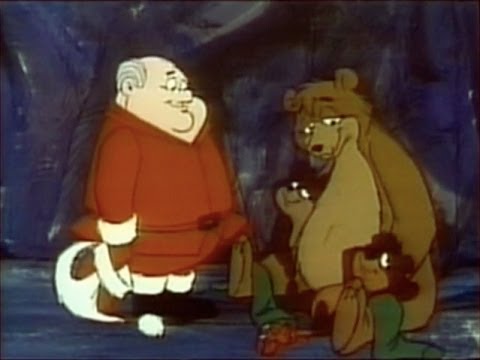
Santa and the Three Bears

Director: Tony Benedict
Writer: Tony Benedict
Producer: Tony Benedict
Cast: Three bears, Santa
Country: USA
Year of release: 1970
Reviewed from: UK VHS

Inasmuch as this site has any sort of tradition, it’s that I review something Christmassy at Christmas time. This tatty old VHS had been sitting on the shelf for about 13 or 14 months, I believe, before I finally persuaded young TF, just turned three, to sit down and watch it on Christmas Eve 2006. This was preceded by a couple of weeks of: “Why don’t we watch Santa and the Three Bears?” “I don’t like it.” “How can you not like it if you’ve never watched it?” “I don’t like it.” And it was followed by TF insisting on watching the video again, later that same Christmas Eve, before he went to bed. And again on Boxing Day.

Kids, eh?

This old VHS tape is so astoundingly cheap that it doesn’t have a company name or catalogue number anywhere on the sleeve or the tape itself. On the other hand, the pictures front and back do actually match the characters on screen, which is something.

The first thing to stress is that these three bears, despite being referred to in the title as “the Three Bears” are not in fact those three bears, ie. The Three Bears. They’re just... three bears. There’s a mother bear named Nana and two bears cubs, Nikomi and Chinook (which I only know as a type of helicopter) and they live in Yellowstone National Park. (Although I have discovered that an identically titled but unrelated children’s book exists which does feature The Three Bears.)

Winter is coming so it’s time to hibernate but the two cubs are excited by the concept of Christmas, which they have heard about from a balding, rotund park ranger known only as Mr Ranger. As Nana settles down, they sneak off to Mr Ranger’s cabin, where he has put up a tree and a bunch of decorations, and he explains to them all about what Christmas involves: Santa and the elves and the reindeer and what have you (and to be fair, a brief mention of the Nativity). Then he returns them to their cave.

But the cubs are very excited and determined to wait up and see Santa. The kindly Mr Ranger, not wanting to disappoint them, puts on a beard and a Santa Claus costume and sets off with a sack of bear-suitable toys - including, somewhat oddly perhaps, teddy bears - but the weather closes in and he cannot make his way through the snow blizzard so he takes shelter for the night in a bus stop.

With no sign of Saint Nick, Nana eventually admits to her two disappointed young’uns that in fact ‘Father Christmas’ is just the Park Ranger and that’s why he’s not coming this year. So when a rotund figure appears silhouetted in the cave entrance and leaves a couple of stockings of toys, the cubs think it’s just Mr Ranger. Except of course that shortly afterwards, the blizzard having abated, Mr Ranger appears with two more stockings.

What? But then... who...? (“Ho ho ho!”) You get the picture.

Now, this cheapo-cheapo VHS release says the films run approximately 30 minutes but in fact it’s about 45 minutes or so. Santa doesn’t actually appear until more than 20 minutes in, and then only briefly in Mr Ranger’s illustrated explanation, although he does, as I say reappear at the end. Moreover, for the first ten minutes there are no bears either, as Mr Ranger potters around Yellowstone Park, accompanied by one of several instantly forgettable, sub-Snow White, choral songs, checking on all the animals. TF and I were looking at the box, wondering if we had the right tape, especially as the title card is missing from the opening credits.

And this really is a terrible copy. The sound is muffled beyond belief, making the dialogue and especially the singing borderline unintelligible. The picture quality is poor but then the animation is strictly Hanna-Barbera level so there’s not a lot of detail lost. Interestingly, there are some attempts at imaginative direction, including some POV shots when Mr Ranger looks down at the two bear cubs at his feet and some jazzy sequences when images appear and disappear in coloured rectangles of different sizes and dimensions.

Speaking of different sizes, it turns out that this anonymous looking little movie has quite a history. It was originally released theatrically in the USA in 1970 as a 76-minute feature film, the extra time being taken up with a lengthy live-action wrap-around in which another park ranger introduces his three grandchildren to the story of 'Santa and the Three Bears'. So that means that the film has a park ranger tell some kids about a park ranger who tells some bear cubs about Christmas. The whole sequence with Santa and the elves is an explanation inside an explanation. Wheels within wheels and fires within fires. Both the feature version and this animation-only version, which apparently ran for years on USA Network, are currently available on DVD.

There are some big names attached to this obscurity. Mr Ranger (and possibly Santa too) is voiced by Hal Smith who started out in westerns in the 1940s and moved into animation voices in the 1960s. He did a lot of additional voices for The Flintstones and other Hanna-Barbera shows, played Otis Campbell in The Andy Griffith Show and was the voice of Owl in Winnie the Pooh films and TV shows for Disney. Santa seems to have been a regular gig for him as he donned the metaphorical beard in Casper’s First Christmas (1979), Yogi’s First Christmas (1980), The Town That Santa Forgot (1993) and an episode of a Disney cartoon I’ve never heard of called Bonkers. Nana Bear is Wilma Flintstone herself, the legendary Jean Vander Pyl.

Writer/director/producer Tony Benedict was a frequent animation writer in the 1960s and 1970s, racking up credits on The Flintstones, The Jetsons (he created the character of Astro the dog), The Pink Panther Show, The Yogi Bear Show and various Warner Brothers holiday specials. He started out in uniform, drawing cartoons for a military newspaper, then sent some of his work to Disney where he was taken on as an apprentice animator on Sleeping Beauty and 101 Dalmatians. After three years he transferred to UPA to work on Mr Magoo then in 1969 he went to H-B, adding scriptwriting to his work as an animator. And he’s still going; some of this info came from a newspaper interview he did only last month.
Bizarrely, the live-action wrap-arounds (of which I have only seen frame grabs on various fansites) were directed by Barry Mahon, better known for nudie nonsense and exploitation fare such as Fanny Hill Meets Lady Chatterly, Nudes on Tiger Reef and The Beast That Killed Women. Shortly before he retired from film-making in the early 1970s he did turn to kiddie fare, directing versions of Thumbelina, The Wonderful Land of Oz and Jack and the Beanstalk. He also made another Crimbo obscurity, Santa and the Ice Cream Bunny. Mahon and Benedict reunited the following year on a truly bizarre Christmas special, Santa’s Christmas Elf (Named Calvin), which consists entirely of still photos of posed puppets. Mahon produced and directed it while Benedict designed and built the characters for what was probably not an homage to La Jetee but, you know, it would be fun if it was.

Santa and the Three Bears is pleasant enough, with a limited number of likeable characters and a simple message that is positive and heart-warming without being cloying or overly sentimental. That it has instantly become TF Simpson’s favourite film - apparently displacing Finding Nemo - suggests that there is something magic in it that a three-year-old can determine, even through the dreadful picture and sound quality of this tape.

But it does present a slight moral dilemma in that the central story features Nana Bear telling Chinook and Nikomi that (gulp) Santa doesn’t really exist and it’s just father-figure Mr Ranger in a costume. The fact that Santa is shown to actually exist after all doesn’t detract from the problem which I’m sure you can see: it raises doubts about the reality of Father Christmas, thus making it perhaps suitable for slightly older children but of dubious recommendation for three-year-olds (unless the dialogue is hidden behind a muffled sound, as here fortunately).

You see, I’ve been thinking about this and the fact that, like most people, I don’t recall ever actually believing in Santa Claus. I must have done - and TF certainly does, bless him - but it’s not ‘belief’ in the sense that we normally use. It’s not a conscious decision or an evaluation of the available evidence. Adults believe in flying saucers or ghosts or God because they consider what they have been told - about evidence or faith or whatever - and on balance they deem the existence of such a thing likely or even certain. But even the most devout believer is aware that there are those who don’t believe, that belief is a choice.

Small children don’t ‘believe’ in Santa Claus, they simply accept that he exists, and that he has flying reindeer and brings presents and is generally magical. They believe in him the same way that they believe in policemen or bicycles: it’s part of their model of the world around them. They don’t doubt, they accept on the available evidence, and ‘Mummy and Daddy told me’ is pretty strong evidence for a three-year-old mind. So when TF discovers or realises - as he must do one distant day - that Santa is just a fiction, it won’t destroy his belief, it will simply cause him to re-evaluate his model of the world around him. At least I hope so.

In the meantime, I might need to invest in a DVD of Santa and the Three Bears before next year because this tape is starting to wear out.

MJS rating: B
TFS rating: A++
Review originally posted 23rd December 2006

Tuesday, 19 May 2015

Spooky Bats and Scaredy Cats

Director: Nathan Smith
Writers: Nathan Smith, Bryan Allen
Producer: Clifford A Miles
Cast: Ken Sansom, R Chase O’Neil, C Brock Holman
Country: USA
Year of release: 2008
Reviewed from: UK DVD (Porchlight)

Who doesn’t love a good monsterfest, a film that gathers together a whole bunch of classic monsters in one story? This specific subgenre can trace its origins back to the final three films in Universal’s Frankenstein series in the 1940s. House of Frankenstein went one better on the previous Frankenstein Meets the Wolf Man by tossing Dracula into the mix. This formula was repeated in House of Dracula then spoofed in Abbott and Costello Meet Frankenstein which also threw a Vincent Price-voiced Invisible Man in as a final gag.

The other two well-known monsterfests are The Munsters (in all its many variants) and Fred Dekker’s wonderful The Monster Squad. Van Helsing falls into the category too as does a 1990s TV mini-series which appropriated the House of Frankenstein title. And then there are the animated monsterfests. Series such as The Drak Pack, The Groovy Ghoulies and Gravedale High took advantage of the freedom which animation offered, where a monster character costs no more than a human one. But probably the two best animated monsterfests are the brace that were produced by the famous Rankin-Bass Studio: the stop-motion Mad Monster Party? (with its completely inexplicable titular question mark) and the lesser-known, cel-animated Mad Mad Mad Monsters.

Well, now here’s another one. Produced in 2007 and released onto DVD in time for Halloween 2008, this is a half-hour stop-motion film so packed with classic monsters that it’s difficult to find a subgenre that it doesn’t tread on. It’s not a great film in terms of script or characters but TF seems to like it and he’s the target audience much more than an old monster-geek like me.

Spooky Bats and Scaredy Cats concerns two children out trick-or-treating. Makean looks to be about seven or eight and is wearing a quite good vampire costume, which just about shoves this into the vampire subgenre because, oddly, that’s the one type of classic monster which is not included. Makean’s name is pronounced ‘Mac -KEE -an’. His sister Katie is about twelve and is dressed as a cat, complete with ears, tail, furry cuffs and ankles and a wide, 1960s-style belt that puts one unavoidably in mind of the very different (or maybe not so different) cat-suits worn by Emma Peel.

After Makean is scared by a mouse and a scarecrow in a cornfield (the mouse is wearing a puritan outfit for some reason), he and his sister walk into the village where they meet an elderly fellow called the Candleman. He has a wide-brimmed hat covered with lit candles and also a pet fish called Brunswick which floats in the air and is towing a small cart along the ground.

Here’s what you need to understand this film. Spooky Bats and Scaredy Cats is the second in a projected series of seven such tales under the banner Evergreen Holiday Classics. The first film in the series was called The Light Before Christmas and there is a trailer for both that one and this on the Spooky Bats DVD. This is why we are neither introduced to Katie and Makean (which is no real narrative problem as they’re generic kids) nor to the Candleman himself. This latter situation is a problem because the Candleman is entirely an invented character with no basis in legend or fiction so we have no references. Katie and Makean evidently know him but how, and who the jiminy is he? And, er, why does he have a pet fish that can fly? Presumably there is some background in The Light Before Christmas but the film-makers have forgotten that people who buy this disc won’t necessarily have seen the previous one (which is still available in the UK but seems to have been deleted in the States).

Also important to know is that the characters and settings are based on the work of James C Christensen, a Hugo- and Chesley-winning artist whose speciality is heavily-clothed figures in whimsical settings, often with a spiritual or religious element. And whose trademark is a fish, swimming through the air. I didn’t know any of this when I watched the DVD.

The Candleman asks the two children if they will deliver some invitations to his Halloween party, to which they agree, hoping to collect some candy along the way. And this is where all the monsters come in...

Among the recipients of invitations are a mummy (inside an Egyptian tomb), a werewolf, a plant-creature who is to all intents and purposes Swamp Thing, a zombie (we only see the cadaverous arm reaching from the grave), a family of ghosts, some giant carnivorous plants, the Grim Reaper, an old witch and finally ‘Frank’ - and we can all guess who that turns out to be. Along the way, the sceptical Katie who doesn’t believe in ‘spooks’ (the M-word is never used) comes round to her more paranoid brother’s way of thinking. The quest ends at the home of the ‘fire-headed pumpkin demon’ (or somesuch) with a selection of the ghouls advancing towards the two terrified children.

But... it turns out that this is actually the Candleman’s home and the ghouls are of course his friends, come for the party. So is the message that we should conquer our fears or that there is nothing to be afraid of? Is the message that spooks and monsters are real but friendly or that they’re not real? This isn’t the first animated special I’ve come across where, despite a general moral tone, the actual moral itself is rather fuzzy.

There are some very nice touches. In handing the invitation to the mummy, Katie accidentally rips his arm off and he picks this up to wave bye-bye (or rather “Bmm-bmm” - there’s a lovely gag at the end where Frankenstein complains to the werewolf that he can’t understand a word that the mummy says). Also, the scene with the ghosts has Katie repeatedly trying to hand over the invitation only for it to fall through the recipient's non-corporeal hand.

Where the film falls down is in its own uncertainty about whether it’s set in the real world or some magical fairyland. Katie and Makean’s costumes suggest that they are contemporary characters, especially as they collect their treats in plastic, pumpkin-shaped baskets. Their speech is contemporary too, as is the older sibling’s dismissive attitude towards her brother’s childish belief in the supernatural which is finally dispelled when the witch lends them two flying broomsticks to carry them to ‘Frank’s place’.

But the village that we see is straight out of the Brothers Grimm via Hollywood, a mittel-European-influenced, 18th century hamlet. There is even a brief glimpse of the lower half of a giant, also out trick-or-treating. When the Candleman (who is very obviously a magical character, even before we notice his fish) sends the kids off on their errand, he summons an old-fashioned carriage without horses or driver, of which Katie blithely comments, “This must be one of those new steam-powered carriages.”

You see the problem? The film’s core is the acceptance by modern, cynical Katie that magic and the supernatural are real, yet she and her brother evidently already live in a quasi-historical world riven with magic and fantasy. This robs the film of its essential dichotomy. Not that five-year-olds like TF are going to mind.

The animation is very good although there is something about the alternate heads of the Candleman figure which means that his mouth movements don’t exactly match his words. I don’t know if this is a problem with the bar-sheeting (see, I know my technical animation terms!) or whether some of the dialogue was changed after the animation had been done. Nevertheless, the designs, the sets, the costumes are all impressive and where digital effects are used they are effectively integrated into the story, such as creating the mist-covered swamp.

Another five Evergreen Holiday Classics are planned: A Cozy Valentine, Shamrocks Leprechauns and Shillelaghs (for St Patrick’s Day), Independence - What a Day! and films based around Easter and Thanksgiving. These are all summarised on the series’ website although it’s notable that the synopsis of the Halloween film is different to what we see here. In November 2008, just after Spooky Bats was released on DVD, The Light Before Christmas opened theatrically in some IMAX theatres.

The company behind the Evergreen Holiday Classics is Tandem Motion Picture Studios, a Utah-based animation studio run by brothers Chris and Nathan Smith. Nathan Smith directed Spooky Bats and wrote it in collaboration with Bryan Allen although curiously Chris Smith doesn’t seem to be credited anywhere. Allen, Smith, producer Clifford A Miles, executive producer Michael R Todd and James C Christensen share the ‘story’ credit and Christensen also gets ‘based upon characters created by’ which seems fair enough. I’m guessing that Todd uses his middle initial to differentiate himself from the Barnsley-born animator who was technical director on Ratatouille, The Incredibles and Wall-E, although I suppose that they could be the same bloke as his bio says he has also working on Disney’s aborted Snow Queen feature (as well as Shark Tale, Reign of Fire and Spider-Man).

Cliff Miles, who also handled voice direction, has worked on a wide range of other projects include the world’s largest dinosaur museum (very rich in fossils, Utah). And in that vein it looks like Tandem’s next film isn’t another Candleman short but a feature called Pangea which will be the first film ever to mix dinosaurs with elves! It’s all about a ‘water elf’ called Nemonie who teams up with a dinosaur called Gobi to search for treasure on the prehistoric supercontinent (Nemonie is also the title used on a trailer on the Tandem Studios website).

Argentinean production designer Nebel Luccion was responsible for translating Christensen’s distinctive style into 3D with the assistance of wardrobe designer Patricia Walton. Visual effects supervisor Mathew Judd has worked on the likes of Lake Placid, Deep Blue Sea, The World is Not Enough, Minority Report and Mission: Impossible II as well as a large number of games and some military training simulation programmes.

Leading the voice cast is Ken Sansom as the Candleman. He has been the voice of Rabbit in Winnie the Pooh films and TV series since the late 1980s; his other credits include Herbie Rides Again, 1983 TV pilot The Invisible Woman and the voice of Hound in the Transformers TV series. R Chase O’Neil (Katie) was born in March 1993 (not October as the IMDB has it) and started her career in 2000 with a small part in a TV movie based on the JonBenet Ramsey case, progressing to war drama Saints and Soldiers and ice skating film Go Figure. C Brock Holman (Makean) was in a 2003 production called A Pioneer Miracle which was directed by cinematographer TC Christensen (I don’t know if he’s related to James C).

The werewolf, the witch and Frankenstein are voiced respectively by Joel Bishop (who was also in Saints and Soldiers and that JonBenet telemovie as well as Stalking Santa and Cyber Sleuths), Mary Parker Williams (Don’t Look Under the Bed, Firestarter 2) and Christopher Miller (who could be one of several actors of that name).

The other element of note is the music by Lisle Moore, who has previously scored trailers such as The Missing, Haunted Mansion and Cold Mountain as well as various Playstation games. Specifically, there is a song midway through the film as Katie and Makean fly on the broomsticks which is an utterly shameless rip-off of The Nightmare Before Christmas (complete with “Halloween! Halloween!” chorus). The aping of Danny Elfman’s music is so blatant that it frankly spoils and cheapens the production as a whole, which is a shame.

One final point to note is the running time which according to the DVD sleeve is 65 minutes. In fact, Spooky Bats and Scaredy Cats runs only half an hour, the rest being padded out with the two trailers, a short (but surprisingly good) look behind the scenes of the production... and half a dozen public domain Casper the Friendly Ghost cartoons. That’s a bit naughty, although we should blame the distributor, not the producers.

While it has its faults, mainly in the story department, Spooky Bats and Scaredy Cats is a nicely produced little special which has enough fun for its target audience and enough monsters gathered in one place to get adult fans excited.

MJS rating: B+
Review originally posted 7th December 2008.

Saturday, 4 October 2014

Ultraman II

Director: Sidney L Caplan
Writers: Sidney L Caplan, Tom Weiner, Steve Kramer, Wally Soul
Producers: Noboru Tsuburaya, Sidney L Caplan
Cast: Barbara Goodson, Steve Kramer, Joe Perry
Country: Japan/USA
Year of release: 1983
Reviewed from: UK VHS

Isn’t it bloody typical? For years I search the video shops of this land for Ultraman tapes (or indeed any other Japanese superheroes). All I ever find is multiple copies of Ultraman: The Alien Invasion, a feature-length re-edit of the first few episodes of the Australian series Ultraman: Towards the Future. I’m not even sure that the second volume of that was released in the UK; I assume it must have been but I’ve never seen it.

So, in the summer of 2005 when I was writing about the character’s history in a feature on Ultraman: The Next for Neo magazine, I stated with some confidence that the Aussie series is the only one ever released in the UK. And while that issue was on sale - while it was on sale! - I came across this 1983 tape of the 1979 animated version, which was simply called The Ultraman. Bloody typical.

The on-screen title, clearly generated after the fact, is Ultraman 2: The Further Adventures of Ultraman which is all very odd because of the four episodes which make up this faux feature, the first is the series’ opener about the creation of 'the' Ultraman himself. So what, if anything, was in the first animated Ultraman ‘film’, if such a beast exists?

Okay, here’s the set-up. In response to some weird writing that appears in the sky, the Earth Defence Force (sometimes called the Earth Defence Organisation) establishes ‘Emergency Science and Defence Squads’ in every ‘zone’ on Earth. Captain Adam (sometimes called Captain Adams) is put in charge of the Eastern Zone ESDS. He agrees to the job provided that he can have at his disposal a super-amazing aircraft (and occasional submarine) called the Super Star (sometimes called the SS13 - as you can, see there’s not much consistency here).

He gathers around him a team of four people: fat comedy sidekick Marconi, tall engineering genius Glen (who is not mentioned by name until the second episode), beautiful Lieutenant Ann Johnson and enigmatic Commander Harris who has been serving aboard Earth Space Station 3. Piloting his one-man spaceship back to Earth, Harris goes through the usual Ultraman scenario: red light blah blah blah lose control blah blah blah giant figure blah blah blah. Ultraman (for it is he) tells Harris that he must go to Earth, using Harris’ body: “The survival of the whole universe, including Earth, depends on it.”

The story proper starts off with an iceberg that crosses the equator without melting and which eventually cracks open to reveal a giant bipedal dinosaur thing which somehow, shortly afterwards, turns into four identical giant bipedal dinosaur things. And let me tell you folks, with their little arms akimbo and mincing gait these are the campest monsters you ever saw. Nevertheless, the crew of the SS13 - which can launch smaller aircraft from itself - succeed in keeping a straight face long enough to defeat the beasties with the assistance of a mysterious giant stranger dressed in red and silver. (Harris has a green star which he places on his forehead to become Ultraman for a limited time. Of course, as is traditional, none of the others have a clue that their giant benefactor is actually their colleague.)

And so, 22 minutes in, we leap to a different episode which takes place just before Ann’s birthday. Marconi and Glen both have crushes on her, of course, but she is most interested in Harris. In this episode a tornado attacks a power station which derives energy from a giant whirlpool. Investigations reveal that at the centre of the tornado is a monster that looks like a five-tentacled heart. After some more flying around, Ultraman appears and gives it a good hiding.

The third story starts with the team enjoying a bit of a holiday but they are swiftly called back into service to investigate a giant red cloud. Glen manages to capture some of it in a bottle, takes it back to the lab and discovers that it coalesces into a living thing when it gets wet. Adams tells him this is very useful information but it’s not really because it has already started raining and the cloud has become a giant pink yeti. The SS13 battles the big beastie until Ultraman appears, dispels the rain clouds and causes the monster to revert to cloud form.

Probably the best of the four stories is the final one, not least because it has a vaguely decent monster, a sort of giant crocodile thing. We start with Marconi destroying this threat by himself using a hand-held rocket launcher at close range - which everyone agrees is very impressive. We then see something that must happen after most kaiju eiga but rarely gets shown: somebody clearing away the bloody great reptilian corpse. The guy supervising the crane and lorry involved turns out to be the Chief of the Space Biology Group who wants the body to study. Oh, and it’s not quite dead (sorry, Marconi). At the same time, a young boy discovers a baby version of the monster and adopts it as a secret pet, despite local warnings that the authorities are looking for a strange creature which could be dangerous. Of course, ‘Baby’ grows at an alarming rate and eventually becomes a full-grown crocodile-thing. Both plots in this episode show some promise and it’s just a shame that there is no apparent connection between them.

Oh, and there’s one really curious thing which I haven’t yet mentioned: the obligatory robot sidekick. In this case it’s a squat, crinkly, alien-looking blob named PDQ who carries a very tiny grey monkey on his shoulder. He makes no significant contribution to any of the stories, is absolutely never explained (nor is his monkey) and really only serves to raise the weirdness quotient of this otherwise distinctly lacklustre cartoon.

Even if you enjoy anime (and as I have observed elsewhere, I can’t stand the stuff) you have to be pretty tolerant to sit through Ultraman II. Stuff like Battle of the Planets may have been fun when we were kids but it doesn’t stand up to the scrutiny of 21st century eyes and The Ultraman isn’t even up to Battle of the Planets standards. Frankly it’s barely up to Thunderbirds 2086 standards.

The characters are one-dimensional, the plots arbitrary - not nonsensical enough to be entertaining, just boring - and the animation is as simplistic and basic as the scripts. The music is derivative and obvious, the monsters for the most part are bollocks and Ultraman is hardly in it at all. This is definitely one for completists. I watched the tape once then gave it away for someone else to ‘enjoy.’

The Ultraman/Ultraman II has no connection with the rest of Ultraman continuity, kicking off with an origin story in a world where the Ultra Brothers are completely unknown (much like Ultraman: The Next, but there the similarities end!). In Japan this version of the character was apparently known as Ultraman Jonias or Ultraman Joe and featured in some stage shows as well as the cartoon. It took me a while to track down confirmation but apparently there was a previous western release of animated episodes which was called The Adventures of Ultraman. However, as this ‘sequel’ kicks off with episode one, it’s difficult to see what could have been on the first volume.

Despite the very obvious breaks between episodes, it’s clear from the linking narration that it was added after the shows were combined into this ersatz feature. The ‘film’ finishes with a series of still images which presumably were designed to play under the closing credits of the episodes if the show was broadcast. There was evidently a Region 1 DVD release of this a while back but that is now deleted.

The voice artists are Barbara Goodson (who was the voice of Rita Repulsa in the early series of Mighty Morphin Power Rangers and both Power Rangers films, and also contributed voices to Akira, Vampire Hunter D, Robotech, Digimon, Cowboy Bebop and stacks of other interchangeable anime), Steve Kramer (who wrote the English script for Zeram), Tom Weiner (also credited as narrator) and Joe Perry. Director/writer/producer Sidney L Caplan apparently also produced Bert I Gordon’s Necromancy and Reginald Le Borg’s So Evil, My Sister. The film is presented as ‘produced by Tsuburaya Production Company Ltd and Associates Entertainment International’; Noboru Tsuburaya’s credit as producer is the only Japanese name to be seen.

MJS rating: C-

[Addendum: Would you Adam and Eve it? Less than a month later, I found a 1987 reissue of this film so it was actually released twice in this country. - MJS]

Thursday, 17 April 2014

The Three Knights

Director: Mark Baker
Writer: Mark Baker
Producer: Mark Baker
Country: UK
Year of release: 1982
Reviewed from: theatrical screening

Any thought that this might be a simple cartoon for little kids is rapidly despatched when the heroic trio of the title ride to the rescue of a young woman being burned at the stake as a witch. First, she is actually being burned at the stake, with flames dancing around her, and second, the two unidentified inidividuals performing the witch-burning are swiftly decapitated and their heads stuck on sharpened wooden sticks.

A terrific piece of cel animation running just shy of a quarter of an hour, The Three Knights is a wordless medieval romp following the adventures of a tall, skinny knight (on a tall skinny horse), a fat knight (on a fat horse) and a little knight (on a little horse). After rescuing the young woman, they ride off and so miss seeing her transmogrify into a green-faced old hag in a black pointy hat.

Over the course of the next ten minutes or so they slay a giant, meet Rapunzel and, in a hilarious sight gag, re-stand a leaning building. Each time, as they ride off, they are oblivious to the consequences and they are unaware of the gradually expanding group of disgruntled folk pursuing them in a manner reminiscent of old Benny Hill Shows (but not speeded up). In the climax, the witch turns herself into a three-headed dragon - not overly dissimilar to Ghidorah - to battle the knights.

Clean of line and perfect of timing, The Three Knights is a mini-masterpiece. It was produced as a student project at the West Surrey College of Art and Design (which also brought us two-thirds of the Nightmares quasi-anthology) and a print is currently available from the BFI. Animation legend Bob Godfrey is generally credited as co-writer but in fact he only receives a non-specific ‘thank you’ credit.

Any opportunity to see this film should be grasped by all fans of British animation.

MJS rating: A+

Friday, 28 March 2014

Po Sledam Bremenskih Muzykantov

Writer: Vasili Livanov
Cast: Oleg Anofriyev, Muslim Magomayev, Anatoli Gorokhov
Country: USSR
Year of release: 1973
Reviewed from: Russian VHS

This direct sequel to the 1969 classic Bremenskie Muzikanty demonstrates a clear progression, not only in the quality of the animation and design but also in the infiltration of western culture into the Soviet Union (as was).

In this story, the King decides that he wants his daughter back from that vagabond Troubadour who is carrying her around the countryside with his four animal friends, and to this end he employs the services of a weaselly private detective. Clad in a garish check suit and driving a rather eccentric old car, this character reminded me of the Sherlock Holmes lampoon Coke Ennyday in The Mystery of the Leaping Fish - but surely that must be coincidence.

In a fairly simplistic storyline, the detective manages to snatch the King's daughter and takes her back to the city, chased by the animals and the Troubadour in a scene which could almost come out of Wacky Races. Back at the city, the Troubadour rescues the girl while the animals distract everyone with a swinging pop concert in the town square. That's about it, the whole thing enlivened with a bit more knockabout comedy than in the first film - the bandits make a brief reappearance - and of course all set to a bunch of folk/pop songs by Genadi Gladkov and Yuri Entin.

What is most interesting here is that in the intervening four years (some sources wrongly list this sequel as 1971) the influence of western pop and pop culture has clearly increased. The musicians in the first film looked like a Russian folk band accompanied by a ballad-singer in bell-bottoms. Here they have been transformed, not too much, but enough to make them recognisably a pop band. I don't know whether Yellow Submarine was ever shown in the Soviet Union - maybe somebody just saw some stills from that film - but the scene of the four animals performing in the town square shows a definite influence in my view.

I haven't been able to find out the name of the director, only that it was not Inessa Kovalevskaya who directed Bremenskie Muzikanty. The film runs about 20 minutes, the title means (and is sometimes cited as) On the Trail of the Musicians of Bremen and it is available on the same tape/DVD/VCD as the first film.

MJS rating: B+

Pinocchio and the Emperor of the Night

Director: Hal Sutherland
Writer: Robby London, Barry O’Brien, Dennis O’Flaherty
Producer: Lou Scheimer
Cast: Scott Grimes, Tom Bosley, Jonathan Harris
Country: USA
Year of release: 1987
Reviewed from: UK VHS


One always approaches with trepidation an old non-Disney animated feature, especially when it is an original sequel to a classic tale already filmed to great acclaim by the House of Mouse. Anyone who has ever suffered through Happily Ever After will know how bad such things can be. Which is why I was pleasantly surprised by this 1987 picture which features an engaging story, likeable characters, some genuine tension and horror, reasonable songs and some frankly terrific animation.

The story kicks off with Pinocchio (Scott Grimes: Critters I and II, Band of Brothers, American Dad) celebrating his first birthday - that is, the first anniversary of his becoming a real boy - when he is visited by his fairy godmother, referred to as such or as ‘the Good Fairy’ but never ‘the Blue Fairy’, despite her hue (she is voiced by singer Rickie Lee Jones). She reminds him that freedom, especially freedom of choice, is the most important thing, which I suppose ties in with the idea of not being somebody’s puppet. Geppetto (Happy Days star Tom Bosley, who played the same character in the 1985 Italian animated series The Adventures of Pinocchio and returned to the role in 2005 for the computer-animated prequel Geppetto’s Secret) has manufactured a beautiful jewel box for the local mayor, for a price of ten gold pieces, and gives his son the responsibility of delivering it.

But along the way, Pinocchio encounters con-artist ‘Professor Scalawag’ (Ed Asner, whose innumerable other voice credits include Gargoyles, Recess, Freakazoid!, Fish Police, Spider-Man, Olive the Other Reindeer and assorted Star Wars video games), a smooth-talking racoon with a monkey sidekick of indeterminate Middle Eastern origin named Igor (ubiquitous voice legend Frank Welker). These two effectively fulfil the fox/cat roles from the original story - unscrupulous and untrustworthy but not actually evil - and they persuade the boy to swap the jewel box for a large, fake ruby. Back home, Pinocchio is ashamed to have failed his father and resolves to avoid any repetition by running away.

He makes his way to a nearby travelling carnival which we saw, in a prologue, disembarking from a spooky-looking ship and setting itself up using dark magic. There he sees a pretty blonde puppet named Twinkle (Lana Beeson, whose recorded credits are limited to this film, the original All Dogs Go to Heaven, a He-Man/She-Ra Christmas Special and a 1985 TV version of Alice in Wonderland). Staying to the end of the show he is approached by the looming puppet master, Puppetino (William Windom: Escape from the Planet of the Apes, Children of the Corn IV), who somehow magically transforms Pinocchio back into a puppet and adds him to his collection.

Although Pinocchio escapes from Puppetino, he is forced to return, accompanied by Scalawag and Igor, to retrieve the jewel box which the two con-merchants had sold to the carnival proprietor. The carnival having upped sticks, they travel down the river in a small paddle-steamer and are eventually swallowed by the carnival’s dark steamer in a scene which evokes at one and the same time the tanker from Thunderball and the whale from the original Carlo Collodi story.

Inside, the puppet-turned-boy is introduced to ‘the land where dreams come true’, a place where children have unlimited toys and, in a particularly disturbing sequence, unlimited booze (it is never explicitly stated that the drink is alcoholic, but it leaves Pinocchio’s vision blurred and distorted). After living out his dream as a star (Scalawag and Igor drag up as dancing girls in an effort to rescue their friend), Pinocchio comes face to face with the towering Emperor of the Night, a huge, four-armed demon voiced by - who else? - James Earl Jones, who is apparently the Good Fairy’s nemesis. Every time someone gives up their freedom, the Good Fairy grows a little weaker and the Emperor grows a little stronger. He has, it turns out, captured Geppetto and shrunk him to bug size.

As it happens, a couple of real bugs are on Pinocchio’s trail in a subplot that fits neatly into the main one. Willikers (voiced by Mayberry’s finest, Don Knotts, who more recently added his vocal talents to Chicken Little) is a ‘glow-bug’, carved from wood by Pinocchio and given life by the Good Fairy as a birthday present to the boy. He is the equivalent of, maybe even a lampoon of, Jiminy Cricket who was of course a Disney invention. Willikers (who takes his name from Pinocchio’s expression of surprise, “Gee willikers!”) has teamed up with Lieutenant Grumblebee, a bluff-talking RAF-type bee, complete with flying helmet, handlebar moustache and devotion to his duties as a member of the ‘Royal Air Bugs’. Grumblebee is voiced, with impeccable English accent, by Dr Smith himself, Jonathan Harris.

The characters - good, bad and uncertain - all come together at the climax when the Emperor is defeated by Pinocchio’s realisation that he has the freedom to choose, leading to an exciting escape from the ship which goes into a meltdown remarkably similar to the one that Godzilla experienced a few years later! I’m sure it will come as no surprise to learn that it all ends with everyone living happily ever after, including a normal-sized Geppetto and both Pinocchio and Twinkle in human form.

You just can’t review animated features without making a comparison to Disney, especially when the story is a nominal sequel, but this Filmation offering stands up on its own very well. The character design isn’t quite as polished as one might hope for and some of the comedy is slapstick which is funny but could be timed better or more integrated into the main plot. But there are a lot of animated features far, far worse than Pinocchio and the Emperor of the Night. This is a children’s film where the funny bits are actually quite funny and the scary bits - and all good children’s films should have scary bits - are actually pretty scary. The Emperor in particular is a magnificent demon whose complexity suggests that he may actually have been partly rotoscoped (especially as there is a credit for a ‘motion control camera supervisor’).

The voice direction is fine, the background paintings are wonderful and there are some terrific fantasy sequences, notably Pinocchio’s big song and dance number when he believes he has become a star, which demonstrate a love of the more abstract and impressionist possibilities of animation. And all done with cels, mind you, no computers here (Basil the Great Mouse Detective, the first animated feature to use computers, was released the previous year).

Director Hal Sutherland and producer Lou Scheimer must have been on the staff at Filmation as they made episodes of many of the company’s TV series, including the animated versions of Star Trek and My Favorite Martian; they were also the team behind the 1974 animated feature Journey Back to Oz. Associate producer and art director John Grusd later worked on shows such as Bravestarr and Sonic the Hedgehog; the other two associate producers are screenwriter Robby London and Scheimer’s daughter Erika who was music supervisor on both this and Happily Ever After (and provided the voice of Marcia in the Brady Bunch cartoon spin-off The Brady Kids!).

London also co-wrote Happily Ever After but mainly works as a producer, his credits including the 1997 animated feature version of A Christmas Carol and a series that no-one was waiting for: Sherlock Holmes in the 22nd Century. Of his two colleagues, Barry O’Brien was a veteran of Happy Days so presumably already knew Tom Bosley, while Dennis O’Flaherty’s credits include Slimer and the Real Ghostbusters and Jayce and the Wheeled Warriors. Tom Tataranowicz, director of Bravestarr: The Legend, The Magic Paintbrush and urban festive special The Night B4 Christmas, is credited as ‘storyboard supervisor’ while Bruce Heller (All Dogs Go to Heaven, Atlantis: The Lost Empire, Treasure Planet) is ‘special effects animation supervisor.’

I really rather enjoyed this largely forgotten movie. The 1989 British video release was packaged in a special box with a raised, three-dimensional image of the main characters and tiny lights which illuminated when a ‘magic jewel’ was pressed. That no longer works on the copy I found in a charity shop and I suspect that finding one that was intact and working would be nigh on impossible today. Fortunately, the film was released on budget-price R2 disc only a few weeks after I saw it.

The Inaccurate Movie Database (and various sites which take their information from it) claims that Liza Minelli provides an unspecified voice for this film, which is pretty ludicrous even by the standards of the IMDB. I can only assume that this comes from somebody misreading the music credits: the song ‘Neon Cabaret’ is written and performed by Brian Banks and Anthony Marinelli. (Another song, ‘You’re a Star’, is by Kid Creole and the Coconuts.)

MJS rating: B+

Thursday, 27 March 2014

Ragnarok

Writer: Alan Moore
Cast: Jon Glover, David Tate, Norma Ronald
Country: UK
Year of release: 1983
Reviewed from: UK video (Nutland)

Okay, sports fans. How many films can you name based on stories by Alan Moore? Well, there’s V for Vendetta and From Hell and The League of Explain to Me Again Why I’m Watching This Crap. And if you’re reading this in 2008 or later you can probably add Watchmen to that list.

What has been entirely forgotten is that Alan Moore’s first screen credit was produced as far back as 1982. It’s 70 minutes long (though the packaging claims “approximately 90 minutes”), it’s British and it’s a (just about) animated sci-fi adventure with ray guns, spaceships, aliens and a talking dinosaur. It’s called Ragnarok and it’s extraordinary.

Calling this production ‘animated’ is stretching the definition of the term because it is told through a series of still drawings, rostrum-filmed in varying degrees of close-up and edited together to tell a story. There is the occasional addition of a death-ray, an explosion or a flashing light but in the animation stakes this falls somewhere between Bleep and Booster and Mr Ben.

Ragnarok himself is a sort of space-roving law enforcement character or ‘Regulator’ who seems to be judge, jury and executioner, somewhat in the manner of Judge Dredd. He has a spaceship called the Sunscreamer, equipped with a computer named VOICE, represented by a digitised image of a woman with long hair. Our hero has a variety of large guns and grenades as well as body armour and a helmet.

His companion is Smith, a flying (well, floating) blue alien who looks like a cross between a manta ray and a jellyfish. Smith communicates through a sort of electrical crackle, Ragnarok speaks English, but they seem to understand each other. Smith can also fire some sort of energy ray from his pointy tail.

The ‘film’ is divided into three parts, the first running about half an hour and the others about twenty minutes apiece - and there are clear differences in the drawing style between all three. In ‘The Shattered World’, a grizzly space prospector named Weegee is collecting minerals from an asteroid, accompanied by his talking cyber-mule Sparkplug (who dreams of transferring his electronic brain into a pleasure droid - and yes, he does make ‘hee-haw’ noises). Weegee’s partner Charlie is messily gunned down in cold blood by the villainous Daddy Bonus and his two henchmen, Razormouth (who has a metal jaw) and Jittercat (who has a head like a leopard).

Alerted by VOICE, Ragnarok comes to the rescue, first killing seven of Daddy Bonus’ other henchmen elsewhere on the asteroid. Most he guns down but two of them drift off into space when Ragnarok switches off their gravity boots. The bad guy has hung Weegee upside-down without functioning life-support on his space-suit in an attempt to get him to reveal where the logbook is, which is what Bonus needs to jump the claim. Our somewhat amoral hero despatches Jittercat and Razormouth and rescues Weegee, leaving Bonus in a similar predicament. The ‘twist’ (which is given away in the sleeve blurb!) is that the asteroids are the remnants of humanity’s original home-world, which was destroyed by war a million years ago. It had a strange name like Dirt or Mud... you can see where this is going.

‘Gates of Hell’ finds the Sunscreamer answering an automatic distress call on the planet Yatan where an interdimensional gateway has gone wrong. Ragnarok and Smith find the world in ruins with only one living being - a sentient Tyrannosaurus named Arang or Hran or somesuch. Hran has a little jacket, a plumed helmet and a refined English accent - and he can throw things around and blow them up using only the power of his mind. It seems that he came through the gateway from a universe where dinosaurs didn’t die out but became the dominant species on Earth and subsequently throughout the galaxy. He has killed and destroyed everything on Yatan and now seeks no less than complete control of the universe, but first he has to get off the planet so he needs Ragnarok’s spaceship.

Guns and grenades have no effect on Hran and even Smith’s energy ray only irritates him. When our heroes think they have finally killed the beast, they race back to the Sunscreamer which takes off, blasting Hran with its engines as he tries to stop them. An epilogue shows two salvage men picking up the same distress signal from Yatan and deciding to head down to the planet, despite a recent official announcement that no-one must land there. This leads into...

...the third part ‘Sacrifice’ which is set on the Regulators’ homeworld of Kobar. We get to see other Regulators although the only ones given names are John Brittlemask (who gets killed) and a young woman named Slow Jane who serves no narrative purpose whatsoever. In charge of them all is a large, elderly woman named Mother Blood who has a grey bun, a permanent snarl and a scar across her eye which switches sides between drawings.

Hran has escaped Yatan and made his way to Kobar where, once again, no-one and nothing can stop him. Ragnarok lures the dinosaur onto a spaceship called the Void Angel with the intention of piloting it into a black hole, thereby ending the unstoppable threat of the loquacious, telekinetic tyrannosaur. But Smith stows away aboard the vessel, knocks out Ragnarok and puts him into an escape pod before piloting the ship to destruction himself.

“Why did he do that?” Ragnarok asks Mother Blood later. “He wasn’t even human.” “Perhaps he loved you,” suggests the matriarch. “Perhaps aliens can love after all.”

It should be evident from these plot synopses that the stories are extremely simplistic pulp sci-fi with no real character development or thought-provoking concepts. None of these would pass muster as a 2000AD ‘Future Shock’, that’s for sure. The final musings on platonic cross-species love seem completely out-of-place after seventy minutes of shooting first and asking questions later.

All the voices for these three adventures - which don’t have separate opening and closing title sequences - are supplied by Jon Glover, David Tate and Norma Ronald. Glover and Tate were both regulars on Week Ending and the former also did a lot of voices for Spitting Image while the latter is probably best known to sci-fi fans as Eddie the Computer in the radio and TV versions of Hitchhiker’s Guide. Ronald was in The Men from the Ministry and had a semi-regular role as Straker’s secretary in UFO.

There is no director listed and Moore is credited only with ‘stories’ not script so it’s not clear whether he wrote this or just came up with the ideas. As he was very much at the start of his career, just a jobbing writer, I suspect he wrote all the dialogue himself. The character was designed by no less a personage than Bryan Talbot, who also drew the cool image on the video sleeve. The actual illustrations on screen are by Dave Williams, Raz and Ham Khan (who I believe are Argentinean), Don Wazejewski, Mark Farmer and Mike Collins - some of whom went on to become big names in the comics field, working for DC, Marvel and of course 2000AD. The only other person credited is David King, who wrote the music (Alan Moore knows the score!).

This bizarre video - essentially an on-screen comic - was produced and released (in March 1983) by Nutland Video Ltd, a company based in Southend-on-Sea. The film has a 1982 copyright date on screen but a 1983 date on the box. The company also produced two rather more genteel videos along similar lines. The Adventures of Gumdrop was based on a series of children’s books by Val Biro about a vintage car and was narrated by Peter Hawkins. Tales of Bobby Brewster was based on a series of books by HE Todd about a young boy and his oddball adventures. There is an advert at the end of Ragnarok for these two videos along with two completely incompatible titles also released by Nutland: Seven X Dead, a retitling of the 1974 US horror film The House of Seven Corpses starring Faith Domergue and John Carradine; and a 1981 US football comedy with the jaw-droppingly awful title The Kinky Coaches and the Pom Pom Pussycats.

A hilariously bland voice - presumably the owner of Nutland Video, whoever he was - reads out the details of all four videos in a monotone that applies the same level of excitement to the phrase ‘When they play... everybody scores’ as it does to describing a vintage car. Seven X Dead is pronounced ‘Seven Times Dead’ and Faith Domergue is pronounced ‘Faith Domergoo’. Nutland’s slim catalogue of titles also included Claude Mulot’s Franco-Italian thriller The Contract, a collection of four cartoons called Zilch! (which may have been more of the rostrum drawings subgenre) and a single episode of Spectreman, the packaging for which included a free Spectreman mask!

Despite its importance as an early work by one of the world’s top comic writers, Ragnarok seems to be completely unknown. The only reference to it anywhere on the web is on Bryan Talbot’s own site where he says: “I met the Nutland Video guys when they did a presentation at a Society of Strip Illustration meeting and I proposed they do a Science Fiction animated feature. I recommended Alan Moore as writer (he was relatively unknown then and looking for work) and he created the character Ragnarok and wrote the script. I designed the character and did the cover illo and logo.”

I picked up this tape from a dealer at the Festival of Fantastic Films in 2007, proving that however dead VHS may seem there are always discoveries to be made. I wonder who owns the rights to this now. It would be an interesting item for some enterprising DVD label to release on the back of the publicity for Watchmen.

MJS rating: B+

Saturday, 22 March 2014

Otherworld

Director: Derek Hayes
Writer: Martin Lamb, Penelope Middleboe
Producer: Naomi Jones
Cast: Daniel Evans, Jenny Livesey, Matthew Rhys
Year of release: 2003
Country: Wales
Reviewed from: UK theatrical screening

British animated features are rare enough, but an entirely Welsh animated feature? There’s a novelty, isn’t it? Actually, Otherworld employs the well-worn device of a live-action framing story with our main characters becoming animated about ten minutes in (cf. The Water Babies, The Phantom Tollbooth, The Pagemaster, James and the Giant Peach...).

Dan (Daniel Evans), Rhiannon (Jenny Livesey) and Lleu (Mathew Rhys: Deathwatch, the BBC Lost World) are three Welsh teens going diving on Lleu’s 18th birthday. Below the boat they see a magical floating island and dive down to it, where they become three characters in stories from the Mabinogi, a book of Welsh legends (and the film's Welsh language title). The idea of the floating island - lush meadows just beneath the sea - is explained in an 1896 newspaper report right at the end of the film. It’s really just a way to take us into the legends, but occasional live-action reflections of the characters remind us (and them?) who they are, and their adventures reflect their real situations (especially Lleu, who discovered that morning that he was adopted).

The main story is a tad confusing, not least because we have several legends conflated together and we switch pretty much at random between our three stories. Keeping track of characters is tricky because everyone wears cloaks and beards and has Celtic names that sound like they’re choking: Lleu Llaw Gyffes, Gronw Pebr, Bendigeidfran. Efnisien... The stories themselves are already well-known in Wales, but for the rest of us there’s a bit too much to take in during this surprisingly long (about 105 minutes) animated film.

Nevertheless there is a lot to recommend this film, not least a non-patronising, adult attitude which belies its 12A certificate. There’s a fair bit of bloody violence - this being animation, it costs no more to show a sword actually going into somebody’s chest and the blood welling up in torrents as they fall. About an hour in there’s a cracking battle which pulls no punches and though the actual reason for it wasn’t clear to me - something to do with a marriage that seals a union between Wales and Ireland - the action is top notch. There is also a certain amount of female and (briefly) male nudity - again it’s not the salacious appeal but the kudos of a film that doesn’t water down a legend by being coy. The highlight is undoubtedly a sort of giant wickerwork demon which appears about half an hour in, which is absolutely terrifying.

The animation (largely done in Eastern Europe) is painted - which takes a bit of getting used to, but is much more appropriate to these sort of stories, landscapes and characters than traditional cell animation, and there is effective use of CGI in some places, such as the wicker demon. A roster of notable character actors provide voices - Philip Madoc, Rhys Ifans, Ioan Gruffudd, Paul McGann - while the visuals are well-served by former Velvet Undergrounder John Cale’s excellent score. The live-action bookends - directed by Marc Evans (My Little Eye) - have just enough narrative to show that the messages in the Mabinogi stories are still relevant.

After the crushing disappointment of the awful Christmas Carol: The Movie, Otherworld restores confidence in the ability of British animation to make good feature-length productions. (Unfortunately, two years later this film remains apparently unavailable on video or DVD anywhere...)

MJS rating: B+

Sunday, 2 March 2014

Moontrek

Director: Jean Image
Writer: France Image, Jean Image
Producer: Jean Image
Cast: Who can tell?
Country: France
Year of release: 1984
Reviewed from: UK VHS


I love animation, me. I love it all (with the sole exception, as previously mentioned, of anime, but let’s not go into that here). I love Disney and Warner Brothers and Terrytoons and Fleischer and Hanna-Barbera and Cartoon Network and Klasky-Csupo. I love American and Canadian and European and Australian animation. I love feature films and TV series and six-minute shorts and student films and weird experimental stuff. I love cartoons. Cartoons kick arse.

Except this one.

Le Secret des Selenites (to use its original title) is far and away the worst feature-length animated film that I have ever seen. It makes Bevanfield’s Beauty and the Beast look like, well, Disney’s Beauty and the Beast.

Apart from being diabolically awful in every respect, the other extraordinary thing about this film - which one cannot guess from either the French or English title - is that it is about Baron Munchausen. Who knew? I expect that most of us are familiar with Terry Gilliam’s gloriously extravagant The Adventures of Baron Munchausen and I have fond memories of catching the 1940s German Munchausen movie - a stunning film riven with alarming Nazi subtexts - on a rare TV screening many years ago. There have been a handful of other Munchausen movies, but I had no idea that there were not one but two French animated features about the notorious liar.

In 1979, Jean Image released Les Fabuleuses Aventures du Legendaire Baron de Munchausen which premiered at no less than the Moscow Film Festival; I have no information on any English language version of that. Le Secret des Selenites was the sequel, produced over 1981-82 and eventually released in February 1984.

And good sir, it’s bobbins.

In 1757 ‘famous astronomer’ and/or astrologer Sirius is convinced that there are sentient creatures living on the Moon - “according to my teacher, the eminent Dr Keppler” - who have the secret of eternal life. He is visited by his good friend Baron von Munchausen and we see a flashback as the Baron relates how he was captured by the Turks and forced to work as a beekeeper. Attacked by some particularly fierce bees, he defended himself by throwing a hatchet which flew up to the Moon. The Baron then planted a magic 'Spanish bean' which grew into a beanstalk “faster than a jolly green giant” and enabled him to retrieve his hatchet.

After assorted inanities, Sirius puts his entire personal fortune at the Baron’s disposal if he will agree to fly to the Moon and take a look. Munchausen hires a sailing ship, the Claire de Lune and rounds up his five loyal servants: Hercules (who is very strong), Hurricane (who can blow very hard), Earful (a little fellow with huge ears who can hear at great distances), Nimrod (who can run very fast) and Cavalo (the nature of whose special talent, frankly, eluded me).

The ship heads for the South Seas where it is becalmed. The captain and crew leave in a longboat for ‘Paradise Island’ while Munchausen and his servants raise up three large balloons which are sufficient to fly them to the Moon. Descending towards a large crater, they breathe oxygen from a barrel.

Landing on the Moon, Hercules fights off a giant, blue bee before the expedition is attacked by three-eyed, two-legged red dragons; fortunately they are rescued by large, flying, green seahorses. Then some blue rock monsters attack but the humans are saved by some friendly Selenites. These are roughly humanoid but have three legs and a detached, floating head which is in the shape of a crescent moon, with a pointy chin and a single, large horn in the centre of the forehead. Shown around the Moon, Munchausen is told that the Selenites eat solid honey, that they use vegetables as weapons and that they are hatched from giant nuts.

The Selenites are threatened, however, by the Green Means, little pepperpot-like aliens with concertina jaws who fly down to the Moon in small flying saucers, intent on stealing the Selenites’ ‘Talisman of Life’. The Green Means capture and threaten the Selenite’s King and Queen, who wear Inca-style head-dresses, but Munchausen and his servants successfully repel the invaders. As a reward, all six are given a talisman by the King which will grant them eternal life.

Presumably they are given a spare one too because the epilogue sees Munchausen and Sirius, with long grey beards, still alive in the far distant year of 1997, while the Baron’s five servants fly between the futuristic skyscrapers in a variety of advanced aircraft.

This is just terrible. The animation is some of the worst I have ever seen, based entirely on simple repeated loops of motion. Nothing happens that doesn’t then happen four or five times again in succession, sometimes in two alternating directions. This even extends to characters standing still - no-one stands still in this movie! Every character on screen is constantly bobbing up and down or side to side in a loop of animation - watching this is enough to drive you batty. The character design is really crude, almost like a child would do. And every character has a single angle from which they are seen: humans and Green Means in three-quarter, Selenites in profile, Selenite King and Queen full face. No-one ever turns in any direction except the opposite one.

To complement the pisspoor design and animation is an appalling script, devoid of wit, characterisation or interest. It should not be possible to destroy a character as wonderful as Baron Munchausen but Jean Image and chums have managed it. Obviously I’m working here from the uncredited American script, but given the general low quality of the film I very much doubt that the original was much better. A lot of the film is just characters saying “Aha. Um. Oh. Aha.” over and over again as they bob endlessly back and forth in an effort to pad out the flimsy storyline and stretch this to feature-length.

No voice actors are credited on the English-language but the original French version featured Jacques Ciron (Le Testament du Docteur Cordelier) as the lead Selenite with Dominique Paturel as Munchausen. Jean Image was born Imre Hadju in Hungary in 1910 and emigrated to France in 1932. Apart from the two Munchausen pictures, his other films were Jeannot l’Intrepide/Johnny the Giant Killer, Bonjour Paris, Aladdin et la Lampe Merveilleuse/Aladdin and his Magic Lamp, Joe Petit Boum-Boum/Johnny in the Valley of the Giants and Pluk, Naufrage de l’Espace/Little Orbit the Astrodog and the Screechers from Space which I want to see, just on the basis of its English title. All except the first were co-written with France Image who was presumably Mrs Hadju.

The Images also created an early 1960s cartoon series, Les Aventures de Joe, about a boy who was shrunk to the size of an insect, and a later stop-motion series, Kiri le Clown. One of Jean Image’s lesser known credits is the special effects in the 1951 British short documentary River of Steel, which was shown at Cannes.

But the most curious credit on this film is the annoyingly catchy theme song, based around the English translation of the French title. Words and music are by Haim Saban and Shuki Levy, who later went on to found Saban Entertainment and bring us, among many other things, Power Rangers!

Anyway, Moontrek is awful. I can’t imagine even the youngest, most easily pleased child being anything other than bored or frightened by this rubbish. It is a chore to watch and has no redeeming features whatsoever.

MJS rating: D
review originally posted 25th October 2005

Monday, 24 February 2014

Malice@Doll

Director: Keitaro Motonaga
Writer: Chiaki J Konaka
Year of release: 2001
Country: Japan
Reviewed from: DVD screener


In the future, in a long-abandoned entertainment complex, the robotic prostitutes (or ‘Dolls’) and various functional/administrative robots continue their now meaningless existence. Then one day, one of the Dolls - Malice - becomes human.

That’s the premise of this extraordinary and beautifully realised fable. In essence it’s a unique twist on the Pinocchio story, with robots becoming human against their wishes (initially). Malice Doll is sent by the head robot, Joe Admin, to be repaired when fluid starts leaking from her eye. But something bizarre happens and when Malice regains consciousness she is, well, conscious. She looks different (though still beautiful), her body is soft and pliant, she can feel pain - both physical and emotional. She has become human.

The other Dolls initially distrust her, but one by one succumb to the desire to change, as do the non-humanoid robots which attend them. The humanity is spread, virus-like, by kissing (“It is all I can do,” says Malice numerous times) but the other dolls and robots become deformed and monstrous. An additional, constant threat is a destroyer robot, Devo Leukocyte, which prowls the corridors - and once the Dolls are human they can feel pain and even die. Eventually Malice progresses beyond humanity and becomes a spirit, soaring away up through the complex.

I’m not 100 per cent certain what it all means, but Malice@Doll is a magical piece of computer animation with a mystical, PK Dick-ian theme, exploring the difference between ‘robot’ and ‘human’ in the way that Hollywood tosh like A.I. conspicuously failed to do. The emptiness of the entertainment complex and of the Dolls’ lives is wonderfully presented. There is no clue as to when or why the complex was abandoned or whether humanity still exists at all. The Dolls and robots have no real idea why they’re there - as they apparently never did - and with the patience of machines they are simply waiting for something or someone to arrive.

Why/how does Malice transform from Doll to human? I don’t know and I’m not sure it matters. It relates in some way to a ghost(?) of a little girl which she sees, but more than that I cannot say. There may be a (M)Alice in Wonderland connection here as screenwriter Chiaki J Konaka also worked on the TV series Alice 6 and the Playstation game and anime series Alice in Cyberland (as well as writing some Ultraman episodes and Evil Dead Trap 2). But other than the image of a rabbit at one point, it’s not immediately evident.

Rendered in 3D CGI, the animation is perfectly suited to the stilted body-movements and mask-like visages of the Dolls and the robots. Interestingly, the ‘camera’ is locked off on every shot, making the film more theatrical and staged. The final sequence, when Malice becomes a spirit, mixes computer animation with traditional cel animation to interesting effect. The character design is credited to Shinobu Nishioka while Yasu Moriki was responsible for ‘creature and conceptual design.’

I speak as someone with a pathological dislike of anime (don’t ask me to explain it: I love Japanese movies, I love cartoons, but Japanese cartoons leave me cold). But Malice@Doll doesn’t seem like anime to me, more like a puppet movie (Konaka has expressed a fondness for Czech animation - Jiri Trnka and the like). Perhaps the new wave of CGI animation emerging from Japan will find a whole new audience in the west, previously put off by western marketing of anime.

Malice@Doll is something new and different and should be watched, and enjoyed, with an open mind.

MJS rating: A-

review originally posted 23rd December 2009