Showing posts with label Christmas. Show all posts

Saturday, 3 June 2017

The Demonic Tapes

Director: Richard Mansfield
Writer: Richard Mansfield
Producers: Richard Mansfield, Daniel Mansfield
Cast: Darren Munn, Alice Keedwell, Daniel Mansfield
Country: UK
Year of release: 2017
Reviewed from: online screener
Website: www.mansfielddark.com

The title, the brief POV prologue and the logline (“In 2007 a series of tapes were found in the basement of a London home”) all suggest this could be more found footage rubbish but, Jove be praised, it’s not. What it is instead is a genuinely terrifying ghost story in the true James-ian tradition. Which should come as no surprise because this is the latest feature from Richard Mansfield, card-carrying MR James fan and one of the UK’s most consistently impressive horror film-makers.

Darren Munn gives a largely solo, largely wordless, completely engrossing performance as the unnamed lead (we’ll call him The Man), spending Christmas alone in an old Victorian townhouse. His two flatmates have headed off for Chrimbo so there’s just him and the cat. There are a few one-sided phone conversations and a brief scene about an hour into the 72-minute feature with a visitor, but for the most part this is Munn on his tod, reacting to things. Subtle reactions to subtle things.

The titular tapes are a box of microcassettes, plus a Dictaphone, which The Man finds in the cellar and listens to out of interest. What he finds are recordings of a medium visiting the house in 2003 in response to the then tenant’s request for help. So in a sense the story largely plays out as an audio drama, except that creepy things start happening on screen. A door opens. A shrouded figure appears briefly.

The tapes include both the medium’s comments and occasional distorted horror voices, on the cusp of intelligibility. Sometimes the tape audio is diegetic, as The Man listens to what we hear, but often it’s a counterpoint, visual story and audio story perfectly complementing each other as Mansfield uses his impeccable understanding of cinematic horror pacing to incrementally ramp up the terror.

A little diligent research on the web reveals that the medium has died but her twin sister is accessible, so The Man invites her round and offers her the box of tapes, leading to the single two-hander scene. (Both sisters are ably played by Alice Keedwell.) On two other occasions the story wisely escapes the confines of the house as The Man sets out into London for a montage of fairground rides, Christmas markets and tube trains. Otherwise, this is basically Darren Munn wandering around a house looking puzzled, and it is a testament to the man’s acting that he conveys so much credible emotion. The Man becomes unnerved, but only very slowly and slightly. Most of what we see, he doesn’t.

What really, really, really makes this work – and it’s something obvious which regular readers will know is a frequent bugbear of mine – is the soundtrack. Specifically that when something spooky appears or happens there isn’t an accompanying music sting. I’ve written before, at length (not least in my review of the otherwise generally very good The Other Side of the Door) about how a crashing chord every time a ghost appears makes things less scary. Richard Mansfield, student of the MR James School of Unnervingly Ambiguous Horror, understand this perfectly. The fact that neither the character on screen nor the film itself acknowledges what we just saw (or think we saw) makes what we saw (and what we might see next) far more terrifying than anything with a blaring, jarring ‘look at the scary thing’ leitmotif. Our attention is focused on the whole screen, not just young Mr Munn, as we scan the rooms and doorways behind him for unnaturally moving shadows or a hint of a white sheet.

This is Munn’s third collaboration with Richard Mansfield, having previously appeared in The Mothman Curse and Video Killer. He was also in two films directed by Richard Mansfield’s husband Daniel, who provides additional tape voices here. (Munn’s other horror credit is the very odd Paranormal Sex Tape which is structurally similar in featuring lots of wordless scenes. I don’t think either of the Mansfields was involved with that, although perhaps one of them could be the pseudonymous director ‘Dick Van Dark’…?) As for Alice Keedwell, making her film debut here, she is half of award-winning cabaret duo House of Blakewell. Back in 2013 Richard Mansfield used his distinctive shadow puppet style to animate a video for House of Blakewell’s morbidly witty song ‘The Truth is…’ which you can find on YouTube.

The effective soundtrack is credited to Pig7, an “experimental, improv electronics duo” whose music, according to their Facebook page “can be described as soundscape, dronescape, filmatic, ambient horror, spacerack, hambient, sconescrape, stonecrop with a hint of Cronenberg.”

Shot in late 2016, in a few days for a few hundred quid, The Demonic Tapes was given a VOD release on Amazon Prime in May 2017, making it Richard Mansfield’s fifth live-action horror feature in three years (The Secret Path and Scare Bear are the other two, plus he’s still making his shadow-puppet shorts). The working title was Fright Christmas and it was briefly known as House of Christmas Evil before Mansfield settled on a less festive but more commercial and direct title. The film is set at Christmas but that's largely incidental. Fright Christmas would still be an awesome title for something though!

A little less avant-garde than his previous movies, The Demonic Tapes shows a maturing of the director's style and an increased, well-deserved confidence. It is also – and I really should stress this point before you tootle off to Amazon and watch the movie – extremely scary. Really very, very frightening indeed. I watched it early one morning, sun shining in through the windows of my own large, Victorian house. I was seriously creeped out. Had I saved my viewing for the evening when I was alone (Madame at her mother’s, young Sir at his theatre club) I would have been crapping myself and would certainly have had great difficulty sleeping that night.

This is a dreadful film – literally. In that it is absolutely jam-packed full of dread. No fancy special effects, no stupid cat-scares (though there is a cat), no plot-hole riddled script, no big budget hype, just unexplained supernatural imagery and ideas woven into a quietly terrifying tale of a man spending Christmas alone in an old house. The implicit horror revealed by the tapes plays on The Man’s mind as it plays on the viewer’s. He doesn’t know he’s in a horror film, we know we’re not, but in both cases there’s a dread of what might be happening just beyond the mortal realm.

Powerful, gripping, expertly crafted, The Demonic Tapes is, in this viewer’s humble opinion, the scariest British haunted house film since Ghostwatch. I can give no higher praise. As I have said before in relation to other of my favourite indie film-makers, the only reason I’m not giving this A+ is because I want to see what Richard Mansfield makes next.

MJS rating: A

Sunday, 29 January 2017

Doll in the Dark

Director: Alejandro Daniel
Writer: Alejandro Daniel
Producer: Alejandro Daniel, Linda Ayr Calvo
Cast: Amy Crowdis, Robin Lord Taylor, Josh Caras
Country: USA
Year of release: 2011
Reviewed from: online screener
Website: https://www.facebook.com/dollinthedark

Doll in the Dark is an obscure US indie which was shot back in 2009 as The Melancholy Fantastic, played a few festivals in 2011 and surfaced on American VOD and cable in 2012. It generated some good reviews and a bit of fan appreciation then pretty much disappeared.

In November 2016, the film resurfaced under its new, more marketable title when Safecracker Pictures released it on UK DVD/VOD, exploiting the casting of a pre-Gotham Robin Lord Taylor. If you like Taylor’s portrayal of proto-Penguin Oswald Cobblepot, you will definitely also enjoy seeing him in this movie. It’s not one of those situations where a subsequently well-known name has a small role that renders a film inconsequential except for the most extreme fanboys/girls of that actor. Taylor here is 50% of what is essentially a two-hander and his character has the same sort of restrained craziness as Cobblepot. Just younger and less sociopathic.

[Update: Since posting this review, I have been told by the director that Doll in the Dark is a heavily re-edited version, not just a retitling. - MJS]

Amy Crowdis is Melanie Crow, a teenage girl living alone after both her parents died. She has a very creepy life-size doll which she treats as a real person. It’s a home-made, skeletal affair of stuffed limbs and torso surmounted with a cracked ceramic head. Sometimes it sits on the sofa, sometimes it’s in the kitchen, sometimes it rides shotgun in Melanie’s car. There is absolutely no suggestion that the doll is actually alive or possessed or has any independent life. This is not a supernatural tale.

The doll never moves, except for a couple of shots when an arm flops down. Noticeably, we also never see Melanie move the doll, except for one scene later on when she carries it upstairs. Removing that shot would have kept the creepy factor higher, but it’s already pretty high so no great loss.

Melanie meets Taylor’s skinny-jeaned emo character in a public library. It’s quite some time until we find out his name is Dukken, which I assumed was Dougan until the credits. Although it seems odd that we have no scene where he tells her his name, that lacuna is actually justified by a reveal near the end. Dukken and Melanie’s paths cross a couple of times and they start spending time together. Dukken is puzzled by Melanie’s doll but not freaked out by it because he thinks it’s just part of her ‘sick taste’, like decorating her Christmas tree with razor blades.

What we have here is an offbeat love story. Sort of. It’s what happens when someone whose freakish unconventionality is a deliberate choice meets someone whose idiosyncratic, individualistic behaviour and rejection of the norm stems from genuine mental health issues. Melanie is very, very cute but in a damaged goods sort of way. Somethin’ ain’t right.

There are other oddities of behaviour. Melanie seems to survive largely on pink ‘snowball’ marshmallows. When she does vary her diet to include a PBJ sandwich, she uses a large carving knife to spread the peanut butter. She watches 8mm public domain cartoons in a car in a barn, her own private drive-in. Although mostly she just talks to an ugly, weird doll. And occasionally the doll talks back.

This doll, we eventually realise, represents her mother.

Because we see everything through Melanie’s eyes, and because it’s obvious right from the start that she ain’t right in the head, she is effectively an unreliable narrator. As the film progresses, we will start to question exactly what is or isn’t real. All credit to Argentinian-born director Alejandro Daniel, this is well-handled and effective. What really sells this unnerving ambiguity is an absolutely bravura performance by Crowdis who has many solo scenes acting opposite just the doll prop. Taylor’s role is more reactive and his character necessarily shallower, since Dukkan’s persona is his own creation, but it’s a fine performance and I can well believe that this is what persuaded the producers of Gotham to cast him.

There are some areas where the film does unravel slightly, not least that it’s not made clear until well into the third act that this is actually happening around Christmas. Most scenes take place in Melanie’s home or open fields and roads so we don't get any confirmation that this is actually the holiday season and the decorations in her house are not a further represention of her detachment from reality.

This is only a short feature, running less than 70 minutes without credits, and thus doesn’t outstay its welcome, reaching its satisfying third act without resort to padding or unnecessary subplots. Though the final scenes offer some sort of resolution, even a happy ending, we know enough about Melanie (or little enough, if you like) to retain doubts about where this will go after the credits roll. What looks like resolution and catharsis could just be redirection and hiatus.

If that last sentence sounded a tad pretentious, then be aware that Doll in the Dark does on occasion steer dangerously close to the naively mannered angst of sixth form poetry. There are musings on death, there’s a (thankfully brief) discussion of Nietzsche, a copy of The Stranger by Albert Camus is a significant prop and there is a length quotation from Kierkegaard in the credits which seems random now but which originally explained and justified the title.

Fortunately, any time that it looks like Doll in the Dark might tip over into pretension some sort of narrative self-righting mechanism steers it back on course. This is an enjoyable, interesting film which is genuinely thought-provoking. You don’t have to be a loner goth to enjoy it.

Filmed in snowy Connecticut, the movie was offered for sale at the 2012 AFM under the title The Christmas Stranger but doesn’t seem to have been released as that. Director Daniel, who used the screen name ‘AD Calvo’ for the original release, previously made a supernatural romance variously known as The Other Side of the Tracks and The Haunting of Amelia. Since completing this picture he has made three more horror films – The Midnight Game, House of Dust and Sweet Sweet Lonely Girl – plus a comedy thriller, The Missing Girl.

Josh Caras, Geneva Carr and David Pirrie make up the solid, if sparse and sparingly used, supporting cast, with Shirley Knight as the voice of the doll.

Bizarrely, the film has ended up on the IMDB twice, listed as both 2011 and 2016. This may lead to some confusion, but it should be pretty obvious, just from the stills, that Robin Lord Taylor made this several years before the first season of Gotham in 2014.

Doll in the Dark is available to download from the Safecracker website.

MJS rating: B+

Sunday, 7 August 2016

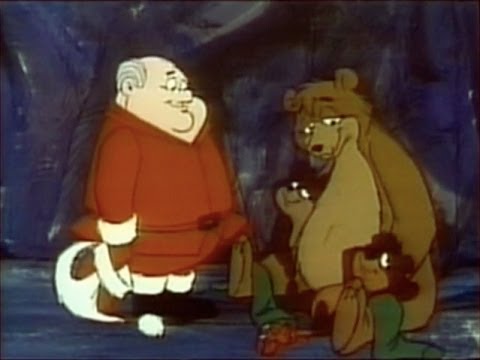
Santa and the Three Bears

Director: Tony Benedict
Writer: Tony Benedict
Producer: Tony Benedict
Cast: Three bears, Santa
Country: USA
Year of release: 1970
Reviewed from: UK VHS

Inasmuch as this site has any sort of tradition, it’s that I review something Christmassy at Christmas time. This tatty old VHS had been sitting on the shelf for about 13 or 14 months, I believe, before I finally persuaded young TF, just turned three, to sit down and watch it on Christmas Eve 2006. This was preceded by a couple of weeks of: “Why don’t we watch Santa and the Three Bears?” “I don’t like it.” “How can you not like it if you’ve never watched it?” “I don’t like it.” And it was followed by TF insisting on watching the video again, later that same Christmas Eve, before he went to bed. And again on Boxing Day.

Kids, eh?

This old VHS tape is so astoundingly cheap that it doesn’t have a company name or catalogue number anywhere on the sleeve or the tape itself. On the other hand, the pictures front and back do actually match the characters on screen, which is something.

The first thing to stress is that these three bears, despite being referred to in the title as “the Three Bears” are not in fact those three bears, ie. The Three Bears. They’re just... three bears. There’s a mother bear named Nana and two bears cubs, Nikomi and Chinook (which I only know as a type of helicopter) and they live in Yellowstone National Park. (Although I have discovered that an identically titled but unrelated children’s book exists which does feature The Three Bears.)

Winter is coming so it’s time to hibernate but the two cubs are excited by the concept of Christmas, which they have heard about from a balding, rotund park ranger known only as Mr Ranger. As Nana settles down, they sneak off to Mr Ranger’s cabin, where he has put up a tree and a bunch of decorations, and he explains to them all about what Christmas involves: Santa and the elves and the reindeer and what have you (and to be fair, a brief mention of the Nativity). Then he returns them to their cave.

But the cubs are very excited and determined to wait up and see Santa. The kindly Mr Ranger, not wanting to disappoint them, puts on a beard and a Santa Claus costume and sets off with a sack of bear-suitable toys - including, somewhat oddly perhaps, teddy bears - but the weather closes in and he cannot make his way through the snow blizzard so he takes shelter for the night in a bus stop.

With no sign of Saint Nick, Nana eventually admits to her two disappointed young’uns that in fact ‘Father Christmas’ is just the Park Ranger and that’s why he’s not coming this year. So when a rotund figure appears silhouetted in the cave entrance and leaves a couple of stockings of toys, the cubs think it’s just Mr Ranger. Except of course that shortly afterwards, the blizzard having abated, Mr Ranger appears with two more stockings.

What? But then... who...? (“Ho ho ho!”) You get the picture.

Now, this cheapo-cheapo VHS release says the films run approximately 30 minutes but in fact it’s about 45 minutes or so. Santa doesn’t actually appear until more than 20 minutes in, and then only briefly in Mr Ranger’s illustrated explanation, although he does, as I say reappear at the end. Moreover, for the first ten minutes there are no bears either, as Mr Ranger potters around Yellowstone Park, accompanied by one of several instantly forgettable, sub-Snow White, choral songs, checking on all the animals. TF and I were looking at the box, wondering if we had the right tape, especially as the title card is missing from the opening credits.

And this really is a terrible copy. The sound is muffled beyond belief, making the dialogue and especially the singing borderline unintelligible. The picture quality is poor but then the animation is strictly Hanna-Barbera level so there’s not a lot of detail lost. Interestingly, there are some attempts at imaginative direction, including some POV shots when Mr Ranger looks down at the two bear cubs at his feet and some jazzy sequences when images appear and disappear in coloured rectangles of different sizes and dimensions.

Speaking of different sizes, it turns out that this anonymous looking little movie has quite a history. It was originally released theatrically in the USA in 1970 as a 76-minute feature film, the extra time being taken up with a lengthy live-action wrap-around in which another park ranger introduces his three grandchildren to the story of 'Santa and the Three Bears'. So that means that the film has a park ranger tell some kids about a park ranger who tells some bear cubs about Christmas. The whole sequence with Santa and the elves is an explanation inside an explanation. Wheels within wheels and fires within fires. Both the feature version and this animation-only version, which apparently ran for years on USA Network, are currently available on DVD.

There are some big names attached to this obscurity. Mr Ranger (and possibly Santa too) is voiced by Hal Smith who started out in westerns in the 1940s and moved into animation voices in the 1960s. He did a lot of additional voices for The Flintstones and other Hanna-Barbera shows, played Otis Campbell in The Andy Griffith Show and was the voice of Owl in Winnie the Pooh films and TV shows for Disney. Santa seems to have been a regular gig for him as he donned the metaphorical beard in Casper’s First Christmas (1979), Yogi’s First Christmas (1980), The Town That Santa Forgot (1993) and an episode of a Disney cartoon I’ve never heard of called Bonkers. Nana Bear is Wilma Flintstone herself, the legendary Jean Vander Pyl.

Writer/director/producer Tony Benedict was a frequent animation writer in the 1960s and 1970s, racking up credits on The Flintstones, The Jetsons (he created the character of Astro the dog), The Pink Panther Show, The Yogi Bear Show and various Warner Brothers holiday specials. He started out in uniform, drawing cartoons for a military newspaper, then sent some of his work to Disney where he was taken on as an apprentice animator on Sleeping Beauty and 101 Dalmatians. After three years he transferred to UPA to work on Mr Magoo then in 1969 he went to H-B, adding scriptwriting to his work as an animator. And he’s still going; some of this info came from a newspaper interview he did only last month.

Bizarrely, the live-action wrap-arounds (of which I have only seen frame grabs on various fansites) were directed by Barry Mahon, better known for nudie nonsense and exploitation fare such as Fanny Hill Meets Lady Chatterly, Nudes on Tiger Reef and The Beast That Killed Women. Shortly before he retired from film-making in the early 1970s he did turn to kiddie fare, directing versions of Thumbelina, The Wonderful Land of Oz and Jack and the Beanstalk. He also made another Crimbo obscurity, Santa and the Ice Cream Bunny. Mahon and Benedict reunited the following year on a truly bizarre Christmas special, Santa’s Christmas Elf (Named Calvin), which consists entirely of still photos of posed puppets. Mahon produced and directed it while Benedict designed and built the characters for what was probably not an homage to La Jetee but, you know, it would be fun if it was.

Santa and the Three Bears is pleasant enough, with a limited number of likeable characters and a simple message that is positive and heart-warming without being cloying or overly sentimental. That it has instantly become TF Simpson’s favourite film - apparently displacing Finding Nemo - suggests that there is something magic in it that a three-year-old can determine, even through the dreadful picture and sound quality of this tape.

But it does present a slight moral dilemma in that the central story features Nana Bear telling Chinook and Nikomi that (gulp) Santa doesn’t really exist and it’s just father-figure Mr Ranger in a costume. The fact that Santa is shown to actually exist after all doesn’t detract from the problem which I’m sure you can see: it raises doubts about the reality of Father Christmas, thus making it perhaps suitable for slightly older children but of dubious recommendation for three-year-olds (unless the dialogue is hidden behind a muffled sound, as here fortunately).

You see, I’ve been thinking about this and the fact that, like most people, I don’t recall ever actually believing in Santa Claus. I must have done - and TF certainly does, bless him - but it’s not ‘belief’ in the sense that we normally use. It’s not a conscious decision or an evaluation of the available evidence. Adults believe in flying saucers or ghosts or God because they consider what they have been told - about evidence or faith or whatever - and on balance they deem the existence of such a thing likely or even certain. But even the most devout believer is aware that there are those who don’t believe, that belief is a choice.

Small children don’t ‘believe’ in Santa Claus, they simply accept that he exists, and that he has flying reindeer and brings presents and is generally magical. They believe in him the same way that they believe in policemen or bicycles: it’s part of their model of the world around them. They don’t doubt, they accept on the available evidence, and ‘Mummy and Daddy told me’ is pretty strong evidence for a three-year-old mind. So when TF discovers or realises - as he must do one distant day - that Santa is just a fiction, it won’t destroy his belief, it will simply cause him to re-evaluate his model of the world around him. At least I hope so.

In the meantime, I might need to invest in a DVD of Santa and the Three Bears before next year because this tape is starting to wear out.

MJS rating: B
TFS rating: A++
Review originally posted 23rd December 2006

Tuesday, 24 December 2013

Silent Night, Bloody Night: The Homecoming

Director: James Plumb
Writers: Andrew Jones, James Plumb
Producer: Andrew Jones
Cast: Mel Stevens, Alan Humphreys, Philip Harvey
Country: UK
Year of release: 2012
Reviewed from: screener
Website:
www.northbankentertainment.com

Silent Night, Bloody Night: The Homecoming is a very interesting film. I’m not convinced that it succeeds in what it sets out to do, but neither am I convinced that I’m necessarily the target audience. And in any case, the ways in which it fails to live up to its lofty ambitions are fascinating and make it very worthy of your attention.

This is one of the new breed of PD remakes. Instead of some bloated Hollywood studio remaking an old movie that was already perfectly good, at a thousand times the budget, creating some soul-less cinematic behemoth, PD remakes are totally independent film-makers remaking an old movie, often one that actually wasn’t very good but is now conveniently within the public domain, at a budget even lower than the original.

Andrew Jones (The Feral Generation) and James Plumb have collaborated on this and also on the first British entry in the somewhat confusing pantheon of Night of the Living Dead remakes and sequels. The original Silent Night, Bloody Night was made in Long Island in 1972 and released two years later. It stars genre fave Mary Woronov as Diane, daughter of the Mayor of a little town where a troubled house comes up for sale. John Carradine plays a mute newspaper editor, there are various Warhol acolytes in supporting roles and Lloyd Kaufman was an associate producer (though it is not, and never has been, a Troma film).

I was advised by the film-makers to watch the original film after their remake and I would advise you, unless you are already familiar with it, to do the same. It’s widely available on various el cheapo-cheapo DVDs and it’s probably all over YouTube too. Watching the 1974 film not only clarifies some of the choices made by the 2012 film-makers but also, truth be told, highlights some of their problems too. Thus, much like the Macbeth porter’s booze, ”it provokes, and unprovokes; ... it makes him, and it mars him; it sets him on, and it takes him off; it persuades him, and disheartens him.” There y’are - that’s classical, that is.

So here’s how the original goes. Back in the 1950s, a man named Wilfred Butler returned to a house outside town which he owned but never lived in, and promptly managed to set himself on fire, fatally. The house was inherited by his grandson, Jeffrey Butler, who has also never lived there, and the townsfolk would like to get rid of the place because of its ghoulish history.

On Christmas Eve, a lawyer appears who has been hired by Butler (over the phone) to offer the town the house at a knock-down price, provided that the money is paid in cash, within 24 hours. The town is represented by the Mayor (Diane’s father), Carradine’s newspaper editor, the Sheriff and the town’s switchboard operator, a large, dowdy woman. The lawyer and his girlfriend plan to spend the night at the Butler House but they are interrupted by an axe-wielding maniac, who then phones up the four local worthies and invites them to the house. Meanwhile, Jeffrey Butler himself turns up at Diane’s door and the two head up to the house to work out what is going on. Wilfred Butler’s diary reveals that, back in the 1930s, he turned the house into a private mental asylum where the patients included his own teenage daughter, Jeffrey’s mother.

Or something. The whole thing is framed as a flashback as Diane takes one last look at the building before the bulldozers move in.

So that’s the original Silent Night, Bloody Night (not to be confused with the 1984 picture Silent Night, Deadly Night or any of its many sequels). The above synopsis pretty much covers the remake as well, with just a few tweaks. The framing story has been dispensed with, two of the worthies have been combined so that the fat, dowdy woman is now the newspaper editor, and the whole story has been updated, so that the self-immolation now takes place in the 1980s and the private asylum was set up in the 1970s. In Wales. All of these changes, however, create problems.

Without the framing story and the snatches of narration from Woronov, the whole diary sequence comes across as a massive tell-don’t-show infodump; the film just stops for a while so that we can be told about a bunch of stuff from the past. It has to be said: the sequence works much better in the original.

John Carradine, with his piercingly quizzical stare, slightly wonky dicky-bow, ever-present cigarette and lack of vocal chords (presumably caused by same) really looks and behaves like a newspaper editor. I can also believe that the fat lady is the switchboard operator (which obviously is not a 21st century profession). But I don’t for a second buy the remake’s large local lady as a newspaper editor. Nor do I buy the ‘newspaper office’ location (where, in this version, Diane now works as a cub reporter) - it’s not nearly cluttered enough to be believable.

Then, as regards the updating (which is of course unavoidable), that only works if we suspend all disbelief and accept this as some sort of fantasy, parallel world. It is believable that an individual might turn their home into a privately run lunatic asylum in the pre-war United States. But not in Great Britain in the 1970s. We have a little thing over here called the NHS.

James and Andrew have had fun recreating in their script some of the most memorable aspects of the original. For example, there’s a rather notorious sequence where somebody’s eye is gouged out with a broken wine glass and this is dutifully re-enacted. They’ve kept character names (and had fun adding other, fan-friendly ones into the credits like the Fulci-inspired ‘Freudstein’ - or indeed, ‘Woronov’). But in other respects I think they’ve taken their eye off the ball, being too faithful sometimes and on other occasions missing out fairly crucial elements.

There is, to be more specific, a distinct lack of motivation in the remake: characters do things but we’ve no idea why. In the original, Diane greets the stranger at her door with a gun, and takes quite some persuading to accept that Jeffrey Butler is who he says he is and not the escaped maniac from a different, nearby lunatic asylum who has been reported on the radio to still be at large. In the 2012 film (which features a mass inmate break-out in the first act), Butler steps through Mary’s door and they just instantly bond.

Likewise, in the 1974 film the slimy lawyer has a wife and kid back home and the reason he wants to stay in the Butler house overnight is for a torrid night of passion with his bit on the side, whereas 28 years later there’s no obvious reason why the lawyer and his girlfriend are staying there. The biggest motivation concerns the truth behind the town, a revelation about the film’s victims which I won’t reveal except to observe that it is, quite coincidentally and somewhat bizarrely, the same plot element as the prologue of a Bollywood comedy I watched recently! In the original, this is revealed, out of the blue, in dialogue very near the end. If it’s mentioned in the remake, I missed it, but actually I think this is an improvement. It’s a pretty daft plot point which gives the killer a reason to pick these people beyond their being pillars of the community. In this instance, I don’t buy the original and prefer the slightly random killing of the remake.

Not that I am particularly a fan of slasher films anyway. I can take them or leave them, but I know there are fans out there specifically devoted to the slasher subgenre. And I have no doubt that SNBN:TH will give slashers fans precisely what they’re looking for. In that respect, it hits its targets. But I can only report, as a more general fan of horror, that I enjoyed the original more than the remake: partly (and this is something that could never be fixed) because its age gives it a certain nostalgic charm, especially given the tattiness of certain prints used for the various PD transfers, which glosses over its narrative failings.

Maybe it would be better to watch the remake in isolation. I don’t know. It’s a choice between not knowing why certain things are the way they are and understanding those things but also seeing how some other things could have been better. For example, while conflating the newspaper editor and the switchboard operator into one character, James and Andrew have simply dispensed with the eccentric chain-smoker, then taken the dowdy woman, crossed out ‘operator’ and written in ‘editor’ with a biro. But newspaper editors aren’t like that, especially in today’s commercial environment, they are hard-nosed businessmen/women. They are still mostly a bit eccentric and I bet they all chain-smoke (or at least they should do in films).

A couple of other things concern me. At one point a character escapes from some handcuffs using a piece of broken pottery to gouge chunks out of their wrists. And while that makes for a bloodily gruesome effect, it should be plenty obvious that You Can’t Do That. Even if you were to find a shard of pottery sharp enough to cut through flesh (we’ve all picked up broken plates - they’re not exactly razors), the thing that keeps a handcuff on you is not your wrist, it’s the fact that your hand is considerably bigger than your wrist. You would need to somehow break the bones in your hand - and there’s a lot of them so you’re looking at crushing rather than snapping - and then gouge chunks out of the heel of your thumb. Or cut your whole damn hand off (but with a plate?). But what we see on screen here, though the prosthetic is good and the image is squeamish and gory, makes no sense.

And finally: Christmas. Truth be told, in neither original nor remake is the Christmas setting particularly relevant. The only way it affects the story is that it makes it a bit more problematical for the town to find a large amount of cash within 24 hours. And I suppose it explains why there’s hardly anyone else around. Really, it’s just a novelty thing in the original: let’s set a horror movie - at Christmastime! There’s an uncomfortable contrast between the general goodwill of the season and the nastiness and violence that ensues.

But at least the 1974 film looks like it’s set at Christmas. There are holly wreaths on the doors, decorations and cards in the interior sets, and snow everywhere. People mention the season. It feels like Chrimbo. There are precious few decorations on show in the remake, and I don’t think anybody ever wishes anyone else happy Christmas. Most egregiously, the film was shot in April so in daytime exterior scenes we can see that the trees and hedges are lush and green with new leaves. Obviously you can’t guarantee snow (unless, like The Children, you spend half your production budget on fake stuff) but this is screamingly obviously not December. There is one gratuitous killing of a random person dressed as Santa, but that’s about as festive as it gets.

The trouble with writing a review like this, where I point out a relatively small number of problems and detail why they are problematical (and sometimes how they might have been solved) is that the piece overall becomes very negative, with these criticisms outweighing the positives. So please consider this review in this context: there are many good points to the film, albeit ones which don’t require individual paragraphs to elucidate. It is well-directed, the acting is fine, the camera-work and sound are good. The horror sequences (including one which was not in the original: an attack on a horny young couple using the empty house as a conveniently isolated location for a spot of Percy Filth) are particularly well-managed, combining slick editing with impressive gore effects. For slasher fans, this is clearly the stuff that is important, not whether the editor of the local rag looks like Aunty Mabel or the leafiness of the hedgerows round-abouts. But like I say, I could never describe myself as a ‘slasher fan’, just a guy who likes horror movies, some of which could be classed as slashers.

And so to the cast and crew round-up. Philip Harvey (who appeared briefly in The Last Horror Movie) is Wilfred Butler, Alan Humphreys (Panic Button, New Years Evil) is his grandson, Kathy Saxondale (Old Zombies) is his wife Marie in flashbacks and Mel Stevens stars as Diane (who, despite being the central character, doesn’t appear until nearly halfway through). Also in the cast are Sule Rimi (Daddy’s Girl, Panic Button, Elfie Hopkins), Richard Goss (In the Dark Half, I am Cursed) and Friday the 13th’s Adrienne King in a voice-only role.

Executive producer Robert Graham was production accountant on a selection of indie features including The Feral Generation, Stormhouse, Panic Button and Outpost 11 (a steampunk horror feature unrelated to Nazi zombie sequel Outpost II) and is clearly now a busy guy. His IMDB listing cites 15 features he has ‘in development’ including Requiem for the Ripper, Legacy of the Ripper and three films called Dragonman. The other exec prod is Manish Patel (The Amityville Asylum) who mostly makes health videos for the NHS. Music, cinematography and editing were all handled by James Morrissey who previously made impressive 2008 half-hour short Alone with the Dead. Alex Harper (Dead of the Nite) was responsible for the make-up effects and Mick Bahler (Red Kingdom Rising) handled the visual effects, including the self-immolation in the prologue.

Needless to say, many of the cast and crew also worked on Night of the Living Dead: Resurrection.

Is SNBN:TH worth watching? Absolutely. Does it work? Sort of. Is it as good as it could have been? Yes and no. Some parts work, others don’t. A few Christmas decos wouldn’t have busted the budget (they’re usually pretty cheap at the start of the year!) and a little less fidelity to the original might have been beneficial - because it’s only relevant to those viewers who watch both, and the film should be able to stand alone. On this basis. I retain high hopes for NOTLD:R, not least because that ‘franchise’ is already so diverse that there’s less to be faithful to, and I think this will give Andrew and James more leeway to make their own film, rather than tying themselves up with trying to accommodate ideas from four decades gone-by.

MJS rating: B

Psycho Santa

Director: Peter Keir
Writer: Peter Keir
Producer: Renee Riordan
Cast: Jeff Samford, Eric Spudic, Krystal Stevenson
Year of release: 2003
Country: USA
Reviewed from: R2 DVD (Sub Rosa)


Psycho Santa is an odd film in that it’s sort of, but not quite, an anthology picture. What we get is a series of flashback stories being told by a guy named Ron (Jeff Samford) to his girlfriend Jess (Michelle Samford, who looks a bit like him so may be his sister) as they drive to a Christmas party. But the stories all feature the same psycho (I think) and are in narrative sequence. Perhaps this just helped with the logistics of filming, allowing each part of the film to be treated like a short.

Under the titles we see a young woman moving around among abandoned cars, apparently hiding from a familiar red-and-white figure whom we glimpse occasionally. When the movie starts with the couple heading for the party, it’s not obvious what the relevance of the credit sequence was.

The first story, ostensibly set ten or eleven years earlier, has two girls (Sequoia Rose Fuller and Rachel Michelle Gnapp) turning up at a remote cabin for their annual Christmas slumber party. The third part of the trio seems to be already there as there are several parcels under the tree with her name on them - shouldn’t they have the other girls’ names on them? - but there’s no sign of her so they assume she has wandered off somewhere. One girl goes out looking for pebbles while the other has a shower. I suppose if you find pierced nipples attractive this nude scene might be sexy, but for some of us it’s a complete turn-off.

As the negligee-clad girls get into party mode, somebody is watching them from outside, then...

After a clever little shock (which I won’t reveal here) we cut back to Ron who explains that all three girls died. His girlfriend doesn’t question him on how anybody could, therefore, possibly know what happened in the cabin.

The next story is set ‘last year’, with two burglars breaking into an empty house, only to find a sexy young woman in her underwear there (statuesque model/make-up artist Gayle Elizabeth). The moment when she sees them, then walks right past as if they’re not there is very nicely handled by the actors and the director. That’s probably the artistic highlight of the film and the explanation makes perfect sense, which is more than can be said for the burglars’ gratuitous murder of the girl. They then open a locked door, from behind which they can hear strange noises - and both meet a gruesome end. (One of the burglars is Lucien Eisenach, who wrote, directed and starred in Fetalboy Goes to Hell, which shares several cast with this films.)

It turns out that the unseen psycho from the first story was this woman's son, something we learn as her husband (Robert Lanham) is interviewed by a detective (writer-director Steve Sessions whose films - Cremains, Hellbound: Book of the Dead, etc - share many of this movie's cast; he also provided the excellent music for this film). The psycho, named Chris and played by Jason Barnes, was thought deceased in a fire at the asylum (‘for the dangerously insane’) where he was held, but in fact he survived with horrific burns and has been kept locked up by the couple ever since. Now he’s on the loose and we see him kill a bloke in Santa costume and steal his clothes and beard.

A couple more murders follow - all flashbacks from the story being told by Ron, and similarly impossible for him or anyone else to know as everyone involved (apart from the psycho) gets offed. Finally, we have Josh (associate producer Eric Spudic, writer of Maniacal and Aquanoids, who was kind enough to send me this disc) and his geekily attractive sister Alice (Krystal Stevenson) whose car breaks down, and we recognise her as the girl from the title sequence.

Probably the biggest failing of the movie, which is well directed with some top notch photography and good editing, is that despite all this it’s very slo-o-ow. Too much time is spent on (well-directed, well-shot, well-edited) sequences of people doing things that we don’t need to see, mostly with little or no dialogue. We watch the burglars, for example, walk up to the house, and then we watch them carefully pick the lock, and then we watch them walk around the house looking for the safe, and it all just goes on too long with nothing happening.

The first story in particular is a tale of about ten minutes that could have been told in two, or could actually have been stretch out to a twenty-minute Tales from the Crypt episode if the characters had been given some dialogue and something to do other than shower, put on underwear, pick up pebbles and dance. Atmosphere is good, but you can have too much atmosphere...

I must confess that by the time we got to the brother and sister walking through the woods I literally fell asleep. Okay, I was a bit tired, but it was just a lengthy sequence of two people walking through the woods. Nothing was actually happening.

After they split up, the girl is menaced by the psycho Santa, runs away from him, and is suddenly, inexplicably (unless I fell asleep again) in a car graveyard, where we have a differently edited re-run of the title sequence. There is a lovely bit of audience misdirection when she hides from her pursuer in an old school bus - more clever, tense scenes like that would have benefited the film overall. Her brother meanwhile ends up at an old cabin, where he also comes face to face with the psycho Santa, but a denouement is in the offing.

Psycho Santa looks surprisingly good for a shot on video feature, and the gore effects are not bad at all. The problem is, it’s simply too long. Well, maybe not too long - it runs about 81 minutes - but there’s just nothing happening for most of that time. And the ending, back with the couple in the car, manages to be both predictable and lame, unfortunately. But I’ve seen far worse.

Available on a convenient double bill with another cut-price Christmas horror, Satan Claus. Most curiously, the film carries no crew credits apart from writer-director, producer, associate producer and composer. Despite the camera-work, editing and special effects all being highly creditable, no-one is actually credited for them! (It also manages to spell Lucien Eisenach's name wrong in the cast list.)

MJS rating: B-
review originally posted 14th December 2004

Satan Claus


Director: Massimiliano Cerchi
Writer: Simonetta Mostarda
Producers: Massimiliano Cerchi, Ken Greenblatt
Cast: Robert Cummings, Jodie Rafty, Robert Hector
Year of release: 1996
Country: USA/Italy
Reviewed from: R1 DVD


Released on a double-bill disc with the nominally similar Psycho Santa, this turns out not be the expected cut-price, shot-on-video indie but an hour-long, professionally made flick filmed in what looks like 16mm (a lot of on-line reviews say this is shot on video but it very obviously isn’t). What is more, director/producer/executive producer Massimiliano Cerchi turns out to be the real name of Al Passeri, Italian helmer of the sublimely dreadful Creatures from the Abyss.

In fact, Satan Claus gives us pretty much from the off what Psycho Santa promised but never really delivered, which is a guy dressed as Father Christmas repeatedly hacking up innocent people while laughing in a jolly manner.

Our hero is aspiring actor Steve Sanders (Robert Hector: The Vampire Project) who is collecting for a local orphanage, dressed as Santa, when he meets his photographer friend Sandra Logan (Jodie Rafty) and her boyfriend Jeff, who is murdered in front of them by the jolly fat guy with the beard. Steve and Sandra report the murder to the cops, specifically a senior cop named George Ardison (Barie Snider).

All we ever see of the Police Station is Ardison’s office, which he shares with a plain clothes police woman named Sharon; there’s a uniformed cop (John Romanelli) who pops in and out, but there is nothing else to indicate that we’re actually in the station. Like most of the interior sets, Ardison’s office is kept very dark to hide the lack of a set dressing budget, so all we see are the two desks and a couple of wall flats with things pinned to them (including, for some reason, a photo of Bill Clinton).

Jeff was actually the killer’s second victim, the first being Ardison’s wife. Over the full sixty minutes a whole bunch more people get hacked up by the killer, who telephones Ardison after each murder asking if he likes the latest ‘present’. Steve has an African-American friend named Maman (writer/performer Lauretta Ali), formerly a witch doctor in New Orleans, and she senses that something evil and unholy is at work, rather than just a psycho. Halfway through, we are suddenly introduced to Steve’s other friend, policewoman Lisa Red, who takes over Sharon’s desk for no apparent reason.

Steve goes to visit Sandra and discovers in her studio a cabalistic circle of candles and a blood-spattered 8x10 of Ardison, plus a Christmas tree decorated with body parts removed from the victims. At the end, Ardison turns up dressed as Santa but so does Sandra and it turns out (I think) that she raised a demon to take revenge on Ardison’s wife because she was having an affair with Jeff. Or something.

Though the plot makes precious little sense, the script has moments of surprisingly decent characterisation while the acting varies from really quite good (Hector, Ali) to thoroughly wooden (Snider). The biggest problem is that almost everything takes place at night, and even the few daytime scenes are dark and underlit, because of the aforementioned budget constraints. However, this does have the advantage of helping to render the rubber body parts less unrealistic.

Satan Claus himself is played by Robert Cummings (widely miscredited on-line as ‘Robert Cummins’). He is hidden behind a beard, but I’m guessing that this is Robert Cummings the stuntman who played ‘Klingon gunner no.1’ in The Search for Spock and was also in They Live, Predator 2, Pumpkinhead, etc. It is certainly not the better known Robert Cummings, the 1930s/1940s comedian who later had roles in Dial M for Murder and Beach Party, on account of him having died in 1990.

Several of the cast and crew were also in Cerchi/Passeri’s next film, Hellinger, including DoP John Gilgar and Nicholas Van Eeden who plays Jeff. Passeri’s other movies, which I have yet to enjoy, include The Mummy Theme Park and Carnage: The Legend of Quiltface. In an earlier life he was allegedly assistant production designer on Alien 2: Sulla Terra and a special effects technician on The New Gladiators. Producer Ken Greenblatt makes a brief appearance as one of a trio of vigilantes attacking anyone they find dressed as Santa. (There is an agent in LA named Ken Greenblatt, but as Satan Claus was filmed in New York I suspect this is actually the off-broadway producer behind Menopause: The Musical.)

The IMDB dates this film to 1996 while other sites say 1999 with the Bill Clinton photo being the only visual clue. There is no copyright date on the print and, given that the six-year-old Creatures from the Abyss was being touted as a new film when I saw it at Cannes in 2000, it is clear that Passeri likes to keep his production dates - shall we say? - fluid. The really odd thing here is the running time - almost exactly sixty minutes. Since there is no market for an hour-long film (except as the bottom half of a Sub Rosa double bill DVD, obviously), one can’t help wondering whether it was supposed to be this long or whether this was all the usable footage that could be salvaged from the production.

MJS rating: C

review originally posted 19th December 2004

Sunday, 24 November 2013

Stalled

Director: Christian James
Writer: Dan Palmer
Producer: Richard Kerrigan
Cast: Dan Palmer, Tamaryn Payne, Mark Holden
Country: UK
Year of release: 2013
Reviewed from: festival screening (Day of the Undead)
Website:
http://stalledmovie.com

Stalled is the eagerly awaited (and long awaited!) second feature from the Freak Out team of Christian James and Dan Palmer. Palmer wrote this script solo and stars in the film, which James directs. It’s a zombie comedy. It’s very clever and very, very, very funny. It’s also slicker, more mature and more professional than Freak Out, although I appreciate the irony of using the term ‘mature’ to describe a film with this many toilet jokes.

Where their first feature succeeded despite its microscopic budget, for their sophomore effort Palmer and James have cannily embraced and even utilised their limitations, so that almost all the film takes place on one set and large parts of it consist of nothing but Dan Palmer on his own in one self-contained part of that set.

And that set is a toilet.

It is Christmas Eve - oh yes, you should also know that this is a very festive horror film - and the office party is in full swing on the seventh floor of an unspecified office block. Palmer is a never-named maintenance technician (his character is listed in the credits as ‘WC’!) called to fix a problem in the ladies loo, which has three stalls. He is forced to hide when a couple of scantily clad lovelies enter, who indulge in a little lipstick lesbianism before one of them bites a chunk out of the other’s neck. You saw this bit in the trailer.

Before long, the room is filling up with undead office workers, some of them in festive fancy dress, and our hero is trapped in his stall. He’s safe as long as he stays there, but he can’t get out. And he doesn’t even have his toolbox with him, which he has left over on the sinks. Not that it has many tools in it tonight, because this is his last day on the job and the toolbox is stuffed with money which he really, really wants to take with him if and when he affects an escape.

Of course, none of the zombies have any dialogue so in order to have some sort of character interplay the script introduces Evie, a lady trapped in the stall at the other end of the row (the middle one contains a dead zombie). We never see Evie, but in a clever conceit the film has ‘WC’ draw a picture of her in marker pen on the toilet wall and this allows Christian James to direct the conversations in a (slightly) more conventional way.

The plot of the film is our hero’s various attempts to reach his toolbox and escape, and it is here where Palmer’s script really shines. On paper, this could have just been a feature-length Road Runner cartoon with Wile E Coyote (hey: WC!) hatching a series of plans, each of which fails miserably and knocks him back to square one. But actually what we get is a well-plotted film with narrative development throughout the three acts. This is a film of cause and effect as each of the various schemes - to hit the fire alarm, to distract the zombies, to reach the toolbox and so on - is based around the current situation and available resources as they stand after the failure (or incomplete success) of the previous effort. Particularly hilarious is a possible rescue which is derailed due to a terrible miscalculation, and I’ll say no more than that.

Stalled is a movie of constant surprises which make it a delight to watch (as long as you’re not averse to crude gags, cleverly delivered). Palmer is absolutely terrific in the lead role, bringing real pathos and depth to the character, and his dialogues with Evie (Hollyoaks' Tamaryn Payne, also in Small Town Folk) open up both their characters, yet leave more to be discovered. I don’t think it’s a spoiler to say that near the end of the film the action finally moves out of the ladies loo; as indeed it does briefly earlier during a very funny musical fantasy sequence. The whole thing builds to a climax which is moving, ironic, clever and satisfying.

‘Moving’ is another odd word to use here, where one would expect to see more uses of ‘movement’. But this is a heart-warming film which never forgets that it’s set at Christmas. Stalled could well become a staple of horror fans’ festive parties, a sort of zombie It’s a Wonderful Life. Freak Out also had a real sense of warmth and compassion in its central relationship and this second film confirms that Palmer and James have the skill to hit all three targets: good horror films which are not only also good comedy films but actually just ‘good films’ in the purest sense.

The supporting cast (which does include a few non-zombie characters) features several notable names: Giles Alderson (Night Junkies, The Harsh Light of Day, Till Sunset), Victoria Broom (Zombie Women of Satan, Three’s a Shroud, Umbrage: The First Vampire), Canadian actor Mark Holden (Final Destination 1 and 5, World War Z, Nightmare Street), Chris R Wright and Peter Stanley-Ward (Small Town Folk), Steve McCarten (Season of the Witch, Harsh Light of Day), TV presenter Rick Edwards and comedian Dave Fulton. Stanley-Ward was associate producer on the film (which reminds me of an old joke: What’s the definition of an associate producer? The only person who’ll associate with a producer. Thank you, remember to tip the waitresses.)

Cinematographer Sashi Kissoon, making his feature debut after a number of shorts (including some for Dave Fulton) does an absolutely stonking job of keeping the camera-work fluid and natural within this small set - and often just within the one stall - without ever becoming staid or repetitive. He has previously been part of the camera crew on features including Alan Partridge: Alpha Papa and something called Alien Uprising which turns out to be Dominic Burns’ UFO under a new title. Credit for the look and feel of the film must also go to the fine work of editor Mark Gilleece and production designer Antony Haylock. The special effects make-up is credited to ‘Snowy Ramone’ whom I suspect to be a pseudonym. And of course, Christian James’ adroit direction holds the whole thing together, creating what is instantly one of the best zombie comedies ever made.

More than that, what I really dug about Stalled was its very British parochialism and the way that it put a comedy spin on the ‘corporate horror’ subgenre which has been explored previously in films like Fired and London Voodoo. Severance put a blackly comic spin on corporate horror but Stalled is much less subtle and works absolutely bloody brilliantly. If you like zombies, if you like horror-comedies, if you like films where characters try to fish mobile phones out of toilets full of mashed zombie brain, you owe it to yourself to watch Stalled at the earliest opportunity, whether or not it’s actually Christmas.

MJS rating: A-

Friday, 8 March 2013

Caesar and Otto’s Deadly Xmas

Director: Dave Campfield
Writers: Dave Campfield, Joe Randazzo
Producers: Dave Campfield, Joe Randazzo, Robin Ritter, Richard G Calderon
Cast: Dave Campfield, Paul Chomicki and more stars than there are in Heaven
Country: USA
Year of release: 2013
Reviewed from: online screener
Website:
www.caesarandotto.com 

Three years after their Summer Camp Massacre, half-brothers Caesar and Otto Denovio are back in their third feature, Caesar and Otto’s Deadly Xmas. It’s actually their fifth film as there have been a couple of shorts in the meantime: C&O in the House of Dracula and C&O Meet Dracula’s Lawyer. (The duo also pop up in Dave Campfield’s recent political satire short The Perfect Candidate.)

By now Campfield and Paul Chomicki have their double act down pat and it is a joy to behold. Caesar and Otto are a wonderful pairing. Like Stan and Ollie, like Eric and Ernie, like Albert and Harold, like Jay and Silent Bob - they are effectively married to each other. They can’t stand each other but they know deep down, even if they won’t admit it, that they need each other and they’re stronger together.

Otto is sweetly pathetic. He’s a slob, but an innocent slob. He just wants a little peace, a little happiness and warmth. In this tale he’s tracking down a girl he had a crush on in high school (multi-divorced Allison, played by the unfeasibly cute Summer Ferguson). It’s difficult not to love Otto, especially given what he puts up with from Caesar.

Caesar has a different kind of pathos. Hyperactive, insecure, egotistic - and paranoid if he isn’t the centre of attention. Caesar is the epitome of that thing we call ‘an actor’. But we can tell that he has a good heart, that he does in fact love his half-brother and that his tantrums and bitchy comments are really all a show, disguising the vulnerable, lonely man inside.

There are depths to these two characters which make us want to spend time with them: ninety minutes every three years just isn’t enough.

The surprisingly complex plot of Deadly Xmas involves a Satanic cult founded in California in the late 19th century, plus Caesar’s latent fear of Santa Claus (or anyone dressed as him). Also the burgeoning Otto-Allison romance, their father’s usual nefarious shenanigans, a squeaky-clean company expanding into slasher movie production and of course a serial killer. A smart script and pinpoint direction careen through the story taking no prisoners, with lots of knowing winks and nods to the B-movie-ness of it all.

Not least of these is a star-packed cast which makes this the It’s a Mad, Mad, Mad, Mad World of second-tier Hollywood. Debbie Rochon! Brinke Stevens! Linnea Quigley! Felissa Rose! Joe Estevez! Robert Z-Dar! And of course, dear old Uncle Lloyd! A quick check on the IMDB reveals that between them these seven fine folk have an incredible 1,100 credits, and even if we allow for duplication in that list there must be about a thousand films with one or other of them in the cast. This is the bedrock of low-budget independent cinema right here folks, step up and take a seat.

But all of this would be so much self-indulgent nonsense if it wasn’t for one crucial fact. Caesar and Otto’s Deadly Xmas is howlingly, gutbustingly funny. Every gag hits the mark, every comic turn, every pause, every double-take, every slapstick, everything. Comedy gold, that’s what this is. Comedy gold.

Also in the cast are: Shawn C Phillips, who has amassed more than 60 IMDB credits himself by appearing in stuff with titles like Sasquatch Assault, Zombie Babies, Kung Fu and Titties, Girls Gone Dead and Fat Planet; Victoria Vertuga, who made another seasonal horror feature the same year, something called Merry F@#$ing Christmas; Aaron Miller, who played ‘Manson victim’ in Dahmer vs Gacy(!); Paul Guay, who wrote Jim Carrey vehicle Liar Liar but, more significantly, was in Don Glut’s Countess Dracula’s Orgy of Blood; Keith Bush, who played Orson Welles on TV a few years back; and Ken MacFarlane, who was in a 2004 Golem movie. Plus producer Robin Ritter and producer/designer/FX guy Richard Calderon.

I loved, loved, loved Caesar and Otto’s Deadly Xmas. It’s clever, it’s knowing, it’s silly, above all it’s joyous. The subgenre of Christmas horror B-movies is not a distinguished one, populated by such crap as Psycho Santa and Satan Claus, but the half-brothers Denovio are the boys to put the sparkle back into festive frights. It doesn’t matter what month it is right now - this is great at any time of the year.

MJS rating: A

Monday, 18 February 2013

Christmas Carol: The Movie

Director: Jimmy T Murakami
Writer: Piet Kroon, Robert Llewellyn
Producer: Iain Harvey
Cast: Simon Callow, Kate Winslet, Nicolas Cage
Year of release: 2001
Country: UK
Reviewed from: UK theatrical release


Much as I love animation, and much as I do my best to support British films, and even though the total number of British animated features ever made is only a dozen or so - nevertheless, I cannot tell a lie. Christmas Carol: The Movie is awful. Laden with potential, this could have been a great movie, or at least a fun movie - but it seems to be trapped in a mire of uncertainty and compromise which has rendered it merely dull. In fact, not just merely dull, but very dull indeed.

The story per se is reasonably faithful to Dickens, except that Scrooge is considerably younger and his estranged fiancée (who does actually feature in the book) is still around, running an alms house which turns out to be heavily in debt to Scrooge, thus bringing her back to him and leading to a romantic ending. As you can see, that’s a pretty big ‘except’ - and it’s not the only one. The film-makers have also introduced two mice, presumably because they think that any cartoon has to have cute animals. Deeply irritating, and with all the comic relief quotient of Jar-Jar Binks, these mice turn a film which would merely have been ‘not very entertaining’ into a real chore to sit through.

The film isn’t just dully written, it looks dull too, with a palette composed almost entirely of browns and greys. And there are songs, but really dull, forgettable ones. The whole is topped and tailed by a live action sequence in which Simon Callow, as Charles Dickens, reads his novel to an appreciative American audience (Callow also provides the voice of Scrooge). Thankfully, his false beard in these scenes is considerably more realistic than the wispy bit of string which clung to his chin when he played Dickens for the BBC.

There were two ways in which Christmas Carol: The Movie could have worked. One would be to go back to the original story - which is a ghost story, remember? - and make it a dark, scary film for adults, set in the disease-ridden world of the Victorian backstreets. There’s a version of the tale which has rarely, if ever, been presented. Alternatively, one could go all out for A Christmas Carol as it exists in the public consciousness, with the singing and the dancing and the laughing and so on.

This film tries to do both, but since they’re mutually exclusive, it ends up doing neither. From the former possibility we have the Callow intro sequence - which might reasonably lead one to expect a faithful adaptation - and the muted colour palette; from the latter come the songs and the mice. But even there the film falls between two stools. Rather than go for ‘cartoon mice’ or ‘realistic mice’ the designers have hedged their bets and created ‘semi-anthropomorphic’ creatures. They are drawn realistically (like the human characters) and don’t speak - but they do stand on their hind legs and adopt human poses, such as shaking their tiny fists when angry. So they’re not realistic enough to make sense, but not cute enough to be entertaining. What is more, since they are both the same shape and size, and only slightly different shades of grey, it is only halfway through the film when the two creatures meet that one realises there are two of them!

Director Murakami (The Snowman) says on the film’s website that it “preserves the original story ... while also developing the relationships between Dickens’ wonderful characters” (you can’t do both!), especially when you’re also “adding some new characters” (mmm, that’s preserving Dickens’ story...) and “expanding the drama and humour of the story” (you can’t do both!). The sheer hubris of buggering about with such a popular, long-lasting story is astounding. Do these people think that all the previous films, from the silent versions to Alastair Sim to Patrick Stewart, have somehow got it wrong and could have been improved with a romantic subplot and some mice? Nothing wrong with altering a classic if you admit that’s what you’re doing, but to present such as being faithful to the original author’s intentions (when in fact even loose adaptations like Scrooged had more Dickens in them!) is downright deceitful.

The whole film is a hopeless waste of time on everybody’s part, and it is utterly mystifying as to who this is aimed at. Adults will be bored to tears and irritated by the mice and songs, and even the animation, though reasonable, is nothing spectacular. Children will totally fail to be captivated by the characters, especially those bloody mice, and will probably be scared by the ghost sequences, which get quite psychedelic and weird.

An all-star voice cast - Jane Horrocks, Rhys Ifans, Michael Gambon - doesn’t make the film watchable. Above all, the film is totally and utterly lacking in humour; there’s not a single gag anywhere in the bland script (co-written, bizarrely, by Red Dwarf star Llewellyn), which would only be excusable if the writers had gone back to the story’s roots as a scary ghost tale. But they haven’t.

A boring film which sadly can’t be recommended to anyone except Dickens completists.

MJS rating: D
review originally posted before November 2004

A Christmas Carol [1969]

Director: Zoran Janjic
Writer: Michael Robinson
Producer: Walter J Hucker
Cast: Ron Haddrick, B Montague, J Llewellyn
Year of release: 1969
Country: Australia
Reviewed from: UK video (Pegasus)

You see them in bargain bins and cheapo shops everywhere - those anonymous cartoon adaptations of public domain stories. They are often stories which have been filmed by Disney (and I’ve known people be daft enough to buy them by mistake), they never have any cast or crew credits on the sleeve, and they’re always 47 or 48 minutes long.

In the spirit of (a) research, and (b) the festive season, I splashed out three quid down Poundstretcher to see what this version of Dickens’ timeless classic actually was. It turns out to be not bad. The animation is for the most part smooth and full, not the limited animation of a typical 1960s/1970s TV cartoon. It is imaginatively directed, using silhouettes effectively for some scenes, for examples. Nothing Oscar-threatening, but considerably better than what one might expect. And the painted backgrounds (by Ann Williams) are colourful and artistic.

The story is very faithful to Dickens, using almost entirely the story’s original dialogue (something that later, bigger animated versions would do well to note). There have been a few scenes snipped for time, so that Scrooge’s nephew Fred appears early on to wish his uncle a merry Christmas, but is not visited during the ghostly sequences. There is also, oddly, one song (sung by Scrooge and Fred). The short running time (47 minutes, though it cheekily says 60 on the sleeve!) means that the film does not outstay its welcome, though the pacing is hampered by the Scrooge/Marley scene which is way too long and too static.

My point (and I do have one) is that what one might assume to be a recent cheap-jack knock-off from the Far East is actually a well-made 1969 Australian TV special, worth three quid of any animation fan’s money. The animation betrays a very obvious East European influence, which is no surprise as director Zoran Janjic worked in Zagreb before moving to Australia in 1960 where he worked on, among other things, the short-lived cartoon adventures of the Beatles.

A Christmas Carol is one of many TV cartoons which Janjic made for API Productions, most notably the series King Arthur and the Square Knights of the Round Table. In 1972 he joined Hanna-Barbera’s Australian studio, working on shows such as The New Scooby Doo Movies and Wait Till Your Father Gets Home.

Scrooge’s voice is supplied by Ron Haddrick, a busy and acclaimed actor on Aussie stage and screen (Quigley Down Under, Shirley Thompson vs the Aliens) who performed with the RSC in the early 1960s. He was also the lead voice in API's 1977 version of A Journey to the Centre of the Earth.

MJS rating: B
review originally posted before November 2004