Showing posts with label western. Show all posts

Saturday, 16 July 2016

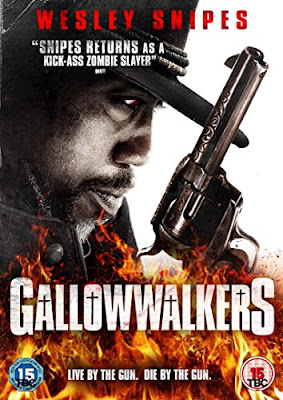
Gallowwalkers

Director: Andrew Goth
Writers: Andrew Goth, Joanne Reay
Producers: Brandon Burrows, Courtney Lauren Penn
Cast: Wesley Snipes, Kevin Howarth, Riley Smith
Country: UK/USA
Year of release: 2013 (eventually…)
Reviewed from: UK DVD

Gallowwalkers does not come with a good reputation. Eleven per cent on Rotten Tomatoes. Average 3.6/10 on IMDB. Average 2.5 stars on Amazon. Most people who have expressed an opinion on it seemed to have been pretty negative. Received opinion is that the film is a clunker.

Well, I’m here to fly in the face of received opinion. I’ve watched Gallowwalkers and while even I hesitate to say it’s great, nevertheless it has undeniable elements of greatness. It also has undeniable flaws – what those are and why they exist I’ll come to in due course – but they are more than compensated for by the film’s positive aspects. I enjoyed it enormously.

Bear in mind that I also appreciated Andrew Goth and Joanne Reay’s previous film, Cold and Dark, which I described in Urban Terrors as “a curious but not unenjoyable melding of police procedural with weird horror.” That film has also been poorly regarded by most critics and punters. Maybe I’m just in tune with what these guys are trying to do.

Gallowwalkers has been described as a ‘zombie western’ but that’s misleading. Films like Cowboys and Zombies and Devil’s Crossing simply place a standard zombie scenario into a Wild West setting. Gallowwalkers is set in something approaching the 19th century American frontier and features characters who return to life, but there any similarities end. This isn’t just a horror film, certainly not just a western. It’s a mystical film, playing on the tropes of the more extreme end of the western genre, beyond Sergio Leone, beyond the old Django movies. Where some westerns are defined simply by iconography – Stetsons, six-shooters, steers and saloons – the real heart of the western genre lies in the themes it explores. Divorced from both the urban and the rural, divorced from both history and modernity, the best westerns are about isolation, struggle, identity, a quest for something undefined, perhaps even unreachable. Great westerns use the frontier of civilisation as a metaphor for the frontiers inside the protagonist’s mind and soul. All great westerns have a mystical element to them, however low it may be in the mix.

Occasionally a western comes along which ramps up the mystical element to eleven. The most famous example of that – and the most obvious comparison for Gallowwalkers, just in terms of its startling imagery and adamant non-realism – would be El Topo. Like Jodorowsky, Andrew Goth uses the western genre and some of its tropes to explore bigger, weirder, stranger ideas – just as he used the police procedural genre in Cold and Dark.

Does it always work? We’ll come to that.

So here’s the surprisingly straightforward plot, as eventually revealed through assorted flashbacks and revelations. Yer man Wesley Snipes is Aman (“a man” = everyman?), who swore revenge on the bastards who raped and murdered the girl he loved. He tracked them down to a jail and shot them in their cells but, in escaping, was himself shot by one of the jailers. His adopted mother called on the Devil to save her son and was granted her wish. But in returning Aman to life, the Devil decreed that those he killed would also return to life.

So those particular bastards are once again walking and talking, led by the thoroughly amoral Kansa (my old mate Kevin Howarth: The Last Horror Movie, The Seasoning House). Or at least, most of them are. Kansa doesn’t know how or why he and his men were reanimated, and hence he doesn’t know why his son wasn’t. Aman is on a quest to kill Kansa and his men, aiming to make sure they stay dead by ripping their fucking heads off. Kansa meanwhile is on a quest to find some mystical nuns whom he believes will be able to restore his son to life.

That’s it in a nutshell but there are all sorts of excursions to the plot, not all of which go anywhere in particular. What matters, more than the plot, are the individual scenes and the truly extraordinary imagery within those scenes. A combination of Goth’s direction, Goth and Reay’s screenplay, Henner Hofmann’s cinematography, Laurence Borman’s production design, Pierre Viening’s costumes and a make-up department overseen by the hugely experienced Jackie Fowler (with designs by the legendary Paul Hyett) – all of this creates a film for which the phrase ‘visually stunning’ would seem a tad half-hearted. Gallowwalkers will blow your mind visually. Christ alone knows what this would be like if watched on drugs. You’d never come down.

Snipes has dreadlocks, a dab of grew in his beard, a black hat and flared trousers. Kansa, whom we initially meet bereft of skin like Hellraiser’s Uncle Frank, takes the face and hair of an albino man and then favours a long, purple coat. One of his men wears a sack on his head, another has a heavy metal helmet covered in spikes, a third prefers grafting lizards’ skins onto his head. His dead son is carried everywhere, swaddled in a wickerwork crucifix. As a child, Aman lived in an orphanage until sent out into the world aged 12, whereupon he was adopted by a lady who singlehandedly runs a slaughterhouse. That woman’s daughter was the lover who was raped and murdered. The slaughterhouse and its owner are still there, with a new child apprentice, also an albino. In fact there is a whole community of albinos…

There are a lot of extreme long-shots in this film, emphasising the emptiness of the desert within which this all takes place. There are no ‘western streets’, no saloons and undertakers. Buildings stand in isolation, and sometimes individual figures do too. In an early scene, a long, straight, single-track, narrow-gauge railway leads from nowhere to nowhere. Three static figures dressed in red (looking distractingly like any one of them could shout “No-one expects the Spanish Inquisition!”) approach from far, far away on a hand-trolley powered by a single Chinese coolie. They take a while to arrive, to even become identifiable for what they are. It’s very David Lean.

The closest that Gallowwalkers gets to a town is that small settlement of albinos, though it’s little more than a few randomly arranged huts and a large, newly built gallows where a row of criminals are collectively hanged with a single pull of a lever. There are tall, somewhat wobbly, horse-drawn prison carts. There are cages on the sand. Everything in this film is ‘real’ in the sense of being raw, wooden, hand-built – but equally unreal in seeming a little arch, a tad deliberate, and deliberately so. These sets, these props, these costumes, this make-up – everything has been designed and created for visual effect and the ideas it provokes, artistically designed for both reality and unreality but certainly not for realism. Therein lies much of the film’s power.

To be honest, it’s not even clear if we’re actually mean to be in the Old West; there’s certainly no reference to any real locations in the dialogue. Gallowwalkers was filmed in Namibia (specifically just outside Swakopmund) where there are great expanses of desert that don’t really look like the southern USA. Huge sweeping dunes are an African thing more than an American one and, after El Topo, the next most obvious visual reference is probably Dust Devil. The one cow we ever see in the slaughterhouse – pretty much the only animal on screen apart from horses and a few goats – is very obviously an African zebu, not a North American steer. There is even a brief cutaway shot of a sidewinder at one point, and you certainly don’t get those in Nevada! Such inclusion of anomalous fauna must be deliberate and serves, like the famous armadillo in the 1931 Dracula, to emphasise the otherworldliness of the setting. Dracula couldn’t actually be set in Europe, despite all the evidence, and Gallowwalkers can’t actually be set in North America.

There’s also maybe something of a Japanese influence in the film. Characters spend a lot of time standing still, eventually moving suddenly, like in the best samurai films. Parallels between the western genre and the samurai genre are legion, so perhaps this sort of comparison is almost inevitable in a film this stylised. While we’re at it, Kansa and his cohorts will put you in mind of the Mad Max films. So that’s an Australian influence too. All this in a British film with an American star shot in a former German colony in southern Africa. Gallowwalkers really is set everywhere and nowhere.

In respect of all the above Andrew Goth’s third feature is a truly cinematic experience. Some people, suckered in by the ‘zombie western’ idea, might understandably have been disappointed to find that this isn’t just Dawn of the Dead with spurs. That’s fair enough. But what surprised me the most when leafing through online reviews and comments was how many people complained that they couldn’t follow what was going on. Some people apparently didn’t realise that the scenes of Aman killing Kansa and his gang in jail are flashbacks. Even though Snipes looks completely different (no dreads, no beard, no hair, with tribal markings painted on his face) and the cinematography is notably different too.

This really isn’t a hard film to follow. As evidence of that: I can follow it, and I’m not renowned for grasping the intricacies of multi-level plots. Yes, there are flashbacks. Yes, the story is revealed to us piecemeal instead of in a linear, chronological fashion (or a walloping infodump). That’s cinema folks. If you can’t follow this, good luck with Memento or Pulp Fiction

More justifiable are complaints from some who have seen this that chunks of the film don’t seem to make sense, serve a purpose or connect to anything else. It’s full of dead ends and unexplained introductions (not necessarily in that order). As criticisms go, this is entirely justified.

For example, there’s a group of prisoners whose guards are shot. Aman takes one young man on as a sidekick. But among the other prisoners are a feisty showgirl/thief and a presumably corrupt priest. These two make other appearances but don’t seem to tie in to the main narrative in any significant way. It’s like they’re meant to be major characters, but aren’t. The opening scenes with the railway, the three guys in red and a guy with a distinctive neck-brace, don’t really make much sense, even after we discover much later that the three ‘cardinals’ are part of Kansa’s gang and Neck-brace was the guard who shot Aman. Did I mention that the lead cardinal has his lips sewn together, but is somehow still able to talk? I suspect some of the ADR on this film may not match with what the characters were originally saying (or attempting to say)…

In fact, if there is one thing that is abundantly clear when watching this film, it’s that the movie has had some serious changes made in post-production. Numerous reviewers have complained that the ‘script’ doesn’t make sense but this is so obviously not what was originally written. Full disclosure: from previous correspondence with Joanne Reay I am aware that the finished film is not what Goth and Reay intended and they’re not exactly happy with what was released. But Jesus, even if I didn’t have that email, I’d be able to work it out. Even allowing for the hallucinatory, trippy nature of the story, settings and characters, there are so many anomalies here – so many things missing and so many things present but in the wrong order – that this simply can’t have been what was intended. Like Strippers vs Werewolves, like The Haunting of Ellie Rose, what you see when you sit down to watch Gallowwalkers is very definitely not the director’s cut.

Yet, while this is evident (to anyone reasonably awake who has seen more than three films in their life), it doesn’t matter as much as some reviewers (and possibly the film-makers) believe. The nature of the film, the stylish, stylistic and symbolic, the mystical, metaphorical and metaphysical, the non-realistic, non-linear but non-arbitrary nature of the artwork that pins our eyes open (and ears: music by Stephen Warbeck and Adrian Glen) is sufficiently ‘out there’ that these lacunae and non-sequiturs blend right in. We don’t really need an explanation for the albino colony any more than we need justification for the anomalous snake and cow. This is a film that wants you to free your mind.

The quality of a really good movie can shine through a lesser cut. Even the shortest edit of The Wicker Man is still a classic. The imposition of narration on Blade Runner didn’t stop it from being instantly recognised by many people as a brilliant film. Even the BBFC-trimmed version of Curse of the Werewolf can be seen for the superior Hammer chiller that it is. The fact that the censors chopped so much out of the ending doesn’t lessen the quality of what precedes that butchery, and the fact that it is externally mandated butchery of the film is screamingly obvious. One would be a fool to blame Terence Fisher or Anthony Hinds for the sudden, arbitrary ending of that cut of Werewolf, just as one would be foolish to blame Anthony Shaffer or Robin Hardy for apparently not establishing Sgt Howie’s character with some sort of prologue. (Or indeed lambasting David Peoples, Hampton Fancher or Ridley Scott – or even Philip K Dick! – for relying too much on the crutch of film noir-style narration and tacking on a happy ending.) Christopher Lee always maintained there was a much better version of The Wicker Man in landfill under a motorway somewhere. Maybe there is, but it must be bloody fantastic because what we have is pretty damn good to start with.

How far does the released version of Gallowwalkers deviate from what Goth and Reay wrote and set out to make?  We just don’t know. They have been understandably reluctant to discuss the film. Does a finished version of what we might term ‘The Director’s Cut’ actually exist? Might we ever see it and make a comparison? To be honest, that seems unlikely. People clamoured for a more artistically true, less obviously commercial version of Blade Runner and The Wicker Man, creating a market for revisions and reversions. I’d love to watch Goth’s prefered cut of Gallowwalkers but not many people have seen the film in the first place and I suspect very few of those are hankering to see it again. Which is a shame.

Gallowwalkers wasn’t always called Gallowwalkers. It started life as a script called The Wretched which was set to star Chow Yun-Fat of all people! Which is interesting because the use of a Chinese protagonist in a Wild West setting harks back to – no, not Shanghai Noon! – back to 1970s TV series Kung Fu. You recall: David Carradine played Kwai Chang Caine, a shaolin warrior travelling through the Wild West, back in the days when you could cast a Caucasian actor as an Asian character and nobody batted an eyelid  (except all the Asian actors who couldn’t get decent parts). In terms of the ‘mystical western’ subgenre, Kung Fu is definitely the original text and its (indirect) influence on Gallowwalkers is clear.

On the subject of race, it’s interesting that absolutely no reference is made in the film to Aman being black. It’s immaterial. That in itself contributes to the non-realism and other-worldliness of the setting. For a more historically accurate depiction of how race was viewed in that time and place, try watching Blazing Saddles. (Aside from Snipes and the actor playing young Aman in flashbacks, there is one other black actor in the film although he is so heavily made-up that you probably won’t recognise him. Mosca, the guy working for Kansa who prefers to cover his head with lizard skin, is played by the living legend that is Derek Griffiths! He’s come a long way since Play School…)

The promotional website for The Wretched still exists, including a detailed synopsis. Chow Yun-Fat’s character is named Rellik and the sidekick he takes on (called Fabulos in the finished film, played by Riley Smith: Voodoo Academy) is named Twenty-One. (Although not stated in the synopsis, this is because he has six fingers on one hand.) Remember what I said about how difficult I find it to follow complex storylines? Well, the synopsis for The Wretched has me beat. I’ve no idea what’s going on. What is obvious, however, is that not only is it very, very different to the released version of Gallowwalkers, it’s so utterly different that it must also be very different to Andrew Goth’s intended cut of the film. There are a handful of recognisable moments/elements and one consistent character name (Skullbucket, the guy with the big metal helmet) but apart from the basic premise – gunman hunts down resurrected dead bad guys in the Old West – The Wretched and Gallowwalkers are essentially different films.

Under the shooting title Gallowwalker (singular) the film was shot in the Namib Desert in October 2006 with an announced budget of $14 million. Snipes was a big star at the time, just a couple of years on from Blade: Trinity, so it was quite a shock when he was charged with tax evasion. The production had to be put on hold for a while so that he could fly back to the States and arrange his bail. The film wrapped just before Christmas and all the props and costumes were sold off. Somebody in Namibia got Kevin Howarth’s awesome purple coat.

…which was slightly inconvenient because in May 2009 the production restarted for pick-ups and some reshoots in America (either Mexico or the southern USA). Snipes was trying to cram all his various acting commitments into a limited time before heading off to pokey for three years so there was only a couple of weeks to get everything together. Fortunately production manager Carol Muller was able to track down all the required props and costumes and either buy them back or rent them.

I would imagine that these reshoots are where the film diverged from Goth and Reay’s original vision as the press report I’ve seen doesn’t mention Goth at all. So it’s entirely possible he didn’t even direct these bits (whatever they are). Interestingly, this press story is also the only mention I’ve come across of Gallowwalker(s) being conceived as the first part of a trilogy. Although Rudolf Buttendach is the credited editor, Peter Hollywood (Elfie Hopkins) gets an 'Additional Editor' credit which looks suspiciously like an acknowledgement that he was hired to cut together the new version, especially as on his FilmandTVPro page he cites the production company as Boundless Pictures. (Boundless, headed by Brandon Burrows and Courtney Lauren Penn is credited prodco on the film, although the credit block just reads 'Jack Bowyer presents...'.)

Before these reshoots there had been talk of a 2008 release, with Tim Bradstreet allegedly creating a prequel comic-book. A trailer was released in 2008 using comic-book-style graphics to link images. I think all the trailer footage is in the finished film but the lips-sewn-together guy definitely has a different voice. Note that the credited prodcos are not Boundless or Jack Bowyer but Sheer Films (Goth and Reay's own company) and Intandem Films. The absence of Intandem's Gary Smith from the final list of executive producers on the film is quite telling.)

Eventually, six years after it was made, Gallowwalkers finally - and very suddenly - appeared. Its world premiere was on 6th October 2012 at Grimmfest in Manchester (not Frightfest as the Inaccurate Movie Database claims, although it was screened as part of a Frightfest all-nighter in October 2014). I’d like to quote the Grimmfest synopsis here because this guy hits the nail right on the head and should have been plastered all over the DVD sleeve:

The Bastard Love Child Of… BLADE and DUSTDEVIL
Achieving a degree of infamy as the film Wesley Snipes was shooting when he was busted for Tax Evasion, this startling, surreal, supernatural Spaghetti Western combines the visual panache of Sergios Leone and Corbucci with a wild, weird and woolly narrative that plays like something Garth Ennis, Alejandro Jodorowsky and Joe R. Lansdale might dream up between them over several bottles of mescal. Part violent revenge drama, part metaphysical quest, with its tongue partly in its cheek, a morbid quip on its lips and a gun always at the ready, this is destined to become a massive cult favourite. And you saw it here first.

The first home release was the US DVD from Lions Gate in August 2013, followed by discs in Germany (August 2013), the UK (May 2014), then France, Japan, Italy, Mexico, Brazil and maybe some other territories too. What looked like it might become a ‘lost film’ is now widely available.

But people look at this movie and think well gee, if it took six or seven years to get released straight to DVD then it must be terrible. Especially if the star got arrested halfway through production. So viewers are prejudiced before they even put the disc in the machine. They don’t know what to expect, they don’t know the background or the context. Hopefully this review will go a little way towards re-evaluating Gallowwalkers in the perception of horror fans.

Alongside those actors already mentioned, the cast includes Tanit Phoenix (no relation to River) as Aman’s lover, Patrick Bergin as a lawman, Steven Elder (also in Cold and Dark) as the priest, Simona Behlikova (also in werewolf-free British werewolf picture Lycanthropy) as Kansa’s woman, wrestler ‘Diamond' Dallas Page as Skullbucket and hell yeah, Derek Griffiths. DG is The Man as far as I’m concerned. Give him an honorary Bafta right now.

Goth and Reay followed this with the science fiction movie DxM (previously Deus Ex Machina) which likewise premiered at Grimmfest. After finishing his sentence for tax evasion, Snipes set about picking up his acting career including a gig on The Expendables 3.

I’ll wrap up with the only words I can find from Andrew Goth about his film, which were quoted on a poster that said the film was in post (so presumably 2007):

“With Gallowwalker [sic] we are creating a new hero in a mythic western world. Like the best of the spaghetti westerns, Aman’s story is one of blood and vengeance, but his nemesis is unlike any that we have seen before. Kansa was a bad man when he was alive and now he’s back from the dead and relishing his supernatural prowess. Their story plays out against vast desert landscapes that underscore the epic state of their battle. We shot on 2-perf, as Sergio Leone did, which gives  super-wide scope. This retro feel is being enhanced by the latest digital capabilities, which allows us to colour the film in a surreal way and creates a graphic novel feel.” – Andrew Goth, director

MJS rating: A-

Sunday, 12 October 2014

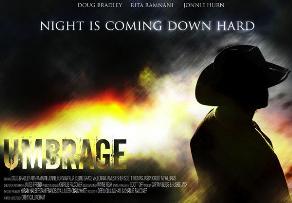
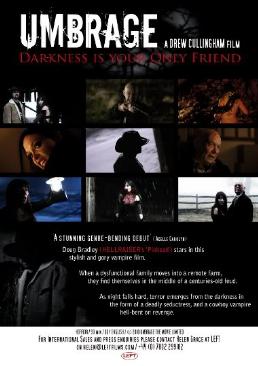
Umbrage: The First Vampire

Director: Drew Cullingham
Writer: Drew Cullingham
Producers: Drew Cullingham, Charlie Falconer
Cast: Doug Bradley, Rita Ramnani, Jonnie Hurn
Country: UK
Year of release: 2011
Reviewed from: screener (Left Films)

‘Umbrage’ is a great word, isn’t it? It stems from the Latin ‘umbra’ meaning ‘shadow’, from whence we also derive such brilliant words as ‘penumbra’, ‘adumbrate’ and, of course, ‘umbrella.’ Its only previous significant artistic use that I know of was ‘Takin’ Umbrage’ by The Federation, a 1988 comedy single which spoofed The Archers.

Now here comes Umbrage: The First Vampire; no relation to Blood: The Last Vampire and the vampire here isn’t called Umbrage, although there is some talk of shadows. It was shot as just Umbrage.

First: confession time. I was really looking forward to watching Umbrage, which has a cool-looking trailer and some reliable people in front of and behind the camera. But despite my best efforts to enjoy the film, I found it disappointing, frustrating and ultimately unsatisfying. Which is a real shame, because it’s trying to do something different and in many respects does it well.

It is, for example, a good-looking movie. Any time I see James Friend’s name in the credits I know I’m in for a visual treat. For my money, he’s one of the best cinematographers working in British indie films. The production design by Charlie Falconer is also good and Scott Orr (The Zombie Diaries) provides a small number of decent gore effects.

Where the film falls down, as so often, is in the script. Drew Cullingham was writer, director, producer (with Falconer) and editor. When a single individual has that much input into a film, there’s potential for a pure, unsullied, personal vision to shine through - but there’s equal potential for major problems to be glossed over or ignored.

The threat here is ill-defined, and that’s a serious problem in a horror movie. It’s never clear what sort of danger our characters are in or why, so it’s difficult to feel any tension or indeed empathy. The threat is vampiric, but the vampire’s motivation is not clear and, in fact, that’s the greater problem right there. None of the characters have a clear motivation for their actions and as a result their actions don’t make sense.

Everything that every character does in a film has to be for a reason. It has to serve a purpose. Actually two purposes. It has to serve a narrative purpose, either progressing the plot or revealing the character (or both) but it must also serve a purpose within the reality of the story. It has to be exactly the sort of thing which that character would do in that situation. And if it’s strange or odd or unlikely or very different to what most people would do in a similar situation, then that difference must be justified and explained, whether at the time or retrospectively.

For example, imagine that you are a husband with a heavily pregnant wife expecting your first child. Would you, only days before the baby is due, in the middle of winter, move into an isolated 17th century farmhouse 20 miles from the nearest town which has no telephone connection and no mobile signal?

Or perhaps you’re going camping in the woods with your mate. (Actually, does anyone outside of horror films realy go camping in the woods? Everyone I’ve ever known who likes camping pitches their tent in fields, or maybe on moorland, or maybe (if they’ve got any sense) on a campsite. Or if they’ve really got sense, they stay in a hotel. But who camps in a wood?)

Anyway, you and your mate have pitched your tent amid the trees and necked a bottle or two of wine when a softly-spoken, attractive young woman appears, not wearing any sort of outdoor gear, claiming to be a birdwatcher looking for owls. After a few minutes, she leads your horny friend off into the darkness and shortly afterwards you hear him scream in terror. You find him, trouserless, face and crotch both full of blood, his dismembered member a few feet away. The girl, who is calm and bloodless and gives every impression of being on drugs, tells you that “the shadows came alive.”

Would you leave your critically injured mate there to die, not even bothering to offer him any comfort, and leg it through the trees with the apparently stoned girl? Really? Why would you do that when the most likely explanation is that your friend was attacked by either her or an accomplice?

Now go back to pretending you’re the expectant father. In the middle of the night, two strangers bang on your farmhouse door. One is in a panic and has obviously been drinking heavily, the other appears to be blissed out. The panicky one reckons that the silent, smily one told him that “the shadows came alive” and that’s why you must let them in because they’re in terrible danger.

I realise that you, in this role-play, cannot call the cops because you have no phone (though you do at least own a shotgun). Nevertheless, would you just invite this drunkard and his junkie girlfriend into your house to sit down next to your already stressed, heavily pregnant wife?

Do you see what I’m getting at here? One more for good luck. Our dad-to-be (played, did I mention, by Doug Bradley) is an antiques dealer and he has come into possession, somehow, of a large Babylonian obsidian mirror (obsidian is a kind of black, volcanic glass). I’m not sure the Babylonians made mirrors from obsidian (though the Aztecs did). Anyway, this thing is absolutely priceless, the oldest known example, in perfect condition - so why would you have it delivered by courier to an uninhabited farmhouse with instructions to just leave it in the barn? And why, having taken it out of its rather rudimentary packaging, would you be careful to remove the cardboard and paper from the barn but leave this 5,000-year-old, irreplaceable artefact propped up on a hay-bale where it could easily get scratched, knocked or broken?

All of these actions (and others) serve a purpose in progressing the plot but serve no purpose within the reality of the film. Time after time, characters behave in a way which is illogical, inexplicable or just downright nonsensical - but expedient. These are all the sorts of problems which should have been sorted out before the film got anywhere near even pre-production. This is why you do multiple drafts of scripts. And at every stage, the writer (or the director or producer - except here they’re all the same guy) should ask the questions that viewers and reviewers will ask. Why is he doing that? Why did she go there? What is the reason behind this decision that nobody in their right mind would make?

Let me give you a practical example, to prove that I’m not just blowing smoke rings here. I was recently doing some writing-for-hire on a script about a Victorian dentist whose schtick is that he makes the best dentures in London. He manufactures false teeth that are better and more realistic than even the finest porcelain, so that none of his competitors can work out how he does it. The dentist’s secret is that he steals teeth from orphans (the rotter!) and then has them polished to perfection by a colony of captive tooth fairies (the swine!).

All well and good, but if I was reviewing a film like that I would ask three pertinent questions (as, I’m sure, would you). (1) Why don’t the other dentists just assume that these perfect false teeth are made from real teeth? That’s kind of the obvious explanation, isn’t it? (2) How would this work, given that children’s teeth are significantly smaller than adult teeth? And would get even smaller if you polished them? (3) Why does he need the tooth fairies? Any fool with a magnifying glass can polish a tooth.

One Sunday morning I was lying in bed, turning things over in my mind, and came up with the following.

The only way to make false adult teeth from children’s teeth is to use three or four child teeth for each adult one, carefully cut and shaped into perfect building blocks. Such precision dental engineering, and the polishing of cracks between blocks to the point of invisibility, is the sort of thing that would be virtually impossible for even the most careful person - but not for tooth fairies. And because small children’s milk teeth have a different structure and slightly different chemical composition to adult teeth, when the other dentists examine these gnashers they can see that they are plainly not just polished human teeth, but they can’t work out what they are.

All three problems solved in one fell swoop. If that film gets made (and if they use anything from my draft) we won’t have audiences asking those three obvious questions.

So, Umbrage-makers, this is what should have been done here. A coherent, credible reason needed to be found for the antiques dealer to cut his family off from civilisation just before the baby is due; for the camper to abandon his gruesomely injured, dying friend without so much as a backwards glance; for the obsidian mirror to be in the barn; and all the rest of the script’s improbable unlikelihoods.

Jacob (Bradley) and his wife Lauren (Grace Vallorani: The Last Seven) are accompanied by Rachel (Rita Ramnani: Jack Says, Just for the Record, Strippers vs Werewolves), his resentful 18-year-old goth stepdaughter from a previous marriage which ended with Rachel’s mother’s suicide just a year ago. So crikey, he wasted no time, did he? Jacob and Rachel share a secret which, when we learn it towards the end of the film, actually shows that they are both terrible people, but at about the same time their characters clumsily change, especially Rachel’s, so that we are apparently supposed to like them and empathise with them even more.

Camping pals Stanley (James Fisher: Hellbride, The Devil’s Music) and Travis (Scott Thomas, also in The Devil’s Music) would seem to be significant among this small cast and we spend quite a lot of time with them but, in retrospect, it can be seen that they are entirely irrelevant to the actual plot. There is no indication of why the girl Lilith (Natalie Celino, who was in unreleased 2008 action-horror pic Furor: Rage of the Innocent) kills Travis, nor of why she doesn’t kill Stanley.

Lilith is, of course, a vampire. She’s actually the mother of all vampires, the woman who, according to some ancient Jewish legends, was Adam’s first wife before Eve was created from one of his ribs, who was later seduced by the archangel Sammael, an analog of Satan. A prologue set in the old west has tall, fit cowboy Phelan (Jonnie Hurn, who was the wheelchair-bound stepfather in Penetration Angst and also in both Zombie Diaries pictures) hunting down stout cowboy Sammaelson (AJ Williams or, as the IMDB has it, Aj Williams) but being attacked by Lilith who bites a chunk from his neck. This, I suppose, is how he becomes The First Vampire.

Sammaelson is, therefore, either the devil or the son of the devil, but this sort of thing can only be gleaned from the Making Of, not the feature itself, where it is explained by ‘AJ Williams’ under his real name of Drew Cullingham.

This prologue and a subsequent, largely incomprehensible flashback, were shot on 35mm in the fake western town of Laredo, Kent, which I think is where a certain 3D comedy horror western musical was filmed. Everything else was shot on the Red camera. Thing is, the 35mm wild west scenes have then been tinted sepia, thus completely negating James Friend’s cinematographic skills. What’s the point of that?

Phelan turns up in Jacob’s barn 120 years later, still wearing a stetson but otherwise dressed in 21st century cowboy casual. He has been searching for Lilith all that time to take his revenge. I’m not sure what part the obsidian mirror plays in all this but at the end the two supernatural beings somehow disappear into the stygian reflector and reappear in Chiselhurst Caves.

Just in case we weren’t sure that this is the quasi-Biblical Lilith, there is also a flashback to, good grief, the Garden of Eden. Wait, is this a creationist horror film? Lilith is naked and so is Adam (Jason Croot, writer-director of horror mockumentary Le Fear) who is portrayed as a sort of Cro-Magnon caveman so maybe it’s not creationist after all.

NB. All my knowledge of Lilith was gained from her entry in Wikipedia and it’s quite possible that this was where Cullingham did his research too, as her appearance in the caves is obviously modelled on the 1892 John Collier painting at the top of her Wiki-page (complete with very large, very real snake draped around Ms Ramnani’s curvaceous, naked frame).

As for the shadows, I’m really not sure what’s going on there. At one point Stanley and Rachel are both attacked, quite savagely, by something invisible while they’re outside but Lilith sits placidly indoors. What are these ‘shadows’? What connection do they have to Lilith? And why did anyone think it would be scary in any way to have characters attacked by invisible things in the dark?

Umbrage is a mishmash of ideas that hasn’t been properly worked out. I’m all for horror westerns: Cowboys and Zombies was terrific. I’ve nothing against British westerns, not that’s there’s many to choose from. But trying to combine vampirism with the wild west and ancient Talmadic myths, all in a contemporary rural setting, centred on a dysfunctional family is a step too far, especially when there’s no real thought given to coherent motivation for any of the characters.

I feel a bit bad knocking the film like this because clearly Cullingham and his cast and crew worked very hard. The Making Of reveals a host of problems from malfunctioning generators on night shoots to Celino suffering an injury during a fight. A massive snow-fall halfway through production had to be incorporated into continuity and some of the shooting days lasted for more than 24 hours solid.

But this Making Of fails even more than the feature, skirting around what sounds like a real struggle against the odds to concentrate on amateurish shaky-cam interviews with clearly distracted cast and crew, of the sadly traditional “What are you doing now?”/”Can you describe your character?” type. Special sympathy for Scott Orr who graciously tries to answer the single most inane question ever included in a Making Of featurette: “So what’s it like being a Scottish special effects artist?”

Interwoven with these uninformative, uninteresting soundbites is a pretentiously black and white sit-down interview, post-completion, with Cullingham in what looks like a fancy restaurant or bar. While he is able to offer some insight into aspects of the film that don’t come across, he sounds smug, self-satisfied and complacent. Extraordinarily, the on-screen interviewer, ‘Making-of documentary director Ian Manson’, captions himself not just once but three times - in a film which is only about 20 minutes long! No offence, mate, but not only did we see the caption the first time, but also: we really don’t care.

Given the troubles and travails of the production, this Making Of is a huge missed opportunity for a sort of low-rent Lost in La Mancha. Consider what Anthony Pedone managed with Camp Casserole despite the film under scrutiny running smoothly without a single problem, what could a really good director have made of The Making of Umbrage? In fact, this could have been one of those rare situations where a DVD is recommended on the basis of an okay film accompanied by excellent extras, But instead we just get 20 minutes of dad-can-I-borrow-the-camcorder interview clips with bored, tired cast and crew who have nothing to say, plus the black and white Ian Manson show.

I was disappointed with Umbrage because it wasn’t the film I was looking forward to, but I was really disappointed with the Making Of because it wasn’t the film it so obviously could have been. Also on the disc are a trailer, a music video (for the song in the trailer) and the full version of the Doug Bradley interview from the Making Of, in which he starts by patiently explaining that he’s best known for playing Pinhead in Hellraiser. Doug’s a pro and he’s used to this sort of thing by now. Since I last saw him on the set of Pumpkinhead 3, he has appeared in (or provided a voice for) a range of UK and US features including The Cottage, Ten Dead Men, Jack Falls, The Infliction and most recently The Reverend.

Mention should be made of the Umbrage soundtrack which features a range of interesting ‘new country’ tracks that give the film a very unusual feel. In many ways, the music is the best part: strikingly original, well-chosen, integrated with the action but never dominating. And often toe-tappingly good - yeeha! The actual music credit is ‘Captain Bliss and Huskie Jack’, two musos who have, very impressively, toured as part of John Mayall’s band!

On the aural downside, whenever character voices are distorted in spooky, demonic ways, they become nigh on impossible to understand. Victoria Broom (Zombie Women of Satan, Dead Cert, Forest of the Damned 2) is credited with ‘special FX voices’.

James Friend’s other recent credits include Stalker, Dead Cert, Jack Falls and Ghosted. Scott Orr worked on Evil Aliens and A Day of Violence while make-up artist Pippa Woods has a CV that includes The Reeds, Stalker, Doghouse and Elfie Hopkins. Cullingham and Falconer have also worked (as DP/co-writer and production designer) on Tim Biddiscombe’s thriller NightDragon (also with Fisher and Thomas in the cast). A significant number of the cast and crew worked on The Zombie Diaries or its sequel and that film’s Michael Bartlett gets a curious credit here as ‘guest director’.

If you want a British vampire western, this is probably the best you can pick. Doug Bradley buckles down to his usual reliable performance, some of the other acting is also good (some less so) and there are some clever moments. But Umbrage - which was retitled A Vampire's Tale in the States -  could have been so much better and its problems stem not from any unexpected snowfall or malfunctioning generator but from a poor script which was nowhere near ready to shoot.

MJS rating: C+

Review originally posted 17th September 2011

Saturday, 7 December 2013

Jesus vs the Messiah

Director: Alan Ronald
Writer: Alan Ronald
Producer: Debbie Attwell
Cast: Simon Phillips, Gemma Deerfield, Danny Idollor Jr
Country: UK
Year of release: 2007
Reviewed from: screener


When you’re watching a film, certainly when you’re watching it for review purposes, a phrase will often pop into your head. Some pithy combination of words will suggest itself, usually about 30-40 minutes in, which perfectly sums up what the film is or does or wants to be. As I watched Alan Ronald’s debut feature Jesus vs the Messiah, having started from a point of knowing nothing whatsoever about the picture, not even whether it was a drama or comedy, three words aligned themselves along my neurons and I realised that I was viewing an existential British western.

British westerns are few and far between; ones about the Son of God are even rarer.

There is little actual western iconography here. One character refers to another several times as “a cowboy” but that’s just because he’s wearing a broad-brimmed leather hat (the director’s own). It’s not really a Stetson, in fact with his long leather coat it makes him look more like a big, black Van Helsing (without the crossbow) than John Wayne or Gene Autry. The excellent score, mostly based around a strummed guitar, manages to evoke vaguely western feelings without ever being an Ennio Morricone pastiche. But the real clue to the genre here is the characters and their situation.

This is a three-hander - two men and one woman - and all three people are lone drifters. She lives in a car, one man has a flat and another home whose location he has forgotten and the other fellow we’re never told anything about, except that he spends his time chasing the first chap. Apart from these three and one barfly featured at the start, the only ‘characters’ are a barman and a waitress, the sort of human furniture that fills the mise-en-scene of a western without having anything approaching a personality. Our three protagonists (well, two protagonists and one antagonist, I suppose) move through a largely empty world, rarely interacting with the rest of humanity. The first half of the story is set in an urban locale, the second half is more rural but everywhere seems empty, the widescreen cinematography turning Paisley car parks and Loch Lomond hillsides into dusty plains.

There are just enough clues to show that this isn’t just my interpretation, this is an intention on the part of Alan Ronald to turn Scotland into Arizona, a sort of Wild West Lothian.

The aforementioned barfly is a hulking Glaswegian bastard whose hobby is forcing strangers into drinking contests. When he makes a move on a woman in a bar and is rebuffed, he doesn’t take kindly to the situation and takes even less kindly to the bearded bloke along the bar who asks him to leave the lady alone. Forced by the thug’s associates to sit down and knock back shots of something which probably tastes like furniture polish, the mild fellow protests feebly but nevertheless emerges triumphant (as the fat bloke brings up his lunch) only to collapse shortly afterwards.

Awakening in the back of the woman’s car, the two introduce themselves warily. She is Sally (Gemma Deerfield: Dawn of the Zombies, Violet, Caped Fear), he eventually admits that his name is Jesus (Simon Phillips: Idol of Evil, Jack Says). It’s pronounced the Biblical way – he’s not Spanish. “You must have had some fucked-up parents,” says Sally. Of course, when a character is named Jesus (he asks her to just call him J) the audience immediately starts wondering whether he really is The Jesus. Especially when he’s in a film with an obviously religious (if apparently contradictory) title like Jesus vs the Messiah. And especially when he has a beard. If there’s one thing that everyone agrees on about the Son of Our Lord, one thing which unites all the different factions and denominations in peaceful unanimity, it’s the universally accepted fact that Jesus had a beard. And was white.

Sally warily accepts J’s offer to crash at his flat but in the morning he finds that his wallet is missing. Being more astute than J, Sally realises that the fat bastard at the bar has it and returns there to retrieve it, which she does. But into this otherwise-deserted-at-this-time establishment comes a heavily built, stoney-faced fellow (Danny Idollor Jr, adopting an American accent, who claims to have been in Buffy the Vampire Slayer although I can’t find any trace of this online) who is searching for J and has no qualms about killing people - with fists or pistol - who get in his way. We have already seen him inexplicably kill some unnamed extras in other situations.

This is ‘The Messiah’ although he is only identified as such in the end credits (and by dint of being the antagonist who is ‘vs’ Jesus). The character is never named on screen although it is surely significant that he addresses J, when they meet as “Brother.”

J turns up at the bar, tries to rescue Sally and has to be rescued in turn from this seemingly unstoppable black behemoth, who is left out cold on the floor. There is a fair amount of people being smacked on the head with objects in this film, usually hard enough to knock them unconscious and, to be fair, a few situations where further blows were required would have been more realistic (but that’s a petty and irrelevant complaint about what is otherwise an absolutely cracking film).

Sally and J, who still don’t trust each other, retreat to a cafe for breakfast and hatch plans to get away from the city but the Messiah tracks them there and persuades J to go with him. This is the magic of the relationship here, into which Sally intrudes: Jesus and the Messiah are in opposition but they both know that Jesus has a destiny and it is the Messiah’s duty to see that this destiny is fulfilled. Just like the Terminator, ‘he can’t be reasoned with, he can’t be bargained with and he absolutely will not stop.’

Over the course of 100 minutes or so we see how Jesus and the Messiah give meaning to each other’s lives, and how Jesus and Sally can give meaning to each other’s lives (there is not even a hint of romance, which is refreshing). Sally never twigs that J is actually the Son of God until J confesses the truth near the end so the audience always has an advantage over her.

But is he? That’s the marvellous thing about this film. We’re dummied into thinking that we’re watching a religious film but then Alan Ronald throws in just enough doubt to make us realise that these two men could just be a couple of fucked-up loners. They’re certainly fucked up, as indeed is Sally, but are they fucked up enough to believe that they’re the Son of God and his Nemesis? Or are they fucked up because they are the Son of God and his Nemesis? Like the best existential movies, JVTM doesn’t provide answers but it does raise some fascinating questions.

This is a thought-provoking film but it’s far from heavy. There’s a bit of action, plenty of tension and a vein of dark humour running through the whole thing, best exemplified by probably the greatest walrus scene in the history of British cinema. I can see this film being a hit at festivals and provoking plenty of internet discussion once people have had a chance to see it. There’s always something fascinating about religious authority figures unafraid to indulge in righteous violence, whether it’s Garth Ennis’ Preacher or the gun-toting priest in Bram Stoker’s Shadow Builder (or indeed my own unproduced TV pilot Padre - ask me about it sometime).

This is also a beautiful film, very much a cinematographer’s film, not surprising as Ronald is a DP by trade whose credits include Pat HigginsTrashHouse, HellBride and KillerKiller (plus camera op on The Devil’s Music, in which he was so memorable in front of the camera as stoned drummer ZC). Ronald uses the widescreen image not just as a window but as a frame, always aware of the shape of the things that make up the picture, whether its an extreme close-up of a character’s eyes or a panoramic landscape with a single figure.

As well as being a terrific movie - a masterful combination of great photography and fascinating characters trapped in an intriguing situation - JVTM is also a triumph of minimalist production in having only five crew. Al Ronald himself wrote, directed and edited and handled the camera. Producer Debbie Attwell was also 1st AD, script supervisor, line producer and stills photographer and also also found time to produce and edit the forty-minute Making Of (which can be found in four chunks on YouTube). Attwell is also an actress who had small roles in TrashHouse and The Devil’s Music. She and Ronald have a long history of working together which includes the short films Sabbat, The Gloop and Blood Bank plus a music video which was included on the German DVD of Suspiria(!) although Ronald’s apparent ambition to star Attwell in a feature based on the Marvel Comics character the Black Cat is pure wish fulfilment I suspect... Attwell’s other genre credits include the atmospheric short film The Train Now Arriving and the spoof Bikini Zombies from the Moon, both for Shock! Horror! Probe! Productions.

The other three crew members were all in the ‘sound department’, which might explain why the sound production and mixing - so often the thing that lets low-budget movies down - is top-notch here. Andrew ‘Biscuit’ Byars was sound recordist (and stunt driver - not a common combination in the industry!) while Craig Woods and Ben McNeill shared duties as sound assistants, production assistants and boom ops. The only other people credited on the film are Al’s brother Gordon Ronald who was ‘pre/post-production assistant’ and shares a foley credit with Al; composer Eli Stone (Al Ronald and Andrew Byars are credited with additional music); executive producer Lee Thacker; and David Smith who made a rather important wooden prop. Gordon Ronald also has the distinction of having originated the long-coated, leather-hated title character in Ronald and Attwell’s short film Messiah, included in the Making Of.

All three leads are excellent in their respective roles, creating believable characters within a barely believable scenario from nothing but hints and suggestions. Ronald, Byars and Woods all make cameos as headbanging victims of the Messiah in an early shot unconnected to the main story while Attwell plays the waitress in the cafe. Alistair Rodger is the guy in the bar and John Lavelle plays the barman.

Technically and artistically a triumph, Jesus vs the Messiah benefits above all from an excellent script which makes us care about these characters and think about them too. It never establishes for certain whether the two men are in fact supernatural entities or just two guys with mental health problems. More than that, it makes it clear that it doesn’t matter which scenario is true. The film works equally well if you believe they are or they aren’t, or indeed if they both are and aren’t at the same time. It doesn’t matter - and that’s the whole point.

The film premiered at a festival in Leith in June 2007. In an example of the coming trend, it is not available on DVD yet but can be purchased as a download from Film Annex for a very reasonable six dollars.

MJS rating: A
review originally posted 23rd April 2008

Wednesday, 16 October 2013

Hellgate

Director: William A Levey
Writer: Michael O’Rourke
Producer: Anant Singh
Cast: Ron Palillo, Petrea Curran, Joanne Ward
Country: South Africa
Year of release: 1989
Reviewed from: R2 DVD (Anchor Bay)


This may possibly be the worst horror film of the 1980s. Hellgate is completely nonsensical and neither scary nor entertaining in the slightest. It is like watching randomly selected scenes from completely different films, all of which star the same actors wearing the same clothes. This is one of those films where you can’t actually tell, just by watching, whether or not it is a comedy. I’m still not sure and, frankly, it doesn’t matter because even if this was supposed to be funny, that doesn’t excuse or explain the cut-price special effects, the lousy acting, the appallingly bad production design, the hopeless direction or the utterly inept editing which seems to have been done in a shed with a pair of garden shears.

Nor, for that matter, does it excuse the awful 1980s fashions and hairstyles, but there’s not much anybody could have done about them, I suppose.

Blonde Chuck (Evan J Kliser: Space Mutiny, American Ninja 3, American Kickboxer), his short-haired girlfriend Bobby (Joanne Ward: Night of the Cyclone) and their permed friend Pam (Petrea Curran) are telling each other ghost stories in a lodge which they have rented while they wait for Pam’s boyfriend Matt. Bobby tells the others the story of the ‘Hellgate Hitchhiker’ which apparently everyone around there knows (suggesting that Bobby is local although this doesn’t otherwise seem to be the case).

“It all happened a long, long time ago,” she says, “way back in the 1950s.”

This is the first and last decent line of dialogue in the entire film.

Four bikers on three bikes roar down the highway in this opening flashback, demonstrating how hard they are by clenching their fists at each other in a display of macho posturing which would - in a more intelligent film - clearly identify them as homosexuals. They stop at a large isolated diner with a big neon sign - it looks more like a nightclub from the outside - which has a gas station next to it. Inside, they throw out all the customers apart from one bloke whom they seem to know so he might be another biker but there is no explanation.

The bikers harass the waitress (Lynda Powell) and then, when an attractive young woman enters, decide to have some delinquent fun. This is Josie (model Abigail Wolcott in her only screen role; she now markets a range of skin-care products and is married to celebrity chef Tom Valenti): tall, slim, ponytailed, softly spoken. The bikers grab her, rip her skirt off and - when the diner’s cook (Tom Hoskins) appears with a shotgun - carry her out to their hogs and roar off.

They head up to ‘Lucas Carlyle’s Hellgate, an authentic 1890’s ghost town’, as it says on a sign over the entrance, complete with incorrect apostrophe. This appears to be some sort of tourist attraction although it is clear that the makers of this film didn’t really work out what it was supposed to be. Basically it’s a collection of new-looking (and flimsy-looking) wooden buildings in the style of the 1890s but with flashing fairy lights strung along every roof. Various people wander up and down the main street, despite this being the middle of the night.

The hoods torment Josie in a sequence which seems gratuitously misogynist even to me (and I’m someone who loathes film critics who accuse films of misogyny so that should indicate quite how bad this is). She runs away but is cornered down an alley by the two lead bikers, Zonk (Lance Vaughan), who looks like Gary Busey, and Buzz (Frank Notard: Rebel Storm) who looks like the lead singer of Dexy’s Midnight Runners.

No, honestly. Zonk.

A moustachioed fellow who bears a passing resemblance to John Astin appears and yells, “Stay away from my daughter!” This is Lucas Carlyle himself, played by Carel Trichardt. He flings an axe into Buzz’s head at the same time that Buzz flings a chain which wraps itself around Carlyle’s left wrist, almost severing his hand. As Zonk revs up his bike to leave, Carlyle uses his other hand to throw a knife although we don’t see where that goes because of the crap editing.

There is absolutely no indication of what happens to the other two bikers, identified in the credits as Fast Freddy (Alan Pierce) and Nervous Norman (Jonathan Taylor) but as they share a bike and one of them is what is known (I believe) as a ‘bear’ it’s not unreasonable to assume that they got married and lived happily ever after. Zonk makes it back as far as the garage next to the diner where we see him remove the knife from his thigh, producing the traditional spurt of blood. (You know, a severed vein just causes blood to well up. If the blood is pumping out in rhythmic spurts that means an artery has been sliced and the victim is going to die very, very soon unless a tourniquet is applied immediately and urgent medical attention sought. But anyway...)

Back in 1989-era present day, Bobby continues with the story...

Some time later, business is poor at the ‘ghost town’; this second flashback is the only time we see the place in daylight, incidentally. There are a few simply written notices attached to various buildings but no sign of any marketing or, I don’t know, prices or anything. No real attempt has been made to make this location - whatever and wherever it is - look like an actual tourist attraction, successful or otherwise.

We now meet Jonas (Victor Mellaney: Safari 3000, Cyborg Cop II, Operation Delta Force II, The Last Leprechaun), a grizzled old timer who helps out around Hellgate fixing things. He goes into a small cave which is supposedly dressed up as a fake gold mine but which in actual fact merely has a sign inside saying ‘Genuine gold ore nuggets’. In attempting to repair this sign, Jonas is distracted by the crappiest looking, plastic, joke-shop bat that I have ever seen. He whacks it with his shovel - an essential tool for anyone planning to repair a notice on the wall of a fake cave, apparently - and it falls to the floor.

Then Jonas sees a pulsating blue light coming from behind some rocks and discovers a large, glowing crystal which fires a beam of blue light at the bat - which promptly flies up off the ground again. The old man rushes off up to see Carlyle, who lives in a huge mansion within easy shuffling distance of the ‘town’.

Now, it is not clear when this flashback takes place as everyone wears fake period clothes but it seems to be closer to the 1950s than the 1980s. Carlyle has a large black and white photo of his daughter on the wall behind his desk and we are meant to think that Josie died that night that the biker gang (whom we later learn were called ‘the Strangers’) came to town. But if so, why does she have very 1980s hair and make-up in this portrait? Well, apparently because the film-makers merely used a photo from Abigail Wolcott’s modelling portfolio and weren’t bothered about the anachronistic styling.

Anyway, Jonas shows Carlyle the crystal and tells him about the bat. Carlyle decides to test the crystal’s life-restoring properties on a goldfish, swimming in a much-too-small bowl on his desk, despite the fish not actually being dead. Zapped by the ray, the fish grows and mutates into an ugly fish monster, shattering the bowl and subsequently exploding. Carlyle then turns the ray onto a stuffed turtle which he just happens to have lying around and the thing comes to life as a distinctly shoddy hand-puppet. Delighted, Carlyle sticks his laughing face right up against the turtle’s beak and is promptly savaged.

You would think that any film which features a man being attacked by a zombie turtle would be at least slightly entertaining. But you would be wrong.

The turtle then explodes.

Finally the crystal blasts a beam at Jonas who suffers through a series of incremental make-ups which show him either getting old or melting (it’s not clear) as he screams and starts to smoulder.

He also explodes, albeit off-screen.

Carlyle of course thinks that he can use the crystal to bring his daughter back to life; his daughter who is buried in a large, genuine cemetery just outside the minute, fake town, under a slab surmounted by a crude, life-size, recumbent statue of herself.

Has any of this made any sense yet? No? Well, buckle up because we’re just getting started.

Now we see Matt (Ron Palillo from Friday the 13th Part VI, top-billed here as token name value on the basis of having been in a 1970s sitcom called Welcome Back Kotter; he was also the voice of the title character in a cartoon series called Rubik the Amazing Cube), stopping off at the diner from the first flashback where he is chatted up by the waitress (Kimberleigh Stark: Cyborg Cop I and II, Project Shadowchaser II, Terminator Woman). He also buys some gas from the garage which is now run by Zonk (Lance Vaughan again, with some really, really bad make-up and hair that does absolutely nothing to make him look 30 years older). Back out on the road, Matt nearly knocks down a mysterious woman clad in a white shift, whom we recognise as Josie. She has lost her ponytail and her 1950s innocence and now has the ability to affect cars (although it’s unclear in what way) using her glowing eyes.

Thinking she’s not well, Matt offers to drive her home, a journey which takes them through Hellgate where he sees people wandering around in a daze, including (we notice, briefly) Buzz. At Carlyle’s mansion, Josie tries to seduce Matt but they are interrupted by the arrival of Lucas Carlyle himself. Carel Trichardt’s ageing make-up is not as bad as Lance Vaughan’s but is still not convincing. Carlyle has a stump where his chain-damaged hand was removed (except of course his fore-arm is now that much longer) and three metal clamps on the side of his head, presumably repairing the damage down by the zombie turtle.

Before it exploded.

(Incidentally, although Carlyle did indeed use the crystal to resurrect Josie, there is no explanation of why she didn’t explode too.)

As Matt makes his escape, Carlyle blasts a couple of rays from the crystal: the first causes a small explosion, the second slices the end off a water-ski sticking out of the back. When Matt makes it to the lodge, Chuck is annoyed to see that his water-ski is damaged. There is never any other suggestion that any of this takes place anywhere near the sea.

After Matt and Pam have made out because they haven’t seen each other for nearly a day(?), Matt and the girls head off to the diner (in a purple jeep) to eat - with only a cursory explanation of why Chuck isn’t with them. On leaving they drive as far as the gas station (ie. next door) before Matt yells to stop the car because he has to explore the place. He finds some newspaper cuttings about the disappearance of Buzz, which look rather less than 30 years old, and is then thrown around the room by Zonk before leaping into the back of the jeep, which roars off.

Picking up Chuck, they head up to Hellgate, which still has those same twinkling fairy lights. In the cemetery, Matt finds his jacket (which he had lent to Josie) being worn by the statue on her grave, even though the statue is lying down. When they actually enter Hellgate, things start to get really weird.

From this point there is nothing to be gained by my trying to recall the narrative sequence of events - because there isn’t one. Here are some of the things that happen:

    • Bobby sees a piano playing itself. A man appears from nowhere, playing it, then fades away. The others tell her it’s just a player piano.
    • A curtain is pulled aside to reveal an attractive woman, who smiles at the boys then walks away through a wall. Despite this ghostly activity, Pam protests, “She’s a zombie.”
    • The quartet find a dozen or more classic cars, some of which have been there since the 1960s according to the documents inside. Chuck proposes taking a couple and selling them. Bobby is nearly grabbed by a cadaverous, Cryptkeeper-like ghoul in one car. Then all the headlights come on at once.
    • Dead bodies rise from the graves in the cemetery.
    • Dead-looking people materialise in chairs.
    • A small crowd of zombies advances down the main street but is completely forgotten about a minute or so later.
    • Bobby announces, “My ankle’s sore. I think I’ve twisted it.” This is notable for two reasons: because her pronunciation makes it sound like “My uncle’s sore” and because how can you only think you’ve twisted your ankle? A sprain, a fracture or a break can’t be determined without a medical check, but you either twist your ankle or you don’t. There can’t be any element of doubt. It’s like saying. “I think I’ve got a headache.”
    • Carlyle takes the keys from the purple jeep, carries them a few yards down the street then just drops them on the ground. When Chuck and Bobby make it to the jeep, Chuck goes looking for the keys and fortuitously finds them. At this point, Carlyle slices the young man’s head off with a sign. Yes, a painted sign that apparently has razor-sharp edges. In the actual effects shot, it is noticeable that Carlyle is wearing the moustache and costume from the 1950s scenes, rather than the metal faceplates and 1980s costume which he wears in the shots before and after.
    • Bobby, understandably traumatised, finds Matt and Pam but they leave her in the saloon (“Can you think of a better place than a saloon?” asks Matt, without a hint of irony). She looks at the stage - or rather, we cut to the stage, because there is nothing to indicate that this is in the same room - where she sees an MC appear out of thin air. This bearded, bowler-hatted, English-accented chap tells a couple of crap jokes and then introduces five cancan dancers (who also fade into existence), the last of which seems to be Bobby herself. Except that crap direction means we never get a good enough look to be sure, and there is no reaction on Joanne’s face because it looks like the actress wasn’t even told what she would be seeing.
    • While Bobby watches the dance with a glassy expression, Carlyle appears behind her and puts a length of stout rope across (not around) her throat, which causes blood to dribble from her mouth. When we cut back to her after another shot of the dancers, she is dead. There is a rope burn on her neck but no sign of blood on her chin.
    • Every so often, we cut to shots of Josie, lying on a bed and murmuring, “Matt...” The make-up team have given her a pasty face but her neck, shoulders and arms are still nicely tanned.
    • We also get a couple of cutaway shots of Zonk, back at the garage, sharpening first an axe and then a machete.
    • Matt and Pam, attempting to escape, see the purple jeep pull up in front of them with the undead Bobby and Chuck in the front. So they take a different car and head up to the mansion (the one that old man Jonas was able to walk to).
    • Inside this colonial-style building are all the trappings of a gothic castle, complete with suits of armour and large amounts of cobwebs. Matt goes upstairs while Pam explores the kitchen - which doesn't match the rest of the house at all. Inside the fridge she finds a severed head which sings: “I just want my body.” (This is director William A Levey himself, apparently ripping off a gag from Young Frankenstein but without using a real song.) Pam says, “Get a grip of yourself!” and shuts the fridge door.
    • Upstairs, Matt is seduced, again, by Josie. Pam appears but is knocked to the floor. Josie then moves a knife very, very, very slowly towards Matt’s throat, giving Pam enough time to wake up, take in the situation and knock the knife away. Except she doesn’t knock the knife away, but Josie stops what she’s doing anyway.
    • Pam and Matt escape but find that Carlyle is on the roof of their car. Instead of just screeching to a halt and letting momentum take its course, they deliberately crash into a building. As Carlyle struggles to his feet, Zonk suddenly appears, standing on the back of the car, waving his axe and machete. Carlyle blasts him with the crystal and Zonk falls to the floor, never to be seen again.
    • The building collapses on top of Carlyle but as it seems to be made of only very light planking it’s no surprise when his hand emerges from the wreckage.
    • Matt and Pam drive away from Hellgate but stop close enough to look back and see the buildings blowing up for no apparent reason.


    There is undoubtedly more but I have blocked it from my memory. This should however be enough to demonstrate that there is absolutely no attempt at continuity or sense. I wondered at one point whether this was all supposed to be a nightmare, or a Carnival of Souls-type situation, but I don’t think it is because, apart from anything else, whose nightmare would it be? Most of the really weird things happen to Bobby and she dies before the end. Throughout all of this, incidentally, there is constant thunder and lightning but never a hint of rain.

    The number of questions raised is probably longer than the actual film script. Prime among them are:

    • Is the town inhabited by ghosts or by zombies?
    • Why does a fake town have a real cemetery?
    • What do Carlyle and his daughter actually do?
    • Why does Zonk go to the town and why do we only see him for about a second and a half when he gets there?
    • And possibly the most important question of all: can I get my money back?

    Actually, I’m reviewing this from the same disc that I was sent to review for SFX. I received the DVD on Friday, watched it on Saturday, wrote the reviews on Sunday and Monday and by Tuesday the disc had achieved that rare feat of being on sale in a charity shop before it was actually released.

    Hellgate really is unremitting shite from start to finish, scraping the barrel in terms of direction, script and production design to the extent that the crappy special effects and the wooden acting seem to rise by comparison to the level of mere mediocrity. A large part of the blame must lie with director Levey who started his career with the worst blaxploitation film ever made, Blackenstein, and followed it with Wham Bam Thank You Spaceman and The Happy Hooker Goes to Washington. This was his last film, thank the Lord. He may have been working from a crappy script, and perhaps the producer interfered, but much of the direction is simply incompetent. One of the most extraordinary things about the film is that it wasn’t directed by Alan Smithee, because it’s difficult to see why anyone would keep their name on this rubbish.

    Scriptwriter Michael O’Rourke wrote and directed two other crappy late 1980s horror movies, Deadly Love and Moonstalker, before disappearing from whence he came. Producer Anant Singh’s other credits include Sarafina!, Cry the Beloved Country, The Mangler and Bravo Two Zero. Observant readers will have gather by now that this film, although set in California, was actually a South African production. Cinematographer Peter Palmer was second unit focus puller on Shaka Zulu, which is about as low as one can go in the pecking order of crew members without actually doing the catering.

    Speaking of people with minor credits, the sleeve of this DVD repeats the claim from the original New World video that the film comes “from the special effects masters behind Hellraiser and Hellbound.” Which is odd as Bob Keen did the effects for those two movies. A close analysis of the credits finds that one of the members of Keen’s Image Animation team on Hellbound was Alan Hedgecock and that Allen Hedgecock is one of three people credited with the effects on Hellgate. It is obvious that he made only a very minor contribution to Hellbound and if he did any work at all on Hellraiser it wasn’t enough to get a credit. (An unpleasant addendum to this is that in 2007 Alan Hedgecock was found guilty of possession of child pornography and conspiracy to rape a minor and setenced to prison. - MJS)

    Astoundingly for such an ineptly edited film (or maybe not so astoundingly) there are three credited editors: Alan Baard, Max Lemon (Picnic at Hanging Rock and, um, Gor) and Chris Barnes - who started out working for Hammer on Plague of the Zombies and continued through to The Legend of the Seven Golden Vampires, fifteen films later. He also worked on The Last Horror Film, Masks of Death and Sammy's Super T-Shirt. No production designer is credited and that also says a lot.

    Also in the cast are Len Sparrowhawk (Terminator Woman, American Kickboxer, Zulu Dawn, Lethal Ninja) and Alan Granville (Black Terrorist, Prey for the Hunter) as a couple of deputies who decide not to go to Hellgate (so what was the point of including them?).

    Sometimes even crap films get a decent DVD release, but in this case the normally reliable Anchor Bay have apparently gone insane. Not only are there no extras of any kind, not even a trailer, they have actually listed the fact that the film is presented in the wrong ratio as a feature! The US release, also through Anchor Bay and double-billed with something called The Pit, was 1.77:1, formatted for 16:9. I’m not a stickler for aspect ratios but the ‘features box’ on the back of the UK sleeve actually crows “Fullscreen presentation (1.33:1)”. Just astounding. The film runs 87 minutes which matches the 91 minutes of the NTSC version; some sources list the original film as 97 minutes but I certainly don’t want to ever sit through another six minutes of this tripe.

    As somebody whose job it is to watch films that most people would consider “the worst film I have ever seen” I try to avoid using specious phrases like “the worst film I have ever seen” - but this really, genuinely is (one of) the worst film(s) I have ever seen. It is relentlessly, unremittingly, mindbendingly bad on every level and in every way without a single thing in its favour.

    MJS rating: D-
    review originally posted 13th February 2006