Showing posts with label gangsters. Show all posts

Saturday, 1 April 2017

Cryptic

Directors: Bart Ruspoli, Freddie Hutton-Mills
Writers: Bart Ruspoli, Freddie Hutton-Mills
Producers: Bart Ruspoli, Freddie Hutton-Mills
Cast: Ed Stoppard, Vas Blackwood, Ray Panthaki
Country: UK
Year of release: 2016
Reviewed from: DVD
Website: http://nextlevelfilms.co.uk

Cryptic is an amazingly good film. By which I don’t mean that the quality of the actual movie is staggering. Yes, it’s good – but it’s not perfect and it won’t blow you away. What I mean is that the fact that Cryptic is a good film – is amazing.

Because of who made it. This is the third horror film from the team of Bart Ruspoli and Freddie Hutton-Mills. They also wrote/produced the middling zombie time-waster Devil’s Playground and wrote/produced/directed the ridiculously titled World War Dead: Rise of the Fallen which, in a crowded market-place, manages to stand out as one of the very worst found footage pictures ever made in this country.

World War Dead was actually made after Cryptic but released first. My understanding is that the executive producers approached Ruspoli and Hutton-Mills, asking them to quickly bang out a zombie picture that could tie in to the centenary of the First World War (tasteful…). Can’t really blame the guys for taking the money and running, and the number of people who have suffered through WWD:ROTF must be pretty minimal, but still it’s not a good film to have on your CV. So it’s fortunate for the duo that Cryptic, which is significantly better than Devil’s Playground and infinitely better than the execrable World War Dead, is now out there to be viewed.

This has certainly revised my opinion of BR and FHM. I was genuinely surprised not just by how much I enjoyed Cryptic but by how skilfully it had been constructed. Where World War Dead was utterly devoid of characterisation or plot, Cryptic is a tightly structured narrative which relies almost entirely on characterisation.

So what I really meant to say, back up at top there, was: Cryptic is, amazingly, a good film. All the right words, not necessarily in the right order.

This is a classic gangster set-up: eight people, one room, loyalties and conflicts ebbing and flowing, tension building until someone lets fly with a shooter. There is a brief discussion about how similar the situation is to “that film, the one with dogs in” to acknowledge that the film-makers understand the territory wherein they are currently working.

The location is a crypt underneath a church (in, presumably, London). Our first two characters are ‘Sexy’ Steve Stevens, a dapper and rational crooked banker (Ed Stoppard: Upstairs Downstairs redux, The Frankenstein Chronicles and Dan Dare audio dramas – rocking a very fine set of threads) and ‘Meat’, a nervous and not terribly bright gangster (typically superb performance by the great Vas Blackwood: Lock Stock, Creep, A Room to Die For). Both have been sent to the crypt by a local Mr Big, as have the next to arrive, brothers Jim and John Jonas.

The Jonas Brothers (presumably named as a gag about the soulless boy band from a few years ago, which fairly accurately dates when this script was written) are both psycho idiots. One is slightly less idiotic than the other and one is slightly more psychotic. But you wouldn’t trust either of them to cat-sit for you or to count to 20 without using their fingers. They are played by Philip Barantini (World War Dead, Young High and Dead) and Daniel Feuerriegel (Spartacus TV series, Pacific Rim 2).

Completing the sextette are Cochise (Ray Panthaki: The Feral Generation, 28 Days Later, World War Dead), an arrogant fellow with intricate designs cut into his beard, and his moll Alberta (Sally Leonard). All six have been sent to the crypt with instructions to locate and guard – but not open – a coffin. Their employer will be with them in due course but has been delayed by illness.
It’s a very Beckett-ian set-up and once again Ruspoli and Hutton-Mills acknowledge their debts with the name of the godfather behind all this is. Meat, Cochise and the others are all… waiting for Gordon.

Two other people show up. One is Ben Shafik as Walter, a posh junkie looking for some drugs he stashed in the crypt. (Shafik was in not only World War Dead and Devil’s Playground, but also the Bart Ruspoli short that the latter was based on, The Long Night.) The other is Gordon’s crooked lawyer (Gene Hunt’s brother, Robert Glenister: Spooks, Hustle, Law and Order UK) who knows all the others (except Walter, obviously) though they don’t know him.

Five gangsters, a lawyer, a banker and a junkie.

The coffin, when located, proves to be a curious metal construction, solidly locked. What – or who – is in there? Meat has an idea, because he has invested in a vampire-slaying kit.

Over the course of the film we learn about the gradual decimation of organised crime in the area, a series of gangland murders which some are saying is the work of a vampire, or at least, someone pretending to be a vampire.

Because, as Steve Stevens assiduously points out, there are no such things as vampires.

But then, if there are no such things as vampires, what is in that coffin and why has the frustratingly delayed Gordon assembled this team to guard it. Guard it against what?

As the plot develops – through dialogue but without being talkie – the characters find themselves in groups of two or three, often discussing the others. Unable to find his junk, Walter is getting withdrawal symptoms. And attempts are made to resolve an unpleasant situation caused by the slightly more psycho of the Jonas brothers having recently raped and murdered a 17-year-old girl.

Eventually somebody cracks and lets off a shooter. Which punctuates the dialogue but thankfully doesn’t tip the film into general mayhem. By now the door is locked and no-one is getting out until Gordon lets himself in. And eventually, inevitably, one of the group, in a dark corner of the crypt, unseen by the others, is killed – with subsequent examination revealing two puncture wounds in the neck.

Five gangsters, a lawyer, a banker and a junkie. And one of them is – possibly – a vampire. Well, you’re spoiled for choice there, aren’t you?

It is a measure of how carefully plotted Cryptic’s script is, that each act of this 90-minute film is exactly 30 minutes long, the inciting incidents for acts two and three occurring dead on the half-hour and the hour. You could set your watch by it. And there’s some lovely, lovely dialogue in the script, some real zingers, many of them delivered by Steve Stevens whose masterful calm clearly infuriates the psycho Jonas Brothers. It’s a cracking script that, while it doesn’t unfold in exactly real time, could probably be adapted into a stage play without too much difficulty.

Notwithstanding all the above, the film falls down in two respects. One is the sound mix. As the group fragments, people hold whispered conversations in corners of the crypt. And sometimes the dialogue just isn’t audible – especially when Ray Panthaki is speaking. You can pump up the volume on your telly but you’d better remember to turn it down again before the next round of shouting and shooting.

The other problem is the character of Alberta, whom you may notice I have barely mentioned. And that’s because she doesn’t really have a character. Which is no reflection on the actor. It’s not that she isn’t given stuff to do. There’s a couple of very funny scenes where two male characters discuss matters while, in the background, Alberta struggles to lift a dead body on her own. And when it is revealed that she is from Transnistria there is debate over whether that is where Dracula comes from.

But there’s just no depth to Alberta, a situation heightened by the seven well-rounded characters surrounding her. Even the junkie has more personality. She is defined by her skin-tight, cleavage-flaunting black leather outfit, her flame-red hair and her eastern European accent. None of those elements define character. She might as well be somebody at Comic-Con pretending to be Black Widow. Maybe Ruspoli and Hutton-Mills suffer from the traditional British male writer’s inability to create realistic female characters. Or maybe they just couldn’t work out what to do with her, beyond using her as a sounding board so that Cochise doesn’t have to talk to himself.

Those cryptic, whispering corners – and indeed the rest of this small but adroitly used set – come courtesy of top production designer Caroline Story (The Seasoning House, Vampire Diary, Its Walls Were Blood). The excellent hair and make-up is by Emma Slater whose British horror CV includes The Borderlands, Stormhouse, Evil Never Dies, Blood Moon, World War Dead, The Rezort and 47 Meters Down). There’s some fine cinematography by Sara Deane (The Horror of the Dolls, World War Dead) and a sympathetic score by Emma Fox. But I think what really stands out is the costume design (not least Ed Stoppard’s terrific coat, which I craved throughout the entire film) courtesy of Raquel Azevedo (The Seasoning House, Truth or Dare, Scar Tissue). It’s somewhat ironic that a movie with so many female department heads should fall down so badly in its non-characterisation of the only woman on screen (a big fat zero on the Bechdel test here).

Ruspoli and Hutton-Mills, whose other feature was prison drama Screwed, are currently in post on sci-fi picture Genesis, which uses many of the same cast and crew as Cryptic. The website for their Next Level Films company says their fourth feature will be called Dark Web, but that’s out of date – it was a comedy thriller that got shelved when they were unexpectedly asked to make World War Dead.

Shot in 2014, Cryptic was released on UK DVD in February 2016 but doesn’t seem to have appeared anywhere else yet. The IMDB lists Chinese and South African releases in September 2014 which we can take with a pinch of salt.

My expectations when I picked up this DVD were low, which only heightened my delight when Cryptic turned out to be such a whip-smart, carefully structured slice of gangster/vampire cinema. It’s a long, long way from the over-the-top bullets’n’bloodsuckers action of From Dusk Till Dawn or Dead Cert. Give it a spin and I think you’ll really enjoy it.

MJS rating: A-

Sunday, 15 January 2017

Essex Heist

Director: Steve Lawson
Writer: Steve Lawson
Producer: Steve Lawson
Cast: Glenn Salvage, Steve Dolton, Adam Collins
Country: UK
Year of release: 2017
Reviewed from: cast and crew screening

Geezer gangster films, man. They’re not my bag. Genre crossovers aside, I don’t think I’ve seen a film about East End criminals since Lock, Stock and Two Smoking Barrels. Yet there is this massively popular and successful subgenre out there. Low/mid-budget film-makers pump these things out, onto Netflix and the shelves of Asda and Morrisons, and they sell in huge quantities.

It’s a subgenre which is largely independent of star names (except for Danny Dyer, I suppose) and distinctively, parochially British. And these things shift by the bucket-load. Recent-ish titles Bonded by Blood and We Still Kill the Old Way both scored big enough to justify a sequel. I don’t know who’s watching these things, I don’t know who’s buying these things, but there’s money to be made.

Step forward, 88 Films. This Leicester-based label has spent the past few years releasing critically acclaimed versions of old horror and exploitation titles, including a number of Troma and Full Moon films as well as Asian extreme horror, 1970s Italian thrillers, all sorts of malarkey. They have also released three recent pictures by my mate Steve Lawson: Killersaurus, The Haunting of Annie Dyer (aka Nocturnal Activity) and Footsoldier (aka Rites of Passage aka Survival Instinct). So when 88 Films decided that they wanted to try their hand – as successful distributors so often do – at producing, they turned to Steve. And in considering what sort of film could be made on a small budget and safely turn a decent profit, the obvious choice was geezer gangsters.

Which brings us to Essex Heist, which I viewed at a cast and crew screening at Phoenix Arts in January 2017. Against long-term expectations, I found myself watching, reviewing – and indeed, enjoying – a geezer gangster film.

Now, my enjoyment and appreciation of the movie was not dependent on it being a Steve Lawson joint. I have always striven for critical objectivity and just because a friend of mine made (or was involved in making) a particular film does not mean that I will give it a free ride. If I had hated Essex Heist, either because it was a bad film in itself or because it was fine for what it was but archetypal of a genre I generally can’t stand, then I would either have written a negative (but constructive) review or, more likely, simply not reviewed it.

But I think the film’s strength lies in the fact that, not only do I have no specific interest in this genre per se, nor does Steve. And nor, to judge by their catalogue, do the 88 Films guys. Approaching a cinematic genre from an outside standpoint can be very beneficial because one is not constrained by accepted practice and conservative tropes. I’m reminded of 28 Days Later, inarguably one of the best British horror films of the modern era. Danny Boyle has never had any interest in, or detailed knowledge of, horror films. He makes no bones about not being a horror fan and having only a minimal awareness of zombie cinema. And that’s one of the reasons why his zombie film turned out to be so impressive, influential and important.

On the other hand, The Gathering was made by someone with no knowledge of the horror genre and it’s absolute shit so, you know, it’s far from a foolproof method.

So here we go at last. Someone who doesn’t watch geezer gangster films reviewing a geezer gangster film made by someone who doesn’t watch geezer gangster films.

Glenn Salvage stars as Jez, who runs a dodgy car-shop fixing up old motors in less than legal ways. Salvage starred in The Silencer ten years ago, one of the micro-budget actioners that Steve used to make. A surprisingly frequent name on this site, I have also seen him in Project: Assassin, Distant Shadow, Left for Dead, Ten Dead Men and The Dead. He’s also in the cast of Survival Instinct but only as a voice on a phone. (In a neat bit of mirroring, Helen Crevel is a phone voice in this movie.)

Jez works for local crime lord Terry Slade, as indeed does everyone else slightly crooked in this unidentified English seaside resort which is variously represented by stock footage, Leicester streets near Steve’s studio and the exterior of the Coalville shoe warehouse where much of The Wrong Floor was filmed. Jez has three blokes working for him on the motors. There’s muscular, intelligent Andy, played by Adam Collins who was the sergeant in Killersaurus and a copper in Justice League. That’s probably the only time you’ll ever see those two films mentioned in the same sentence but hey, if you’re playing Six Degrees of Kevin Bacon that sort of thing can be a winner.

There’s weaselly junkie Daveyboy, played by Marcus Langford who was Twinkle Toes Tommy Duggan in The Wrong Floor (he’s the boxer who spews up green stuff in the trailer). Langford is an old hand at this sort of movie having also appeared in such do-what, knock-it-on-the-‘ead, didn’t-you-kill-my-bruvver titles as Age of Kill, I am Hooligan, Gatwick Gangsters, Rossi’s Boyz, Vigilante Style, Bonded by Blood 2 and Rise of the Footsoldier 3. He was also, like Yours Truly, in Leicester-shot Bollywood nonsense Yamla Pagla Deewana 2. And there’s mild, naïve Clive, played by Dean Leon Finlan, a Brummie actor who has been working on stage since he was eleven, recently moving into film.

Basically, these three look like Vin Diesel, Steve Buscemi and my brother-in-law. Although I appreciate that’s only 66% helpful to most of you.

Andy has been dating Stacey (Georgia Annable: Whiteblade) who is not only Terry Slade’s niece, she actually has enough dirt on her uncle to keep her in the jewellery and shoes to which she has become accustomed. Through Stacey, Andy has discovered that Slade is personally bringing a million quid in cash down from his casino in Nottingham. Which gives Jez an idea for an audacious blag, a scheme which the other three all sign up for.

Quite how they think they will get away with this when Slade controls the whole town’s underworld is glossed over to some extent. Principally, as so often in crime cinema, they are driven by greed. Jez would like to move away from sitting in a little backstreet lock-up managing three bozos in a cut-and-shunt car-fiddling scheme. Andy, who is genuinely smitten with Stacey, would like to settle down with her. Clive needs money to pay for his mum’s care home costs. And Daveyboy owes some dealers for some smack. (Richard Carter turns up briefly in the first act as a debt collector; his previous credits include London Heist, Shooters Hill and The Hatton Garden Job.)

The blag goes almost according to plan. Slade is played by Steve Dolton, taking a break from acting on the other side of the law as a detective in British horrors Devil’s Tower, Nocturnal Activity and The Curse of Robert the Doll (he is also in Killersaurus and Zombie Undead). His driver and minder, who both skedaddle the moment a gun is pulled on them, are Wrong Floor director Marc Hamill and the incredibly busy Ryan Flamson (Mickey Firefirst in Marc’s film).

Back at the lock-up, things fall apart. Something has gone wrong horribly somewhere which means one of the four crooks is cheating on the others. Honesty, you can’t trust anyone nowadays. Hence arguments, hence recriminations, hence violence and bloodshed. Don’t expect a happy ending.

Essex Heist succeeds on three counts: a quartet of excellent performances (and indeed top work by the supporting cast, which also includes Raven Lee from Nocturnal Activity in a shower scene); Steve’s usual professional and solid direction; and a cracking script which clearly delineates and motivates the characters. One of the things that I dislike about the geezer gangster genre (based, I will admit, largely on trailers and other marketing) is that it always seems to glamorise its protagonists (and antagonists). Essex Heist does no such thing. These are four awful men. They may vary in their awfulness. Clearly Daveyboy is a snivelling little shit whose dependence on crack makes him the least trustworthy member of the gang, none of whom you would ever ask to feed you cat while you’re on holiday. And clearly Clive is a good lad who loves his mum, doesn’t want to get involved in any violence and has a genuine talent for car maintenance that he could put to better use with a job at Kwikfit.

But none of them are good people. You wouldn’t ever want to go for a drink with any of them. Thus their downfall is of their own making, a retribution both just and deserved.

Steve produces with his usual adroit efficiency, keeping most of the action within the lock-up, represented by his own studio. It’s a system which, one cannot deny, works better in tales of small-time crooks than it does in epic sagas of genetically recreated dinosaurs (however much fun those may be…). A particularly nice motorbike – belonging to Andy and an integral element of Jez’s plan – gives a veneer of production value that raises the perceived budget above the actual one.

So I was very impressed by Essex Heist, which runs a taut 75 minutes and delivers a coherent, narratively satisfying story about believable characters behaving in a credible manner. That said, I am aware that I am not the target audience for this. So if you are that person who actually buys all the geezer gangster films that get made, someone who strolls towards the checkouts in Asda with your trolley of loo paper and frozen chicken only to pause in your tracks as you pass the DVDs, your eye caught by a glaring, shaven-headed thug toting a shotgun, inexorably blurting out: “Blimey! That looks good!” and chucking a casual blu-ray on top of your four-pack of tinned spaghetti hoops – then this may or may not be your cup of Rosie Lee. I don’t know. I don’t know you so I don’t know on what criteria you judge this sort of thing.

But if, like me, you’re much more at home watching a werewolf, killer robot or swarm of giant ants – but are looking for something a little different, a non-horror title to clear the cinematic palette – then you could do a lot worse than Essex Heist. And if this does well, and 88 Films proceed to further production, then who knows what homegrown delights we might see from them in years to come.

In the meantime, Steve Lawson says he may make a shark movie. And I freaking love shark movies, me. Bring it on.

MJS rating: A-

Saturday, 13 August 2016

Sally Kerosene

Director: Steve Barker
Writer: Steve Barker
Producers: John O’Hara, Kieran Parker
Cast: Amanda Loy Ellis, Olivia Shaw, Alex Zed Fodor
Country: UK
Year of release: 1995
Reviewed from: VHS

Sally Kerosene is one of a number of 20-year-old VHS tapes I recently came across and watched. The principal interest in this one being that it is an early work by Steve Barker, creator of the Outpost trilogy.

This near-future, film noir cyberthriller is about half an hour long and stars Amanda Loy-Ellis (subsequently in episodes of Cracker, Peak Practice etc) in the title role. Produced just three years or so after the web was invented, just as ‘the internet’ was becoming a thing, there is a charmingly retro feel to the film as Sally and her partner Max (Tim Poole, also in Stephen Gallagher-scripted mini-series Oktober) explore the net using VR goggles and gloves, which was kind of how we all hoped it might be.

Underneath Sally’s sprightly, cynical narration we’re told about how she and Max worked for crime boss Parry (Gregory Cox – later in X-Men: First Class!) but came a cropper when the online information they were stealing was also stolen by someone else. Sally is betrayed by Max and ends up being driven around by a couple of hitmen (Alex Zed Fodor and the always watchable Tom WuRa.One, Mutant Chronicles – who around this time was doing bit parts in episodes of Cracker and Thief Takers).

Interspersed with this are scenes of Sally talking with her mother (Olivia Shaw) who would very much like her daughter to settle down, dress a bit more feminine and give some idea of what she does for a living. These scenes are in colour while the main story is in black and white, plus there is a fun spoof cop show in distorted hypercolour which Sally watches on her ‘interactive TV’. Nic Osborne was the DP and some fine work indeed is on show here. The whole thing is neatly snipped together thanks to the adroit editing of Hardeep Takhar and Andrew Ward (who later worked on Wallace and Gromit!).

Sally Kerosene is a crisp, smart 30-minute short of the sort that they don’t make them like any more. Made back in the days when there was almost no way for something like this to be seen (except at festivals), this is a calling card as much as anything. But it’s also a neat little film, a half-hour story told over half an hour, reliant on its script, acting, direction, photography and design rather than flashy gimmicks. That said, Sally is a fun character in a fun world and there’s no reason she couldn’t have returned in a feature.

This was Steve Barker’s graduation film, produced at the Surrey Institute of Art and Design. It played some festivals and won a few awards, including Best Short at Houston, but its biggest exposure was on TV. Back when there were only four channels and the fourth one was actually good, there was a C4 series called Shooting Gallery which each week collected together two or three impressive short films. This slot actually ran for several years and a few episodes are available on All4 – but not the November 1995 episode ‘Images of Femininity’ which included Sally Kerosene.

It’s clear from comments that lie scattered on various forums and blogs that Steve Barker’s film made a strong impression on those who saw it (and understandably so). For example, I found a 2009 blog post by Chris Regan, director of Jenny Ringo and the Monkey’s Paw, in which he describes Sally Kerosene as, in his opinion, “the greatest short film ever made…Essentially, it's a British cyberpunk thriller that manages to be huge in scale and scope whilst never over-reaching it's meagre budget. And the title character is super cool.”

Sally Kerosene was Steve Barker’s entry into the film industry, helping him to get his foot in some doors and establish a name for himself. After a number of writing gigs including crime thriller Plato’s Breaking Point and true-life crime caper The Great Dome Robbery, Steve made his mark with 2008’s Outpost and its 2012 sequel (for the third film he handed the directorial reins to Sally/Outpost producer Kieran Parker). More recently he shot second unit for Paul Hyett on Howl and now his latest feature The Rezort (aka Generation Z) is lined up to screen at Frightfest next week (it has already played Edinburgh and had a limited theatrical release in Spain).

For some reason, Sally Kerosene has never appeared online. In fact there's almost no record of it outside of a BFI page. It's not on the IMDB and there isn't a single image anywhere on the net (apart from the VHS sleeve I've just scanned). I know a lot of people would like to see it so maybe once Steve has finished promoting The Rezort he could dig out a copy. Until then, my VHS tape and a few off-air copies held by Chris Regan and others are the only evidence of this corking sci-fi romp.

MJS rating: A

Wednesday, 27 July 2016

The Interrogation

Director: Ian David Diaz
Writer: Ian David Diaz
Producers: Ian David Diaz, Angela Banfill
Cast: Oliver Young, Richard Banks, Giles Ward
Country: UK
Year of release: 1996
Reviewed from: VHS tape

In 1999, a low-budget British thriller called The Killing Zone was released straight to VHS.  Directed by Ian David Diaz, it was produced by ‘The Seventh Twelfth Collective’, which was Diaz, Julian Boote and their pals, The same gang made ultra-obscure horror anthology Dead Room (only ever released in Greece and Thailand!), Anglo-Canadian horror Fallen Angels and two American thrillers, Bad Day and Darkly Dreaming Billy Ward.

It’s a lo-o-ong, long time since I’ve seen The Killing Room, but a little digging reveals that it is about a cool, calm underworld assassin named Matthew Palmer. Viewing the world from behind large, thick-framed glasses, Palmer’s name is a tip of the hat to Harry of that ilk and there are other Michael Caine references scattered throughout the three stories which together make up the 65-minute feature.
The first story concerns a couple of small-time crooks who are believed to have stolen some cocaine. Tied to chairs in a warehouse, they are interrogated by a sadistic gangster while Palmer stands implacably by. This story is a remake of a short film which Diaz shot in 1996 called The Interrogation.

The point of all this is that, 20 years on, I found The Interrogation among a pile of VHS tapes I was taking to the skip so decided to give it one last watch before it becomes landfill. It’s a smartly-directed, tightly written, generally well-acted little thriller. Much of the film is experienced crook Fenton (Richard Banks) and first-timer Finn (Oliver Young) tied up and questioned by ‘Mad Dog’ McCann (Giles Ward), a tall, pony-tailed, dinner-jacketed sadist who wants to get this all over and done with so he can make it to a dinner party on time.

Fenton takes his impending death in his stride. Finn is scared shitless. Both are adamant that the contacts they were due to meet were already dead – and without any cocaine – when they got there. McCann doesn’t believe them. While McCann knocks the two around and reveals how much homework he has done on them – he knows their motives, their backgrounds, their needs – Palmer just stands motionless in the background in trench coat and spoddy glasses. But he’s not window dressing, he will become very relevant towards the end of the story.

The reason why all this is of interest to me is the casting. Banks, Young and Ward all reprised their roles when the film was remade as part of The Killing Zone, which starred Padraig Casey as Palmer. But in this short film, Martin Palmer is played by none other than Kevin Howarth.

Kevin’s page on the Inaccurate Movie Database lists his first film as a thriller called Cash in Hand, then relationship drama The Big Swap, both listed as ‘1998’ along with Razor Blade Smile. In fact The Big Swap was his debut, filmed in 1996, followed by RBS then Cash in Hand (filmed as The Find). So this short apparently just predates The Big Swap. By the time that Diaz was shooting the feature version, Kevin already had several films on his CV and either didn’t need to do The Killing Zone or was simply too busy.

Subsequently of course Kevin has become a familiar face to fans of British horror with roles in The Last Horror Movie, Summer Scars, Cold and Dark, Gallowwalkers and The Seasoning House.

If I hadn’t know this was Kevin Howarth, I probably wouldn’t have recognised him. Maybe it’s just the hair, glasses and make-up but he looks somewhat rounder of face, less gaunt than he appears in later films. Once he speaks, however, the voice is unmistakable. Kevin has always been particularly good at portraying largely emotionless characters (much harder than it sounds) and Palmer is about as emotionless as they come. But he’s threatening, in the same way that a gun on a table is threatening.

Although most of the cast of this film disappeared after making this and Dead Room, a few names in the credits have, like young Mr Howarth, gone on to greater things. Co-producer and editor Piotr Szkopiak is now an experienced soap editor, with many episodes of EastEnders, Emmerdale and Corrie to his name. And composer Guy (son of Cliff) Michelmore is now – how cool is this? – the regular composer for animated Marvel projects, including series based on Thor, Hulk, Avengers, Dr Strange and Iron Man.

It’s not quite true to say that there’s no record of The Interrogation anywhere as it has a page on the BFI website, but that’s all. So now it has a review too. It’s a crisply directed, enjoyable short but, unless Ian David Diaz decides to post it online, your chances of ever seeing it are effectively nil. On the other hand, a DVD of The Killing Zone can be picked up easily and cheaply so the story’s there if you want to check it out. Just not with Kevin Howarth.

MJS rating: B+

Friday, 8 January 2016

Sudden Fury

Director: Darren Ward
Writer: Darren Ward
Producer: Darren Ward
Cast: Nick Rendell, Paul Murphy, Andy Ranger
Country: UK
Year of release: 1998
Reviewed from: UK DVD
Website: www.giallofilms.com

Sudden Fury is an action-packed, low-budget British gangster picture with effective, professional-looking action sequences and the sort of generic two-word title that Andy Sidaris has made a career out of. (Actually, although Sidaris has never made a Sudden Fury, the title was used for films in 1975 and 1993.)

The plot is not overly complicated. Crime boss A, Randall (Paul Murphy), has stolen £2.5 million of cocaine from crime boss B, Harris, but his goons left one of the guards alive so Harris knows who hit him. Randall and his lieutenant Jimmy (Andy Ranger) hire top hitman Mike Walker (Nick Rendell) to pretend to return the goods but really take out Harris’ men. Jimmy will then kill Walker and plant stuff on him so it looks like he was working for another gang entirely, thereby deflecting the heat from Randall and co. But things go awry when Walker survives - which comes as no great surprise, really, given that they have already said he’s the best hitman there is. Now Walker is on the run with the cocain, Randall wants him taken out, and the threat of all-out warfare between the two gangs looms ever closer.

But before we meet Walker we have a prologue which, presumably in some attempt to out-pottymouth the opening scene of Four Weddings and a Funeral, crams the word ‘fuck’ 57 times into five minutes. Yes, I counted. There’s plenty of other swearing - as indeed there bleeding well should be in a gangster picture - but it is so heavily laid on with a trowel in the prologue that it distracts from the important scene-setting information conveyed by the small number of words that don’t begin with F.

Considering the low-budget, the acting’s not bad, at least among the main characters, but no-one’s going to win any Oscars and most of the smaller roles are completely wooden. The cast are basically a rep company for writer/director/producer Darren Ward, their only other credits being his other films such as Bitter Revenge and Nightmares. There’s something to be said for the convenience of casting your mates but at some point a film-maker with ambitions needs to start putting out casting calls and getting people who actually profess to be actors.

And there is one of those here, to be fair: none other than dear old David Warbeck in his final screen role. He plays a slightly effete, asthmatic sadist named Pike, who works for Harris and takes great delight in torturing two of Randall’s men with a blow-torch. He lifts his scenes - in fact the whole production - to a new level through his presence and must have been a great boost to the morale and confidence of cast and crew. Unfortunately, he gets plugged about half an hour in.

Which leads me to one of the main problems with the film: characters are introduced and then killed off and it’s very hard to work out who our protagonist and antagonist are; in other words, who should we be rooting for and why? There has to be at least one character with whom we sympathise (even if he has a dark side - that’s the depth that an anti-hero brings to a story) and we must want him to achieve something. He must have a quest, even if it’s only to survive. All that stuff you read about ‘the hero’s journey’ may sound like media studies nonsense but, when you analyse why some films work and some films don’t (or, as in this case, only work partially), you find it often comes down to the presence or absence of a hero’s journey.

You can have as many explosions and as much spurting blood as you want - Sudden Fury has stacks of both and it’s all very well done - but the key to a good film lies in the script and that, of course, is where so many micro-budget pictures fall down, even though a good script doesn’t cost any more than a bad one.

The protagonist and antagonist here would seem to be Walker and Randall, but the relationship is simply one of employer and employee for the first act, until Randall and Jimmy double-cross Walker, and then they separate completely into two plotlines. The hitman hides out in the house of a friend, Alex Renzie (also a hitman, I think) while he recovers from his wounds and it is only when he learns that Alex has been kidnapped and tortured in an effort to track him down that Walker becomes an active character, driving the plot in the final act. Which is about the time that an unseen assailant plugs Randall full of lead.

We never know enough about Walker - or indeed anyone - to really care what happens to whom. Randall may be an amoral bastard who takes a delight in killing two small children but our introduction to Walker sees him gratuitously killing Randall’s bodyguard when he arrives for a meeting with the crime lord, so why should we sympathise with him either? He does get one of the few brief scenes of tenderness, but as that involves shagging a prostitute that Alex has ordered for him as a treat, that also fails to ground our sympathy with Walker. Ultimately, we sympathise with him only because everyone else seems to be much worse. The one truly likeable character who is not a violent criminal (or at least, not depicted as such) is Alex, but he doesn’t have much screentime before being brutally tortured and killed by Randall’s men.

This torture is actually pointless because Randall has a watch on Alex’s house anyway and the goon on duty spots Walker answering the door to the hooker. Unfortunately this was shot in 1997-98 when mobile phones were not ubiquitous, the few on display here being the size of a small house brick, so there’s no way to get the message back. (We also see Randall reading a copy of the now defunct newspaper Today - oh, it all seems so long ago...)

Alex’s torturer is a moustachioed South Africa named Lennox (Victor D Thorn, also in Chris Barfoot’s sci-fi shorts Phoenix and Helix) who seems to be in charge of the various gun-toting goons guarding an old warehouse which is, we assume, Harris’ (now Randall’s) cocaine factory. When Walker comes looking for his friend, he despatches a number of these before teaming up briefly with a character whose appearance is a surprise. This volte-face, and the instant trust which Walker places in his new accomplice, is narratively convenient but doesn’t make any sense at all and the other person is killed fairly swiftly.

This leaves the climax of the film as a one-on-one battle to the death between Walker and Lennox, briefly interrupted by a flashback to a time when they worked together. Dressed in camouflage gear, it’s not clear whether they are meant to be soldiers or mercenaries, nor where they are (it’s clearly deciduous English woodland, but I got the impression we were meant to be in Africa). Anyway, this reveals a long-standing enmity between the two men but it’s too little too late.

The climax is very exciting indeed, let’s not take that away from Sudden Fury, but our antagonist has switched arbitrarily from crime boss Randall to Lennox, who is nothing but a chief thug and whom we only met halfway through the picture. It’s simply unsatisfying to have the main threat dead elsewhere by another’s hand while our hero battles someone who up to now has been a minor character. What we want to see, after an hour and a half of this stuff, is the last two men standing: Walker, with nothing left to lose, and Randall, the wine-drinking sophisticate reduced to getting his hands dirty. But it is not to be.

Which is a shame because the climactic battle, in fact all the action sequences, are very, very well-staged. Pyrotechnics are deployed well, exciting without being gratuitous, while bodies and (importantly) the walls behind them are riddled with bullets. In terms of what would literally be ‘bang for your buck’ if this had been paid for in US dollars, Ward and his team have put together terrific action scenes that are violent, tense, bloody and exciting, without overstepping the mark. No kickboxing here, thank Christ! Ward’s direction combined with the two-for-one cinematography and editing of Peter Dobson (Sanitarium, Hellbreeder, Darkhunters) shows some of the Hollywood big boys how to stage a fight scene so that the audience is drawn in without losing track at any time of who is where and what they’re doing.

One final criticism of the script is that never, at any point, does any character make any reference to the police. Bodies pile up, entire families are wiped out in blood-splattered attacks and no-one seems at all bothered about what PC Plod might be doing to track down those responsible.

To sum up, despite excellent effects and professional-looking action sequences, Sudden Fury has a plot structure which doesn’t stand up, extremely limited characterisation and dialogue which boasts lots of swearing but no wit and no snappy, quotable ‘zinger’ lines. But does any of that matter to the intended audience? I suspect not. This is a film for those DTV movie fans whose idea of ninety minutes well spent is watching Steven Seagal’s unconvincing body double cracking skulls at least twice in every reel. In that respect, it succeeds and DVD releases in both the USA (through Sub Rosa) and UK (through Boudicca) are testament to that. But it is still a shame that Sudden Fury couldn’t find more time for characters and plot, in either the development process or, indeed, on the actual screen.

MJS rating: B+
Review originally posted 13th November 2006.

Wednesday, 17 June 2015

The Silencer

Directors: Steve Lawson, Simon Wyndham
Writer: Steve Lawson
Producers: Steve Lawson, Simon Wyndham
Cast: Glenn Salvage, Maye Choo, Clive Ward
Year of release: 2006
Country: UK
Reviewed from: DVD screener

The latest feature from Steve Lawson (Insiders) is a taut, exciting, polished piece of action film-making with engrossing characters, a cohesive storyline and well-edited, kick-arse fights. I’m not sure you can ask for much more than that.

Glenn Salvage (Left for Dead, Underground, Ten Dead Men) stars as Michael Eastman, one third of an anti-narcotics team which aims to catch local gangster Sirrus Rooke (Clive Ward: Insiders) in the act of dealing drugs. The bust must be timed to the second - so where are Eastman’s colleagues Chris (Chris Jones: Soul Searcher) and Richard (writer-director-producer Steve Lawson) when the moment comes?

Well, it transpires that they’re both as crooked as a nine-bob note and hoping that Rooke’s goons will dispose of the honest 33 per cent of their team before he finds out what is going on. However, though thoroughly shot up and left for dead, Eastman survives - sort of. A doctor (Vimal Stephens: Animals) explains the situation to him, when he is ready to leave hospital some time later. He cannot speak - vocal chords shot to hell; he cannot feel pain - which is handy in a fight but means he can’t tell if he is seriously injured; and although he can walk, one solid thump to his lower back will leave him paralysed.

Returning home, Eastman finds that his wife Lily (Maye Choo: Silent Witness, Blood Ties) has now shacked up with Richard. His boss Ginty (Jim Clossick) finds him a grotty bedsit and provides a phone which he can use to text people. Ginty and Richard both do their best to make Eastman feel guilty, assuring him that it was his timing that was off and he was responsible for screwing up their only chance of nailing Rooke.

But Eastman is determined to get to the bottom of all this, to find out who set him up and why. He pulls on his leathers and his helmet, gets on his motorbike and before you know it he’s a subway vigilante. Small-time dealer Danny (Kevin Gash) and his thugs are getting ready to rape a Chinese girl (Christine Yung) when a mysterious, silent figure turns up and kicks seven shades of shit out of them. With its symmetrical framing and helmet-wearing vengeance dealer, this scene is basically what The Wraith would have looked like if Stanley Kubrick had directed it.

Writing and editing keep the film tight and to the point (75 minutes). It’s a clever and well-crafted take on the mysterious vigilante subgenre which could so easily have descended into sub-Batman exaggeration but instead stays rooted in the real world of thugs, dealers and bent coppers. Great fight direction (mostly by Simon Wyndham, one scene by Chris Jones) and remarkably accomplished cinematography (also by Wyndham) combine to make the film look much, much better than its budget suggests it should.

The downside is that some of the acting is, frankly, no great shakes (you might think I’m one to talk if you’ve seen my brief role in Insiders). There’s a lot of aggression and threat in the dialogue which is diluted by performances that often don’t seem aggressive or threatening enough. Perhaps the unavailable luxury of rehearsal time or even workshopping would have helped. A notable exception is Salvage who turns in a terrific performance despite - or perhaps because of - his lack of dialogue, and Choo is remarkably good too.

That said, the fights go some way towards making up for the talkie bits. Low-budget martial arts pictures can often look like, at best, home-made training videos but the action sequences in The Silencer are extraordinarily professional in both choreography and camera-work.

This is a distinct step-up from Insiders in almost every department. It’s an excellent low-budget martial arts picture, completely independent and 100 per cent British. Well done to all concerned.

MJS rating: A-
Review originally posted 31st July 2006.

Tuesday, 16 June 2015

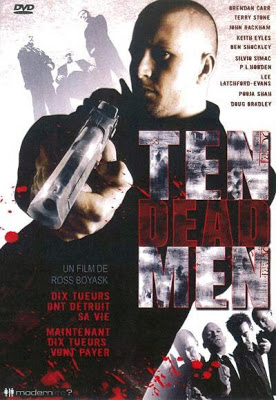
Ten Dead Men

Director: Ross Boyask
Writer: Chris Regan
Producer: Phil Hobden
Cast: Brendan Carr, Doug Bradley, John Rackham
Country: UK
Year of release: 2008
Reviewed from: screener

Ten Dead Men (or 10 Dead Men as the US distributor insists on calling it) is a brutal, violent film in which unpleasant people hurt each other very badly. It is also skilfully crafted and adroitly directed with some excellent performances and a thoroughly professional look.

Like the previous feature from director Ross Boyask and producer Phil Hobden, Left for Dead, this is a gangland revenge tale in which a bloke who makes his living by hurting and killing people decides to give it all up and settle down, only to find that his bosses want to punish him by, ah, hurting and possibly killing him. So he goes away then comes back and, ah, hurts and kills them. The morality of the central character is distinctly dubious but then it must perforce be in any gangster film.

Certainly, Boyask and Hobden’s films don’t glamourise the lifestyle like studio produced gangster films do. These characters are unpleasant men living miserable, unhappy lives. But whereas Left for Dead was borderline fantasy and devoted most of its action to fancy kickboxing, Ten Dead Men is much dirtier and more realistic. There are a few spin-kicks towards the end but you certainly couldn’t call this a martial arts picture. Last time I checked, slamming someone’s head repeatedly into the floor was not actually a martial art.

Brendan Carr (who played a ‘spectacular warrior’ in Intergalactic Combat) stars as Ryan who has actually left all that and settled down with a wife and a mortgage. But he finds himself pulled back into the darkness and shortly afterwards, mob boss Hart (Terry Stone: Doghouse, Jack Said, Kung Fu Flid) has Ryan executed after first forcing him to watch the murder of his wife Amy (some excellent, terrified acting from ex-EastEnder Pooja Shah). Ryan’s bullet-riddled body is wrapped up and thrown into the sea but somehow... somehow... he survives and makes it back to the beach.

This is the closest that the film gets to the not-quite-realism of its predecessor. Although I did wonder at some points whether this whole thing was flashing through Ryan’s brain in one second as the bullets take his life away, I think that ultimately we just have to accept that somehow... somehow... he has survived.

So actually, Left for Dead would have been just as good a title here. Possibly even more apposite. But the Modern Life? team had already used it once.

What follows is basically a sequence of revenge killings on the ten men who were directly involved, in one way or another, in the death of Amy and the pseudo-death of Ryan. These include professional cage-fighter Bruiser (Tom Gerald), pathetic body-disposer Axel (John Rackham, writer-director of Bloodmyth), compulsive gambler Harris (Lee Latchford-Evans, formerly of ghastly plastic pop combo Steps!), corrupt cop Detective Inspector Keller (Ben Shockley) and the closest thing that the film gets to comic relief: a bickering couple named Parker and Garrett (JC Mac and Jason Lee Hyde, both in Stagknight) who are probably gay although this is never explicitly stated. There is also a smartly-dressed, sinister sadist simply called the Projects Manager (Keith Eyles, who played the father in Ross Shepherd’s award-winning short Kingdom of Shadows) who becomes the main villain, Hart himself keeping well out of the way of any actual violence.

Obviously that’s not ten men but the others such as Stone (producer ‘PL’ Hobden) aren’t as clearly defined and seem like rather interchangeable, shaven-head thugs. The film’s website has brief character bios which mention, for example, that Stone is Hart’s nephew but this is never stated in the film.

All this would be a frankly tedious sequence of one fight after another - simultaneously violent and picaresque - if the film was told in chronological order. But where the script by Brighton-based Chris Regan (Jenny Ringo and the Monkey's Paw), working from Boyask and Hobden’s story, works brilliantly is in chopping up the tale and mixing it with slices of earlier events so that we only learn why this is happening as we’re watching it happen. Cause and effect bundled together into one remarkably coherent and logical plot.

Not that the viewer could necessarily work out precisely what is going on without a little help. Hence the drily detached narration by Doug Bradley - which at first seems, as narration invariably does, tacked-on and gratuitous. As the film progresses, as we start to realise which bits of the story happened before or after other bits (including, later, some bits which we saw out of context at the start), Bradley’s narration becomes not only worthwhile but indispensable.

Ten Dead Men eschews the voyeuristic glee of so many gangster films in favour of powerful character conflict and fights which, though realistic, remain watchable and serve a narrative purpose. It is an imaginative, well-crafted British gangster thriller which, if there was any logic in the world, would have had a theatrical release instead of whatever tedious, inferior reworking of Lock, Stock Guy Ritchie has churned out this month.

Also in the generally very fine cast are Jason Maza, Silvio Simac (Transporter 3, Intergalactic Combat), Adrian Foiadelli, Cecily Fay (who was inside the TV series Marvin costume in the awful Hitchhiker’s Guide movie) and Glenn Salvage (The Silencer). Many of the cast were in Left for Dead and/or Boyask’s earlier film fIXers; quite a few were in Bloodmyth and/or Rise of the Footsoldier.

Scott Benzie (Soul Searcher, Room 36) provides the score. The cinematographer was Darren Berry and Ross Boyask did his own editing. The very busy stunt co-ordinator was Jude Poyer (Stag Night of the Dead, Beyond the Rave) whose early work in Hong Kong includes the likes of Star Runner and Gen-Y Cops.

The rather impressive UK DVD of Ten Dead Men includes ten deleted/alternate scenes, a 55-minute Making Of, two commentaries, sundry other behind-the-scenes bits, a brace of trailers and a 30-page spin-off comicbook entitled Ten Dead Men: The Last Job.

Not just another British gangster film, Ten Dead Men is proof that there is life in the genre yet, despite the paucity of imagination which normally infects these films.

MJS rating: A-
Review originally posted 3rd April 2009.

Monday, 21 April 2014

Time of My Life

Director: Christopher Douglas-Olen Ray
Writer: Harmoni McGlothlin
Producer: Robyn Ray
Cast: Josh Williams, Tony Williams
Country: USA
Year of release: 2007
Reviewed from: DVD

Christopher Douglas-Olen Ray? Could he be any relation to Sir Frederick Olen Ray, the auteur behind Hollywood Chainsaw Hookers, Evil Toons, The Phantom Empire etc? Yes indeed, this is Fred’s eldest who has been shadowing his father for most of his twenty eight years, working as Second AD, Production Assistant and other crew roles, sometimes in front of the camera too, on FOR movies such as Cyclone, Terminal Force, Hybrid and Biohazard. Let’s face it, what better education could there be?

Well now young Christopher is itching to make his own first feature but rather than simply doing the B-movie equivalent of asking Dad to borrow the car, or assuming that he knows it all now and charging ahead. he has very sensibly started with a simple but effective short film, which functions as both practice for him and a calling card for the rest of us to watch.

Four actors, one set. Tony Williams is Gator, a Florida fisherman who supplements his income by running drugs for gangland boss Thomas (Josh Williams). Thomas’ goons Bob (Bill Lambert) and Jackson (David Ramirez) have trussed up Gator in a warehouse where his screams won’t be heard so that Thomas can politely enquire what has happened to the quarter-million dollars’ worth of dope that the fisherman was supposed to deliver.

It’s not a new set-up: how many short films are there which consist primarily of a sharp-suited gangster interrogating some poor sod? Lots. In the years immediately following the release of Reservoir Dogs, it was practically the only story that any aspiring film-maker seemed to know. But Ray makes his film work by keeping things simple. Crisp black and white photography by Lance Mitchell (who was assistant camera operator on titles like Gary Graver’s Veronica 2030 and Jim Wynorski’s Lost Treasure) gives the film style and hence gravitas and the director frames his shots with a sharp eye. The opening shot of the gangsters walking in is terrific: everything in the sunlight is bleached into non-existence, making it seem as if the men are strolling from a great cosmic emptiness into the monochrome claustrophobia of the lock-up. There’s another memorable two-shot in which drifting cigar smoke makes a point that would probably have been done with complex CGI in an equivalent scene in a Hollywood blockbuster.

Anyway, the gist of the plot is that Gator is knocked about until he explains where the dope has gone. But Thomas doesn’t believe his series of stories and counters them with brutal twist-tales of his own, illustrated with cut-aways, also in black and white. Eventually Gator turns the tables, to some extent, by admitting where the drugs have really gone.

It’s a smart little script, telling us just as much as we need to know about these two characters - neither of them exactly sympathetic - so that we care what happens to them in the end. Time of My Life is exactly what a short film should be: a concisely told, adroitly constructed snippet of someone’s life, a moment in time that illuminates, for a moment, a larger, unseen story somewhere.

The director also handled the editing (as Chris Ray). Writer Harmoni McGlothlin is not, as I first assumed, a pseudonym but a real person. Producer Robyn Ray (Chris’ missus) is, I believe, not the casting director of that name. Brian Bellamy, who has worked with Lance Mitchell since they were Best Boy and Best Boy Electric on Femalien II nine years ago, is credited as First Assistant Camera.

The special effects make-up is by Ron Karoska (Wishmaster III and IV, Dead and Rotting, 2001 Maniacs, Candy Stripers) and the special effects props by Carl Soto, who worked with Mr Ray Senior on Hybrid. Former pro wrestler Ric Draisin was stunt co-ordinator.

You need two things to make any film - skill and talent - and this little gem ably demonstrates both. Copies of Time of My Life are available from the director for ten bucks plus shipping, with whatever funds this raises being put towards his first feature. It’s good to see a young filmmaker showing such entrepreneurship (especially when he could surely rely simply on the goodwill that his family name brings) so I recommend chancing a tenner on this film to support the next generation of independent Hollywood talent.

MJS rating: B+

Thursday, 17 April 2014

The Return of the Bionic Boy

Director: Bobby A Suarez
Writers: Ken Metcalfe, Joe Zucchero
Producer: Bobby A Suarez
Cast: Marrie Lee, Master Johnson Yap, Joe Zucchero
Country: Philippines
Year of release: 1978
Reviewed from: UK VHS

Herewith a short history of bionics. The word was invented by Jack E Steel, a medical doctor and former US Air Force Colonel in 1958. It was given literary credibility by Martin Caidin in his 1972 novel Cyborg which was adapted the following year into a TV movie - The Six Million Dollar Man, starring Lee Majors as US Air Force Colonel Steve Austin.

The telemovie was a big hit, pushed the term ‘bionic’ into the public consciousness and was followed (I didn’t know this - thanks Wikipedia!) by two more Movies of the Week about Steve Austin: Wine, Women and War and Solid Gold Kidnapping.

A weekly TV series of The Six Million Dollar Man started in January 1974 and ran for four years, totalling 100 episodes. The show was a massive hit, in those pre- and post-Star Wars days and it was inevitable that a distaff spin-off would be produced. The character of tennis player Jaime Sommers (Lindsay Wagner) was introduced in the second season of The Six Million Dollar Man in March 1975, returned at the start of season three and then The Bionic Woman ran simultaneously for three seasons, including a couple of two-part stories which stretched across both shows. This series, like its progenitor, was produced by Kenneth Johnson. Three reunion TV-movies followed in 1987, 1989 and as recently as 1994.

In November 1976, a possible third series was considered, aimed at a younger audience, and was trialled as a double-length episode of The Six Million Dollar Man called ‘The Bionic Boy’. But 15-year-old athlete Andy Sheffield (Vincent Van Patten) wasn’t as popular as Jaime Sommers and his spin-off never materialised. Fortunately neither was there any stand-alone televisual future for The Bionic Dog. No, honestly, they introduced a bionic dog.

Until Star Wars appeared, the two Bionic series were the biggest sci-fi hit around, hugely popular across the globe. Everywhere you looked, kids in playgrounds and comedians on TV were running in slow motion or punching each other slowly while making “Pow-ow-ow-ow...!” noises.

This came to the attention of the Philippines' greatest purveyor of popular cinema, Bobbie A Suarez. The first title from BAS Film Productions Inc, set up to produce exploitable action movies dubbed into English for international sale, was therefore The Bionic Boy, starring a nine-year-old (some sources say eight) tae kwon do prodigy named Master Johnson Yap who had been prominently featured in the Singapore press.

In The Bionic Boy, Yap played the son of an Interpol agent who took on a bunch of international gangsters in revenge for the death of his parents. The film was the last known work of director Leody M Diaz, who passed away after wrapping production but before the movie was released. Diaz also helmed the semi-mythical Filipino epic Batman Fights Dracula and worked as action director on several of the popular Darna series of superheroine pictures. The screenplay was written by Romeo N Galang from a story by Suarez; Galang also wrote and directed an even more mythical film, 1973’s Fight Batman Fight! To the best of my knowledge no-one has ever actually seen either Batman movie although vintage newspaper ads confirm their existence. If a copy of either ever surfaced, it would be a major find. Until then, we must content ourselves with that old VHS of James Batman.

The Bionic Boy is generally dated to 1977 which would put it after the TV episode of the same name, but it might well have been in production before then. And of course, it’s an obvious spin to take on the concept (curiously no-one seems to have ever considered a bionic girl...). Certainly the publicity made no bones about the movie’s inspiration:

“FIRST - it was The Six Million Dollar Man. THEN CAME - The Bionic Woman. NOW COMES - the ultimate in action thrills and suspense with Asia’s youngest master of martial arts.”

Combining the fad for bionic stuff with the 1970s vogue for chop-socky pictures was a smart move by Suarez and the film sold well. It was released in Pakistan (“He is more than a warrior... more than a super hero... he is the fighting fury of World War III.”) and Mexico (“Despues de El HOMBRE NUCLEAR y LA MUJER BIONICA, una nueva dimesion de aventuras y accion con un poderoso e indestructible personaje que le hara estremecer!!!”) and probably a bunch of other places. But not, so far as I can tell, the United States.

Suarez and Galang than reteamed for They Call Her... Cleopatra Wong starring the one and only Miss Marrie Lee. And when that was also a success, the obvious next step was to combine the two franchises. The result was Dynamite Johnson - and that’s the film we’re discussing here.

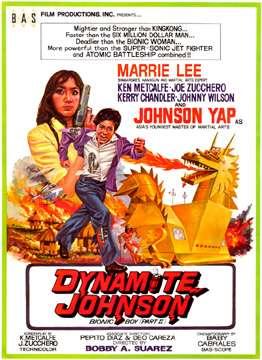
Mightier and Stronger than KINGKONG (sic)...
Faster the the SIX MILLION DOLLAR MAN...
Deadlier than the BIONIC WOMAN...
More powerful than the SUPER-SONIC JET FIGHTER and ATOMIC BATTLESHIP combined!!!

...ballyhooed the poster, which reused part of the artwork from the first film and subtitled the movie, in very small print ‘Bionic Boy (Part II)’. And that small print is what I find odd about all this because there is no other attempt in the publicity to link this to either of BAS Film Productions’ previous movies. Marrie Lee (‘Singapore’s handgun and martial arts expert’) is prominently featured but there is no mention of ‘Cleopatra Wong’ on the poster. And she is definitely playing the same character - a sexy, powerful chick composed in equal parts of legs, eye-shadow and attitude. Yap’s character calls her ‘Auntie Cleo’ and other characters refer to her specifically as ‘Cleopatra Wong’.

So why was the word ‘bionic’ so prominent in publicity for the first film but so hidden in the second? It could be that Suarez had got wind of legal arguments in the USA where some enterprising soul had decided to release the three-year-old Japanese monster flick Godzilla vs Mechagodzilla as Godzilla vs the Bionic Monster. Universal Studios, which made The Six Million Dollar Man, made loud, threatening noises and the posters were quickly amended to read Godzilla vs the Cosmic Monster.

Which makes it all the more bizarre that, while one film was losing the word ‘bionic’ from its title, this one was adding it in. Dynamite Johnson became The Return of the Bionic Boy, with the title rather obviously added as a still frame, interrupting the credit sequence of Master Johnson Yap doing his tae kwon do schtick.

Before the credits is a sequence of American mercenaries attacking some sort of industrial establishment who are interrupted by a robotic dragon. It’s a vehicle, togged up like a silver dragon, with a flame-thrower in its mouth and a machine gun in its tail. It’s goofy as all get-off but it’s an impressive, full-size, fully-functioning prop and the only thing that really lets the side down is that we have all seen Dr No at least seven times.

Master Johnson Yap plays a boy named ‘Sunny’ - presumably his surname is ‘Johnson’ - who arrives, in a wheelchair, in the Philippines from Singapore for surgery on his broken legs. For some reason, this surgery not only restores his ability to walk, it also greatly enhances his ability to do flying leaps and spin-kicks. And it raises his sight and hearing to superhuman levels too.

That’s surgery on his legs, folks.

Furthermore, no-one ever comments - not the good guys, not the bad guys - on Sunny’s amazing fighting ability.

Not having seen The Bionic Boy, I can’t say whether this film ties in to that at all but it seems unlikely that there is any narrative connection because Sunny isn’t actually bionic at the start of the film in which he ‘returns’. While recovering in hospital, his bionic ears overhear some bad guys talking in another room so he goes to investigate but when he tells the doctor and Auntie Cleo, no-one believes that he could have heard anything.

So he discharges himself from hospital (or sneaks out - I’m not sure) and tracks down some bad guys exchanging stuff at the docks. “Hey, what’s that kid doing here? Beat it!” says one, whereupon Sunny proceeds to defeat a whole bunch of chop-socky goons from both criminal gangs.

This sequence also introduces us to the least subtle, most stereotyped homosexual film character in cinematic history. Introduced here as the bad guy’s driver but later apparently some sort of second-in-command, this dark-skinned, skinny fellow wears an outfit that looks like one of Liberace’s cast-offs wrapped round a broomstick. He doesn’t just camp it up, he flounces, he pouts, he squeals like a little girl. In fact, he behaves in general like a little girl. It’s like the actor’s idea of homosexuality is ‘grown men who act like four-year-old girls’. On uppers.

He’s actually pretty funny - one of the film’s highlights - because he is so massively over-the-top he’s round the bend and back underneath. Comic relief that is, in its own way, actually comic, just not in any way that was intended. Honestly, next time you see an old clip of Are You Being Served you’ll think, ‘My word, that John Inman is essaying a sensitive and considered portrayal of a gay man.’ By comparison, at least.

Truth be told, after this it all gets a bit less interesting and, remarkably, Dynamite Johnson aka the Bionic Boy disappears from his own film for most of the running time as Cleopatra Wong takes centre stage. It’s some sort of smuggling operation of course, plutonium or something, I think. One thing is for sure: unlike the last Bobby Suarez/Marrie Lee film I saw, there’s no strawberry jam involved here.

Master Johnson Yap does get a sequence where he plays basketball with some kids, amazing them with his bionic b-ball skills before kicking the arses of some more chop-socky goons. There’s no doubt that the lad knows his moves and while he’s not outstandingly impressive, he’s not embarrassingly bad either. The last half-hour or so is, once again, a massive extended fight sequence, with our main characters joined by a couple of young blokes in black pullovers - don’t know who they are. The robot dragon reappears briefly. Finally, all the bad guys are beaten and our heroes fly off in an unexplained helicopter which comes to collect them.

One of the film’s problems is that it’s never sure whether it’s the Bionic Boy or Cleopatra Wong who is doing the returning. Although they do have some character scenes together, the movie seems to flip between the two for extended periods. But there is plenty of fighting, a reasonably coherent (if somewhat skimpy) plot, a great robot-dragon-machine and the campest fruit west of the Pacific.

The Return of the Bionic Boy finally made it to the UK in November 1986 courtesy of Cable 2 Video with a sleeve which assured any potential renters that this was ‘The First Bionic Boy’ and Marrie Lee’s name spelled wrong. The back of the sleeve, which features a staggeringly bad drawing of Master Johnson Yap, credits the director as ‘Bobby A Stuart’ although Suarez receives the correct credit on screen. It’s also worth reproducing the marvellous sleeve blurb from the UK release:

Fast, exciting Martial arts action with a pint-sized warrior. Almost a satire of the Bruce Lee classics with a touch of ‘BMX Bandits’ thrown in. A half-pint warrior with the added aid of bionics and an equally lethal aunt as his constant companion/guardian clean up around them.

Martial arts enthusiasts become unpopular when they cause havoc in the street, but become heroes when they capture criminals.

Lively action movie with unacceptable behaviour from a half-computerised boy followed by reformation and an old-fashioned moral for young teenagers.

Which is stretching things a bit because really it’s an hour and a half of a little lad and a hot chick kicking the arses of production line martial arts goons. An interesting aspect is that Johnson’s ‘bionics’ are never commented upon (and certainly never shown). It’s really just an excuse to have the youngster beat grown-ups at kung fu. In that sense, it’s no different from the 1990s movies that would cast Billy Blanks or Don ‘The Dragon’ Wilson or whoever as a cyborg just so that the hero could justify being so much better than the anonymous stuntmen who queue up to jump away from him.

In fact, now I come to think of it., the hero of this film is actually a cyborg. It’s easy to miss that because cinematically, in a post-Terminator world, ‘cyborg’ is usually taken as a synonym for ‘robot’ or ‘android’, cheapjack film-makers failing to notice that Arnie had a layer of human skin and flesh covering his metal skeleton, rendering him a cybernetic organism. But Dynamite Johnson really is half-human, half-robot, yer actual cyborg (as indeed was Steve Austin of course).

All of which means that, unless someone can demonstrate evidence to the contrary, The Return of the Bionic Boy is officially the first ever KCM.

The screenplay is credited to Ken Metcalfe and Joe Zucchero who also play two of the lead roles, though I’m not sure who. Apart from master Yap and Miss Lee, I can’t actually identify any of the actors with their characters. No matter. The UK sleeve calls Metcalfe ‘Ken’ as writer but ‘Ron’ as actor. The two also wrote Bamboo Gods and Iron Men together. Metcalfe contributed to the script of the Roger Corman-produced TNT Jackson, a Cirio Santiago blaxploitationer which clearly inspired the title Dynamite Johnson - and which was allegedly released as Dynamite Wong and TNT Jackson in the Philippines. It’s easy to see how audiences might confuse that film’s Jeannie Bell with Pam Grier, both being about seven feet tall with a giant afro. In Dynamite Johnson, Marrie Lee also sports a Foxy Brown style wig and costume for one sequence but she would be harder to confuse with Grier, what with not actually being black and everything.

Ken ‘Ron’ Metcalfe’s other writing credits include Firecracker and Hell Hole for Santiago and American Commandoes and Warriors of the Apocalypse for Suarez. As an actor, he appeared in about 50 films between the late 1960s and the late 1990s including The Beast of the Yellow Night and Enter the Ninja. A sideline in casting local talent as extras got him credits on Hamburger Hill and Born on the Fourth of July!

Joe Zucchero wrote Final Mission, The Devastator and Eye of the Eagle for Ciro and Devil’s Angels for Bobby. As an actor he has about 30 credits, mostly (like Metcalfe) for the prolific Santiago. His sideline was in editing including both versions of Ciro Santiago’s boy-and-his-pteranodon classic, Vulcan and Anak ng Bulkan. (The Inaccurate Movie Database credits the script to Suarez and Romeo N Galang which is nonsense, although Suarez does take story credit.)

The cinematographer was Eduardo ‘Baby’ Cabrales whose CV includes Cleopatra Wong and the sixth entry in the long-running Shake Rattle and Roll Filipino horror anthology series. ‘Associate director’(?) Pepito Diaz worked on Delta Force 2, American Ninja and William Mesa’s enjoyable late-1990s monster flick DNA. Gene S Suarez was executive producer. The cast has some big-name (or at least, prolific) Filipino actors including Chito Guerrera (Fight Batman Fight, 7 Crazy Dragons), Joe Sison and Manny Tibayan.

Special effects are credited to Benny Macabale (One-Armed Executioner) with Margie Catro handling make-up and Nita Bayed as ‘costume caretaker’. Other credited crew include Isabelo Tatos (setting in-charge), Rolly Banta (special props), David Cheung (film editor), Bonnie Esquerra (production supervisor) and Willie Henson and Rolly Mercado (schedule masters). Alex Pecate is credited as both actor and stunt co-ordinator but the highlight of the credits, indeed of the opening titles, must surely be ‘P.I.S.S.’. This probably stands for Philippines International Stunt Squad or something but, dudes, it doesn’t matter what that stands for. Change your name!

Now comes the sad part. I had owned this VHS tape for quite a few years and planned to rewatch it (one of the few tapes I still own) in order to put a review on this site to complement my review of They Call Her Cleopatra Wong (which you will find under its UK video title of Female Big Boss). In December 2007, after I had posted that Cleopatra Wong review, Bobby Suarez himself became aware of it and sent me a very nice e-mail, telling me about all his plans to return to film-making.

Even though I don't do many interviews any more, I really wanted to interview Bobby Suarez. But not until I had rewatched The Return of the Bionic Boy. And that wasn’t going to happen until after I moved house because everything - DVDs, CDs, magazine, books and my handful of remaining video tapes - was packed up.

Well, we moved in December 2009 and in June 2010 I finally got round to putting The Return of the Bionic Boy into my surviving VHS machine. Both tape and player still worked fine and the movie was as gloriously bonkers as I remembered it. I set to writing this review.

And that was when I discovered that Bobby Suarez had died on 8th February 2010, aged 67. And that depressed me, not just because he joined Cirio Santiago on the list of Filipino directors I really wish I had interviewed, not just because the handful of e-mails I had exchanged with him showed Bobby to be an intelligent, friendly man, but also because nobody seemed to have noticed his death. It was listed on Wikipedia and the IMDB but I certainly didn’t see any discussion on any of the film boards where I occasionally chat or lurk.

So Bobby will never see this review. But his work lives on and maybe somebody will give his films a really good DVD release. In the meantime, I’ve posted, in lieu of the interview that I'll never get, that original e-mail which so delighted me when it appeared out of the blue on Boxing Day three years ago.

Rest in peace, Bobby.

MJS rating: B+