Director: Rachel Lee Goldenberg
Writer: Paul Bales
Producer: David Latt
Cast: Gareth David-Lloyd, Dominic Keating, Ben Syder
Country: USA
Year of release: 2010
Reviewed from: UK disc (Revolver)
Website: www.theasylum.cc
The UK sleeve of the latest Asylum feature is magnificent: dinosaurs! dragons! the Palace of Westminster alight! a giant octopus attacking Westminster Bridge! some sort of robot-thing! Sherlock Holmes himself! and Ianto off
Torchwood! Much is promised. Fortunately, most is delivered in a storming steampunk romp which puts to shame many bigger-budgeted, more faithful Holmes pictures.
Which is why it’s a shame that the only quote they could come up with was “in an extraordinary league of its own” (credited to ‘blockbuster.co.uk’) which has the unfortunate effect of suggesting this film is similar in some way to notorious 2003 turkey
The League of Extraordinarily Bad Special Effects. Trust me, it’s not. It’s everything that
The League of Excruciatingly Poor Acting tried to be and failed.
This is, for one thing, entertaining, which the bigger film certainly wasn’t and, despite its tiny budget, this has better effects and better production values all round than
The League of Exceptionally Bad Scripts. It also helps that Caernarfon looks a lot more like 19th century London than Prague could ever manage. And that the Asylum’s film doesn’t star past-his-sell-by-date old twat Sean Connery.
But I’m damning with feint praise here. Almost anything would be better than
The League of Explain to Me Again Why I’m Watching This Shit (you can tell I really don’t like it!).
Sir Arthur Conan Doyle’s Sherlock Holmes - to use the eventual full on-screen title - is a belter, easily one of the Asylum’s best.
The title is an oddity worth noting as the production was shot under the working title
Sherlock. The trailer calls it
Sherlock Holmes but the DVD and titles call it
Sir Arthur... (with the possessive credit in much smaller type, of course) although it’s just called
Sherlock Holmes again at the end of the credits. The dilemma, of course, was to cruise as much as possible on the back of the near-simultaneous Guy Ritchie
Sherlock Holmes without making people think this was a film they had already seen.
So this is kind of a mockbuster but only in the sense that
War of the Worlds was, not in the more literal and obvious sense of
Transmorphers or
Snakes on a Train.
Though not adapted - even loosely - from any Conan Doyle story, the script by Paul Bales includes a few nods to ‘the canon’. The characterisations of Holmes and Watson are pretty spot-on and while the plot itself is (let’s be honest) bonkers nonsense, the fantastical steampunk setting gives this hugely likeable film a degree of leeway which it might not be able to afford if it had a more conventional story.
For a low-low-budget feature (about $150,000, give or take, from what I can piece together) this looks mightily impressive and does a great job of recreating Victorian London - which is why the one or two anachronisms and Americanisms which do creep in jar annoyingly. For example, the credits play over CG cityscapes of 19th London, one of which is a railway station. But the engine briefly seen in front of the station is very, very obviously an American railroad engine.
This isn’t something that you have to be a bit of a geek to spot (like the CG ‘American’ submarines in
Mega-Shark vs Giant Octopus which were actually Royal Navy subs). British and American steam engines look absolutely nothing like each other, apart from having wheels, and anyone who has ever been a small boy should know that.
On the one hand, this is nitpicking: it’s on-screen for no more than a few seconds as part of a larger image and has no involvement with the story. But it gave me the thirst for a neologism: 'nometgir'. A Nometgir is something which is wrong but of which it can be said that it would be ‘No more expensive to get it right.’ There are a couple of other shots of a (real) steam engine in action later on which were presumably shot at the Welsh Highland Railway, which has a terminus at Caernarfon.
While I’m nitpicking, the film starts with a prologue of an old Dr Watson (played by David Shackleton:
Another Night, Secret Rage) in 1940, specifically 29th December 1940 which was, of course, the height of the Blitz. It’s a cheap-but-effective shot of squadrons of planes flying over London, explosions erupting below. But it is missing four things, all of which were in action throughout every single night of the Blitz: anti-aircraft fire, barrage balloons, searchlights and an ARP warden yelling “Put that bloody light out!” at the aged doctor who sits on the top floor of a building, attended by a young woman and gazing out through a lit window. Rachael Evelyn (
John Carter of Mars, Ironclad) is credited as ‘Miss Lucy Hudson’, a nice touch which implies that she is the (great-?) grand-daughter of the original housekeeper.

Watson comments that it is the second time he has watched London burn - and somebody has really done their homework here because 29th December 1940 was not just the biggest raid on London up to that point, it was also the night that the Luftwaffe dropped far more incendiary bombs than ever before because they knew that there was a neap tide that night, meaning the River Thames was unusually low and it would be considerably more difficult for the London Fire Brigade to reach it with their hoses.
Even without showing a light, the top floor of a building is a bleeding dangerous place to be during an air raid. But Dr Watson takes this opportunity to recount to Miss Hudson an undocumented Sherlock Holmes adventure, which she dutifully transcribes. This nice little scene is let down a little in the logic stakes by Miss Hudson’s initial enquiry, after Dr Watson explains the set-up: “Who is ‘he’?”
Well, ‘he’ is the bloke I wrote all those famous stories about who lodged with your Gran for most of his adult life. I’m surprised that neither I nor your Gran ever mentioned him before...
And so we flashback to another very specific date: 19th May 1882. According to various Sherlock Holmes chronologies (which I have just googled) this would make the events of the Asylum’s movie the first case solved by Holmes after his first meeting with Watson in Chapter 1 of
A Study in Scarlet, ahead of the first documented case, 'The Speckled Band' (there are two earlier cases in the canon but they are recounted by Holmes to Watson as events which predated their meeting).
This is all well and good, and ties in with the lack here of the celebrity which is often seen to surround Holmes in later stories, as well as nice little touches like a suggestion that Holmes, though a smoker, is not yet a drug addict. But, that said, the plot hinges on Holmes and Lestrade having worked alongside each other on numerous occasions and Lestrade has a quite unsubtle and obvious dislike of Watson (which is never explained, as far as I can tell). Certainly H and W seem like old pals, not newly minted friends.
Ah yes, the relationship between Sherlock Holmes and Dr John Watson. On the commentary, writer Bales calls this a “Victorian bromance” and there is a definite - but gloriously subtle - homoerotic subtext here. There are just enough moments where Holmes and Watson hold eye contact that little bit longer than two pals normally would. It’s super!

There is no doubt that the casting of Gareth David-Lloyd adds to the subtext because, despite his Victorian garb and his trim moustache, he still seems like Ianto. Or at least, his relationship with Holmes smacks of Ianto and Captain Jack. Like Captain Jack, Holmes is mercurial, enigmatic, super-confident, dynamic, occasionally flamboyant and roguishly handsome. Like Ianto Jones, Dr Watson is stiffly formal, reserved, responsible and very, very loyal. It is impossible not to map the one relationship onto the other.
So here’s what I’m trying to figure out: am I reading too much subtext into this because of the casting of Gareth David-Lloyd, or did they cast Gareth David-Lloyd (at least in part) in order to add a deliberate subtext?
Anyway, we haven’t met Holmes and (young) Watson yet because first we have a scene on board a ship in the middle of the English Channel. We later learn that this was carrying tax money back from the West Indies which is a little odd because you would expect a ship like that to go to a West Coast port like Liverpool or Bristol. But that’s the least of the crew’s problems. It’s night-time and all seems well until someone screams that there is something in the water heading straight for them. There is much staring and peering but curiously no-one does what you or I would do in such a situation, which is change course.
The whatever-it-is then disappears and all seems well until - tentacles! Yes, it’s a giant octopus. In point of fact, it’s probably the same CGI giant octopus that was in
Mega-Shark vs Giant Octopus. It drags sailors off the deck, pulls down masts and generally wrecks the ship.
When we finally meet Watson, he is performing an autopsy. Holmes breezes in and proceeds to identify the cause of death from tiny, almost imperceptible, apparently meaningless clues - as is his wont. It’s a nice establishing scene. Curiously, there’s no precise date on it although it must be a day or two later. In fact, we never get any more date or location captions.
Lestrade (William Huw, who was Tom in
Merlin and the War of Dragons) has called in Holmes to investigate the disappearance of the ship, since there was no storm and no obvious cause of its sinking. There is a single survivor, who is in hospital and quite mad, which is why Holmes has called in Watson.

Somewhere around here, the plot starts to unravel, which is a shame as the film has barely started. But hold on for the ride because it’s great fun, if defiantly loopy.
Holmes, Watson and Lestrade go to a cliff top, accompanied by a local rock-climber (played by a local rock-climber) with the intention of abseiling down to examine the shipwreck. Yes, we have already established that the ship sank in mid-Channel, but let’s just roll with it because there is a smashing dialogue exchange here:
Watson: “I can’t let you do this, Holmes. It’s far too dangerous.”
Holmes. “You’re right. You should do this. After all, you have a military background.”
Watson: “I was an army surgeon!”
David-Lloyd’s restrained exasperation makes this a gem of a moment. And there are a few others scattered around the script.
Much to his concern, and entirely devoid of safety equipment except the rope tied around his waste, Watson descends the cliff. Filmed on South Stacks, Anglesey, there is some nice editing here as we repeatedly cut between a stunt double halfway down a real cliff and close-ups of the actor on a much smaller cliff. If the latter is not quite as vertical as the former, no worries.
Halfway down the cliff, Watson reports that there is no sign of the ship. He does however see someone in the water who seems to be struggling but, after Watson shouts down and receives no response, turns out to be merely a wave-tossed corpse. Watson then re-ascends, surviving the predictable last-moment rope-snap, and completely fails to mention the corpse, while neither Holmes nor Lestrade seems at all bothered at the absence of the ship’s remains (an absence which is not surprising as it sank several miles out to sea).
Basically, what we have here is a scene which is great in terms of character development, but adds precisely nothing to the narrative. Watson is prepared to climb down the cliff for his friend, even though it is plainly stupidly dangerous. Holmes presents a studied insouciance, more bothered about his pipe than his rope-suspended pal, but he has presumably made a careful assessment of the situation and deduced that Watson will be safe - then leaps into action when the rope frays. Meanwhile, Lestrade is determinedly indifferent and stand-offish. In character terms, this is cracking stuff.

But the scene drags on and on before eventually going nowhere at all. There’s all this preamble about looking at the ship but the ship’s not there and no-one cares. A dead body is there, which may or may not have some connection with the sinking, but that doesn’t even get mentioned. At the end of the scene, none of the characters know any more than they did at the start, and nor do the audiences. Narrative progression is precisely zero.
On the DVD commentary is the revelation that this scene was not in Paul Bales’ screenplay but was added by director Rachel Lee Goldenberg to replace one in which Holmes and Watson use a Victorian submarine to examine the wreck, while fending off sharks. (There are indeed sharks in the English channel, but not many. Presumably this would have been a smaller version of the CGI shark from
Mega-Shark vs...) The sub scene was deemed too difficult and expensive, even for the ambitious Asylum (you’ll see how ambitious later) which is a shame. Not just because a sequence with a submarine and a shark would have been terrific, but because I can’t help feeling that there might have been something in what they found down on the wreck which would inform the whole plot and allow it to make sense.
Or maybe not.
This may also explain why the cliff scene is so painfully long: they had to replace a complicated scene with the same number of pages. Holmes and Watson are separated so there’s no opportunity for dialogue and, while David-Lloyd’s acting here is top-notch, there’s only so many times you can look at Watson’s terrified stare or a close-up of his foot knocking pebbles down the cliff.
It may be that the scene seems to drag because nothing happens. But my belief is that it drags
and nothing happens.
A somewhat picaresque narrative proceeds from here, with progression between scenes usually determined by Holmes’ ability to identify any fragment of stuff as having only possible originated in one location.
First, we cut to the East End, represented surprisingly well by the streets of Caernarfon. Why this works - and this may be deliberate but I suspect it’s just serendipitous - is because in Victorian times, not everything was Victorian. It’s a common mistake, in the production design of historical films, to set everything in period. But look around you: not everything in 2010 (or whenever you’re reading this) dates from this year. Good Lord, I’m typing this on an antique desk in a 19th century house. Even my filing cabinet dates from the last century (1998 to be precise).

So the fact that this cinematic East End seems to be a mishmash of Victorian architecture and older is actually just right. Not quite as old, however, as the small
Tyrannosaurus rex which attacks a young man as he is attempting to negotiate a business deal with a tart. It’s a very small
T rex, obviously a juvenile (well, not really, but all will be revealed later).
Again from the ‘Director‘s Commentary’ (which also features associate producer/writer Bales and line producer Stephen Fiske) we learn that this was written as an
Iguanodon but was changed to a
T rex because The Asylum already own a CG
T rex and didn’t have the budget to spring for a different species. This is interesting because of course
T rex was unknown to science until the early 20th century while
Iguanodon, as one of the first dinosaurs properly studied and described, was well known by the 1880s.
Look, I’m going to stick in a spoiler here, because it’s essential for proper discussion. A dinosaur in Victorian London has to be either the result of some form of time travel or a robot. This one’s a robot. If there was time travel afoot, a
T rex would have made sense, even before its scientific discovery. But someone built this dinosaur. Presumably they built it at half-size so that it could get down narrow East End passageways and through doors.
By 1882, it had finally just been established that
Iguanodon was bipedal, which left me thinking how brilliant it would be if some mad Victorian inventor had created a robot based on the utterly wrong quadropedal
Iguanodon statue at Crystal Palace, the one with the spiky thumb bone placed on its nose like a rhino horn. It had also been well established by then that
Iguanodon was a herbivore so quite how or why it would have savaged innocent East End kerb-crawlers is, I fear, moot.
What had certainly not been established - because it was only proven about a century later - is that bipedal dinosaurs carried their bodies horizontally with their tail held out straight for balance. As late as the 1970s, models and drawings of T rex and other bipeds showed them as tripeds: bodies held upright, tail supporting them like a kangaroo at rest as they lumbered across the prehistoric plains. It’s really only since
Jurassic Park and
Walking with Dinosaurs in the 1990s that the public perception of theropod dinos has changed to something analogous to a kangaroo in motion (only, obviously, without the hopping) so that the tail balances the body as the creature moves at high speed.

But to be fair, the fact that the inventor of this robotic juvenile
T rex has correctly predicted its stance 100 years before the palaeontological establishment doesn’t really matter. It doesn’t matter because it’s less astounding than that the inventor has predicted any kind of
T rex twenty years before the first
Tyrannosaur skeleton was even chipped out of a rock.
The next morning, Watson reads about this event in the newspaper over breakfast, dismissing the report as pure sensationalism. A description of the creature, presumably supplied by the terrified moxy who witnessed the attack, says it had glowing eyes and sulphurous breath. Yet, despite this understandable exaggeration, Watson subsequently refers to it as a dinosaur - a deductive leap of appropriately Sherlockian proportions (unless he has read ahead in the script).
But at this point, and running the risk of seeming like I’m doing nothing but complain about a film that I really enjoyed enormously, I must mention the worst scene in the film. It’s just a short, establishing shot of Baker Street, the camera following a young boy delivering newspapers (we actually get it twice in the film) and it has three utterly egregious mistakes, each of which is a
nometgir: no more expensive to get it right.
Actually it’s four mistakes if we include the fact that young Tomos Jones has had his name unfortunately anglicised to Thomas in the end credits.
First there’s the costume. Underneath his waistcoat, the paper boy is wearing a close-fitting, round-neck, long-sleeved top which is utterly anachronistic in terms of both style and cleanliness. This is a Victorian urchin for God’s sake - smear some crap on him. Worse than that though is the way that he is delivering the papers. He’s doing it in the American manner. That is, each paper is tightly rolled and tied with string and he is nonchalantly flinging them onto doorsteps as he walks down the street.

No no no, a thousand times no! No British paper boy has ever done anything like that. Not in 1882, not in 1982, not now - and if newspapers still exist seven decades hence, they won’t do it in 2082 either. It’s one Americanism which has not seeped into British society despite its ubiquity in US movies and TV. Unlike teenage proms and trick or treating and other ghastly imports, throwing newspapers will never catch on here for the simple reason that, if any British paper boy did this, every customer would complain and he would be out of a part-time job before you could say “Where’s my bloody
Daily Mirror?”
In the UK, newspapers are kept flat: either unfolded (tabloids) or folded once (broadsheets). A stack of them is then slid into the paper boy’s bag. No rolling, no string. You couldn’t roll most Saturday or Sunday papers anyway - they’re too stuffed full of supplements. And it would really screw up the free DVDs (although that’s not quite so germane in a Victorian setting obviously). Then - and pay attention, Hollywood - the paper boy walks up to each front door, carefully folds the newspaper and pushes it through the letterbox. So that the householder, coming downstairs, can simply pick up the paper off the doormat.
I’m really puzzled that nobody thought to mention this at the time. There were only about nine or ten Americans on the production: everyone else was Welsh or English. Didn’t anyone say to the director: you know, this isn’t how newspapers are delivered in Britain. And it would have cost no more to get it right, in fact it would have been cheaper because the production budget wouldn’t have had to shell out for bits of string!
But even this is overshadowed by a mistake which will, I suspect, have many Holmes purists frothing at the mouth. They have got the man’s address wrong.
If there is one thing that everyone knows about Sherlock Holmes, it’s his address. He lives at 221B Baker Street. But not this Sherlock, oh no. The number on his front door is 221.
And yet and yet, maybe not all Holmes purists will get apoplectic at this because, astoundingly, the Wikipedia entry on 221B Baker Street (which has presumably been written by obsessive Conan Doyle nerds) makes the same mistake, or at least the mistake which I infer from this as the best explanation for the wrong door number. I can only assume it stems from an American misunderstanding of how British addresses work.

Here is what Wikipedia says: “The number followed by a letter is a separate number in law and indicated an apartment on the 1st floor (US - 2nd floor) of a residential lodging house that was likely to have formed part of a Georgian terrace.” This is simply wrong. For starters, Sherlock Holmes does not live in an ‘apartment’ (what we could call a flat over here). He ‘takes rooms’ in a boarding house belonging to Mrs Hudson. And as such, he does not have a separate address. If you came and stayed in my back bedroom for a while, you wouldn’t have a different address to me. 221B is the number of the whole house, not the bedroom and sitting room on the first floor where Holmes spends his time.
If the building was numbered 221 and divided into discrete flats, Holmes’ address would be ‘Flat B, 221 Baker Street, London’. Note that the subdivision of the building is listed before the building itself, which is the opposite to the American way of forming addresses. In the USA, the address would be ‘221 Baker Street, Apartment B, New York’.
If you will allow me a little divulgence from the actual review (you may recall, I’m supposedly reviewing a film here), this raises the interesting topic of the differences between American and British house numbering. And it’s not unreasonable that Americans should find our system confusing because nobody in Britain understands theirs. A check of Wikipedia reveals that there are umpteen different numbering systems in the States but they are mostly based on geographical location, whereas UK house numbering is purely about relative position.
Most American cities have been built from scratch within the past 150 years or so, usually on a grid system which creates blocks. Sequentially numbered streets run in one direction and sequentially numbered avenues run perpendicular to them. As I understand it, the house number generally indicates how many yards the property is from the junction with the adjacent side-road. So 1234, 56th Street would be 12 yards from the junction with 34th Avenue. Or 34 yards from the junction with 12th Avenue. Or something. I don’t bloody know!
The point is that the numbers are not sequential. They’re in ascending order (I think) but they don’t naturally follow on and consequently, if it becomes necessary to add a new property onto a block, this can be done without worrying about other addresses. Because the address simply denotes a specific point on the ground, irrespective of what properties might be on either side.
British house numbering, on the other hand, is sequential. So when we read that, for example, Michael Jackson was born at 2300 Jackson Street, the reaction in the UK is to think, “Crikey! That’s a long street - it’s got 2,300 houses on it.”
In this country, our towns and cities haven’t been planned. They mostly started as Iron Age settlements, long before anyone had even found America, not even the Vikings. And over the ensuing 1,000+ years, these towns have expanded organically, chaotically, with odd roads built around odd clusters of buildings, then new odd buildings built alongside the odd roads when the old buildings fall/burn down. There’s no grid system and none of our thoroughfares are numbered.
A British street (or avenue or road or way or close or lane or...) starts with house number 1. Next door is house number 3, then house number 5 and so on. On the other side of the street, opposite number 1, is house number 2, then number 4 and so on. Odd numbers up one side, even numbers up the other. If one side has large buildings and the other small, or there’s a major interruption such as a park, then it is possible for the two sides to be completely out of sync with, say, house number 120 opposite house number 75. Where the two sides are roughly in sync despite the presence of a park or other interruption, that usually indicates that houses existed there once but have been pulled down. British streets can be quite long: my old address was number 405 and I think the road went up to about 600. But it would be extremely unusual to have a four-figure house number.
Sometimes, new houses will be added partway along the street, either because previously empty land is being built on or because a large building has been pulled down and replaced with two or more smaller ones. Because the British system is about relative position on the street, not geographical location, new numbers have to be inserted into a sequence which is already complete. And the way we get round this is - we stick letters on the end.
So, in a nutshell, the address ‘221B Baker Street’ indicates that Mrs Hudson’s house is two doors along from 221 Baker Street, but before you get to 223 Baker Street. Her neighbour on one side is number 221A and on the other is 223 (or, conceivably, 221C).

It’s nothing to do with apartments at all. Sherlock Holmes does not live in an apartment. (Of course, the address was fictional when the stories were written as Baker Street only had about a hundred houses at that time.)
And that is why the sight of a Victorian lad in a white, long-sleeved T-shirt, flinging rolled-up newspapers onto the doorstep of a house at 221 Baker Street rankles so much with me. None of those things would have cost any more to get right. Gah!
(By the way, if any wiki-geeks want to correct the entry on 221B Baker Street and use this as a reference, feel free.)
After breakfast, Watson and Holmes go for a ‘morning constitutional’. A cynic might think their chosen area is rather thickly wooded for central London but in fact London is a green city and there are plenty of densely forested parks within easy walking distance of Baker Street, so I’ll happy approve this decision. They observe that a park fountain is rather lacklustre this morning, compared with its usual height, just as a drunk bloke (Dennis Jones, recognisable as an extra in other scenes) runs past them, screaming about a monster.
Before you can say ‘prehistoric anachronism’, the
T rex appears and chases the men through the trees. They eventually take shelter in a semi-derelict wooden building which apparently used to house the pump mechanism for the fountain - only it’s not there. The machinery has been stolen - which is why the fountain is only reaching half its normal height. I’m sure, like me, you’re wondering how the fountain is able to operate at any height if there’s no pump. You may also be wondering why a park fountain would require a separate building, some distance away, with a huge machine pump. There’s nothing like that near any of the fountains in any of my local parks...
Around this time we are introduced to our chief villain, played by Dominic Keating from
Star Trek: Enterprise, the only actor to fly over from LA although he’s actually British. In fact he was born in Beaumont Leys, just up the road from here. We know he’s the villain because we’ve seen the trailer but we don’t yet know who he is. He’s just a bloke in a wheelchair with a bad cough (and it’s not often you see a wheelchair with a cough - aythangyew!).

This invalid is accompanied by an attractively formal woman who introduces herself as Anesidora Ivory (Elizabeth Arends, who was a cruise ship performer, appeared in an episode of
Corrie and was in a stage play called
Waitress for Godot!). Dressed like a Spanish widow who is secretly glad her husband fell off a boat, Anesidora holds herself upright at all times, neither smiles nor frowns and has pale skin which leads Watson to assume she is the patient, although she is actually seeking medication for the man in the wheelchair whom she calls her uncle. Dr Watson is somewhat smitten by the mysterious beauty and is all for asking her to the opera that very night until he receives a phone call from Holmes asking Watson to meet him in the East End that evening.
A note on the telephones seen here seems in order, especially as the script goes to the trouble of having Holmes comment on what a marvel they are. And in fact they would have been in 1882, a mere six years after the introduction of telephony to the UK. Holmes appears to be using a proper Victorian phone, with a cylindrical doodad held to his ear, except that he is not actually talking into anything! At this early stage, the mouthpiece was part of the main phone device. In 1882 the speaker’s mouth had to be near the wall-mounted mouth-piece. Holmes just seems to be rabbiting into thin air.
At the other end of the line, Watson is talking into a hulking great, 1940s-style bakelite device which is massively - and obviously - anachronistic. Now, here’s the thing. The commentary reveals that what Ben Syder is holding to his ear is actually a candlestick. I say bravo: terrific improvisation by props maker Keelie Shepard. But why stop there. All that was needed was a wooden box with a black-painted yoghurt pot stuck on the front and we would have believed that Holmes had a real Victorian phone with him. And then, since the two ends of the conversation are shot separately, why not reuse the same fake Victorian phone for Watson instead of giving him this thing that’s about 50-60 years too early?
Holmes and Watson’s investigations take them to a rubber factory run by (and apparently entirely staffed by) a suspicious character named Grolton (Dylan Jones, who also supervised the horses used on the shoot). Grolton says he sold a large order of rubber to an anonymous purchaser whom he never saw but when he grudgingly goes inside the building to find the invoice (following Holmes’ suggestion that the rozzers might be interested in certain matters of employment law in his factory...) what should turn up but that pesky
T rex.
The beast seems to rip Grolton’s head off - an exterior shot shows blood splatting against the inside of a window - but when Grolton’s body is thrown through the (supposedly heavily barred) window onto the cobbles below, his noggin is intact, albeit his skin is peeling and he is very much dead. Our intrepid duo force their way in and confront the beast, running around the factory (actually an industrial museum) until Holmes injures his leg. Back in Baker Street, there’s a lovely moment where Watson washes the wound with the nearest available alcohol and Holmes’ agony stems not from the pain but from the improper use of a particularly fine brandy.
Finally, the investigation leads to a ‘castle’ (really a Tudor country house) where Holmes and Watson, after falling through a hole in the floor, find a static octopus and
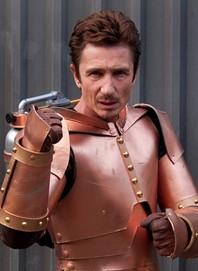
T rex - which, it must be said, is remarkably well-balanced as it stands silently. They also find what might at first be taken to be a steampunk automaton but actually turns out to be a powersuit. And this, without a doubt, is one the film’s strongest elements. Designed by Paul Curtis and constructed from leather painted to resemble brass, the suit is a magnificent creation - and wearable too! It has just enough gimcracks and gewgaws to really be a believable steampunk power-assisted exo-skeleton.
The person inside knocks Holmes around a bit before being revealed as... Dominic Keating (we still don’t know his character’s name and indeed won’t until a potentially confusing epilogue to the movie). This makes sense, as we have previously seen him in a wheelchair. What we have here, not to put too fine a point on it, is a 19th century version of Iron Man. This film was released only a few months before
Iron Man 2 so this is surely not coincidental, although nothing is made of it, even on the commentary.
Instead, writer Bales says that the power-suit and its wearer were inspired by the legend of Spring-Heeled Jack. Which just leaves me scratching my head. Because there’s no connection or similarity at all. And that, my friends, is a huge disappointment. When I first heard about this movie and checked the cast list on the IMDB, seeing that Keating was credited as ‘Spring-Heeled Jack’ got me terribly excited (that’s not his on-screen credit).

Spring-Heeled Jack is a Victorian urban myth of tremendous potential. From the 1830s through to the turn of the century, stories surfaced sporadically across England of a mysterious figure who could make extravagant, superhuman leaps over walls and onto rooftops. In some reports he was a man, in some he was dressed as a devil, and some witnesses claimed he was the Devil himself (or one of his demonic minions). There were reports that his eyes glowed red, many anecdotes had him breathing fire, everyone agreed he wore a long, dark cloak. Some people reported being physically attacked, others were shocked or terrified, still others considered Jack a naughty trickster.
Only one thing was unanimously agreed by all who saw Spring-Heeled Jack (and most who didn’t): he was a wrong’un.
A lot of stories were published about Spring-Heeled Jack, some recounting ‘genuine’ sightings, others works of melodramatic fiction which enhanced and fed back into the urban legend. It’s difficult to separate fact from fiction when there are no actual substantial facts.
On screen, Jack has only ever really appeared once, in Tod Slaughter’s 1946
Curse of the Wraydons, although the legend also inspired part of the 1924 German expressionist classic
Waxworks. According to the IMDB, there was an American three-minute short about him in the late 1990s and I believe that Ashley Thorpe (
Scayrecrow, The Screaming Skull) has a
Spring-Heeled Jack short in development as part of his ‘Penny Dreadful’ series of digital animations. But a proper, big-budget (well, you know what I mean), feature-length, name-cast, steampunk tale pitting
Spring-Heeled Jack against Britain’s greatest detective? That would be awesome!
It would, you know. It would. And it’s the sort of thing The Asylum could do. I’d be happy to write it for them tomorrow.
But this ain’t it.
There is no suggestion that Dominic Keating (as we are forced to keep calling him) has used this power suit to terrorise the population or to wreak mischief among honest, God-fearing folk or even to leap over high walls. He can only just walk in the thing!
So what is he up to? Gradually we now discover his nefarious plans and I must say that they are, without a doubt, the most random, unfocused, nonsensical criminal plans I have ever heard explained from the speakers of my TV set.
But before we get to that, something odd crops up in the dialogue: Holmes calls Keating ‘brother’. He actually addresses him directly as ‘brother’ several times. And Keating, in reply, calls Sherlock Holmes ‘Robert’.
Eh?
Leaving aside the ‘Robert’ schtick - as indeed the script does - our natural assumption is that Keating is playing Mycroft Holmes. After all, Sherlock only has one brother and we all know that Mycroft is cleverer than Holmes, although the industrious work of Keating’s character would be at odds with Mycroft’s languor. Mycroft has steampunk credentials, having been featured in
The League of Extraordinary Gentlemen (the superb comic, not the shitty film). In fact, there is a Mycroft Holmes/Spring-Heeled Jack connection because of a 1997 comic called
Predator: Nemesis in which Mycroft helped to bring said miscreant to justice, discovering in the process that the high-leaping demonic figure is actually one of those extraterrestrial hunters.
But this character, according to the commentary, is not Mycroft. It’s some third Holmes brother never previously mentioned. Which is all well and good but we can’t tell that from the film. If Holmes would at least address his brother by name, we would twig that this is not Mycroft gone rogue, but he doesn’t. In fact, the constant use of ‘brother’ becomes tiresome and unrealistic. It’s the sort of thing that a sibling might do in a formal situation but to continue to use it when the brother in question is addressing you by your first name (or someone’s first name at least!) seems frankly rude.
Again, the commentary provides an explanation. Keating’s character was originally written as Holmes’ uncle. Now, repeatedly addressing an older relative in a formal manner would sound credible. If we mentally replay this scene with the word ‘brother’ replaced with ‘uncle’, that’s slightly better. The casting of Keating in the role (he was 47 when he shot this) made the director rethink the relationship and turn him from uncle into brother.
Which is fine for viewers who know nothing at all about Sherlock Holmes, but awfully confusing and misleading for those of us with a smidgeon of Holmes-ian knowledge. If there was at least a third-person reference to Mycroft, we would understand that this isn’t him. But no.
Meanwhile, names and relationships notwithstanding, what is he up to? Well, for starters he has Inspector Lestrade imprisoned and trussed up. He also has an unhealthy relationship with Anesidora who not only isn’t his niece, she isn’t even human. She’s another robot, like the octopus and the dinosaur, which explains her stiff posture and her unwavering expression. Arends really does play the part very well, and the brief glance of smouldering passion between creator and automaton is a powerful and disturbing image that briefly lifts this otherwise bonkers third act into the realm of impressive science fiction drama.
Oh, and she kills Sherlock Holmes. Shoots him dead. Right, that’s the end of him.
Poor old Watson gets strapped to some sort of torture apparatus as Keating explains the details of his plan, all of which is motivated by a sense of revenge against Lestrade. It seems that Keating is an ex-copper who worked alongside Lestrade but retired through injury. Since then he has noticed how Lestrade has been in the habit of taking the credit for cases solved by Keating’s estranged brother ‘Robert’. And so aggrieved by this is the elder sibling that he plans to attack London with a giant, flying, fire-breathing robotic dragon - and then blame that on Lestrade!
Let’s get this right. Keating constructed a giant, robotic octopus and used it to steal a shipload of tax money which he then spent on making a giant flying dragon, including the purchase of an enormous quantity of Grolton’s patent specialised rubber. He also built a half-size robotic dinosaur which he used to attack Grolton to prevent Holmes seeing an incriminating receipt for all that rubber. And he set the dinosaur loose against the whores of Whitechapel and their clientele and he even set it on his own brother, on whose unwitting behalf this grand vengeance was being orchestrated. Furthermore he built a power-suit and a life-size automaton realistic enough to fool a medical doctor and with which he has some weird, Coppelian relationship.
Somewhere along the line he also stole a pump from a park fountain. Which seems odd because you would think that someone capable of manufacturing amazing machines like these would be able to build a simple bleeding pump.
Now he is going to fly over London, inside his own robotic dragon, with the still bound-and-gagged Lestrade in the cockpit beside him for some reason, destroying iconic buildings and causing a general conflagration the likes of which hasn’t been seen since 1666. Which, for some reason, will be blamed by everyone on Lestrade.
And on top of all this, he has placed a bomb inside Anesidora and despatched her to Buckingham Palace, there to threaten the life of Her Majesty Queen Victoria with a big explosion, presumably also as part of his scheme to frame Lestrade in revenge for the Inspector’s sidelining of Sherlock Holmes in documented accounts of cases on which they have worked together. Got it?
It seems to me that the slight illogicality here - that an explosion at the gates of Buckingham Palace will actually have relatively little impact on a night when a dragon is setting fire to Westminster Abbey and St Paul’s Cathedral - is somewhat dwarfed by the elephant in the room, which is this:
This whole plan is batshit insane! This redefines new levels of batshit insanity. You know those caves in South America that are home to colonies of millions of bats and are just coated inside with bat guano to a depth of several metres? Even that amount of batshit cannot convey how utterly and completely batshit insane this plan - and hence, let’s face it, the film’s essential plot - actually is.
Don’t get me wrong: I love the dragon. A giant, flying, steampunk, robo-dragon attacking London is exactly what we want. It’s a sort of thematic cross between
Reign of Fire and the climax of
Doctor Who: ‘The Next Doctor’. For some reason the dragon actually looks robotic unlike the super-realistic giant octopus and
Tyrannosaurus rex (and spooky-faced aspiring dominatrix).
I also love the crazy hybrid between a hot-air balloon and a helicopter with which Sherlock Holmes gives chase after he has emerged miraculously (if not unexpectedly) alive and freed the surprised Watson. While Holmes flies up and away in the ‘airship’ which his brother somehow also found the time to build, Watson sets off for central London on horseback. Which is optimistic because Anesidora has not only got a good head-start, she’s travelling by train. Granted it is, apparently, a little branch line, but it’s still trundling along at a good speed and not going to need to stop for some hay.
As the dragon and the heli-balloon do battle above London, Anesidora strides calmly towards Buckingham Palace, although as she seems to be walking along an unlit, unpopulated country road it’s somewhat unclear from which direction she is approaching. She’s certainly not strolling up the Mall.
The gates of the palace are guarded by four soldiers in uniforms which score points for authenticity but lose them again for lack of consistency. Two of the soldiers actually have speaking roles and challenge the approaching woman, albeit not with “Halt! Who goes there? Friend of foe?” which, as every schoolboy knows, is what British soldiers are required to shout when on guard and approached by an unknown person. Perhaps these particular palace guards were confused by some prior disagreement over which regiment was actually supposed to be guarding Buckingham Palace that night, since the officer (who, for some reason, has no chin-strap on his bearskin) is wearing the uniform of the Coldstream Guards while the private alongside him is very obviously in the uniform of the Grenadier Guards.
No, I’m being unfair when I say ‘obviously’. This is not something that most people, even most British people, will notice. And I suspect that whichever Welsh theatrical costumier supplied the uniforms probably didn’t have a particularly extensive range of Royal Guardsmen tunics. We’ll let this one go.
I don’t think it’s a spoiler to say that Watson stops Anesidora. There’s actually quite a nice character arc there. Watson is initially attracted to the mysterious
femme fatale when she visits his surgery, then saddened to find that her ‘uncle’s’ relationship with her is distinctly unavuncular, then horrified to learn that she is an unthinking automaton capable of the motions of love but not the emotions, and finally forced to destroy her in his duty as an upstanding Englishman.
Meanwhile, in a ludicrously ambitious sky battle which is nevertheless thrilling, exciting and enjoyable, Holmes eventually defeats his brother, parachuting to safety as the heli-balloon crashes, while the impact of the dragon on the ground fatally injures Keating but apparently leaves Lestrade relatively unscathed, even though logic tells us that only the former would have been able to actually hold onto something as the reptilian steampunk aircraft plummeted to Earth.
In the first of three epilogues, Holmes mentions to Watson, over breakfast back in Baker Street, that his first name is actually Robert. What? No it isn’t - it’s Sherlock. Many were the Victorian gentlemen who were known by two names that were actually a double-barrelled, unhyphenated surname: Conan Doyle for one. But England’s greatest detective isn’t called Something Sherlock Holmes. He’s called Something Holmes. Or are we to think that he is one of those people who choose to use their second Christian name instead of their first? Is ‘Sherlock’ a middle name or the first half of a double-barrelled surname? Frankly, who cares? This revelation seems utterly pointless and doesn’t enhance the film one iota. It could be the least exciting revelation of any movie epilogue ever.
Next we leap forward to December 1940 where geriatric Watson finishes recounting his tale to Lucy Hudson and then expires peacefully. And if Miss Hudson had any sense, she would take that as her cue to grab her gas-mask and head down to the nearest shelter.
Finally, we jump forward a short time to a brief churchyard scene. As Miss Hudson visit the grave of Dr John Watson, another figure passes by in the background. A stiffly formal, vaguely Spanish-looking woman. It is Anesidora (or at least, an Anesidora), unchanged since we last saw her some six decades ago. And she is placing flowers on the unintentionally cheap-looking grave of ‘T Holmes’. Which is our first clue, moments before the credits roll, that Keating’s character was not Mycroft. And moments later the credits do indeed confirm that he played ‘Thorpe Holmes.’ Which also explains why, in the eight-and-a-half-minute Making Of, Keating introduces himself with, “I’m Dominic Keating and I play Thorpe.”
And what a Making Of! In less than nine minutes we get comments from (or at least have identified for us) all five main cast members, line producer Steve Fiske, 1st assistant camera Bryan Olinger (subsequently promoted to DP on
Mega Piranha), robo-suit designer Paul Curtis, director Rachel Goldenberg, ‘creative consultant’ Roy Gerard Calder, costume designer Nikkie Alsford (
Dogging: A Love Story), passing journalist Brian Raftery, production assistant Dilwyn Parry Jones, bit-part actors Dennis Jones and Dylan Jones, sound recordist Ben Forman (
Silent Night Zombie Night, Haunting of Winchester House), Steadicam op Luke Rocheleau (
Juko’s Time Machine), make-up artist Ruth Pease (
Psychosis) and 1st AD Alexander X Hutchinson (temporarily promoted from his regular Asylum gig as 2nd AD) who gets more on-screen comments than anyone - possibly because he was one of three people who shot this Making Of - and just never stops complaining. He doesn’t like the film, he doesn’t like the schedule, he doesn’t like Wales. Miserable bleeder.
Sherlock Holmes was shot on a tight 13-day schedule in and around Caernarfon in September 2009.
HMS Pickle, a charity-owned replica of a schooner which served under Nelson at Trafalgar, is the ship that gets attacked by the octopus. Dinorwig Quarry Hospital (miscredited as ‘Dinowig’!) was used for Watson’s surgery and the adjacent National Slate Museum provided a great location for Grolton’s rubber factory. Thorpe’s lair was Gwydir Castle while Glynliffon Mansion and the Faenol Estate also provided scenery. Basically, as an advert for Gwynedd tourism,
Sherlock Holmes scores admirably. The area looks lovely and full of fascinating industrial heritage. A trip to Anglesey was required for the cliff top scenes filmed on South Stack cliffs.
Mere hours after wrapping, most of the Transatlantic travellers caught a plane back, leaving the director and cameraman to spend a couple of days in London getting establishing shots and effects plates by pretending to be tourists videoing their holiday. A final day of ‘second unit’ photography in Malibu, including the ultimately pointless body-in-the-sea shots, was line produced by
Chris Ray.
Three directors of photography are credited: Bryan Olinger (despite his Making Of credit as 1st AC), Scott Wheeler (of effects house Tiny Juggernaut, who are The Asylum’s regular VFX providers) and Paul Saunders (previously 1st AC on
The Terminators and
Transmorphers 2). With the ever-cheerful Alexander X Hutchinson as 1st assistant director, the vacant 2nd AD role was taken by Shelley Tyson, fresh from You-Know-Who’s musical-horror-western
Eldorado.
Much of the logistical credit for
Sherlock Holmes must go to Helen Pritchard, credited as ‘UK production manager’ who supplied supporting cast and background extras through her Clic Agency and also helped with locations etc. She was also a key figure in The Asylum’s previous Welsh-shot feature,
Merlin and the War of Dragons.
Of the three leads, two are well-known. Outside of the Hub, Gareth David-Lloyd has done TV work in stuff like
Rosemary and Thyme and
Casualty and has been attached to a mooted British sci-fi feature,
Casimir Effect. Away from the
Enterprise, Dominic Keating has had recurring roles in
Heroes and
The Immortal, appeared in
Species IV and
Beowulf, and way back when he was in stuff like
Inspector Morse and, indeed,
Casualty. But Ben Syder is a genuine discovery. Born in Prestatyn, he has been acting since 2006, has done some stage work and some student shorts but this is his feature debut. It takes a while to get used to his mannerisms but once he (or it might be me) settled down, he came across very well indeed.
Catriona McDonald, who appears briefly as Mrs Hudson, was in another intriguing Victorian fantasy,
Newgate, about which I have never been able to discover very much. A few of the other speaking cast were also in
Merlin and the War of Dragons. ‘Additional FX’ are credited to Latitude Effects (aka Erica Steele and Mark Atkins of Ghost Show Pictures).
Writer Paul Bales is one of the partners in The Asylum, where he “handles the day-to-day operations of the company, administration and finance, and domestic sales.” His other scripts for the company include
Legion of the Dead (which he also directed),
The Da Vinci Treasure, 100 Million BC and
Megafault. Director Rachel Lee Goldenberg wrote and directed one of The Asylum’s more atypical features,
Sunday School Musical(!) and was 1st AD on the likes of
I am Omega, Alien vs Hunter, Monster, 2012: Supernova, The Seven Adventures of Sinbad and
Princess of Mars.
So what works and what doesn’t on The Asylum’s
Sherlock Holmes? Well, the performances are all pretty good where the actors are given something to work with. There’s a good chemistry between Holmes and Watson, William Huw makes the most of the often thankless role of Lestrade, Keating doesn’t ham up his loony villain role as much as the part perhaps deserves - and Arends, as noted, makes a clear impression.
The effects are, on the whole, great. I mean, they’re not Industrial Light and Magic. But dollar for dollar they’re pretty damn good and certainly good enough for a film of this ilk. Some big Hollywood piece of crap could do the same and it would be ten, maybe a hundred times better - but that would cost a thousand, maybe ten thousand times more. And take a couple of years. And employ so many people that the producers would need the rights to a whole other song for the additional three minutes of credits while endless lists of computer programmers’ names scrolled past an empty auditorium.
Goldenberg’s direction is all right. I guess, given the ultra-tight schedule and other logistical restraints like shooting in (effectively) the middle of nowhere. There are small moments when the direction shines, but there are bigger aspects where it falls down and Goldenberg must take responsibility for the changes to Paul Bales’ script and how they affect the finished movie.
For example, replacing the submarine sequence with the cliff sequence is reasonable and there are some nice character touches in that scene - but it makes no sense in terms of investigating a ship that sank out of sight of land. The body in the water element of the scene appears from nowhere and goes nowhere and the whole sequence, as previously mentioned, comes to nought.
 |
This is me, pretending to be Holmes, on the
actual Caernarfon location where the film was shot! |
Similarly, Goldenberg’s decision to make Keating’s character a brother seems to have consisted of simply crossing out ‘uncle’ in the script and writing ‘brother’ in with a biro. No thought has been given to either how that affects the dialogue - brothers would address each other by first name - or what ramifications it might have in terms of conflicting with the cultural baggage of Sherlock Holmes. Just one additional line of dialogue that alluded to Mycroft and established that this isn’t him would have sufficed. Paul Bales can’t be blamed for this; he was in LA while all this was going on.
And that scene of a paperboy throwing a rolled-up newspaper onto the doorstep of 221 Baker Street still rankles with me. Because it is so wrong in so many ways, not one of which would have required additional expense or time. Just care.
Having said all that, what Paul Bales can be held responsible for is the completely arbitrary and nonsensical plot. Sherlock Holmes stories are lot harder to write than you might think because they have to be incredibly clever. It’s not enough to slip in little references to the canon if the actual plot doesn’t hang together in a way that befits the character. I’m entirely undecided on whether extending the world of Holmes into a steampunk fantasy milieu makes plotting easier or more difficult, possibly both. But I do know that the script’s attempts to justify and explain Thorpe’s actions don’t hold up at all, either in terms of making sense or as a solution to the preceding mystery elements. Embracing the
fantastique does not negate the requirements of cause and effect. I wouldn’t want to deny us all the pleasure of a dinosaur, a giant octopus, a brass power-suit, a robot woman and a heli-balloon vs robo-dragon battle above the Thames - but perhaps it might have been better to simply make Thorpe an eccentric madman rather than try to justify his surreally unjustifiable actions.
But let’s be clear about one thing. Despite its faults, I absolutely
loved this movie. Having watched it, I was quite happy to watch it again a few days later for the commentary - and there are not many films to which I will extend that courtesy. This is a rip-roaring, action-packed, science-fantasy adventure: hugely enjoyable and daft as a brush. And kudos to The Asylum for filming it in Britain. God knows that Holmes has been badly served over the years by some bloody awful films, many of which shuffled him to America and/or the 20th century to save on collar-studs and gas-lamps. This film shows that even on a tiny budget, some degree of historical verisimilitude can be managed.
As well as the commentary track and Making Of, which I was glad to see Revolver kept for the UK disc, the extras include a trailer and a couple of minutes of bloopers which includes, for once, something genuinely funny. It’s an overhead shot of Holmes in the heli-balloon basket (not actually used in the film) which has to cut when a piece of the camera actually falls off and lands on the hapless Syder’s head. Has to be seen to be believed.
Finally, it’s worth noting that the UK sleeve differs significantly from the US version. Both have the Palace of Westminster in flames and a giant octopus attacking Westminster Bridge, but for the UK a two-shot of Syder and David-Lloyd has replaced the three-shot of those two fellows plus Keating. More to the point, the dragon and the
T rex both appear twice. But since the octopus doesn’t attack Westminster Bridge, the image is already an exaggeration so what the heck, chuck a few more reptilian robots in there. And even more to the point, the dark background to the original one-sheet has been abandoned in favour of a sort of blue-grey sheen which makes this look just that little but more like the Guy Ritchie film. (Which I haven’t seen and I’m not really bothered about, whereas I pre-ordered this from Amazon the moment I found out it was getting a UK release.)
MJS rating: B+
Review originally posted 13th May 2010.


 Eventually the army move in and everything is set for the big finale in which about a hundred identical Chitti robots, including the original, form themselves into huge geometric shapes through the marvel of (a) CGI effects and (b) the director having watched the Matrix sequels. So actually this is quite effective because it’s all the fun of the big effects sequences from The Matrix 2 and 3 without any of the pretentious bollocks.
 As well as being the most expensive Bollywood movie ever (US$35-40 million, which in LA would buy you a medium-sized romcom), Robot had the widest opening of any Bollywood picture, on 2,253 screens worldwide, 300 of them outside India. There was even a red-carpet London premiere with the stars in attendance although curiously most of the western media seem to have ignored this, just like they ignore Bollywood in general.
 Incredibly, Rajnikanth was 58 years old when he made this. I mean, it’s clear he’s older than his co-star and no spring chicken but crikey! His 178 IMDB credits include haunted house comedy Chandramukhi, jungle adventure Bloodstone and a version of Aladdin called Alavuddinum Athbutha Vilakkum.