Director: James T Williams
Writer: James T Williams
Producer: Anthony Archambault
Cast: Rob Leetham, Iona Thonger, Chris McAleer
Country: UK
Year of release: 2008
Reviewed from: screener
Website: www.mrglassproductions.com
Waiting for Dawn is a valiant attempt to do something different. I’m not certain to what extent the film succeeds in that attempt but it makes a decent stab at it and should be applauded for what it achieves.
Rob Leetham (who was also in dodgy fanfilm The Hellraiser Chronicles: A Question of Faith but we won’t hold that against him) stars as Carl Teagarden, an ordinary sort of bloke who proposes to his girlfriend Vicki (Iona Thonger) one morning and later finds himself wondering if he has made the right choice. Carl and Vicki have just moved into a new home, returning to the town where they grew up, and they notice that a drinking establishment called The Waiting Room is still operating - and still closed.
The Waiting Room, it seems, is a bit of a local urban legend, always closed but not apparently derelict or deserted. But when Carl has to wait for Vicki, just for 20 or 30 minutes, on the corner near the pub, he decides to pop inside for a pint and a shufti. Because for the first time ever the place appears to be open - with two bouncers on the door. Inside he finds an empty bar with a misanthropic barman (Thomas Morton, who also handled the music score and sound design), two youths playing pool and a curious fellow who introduces himself as Darwin Barrett (Chris McAleer).
(A note on character names: Darwin is not a good one because it sounds too much like ‘Darling’ when spoken, even with good sound recording, raising unintentional humorous memories of Blackadder Goes Forth. The name Darwin should be restricted to talking dolphins and direct descendants of the father of evolutionary biology.)
The long and the short of it is that The Waiting Room turns out to be a place where the rules of time and space do not apply. This is first made explicit a full 25 minutes in when Carl nips into the gents and re-emerges a minute or so later to find that the place is now somehow packed with people, all of whom look like they’ve been there for some time.
He explores the pub’s back room where there is some sort of rave going on and eventually finds a way out but emerges in another town and having travelled back in time - something made evident when he goes to visit his parents. All the whole he is trying to contact Vicki and when he eventually receives a voicemail from her he returns to The Waiting Room.
It’s nice to see a British time travel film - we don’t do enough of them - and in terms of genre this sits alongside something like Groundhog Day, never actually explaining its time travel elements. The downside is that, while we certainly don’t want a pat explanation, it doesn’t feel like the movie’s premise is properly explored either. The non-resolution ending doesn’t really make much sense and really a film like this has to do one of two things: either fully explore its central premise or provide some sort of resolution which allows us to finally understand what has been going on and why. Waiting for Dawn doesn’t really do either, alas.
The various people that Carl meets in the pub are all apparently aware of what is going on and some even realise that Carl is new but no-one makes any attempt to explain things to him. People make obtuse comments - some of which the viewer understands because, having read the synopsis, we’re more clued in than Carl - but nobody actually discusses the situation in any meaningful way so neither Carl nor the audience really learns anything. What should be a journey through the human psyche becomes instead a picaresque trail past a succession of unsympathetic (and, truth be told, mostly very boring) minor characters.
Described as a ‘metaphysical love story’, Waiting for Dawn never justifies why Vicki and Carl have been parted. There’s some implication that it’s to do with Carl’s second thoughts (externalised during the first act in a too-long scene with a mate of his in a different pub) and before the film is over he has announced his absolute, certain, undying love for Vicki. All very sweet but we’re left with no indication that Carl has actually learned anything or that his realisation of his certainty will help him or Vicki in any way. In a story like this one expects some sort of moral justice but it seems that the various tossers and tits encountered by Carl are all happy to stay in The Waiting Room while our hero must suffer, possibly into eternity, for nothing more than an entirely understandable moment of doubt.
Technically, Waiting for Dawn is highly commendable. The acting is all good, especially from Leetham, and the dialogue is fine except that it doesn’t really tell us anything. We constantly expect to learn something and, well, never do. Lighting, sound and editing are all top-notch and it is especially fine to see a slice of fantastique indie cinema which eschews special effects completely (unless one counts the smoke and light in the rave scene).
This is the first feature from Mr Glass Productions, a Shrewsbury-based film-making group who have previously concentrated on shorts, including The Man of Great Stature, It Ain’t Rocket Science, Chain and a series for the Beeb called The Cold Light of Day (not to be confused with the Dennis Nilsen biopic). James T Williams pulls multiple duties as writer, director, editor and co-producer, as well as acting. Also in the cast are Joseph Ripley (who was one of the infected in 28 Weeks Later), Campbell Foster (who was also in a version of The Tell-Tale Heart and a British horror feature I had not previously encountered but want to find out more about, Newgate) and Neil Higham as Carl’s dad.
In an era when there are so many comparatively easy, lazy ways to make your debut feature, Waiting for Dawn is a valiant - and to some extent successful - attempt to do something different, challenging and original. That it doesn’t quite come off is, I think, possibly due to over-ambition. There are some interesting ideas here but they don’t really go anywhere and if we, the audience, are to be taken on a journey, we expect some sort of destination. Carl is a well-developed character and a terrific performance from Leetham; Thonger also does a great job with her comparatively limited screen time. But most of the other characters seem like cyphers - and not terribly sympathetic cyphers either. A ‘pub of the damned’ is a great concept but the lost souls inside it need to be fascinating characters; we should either want to spend time with them or dislike then but be unable to tear ourselves away.
Near-as-dammit feature-length at 68 minutes, this could easily be stretched to 70 by doing a Charles Band on the end credits and slowing them down a bit, or maybe a slight re-edit would add in another 120 seconds or so. Or maybe Mr Glass Productions should build on the experience of Waiting for Dawn and crack on with developing their next feature. I would certainly like to see more from this lot.
MJS rating: B
MJ Simpson presents: the longest-running single-author film site on the web, est.2002.
Showing posts with label time travel. Show all posts
Wednesday, 19 November 2014
Monday, 24 February 2014
Man Who Sold the World
Director: Louis Melville
Writer: Louis Melville
Producers: Louis Melville, Stuart Fenegan
Cast: Jonathan Sidgwick, Rita Kvist, Dan van Husen
Country: UK
Year of release: 2007
Reviewed from: advance screener disc
Even from this unfinished version it's clear that Man Who Sold the World is an authentically spooky fantasy and an undeniably original film. The two central performances are both great, the creepy kid is suitably creepy, the sense of paranoia and nightmare is very well built, the transitions between levels of reality/dream are adroitly handled, the locations are marvellous and well-used, the editing is bang-on, the camerawork is great and the music is terrific.
But I would be lying to you if I said I understood the ending.
Jonathan Sidgwick (The Witches Hammer, Bane) stars as Max Trisch who inherits a rambling, antiques-filled stately home from his grandmother and drives out there to take a look. In an upstairs room he finds Zisna (Dan van Husen: House of Blood, Forest of the Damned, Cold and Dark), an Aleister Crowley lookalike priest, helping himself to some thing that Max’s mother had borrowed. Subsequently exploring the local area, Max finds an empty church with a worried Christian priest, Reverend Carmichael (Andrew Tiernan: 300, The Quatermass Experiment, The Bunker), who is evidently in opposition to Zisna.
But mostly what Max sees is an expressionless, silent boy (Alex McNeill), aged about 12 or so and wearing an old-fashioned school uniform. Appearing and disappearing, this ghost leads Max through the woods until he collapses and finds himself revived in the stately splendour of Zisna’s home, from where the charismatic leader controls, via internet sermons, a worldwide cult of ‘Koslantians’. This seems to be a standard end-of-the-world cult: armageddon is a-coming and the Koslantians will be saved and transported to humanity’s true home, a place called Koslantis. Evidently, acolytes can progress through levels as a ‘tapoge’. It’s all a sort of Branch Davidians meets Scientology set up with a heavy dose of Crowleyism. Max, understandably, is polite to his gracious host but remains thoroughly cynical.
Max’s Scandinavian girlfriend Lidija (the lovely Rita Kvist - The Weight of Water, Lime - about whose brief, gratuitous nude scenes you won’t find me complaining) arrives to keep him company. Together they investigate the old house and find evidence that Max’s grandmother was inadvertently responsible for allowing the Nazis to get their hands on the Holy Grail. This ties in with visions of Nazi pomp and circumstance which Max is experiencing, all Teutonic knights and busty Rhinemadchen.
This is one of those films where the weirdness builds relentlessly over the full ninety minutes. Max and Lidija attempt to drive away but however far they go, they’re still within walking distance of the house. Red-jacketed Koslantian tapoges hunt for them; Reverend Carmichael bangs on their door, shouting that the apocalypse is here; Max’s pet python Fido escapes and is never found (a shot of Fido slithering past a half-eaten apple must have some sort of Biblical symbolism, I guess). Most significantly, elements of Nazi concentration camps start to appear with first the creepy boy and then Max himself in stripy prison pyjamas with a yellow Jewish star. (This raises the question of whether Max is Jewish, which seems unlikely as what we are told about his paternal grandmother indicates her to be Christian, possibly Catholic. Maybe he’s Jewish on his mother’s side.)
Interspersed with this are interactions between Max and a beardy psychiatrist, sometimes in cutaways, sometimes in voice-overs which sound rather too much like narration. I actually found these quite confusing: at first I thought they were flashbacks to before Max left London, then they seemed to be part of the main story (which left me wondering how Max was able to drive back and see the shrink, then get home so quickly). Eventually I decided that they must be a framing story with everything else as a flashback. The disc I saw wasn’t the final edit so this confusion may be cleared up - or perhaps it’s deliberate.
And that ending? I really don’t know. It’s something to do with stigmata, and Adolf Hitler himself appears briefly in some sort of white limbo. But precisely what is going on, what it means and how it relates to anything else - search me. In some way, Man Who Sold the World reminded me of old European films: plenty of weirdness, middle class protagonists trapped in a nightmarish series of events and no real explanation for the viewer. If this had been made thirty years ago in Spain, Redemption would be all over it. There is also a touch of The Avengers in the dangerous eccentricity hidden away in the English countryside, maybe a dash of The Wicker Man too.
For a first-time director, Louis Melville does a bang-up job. Every time I made a note of something which didn’t seem to make narrative sense, I had to scribble it out two minutes later as the situation was explained in the dialogue. He is greatly assisted by the cinematography of James Friend (Wishbaby, Reverb) and Boyd Skinner (Cargo, Springheel Jack) although there is an unavoidable shot-on-DV flatness to the image. Editors Adam Biskupski and Richard Graham are also to be commended for stitching together such a potentially disjointed story. A fine orchestral and piano score by Simon Lambros (The Last Horror Movie, Puritan) is augmented by a handful of sparsely beautiful songs by Tally Koren. Mark Stevenson, who was so great as the assistant in The Last Horror Movie, appears as a monk with a mask even beakier than the one in HellBride.
Though it kept me gripped to the very end, Man Who Sold the World left me slightly niggled because I don’t know whether I was even supposed to understand the denouement. The whole film goes somewhere - but where? Undeniably skilfully constructed and resolutely intriguing, here is a movie which raises more questions than it answers. Take a look - maybe you’ll spot something I missed.
MJS rating: B+
Writer: Louis Melville
Producers: Louis Melville, Stuart Fenegan
Cast: Jonathan Sidgwick, Rita Kvist, Dan van Husen
Country: UK
Year of release: 2007
Reviewed from: advance screener disc
Even from this unfinished version it's clear that Man Who Sold the World is an authentically spooky fantasy and an undeniably original film. The two central performances are both great, the creepy kid is suitably creepy, the sense of paranoia and nightmare is very well built, the transitions between levels of reality/dream are adroitly handled, the locations are marvellous and well-used, the editing is bang-on, the camerawork is great and the music is terrific.
But I would be lying to you if I said I understood the ending.
Jonathan Sidgwick (The Witches Hammer, Bane) stars as Max Trisch who inherits a rambling, antiques-filled stately home from his grandmother and drives out there to take a look. In an upstairs room he finds Zisna (Dan van Husen: House of Blood, Forest of the Damned, Cold and Dark), an Aleister Crowley lookalike priest, helping himself to some thing that Max’s mother had borrowed. Subsequently exploring the local area, Max finds an empty church with a worried Christian priest, Reverend Carmichael (Andrew Tiernan: 300, The Quatermass Experiment, The Bunker), who is evidently in opposition to Zisna.
But mostly what Max sees is an expressionless, silent boy (Alex McNeill), aged about 12 or so and wearing an old-fashioned school uniform. Appearing and disappearing, this ghost leads Max through the woods until he collapses and finds himself revived in the stately splendour of Zisna’s home, from where the charismatic leader controls, via internet sermons, a worldwide cult of ‘Koslantians’. This seems to be a standard end-of-the-world cult: armageddon is a-coming and the Koslantians will be saved and transported to humanity’s true home, a place called Koslantis. Evidently, acolytes can progress through levels as a ‘tapoge’. It’s all a sort of Branch Davidians meets Scientology set up with a heavy dose of Crowleyism. Max, understandably, is polite to his gracious host but remains thoroughly cynical.Max’s Scandinavian girlfriend Lidija (the lovely Rita Kvist - The Weight of Water, Lime - about whose brief, gratuitous nude scenes you won’t find me complaining) arrives to keep him company. Together they investigate the old house and find evidence that Max’s grandmother was inadvertently responsible for allowing the Nazis to get their hands on the Holy Grail. This ties in with visions of Nazi pomp and circumstance which Max is experiencing, all Teutonic knights and busty Rhinemadchen.
This is one of those films where the weirdness builds relentlessly over the full ninety minutes. Max and Lidija attempt to drive away but however far they go, they’re still within walking distance of the house. Red-jacketed Koslantian tapoges hunt for them; Reverend Carmichael bangs on their door, shouting that the apocalypse is here; Max’s pet python Fido escapes and is never found (a shot of Fido slithering past a half-eaten apple must have some sort of Biblical symbolism, I guess). Most significantly, elements of Nazi concentration camps start to appear with first the creepy boy and then Max himself in stripy prison pyjamas with a yellow Jewish star. (This raises the question of whether Max is Jewish, which seems unlikely as what we are told about his paternal grandmother indicates her to be Christian, possibly Catholic. Maybe he’s Jewish on his mother’s side.)
Interspersed with this are interactions between Max and a beardy psychiatrist, sometimes in cutaways, sometimes in voice-overs which sound rather too much like narration. I actually found these quite confusing: at first I thought they were flashbacks to before Max left London, then they seemed to be part of the main story (which left me wondering how Max was able to drive back and see the shrink, then get home so quickly). Eventually I decided that they must be a framing story with everything else as a flashback. The disc I saw wasn’t the final edit so this confusion may be cleared up - or perhaps it’s deliberate.And that ending? I really don’t know. It’s something to do with stigmata, and Adolf Hitler himself appears briefly in some sort of white limbo. But precisely what is going on, what it means and how it relates to anything else - search me. In some way, Man Who Sold the World reminded me of old European films: plenty of weirdness, middle class protagonists trapped in a nightmarish series of events and no real explanation for the viewer. If this had been made thirty years ago in Spain, Redemption would be all over it. There is also a touch of The Avengers in the dangerous eccentricity hidden away in the English countryside, maybe a dash of The Wicker Man too.
For a first-time director, Louis Melville does a bang-up job. Every time I made a note of something which didn’t seem to make narrative sense, I had to scribble it out two minutes later as the situation was explained in the dialogue. He is greatly assisted by the cinematography of James Friend (Wishbaby, Reverb) and Boyd Skinner (Cargo, Springheel Jack) although there is an unavoidable shot-on-DV flatness to the image. Editors Adam Biskupski and Richard Graham are also to be commended for stitching together such a potentially disjointed story. A fine orchestral and piano score by Simon Lambros (The Last Horror Movie, Puritan) is augmented by a handful of sparsely beautiful songs by Tally Koren. Mark Stevenson, who was so great as the assistant in The Last Horror Movie, appears as a monk with a mask even beakier than the one in HellBride.
Though it kept me gripped to the very end, Man Who Sold the World left me slightly niggled because I don’t know whether I was even supposed to understand the denouement. The whole film goes somewhere - but where? Undeniably skilfully constructed and resolutely intriguing, here is a movie which raises more questions than it answers. Take a look - maybe you’ll spot something I missed.MJS rating: B+
review originally posted 29th June 2007
Labels:
2007,
British Horror Revival,
cults,
Nazis,
time travel,
UK
Saturday, 22 February 2014
Lub Lae
Director: Don’t know
Writer: Don’t know
Producer: Don’t know that either
Cast: Jutharat Uttakorn, Nattanun Khunwat, Anchisa Liewpairoj
Country: Thailand
Year of release: 2004
Reviewed from: Thai VCD
Why is is that the films without subtitles are always the talkiest? Ah well...
This recent Thai horror/fantasy starts with a gang of crooks shooting it out with the cops as they try to escape through the jungle. Suddenly a sort of magical portal thing opens up, sucks them through and then vanishes.
The quartet - whom, for the sake of argument, we will call John, Paul, George and Ringo - find themselves somewhere else, in the open countryside near some mountains. Obviously I can’t determine to what extent they debate the bizarre metaphysical phenomenon that has delivered them there, safe from the cops’ guns, but anyway they set out in search of civilisation. And they find it: a village which is populated entirely by women.
Although many of the inhabitants are beautiful young things, as is traditional, I must give this film credit for also including old women, fat women and little girls, suggesting a functioning society. The ladies seem pleasantly surprised by the arrival of four young chaps and clearly understand what men are and how they should relate to them. But if there is any explanation of how this all-female society exists in perpetuity - or indeed, just where they are - then obviously that passed me by.
In flashbacks we see that Paul is not in fact a crook but became involved by accident. In a bar, he bumped into his old friend John and they had some drinks then went back to Paul’s place. When a drunken neighbour barged in and threatened Paul, John took it on himself to brain the guy with a handy trophy; Paul was shocked but helped to put the body in a cupboard. Cops later discovered the body and arrested Paul but he was sprung from a police van by John and two buddies (George and Ringo) posing as cops. By this sequence of events, he found himself party to murder and directly involved in a bank heist.
The four lads are offered sumptuous food and then John, George and Ringo all head off for nights of wild passion with their designated lovelies. Paul, however, politely declines both the offered booze and the attentions of his companion (whom we’ll call Linda). The two get to talking and eventually fall in love.
Meanwhile, Ringo has discovered that the village has a plentiful supply of gold nuggets, stored in a hut guarded by two heavy ladies armed with axes. The next night, while John entertains the ladies, Ringo and George sneak down to the hut, club the guards to death and take two sacks of gold, which they bury in the woods (watched by an unseen Paul and Linda). The two villains return to the table where John continues to hold court but the two guards turn up, blood on their faces but very much alive. The assembled women advance on the three men who find that their guns have no effect: whenever they fire a bullet it is absorbed by a sort of magical vortex that appears in front of the intended victim.
The ladies’ weapons of choice are a sort of wooden trident, looking not unlike a deadly rake, which they use to impale each of the men through the midriff. George suffers a particularly nasty fate when he falls into a pit and a trident-thing drops from above. In a smooth piece of editing which makes this appear as single shot, the camera then dollies forward and tilts down to look into the pit where we see George impaled. There is also a gruesome (but very dark) shot of one of the trio being physically ripped in half by the women, and John gets decapitated into the bargain.
Of course, the woman also want John but Linda wants to save him and a stand-off develops between Linda’s mother (who is probably some sort of old wise woman) and the village leader (the young lady depicted, axe in hand, on the DVD sleeve). At that moment, the magical portal from the start of the film opens up behind Paul and Linda and they fall through it, rendering the point moot. The film ends with the cops surrounding Paul as he lies, crying, at the foot of a tree, cradling Linda who has become a skeleton. Somehow. A brief epilogue shows another gang of crooks going through the portal.
Once it gets going, this is a gruesome and effective horror film - but it doesn’t get going until very near the end. We could have a had a whole third act of the women hunting the men, picking them off one by one, but instead from the moment the two guard’s heads get bludgeoned to the mother-vs-leader stand-off is about five minutes, if that. It may be that the characterisation and plot development throughout the movie is enough to carry it if you speak Thai, but for those of us looking to enjoy a horror film, this delivers too little too late.
As usual with modern Thai horrors, the production values seem good, the effects are credible and the cinematography is top-notch. This is a well-directed film and probably well-acted though it’s always difficult to tell when one doesn’t understand a word of the language. So Lub Lae is okay for what it is, but what it is is not what it’s advertised as. I don’t think that a fantasy romantic crime drama can be classed as a horror film just because its has five minutes of horror at the end.
MJS rating: B-
Writer: Don’t know
Producer: Don’t know that either
Cast: Jutharat Uttakorn, Nattanun Khunwat, Anchisa Liewpairoj
Country: Thailand
Year of release: 2004
Reviewed from: Thai VCD
Why is is that the films without subtitles are always the talkiest? Ah well...
This recent Thai horror/fantasy starts with a gang of crooks shooting it out with the cops as they try to escape through the jungle. Suddenly a sort of magical portal thing opens up, sucks them through and then vanishes.
The quartet - whom, for the sake of argument, we will call John, Paul, George and Ringo - find themselves somewhere else, in the open countryside near some mountains. Obviously I can’t determine to what extent they debate the bizarre metaphysical phenomenon that has delivered them there, safe from the cops’ guns, but anyway they set out in search of civilisation. And they find it: a village which is populated entirely by women.
Although many of the inhabitants are beautiful young things, as is traditional, I must give this film credit for also including old women, fat women and little girls, suggesting a functioning society. The ladies seem pleasantly surprised by the arrival of four young chaps and clearly understand what men are and how they should relate to them. But if there is any explanation of how this all-female society exists in perpetuity - or indeed, just where they are - then obviously that passed me by.
In flashbacks we see that Paul is not in fact a crook but became involved by accident. In a bar, he bumped into his old friend John and they had some drinks then went back to Paul’s place. When a drunken neighbour barged in and threatened Paul, John took it on himself to brain the guy with a handy trophy; Paul was shocked but helped to put the body in a cupboard. Cops later discovered the body and arrested Paul but he was sprung from a police van by John and two buddies (George and Ringo) posing as cops. By this sequence of events, he found himself party to murder and directly involved in a bank heist.
The four lads are offered sumptuous food and then John, George and Ringo all head off for nights of wild passion with their designated lovelies. Paul, however, politely declines both the offered booze and the attentions of his companion (whom we’ll call Linda). The two get to talking and eventually fall in love.
Meanwhile, Ringo has discovered that the village has a plentiful supply of gold nuggets, stored in a hut guarded by two heavy ladies armed with axes. The next night, while John entertains the ladies, Ringo and George sneak down to the hut, club the guards to death and take two sacks of gold, which they bury in the woods (watched by an unseen Paul and Linda). The two villains return to the table where John continues to hold court but the two guards turn up, blood on their faces but very much alive. The assembled women advance on the three men who find that their guns have no effect: whenever they fire a bullet it is absorbed by a sort of magical vortex that appears in front of the intended victim.
The ladies’ weapons of choice are a sort of wooden trident, looking not unlike a deadly rake, which they use to impale each of the men through the midriff. George suffers a particularly nasty fate when he falls into a pit and a trident-thing drops from above. In a smooth piece of editing which makes this appear as single shot, the camera then dollies forward and tilts down to look into the pit where we see George impaled. There is also a gruesome (but very dark) shot of one of the trio being physically ripped in half by the women, and John gets decapitated into the bargain.
Of course, the woman also want John but Linda wants to save him and a stand-off develops between Linda’s mother (who is probably some sort of old wise woman) and the village leader (the young lady depicted, axe in hand, on the DVD sleeve). At that moment, the magical portal from the start of the film opens up behind Paul and Linda and they fall through it, rendering the point moot. The film ends with the cops surrounding Paul as he lies, crying, at the foot of a tree, cradling Linda who has become a skeleton. Somehow. A brief epilogue shows another gang of crooks going through the portal.
Once it gets going, this is a gruesome and effective horror film - but it doesn’t get going until very near the end. We could have a had a whole third act of the women hunting the men, picking them off one by one, but instead from the moment the two guard’s heads get bludgeoned to the mother-vs-leader stand-off is about five minutes, if that. It may be that the characterisation and plot development throughout the movie is enough to carry it if you speak Thai, but for those of us looking to enjoy a horror film, this delivers too little too late.
As usual with modern Thai horrors, the production values seem good, the effects are credible and the cinematography is top-notch. This is a well-directed film and probably well-acted though it’s always difficult to tell when one doesn’t understand a word of the language. So Lub Lae is okay for what it is, but what it is is not what it’s advertised as. I don’t think that a fantasy romantic crime drama can be classed as a horror film just because its has five minutes of horror at the end.
MJS rating: B-
review originally posted 13th January 2007
Wednesday, 1 January 2014
The Kingdom of Shadows
Director: Ross Shepherd
Writer: Ross Shepherd
Producer: Raj Sulaman
Country: UK
Year of release: 2005
Reviewed from: UK festival screening (FFF 2005)
Official site: www.paravelfilms.com
At the 2005 Festival of Fantastic Films I was once again roped in by my old mate Steve Green to help judge the competition for short amateur films. Steve had single-handedly whittled the wide selection submitted to a dozen movies which were then marked for various elements by a panel consisting of myself, Headpress editor David Kerekes and director Norman J Warren (Satan’s Slave, Incident).
The overall winner, by a considerable margin, was this original and charming fantasy; we all three scored it highest and as such its combined score was considerably in advance of the (very good) films which received commendations.
The title refers to a famous quote by Maxim Gorky on seeing his first film, a Lumiere production: "Last night I was in the kingdom of shadows. If you only knew how strange it is to be there. It is a world without sound, without colour. ... It is not life but its shadow, it is not motion but its soundless spectre.” Various books and documentaries on early cinema have also used the phrase.
In Ross Shepherd’s student graduation film, an eight-year-old boy named Alex becomes bored at home, ignored by his parents. Exploring the loft he finds a large cardboard box, full of tangled bird’s nests of 35mm film. Then crawling inside, as a young boy is wont to do, he finds himself entering another world; it’s a sort of The Lion, the Witch and the Carton.
This is the world of the silent film - and it is really silent. Alex finds himself unable to make any sound whatsoever and coloured grey, and everything around him is equally monochrome and silent. He finds people in Victorian clothes at a railway station but they don’t respond to him. Crawling back through the tangle of film, he re-emerges at home and tries to tell his parents what happened. His mother dismisses her son’s tales as nonsense but his father (Keith Eyles: Bloodmyth, Ten Dead Men) is intrigued enough to look in the box himself.
The Kingdom of Shadows is a lovely-looking film with an interesting and worthwhile point to make, made for the Surrey Institute of Art and Design. The acting is good, including a nice appearance by Dennis Chinnery, the veteran actor who was in Plague of the Zombies and numerous Doctor Who episodes (as various characters) as well as the False Profit segment of Nightmares. He plays one of the Lumiere Brothers, who appear in a prologue set in 1948, the year that the first brother died, and again later in a less substantial form. Shot on 16mm, which is increasingly rare nowadays, the silent sequences have been digitised into monochrome and provided with a few suitable fake scratches. Cinematographer James Watt does sterling work in both colour and faux black and white.
A deserving winner in Manchester, I hope it goes on to greater things at other festivals. And let’s keep an eye on Ross Shepherd and see what he can do in the future.
A smashing little film which is thoroughly professional and delightfully entertaining.
MJS rating: A
review originally posted 7th September 2005
Writer: Ross Shepherd
Producer: Raj Sulaman
Country: UK
Year of release: 2005
Reviewed from: UK festival screening (FFF 2005)
Official site: www.paravelfilms.com
At the 2005 Festival of Fantastic Films I was once again roped in by my old mate Steve Green to help judge the competition for short amateur films. Steve had single-handedly whittled the wide selection submitted to a dozen movies which were then marked for various elements by a panel consisting of myself, Headpress editor David Kerekes and director Norman J Warren (Satan’s Slave, Incident).
The overall winner, by a considerable margin, was this original and charming fantasy; we all three scored it highest and as such its combined score was considerably in advance of the (very good) films which received commendations.
The title refers to a famous quote by Maxim Gorky on seeing his first film, a Lumiere production: "Last night I was in the kingdom of shadows. If you only knew how strange it is to be there. It is a world without sound, without colour. ... It is not life but its shadow, it is not motion but its soundless spectre.” Various books and documentaries on early cinema have also used the phrase.
In Ross Shepherd’s student graduation film, an eight-year-old boy named Alex becomes bored at home, ignored by his parents. Exploring the loft he finds a large cardboard box, full of tangled bird’s nests of 35mm film. Then crawling inside, as a young boy is wont to do, he finds himself entering another world; it’s a sort of The Lion, the Witch and the Carton.
This is the world of the silent film - and it is really silent. Alex finds himself unable to make any sound whatsoever and coloured grey, and everything around him is equally monochrome and silent. He finds people in Victorian clothes at a railway station but they don’t respond to him. Crawling back through the tangle of film, he re-emerges at home and tries to tell his parents what happened. His mother dismisses her son’s tales as nonsense but his father (Keith Eyles: Bloodmyth, Ten Dead Men) is intrigued enough to look in the box himself.The Kingdom of Shadows is a lovely-looking film with an interesting and worthwhile point to make, made for the Surrey Institute of Art and Design. The acting is good, including a nice appearance by Dennis Chinnery, the veteran actor who was in Plague of the Zombies and numerous Doctor Who episodes (as various characters) as well as the False Profit segment of Nightmares. He plays one of the Lumiere Brothers, who appear in a prologue set in 1948, the year that the first brother died, and again later in a less substantial form. Shot on 16mm, which is increasingly rare nowadays, the silent sequences have been digitised into monochrome and provided with a few suitable fake scratches. Cinematographer James Watt does sterling work in both colour and faux black and white.
A deserving winner in Manchester, I hope it goes on to greater things at other festivals. And let’s keep an eye on Ross Shepherd and see what he can do in the future.
A smashing little film which is thoroughly professional and delightfully entertaining.
MJS rating: A
review originally posted 7th September 2005
Sunday, 22 December 2013
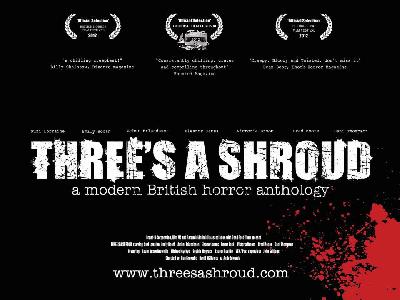
Three's a Shroud
Directors: Dan Brownlie, David VG Davies, Andy Edwards
Writers: Dan Brownlie, David VG Davies, Andy Edwards
Producers: Dan Brownlie, David VG Davies, Andy Edwards
Cast: Eleanor James, Emily Booth, Suzi Lorraine
Country: UK
Year of release: 2012
Reviewed from: festival screening (BHFF 2012)
Website: www.threesashroud.com
Three’s a Shroud is part of the British Horror Anthology Revival, a wholly owned subsidiary of the BHR. Dan Brownlie exec-produced the feature and shot one segment plus the framing story, bringing in Andy Edwards and David VG Davies for the other two bits.
It’s cheap, it’s cheerful, it’s fun. Can’t ask for much more than that. Plus it has - though I am one of the few people who would consider it such - an All Star Cast.
In the framing story (called ‘Two’s Company’ although there are no title captions anywhere in the film), a young boy asks his baby-sitter to tell him and Teddy some scary stories before he goes to sleep. Which is all well and good - I do like a framing story in my anthologies - but the baby-sitter is Suzi Lorraine (receiving co-credit with Brownlie for this part of the script). Now, she undoubtedly adds name value to the production, but I don’t buy her as a babysitter: way too old and way too glam. Baby-sitters are teenagers, and Suzi Lorraine is not in a position to play a teenager any more.
Lorraine is one of those ‘scream queens’ who seems to have fashioned an extensive career without ever being in anything that anyone has ever actually seen (or heard of). According to the IMDB she’s made about 60 films in the past ten years, starting out in Sinister Cinema crap opposite Misty Mundae, under various names. From where I sit her career seems to have consisted largely of writing columns for Gorezone - and latterly Shock Horror - while posing in various stages of blood-spattered undress.
I’m pleased to report that on this evidence she can actually act, and hopefully her role in Ivan Zuccon’s Wrath of the Crows will give her some stature. Nevertheless, I just don’t believe her for one minute as a baby sitter. Nor do I believe that any small boy, if he had a baby sitter that hot, would demand bedtime stories when he could be spying on her through the bannister then nipping back to bed for a quick pubescent one off the wrist.
Ooh, that’s not a good start for a review is it? Ick.
Anyway, Suzi tells the lad (the director’s son, Louie Russo Brownlie, far from the worst child actor I’ve seen) and his ted three stories. The first, ‘Don’t Open the Door’, is directed by Brownlie and concerns a couple who lived at the same address previously. Brad Moore (The Nephilim, House Party of the Dead V and VI) is the bloke and Amber Erlandson is his missus, who very considerately dresses to cook him breakfast. Tight white blouse, pencil skirt, stockings and suspenders (I’m guessing), hair all done fab and plenty of liner and lippy. All that just to fry up some bacon and eggs. But Erlandson looks at home in such stiffly formal get-up because she is aka fetish model Morigan Hel - last spotted several years ago in Nature Morte!
Anyway, the nub of this tale is that, later that evening the Wife comes back from wherever she’s been and calls the Hubby from her mobile, instructing him in no uncertain terms that he must not open the door to her. He is understandably confused by this, even more so when he can see her through the frosted glass, standing outside on the doorstep, ringing the bell.
There’s a really nice disconnect, well-handled by Brownlie, between the two versions of the Wife, apparently existing simultaneously: the fuzzy figure seen through the door panel who wants to get inside, and the one on the phone, seen only as an extreme close-up of a bloodied mouth and nose, who endlessly repeats - but never explains - her mantra: “Don’t open the door.” The Husband, who clearly loves the Wife despite their minor domestic over the breakfast table, goes through a barrage of emotions, well-handled by both Moore’s acting and Brownlie’s script. The denouement, when it comes, is satisfying, horrific and apt - exactly what we all want from an anthology segment.
The one area where it could have been improved would have been a bit more variation in the wife’s instructions because just repeating “Don’t open the door” gets a bit boring. I was hoping that she might branch out a bit: “Look, I’m begging you, if you love me, whatever you do, do not open that door.” Sort of thing.
Nevertheless, a good start. But Teddy still isn’t tired so onto the next story ‘Over-Developed’ (it’s about a photographer, see, and there are also some busty women, get it - oh please yourselves). There’s a lot of recognisability here. It amused me that in the very first shot of Eleanor James, the actress is instantly recognisable, even though all we see of her is her feet. Knowing that she was in the cast (and hadn’t been in the first tale) I was watching out for her - and suddenly there they are: a pair of strappy heels that no-one - no-one! - in British indie films could get away with except Ella James.
Also, it was very obvious that this was David VG Davies’ segment. Bear in mind that I haven’t seen either of Davies’ features - Animal Soup and Monitor - but I’ve read enough about them to realise that the fragmentary, post-Lynchian style of direction here has got to be the work of DVGD - and indeed it is.
So there you are: I recognised the directorial style of a film-maker whose work I’ve never previously seen, and I recognised an actress from her shoes. A bloody genius, me.
Michael Gyekye makes his feature debut as Mickey, a photographer who is obsessed with model Sarah (the photogenic Ms James). But, as so often with attractive, intelligent women, Sarah prefers the company of some tattooed bozo who chats up barmaids behind her back (ably portrayed by this segment’s director). Mickey is tormented by the voice in his head, telling him that he can have Sarah. Then, and this is where it gets really trippy, that voice is somehow personified as a little clown demon thing.
Effects guy Mike Peel created this puppet, which is stiff and inflexible but not more so than the stars of latter-day Puppet Master sequels. It looks, in all honesty, like a cross between Killer Klowns from Outer Space and The Mr Men. If one of the Killer Klowns anally raped Mr Happy, the resulting offspring would be this creature, known to the film-makers as 'Flowers'. Actually, that raises the question of: how would you go about anally raping a Mr Man? I mean, if the front of their body is one huge face, does that mean that the other side is just one giant arse, separated by the world’s shortest (or possibly most circular) alimentary canal? Ick again! How do I get onto these subjects?
‘Over-Developed’ also features the legendary Emily Booth as a woman complaining about her photos (Bouff’s having a bit of a run this year, what with this, The Reverend, Inbred and Death), plus Sophia Disgrace (The Shadow of Death, Spidarlings and Paul TT Easter’s Thumb N It) and Emma Lock, who was in Andy Edwards’ marvellous short Six Ghosts (watch it on Vimeo) and, erm, The Human Centipede II. Can I get another ick?
Writing this a few days later, I can’t actually remember how ‘Over-Developed’ ends, which is perhaps a good sign. What does stick in my mind is a scene where Mickey spies on Sarah in a dingy bar while a punk band (Dan Brownlie’s beat combo brand-B) slam away on a tiny stage. One has to wonder how come she doesn’t spot him as there’s only about three other people in the place. But that’s a quibble. Some good use of digital, as well as practical, effects make this segment interesting as well as horrific, but it’s let down by poor sound with numerous points where the soundtrack disappears altogether for a second or two.
So anyway, with Teddy still not yawning, Suzi L tries one last story. This is ‘The Time-Traveller’s Knife’ an enormously enjoyable sci-fi/slasher romp directed with skill and panache by Andy Edwards.
It’s Halloween and goth barmaid Amelia (Hannah Wilder) is shutting up her pub, only to discover that three of her friends have hidden in the toilets in the hope that all four can enjoy a private lock-in - to which Amelia reluctantly agrees. Much booze is drunk, and very quickly so are the girls. But a mysterious text message claims there is a killer in the pub with them. And indeed there is: a figure in a black costume and scary white mask (another Mike Peel creation, I believe, based on designs by Mr Brownlie). Who could that be, if it’s not one of the girls? Is it one of the girls? Is it more than one of them?
The driving force behind the plot is an antique watch, recently given to Amelia by her boss, which jumps her backwards and forwards in time throughout the evening. I love time travel stories, me, and this is a corker. It gets very complicated and I would need to watch it again to see whether it actually makes narrative sense and whether all the causes and effects happen in the right order, from various people’s point of view. There’s certainly no obvious problems. I would like to think that Edwards has a flow-chart somewhere showing where and when each girl is at any given point. I know I’d have something like that if I was attempting a script like this.
‘The Time-Traveller’s Knife’ was my favourite segment, though all three have their merits. Wilder is excellent in the challenging lead role, perfectly balancing the humour and horror of the situation and helped by Edwards’ smart script which, unusually for a time travel tale, lets Amelia ponder out loud what’s going on and why. The other three actresses are also very good: Aisling Knight (Exorcism), Kate Soulsby (Zombie Women of Satan, Blood Army) and Victoria Broom, also credited as Associate Producer, whose many horror credits include Umbrage: The First Vampire, Dead Cert, Forest of the Damned 2, Monitor, Stalled and Deranged.
Finally the film wraps up with the (somewhat predictable) conclusion of the framing story. The boy’s mother is played by Dani Thompson (Just for the Record, Forest of the Damned 2, Zombie Women of Satan 2 - yes, there’s a sequel!). Thompson is actually a bit younger than Suzi Lorraine, though just about old enough to have a son this age - but again, way too glam for the part. While Thompson and Lorraine may bring in the drooling fanboys, ‘Two’s Company’ would have worked better with a more mumsy mother and a teenage baby-sitter. And you know, it’s not like there aren’t already plenty of hot chicks in the cast.
In fact, probably the biggest failing of Three’s a Shroud - and it’s only a minor one, but it bugs me - is that, Master LR Brownlie aside, pretty much the entire cast are about the same age: mid-20s to mid-30s. It’s a common failing of low-budget horror films. Most of the people who make these things and want to appear in these things are of the same generation. Which can be fine within a limited story but seems artificial and restrictive when there are characters like Suzi’s and Dani’s that would work better outside of that age group. One to bear in mind there, casting directors.
Binding all four stories together, in a particularly nice touch, is a fifth: a spoof feature about deadly make-up (or something) called Night of the Pouting Dead. The babysitter is watching this on TV; the husband in ‘Don’t Open the Door’ does likewise; there are posters for it in ‘Over-Developed’ (plus a very visible copy of Shock Horror with Bouff on the front); and Amelia in ‘The Time-Traveller’s Knife’ wears a Night of the Pouting Dead T-shirt.
I enjoyed Three’s a Shroud very much and heartily recommend it to you. It wears its tiny budget on its sleeve but it wears its enthusiasm and commitment on its other sleeve. This is what modern horror anthologies should be like: creepy and fun and gory and clever and nasty.
MJS rating: A-
review originally posted 18th October 2012
Writers: Dan Brownlie, David VG Davies, Andy Edwards
Producers: Dan Brownlie, David VG Davies, Andy Edwards
Cast: Eleanor James, Emily Booth, Suzi Lorraine
Country: UK
Year of release: 2012
Reviewed from: festival screening (BHFF 2012)
Website: www.threesashroud.com
Three’s a Shroud is part of the British Horror Anthology Revival, a wholly owned subsidiary of the BHR. Dan Brownlie exec-produced the feature and shot one segment plus the framing story, bringing in Andy Edwards and David VG Davies for the other two bits.
It’s cheap, it’s cheerful, it’s fun. Can’t ask for much more than that. Plus it has - though I am one of the few people who would consider it such - an All Star Cast.
In the framing story (called ‘Two’s Company’ although there are no title captions anywhere in the film), a young boy asks his baby-sitter to tell him and Teddy some scary stories before he goes to sleep. Which is all well and good - I do like a framing story in my anthologies - but the baby-sitter is Suzi Lorraine (receiving co-credit with Brownlie for this part of the script). Now, she undoubtedly adds name value to the production, but I don’t buy her as a babysitter: way too old and way too glam. Baby-sitters are teenagers, and Suzi Lorraine is not in a position to play a teenager any more.
Lorraine is one of those ‘scream queens’ who seems to have fashioned an extensive career without ever being in anything that anyone has ever actually seen (or heard of). According to the IMDB she’s made about 60 films in the past ten years, starting out in Sinister Cinema crap opposite Misty Mundae, under various names. From where I sit her career seems to have consisted largely of writing columns for Gorezone - and latterly Shock Horror - while posing in various stages of blood-spattered undress.
I’m pleased to report that on this evidence she can actually act, and hopefully her role in Ivan Zuccon’s Wrath of the Crows will give her some stature. Nevertheless, I just don’t believe her for one minute as a baby sitter. Nor do I believe that any small boy, if he had a baby sitter that hot, would demand bedtime stories when he could be spying on her through the bannister then nipping back to bed for a quick pubescent one off the wrist.
Ooh, that’s not a good start for a review is it? Ick.
Anyway, Suzi tells the lad (the director’s son, Louie Russo Brownlie, far from the worst child actor I’ve seen) and his ted three stories. The first, ‘Don’t Open the Door’, is directed by Brownlie and concerns a couple who lived at the same address previously. Brad Moore (The Nephilim, House Party of the Dead V and VI) is the bloke and Amber Erlandson is his missus, who very considerately dresses to cook him breakfast. Tight white blouse, pencil skirt, stockings and suspenders (I’m guessing), hair all done fab and plenty of liner and lippy. All that just to fry up some bacon and eggs. But Erlandson looks at home in such stiffly formal get-up because she is aka fetish model Morigan Hel - last spotted several years ago in Nature Morte!
Anyway, the nub of this tale is that, later that evening the Wife comes back from wherever she’s been and calls the Hubby from her mobile, instructing him in no uncertain terms that he must not open the door to her. He is understandably confused by this, even more so when he can see her through the frosted glass, standing outside on the doorstep, ringing the bell.
There’s a really nice disconnect, well-handled by Brownlie, between the two versions of the Wife, apparently existing simultaneously: the fuzzy figure seen through the door panel who wants to get inside, and the one on the phone, seen only as an extreme close-up of a bloodied mouth and nose, who endlessly repeats - but never explains - her mantra: “Don’t open the door.” The Husband, who clearly loves the Wife despite their minor domestic over the breakfast table, goes through a barrage of emotions, well-handled by both Moore’s acting and Brownlie’s script. The denouement, when it comes, is satisfying, horrific and apt - exactly what we all want from an anthology segment.
The one area where it could have been improved would have been a bit more variation in the wife’s instructions because just repeating “Don’t open the door” gets a bit boring. I was hoping that she might branch out a bit: “Look, I’m begging you, if you love me, whatever you do, do not open that door.” Sort of thing.
Nevertheless, a good start. But Teddy still isn’t tired so onto the next story ‘Over-Developed’ (it’s about a photographer, see, and there are also some busty women, get it - oh please yourselves). There’s a lot of recognisability here. It amused me that in the very first shot of Eleanor James, the actress is instantly recognisable, even though all we see of her is her feet. Knowing that she was in the cast (and hadn’t been in the first tale) I was watching out for her - and suddenly there they are: a pair of strappy heels that no-one - no-one! - in British indie films could get away with except Ella James.Also, it was very obvious that this was David VG Davies’ segment. Bear in mind that I haven’t seen either of Davies’ features - Animal Soup and Monitor - but I’ve read enough about them to realise that the fragmentary, post-Lynchian style of direction here has got to be the work of DVGD - and indeed it is.
So there you are: I recognised the directorial style of a film-maker whose work I’ve never previously seen, and I recognised an actress from her shoes. A bloody genius, me.
Michael Gyekye makes his feature debut as Mickey, a photographer who is obsessed with model Sarah (the photogenic Ms James). But, as so often with attractive, intelligent women, Sarah prefers the company of some tattooed bozo who chats up barmaids behind her back (ably portrayed by this segment’s director). Mickey is tormented by the voice in his head, telling him that he can have Sarah. Then, and this is where it gets really trippy, that voice is somehow personified as a little clown demon thing.
Effects guy Mike Peel created this puppet, which is stiff and inflexible but not more so than the stars of latter-day Puppet Master sequels. It looks, in all honesty, like a cross between Killer Klowns from Outer Space and The Mr Men. If one of the Killer Klowns anally raped Mr Happy, the resulting offspring would be this creature, known to the film-makers as 'Flowers'. Actually, that raises the question of: how would you go about anally raping a Mr Man? I mean, if the front of their body is one huge face, does that mean that the other side is just one giant arse, separated by the world’s shortest (or possibly most circular) alimentary canal? Ick again! How do I get onto these subjects?
‘Over-Developed’ also features the legendary Emily Booth as a woman complaining about her photos (Bouff’s having a bit of a run this year, what with this, The Reverend, Inbred and Death), plus Sophia Disgrace (The Shadow of Death, Spidarlings and Paul TT Easter’s Thumb N It) and Emma Lock, who was in Andy Edwards’ marvellous short Six Ghosts (watch it on Vimeo) and, erm, The Human Centipede II. Can I get another ick?
Writing this a few days later, I can’t actually remember how ‘Over-Developed’ ends, which is perhaps a good sign. What does stick in my mind is a scene where Mickey spies on Sarah in a dingy bar while a punk band (Dan Brownlie’s beat combo brand-B) slam away on a tiny stage. One has to wonder how come she doesn’t spot him as there’s only about three other people in the place. But that’s a quibble. Some good use of digital, as well as practical, effects make this segment interesting as well as horrific, but it’s let down by poor sound with numerous points where the soundtrack disappears altogether for a second or two.
So anyway, with Teddy still not yawning, Suzi L tries one last story. This is ‘The Time-Traveller’s Knife’ an enormously enjoyable sci-fi/slasher romp directed with skill and panache by Andy Edwards.
It’s Halloween and goth barmaid Amelia (Hannah Wilder) is shutting up her pub, only to discover that three of her friends have hidden in the toilets in the hope that all four can enjoy a private lock-in - to which Amelia reluctantly agrees. Much booze is drunk, and very quickly so are the girls. But a mysterious text message claims there is a killer in the pub with them. And indeed there is: a figure in a black costume and scary white mask (another Mike Peel creation, I believe, based on designs by Mr Brownlie). Who could that be, if it’s not one of the girls? Is it one of the girls? Is it more than one of them?
The driving force behind the plot is an antique watch, recently given to Amelia by her boss, which jumps her backwards and forwards in time throughout the evening. I love time travel stories, me, and this is a corker. It gets very complicated and I would need to watch it again to see whether it actually makes narrative sense and whether all the causes and effects happen in the right order, from various people’s point of view. There’s certainly no obvious problems. I would like to think that Edwards has a flow-chart somewhere showing where and when each girl is at any given point. I know I’d have something like that if I was attempting a script like this.‘The Time-Traveller’s Knife’ was my favourite segment, though all three have their merits. Wilder is excellent in the challenging lead role, perfectly balancing the humour and horror of the situation and helped by Edwards’ smart script which, unusually for a time travel tale, lets Amelia ponder out loud what’s going on and why. The other three actresses are also very good: Aisling Knight (Exorcism), Kate Soulsby (Zombie Women of Satan, Blood Army) and Victoria Broom, also credited as Associate Producer, whose many horror credits include Umbrage: The First Vampire, Dead Cert, Forest of the Damned 2, Monitor, Stalled and Deranged.
Finally the film wraps up with the (somewhat predictable) conclusion of the framing story. The boy’s mother is played by Dani Thompson (Just for the Record, Forest of the Damned 2, Zombie Women of Satan 2 - yes, there’s a sequel!). Thompson is actually a bit younger than Suzi Lorraine, though just about old enough to have a son this age - but again, way too glam for the part. While Thompson and Lorraine may bring in the drooling fanboys, ‘Two’s Company’ would have worked better with a more mumsy mother and a teenage baby-sitter. And you know, it’s not like there aren’t already plenty of hot chicks in the cast.
In fact, probably the biggest failing of Three’s a Shroud - and it’s only a minor one, but it bugs me - is that, Master LR Brownlie aside, pretty much the entire cast are about the same age: mid-20s to mid-30s. It’s a common failing of low-budget horror films. Most of the people who make these things and want to appear in these things are of the same generation. Which can be fine within a limited story but seems artificial and restrictive when there are characters like Suzi’s and Dani’s that would work better outside of that age group. One to bear in mind there, casting directors.
Binding all four stories together, in a particularly nice touch, is a fifth: a spoof feature about deadly make-up (or something) called Night of the Pouting Dead. The babysitter is watching this on TV; the husband in ‘Don’t Open the Door’ does likewise; there are posters for it in ‘Over-Developed’ (plus a very visible copy of Shock Horror with Bouff on the front); and Amelia in ‘The Time-Traveller’s Knife’ wears a Night of the Pouting Dead T-shirt.I enjoyed Three’s a Shroud very much and heartily recommend it to you. It wears its tiny budget on its sleeve but it wears its enthusiasm and commitment on its other sleeve. This is what modern horror anthologies should be like: creepy and fun and gory and clever and nasty.
MJS rating: A-
review originally posted 18th October 2012
Sunday, 16 June 2013
GI Samurai
Director: Kosei Saito
Writer: Toshio Kamata
Producer: Takeshi Motomura
Cast: Sonny Chiba, Jun Eto, Hiroyuki Sanada
Country: Japan
Year of release: 1979
Reviewed from: UK VHS
Have you ever been watching a film and found yourself repeatedly saying “Holy moley, this is awesome!” as the movie just gets better and better? No? Well then presumably you’ve never seen GI Samurai. Even in what is very evidently a heavily cut-down version, this amazing, action-packed epic stands out as a strong contender for the title of greatest sci-fi/war movie of all time.
Also known as Time Slip: The Day of the Apocalypse (the full title is both on-screen and on the box of this British VHS release), Sengoku Jietai cost a fortune, features vast numbers of extras and packs a punch that combines science fiction and samurai films into a whole that is even greater than the sum of its parts. All this - and it stars Sonny Chiba too!
This is a time travel film and there are of course two sorts of time travel stories. Some, like Back to the Future, Retroactive or the marvellous East German comedy Tomorrow I’ll Wake Up and Scald Myself with Tea, play with the idea of time travel and the complications it can create. Others, ranging from A Connecticut Yankee in King Arthur’s Court to Life on Mars, simply use time travel as a device to set up a culture clash scenario. The Terminator is an unusual example of a film which falls into both camps.
GI Samurai is firmly in the Connecticut Yankee mould, with a very simple premise that is never explained because, frankly, it doesn’t need to be. A gaggle of military personnel from Japan’s Self Defence Force travel back in time about 400 years. Presumably they’re starting from what would be the present day - late 1970s - but there is no indication of what happened except that every soldier’s watch has stopped at 5.18. (Actually, there are some weird polarising effects and suchlike which presumably is the time slip itself but this is after everyone has spotted that their watches are kaput.)
There are about 20-30 troops all told and between them they have a jeep, a half-track armoured personnel carrier (both equipped with a heavy machine gun), a light tank, a lorry full of ammo, a helicopter and a motor patrol boat. They rendezvous on a beach somewhere; we’re not told where and we’re not told why. They’re clearly still in Japan (as will quickly become clear and in any case the SDF was not supposed to operate outside the country) but they seem to be on active service rather than just manoeuvres. I think it really doesn’t matter.
The point is that once the lorry, the chopper, the MPB and the convoy of jeep, tank and APC (initially introduced in darkness as part of a much larger convoy) have introduced themselves, they spot three samurai warriors on horseback who take a look then turn and ride off. Before you know it, a hail of arrows rains down on the soldiers from a row of medieval archers atop a nearby cliff and they have no defence except to cower behind their vehicles.
This is the crux of GI Samurai: 20th century weapons and techniques against those of the 16th century. It’s not as obviously one-sided as you might think.
The soldiers repel another attack but also establish an alliance with a rival lord who turns up to investigate what is going on. He realises that, with the assistance of these strangers and their amazing weapons he could defeat his enemies and rule the whole country.
We don’t get to really know any of the soldiers, at least not in this cut-down version, apart from Lt Yoshiaki Iba, played by the legendary Chiba-san. Some small amount of characterisation is evident in scenes that they share with some of the non-combatant locals: a young woman, an old lady, some kids. There is probably much more of this in the full version. But the bulk of the film is two battles, one small one and one very big one.
Initially, Lt Iba’s men attack a castle and have little difficulty in beating the defenders, delighting their new-found samurai allies, but then they progress to a pitched battle against a very large samurai army and this long, thrilling, sometimes horrific sequence constitutes the bulk of the movie in this edit. It’s terrific, absolutely terrific.
Yes, the 20th century troops have automatic weapons, heavy machine guns, grenades and a damn great tank but they are outnumbered by several hundred to one. What use automatic firepower when you are facing literally thousands of warriors, highly trained and completely fearless, willing to lay down their life for their lord? The soldiers-vs-samurai theme is much, much more than just a high concept, it’s a fascinating examination of how different styles of warfare deal with each other, demonstrating the strengths and weaknesses of each. Most war films, by their very nature, pitch against each other enemies who are roughly equivalent in terms of technology and tactics. GI Samurai is in some ways more like a western with Lt Iba’s men as the Seventh Cavalry and the samurai as the Cherokees, fighting by their own methods and on their own territory.
Two films jumped into my head as precedents while I watched this. One is my favourite film of all time, The Man Who Would Be King, in which two 19th century British soldiers successfully conquer an Indian mountain kingdom by supplying one local warlord with Martini-Henrys and the training to use them. But the comparison breaks down because although Iba allies himself with one of the local warlords, his men fight alone. A better comparison might be, well at first I thought Zulu but then I revised that to Zulu Dawn. The Japanese soldiers, like the British at Isandlwana, grossly underestimate the abilities and tactics of the local ‘savages’ and pay the price for their hubris in a terrifying and bloody confrontation.
But there is another film that stands comparison with GI Samurai and what makes it particularly interesting is that it was produced a few years later. That film is Return of the Jedi.
The Ewok attack on the Imperial forces in that film is remarkably similar to the samurai attack on the SDF forces in this one and when we consider that the Ewoks were originally going to be Wookiees, we can see an even closer comparison (there used to be fan art and fan fiction about ‘Samurai Wookiees’ back in the 1980s but I don’t know whether that had any direct derivation from canonical Star Wars material). The medieval army in GI Samurai use traps and knowledge of the terrain to the full extent just as the Ewoks would do four years later. Most specifically there is a sequence where they attack the vehicles by rolling logs down a steep incline. If you can watch that without thinking of Endor you’re a better man than I am.
It is well known that George Lucas is a long-time fan of Japanese movies. He has acknowledged the debt that Star Wars owes to Kurosawa’s The Hidden Fortress and Darth Vader’s helmet has clear Samurai origins. I would be genuinely surprised if Lucas had not seen GI Samurai before making Jedi (or if not Lucas, maybe Lawrence Kasdan or Richard Marquand). The comparison is obvious, this film was a major production promoted internationally and it would be a big coincidence if there was no direct influence.
What the samurai have that Ewoks don’t, of course, is spectacle. Many samurai movies concentrate on individuals or small groups so it is jaw-dropping to see hundreds of men, each with a tall, fluttering war banner sticking up from his back, charging across a hillside. You can feel the fear of the SDF soldiers, facing this enemy which charges so brazenly and so relentlessly. Like the Terminator, a samurai army “can’t be reasoned with, can’t be bargained with and it absolutely will not stop.”
There’s wave after wave of attack and gradually the soldiers lose one vehicle after another. Eventually only a handful of survivors make their way to a wooden building where they are met by the warlord whom they befriended earlier, and so the film culminates in a bleak and shocking ending.
There are some loose ends and obvious gaps in the non-battle parts of the plot, due to losing so much footage. The original version apparently runs 140 minutes but this VHS tape is only 88 minutes so the best part of an hour has been cut. That extra time may help the film by allowing us to know these soldiers as people or it may drag it down by spending too long on character and dialogue with no action. I’ll need to see the full length version to comment on whether or not it’s as good as this edit, but I’d love it to be even better.
The medieval soldiers have no idea what they’re fighting and they don’t care. There’s a great shot where one of them repeatedly jabs his sword down the barrel of the tank’s gun, believing that he is attacking it in some way. But what stands out among the carnage is Lt Iba and his decision to fight back against the samurai on their own terms, to which end he mounts a horse and grabs a sword, a bow and a bunch of arrows. The film constantly hammers home that one method or level of technology is not inherently superior to the other and that war is a brutal, cruel business however you do it.
GI Samurai is based on a novel by Ryo Hanmura but virtually the only information I can find anywhere on this author - apart from birth/death dates of 1933/2002 - is that he jointly won the Hayakawa SF Competition in 1960 and later won the Naoki Award for best popular literature by a young writer. The Encyclopedia of Science Fiction cites one other title by Hanmura: Misaki Ichiro no Teiko. Toshio Kamata (Legend of Eight Samurai) wrote this film’s screenplay and it was directed by Kosei Saito who makes a much more exciting and coherent job of things than he managed with the awful Ninja Wars.
Sonny Chiba is probably best known to ‘the kids’ now for playing Hattori Hanzo in Kill Bill Vol.1 and Uncle Kanata in The Fast and The Furious: Tokyo Drift but he started acting back in the late 1950s and by the time he made GI Samurai had already established a global reputation in The Street Fighter and its sequels (including one of my favourite films, Sister Street Fighter) as well as The Shogun’s Samurai, Message from Space, The Bodyguard and Gangster Cop. His other notable films include Battle Royale II, Sure Death Revenge, Samurai Reincarnation, Dragon Princess and, um, Aces: Iron Eagle III.
Other cast members here include Jun Eto (Godzilla X Mechagodzilla), Kenzo Kawarasaki (Parasite Eve and a 1997 TV version of Ring), Asao Koike (Baby Cart in Peril and a couple of Zatoichi pictures), Masao Kusakari (ESPY), Noboru Nakaya (Kwaidan, Lady Snowblood: Blizzard from the Netherworld), Miyuki Ono (Evil Dead Trap) and the legendary Hiroyuki Sanada (Ring and sequels). Executive producer Haruki Kadokawa (Samurai Reincarnation, Ninja Wars, Kinji Fukasaku’s Virus and heir to the Kadokawa publishing empire) gave himself a role too.
Info on the crew is harder to come by. The only credits on the English language version are a cast list (differentiated only into ‘soldiers’, ‘samurai’ and ‘others’) plus director Saito, musical director (Kadokawa giving himself an extra credit), fight director (Chiba) and, for some reason, sound recordist Fumio Hashimoto (Angel Guts: Red Classroom). If the IMDB is accurate, the art director was Hiroshi Ueda who also designed Incident at Blood Pass, Samurai Banners and The Birth of Japan, while the music was composed by Kentaro Haneda who scored a lot of anime including Barefoot Gen and Robotech: The Macross Saga.
Sengoku Jietai was remade in 2005 as Sengoku Jietai 1549, accompanied by a manga adaptation. This was directed by Masaaki Tezuka - fresh from three Godzilla pictures - and although it was quite widely publicised the film appears not to have had an English language release (although the comic was translated and published in the USA). Much less well known is a 2006 TV series based on the same story, Sengoku Jietai: Sekigahara no Tatakai directed by Kosei Saito again under his other name of Mitsumasa Saito.
The full 140 minute version of Time Slip is now available on DVD in the UK under the GI Samurai title from Optimum both singly (HMV has it for a fiver, as I type this!) and as part of the three-disc Sonny Chiba Collection Vol.2 (with Bullet Train and Golgo 13). The US DVD is deleted but a two-disc special edition is planned for April 2008 release. I’m sorely tempted to invest in one or other of these because I want to see the full version of this completely brilliant movie.
MJS rating: A
review originally posted 27th January 2008
Writer: Toshio Kamata
Producer: Takeshi Motomura
Cast: Sonny Chiba, Jun Eto, Hiroyuki Sanada
Country: Japan
Year of release: 1979
Reviewed from: UK VHS
Have you ever been watching a film and found yourself repeatedly saying “Holy moley, this is awesome!” as the movie just gets better and better? No? Well then presumably you’ve never seen GI Samurai. Even in what is very evidently a heavily cut-down version, this amazing, action-packed epic stands out as a strong contender for the title of greatest sci-fi/war movie of all time.
Also known as Time Slip: The Day of the Apocalypse (the full title is both on-screen and on the box of this British VHS release), Sengoku Jietai cost a fortune, features vast numbers of extras and packs a punch that combines science fiction and samurai films into a whole that is even greater than the sum of its parts. All this - and it stars Sonny Chiba too!
This is a time travel film and there are of course two sorts of time travel stories. Some, like Back to the Future, Retroactive or the marvellous East German comedy Tomorrow I’ll Wake Up and Scald Myself with Tea, play with the idea of time travel and the complications it can create. Others, ranging from A Connecticut Yankee in King Arthur’s Court to Life on Mars, simply use time travel as a device to set up a culture clash scenario. The Terminator is an unusual example of a film which falls into both camps.
GI Samurai is firmly in the Connecticut Yankee mould, with a very simple premise that is never explained because, frankly, it doesn’t need to be. A gaggle of military personnel from Japan’s Self Defence Force travel back in time about 400 years. Presumably they’re starting from what would be the present day - late 1970s - but there is no indication of what happened except that every soldier’s watch has stopped at 5.18. (Actually, there are some weird polarising effects and suchlike which presumably is the time slip itself but this is after everyone has spotted that their watches are kaput.)
There are about 20-30 troops all told and between them they have a jeep, a half-track armoured personnel carrier (both equipped with a heavy machine gun), a light tank, a lorry full of ammo, a helicopter and a motor patrol boat. They rendezvous on a beach somewhere; we’re not told where and we’re not told why. They’re clearly still in Japan (as will quickly become clear and in any case the SDF was not supposed to operate outside the country) but they seem to be on active service rather than just manoeuvres. I think it really doesn’t matter.
The point is that once the lorry, the chopper, the MPB and the convoy of jeep, tank and APC (initially introduced in darkness as part of a much larger convoy) have introduced themselves, they spot three samurai warriors on horseback who take a look then turn and ride off. Before you know it, a hail of arrows rains down on the soldiers from a row of medieval archers atop a nearby cliff and they have no defence except to cower behind their vehicles.This is the crux of GI Samurai: 20th century weapons and techniques against those of the 16th century. It’s not as obviously one-sided as you might think.
The soldiers repel another attack but also establish an alliance with a rival lord who turns up to investigate what is going on. He realises that, with the assistance of these strangers and their amazing weapons he could defeat his enemies and rule the whole country.
We don’t get to really know any of the soldiers, at least not in this cut-down version, apart from Lt Yoshiaki Iba, played by the legendary Chiba-san. Some small amount of characterisation is evident in scenes that they share with some of the non-combatant locals: a young woman, an old lady, some kids. There is probably much more of this in the full version. But the bulk of the film is two battles, one small one and one very big one.
Initially, Lt Iba’s men attack a castle and have little difficulty in beating the defenders, delighting their new-found samurai allies, but then they progress to a pitched battle against a very large samurai army and this long, thrilling, sometimes horrific sequence constitutes the bulk of the movie in this edit. It’s terrific, absolutely terrific.
Yes, the 20th century troops have automatic weapons, heavy machine guns, grenades and a damn great tank but they are outnumbered by several hundred to one. What use automatic firepower when you are facing literally thousands of warriors, highly trained and completely fearless, willing to lay down their life for their lord? The soldiers-vs-samurai theme is much, much more than just a high concept, it’s a fascinating examination of how different styles of warfare deal with each other, demonstrating the strengths and weaknesses of each. Most war films, by their very nature, pitch against each other enemies who are roughly equivalent in terms of technology and tactics. GI Samurai is in some ways more like a western with Lt Iba’s men as the Seventh Cavalry and the samurai as the Cherokees, fighting by their own methods and on their own territory.
Two films jumped into my head as precedents while I watched this. One is my favourite film of all time, The Man Who Would Be King, in which two 19th century British soldiers successfully conquer an Indian mountain kingdom by supplying one local warlord with Martini-Henrys and the training to use them. But the comparison breaks down because although Iba allies himself with one of the local warlords, his men fight alone. A better comparison might be, well at first I thought Zulu but then I revised that to Zulu Dawn. The Japanese soldiers, like the British at Isandlwana, grossly underestimate the abilities and tactics of the local ‘savages’ and pay the price for their hubris in a terrifying and bloody confrontation.
But there is another film that stands comparison with GI Samurai and what makes it particularly interesting is that it was produced a few years later. That film is Return of the Jedi.The Ewok attack on the Imperial forces in that film is remarkably similar to the samurai attack on the SDF forces in this one and when we consider that the Ewoks were originally going to be Wookiees, we can see an even closer comparison (there used to be fan art and fan fiction about ‘Samurai Wookiees’ back in the 1980s but I don’t know whether that had any direct derivation from canonical Star Wars material). The medieval army in GI Samurai use traps and knowledge of the terrain to the full extent just as the Ewoks would do four years later. Most specifically there is a sequence where they attack the vehicles by rolling logs down a steep incline. If you can watch that without thinking of Endor you’re a better man than I am.
It is well known that George Lucas is a long-time fan of Japanese movies. He has acknowledged the debt that Star Wars owes to Kurosawa’s The Hidden Fortress and Darth Vader’s helmet has clear Samurai origins. I would be genuinely surprised if Lucas had not seen GI Samurai before making Jedi (or if not Lucas, maybe Lawrence Kasdan or Richard Marquand). The comparison is obvious, this film was a major production promoted internationally and it would be a big coincidence if there was no direct influence.
What the samurai have that Ewoks don’t, of course, is spectacle. Many samurai movies concentrate on individuals or small groups so it is jaw-dropping to see hundreds of men, each with a tall, fluttering war banner sticking up from his back, charging across a hillside. You can feel the fear of the SDF soldiers, facing this enemy which charges so brazenly and so relentlessly. Like the Terminator, a samurai army “can’t be reasoned with, can’t be bargained with and it absolutely will not stop.”
There’s wave after wave of attack and gradually the soldiers lose one vehicle after another. Eventually only a handful of survivors make their way to a wooden building where they are met by the warlord whom they befriended earlier, and so the film culminates in a bleak and shocking ending.
There are some loose ends and obvious gaps in the non-battle parts of the plot, due to losing so much footage. The original version apparently runs 140 minutes but this VHS tape is only 88 minutes so the best part of an hour has been cut. That extra time may help the film by allowing us to know these soldiers as people or it may drag it down by spending too long on character and dialogue with no action. I’ll need to see the full length version to comment on whether or not it’s as good as this edit, but I’d love it to be even better.
The medieval soldiers have no idea what they’re fighting and they don’t care. There’s a great shot where one of them repeatedly jabs his sword down the barrel of the tank’s gun, believing that he is attacking it in some way. But what stands out among the carnage is Lt Iba and his decision to fight back against the samurai on their own terms, to which end he mounts a horse and grabs a sword, a bow and a bunch of arrows. The film constantly hammers home that one method or level of technology is not inherently superior to the other and that war is a brutal, cruel business however you do it.GI Samurai is based on a novel by Ryo Hanmura but virtually the only information I can find anywhere on this author - apart from birth/death dates of 1933/2002 - is that he jointly won the Hayakawa SF Competition in 1960 and later won the Naoki Award for best popular literature by a young writer. The Encyclopedia of Science Fiction cites one other title by Hanmura: Misaki Ichiro no Teiko. Toshio Kamata (Legend of Eight Samurai) wrote this film’s screenplay and it was directed by Kosei Saito who makes a much more exciting and coherent job of things than he managed with the awful Ninja Wars.
Sonny Chiba is probably best known to ‘the kids’ now for playing Hattori Hanzo in Kill Bill Vol.1 and Uncle Kanata in The Fast and The Furious: Tokyo Drift but he started acting back in the late 1950s and by the time he made GI Samurai had already established a global reputation in The Street Fighter and its sequels (including one of my favourite films, Sister Street Fighter) as well as The Shogun’s Samurai, Message from Space, The Bodyguard and Gangster Cop. His other notable films include Battle Royale II, Sure Death Revenge, Samurai Reincarnation, Dragon Princess and, um, Aces: Iron Eagle III.
Other cast members here include Jun Eto (Godzilla X Mechagodzilla), Kenzo Kawarasaki (Parasite Eve and a 1997 TV version of Ring), Asao Koike (Baby Cart in Peril and a couple of Zatoichi pictures), Masao Kusakari (ESPY), Noboru Nakaya (Kwaidan, Lady Snowblood: Blizzard from the Netherworld), Miyuki Ono (Evil Dead Trap) and the legendary Hiroyuki Sanada (Ring and sequels). Executive producer Haruki Kadokawa (Samurai Reincarnation, Ninja Wars, Kinji Fukasaku’s Virus and heir to the Kadokawa publishing empire) gave himself a role too.
Info on the crew is harder to come by. The only credits on the English language version are a cast list (differentiated only into ‘soldiers’, ‘samurai’ and ‘others’) plus director Saito, musical director (Kadokawa giving himself an extra credit), fight director (Chiba) and, for some reason, sound recordist Fumio Hashimoto (Angel Guts: Red Classroom). If the IMDB is accurate, the art director was Hiroshi Ueda who also designed Incident at Blood Pass, Samurai Banners and The Birth of Japan, while the music was composed by Kentaro Haneda who scored a lot of anime including Barefoot Gen and Robotech: The Macross Saga.
Sengoku Jietai was remade in 2005 as Sengoku Jietai 1549, accompanied by a manga adaptation. This was directed by Masaaki Tezuka - fresh from three Godzilla pictures - and although it was quite widely publicised the film appears not to have had an English language release (although the comic was translated and published in the USA). Much less well known is a 2006 TV series based on the same story, Sengoku Jietai: Sekigahara no Tatakai directed by Kosei Saito again under his other name of Mitsumasa Saito.The full 140 minute version of Time Slip is now available on DVD in the UK under the GI Samurai title from Optimum both singly (HMV has it for a fiver, as I type this!) and as part of the three-disc Sonny Chiba Collection Vol.2 (with Bullet Train and Golgo 13). The US DVD is deleted but a two-disc special edition is planned for April 2008 release. I’m sorely tempted to invest in one or other of these because I want to see the full version of this completely brilliant movie.
MJS rating: A
review originally posted 27th January 2008
Saturday, 16 February 2013
Chainsaw Cheerleaders
Director: Don Farmer
Writer: Don Farmer
Producer: Jackey Hall
Cast: Tiffany Shepis, Debbie Rochon, Michele Grey
Country: USA
Year of release: 2008
Reviewed from: screener
Some films significantly fail to deliver what they promise - misleading marketing campaigns, inappropriate titles, nonsensically unrelated poster designs, we’ve all been there - but you can’t fault Chainsaw Cheerleaders on that score. There are cheerleaders. They have chainsaws. Tick, tick.
The acting is variable, the plot doesn’t make a great deal of sense and there are distracting continuity errors but these deficits are more than made up for by slick direction, good dialogue, great sound, commendably brief usage of gore and nudity which doesn’t distract from the action, an original story, interesting characters and a decent cast which includes the always marvellous Debbie Rochon and the eminently wonderful Tiffany Shepis.
A prologue is set in ‘Europe, 1508’ and I’m sorry but I don’t know Don Farmer well enough to know whether that caption is meant to be as funny as it is - but since the whole film is by necessity somewhat tongue-in-cheek, I’ll give him the benefit of the doubt. La Shep is a witch named Lucinda, torturing a young woman in an attempt to conjure a demon or open a portal or whatnot or something. The victim is pegged out on the ground and our first problem is that she has a really thick Californian accent. Tiff’s accent is fine, suitably non-specific, and the same is true of the two witch-hunters/monks who turn up to stop her. But the victim is straight out of Malibu. Also, she’s wearing a sleeveless top and has her arms held wide so that we can see... look, a lot of European women still don’t shave their pits today. It’s a careless point which is distracting (though not as much as her accent) but could have been easily solved. I’m not suggesting some sort of armpit-merkin, just sleeves would have been fine.
Anyway, Lucinda has some sort of demon-snake-thing which looks like a cross between an eel and a small graboid: all black and smooth with a three-part jaw. It’s not really explained what this is or what part it is designed to play in the invocation. When the witch-hunters turn up, they grab Lucinda and it’s not entirely clear what happens next. There’s a sort of swirly, sparkly effect and she either escapes through it or is pulled through it. Anyway, she disappears from 1508-vintage Europe. It’s not clear what happens to the demon-snake-eel-thing or whether the valley girl victim has suffered in any way.
Jump forward 500 years and we find high school student Sally (Erin Bushko: Skin and Bones) browsing a shop full of goth/hippy accoutrements for suitable props which might enhance her performance as Lady Macbeth in a forthcoming production of the Scottish play. Purple-haired, multi-pierced shopkeeper Angelique (Harmony Xanix) comes on to Sally, then starts talking about how she needs her blood to resurrect the witch Lucinda and before she can get away, Sally is grabbed by a silent, beefy bloke (Rudy Ownbey, who also played one of the monks although I’m not sure if that’s meant to indicate some sort of reincarnation or is just efficient casting).
This is slightly misleading because Sally is almost incidental to our story (and it is unfortunate that a scene this early contains the film’s weakest acting). Eventually we meet our main protagonist, troubled goth teen Dawn (Michele Grey: Plague of the Damned, Unspeakable - who also gets hair, make-up and associate producer credits). She argues with her mother (Susan Delmonico - writer/director Don Farmer cameos as Dawn’s non-speaking father) and is shocked when her best friend Ciara (Ciara Richards: Demon Sight, Dorm of the Dead - it’s pronounced like ‘Sierra’) claims that Dawn’s boyfriend is cheating on her.
The boyfriend is skinny goth Dax (Christopher Shaw, who also gets a ‘grip’ credit) whom Dawn discovers arm in arm with BBW Autumn (Emma Paduraru) and promptly decks with a headbutt. There’s a continuity problem here with Dax’s sunglasses; looks like they realised that they would get broken so in some shots they’re on his face, in others they’re in his hand. But that’s nothing to Dawn’s heavy-duty eyeliner which is smeared to indicate emotional, tear-filled moments. Unfortunately, both here and later in other scenes, the make-up goes from fine to smeared and back so often that I began to wonder whether this was a deliberate gag like Marty Feldman’s movable hump in Young Frankenstein.
Exasperated by their daughter, Dawn’s parents take her to psychiatrist Dr Lacey (the justifiably ubiquitous Debbie Rochon who for some reason is not listed in the end credits, though she is in the opening credits and credit block). The shrink’s recommendation is... cheerleader camp.
And so we are introduced to our three cheerleaders (this being an incredibly small ‘camp’): blonde bitch Bambi (‘model/spokesperson’ Misty Marie), blonde bitch Jessica (bikini model Rabecca Lee) and blonde bimbo Chassy (Jackey Hall: Swamp Creek, Dorm of the Dead - who also produced). With her short, red hair, skinny physique, cynical attitude and heavy (if mutable) eyeliner, Dawn is completely out of place and of course looks massively uncomfortable when she dons her cheerleader outfit. Heather Hansen (Lord of the Dead) appears briefly as butch Coach Calahan but then disappears from the story.
Naturally the blondes don’t want Dawn there any more than she wants to be there although there is no outright hostility between them. To raise funds for their minimalist cheerleading team (it’s not really a ‘camp’ in any sense) they have to sell magazine subscriptions door-to-door. I can only assume, from my transatlantic perspective, that this is a common practice among young people involved in such activities although it seems odd that the four young women set out to do this unencumbered by either any means of recording completed sales (nowhere to conceal a notebook in those skimpy outfits) or indeed, any sample magazines.
Anyway...
One of the local houses, which the blondes pretend is haunted although it isn’t, is home to Angelique (remember her) and her hulking male assistant. From the doorstep, Dawn spies a large bag inside the house which seems to contain a body, with movements indicating the person inside is still alive.
From hereon everything becomes a bit more confusing. Lucinda appears from the previously seen swirly, sparkly effect, kills Angelique and then possesses Bambi who from then on intermittently spouts a demonic, horned forehead. Dawn acquires a chainsaw from somewhere and, when pursued by Angelique’s accomplice, slices him vertically in two.
What I really don’t understand is why Lucinda-Bambi then sets out to kill both Dr Lacy and the unfaithful Dax. The Doc, whose rape-fantasy role-play session with a masked boyfriend (the amazingly prolific Jim O’Rear: Psycho Beach Party, Star Trek IV, Vampire Wars, Skarecrow, Wolfsbayne) ends in dissatisfaction later indulges herself with a little self-gratification. But the demon-snake-eel-thing appears in her house - for some reason and in some way - so that when she reaches for a vibrator she picks up the evil thing without realising it until it’s well inside her. This is an original and ultimately splattery demise which benefits from top-notch effects, as indeed does the CGI demon-snake-eel-thing itself. I just wish there was some explanation of what it is and why it’s there.
Two cops (Chris Henshaw and Dan Demic) subsequently come looking for Dawn to see if she knows anything about Dr Lacey’s death. They also show up at Dax’s apartment where he and Autumn are lying in a pool of blood, just after Dawn arrives carrying her chainsaw. But it was really demonic Lucinda-Bambi who killed the cheating couple and she returns and kills the two cops too.
What I can’t fathom is what Lucinda-Bambi is trying to achieve or indeed how she even knows about Dr Lacey and Dax, neither of whom has any direct connection with Bambi. Since all three of the deceased had wronged Dawn in some way, it seems that Lucinda-Bambi is somehow taking revenge on Dawn’s behalf - but why would she do that, even if she knew who these people were (which she doesn’t, although there seems to be a deleted scene of Dr Lacey in Angelique’s shop which might provide some hidden motivation). She also rips Jessica’s face off for some reason, leaving Dawn and the not-so-bimbo Chassy to stand-off against her in a bar where the demon takes a waitress (Amy Dianne) hostage and demonstrates some magical teleportation abilities.
It’s a curious thing that the direction and the sheer fun of this film allows one to enjoy the story and even find the conclusion satisfying while the actual plot makes no sense. At the end the swirly, sparkly time portal thing appears again and one of the monks turns up to drag Lucinda back to the 16th century. How? Why? Who knows? Who cares? Chainsaw Cheerleaders is fun and that, really, is all there is to it.
What the film isn’t, surprisingly, is cheesy. The gore effects by Joey Pruitt (Side Sho) are used sparingly and hence effectively. Although there are several hints of lesbianism and even a shower scene, there is no actual lesbian shower scene beyond a single kiss. Which I find commendable because I get annoyed when a perfectly good horror film stops for five minutes of T&A. I usually end up fast-forwarding through those scenes just like I (and I’m sure, you) fast-forward through the talky plot-bits of hardcore porn (on the rare occasion when I watch it, hem hem).
There are porn movies and there are narrative movies and there is no need to combine the two. In other words, please don’t stop the film for five minutes to show me naked women arousing each other. If I want to watch that, I can watch an hour or more of it without having to remember where we had got to in the plot.
Anyway, Chainsaw Cheerleaders very definitely does not do this (and this is the ‘unrated director’s cut’ - although I’m not entirely sure what an unrated director is) which earns it another notch on the MJS rating scale.
Bill Schweikert (credited as ‘William Schweikert’ at the end where he is listed as both DOP and camera operator) does a great job, giving the film a really professional look, especially during the night-time scenes. Michael D’Anna (director of the previously mentioned Side Sho) edited the film while the sound was recorded by Mark Williams and Earl Hoffert. Person or persons named ‘Grandfather Spell’ is credited with the music, with additional music by Kevin McLeod. A band called House of Flies performs in one scene.
If the Inaccurate Movie Database is to be believed, this is Donald Farmer’s 22nd film in 22 years (not counting the extra scenes he shot for Mark Bender’s Deadly Run in 1995). Several of the cast, including Tiff, were in Don’s previous feature Dorm of the Dead where Jackey Hall had such a grand time that she subsequently badgered Don about making another movie. He jokingly promised that they would make one as soon as she found the production budget so Ms Hall went off and came back with property developer Don Babb on board as executive producer. (It’s amazing how many indie films are bankrolled by people who have made their money from property.) After considering a script called Stripper Ripper, Babb plumped for Chainsaw Cheerleaders and the film was shot in Georgia in Autumn 2007.
I don’t know what Stripper Ripper might be like and I’ve not seen any of Farmer’s previous films. On the basis of this one, he’s got the direction down fine but could benefit from a more coherent script. This one has great scenes but the overall story just doesn’t hold together. The cheerleader stuff works fine but Lucinda is really just a generic, supernatural threat without clear motivation or purpose. We don’t know what she’s trying to do and yet she is clearly trying to do something. And that never-explained demonic eel-beastie still has me scratching my head.
Nevertheless, Chainsaw Cheerleaders is slick, sexy, funny, bloody and with just the right amount of power-tool related mayhem. A fine slice of unpretentious B-movie entertainment.
MJS rating: B+
review originally posted 13th September 2008
Writer: Don Farmer
Producer: Jackey Hall
Cast: Tiffany Shepis, Debbie Rochon, Michele Grey
Country: USA
Year of release: 2008
Reviewed from: screener
Some films significantly fail to deliver what they promise - misleading marketing campaigns, inappropriate titles, nonsensically unrelated poster designs, we’ve all been there - but you can’t fault Chainsaw Cheerleaders on that score. There are cheerleaders. They have chainsaws. Tick, tick.
The acting is variable, the plot doesn’t make a great deal of sense and there are distracting continuity errors but these deficits are more than made up for by slick direction, good dialogue, great sound, commendably brief usage of gore and nudity which doesn’t distract from the action, an original story, interesting characters and a decent cast which includes the always marvellous Debbie Rochon and the eminently wonderful Tiffany Shepis.
A prologue is set in ‘Europe, 1508’ and I’m sorry but I don’t know Don Farmer well enough to know whether that caption is meant to be as funny as it is - but since the whole film is by necessity somewhat tongue-in-cheek, I’ll give him the benefit of the doubt. La Shep is a witch named Lucinda, torturing a young woman in an attempt to conjure a demon or open a portal or whatnot or something. The victim is pegged out on the ground and our first problem is that she has a really thick Californian accent. Tiff’s accent is fine, suitably non-specific, and the same is true of the two witch-hunters/monks who turn up to stop her. But the victim is straight out of Malibu. Also, she’s wearing a sleeveless top and has her arms held wide so that we can see... look, a lot of European women still don’t shave their pits today. It’s a careless point which is distracting (though not as much as her accent) but could have been easily solved. I’m not suggesting some sort of armpit-merkin, just sleeves would have been fine.
Anyway, Lucinda has some sort of demon-snake-thing which looks like a cross between an eel and a small graboid: all black and smooth with a three-part jaw. It’s not really explained what this is or what part it is designed to play in the invocation. When the witch-hunters turn up, they grab Lucinda and it’s not entirely clear what happens next. There’s a sort of swirly, sparkly effect and she either escapes through it or is pulled through it. Anyway, she disappears from 1508-vintage Europe. It’s not clear what happens to the demon-snake-eel-thing or whether the valley girl victim has suffered in any way.Jump forward 500 years and we find high school student Sally (Erin Bushko: Skin and Bones) browsing a shop full of goth/hippy accoutrements for suitable props which might enhance her performance as Lady Macbeth in a forthcoming production of the Scottish play. Purple-haired, multi-pierced shopkeeper Angelique (Harmony Xanix) comes on to Sally, then starts talking about how she needs her blood to resurrect the witch Lucinda and before she can get away, Sally is grabbed by a silent, beefy bloke (Rudy Ownbey, who also played one of the monks although I’m not sure if that’s meant to indicate some sort of reincarnation or is just efficient casting).
This is slightly misleading because Sally is almost incidental to our story (and it is unfortunate that a scene this early contains the film’s weakest acting). Eventually we meet our main protagonist, troubled goth teen Dawn (Michele Grey: Plague of the Damned, Unspeakable - who also gets hair, make-up and associate producer credits). She argues with her mother (Susan Delmonico - writer/director Don Farmer cameos as Dawn’s non-speaking father) and is shocked when her best friend Ciara (Ciara Richards: Demon Sight, Dorm of the Dead - it’s pronounced like ‘Sierra’) claims that Dawn’s boyfriend is cheating on her.
The boyfriend is skinny goth Dax (Christopher Shaw, who also gets a ‘grip’ credit) whom Dawn discovers arm in arm with BBW Autumn (Emma Paduraru) and promptly decks with a headbutt. There’s a continuity problem here with Dax’s sunglasses; looks like they realised that they would get broken so in some shots they’re on his face, in others they’re in his hand. But that’s nothing to Dawn’s heavy-duty eyeliner which is smeared to indicate emotional, tear-filled moments. Unfortunately, both here and later in other scenes, the make-up goes from fine to smeared and back so often that I began to wonder whether this was a deliberate gag like Marty Feldman’s movable hump in Young Frankenstein.
Exasperated by their daughter, Dawn’s parents take her to psychiatrist Dr Lacey (the justifiably ubiquitous Debbie Rochon who for some reason is not listed in the end credits, though she is in the opening credits and credit block). The shrink’s recommendation is... cheerleader camp.And so we are introduced to our three cheerleaders (this being an incredibly small ‘camp’): blonde bitch Bambi (‘model/spokesperson’ Misty Marie), blonde bitch Jessica (bikini model Rabecca Lee) and blonde bimbo Chassy (Jackey Hall: Swamp Creek, Dorm of the Dead - who also produced). With her short, red hair, skinny physique, cynical attitude and heavy (if mutable) eyeliner, Dawn is completely out of place and of course looks massively uncomfortable when she dons her cheerleader outfit. Heather Hansen (Lord of the Dead) appears briefly as butch Coach Calahan but then disappears from the story.
Naturally the blondes don’t want Dawn there any more than she wants to be there although there is no outright hostility between them. To raise funds for their minimalist cheerleading team (it’s not really a ‘camp’ in any sense) they have to sell magazine subscriptions door-to-door. I can only assume, from my transatlantic perspective, that this is a common practice among young people involved in such activities although it seems odd that the four young women set out to do this unencumbered by either any means of recording completed sales (nowhere to conceal a notebook in those skimpy outfits) or indeed, any sample magazines.
Anyway...
One of the local houses, which the blondes pretend is haunted although it isn’t, is home to Angelique (remember her) and her hulking male assistant. From the doorstep, Dawn spies a large bag inside the house which seems to contain a body, with movements indicating the person inside is still alive.
From hereon everything becomes a bit more confusing. Lucinda appears from the previously seen swirly, sparkly effect, kills Angelique and then possesses Bambi who from then on intermittently spouts a demonic, horned forehead. Dawn acquires a chainsaw from somewhere and, when pursued by Angelique’s accomplice, slices him vertically in two.
What I really don’t understand is why Lucinda-Bambi then sets out to kill both Dr Lacy and the unfaithful Dax. The Doc, whose rape-fantasy role-play session with a masked boyfriend (the amazingly prolific Jim O’Rear: Psycho Beach Party, Star Trek IV, Vampire Wars, Skarecrow, Wolfsbayne) ends in dissatisfaction later indulges herself with a little self-gratification. But the demon-snake-eel-thing appears in her house - for some reason and in some way - so that when she reaches for a vibrator she picks up the evil thing without realising it until it’s well inside her. This is an original and ultimately splattery demise which benefits from top-notch effects, as indeed does the CGI demon-snake-eel-thing itself. I just wish there was some explanation of what it is and why it’s there.Two cops (Chris Henshaw and Dan Demic) subsequently come looking for Dawn to see if she knows anything about Dr Lacey’s death. They also show up at Dax’s apartment where he and Autumn are lying in a pool of blood, just after Dawn arrives carrying her chainsaw. But it was really demonic Lucinda-Bambi who killed the cheating couple and she returns and kills the two cops too.
What I can’t fathom is what Lucinda-Bambi is trying to achieve or indeed how she even knows about Dr Lacey and Dax, neither of whom has any direct connection with Bambi. Since all three of the deceased had wronged Dawn in some way, it seems that Lucinda-Bambi is somehow taking revenge on Dawn’s behalf - but why would she do that, even if she knew who these people were (which she doesn’t, although there seems to be a deleted scene of Dr Lacey in Angelique’s shop which might provide some hidden motivation). She also rips Jessica’s face off for some reason, leaving Dawn and the not-so-bimbo Chassy to stand-off against her in a bar where the demon takes a waitress (Amy Dianne) hostage and demonstrates some magical teleportation abilities.
It’s a curious thing that the direction and the sheer fun of this film allows one to enjoy the story and even find the conclusion satisfying while the actual plot makes no sense. At the end the swirly, sparkly time portal thing appears again and one of the monks turns up to drag Lucinda back to the 16th century. How? Why? Who knows? Who cares? Chainsaw Cheerleaders is fun and that, really, is all there is to it.
What the film isn’t, surprisingly, is cheesy. The gore effects by Joey Pruitt (Side Sho) are used sparingly and hence effectively. Although there are several hints of lesbianism and even a shower scene, there is no actual lesbian shower scene beyond a single kiss. Which I find commendable because I get annoyed when a perfectly good horror film stops for five minutes of T&A. I usually end up fast-forwarding through those scenes just like I (and I’m sure, you) fast-forward through the talky plot-bits of hardcore porn (on the rare occasion when I watch it, hem hem).There are porn movies and there are narrative movies and there is no need to combine the two. In other words, please don’t stop the film for five minutes to show me naked women arousing each other. If I want to watch that, I can watch an hour or more of it without having to remember where we had got to in the plot.
Anyway, Chainsaw Cheerleaders very definitely does not do this (and this is the ‘unrated director’s cut’ - although I’m not entirely sure what an unrated director is) which earns it another notch on the MJS rating scale.
Bill Schweikert (credited as ‘William Schweikert’ at the end where he is listed as both DOP and camera operator) does a great job, giving the film a really professional look, especially during the night-time scenes. Michael D’Anna (director of the previously mentioned Side Sho) edited the film while the sound was recorded by Mark Williams and Earl Hoffert. Person or persons named ‘Grandfather Spell’ is credited with the music, with additional music by Kevin McLeod. A band called House of Flies performs in one scene.
If the Inaccurate Movie Database is to be believed, this is Donald Farmer’s 22nd film in 22 years (not counting the extra scenes he shot for Mark Bender’s Deadly Run in 1995). Several of the cast, including Tiff, were in Don’s previous feature Dorm of the Dead where Jackey Hall had such a grand time that she subsequently badgered Don about making another movie. He jokingly promised that they would make one as soon as she found the production budget so Ms Hall went off and came back with property developer Don Babb on board as executive producer. (It’s amazing how many indie films are bankrolled by people who have made their money from property.) After considering a script called Stripper Ripper, Babb plumped for Chainsaw Cheerleaders and the film was shot in Georgia in Autumn 2007.I don’t know what Stripper Ripper might be like and I’ve not seen any of Farmer’s previous films. On the basis of this one, he’s got the direction down fine but could benefit from a more coherent script. This one has great scenes but the overall story just doesn’t hold together. The cheerleader stuff works fine but Lucinda is really just a generic, supernatural threat without clear motivation or purpose. We don’t know what she’s trying to do and yet she is clearly trying to do something. And that never-explained demonic eel-beastie still has me scratching my head.
Nevertheless, Chainsaw Cheerleaders is slick, sexy, funny, bloody and with just the right amount of power-tool related mayhem. A fine slice of unpretentious B-movie entertainment.
MJS rating: B+
review originally posted 13th September 2008
Saturday, 12 January 2013
The Notebooks of Cornelius Crow
Director: Sean Martin
Writers: Sean Martin, Nicholas Mark Harding
Producer: Douglas Elford-Argent
Cast: Adam Napier, Christopher Dunne, Siri Ingul
Country: UK
Year of release: 2010
Reviewed from: online (IMDB)
The Notebooks of Cornelius Crow was produced in 2003, played festivals in 2004/05 - then disappeared. In 2012 I noticed that director Sean Martin had made it available online through IMDB (and also through Amazon.com, which may be a better quality version since you have to pay for that while the IMDB version - which I watched - is free). According to Google, the film actually went up on the Italian, French and German versions of IMDB in 2010 so I’m considering that as the release year until I hear otherwise.
Anyway, the film is out there now and you can watch it. Which you should do because it’s quite good and interesting and original - so it’s a real shame that it apparently never had a DVD release (although one was planned, and a short montage of clips from a commissioned Making Of exists online).
Thematically, Notebooks fits comfortably into the ‘hidden London’ subgenre alongside Hadi Hajaig’s Puritan, Neil Gaiman’s Neverwhere and TV anthology Urban Gothic (although not London Voodoo, which is about Londoners and London society/community but not the actual built environment of the city itself). This is one of those films with maps of the city and the subtext that the whole thing has been built to a plan.
Sean Martin is something of an expert on this sort of historical oddness, having written books about Knights Templar, Gnostics and Alchemy (for Pocket Essentials, the same people I did my first Hitchhiker’s Guide book for). So in writing and directing Notebooks he knows of what he speaks. And he manages to shoehorn everything into about 80 minutes: Nicholas Hawksmoor, Egyptology, the Great Plague, the Great Fire of London, the Blitz and both Jacks: Spring-Heeled and The Ripper. Plus the difference between the Gregorian and Julian calendars is some sort of plot point.
Adam Napier (who was in the Doctor Who episode ‘The Impossible Astronaut’) is good in the lead role of Jack Cade, an amiable everyman who read Philosophy at Cambridge and now vacillates between his local pub (The Saracen’s Head - a name mentioned/shown enough times that it must be significant) and his flat where his landlord (Simon Roberts: Hollow) is forever chasing last month’s rent.
Cade (who shares his name with the leader of an unsuccessful 15th century rebellion) has an old mate from uni, Billy Dodd (Matt Raper) who knows secrets and passes onto him a battered old notebook before being killed. This precipitates a whole bunch of curious characters into Cade’s life, including Saffron Hill (Siri Ingul, subsequently cast in a Norwegian soap opera), a homeless friend of Billy’s; Peter L’Enfant (Steve Dineen), a yuppie from uni days, now working for some sort of occult property developers (plus his power-suited lady boss Kathleen Durer: Louise Dumayne) and Cornelius Crow himself (Christopher Dunne: Lighthouse, 28 Days Later, Mutant Chronicles), who can apparently not only travel through time but bring it with him. Olegar Fedoro, sedately sinister as Jack the Ripper, previously starred as Rasputin in a 2002 TV movie.
The Notebooks of Cornelius Crow is packed with enigmatic, unexplained stuff - but in a good way. What are we to make of scenes set in a previously unnoticed, wood-panelled ‘other bar’ at the Saracen’s Head where the comely serving wench brings over ale in pewter tankards - yet is clearly wearing denim jeans? How significant is it that a 21st century incarnation of Ripper victim Mary Kelly is played by the same actress as the pub’s regular barmaid (Lauren Bigby: Asylum Night)?
On top of all this, Martin throws in a gimmick of frequent sepia flash-montages of still photos, engravings or archive footage related to whatever is being discussed on screen (interspersed occasionally with flashbacks of earlier scenes). This could have been annoying but it is actually adroitly handled and really adds to the film’s distinctive feel. So kudos to editor Wendy Hankey aka Gwendolyn Garver (who subsequently married this film’s producer Douglas Elford-Argent).
The characters in this film are interesting and, within the fantasy milieu, believable - because they all have relationships to each other which define them. The plot, though complex, is intriguing and gripping. Solid acting across the cast (several of whom were in Sean Martin’s first feature Mystery Play and/or other Elford-Argent produced films) and nice camera-work by Scottish DP Ray Wadia (who is now a top photographer based in Florida) plus a decent score by Douglas Whyte (who is now a top West End musical director named Jennifer) all add up to a thoroughly enjoyable and intrinsically British movie.
An overlooked obscurity, The Notebooks of Cornelius Crow shows how clever, interesting, well-made films can slip through the cracks - but can still be tracked down by the diligent fan of new British horror.
MJS rating: B+
Review originally posted 12th December 2012
Writers: Sean Martin, Nicholas Mark Harding
Producer: Douglas Elford-Argent
Cast: Adam Napier, Christopher Dunne, Siri Ingul
Country: UK
Year of release: 2010
Reviewed from: online (IMDB)
The Notebooks of Cornelius Crow was produced in 2003, played festivals in 2004/05 - then disappeared. In 2012 I noticed that director Sean Martin had made it available online through IMDB (and also through Amazon.com, which may be a better quality version since you have to pay for that while the IMDB version - which I watched - is free). According to Google, the film actually went up on the Italian, French and German versions of IMDB in 2010 so I’m considering that as the release year until I hear otherwise.
Anyway, the film is out there now and you can watch it. Which you should do because it’s quite good and interesting and original - so it’s a real shame that it apparently never had a DVD release (although one was planned, and a short montage of clips from a commissioned Making Of exists online).
Thematically, Notebooks fits comfortably into the ‘hidden London’ subgenre alongside Hadi Hajaig’s Puritan, Neil Gaiman’s Neverwhere and TV anthology Urban Gothic (although not London Voodoo, which is about Londoners and London society/community but not the actual built environment of the city itself). This is one of those films with maps of the city and the subtext that the whole thing has been built to a plan.
Sean Martin is something of an expert on this sort of historical oddness, having written books about Knights Templar, Gnostics and Alchemy (for Pocket Essentials, the same people I did my first Hitchhiker’s Guide book for). So in writing and directing Notebooks he knows of what he speaks. And he manages to shoehorn everything into about 80 minutes: Nicholas Hawksmoor, Egyptology, the Great Plague, the Great Fire of London, the Blitz and both Jacks: Spring-Heeled and The Ripper. Plus the difference between the Gregorian and Julian calendars is some sort of plot point.
Adam Napier (who was in the Doctor Who episode ‘The Impossible Astronaut’) is good in the lead role of Jack Cade, an amiable everyman who read Philosophy at Cambridge and now vacillates between his local pub (The Saracen’s Head - a name mentioned/shown enough times that it must be significant) and his flat where his landlord (Simon Roberts: Hollow) is forever chasing last month’s rent.Cade (who shares his name with the leader of an unsuccessful 15th century rebellion) has an old mate from uni, Billy Dodd (Matt Raper) who knows secrets and passes onto him a battered old notebook before being killed. This precipitates a whole bunch of curious characters into Cade’s life, including Saffron Hill (Siri Ingul, subsequently cast in a Norwegian soap opera), a homeless friend of Billy’s; Peter L’Enfant (Steve Dineen), a yuppie from uni days, now working for some sort of occult property developers (plus his power-suited lady boss Kathleen Durer: Louise Dumayne) and Cornelius Crow himself (Christopher Dunne: Lighthouse, 28 Days Later, Mutant Chronicles), who can apparently not only travel through time but bring it with him. Olegar Fedoro, sedately sinister as Jack the Ripper, previously starred as Rasputin in a 2002 TV movie.
The Notebooks of Cornelius Crow is packed with enigmatic, unexplained stuff - but in a good way. What are we to make of scenes set in a previously unnoticed, wood-panelled ‘other bar’ at the Saracen’s Head where the comely serving wench brings over ale in pewter tankards - yet is clearly wearing denim jeans? How significant is it that a 21st century incarnation of Ripper victim Mary Kelly is played by the same actress as the pub’s regular barmaid (Lauren Bigby: Asylum Night)?
On top of all this, Martin throws in a gimmick of frequent sepia flash-montages of still photos, engravings or archive footage related to whatever is being discussed on screen (interspersed occasionally with flashbacks of earlier scenes). This could have been annoying but it is actually adroitly handled and really adds to the film’s distinctive feel. So kudos to editor Wendy Hankey aka Gwendolyn Garver (who subsequently married this film’s producer Douglas Elford-Argent).The characters in this film are interesting and, within the fantasy milieu, believable - because they all have relationships to each other which define them. The plot, though complex, is intriguing and gripping. Solid acting across the cast (several of whom were in Sean Martin’s first feature Mystery Play and/or other Elford-Argent produced films) and nice camera-work by Scottish DP Ray Wadia (who is now a top photographer based in Florida) plus a decent score by Douglas Whyte (who is now a top West End musical director named Jennifer) all add up to a thoroughly enjoyable and intrinsically British movie.
An overlooked obscurity, The Notebooks of Cornelius Crow shows how clever, interesting, well-made films can slip through the cracks - but can still be tracked down by the diligent fan of new British horror.
MJS rating: B+
Review originally posted 12th December 2012
Friday, 11 January 2013
An Angel for May
Director: Harley Cokeliss
Writer: Pete Milligan
Producer: Michael Cowan, Harley Cokeliss, Jason Piette
Cast: Tom Wilkinson, Geraldine James, Matthew Beard, Charlotte Wakefield, Anna Massey
Year of release: 2002
Country: UK
Reviewed from: UK TV screening
Whatever happened to the Children’s Film Foundation? Their films were in cinemas every Saturday morning, on TV every summer holiday, and on Screen Test every week. Well, they still exist (as the Children’s Film and Television Foundation) and here’s one of their more recent offerings, co-produced with the Yorkshire Media Production Agency and Brighton’s Spice Factory (the company that brought us the delirious Killer Tongue, to which this film bears no similarity whatsoever).
Matthew Beard (Soldier Soldier, Big Meg Little Meg) plays 12-year Tom whose life is far from great: asthmatic, single child, no friends, parents separated and on the brink of a divorce. Following a strange dog, he finds the semi-demolished remains of an old farmhouse up on the Yorkshire moors, and somehow falls through a wall and back in time to 1941.
The working farm is run by Sam Wheeler (Tom Wilkinson: The Full Monty) with his daughter Alison (Julie Cox: Dune mini-series, Death Machine, Franz Kafka’s It’s a Wonderful Life) and his new lady friend Susan (Geraldine James: Band of Gold). Sam has ‘adopted’ ten-year-old May (newcomer Charlotte Wakefield) who was found in the rubble of a bombed terrace by Alison, several days after an air-raid. A distracted, almost semi-feral child (she won’t come in the house, sleeping with the dog Tess in a kennel), May spent a short while in an institution and may have to go back there. but a blossoming friendship with Tom brings her out of her shell.
Eventually, Tom finds a way back to his own time, where he not only must explain his disappearance to his distraught mother (Angeline Ball: The Commitments) but also discovers some terrifying information about what became of May and the others.
Adapted from Melvin Burgess’ critically acclaimed novel by 2000AD scribe Pete Milligan, An Angel for May is a wonderfully sweet, beautifully observed family film of the sort that They Don’t Make Them Like Any More. Director Cokeliss (who used to spell his surname Cokliss) made two of the best ever CFF films back in the 1970s: The Battle of Billy’s Pond and Glitterball (a sci-fi cult classic uncannily similar to, but predating, ET). Since then he was worked extensively in films (Dream Demon, Bad Moon Rising etc.) and TV (Hercules, Xena etc.); he previously collaborated with Milligan on the largely unseen Pilgrim.
Shot in eight weeks outside Sheffield, An Angel for May does a terrific job of recreating wartime Yorkshire. The CGI warplanes which fly overhead aren’t quite as believable as those in Saving Private Ryan or Pearl Harbour - but this film was probably made for less than the catering budget of those overblown productions. Presumably the book dwells more on Tom’s feelings and thoughts concerning the strange world in which he finds himself - rationing and gas masks and bombing raids; no TV or computer - but with a limited running time Cokeliss and Milligan concentrate more on the characters and the relationships.
The cast are all excellent. Wakefield is a real discovery, and (at the risk of giving away an obvious plot point) she looks sufficiently like the older version of herself, while Wilkinson (who took the role because his children liked the script) brings to Wheeler not only a warm sensitivity but also a beautifully subtle hint that he may know more about Tom’s magical appearance than he’s letting on. Also in the cast are veteran actresses Anna Massey (Vault of Horror, Peeping Tom, Haunted) and Dora Bryan plus a brief cameo by Goodness Gracious Me’s Nina Wadia.
An Angel for May had a few festival screenings but its UK premiere seemed to be tucked away in the Children’s ITV schedules one morning a few days before Christmas 2002. Hopefully this heart-warming, enjoyable movie will be discovered on video because it certainly deserves more exposure in this world of cheap, cynical, product-led children’s cinema.
MJS rating: A-
Review originally written before November 2004
Writer: Pete Milligan
Producer: Michael Cowan, Harley Cokeliss, Jason Piette
Cast: Tom Wilkinson, Geraldine James, Matthew Beard, Charlotte Wakefield, Anna Massey
Year of release: 2002
Country: UK
Reviewed from: UK TV screening
Whatever happened to the Children’s Film Foundation? Their films were in cinemas every Saturday morning, on TV every summer holiday, and on Screen Test every week. Well, they still exist (as the Children’s Film and Television Foundation) and here’s one of their more recent offerings, co-produced with the Yorkshire Media Production Agency and Brighton’s Spice Factory (the company that brought us the delirious Killer Tongue, to which this film bears no similarity whatsoever).
Matthew Beard (Soldier Soldier, Big Meg Little Meg) plays 12-year Tom whose life is far from great: asthmatic, single child, no friends, parents separated and on the brink of a divorce. Following a strange dog, he finds the semi-demolished remains of an old farmhouse up on the Yorkshire moors, and somehow falls through a wall and back in time to 1941.
The working farm is run by Sam Wheeler (Tom Wilkinson: The Full Monty) with his daughter Alison (Julie Cox: Dune mini-series, Death Machine, Franz Kafka’s It’s a Wonderful Life) and his new lady friend Susan (Geraldine James: Band of Gold). Sam has ‘adopted’ ten-year-old May (newcomer Charlotte Wakefield) who was found in the rubble of a bombed terrace by Alison, several days after an air-raid. A distracted, almost semi-feral child (she won’t come in the house, sleeping with the dog Tess in a kennel), May spent a short while in an institution and may have to go back there. but a blossoming friendship with Tom brings her out of her shell.
Eventually, Tom finds a way back to his own time, where he not only must explain his disappearance to his distraught mother (Angeline Ball: The Commitments) but also discovers some terrifying information about what became of May and the others.Adapted from Melvin Burgess’ critically acclaimed novel by 2000AD scribe Pete Milligan, An Angel for May is a wonderfully sweet, beautifully observed family film of the sort that They Don’t Make Them Like Any More. Director Cokeliss (who used to spell his surname Cokliss) made two of the best ever CFF films back in the 1970s: The Battle of Billy’s Pond and Glitterball (a sci-fi cult classic uncannily similar to, but predating, ET). Since then he was worked extensively in films (Dream Demon, Bad Moon Rising etc.) and TV (Hercules, Xena etc.); he previously collaborated with Milligan on the largely unseen Pilgrim.
Shot in eight weeks outside Sheffield, An Angel for May does a terrific job of recreating wartime Yorkshire. The CGI warplanes which fly overhead aren’t quite as believable as those in Saving Private Ryan or Pearl Harbour - but this film was probably made for less than the catering budget of those overblown productions. Presumably the book dwells more on Tom’s feelings and thoughts concerning the strange world in which he finds himself - rationing and gas masks and bombing raids; no TV or computer - but with a limited running time Cokeliss and Milligan concentrate more on the characters and the relationships.
The cast are all excellent. Wakefield is a real discovery, and (at the risk of giving away an obvious plot point) she looks sufficiently like the older version of herself, while Wilkinson (who took the role because his children liked the script) brings to Wheeler not only a warm sensitivity but also a beautifully subtle hint that he may know more about Tom’s magical appearance than he’s letting on. Also in the cast are veteran actresses Anna Massey (Vault of Horror, Peeping Tom, Haunted) and Dora Bryan plus a brief cameo by Goodness Gracious Me’s Nina Wadia.An Angel for May had a few festival screenings but its UK premiere seemed to be tucked away in the Children’s ITV schedules one morning a few days before Christmas 2002. Hopefully this heart-warming, enjoyable movie will be discovered on video because it certainly deserves more exposure in this world of cheap, cynical, product-led children’s cinema.
MJS rating: A-
Review originally written before November 2004
Subscribe to:
Comments (Atom)
.jpg)
.jpg)