Showing posts with label sci-fi. Show all posts

Sunday, 20 January 2013

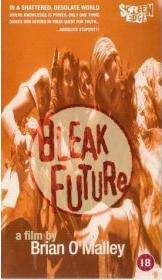
Bleak Future

Director: Brian S O’Malley
Writers: Brian S O’Malley, Steven Darancette
Producer: Steve Darancette
Cast: Frank Kowal, Brad Rockhold, Wendie Newcomb
Country: USA
Year of release: 1997
Reviewed from: US DVD
Website:
www.bleakfuture.com

The DVD of Bleak Future arrives bedecked with praise. “This movie is awesome,” says Aint It Cool News. Well, they say that about almost everything (although to be fair, the entire budget for this film was probably less than some studio publicists spend on promoting crappy blockbusters through Aint It Complete Nonsense).

“The energy and enthusiasm of Peter Jackson’s Bad Taste,” says Nathan Shumate at Cold Fusion Video Reviews. Well, I know Nathan slightly through discussion boards and I find his reviews to be accurate and insightful (and entertaining). I trust this guy’s judgement.

But hey, what’s this third quote? “Funniest sci-fi film in years,” says ‘Mike Simpson, SFX magazine’. What the heck does he know about anything?

Ah, I love DVDs that have quotes from me on the back! And I love even more films which, when rejigged and rejogged for a super-wicko DVD release actually include me in the ‘thank you’s at the end! I do recall reviewing Bleak Future when it was released on VHS in the UK by the old Screen Edge label in 1998. And I did indeed write that quote and, having watched the film again nine years later, I stand by every word of it (all five of ‘em). Bleak Future really is one of the funniest science fiction films of recent years. What is more, I’ll go further. This isn’t just comedy for comedy’s sake, this is actually one of the best post-apocalypse movies ever made.

It’s always tempting with post-apocalypse films to compare them to Mad Max (or Mad Max 2) but two titles jumped into my head while watching the Bleak Future DVD and they refused to go away. If I had to stop writing now and sum this film up in one sentence, I would say: ‘Bleak Future is Beneath the Planet of the Apes meets The Bed Sitting Room.’

But I don’t have to stop writing now. I can go into some detail about why this movie is so damn good.

In a world of ruins and deserts, Slangman (Frank Kowal) wanders across the land. Possessor of a large dictionary, he makes his living by selling definitions of words (I particularly like the idea that the exchangeable currency in this world is batteries). Self-styled ‘most intelligent man in the known world’, Slangman is irritable, self-confident and often exasperated. Searching for the mythical ‘Source’, said to be a repository of knowledge from before the great cataclysm, he gathers around him a small coterie of acolytes. There’s Atlatl (Brad Rockhold), a mute Scottish warrior; Femme (Wendie Newcomb), a bimbo actress; and Brother Alfonze (Steven A Kowal - Frank’s brother) a hippy hermit.

Standing in his way are a range of ‘mutants’ including Doctor Obvious (Rob Cunningham) who also believes himself to be the smartest man in the world; King Malice (played by a guy credited only as Bones) and his mutant court; and the terrible Malathion Man (Tom Johnson) armed with what appears to be highly acidic urine.

As Slangman and co. stumble across the patchy desert towards the Source, we break off occasionally for documentary footage of what happened to the world. An era of unprecedented peace and prosperity led to the development of the Pangaea Project, an attempt to move the planet’s tectonic plates to create one super-continent without countries or borders. The film’s climax is both the end of Slangman’s journey and the culmination of the documentary, the latter explaining the circumstances of the former. In this respect it reminded me of a terrific SF novel I once read, The End of the World News by Anthony Burgess, which used a similar structure but with three narrative strands.

The thing about post-apocalypse movies is that, their setting generally being a featureless desert, it’s the characters that make them. And Bleak Future has great characters. It’s a wonderfully restrained film that doesn’t try to go overboard on ‘clever’ dialogue but instead lets us learn about the characters through their reactions to the world around them.
And it’s a marvellously constructed world, a credible, crumbling fin-de-civilisation wilderness which has created its own rules and its own society from the remnants of what was once there. You can believe that there are still actors staging crappy fringe theatre - and that in a world without TV or radio, people might actually watch such stuff. You can equally believe that hordes of insane warriors charge around with swords and sticks. You can believe anything if it’s presented with an intelligent, satirical bent.

When I first saw Bleak Future on that Screen Edge VHS, in those far-off days when ‘DVD’ was still a sexually transmitted infection, it was a rough and ready thing. It was clearly a labour of love. Shot on Super-8, the grainy, sometimes wobbly image looked like a real, grown-up film. There was nothing digital in those days except watches and alarm clocks so you either shot on 16mm if you could afford it or Betacam if you couldn’t. The former looked polished and left you unfairly compared with the 35mm big boys, the latter invariably looked like a wedding video. But there was a grittiness to Bleak Future that marked it out as something special, something that somebody really, really cared about.

Well, God bless Brian O’Malley because he has managed to upgrade Bleak Future into a minor masterpiece - without losing that same rough and ready feel. For three years he used modern technology to make the old film look like it would have done when new if today’s technology had been available back then but had worked like the old technology did when the film was made. D’you see?

The film has been re-edited and digitally doodah-ed; tints and tones have been added; pick-up shots have been filmed in the same locations and seamlessly integrated; the entire dialogue track (so often the Achilles' heel of enthusiastic low-budget movies) has been recorded with all but one of the original cast looping their own lines. I no longer have that old VHS so I can’t make direct comparisons, not that I need to. The new version of Bleak Future is a thing of beauty - that’s all you need to know.

And what a package on the DVD: literally hundreds of stills, designs, pieces of artwork and publicity materials. Stacks of behind the scenes footage and commentaries which document the incredible story behind the film. The scenes with the stuck truck are priceless. This is one of the best value DVDs I have ever seen, packed with so much stuff it would take you weeks to get through it all. Sometimes a multiplicity of extras masks a shoddy feature but not in this case. On the Bleak Future DVD, the extras complement the feature magnificently, creating an all-round entertainment package that means you may never have to leave your armchair again.

But what of the cast and crew of Bleak Future? Where did life take them after making this film? Frank Kowal was set decorator on some of Steve Oedekerk’s ‘thumb’ spoofs and was production secretary on Roger Corman’s Black Scorpion TV series. Wendie Newcomb worked on the digital effects on Black Scorpion and a few other pictures. Steven A Kowal was a runner on Black Scorpion (I sense a pattern developing here). Producer/co-writer Steve Darancette went on to pen episodes of Krypto the Superdog and Biker Mice from Mars. Most of the cast and crew simply returned to normal life. As for O’Malley himself, he made one more feature, Minimum Wage, and worked for Roger Corman for a while, including a stint as script co-ordinator on, unsurprisingly, Black Scorpion.

In a way, the fact that Bleak Future has not been followed by a string of other indie movies makes this all the more special. O’Malley seems to have dedicated most of his life to Bleak Future in one form or another and it shows, the love shows, the passion shows. I mean, yes, the guy really needs to put this behind him now and get out of the house a bit more, maybe kick a ball about in the yard or something, but you can’t fault his dedication. This is the sort of feature film that you get to make only once, before you realise how much ridiculously hard work is involved - which is ironic because in a sense he has made it twice.

Are you getting the impression that I rate Bleak Future highly? You’re damn right I do. This was one of my favourite films even before O’Malley stuck my name in the end credits. A brilliant piece of fantasy storytelling, a hilarious comedy, a penetrating satire on the human condition - and that’s just the Making Of featurette. The movie itself is all this and more. In fact, this deserves something that I have almost never handed out in all the years I have been running this website. Brian Scott O’Malley, I award you...

MJS rating: A+
Review originally posted 16th April 2007

Thursday, 17 January 2013

Bane

Director: James Eaves
Writer: James Eaves
Producers: James Eaves, Laura Eaves
Cast: Jonathan Sidgewick, Tina Barnes, Sophia Dawnay
Country: UK
Year of release: 2008
Reviewed from: advance screener
Website:
www.amberpictures.co.uk

Bane is one of the most anticipated British indie pictures of recent years; several other film-makers have commented to me how much they’re looking forward to it. Well, here it is, landing on my doormat a couple of days after the cast and crew screening and a few days before the public premiere in London. And while it has its flaws, this is an impressive, original and skilfully crafted piece of sci-fi cinema.

Yes, it’s SF. Well, it’s a horror movie too. There’s plenty of blood, but the rationale behind it all is pure science fiction.

I don’t know whether a term has ever been coined for the subgenre that involves a bunch of strangers waking up in a mysterious place with no way out and no idea how they got there. I suppose Cube is the most famous example and Aquarium possibly the most recent one. Although we have a prologue showing four women being forcibly sedated, Bane effectively starts when they awaken, not just unsure how they got there but shorn of all memories, even their own identities.

All they have are name-tags on their wrists, identifying the level-headed, assertive one as Katherine (Sophia Dawnay: Rock Rivals), the nervous, weak one as Elaine (Sylvia Robson), the sympathetic, meek one as Jane (Lisa Devlin) and the bolshy, aggressive one as Natasha (Tina Barnes: A Day of Violence). They are dressed in simple, plain clothes, they each have a camp bed and they are in some sort of secure internal area. A six-foot high metal fence surrounds them, shadowy figures glimpsed behind the opaque sheets fastened to it. There is a locked door in one corner and an area curtained off with a toilet and shower. And there is a clock, which will become significant.

They don’t know who they are, where they are, why they’re here or how they got here. The only people they see, apart from occasional silent, masked workers, are a young fellow and an older bloke in a lab-coat. The latter, eventually named as ‘Dr Murdoch’ is played by the curiously lipped Daniel Jordan (who was in Elisar Cabrera’s first two features, back in the 1990s, Virtual Terror and Demonsoul); the former, unnamed and credited only as ‘the handsome man’ is played by Jonathan Sidgewick (The Witches Hammer, Man Who Sold the World). One by one, the women are taken to another room in the complex and interrogated while hooked up to a small machine. Of course, they are unable to answer any questions and at the end they can ask one question but the answers they get aren’t much help.

Things rack up a gear when Jane, unable to sleep, sees a frightening figure enter the prison room in the middle of the night and stab Elaine. Is it a nightmare? Apparently not as, the following morning, Elaine finds a four-figure number carved into her skin (which, truth be told, doesn’t really fit with the rather violent attack which we, and Jane, witnessed). The following night Jane sees the figure, who is dressed in blood-stained surgical overalls, return and brutally murder Elaine.

Now we’re in horror movie territory rather than just existential fantasy, although it is with the next violent death that things really get going. I can’t say too much more about the plot without spoiling it except to say that extraterrestrials are involved in some way. Quite a surprising way actually. And all credit to the production for commendably showing us enough of an alien to make us see that it’s non-human (and rather scary) without showing us the whole thing. Also, several people get covered in a lot of blood at various stages and some of the deaths are astonishingly brutal without either the character or the director revelling in any sort of sadism.

That said, the explanation - when it does come - is not wholly satisfactory. Partly because it doesn’t entirely make sense, certainly in terms of many of the details of what the women have been subjected to. For example, it is stressed that the ‘experiment’ specifically required four women, not three, but it’s difficult to see why that is. Also, we’re given too much of an infodump at the end rather than being drip-fed clues throughout the film which finally make sense with the climactic revelation. And finally, some of the explanation is presented in the form of a video shown to the survivor(s) which explains basic recent history that they would know if they hadn’t had their memories wiped. That sort of thing, apart from being a bit of a cop-out structurally, always irritates me because it’s like somebody in a 1950s-set story watching a newsreel that explains that the leader of the Nazis was a man called Adolf Hitler who had a small moustache. You just think: who made this documentary and who did they expect to watch it?

I can understand how the results of this ‘experiment’ achieve what Dr Murdoch and co are setting out to do but I can’t see any reason why they would know that these things would happen if they did this, nor why they have to do it in this particularly odd way. For example, there doesn’t seem to be any reason for the women to be kept behind the metal fence - which gives some sort of psychic shock if they touch it. Yes, it’s a cool-looking and undoubtedly cost-effective set that James Eaves and production designer Harold Gasnier have put together - but in narrative terms, there’s no reason for this complicated set-up when they could just be locked in a large room. (Gasnier, who played Le Cardinale in The Witches Hammer, is primarily an actor and here also shares a ‘creature design’ credit with Beverly Webb. He also directed The Demon Within.)

I’m also a little surprised that the women make no attempt to escape. I would have tried stacking the beds on top of each other or something like that. This quartet seems to just accept their imprisonment with varying degrees of anger and resignation.

But that’s the film’s biggest strength: it’s a film about characterisation more than plot. Although it is bloody in places - the screener disc came packaged in a blood-soaked cloth pouch, which was a nice touch - Bane really is existential fantasy at heart.

I’m reviewing a screener rather than the released version so ithere may be further editing work to do as the film is simply too long at 115 minutes. A small film like this needs a very good reason to go above an hour and a half, maybe a hundred minutes tops. That shocking second death mentioned above comes at the halfway mark and it should really be the transition between the first and second acts so about twenty minutes or so could (and in my view should) be snipped from the early scenes.

I’m all for a slow build-up, exploring characters and the situation in which they find themselves. The trouble is that, when your characters are empty vessels who don’t even know themselves and your situation is an unexplained, featureless environment, you don’t really have that luxury. Because we are told so little about what is going on at the start, we don’t need to take so long being told it. While I’m being picky, there are a couple of inconsistencies in the door, which is normally soundly locked but later left open, and the clock, which is broken but later reappears.

Those are the weaknesses of Bane but they are, in this reviewer’s humble opinion, more than compensated for by the film’s strengths, not least a fine script and terrific direction by James Eaves. All four actresses are good although the two speaking male actors aren’t given much to do, to be honest. But the standout performance here is Tina Barnes who turns Natasha, a role which could have been a stereotypical, one-note angry bitch, into a superbly realised, fully-rounded character. This is simply one of the best acting performances I have seen in a new British horror movie since I started writing professionally - what, thirteen years ago.

While Katherine, as the natural leader, seems the more central role, Natasha is a fascinating character with an extraordinary amount of depth for one so - by necessity - sketchily written. The transformations she goes through as events progress are thoroughly believable and drag sympathy from the audience for a character who, on the face of things, seems fairly unsympathetic. By anybody’s standards, that’s an impressive bit of acting.

Barnes was the wife of Jonathan Sidgewick’s character in The Witches Hammer and was also in Darren Ward’s short Nightmares. She can be seen in Hellbreeder, Darkhunters, Cold Earth and A Day of Violence and is definitely someone I will be watching out for in future.

Four concept artists are credited on Bane: Rikin Parekh (who did storyboards for Jake West’s Pumpkinhead sequel), Sam Smith (also fight choreographer), Charlotte Thomson and John Hatcher. Cinematographer John Raggett’s CV includes not only Eaves’ films and those of his former co-director Johannes Roberts but also Nature Morte, Nightmares, A Day of Violence and John C Evans’ The Last Blood Line - which also stars Jonathan Sidgewick. Ronnie Doyle (Until the Sun Goes Down, 2.0) composed the commendably effective score. Glen Yard, who was ‘post-production sound designer’, also worked on The Witches Hammer and Freak Out and got a gag credit as ‘UFO wrangler’ on Evil Aliens.

Bane is a brave, serious, ambitious and on the whole successful attempt to do something different. It’s very easy to make yet another film about zombies, vampires or serial killers but (non-comedy) British science fiction pictures have always been relatively few and far between unless you stretch the boundaries of the definition to an unfeasible extent. Bane is a more mature picture than The Witches Hammer and certainly not a fun film in any way. In fact, towards the end it gets pretty bleak indeed.

So the start goes on for a bit too long and the culmination is a bit too quick (and doesn’t really make sense) but, inbetween, the meat of the film is a hugely impressive psychological character study which I can thoroughly recommend.

MJS rating: A-
Review originally posted 12th April 2008