Showing posts with label 2004. Show all posts

Wednesday, 28 September 2016

Distant Shadow

Director: Howard J Ford
Writer: Mark Andrews
Producer: Mark Andrews
Cast: Rosie Fellner, Stephen Tiller, Trevor Byfield
Country: UK
Year of release: 2004
Reviewed from: UK DVD

Distant Shadow is listed on the Inaccurate Movie Database as ‘Horror/Mystery/Thriller’ and the UK DVD sleeve carries the line “A gritty and relentless urban chiller.” On this basis, I added it to my master list of 21st century British horror films. The fact that it was directed by Howard J Ford, who went on to make the magnificent The Dead and its sequel added to my impression that this was an obscure, forgotten, early entry in the British Horror Revival.

Well, I’m here to let you know that Distant Shadow is not in any way, shape or form a horror film, no matter how much you stretch the genre. In 100 minutes there are precisely two moments that could be conceivably viewed as ‘horror’. A very brief dream sequence in which someone in bed is stabbed by an intruder, and a momentary hallucination when our heroine thinks she sees a recently killed person in the bathroom mirror but it’s actually her boyfriend. That’s it. There are in truth far more humorous bits than scary bits but it ain’t a comedy so it definitely ain’t a horror picture.

It’s a thriller, and an okay-ish one in a low-rent, late ‘90s, DTV sort of way. It’s not terrible but it’s unlikely anybody has ever watched it more than once and you’re not missing anything by never having seen it (or, quite possibly, ever heard of it).

Rosie Fellner (Nine Lives) stars as Michelle Wallace, a 20-year-old unemployed woman who lives in a bedsit in a somewhat dodgy boarding house owned by a somewhat dodgy landlord. Stephen Tiller (who now directs operas) is Charles Paskin, the middle-aged man who moves into the room opposite. Not that you would know this from the UK sleeve which lists (and depicts) Shane Richie as the main star with Mark Little and Trevor Byfield either side of him.

EastEnders’ Richie (also in The Reverend) plays Paul, a knobhead colleague of Michelle’s boyfriend Steve (Andrew Faulkner) who doesn’t even appear until the 40-minute mark, although he does actually become peripherally relevant to the plot later. Neighbours’ Little turns in a commendable comic relief performance as the landlord, whose only concerns are (a) getting his rent and (b) Elvis. Only Byfield (Beyond the Rave, Slayground) is a major character as John Clay, who starts out as Paskin’s boss and ends up as the main villain.

Although he claims to be a writer, Paskin is actually a secret agent working for a shady, unspecified department within the UK Government. He’s trying to track down some crucial information about a secret project from the 1980s called Magog which has been stolen. Two thing stand out about this. The first is that the documentation is somehow encoded on a microcassette, of the sort that I used to record my interviews on. On a couple of occasions, people connect a Dictaphone to a PC, across the screen of which scrolls a large amount of binary which then somehow decodes itself into a formatted text document (all in green text on black of course). This seems highly unlikely. Basically the microcassette is just a MacGuffin – which later in the film is replaced without explanation by a 3.5” diskette anyway.

The other notable thing is that absolutely everyone pronounces the Biblically derived codename name ‘Magog’ with a short A (as in ‘mad’) and emphasis on the second syllable. Whereas I have always understood that it is correctly pronounced with a long A (as in ‘made’) and equal stress on both syllables. Even though this is completely irrelevant, it annoyed me enormously. So much so that I just checked the pronunciation on Wikipedia, which agrees with me.

Anyway, Michelle was orphaned at the age of four in a prologue when she saw her mother murdered by a man with a distinctive scar. He was seeking a folder intended for Michelle’s often absent father who had apparently already been killed. Hidden in a cupboard, young Michelle clearly saw the convenient label on the envelope, which read ‘Magog’. So we know there’s some connection between Michelle and Charles.

And that’s probably the film’s biggest flaw: the plot is based entirely on the coincidence of these two people living in adjacent bedsits on the same corridor of the same floor of the same building. Although we later find out that Charles knows who Michelle is, there is no suggestion that he deliberately moved in next door to her, nor is there any reason on God’s Earth why he would do that, except to kick-start the plot.

There are quite a lot of minor characters whose paths cross that of the MacGuffin and it seems at first like this might be one of those hard-to-follow, twisty-turny thrillers but it is to the credit of both Howard Ford’s direction and Mark Andrews’ script that the plot unfolds and explains itself in a way that makes a reasonable amount of sense, curious IT ideas notwithstanding.

On the downside, once things move up a gear and bullets start flying, we are presented with a succession of professional hitmen who make Imperial Stormtroopers look like Olympic rifle-shooters, failing to hit targets who are only a few yards away in a narrow corridor. A lot of people do get killed, including some significant characters, most of whom are entirely innocent and are just casually despatched for being in the wrong place at the wrong time. However, there are too many really obvious, clichéd ‘surprises’ such as characters we thought dead turning out to be alive and turning up in the nick of time, or gunshots which turn out to be fired by and aimed at people other than the ones at whom we were looking.

As for Project Magog, this is revealed to be some sort of unethical biological warfare experiment in Africa which was disguised as a vaccination programme and has resulted in the deaths of ‘millions’ (so implicitly AIDS, although mentions of Ethiopia glimpsed in the decoded document alternatively suggest that it could have been an artificial driver behind the famine which devastated that part of the continent). But absolutely nothing is made of this.

Distant Shadow was apparently shot in 1998 as a diary page from 16 years previously is clearly marked ‘1982’. It premiered at the ‘Cherbourg-Octeville Festival of Irish and British Film’ in October 2000 but didn’t appear on DVD until March 2002, when there was a US release. The British disc, on the Lighthouse label, followed in May 2004.

This was actually Howard Ford’s second feature, his first being an even more obscure thriller called Mainline Run way back in 1994, which was executive produced by Mark Andrews. Howard also edited this film while brother Jon was the DP. Guy Michelmore provided the music, after starting out on things like The Interrogation but before establishing his niche as the go-to guy for Marvel superhero cartoons. First AD Stefan Smith also AD-ed A Day of Violence and directed his own BHR entry Aggressive Behaviour aka Unwelcome. The special effects were provided by Alastair Vardy whose low-budget credits include Hellbreeder, Darkhunters, LD50, Sudden Fury and Edgar Wright’s A Fistful of Fingers, while his big budget gigs include Die Hard 5, World War Z, Victor Frankenstein and Game of Thrones.

The cast also includes Andrew Pleavin (Attack of the Gryphon, Return to House on Haunted Hill) and Glenn Salvage (The Silencer, Ten Dead Men). The Demon Headmaster himself, Terence Hardiman, is suitable aloof as Clay’s boss.

Distant Shadow kept my attention throughout, which is more than many films I’ve watched recently have managed. It has some decent production values for its budget and Howard’s direction gives it a class one might not expect, helped by Jon’s photography. It’s probably weakest in its characterisation, especially Paskin who is a bit meh for a secret agent. He doesn’t have anything approaching the flair of a Bond or a Bourne, but he also doesn’t have the subdued parochialism of a George Smiley. He also has very little chemistry with his female co-star, leaving the film somewhat hollow, with interesting supporting characters but nothing strong or distinctive at its centre.

Whatever, this is definitely neither a horror film nor a relentless urban chiller, just a production line British thriller with a slightly daft, clichéd plot and a few good aspects but nothing that lingers in the memory.

MJS rating: B-

Wednesday, 8 June 2016

Grave Matters

Director: Aimee Stephenson
Writer: Aimee Stephenson
Producers: Tim Jackson, Guy J Louthan
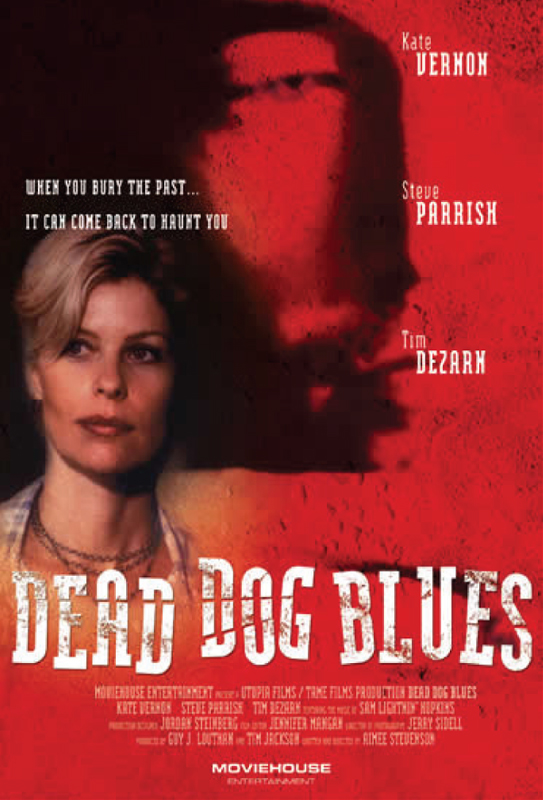
Cast: Kate Vernon, Steve Parrish, Tim DeZarn
Country: UK
Year of release: 2004
Reviewed from: US DVD

This early entry in the BHR has been on my wants list for a while. Eventually I got round to picking up a DVD off eBay and gave it a spin. Two things struck me. First, it doesn’t feel very British. Set in the American deep south, with an American cast, if you weren’t warned in advance that this is a British film, you wouldn’t know. The only clue is some London post-production credits at the end. That’s not a problem.

The other thing that struck me is that this is actually a bloody brilliant film. It’s a beautifully scripted, slickly directed thriller with an intrinsic supernatural element. From the brief synopsis I’d read I expected it to be something of a black comedy but actually it’s played straight, albeit with a jet-black streak of wry cynicism. It reminded me very much of the sort of thing that Joe R Lansdale writes, and fuller praise I could not give.

Christine (Kate Vernon, later in Battlestar Galactica) and Mike (Steve Parrish: Scanners III) are a young married couple, living in a small house in Shitsville, in the shadow of a huge chemical plant. They were in love once but now they mostly argue. She dreams of something better, he’s a sexist, arrogant pig. But they’re both equally concerned when they discover a dead body in their yard.

Christine wants to call the cops but Mike has been in trouble with the police before so they wrap the body in bin liners and bury it out back. Before they do so, Mike checks for ID and finds none but does extract an envelope from the corpse’s pocket, containing a list of names.

A little later, as tensions heat up between Mike and Christine, something snaps inside her and she goes crazy, battering her husband to death. Repentant, shocked and frightened, Christine wraps Mike in bin liners, redigs the hole and dumps him on top of the other corpse.

…So it’s a big shock when Mike reappears, clean and uninjured. As a ghost, he is no less abusive and mean than he was in life, perhaps even more so because he is now invulnerable. He has enough corporeality to grab Christine, but can also jump from place to place or change his appearance. He is also able to [spoilers on] converse with a silent, ghostly figure that Christine has glimpsed in the yard and hence he has discovered that this (ie. the first body in the impromptu grave) is a cop that she was having an affair with. This accusation prompts Christine to admit that she killed the cop when she discovered he wasn’t a nice guy who could take her away from all this but was just a lothario cheating on his own wife.

Before Mike died, he had picked up stories from work about a detective snooping around, asking questions. This is Chief Coveleski (Tim DeZarn, who played different characters in episodes of DS9, TNG and Voyager) who now comes knocking on Christine’s door. He suspects that she might be the woman his colleague was having an affair with before disappearing. Putting two and two together, he surmises that Mike probably found out about the affair, killed the cop and then did a runner. This isn’t true of course, but would exonerate Christine of the first murder. The results of which are currently buried underneath the body of her second victim.

And that second victim, whom she can see and hear but Coveleski can’t, is distracting and unnerving her while she’s trying to concoct answers to the detective’s questions that sound plausible but aren’t either (a) true or (b) potentially incriminatory. Adding to the complexity is that Coveleski is operating outside of the law. He doesn’t want to bring the cop’s murderer to justice, he just wants to locate the corpse so he can get his hands on the envelope. (We never find out what the list of names means. It doesn’t matter. [spoilers off] It’s a MacGuffin.)

I debated whether I should spoiler protect the details of the plot, given that almost no-one has seen this film which is long out of print. And then I thought hell yes, because I really, really want you to see this film. I want people to get it off eBay or Amazon Marketplace. Ultimately it would be awesome if a distributor could pick it up and give it a really good reissue. It was only ever released in the States, Maybe a UK label could get the rights, give it a digital remaster and add a producer commentary and whatever extras they can generate. (All the US disc has is trailers for this and a couple of unrelated films.)

Throughout Grave Matters there’s a sense of oppressive heat, from the baking sun in the day and from the clouds of steam and smoke emanating from the chemical plant at night. This is a hot, sweaty, claustrophobic film: atmosphere in spades, pressing down on all the characters. Well, I say all, there’s really only three main ones. (Robert Firth provides a couple of phone voices.) I love the way the plot twists; I love the conflicting ideals and motives of the characters, none of whom are particularly nice; I love the integration of the supernatural with the criminal. Although it’s clear that Mike’s ghost is real, by the end of the film I found myself questioning whether it actually was real after all, or whether the whole thing is psychological in nature. That’s the sign of a good ghost story, right there.

A 1996/2001 dual copyright date suggests this was filmed (as Dead Dog Blues) in the mid-nineties and finally finished off in post five years later. There is mention of how Christine had a dog which Mike beat and kicked, and that this hound was hit and killed by a car. A cutaway later in the picture shows a dead dog by the side of the road but that is presumably just random roadkill. And in one scene two local dogs get into the yard and start digging up the grave. So it’s clear that dogs featured more prominently in an earlier version of the script, possibly even in an earlier cut of the movie.

And regarding ‘blues’, there is a fine soundtrack of old Lightnin’ Hopkins numbers which I absolutely loved – and not just because they added extra layers to the atmosphere and setting.

Experienced DP Sidney Siddell lit the picture under his occasional nom-de-screen Jerry Siddell (but is credited as Sidney in the cast list; he appears in silhouette as a nosy neighbour). Producer Guy J Louthan had been working since the mid-1980s as production manager, producer and sometimes 1st AD on a range of features including Doppelganger, Jaume Balaguero’s Darkness and Fear of a Black Hat (and later, Seed of Chucky). Production designer Jordan Steinberg is a set dresser whose recent credits include Transformers: Dark of the Moon and Parks and Recreation. Costume designer Esther Lee has Hollywood costumer credits on the likes of Bridesmaids and Fantastic Beasts and Where to Find Them. Film editor Jennifer Mangan (aka Jennifer Spenelli) has subsequently amassed an impressive roster of credits including the first Harry Potter, the Italian Job remake, Ghost Rider and Divergent.

The legendary Gary J Tunnicliffe provided the special effects make-up. The almost as legendary Neill Gorton provided the dead dog.

The earliest screening of this film that I know of, under its original title, was at Exofest 4 in Detroit in November 2003. My BHR masterlist has a note of an unidentified screening in November 2001 but that could be my typo. March 2004 was the date of the one and only DVD release, courtesy of York Entertainment (under the new title, with a misleading sleeve image and hyperbolic blurb). Moviehouse Entertainment, who had (perhaps still have) the distribution rights also considered selling this as The Burial. The IMDB lists it as a 2004 film which is just plain wrong, but then it also says this runs 90 minutes when it’s actually 70. And director Aimee Stephenson’s name is spelled wrong: it’s a PH, not a V.

Now I may be wrong on this, but I believe that Dead Dog Blues could be the first ever British horror film directed by a woman. So this is a significant – as well as terrific – movie. But who is Aimee Stephenson? A little journalistic searching revealed that the question should be “Who was…” as Ms Stephenson is no longer with us. And her death was as awful as it was bizarre.

Born in October 1956, Janet Aimee Stephenson started out as a model and actress before moving into film-making. Do you have the 1980 Roxy Music album Flesh and Blood in your collection? If not, no matter because here’s a jpeg of the sleeve. The nearest of the two girls is Aimee Stephenson. In the 1980s Aimee and her boyfriend Tim Jackson (producer of Dead Dog Blues) worked in the States on some Roger Corman productions although I don’t know which ones. In 1991 they teamed up with a guy called Sean Manchester who had written a non-fiction book about the so-called ‘Highgate Vampire’. The plan was to make a documentary, and possibly a narrative feature film, about the subject but it never came to anything for various reasons.

Loser was a short film directed by Tim, produced by Aimee in 2000: “On the run and escaping the past, Eddie and Alice have to confront their future together.” Aimee is apparently credited as script editor on a 2005 drama called Mouth to Mouth but that script must have been in development for a while as she was no longer with us by then.

In 2001 Aimee and Tim were in Peru, researching a book. The luggage hold of the bus they were travelling on contained some illegal fireworks which caught fire and exploded. Aimee caught the full brunt of the flames and suffered 48% third degree burns to her face, arms, legs and torso. Tim and 17 other passengers were also very badly burned. Despite her appalling injuries, the ambulance which arrived would only take Peruvians with Peruvian medical insurance. A promised second ambulance never turned up so the attending doctor drove them in his car more than a hundred miles to the nearest hospital. After a week there, Aimee was flown home (via Switzerland) to Salisbury – where she shortly passed away. I can’t imagine the pain she must have gone through, or what Tim Jackson and her other friends and family must have suffered watching her agony.

Aimee Stephenson never saw the DVD release of Grave Matters. She joins Andrew Hull (Siren) and Charly Cantor (Blood) on the short list of directors who made one British horror film then passed away absurdly young before it could be released. What Aimee left us is a brilliant, gripping, imaginative, powerfully cinematic movie that has barely been seen and never been written about. I can’t find a single review, under either title, online or among my magazine collection. There are a couple of comments on the IMDB and one on Amazon, but they’re pretty dismissive. There is precisely one still online (above, from the British Council website) and no trailer. Just like Blood (I haven’t seen Siren yet) the departed director has left a fine legacy in their single work which is waiting to be rediscovered and fully appreciated.

I honestly can’t recall the last serious film I enjoyed as much as Grave Matters. It’s an utterly brilliant movie and I wish more people knew about it. And about the woman who made it.

MJS rating: A

Thursday, 7 May 2015

62 Pages

Director: Andrew John
Writer: Andrew John
Producer: Andrew John
Cast: Andrew John, Thomas Lee, Dean Greatbatch
Country: UK
Year of release: 2004
Reviewed from: screener VHS

At 38 minutes this is the longest picture yet from teenage filmmaker Andrew John, whose previous shorts include Dia de los Muertos and 100 Today, Dead Tomorrow. It was shot on video, it stars his mates and it was clearly filmed in and around his home.

And you know what? I really enjoyed this. It doesn’t outstay its welcome, it doesn’t try to reach beyond its grasp, and the two most common faults of amateur film-making - script and sound - both stand up to scrutiny. Granted, it doesn’t entirely make sense but it has convincing characters, entertaining and well-executed gore effects, an imaginative storyline and one brilliant moment which very nearly made me fall off my chair with laughter.

Writer/director/editor/cameraman/executive producer Andrew John stars as Jack, who lives with his older brother Harry (Thomas Lee, aka Tom Rutter, director of Full Moon Massacre) in a comfortable middle-class house. Both the actors and the characters are in their teens; there is no sign or mention of parents, although there is a car on the drive. It’s almost as if this is set in some sort of alternative world where parents don’t exist, which probably wasn’t the intention but is an interesting interpretation if you care to look at things that way.

Jack has daily counselling, for some unspecified reason, from a ‘councillor’ (sic) played by Dean Greatbatch as a porno-watching, money-grabbing bastard with no interest in Jack’s welfare whatsoever. When Jack comes home after being fleeced of thirty quid by this counsellor, he has his wallet stolen by a local yob, but he subsequently finds a Satanic notebook in which he decides to record his feelings. No sooner has he started doing this than he hears that Harry has been killed on his way to the shops (he is told over the phone!). Filled with guilt because Harry had asked him to go down the shops, he had refused and Harry had gone himself, Jack writes ‘Now he’s dead and it’s all my fault’ over and over again, eventually filling all 62 pages of the notebook.

Grieving hysterically in the back garden, Jack falls down a hole, perhaps an old well. I must admit that I didn’t understand this hole. At one point, Jack sees a demonic version of himself appear from it and on another occasion he falls through the hole into an alternative reality where his undead brother chases him with a pistol.

At heart, this is a revenge picture. When the lad who stole Jack’s wallet tries to burgle the house, Jack attacks him with a sledgehammer, then ties him to a chair and lays into him with electric drill and various knives, before literally ripping his guts out. For a no-budget movie, these gore effects are very well done. More importantly, they are shot and edited in such a way as to help disguise their cheapness, not foreground it.

Jack then goes looking for his counsellor, armed with a pistol (I don’t know where he found that). Bursting in on the porno-watching pervert, gun-toting Jack stands in front of him as the counsellor desperately tries to switch off the TV using the remote, leading to the funniest ‘Mexican stand-off’ I have ever seen. For this one scene alone, Andrew John is to be applauded. After a detour in the woods which I didn’t understand, the film culminates with Harry, the yob and the counsellor emerging from the hole as zombies to attack Jack in his own garden.

The director’s passion for film-making, his enthusiasm and his commitment all come across. This is a highly commendable effort from a very promising young filmmaker who could go on to do really great things - by the time he reaches his twenties! Tom Rutter provides the impressive splatter effects which are used just enough to impress without falling into gratuitous silliness. The acting is naturally somewhat variable but John does a great job once his character flips and Greatbatch clearly has a ball as the counsellor. I still don’t understand precisely where the notebook and the hole fit in, but they do at least serve to distinguish the story from a generic revenge fantasy.

MJS rating: B+
Review originally posted 13th December 2005.

Wednesday, 1 October 2014

Ultraman: The Next

Director: Kazuya Konaka
Writer: Keiichi Hasegawa
Producer: Kiyoshi Suzuki
Cast: Tetsuya Bessho, Kenya Osumi, Kyoko Toyama
Country: Japan
Year of release: 2004
Reviewed from: screener DVD

Watching this latest incarnation of the long-running movie/TV series, I couldn't help thinking about the similarities between Ultraman and Doctor Who. Both franchises started in the 1960s ('63 for the Doctor, '66 for the big silver guy) and star an alien who comes to Earth where he befriends and protects humans, while also continuing his adventures in outer space. Both characters have 'superhuman' abilities of some sort and super-advanced technology without being conventional superheroes and can pass for human when necessary.

Both series have changed constantly over the years, including not only their lead actor but the nature and identity of the lead character, even though that lead character has in other ways remained constant (and both have experimented with teaming up different incarnations of the lead character in various combinations). Both are primarily TV franchises which have spun off into films, books, comics, stage shows and other media as well as inspiring plenty of toys and collectables. They are, on the one hand, children's series yet enjoyed by many adults - not merely for nostalgia value - and have attracted a cult following outside their country of origin where the subtleties and intentions of the stories can be widely mis- and re-interpreted.

On the negative side, Ultraman and Doctor Who have both become bogged down - the former with repetition and formula, the latter with continuity and back story. They limit themselves by catering increasingly for established fans at the expense of those coming to the franchises anew. And their effects, especially their monster effects, have become outdated and a little embarrassing - or at least, are viewed as such by many people who don't actually watch the series, which is almost as bad.

In 2005 Doctor Who returned after a 16-year-hiatus (the longest that Ultraman has ever been absent from the screen, I think, is four years) with Christopher Eccleston in the lead role. The new version skipped over a lot of the old continuity without contradicting it or throwing it out, leaving viewers pleasantly uncertain/unbothered about whether this was a sequel (effectively, a continuation of the old series) or a reinterpretation (basically starting from scratch again). The essential premise remained unchanged, successfully fulfilling both the concept of that premise as it existed in the wider cultural zeitgeist and the concept as understood by the hardcore fans. Sufficient iconography was there to please everyone, no matter how detailed or vague their memories - TARDIS, Daleks, sonic screwdriver - without getting in the way of those for whom the series was something completely new.

Around the same time, the character of Ultraman was similarly reinvented in this movie which hit Japanese cinemas in December 2004 - and with, in this reviewer's opinion, similar success. What do we know about the Doctor? He's an alien, a 'Time Lord', who travels in time and space using a spaceship that looks like a blue telephone box (called the TARDIS) which is bigger inside than out. He has a young female companion with him in a strictly platonic relationship, and of all the races he encounters the most deadly are his sworn enemies, the Daleks.

And what do we know about Ultraman? He is an alien who comes to Earth and somehow melds with a military or quasi-military individual. When danger threatens, usually personified by one or more giant monsters, that individual can transform into Ultraman who is a giant humanoid, clad in a silver and red outfit including a helmet with blank staring eyes. Ultraman is never seen without this outfit which may actually be part of him - is that really a helmet or is it his head? He is handy in a fight against any giant monster, whether grappling one-to-one or blasting off rays. But he can only exist for a short time and must return to human form when a light on his chest starts flashing to indicate that his strength is nearly exhausted.

The more recent series - Ultraman Tiga, Ultraman Dyna and Ultraman Gaia - sought to reinvent the franchise from scratch and although they were evidently more successful than the rather poor 1996 Doctor Who telemovie, nevertheless they may end up being viewed as some sort of 'alternative' franchise. On the other hand, the new TV series Ultraman Max (featuring episodes directed by Gamera helmer Shusuke Kaneko and Takashi Miike!) which is in production as I write this in mid-2005 apparently returns the character closer to his roots and it could be this movie which becomes the equivalent of the Paul McGann Who film.

So what is Ultraman: The Next all about? Tetsuya Bessho (Godzilla vs Mothra, Parasite Eve) plays air force pilot Lieutenant Shunichi Maki, who flies an F-15 Eagle and whose nearly-six-year-old son Keimu (Ryohei Hirota) suffers from a terminal blood disease that means he may not see his seventh birthday. Understandably wanting to spend more time with his little boy while he has the chance, Maki retires from the air force and takes a job piloting a light aircraft for private travellers, operating from a small local airport.

Just before Maki retires, he and his wingman Captain Kurashima are scrambled to intercept a mysterious radar blip travelling at incredible speed. Kurashima's instruments go haywire and force him to abort but Maki carries on and finds that the UFO is a glowing red light which envelopes his plane. He finds himself seeming to float in some sort of glowing tunnel where he can see a giant humanoid. (The tunnel effect is, by coincidence, basically the same as that used in the title sequence of Doctor Who!)

Maki's Eagle explodes and he is believed dead, but he later stumbles into a roadside diner, tattered and bruised but without any serious injuries, and with no idea how he survived.

Once into civvy street, Maki's life settles down until a passenger on one of his flights (who has been secretly following and photographing him) pulls a gun and forces him to divert to a nearby highway, which has been specially closed by the military in order for his plane to land. He is then driven to a top secret military base where he is interrogated about what really happened on that mysterious flight. Back at the airport, Keimu waits for his daddy with Maki's wife Yoko (Nae Yuki) and their joy when his plane lands turns to dismay when they find that the pilot is not Maki but Kurashima, accompanied by two soldiers. Kurashima can't tell them anything about where Maki is, but he can at least confirm that he is alive.

That female passenger who pulled a gun and is now interrogating Maki is a military scientist named Sara Mizuhara (Kyoko Toyama: An Obsession) who works for an anti-terrorist organisation called the BCST. She explains that a similar (but blue) light was reported in the seabed location of a downed UFO a few weeks earlier and had similarly affected the minisub pilot who was sent to investigate it: the sub was destroyed but he somehow survived. Archived security camera footage shows this poor soul, Takafumi Udo (Kenya Osumi), in a cell where he can be seen to be gradually mutating into some sort of reptilian beast. He later escaped, drawing to himself and absorbing hundreds of lizards which enabled him to grow and mutate, eventually blasting out of the base. We actually saw this in a dimly lit prologue, with Sara unable to fire at the monster as Udo's human face reappears briefly.

With the monster (codenamed 'The One', and still played by Osumi inside the costume; interestingly he is actually a professional dancer) now on the loose somewhere, the military are naturally keen to contain and study Maki as his development may give them some clue about how to defeat The One. He is codenamed 'The Next' - which explains the movie's apparently ungrammatical title - and held in a fortified underground cell. When The One comes calling, apparently attracted by some sort of psychic link with The Next, something takes over Maki and he is able to break out of his cell, then grows to about twenty feet tall and mutates into some sort of silver-clad alien being.

It's a measure of the maturity of the film-makers that we are nearly halfway through the film before we get our first sight of Ultraman (and that the character is never referred to by that name until right at the end of the film, when a news reporter comes up with it).

The two large (but interestingly, not giant) aliens fight as Sara looks on, incredulous. At one point, she is about to be thrown aside by The One's lengthy, powerful tail but The Next throws himself in the way. Eventually The One smashes its way out of the building, as a light on The Next's chest starts to flash and he collapses into a heap, morphing and shrinking back into the form of Maki.

There are further revelations between this point and the climactic return match, but they mostly concern the people, not the monsters. We never find out what The One and The Next actually are, or where they come from, or what sort of hold they may have over their respective hosts. We do later see Udo once again in human form, further cementing the similarities between the two aliens, although the alien-human connection seems to be different with Udo/The One. The implication is that two warring entities have come to Earth and are continuing an existing fight, with humanity now caught up in the middle. This gives the film a strong narrative thread which stands alone without requiring any foreknowledge of Ultraman's past.

Where the movie really scores is in exploring the way that all this impacts on the lives of Maki, Sara and everyone else who is directly or peripherally involved, which I have always held to be a large part of what good science fiction is about. Take your science fictional premise - whether it's aliens or artificial intelligence or time travel or nanotechnology or whatever - and show how that would affect people. (The new Doctor Who does this terrifically too. For the first time, we get to see how the sudden 'disappearance' of the Doctor's companion affects those closest to her.) We learn more about Sara and discover why she didn't kill Udo/The One when she had the chance, and there is redemption for Kurashima who feels guilty over his collusion with his friend's kidnappers. There are some great minor characters too, including the boss of the airport where Maki works and a junior military officer who challenges Sara over her actions which have resulted in the deaths of some of his men. When did you last see a monster movie where somebody was actually bothered that a squad of miltary grunts had been killed by the beastie?

Although the 'terminally ill son' subplot gets a wee bit soap opera-esque at times, it gives the character of Maki greater depth and clearly defined motivation, both in seeking normality and in resolving to accept the responsibility thrust on him to aid the military organisation which kidnapped him. But more than this we get some real insight into what it might be like to actually be Ultraman's host - a concept which of course implies that Ultraman himself is a form of parasite. Maki doesn't know that he is (or could be) the defender of mankind against alien attack. All he knows is that under certain circumstances he loses consciousness and/or control and something alien (in every sense) takes him over for its own ends. We do later see Ultraman save a mother and child from a collapsing building, but we are left to make up our own minds whether this is the action of a sympathetic human father (Maki is the first ever Ultraman host to have a wife and kid) or a philanthropic alien - or some melding of the two.

Ultraman/The Next may be a superhero (he isn't really one in this movie, except in the broadest possible sense, but he could become one) but Maki isn't any sort of hero at all, super or otherwise. He's just some poor guy who is being used by something beyond his, or anybody's, understanding - and also being used by the military. The great irony lies in the fact that Maki was a military man himself, a terrific Eagle pilot, but he tried to escape the responsibilities of that life, only to have something bigger and worse thrust upon him (and by proxy, upon his family) against his will. It's his acceptance of this, but only on his own terms as much as he can (for example, he briefly escapes his captors when he hears that his son is in hospital) which makes him an ersatz hero, not his uncontrollable ability to grow to 50 metres high and fire energy blasts from his forearms.

The difference between this version and previous incarnations is summed up perfectly in a line that a shaken, confused, possibly even terrified Maki says after that first big fight with The One: "I became a monster." In fact there are numerous dialogue references to Maki's new giant alter ego as a 'monster' - and none as a 'hero'.

And yes, Ultraman does grow to his traditional giant size before the final battle, to match the now-similarly enormous The One, although there is an unusual scene at one stage where the good guy, even at 20 feet or so, is dwarfed by the newly grown monster, something that has rarely if ever been seen before.

As well as a script which brings new depth and breadth to both plot and characterisation, Ultraman: The Next also benefits from good special effects, including a CGI Ultraman for the climactic flying sequences (these were directed by Ichiroh Itano whose anime credits include Urusei Yasura, Macross and Megazone 23). Those who consider anything less than state-of-the-Hollywood-art effects to be 'cheap' will no doubt bring their prejudices to bear and still mock, but this movie is a huge step up from 1970s/1980s series that many people in the West might recall. There are still limitations in the suitmation; for example The One has a quite long but completely rigid neck - the actor's head is between the costume's shoulders - which means that the monster often tends to not look at where it is going or what it is doing. This is a shame because the head itself is an excellent animatronic effect with moving jaw and eyes. If a flexible neck couldn't be achieved on the budget available, then the neck should have been shortened to almost nothing. It's a design problem rather than a construction one.

On the whole, however, The One is a terrific monster. There is a marvellous sequence towards the end of the film when he draws to himself, and absorbs, hundreds of crows. As with the lizards (and rats in another sequence) this causes him to grow and mutate, in this case sprouting a massive pair of wings in preparation for the climactic aerial showdown with The Next. In striking a heraldic pose, and in another shot when he bursts out of the ground, The One reminded me of the recent Thai monster flick Garuda, though this is probably just coincidence. The removal/destruction of these wings, incidentally, is arguably the highlight of the film, a pair of successive images which form a real 'double wow' moment.

Ultraman's own costume is fantastic. It looks enough like the (many) previous incarnations to be recognisable but has been given a 21st century make-over, resembling a suit of body armour or an android body. As mentioned above, I subscribe to the theory that what we see as a 'costume' is actually the being himself, and this stylish, effective design plays to that idea much more than the old silver ski-suits with their baggy wrinkles at hips and shoulders ever did. We do, incidentally, finally get to see the iconic crossed-arms pose but like so much else here a rationale has been found for this. It's a way for the character to steady his forearms and blast off his energy bolts accurately. He doesn't just stand like that because That's What Ultraman Does and the fanboys expect it. Similarly, the flashing light on the character's chest, which has always previously been an entirely gratuitous 'ticking clock' to add tension (and sometimes to keep effects sequences to an affordable length!) is finally given a genuine reason to exist in this movie.

Another interesting point of note is that there is very little miniature work on show. Two of the three main Ultraman-vs-monster fights (monster-vs-monster?) actually take place indoors and the third is mostly green-screened (very effectively, using low-angled shots) against real buildings, before shifting up into the sky. The camera is frequently positioned at human eye-level, looking up at the two giants, which works wonders. There is a tendency for effects unit directors on kaiju eiga to place their camera at the eye-level of their protagonists which often hinders the suspension of disbelief required to accept that these are giant beings, not just two men in costumes. Similarly, many effects directors on these pictures don't bother to overcrank the camera during action shots, which is essential to slow down the movement slightly and give these giant beings weight; it's done properly here. Ultraman: The Next is a film made by people who have looked at current and previous productions within this genre and learned from them, without ditching what made them great in the first place.

This is director Kazuya Konaka’s fourth Ultraman movie, following Ultraman Zearth 2, Ultraman Tiga and Ultraman Dyna and Ultraman Gaia: The Battle in Hyperspace (which was actually a three-way team-up between Messrs Gaia, Tiga and Dyna). He also directed the thoughtful sci-fi picture Dimension Travellers and ghost story Shigatsu Kaidan. Keiichi Hasegawa’s other scriptwork includes the aforementioned Gaia/Tiga/Dyna picture, various episodes of the Ultraman Tiga TV series and the Godzilla kaiju-fest GMK: All Monsters Attack. The cinematography is very dark but that is more likely a problem with the timecoded DVD-R screener that I watched rather than the work of DP Shinichi Ooka. Yuichi Kikuchi (GMK: All Monsters Attack, Godzilla X Mechagodzilla) is credited as special effects director.

I would love to see more Ultraman like this, although by all accounts Ultraman Max restores such temporarily absent elements as the character’s origins in Galaxy M-78 (and slightly baggy silver ski-suits). Maybe production company Tsuburuya have decided that pleasing the hardcore fans is the way to go. But given how many times the character has been reinvented over the years, I would like to think that there is sufficient room for both sorts of Ultraman.

Being picky, my biggest problem with the film is the music. I recall a meeting with the UK Sci-Fi Channel in the mid-1990s, trying to persuade them to show Ultraman and the biggest stumbling block (apart from the fact that the channel was only prepared to pay peanuts) was the martial, orchestral music, which the channel said would need to be replaced with something more techno. Unfortunately (or possibly fortunately) nothing ever came of that meeting. In this film, the music (credited to Tak Matsumoto aka 'B'z') is rockier and generally very good but unfortunately his 'Theme from Ultraman' which plays whenever the F-15s appear on screen (and that’s quite often during the first 20 minutes or so) is a stirring pastiche of the Top Gun theme which rapidly becomes as irritating as it is derivative.

That’s a shame, but not nearly enough to spoil a corking movie, and most of the other music is great. (The closing credits play under an English language song by Matsumoto's group TMG called 'Never Good-bye', written by bassist Jack Blades, formerly with Night Ranger and Damn Yankees, and sung by Eric Martin from Mr Big - who must be a kaiju fan because his 2003 solo album was called Destroy All Monsters.)

I can't claim complete familiarity with every incarnation of Ultraman - God knows there have been enough of them - but I really did enjoy Ultraman: The Next hugely. It works not just as a new version of a cinematic/televisual icon, and not just as a terrific sci-fi romp, but as one of the new breed of more sensible kaiju eiga. If you can accept the basics, not least that a fifty-metre tall humanoid could exist and move freely without collapsing under his own weight because of the vastly increased size-to-mass ratio, then what you will find here is a well-written, well-made, exciting, thought-provoking science fiction adventure which explores its premise and builds to a rip-roaring finale.

It's not your parents' Ultraman.

MJS rating: A

Thursday, 7 August 2014

Vampires vs Zombies

Director: Vincent D’Amato
Writer: Vincent D’Amato
Producer: Damien Foisy, Rob Carpenter
Cast: Bonny Giraux, Maritama Carlson, Brinke Stevens
Country: Canada
Year of release: 2004
Reviewed from: UK DVD (Hardgore)
Website: www.creepysixfilms.com

Sometimes you just want to relax with a shitty horror film, but bloody hell, does it have to be quite this shitty? Vampires vs Zombies is, despite my best efforts to find something good to say about the thing, a pile of muddled, boring, amateur rubbish whose sole saving grace is a small role for everyone’s favourite marine biologist, Brinke Stevens.

Aside from Brinke, this whole thing is a sorry mess, not least because it singularly fails to feature the promised ‘vampires vs zombies’ schtick. It has vampires, it has a few zombies and it has some things that can’t decide if they’re vampires or zombies or both. But at no point do vampires (or even a vampire) fight zombies (or even a zombie).

Bonny Giraux (who played Ophelia in an indie version of Hamlet) and CS Munro star as Jenna and Travis Fontaine who are supposed to be father and daughter although both appear to be in their early thirties. Jenna has a weird trout-pout and muscular man-arms; Travis is a thin guy who close-shaves what little hair he has left, leaving him looking like the lead singer in a not-very-good REM tribute band.

They are driving nowhere in particular when they meet a mother (Brinke) and her two daughters, one of whom (Melanie Crystal) is bound and gagged because she has ‘the plague’ and the other of whom, Carmilla (Maritama Carlson) - isn’t because she doesn’t. The mom asks the Fontaines to take Carmilla with them so that her sister won’t infect her. Or something. And this they agree to do, for some reason.

A long and tedious scene at a gas station - though to be fair, it’s not that much more tedious than anything else in this movie - involves a goth chick with a dog called Bob. That is, the goth chick (Ligaya Allmer) is called Bob; we’re never told the dog’s name. Producer Rob Carpenter is the gas station attendant who gets vampirised by Carmilla when he unlocks the toilet door for her and who then vampirises Bob in turn, and also some other unnamed guy in a jeep (Derek Champion).

Brinke and the other girl later arrive at the same gas station, or possibly a different one, where we discover that the girl, Tessa, isn’t her daughter but has been kidnapped, though she makes absolutely no effort to escape. An old guy with a white beard called ‘The General’ turns up. That is, the old guy (Peter Ruginis) is called The General; we’re never told the beard’s name. (Seasonally typecast, Ruginis and his beard have only three other IMDB credits, all as Santa Claus.) He thinks that Tessa is Carmilla, who killed or attacked his daughter, or something, so he takes her and she doesn’t bother telling him who she really is.

The General is in phone contact with Travis who says that he has the real Carmilla. So The General lets Tessa go, whereupon she attacks him because she is a vampire. Or something.

The Fontaines’ car breaks down so they flag down a passing jeep which turns out to be the guy we saw before who is now a vampire who they have to kill. Carmilla and Jenna take off in the jeep with Travis in the car, now repaired by the addition of a small bottle of water to the engine. They’re heading for some meeting point with The General, which turns out to be an ‘old church’ that has been converted into a ‘convent’, despite the fact that neither the outside (huge, late 19th century municipal building) nor the inside (huge, 20th century municipal building) looks like either a church or a convent.

A frankly bizarre line of dialogue about, “They converted lots of these churches into convents,” made no sense until much later when I realised that the bozos behind this film don’t actually know what a convent is. They think it means a Catholic girls’ school. Which it doesn’t.

Carmilla and Jenna, who had a completely unerotic topless sex scene in the (parked) jeep on the way here, have another in a room which they both describe as creepy and weird even though, like every other interior, it’s just an ordinary, run-of-the-mill room with featureless, painted walls. There is absolutely nothing creepy or weird about this location whatsoever so the film is reduced to shooting characters in tight close-ups and hoping that we’ll believe them when they talk about what a spooky place they’re in, in defiance of what we can see over their shoulder.

Half a dozen vampire/zombie girls then turn up from nowhere for no reason, dressed in white blouses and check skirts like rejects from the auditions for a Britney Spears video (this was when I finally twigged that the film-makers don’t know the difference between a convent and a convent school). Travis appears, also from nowhere, shouting “Look what I found:” and spends a couple of minutes hacking the zompire/vambie girls up with a convenient and unexplained chainsaw.

There’s something in the crypt about Carmilla’s coffin and there’s a scene back outside where The General reveals that he has found his dead daughter in the back of Fontaine’s car, leading to a chaotically inept fight between various people which ends with Travis suffering mild injuries from a wooden stake through his shoulder (like most people in crap vampire films, his boneless, muscle-free torso must have the consistency of mashed potato). The General’s daughter (Erica Carroll, whose TV credits include episodes of The Outer Limits redux, Battlestar Galactica redux, V redux, Supernatural, The 4400, Smallville, Fringe and Masters of Horror) is despatched when Jenna picks up some stuff from the floor of the car, sellotapes it together and dangles it in the other girl’s mouth, causing her to cough up blood and expire.

For some reason and in some way.

Mixed in with all this half-witted nonsense are random scenes of Jenna in a hospital or at home with a doctor (Roy Tupper) who turns up eviscerated in a bath in his early scene but later appears fine. I think, perhaps, maybe, this is supposed to suggest that the entire Carmilla storyline is taking place inside the head of a mentally ill Jenna. Or something.

And zombies? There are two scenes on the road when grey-putty-faced shuffling individuals are deliberately ploughed down by cars and there’s a final scene (possibly a dream) when Jenna and Carmilla, having killed Travis and The General, escape to a motel room which is suddenly, inexplicably filled with zombies. Who then eat them.

Absolutely not one shred of this makes the slightest bit of sense. An appallingly bad script, amateur-ish direction, wobbly camera-work, occasional random inappropriate music and minimal production design combine with some of the most wooden, two-by-four acting I’ve ever seen in my life to turn this entire film into a huge, stinking pile of crap. I bought this from Poundland and frankly I think they overcharged me by about 75p. It’s not even entertainingly bad, it’s just dull. Despite the amount of throat-bitings, stake-stabbings, chainsaw-hackings and other bloody mayhem, this is the dullest film I’ve sat through for ages. It is entirely devoid of tension, excitement, thrills or any smidgeon of interest. It’s 77 minutes of boring stuff happening slowly to people we don’t care about for no apparent reason.

This only avoids a D- through the presence of the ever-reliable Ms Stevens whose acting talents (and knowledge of undersea ecology) are, I fear, sadly unmatched by any discerning judgement in what projects she chooses. Brinke also turns up as a state trooper shortly after the jeep guy is killed and it’s a toss-up between whether it’s dumber that she doesn’t spot a dead body hastily hidden under a couple of bin liners or that none of the others spot that she’s Carmilla’s mother. Or is she meant to be a completely different character who just looks the same? Who knows? (Other titles in Brinke Stevens’ 120+ filmography reviewed on this site include The Naked Monster, Dr Horror’s Erotic House of Idiots, Witchouse 3, Invisible Mom and Caesar and Otto’s Summer Camp Massacre. All of them are much, much better than this, even Witchouse 3.)

Incredibly, Vampires vs Zombies claims to be based on J Sheridan LeFanu’s 1872 novella Carmilla. Well, it has a lesbian vampire called Carmilla whose mother leaves her with a father and daughter, the latter of whom she seduces. And there’s a guy called The General, but really I think that’s about the closest the film gets to anything LeFanu ever wrote. On the other hand, it’s a lot closer to LeFanu’s story than it is to what’s written on the back of the sleeve:

The battle between the living dead and the undead has begun!
Jenna, who has fallen victim of a strange vampiric/zombie plague, sets out with her father to find and destroy the source of the vile infection. Only then will she be saved.
Along the way, they agree to provide safe passage for a mysterious woman, unaware she is actually Carmilla – a centuries-old baroness and the source of the plague! to make matters worse, the countryside is infected with armies of ferocious zombies.
In order to survive, they ally with The General, who has his own score to settle with Carmilla, as well as the weapons and means to do it. As the men battle endless attacks from the living dead, Carmilla slowly seduces Jenna in mind and body.

Nope, there’s nothing like that in the film. Not any of it.

Now, to be fair to film-maker Vincent D’Amato, he wrote this as Carmilla 2000, shot it (on 16mm in Vancouver) as Carmilla the Lesbian Vampire and then saw it distributed by The Asylum (when they were handling pick-ups rather than producing their own mockbusters) as Vampires vs Zombies. On his website, he reckons that he and partner Nicole Hancock agreed to what they thought was just a video sleeve strapline and were shocked to find out it was the new title.

But even as a strapline it would be a lie. And under its production title the film would still be massively unsatisfying because, instead of wondering why there are hardly any zombies, viewers would be wondering why the hell there are any zombies at all in a vampire picture. The trailer has a voice-over saying that “after the zombie-vampire wars left the cities destroyed, the conflict moved to the country” which doesn’t explain anything and isn’t alluded to in the film.

While I’m giving this a good kicking, it’s worth pointing out that, although the driving scenes indicate that there are very few cars around on these lonely roads, during the gas station sequences vast amounts of traffic can be seen driving past outside.

Really, what can you expect from someone whose pseudonym expresses an admiration for the works of Aristide Massaccesi? ‘Vincent D’Amato’ indeed. Many of the cast and crew have also appeared in or worked on other features or online serials by D’Amato and friends including Corpse-O-Rama, Hell Hath No Fury, The Renfield Syndrome and Heads are Gonna Roll, a short which was shot during the production of this film.

Apparently D’Amato has now restored both the original title and some cut gore but dude, that’s not going to be enough to save this. Embarrassingly poor on every level, Vampires vs Zombies should be avoided under any title and in any form even if you have a 77-minute shaped hole in your near future when you would otherwise be self-harming or abusing animals. Anything - anything - is better than this.

MJS rating: D

Monday, 5 May 2014

Wamego: Making Movies Anywhere

Producers: Steve Balderson
Cast: Steve Balderson, Clark Balderson, Karen Black
Country: USA
Year of release: 2004
Reviewed from: US DVD
Website: www.dikenga.com
Now free on Vimeo - see end of review

The Making Of documentary is a relatively recent invention. It started out as the occasional TV special on a big summer blockbuster and gradually became fused with the electronic press kit or EPK. Although there were Making Ofs during the VHS era it was really the advent of DVD in the late 1990s that brought this specific type of film to the fore. It rapidly became the norm to make a 20-30 minute ‘featurette’ for any movie in production, mixing behind-the-scenes footage with cast and crew interviews.

The first feature-length Making Of which was capable of distribution on its own was probably Burden of Dreams in 1982, Les Blank’s documentary on Werner Herzog’s epic drama Fitzcarraldo. But that was a one-off and it was only with The Hamster Factor and Other Tales of Twelve Monkeys fifteen years later that the in-depth Making Of documentary became established as a cinematic subgenre in its own right.

Nowadays it’s rare indeed to find a film that doesn’t have a Making Of and in the field of independent cinema it is almost a given that some aspiring or student film-maker will be allowed to hang around the set with a camcorder and assemble something for the DVD. The problem is: the more of these things one watches, the more one realises that all films are basically made the same way. It takes something really special like Lost in La Mancha (which, uniquely, is the Making Of a film that was never made) to stand out from the crowd. For the most part, every Making Of is pretty much like every other Making Of and only the details differ.

Imagine if you watched a documentary film about someone building a house. All very interesting and you could learn a lot about the construction industry. Now watch another documentary about someone else building a different house. And another and another. After a while the only thing that will distinguish one film from another is the colour of the front door. And so it is with Making Of documentaries.

All of which is interesting but to some extent irrelevant because Wamego: Making Movies Anywhere is not a typical Making Of.

Wamego is the name of the town where the Balderson family live. It is in the North East corner of Kansas which is an almost entirely rectangular state. It’s called a ‘city’ but has a population of just over 4,000 which makes it about two thirds the size of the the village of East Leake where I went to school. I find it fascinating that the USA, a huge country where everything seems to be several times larger than it is in the rest of the world, nevertheless has cities that are smaller than English villages. Anyway...

Wamego is real small-town America, a place where everyone knows everyone else - in fact, as producer Clark Balderson points out, most people are related to everyone else in some way. According to online man-in-a-pub Wikipedia, the town’s two main claims to fame, apart from the Baldersons, are a museum devoted to The Wizard of Oz and (allegedly, at one time) the largest LSD factory in the United States. It is not the sort of place where you would expect a feature film to be made - and that is the point of this documentary.

There was a six-year gap between Steve Balderson’s first feature, the sublime black comedy Pep Squad, and his second, the achingly beautiful murder mystery Firecracker. Wamego goes some way to explaining why, despite widespread critical acclaim and a bunch of awards, a follow-up to Pep Squad was so long in coming.

Strictly speaking, this is not a film about making a movie, it’s a film about getting a movie made. Clark Balderson, Steve’s father and producer, sums it up in one concise quote: “The average guy, sitting in a movie theatre, watching a movie, cannot begin to comprehend the amount of detail, the degree of complexity, that is present in a motion picture.”

Unlike a standard Making Of, Wamego does not show us how particular shots were filmed and it doesn’t interview all the cast and crew. There are some talking heads but the level of luvviness usually seen in these things - “Oh, he was just wonderful to work with. He’s a delight. We just had so much fun together...”: give me a flipping break - is much lower than normal. There are a few comments about how wonderful Karen Black is but also some carefully veiled intimation that she is also, shall we say, somewhat demanding.

What Steve, Clark and their cast and crew demonstrate and recount is the amount of work - administrative, technical and sheer manual labour - required to produce a piece of quality cinema like Firecracker. But at the same time, they are at pains to point out that by operating outside the Hollywood system they were able to make the decisions they wanted rather than kowtowing to received wisdom about how things must be done. This made their lives easier and ultimately made Firecracker possible.

Not that Steve Balderson is some sort of dangerous maverick. He has to negotiate with stars’ agents, he has to pay wages commensurate with SAG agreements, he has to abide by the rules.

The written rules.

Film-making as an industry is hidebound by unwritten rules so hooray for Balderson and son who don’t give a tinker’s cuss about ‘how it should be done’. What they care about is efficiency, cost effectiveness, practicality and artistic vision. If any one thing comes through when watching the hundred minutes or so of Wamego it’s that at no point was Steve ever prepared to compromise his vision of what Firecracker should be like. And if that meant turning down big stars who actually wanted to do the film (Debbie Harry was very nearly Sheriff Ed, a role eventually played by Susan Traylor) then so be it.

Wamego is more than a document, more than a documentary, it’s a masterclass in how to pursue your dreams. There are two lessons here: (1) You don’t have to do things the way everybody else does if you can find a way that’s better for you, and (2) you had better be prepared to work bloody hard. I was amazed to find, for example, that Steve, Clark and a few friends actually built all the ‘gypsy wagons’ seen in the carnival scenes from scratch. Just building those wagons must have taken more time, effort and money than some people put into a whole movie. At the same time, scenes of cast and crew painting colourful side-show banners have a tremendous sense of esprit de corps that says, ‘Hey kids, let’s do the show right here!’

No director is credited on Wamego although the IMDB lists Steve, Joe Martin and Ed Leboeuf. The credits simply say that the film was compiled by Imagemakers, which is a graphic design and advertising agency that Steve runs when he’s not shooting movies.

Wamego is a fascinating, intriguing, uplifting movie packed with conflict resolved, obstacles overcome and ambitions achieved, just like any good, well-told story. And just like any great movie, three years later Wamego spawned a sequel.

MJS Rating: A-


WAMEGO: Making Movies Anywhere from Steve Balderson on Vimeo.

Thursday, 1 May 2014

Hacked Off

Director: Andrew Weild
Writers: Andrew Weild, Fraser Barsby
Producer: Fraser Barsby
Cast: Ross Maxwell, Liam Browne, Layla Anna-Lee
Country: UK
Year: 2004
Reviewed from: DVD

Well, here it is at last. One of the rarest and most obscure British horror films of the naughties. A movie so poorly documented that I didn’t even find out it had had a release until after Urban Terrors was published: Andrew Weild’s 2004 teen slasher Hacked Off. I finally tracked down a copy on eBay and got the chance to watch it.

It’s not great, certainly, but it’s not quite as terrible as the handful of contemporary reviews suggest. And its problems are not those which contemporary reviewers identified (apart from the poor sound, which is really bad).

2004 was a good year for British horror. In that year we got Shaun of the Dead, The Last Horror Movie, Dead Man’s Shoes and London Voodoo. Mind you, we also got The Porcelain Man, Nine Lives, Dust and LD50. While Hacked Off doesn’t approach the quality of the former group, I’d still watch it before sitting through any of the latter quartet (to be fair, I’ve still not tracked down a copy of Dust, but its reputation precedes it).

Hacked Off starts with a caption – ‘Northern France, Autumn 1992’ – and then launches straight into a seven-minute prologue which consists of subtitled conversations between someone on the ground and someone in a light aircraft, searching for a patient who has escaped from an asylum. I say subtitled but what we don’t actually get is the original French dialogue, probably because that would have involved actually finding someone French to translate it and speak it.

Now on the one hand, kudos to the production for finding and using an actual aeroplane. No stock footage this. A gent named Barry Colvin, credited as ‘police pilot’, provided and flew the plane. There is footage of the plane shot from the ground and there is aerial footage shot from the plane, which adds enormously to the perceived production value. Only two things trouble me, well three. If this patient is, as we learn, massively dangerous, shouldn’t there be a more widespread search with, you know, dogs and stuff? Also, in the final conversation between ground and air, the pilot says there’s no sign of the escapee in the area he’s looking at and it’s now too dark to see anything. Well hold on, monsieur le pilot, but if it’s too dark to see, how do you know the guy’s not right underneath you?

But the most troublesome thing is the darkness. This prologue, like much of the rest of the film, is shot day-for-night with a blue filter and it’s simply way, way too dark. Often, all we can see are dark blue shapes moving about among even darker blue shapes. One of these shapes is a telecoms engineer (played by producer Fraser Barsby) who is killed – in some manner that is too dark to see – by our escaped lunatic.

Now we launch into our title sequence, which plays over a load of stuff about some students meeting up, driving a minibus onto a ferry, having fun on the boat, then driving through France, stopping off at a market, eventually arriving at the 17th century farmhouse, converted into a luxury holiday home, which is their destination. While on the ferry they meet a Dutch guy and invite him along. This sequence is presumably supposed to introduce us to our main characters but it singularly fails to do that because by the end of it we don’t know any of their names or any of their relationships. The only good thing is that by counting how many people got out of the minibus, I discovered there were eight of them (including the Dutch guy). By the end of the film, we still won’t know all their names or their relationships, although a couple of them are lesbians apparently.

The above, like the prologue, lasts for a full seven minutes. Given that the entire feature only runs 70 minutes, that means we are fully 20% of the way into the film before eventually getting past the ‘Directed by Andrew Weild’ caption.

Apart from the hot lezzas and the Dutch guy who turns out to be a skilled chef, the only distinguishable character is the ostensible leader of the group, a tall, foul-mouthed, bullying, deeply unpleasant Scouser called… no, even after watching this all the way through I have no idea what the character’s name is. Barsby and Weild’s script is not only short on characterisation, it doesn’t even bother identifying the various characters. Why do people do this? Do they genuinely not realise that, in presenting us with a whole bunch of people, all of similar age and dressed similarly, the one thing that might be useful is to at least know people’s names?

So, people unpack and the Dutch guy cooks and people eat and people drink and people play Twister and my God it’s dull. Eventually there’s a knock at the door and it’s a gendarme, puzzled to see them there as the property’s owners had assured him the place would be empty (a pointless thread of a plot strand which is never mentioned again). He warns them that a crazy psycho named Jacques Sykes has escaped from the local asylum so they should stay inside and keep the doors locked. Fortunately, one of the students recognises the name of the psycho and proceeds to regale his pals at length and in detail about a series of crimes which happened near here ten years ago. Because why shouldn’t he just happen to be an expert on something which happened in a different country when he was nine?

So hang on, this all must mean that the prologue is actually taking place on the same night that the gang arrive at the farmhouse. So all the stuff on the ferry was effectively a flashback of sorts because it happened in daylight, before Sykes escaped from le nuthouse. This is all confusing because the natural assumption, when viewing a film shot in 2002, having seen a prologue captioned ‘1992’, is that the main story brings us up to the present day, especially when characters talk about something which happened ten years before. But that would mean the entire film is set in 1992 for absolutely no reason - certainly none of the clothes or hairstyles look particularly ‘90s. In fact the lad who makes the obligatory discovery that there’s no mobile coverage says he wants to check his Lottery numbers. But the National Lottery didn’t launch until 1994, and anyway in 1992 mobile phones were still rare and well out of the financial reach of students.

Here’s what I think must have happened. Weild and Barsby perhaps originally planned that the prologue with the aeroplane would be the original search for Sykes after he butchered an entire village, so they created the caption that set it ten years earlier. But they then rewrote the dialogue for the pilot and his colleague on the ground, making it a search for Sykes after he escapes. But then they forgot to remove the caption! I can see no other possible explanation. It’s quite the dumbest, crassest error I’ve seen in a film for quite some time.

Sykes, who is now togged up in the telecoms engineer’s gear, proceeds to butcher the assembled, unlikeable characters one by one. Unfortunately, the deep, dark day-for-night filming means that everything outside (and everything inside after the lights go out) is unfathomable, Added to constant poor sound recording (by Barsby) this means we can often neither see nor hear what is actually going on.

One thing we do get to see is two lesbians in bikinis making out in a swimming pool. When Dutch chef guy turns up, they invite him in for a threesome. He scurries back to his room to get changed but, in a quite amusing sequence, spends so long posing in front of the mirror as he tries to decide whether to go for, as Kevin Bacon famously put it, “shorts or budgie smugglers”, that by the time he arrives back at the pool both girls have gone into the sauna and there been savagely butchered.

Dutch guy runs back to the main house to tell people but the Scouse twat accuses him and ties him to a chair. The girls’ bodies have, it seems, swiftly disappeared from the sauna so the rest of the gang go outside looking for them, thinking they have just wandered off, which seems a bit daft given the copious quantities of blood still in the sauna.

After that, it all becomes a bit vague and it’s impossible to tell who gets killed in what order by the steadily walking, implacable, shades-wearing psycho. There was talk in the publicity of the killer assembling a “makeshift morgue” but that doesn’t come across at all through the Stygian photography. Eventually the final girl – whoever she is - runs down the killer with the minibus but a radio news report, delivered in the traditional flat monotone, tells us that the guy’s body was never found.

A brief epilogue “three months later” sees the killer still togged up as an engineer, stalking the final girl in her large, opulent flat. Needless to say, absolutely no motive is ever given.

Now here’s the thing, while Hacked Off is thoroughly generic, it’s also early enough in the history of the British Horror Revival to actually be quite innovative. Think about it: what precedents are there for British slashers? Sure there were a few movies about psychos in the mid-1970s from the likes of Pete Walker, but the modern teen slasher was invented by John Carpenter in 1978. Can you – can anyone – name me a British film before Hacked Off which used the standard slasher tropes that were established in the late 1970s. The closest I can get is Simon Hunter’s Lighthouse but the setting and characters there are more original and distinctive. This is just a bunch of obnoxious teenagers, going off somewhere away from it all, and then being stalked and brutally killed for no reason whatsoever by a dispassionate but relentless nutjob with a variety of tools.

Nowadays that sort of thing is a ten-a-penny but back in the early naughties, as the BHR was getting into its stride, it was still quite a radical idea to make one of these things in Britain (or in this case, mostly France – the top/tail UK scenes were shot in King’s Lynn). So, just as it was nearly 30 years from Night of the Living Dead to the first modern British zombie film, so we can see it took the best part of a quarter of a century for the influence of Halloween and Friday the 13th to be felt over here. Of course, a couple of years later along came Bryn Hammond with The Summer of the Massacre to show us all how it should really be done…

The movie was a co-production between Elig Films and Chipboard Productions, one of which was Andrew Weild and one was Fraser Barsby. The two gents pretty much comprised the entire crew; apart from music credits, the only other names are Alexis Park (gaffer and stills) and Emma Blickem (production assistant and catering) whom I would venture to suggest were their girlfriends at the time. Weild is credited as both DP and camera operator; Barsby as production designer, sound recordist and special make-up; the two share editing, costume, sound effects and (with Blickem) casting. That’s your lot.

Neither fellow made another feature. Fraser Barsby still lives in Norfolk where he has a company that sells and customises ex-Army Land-Rovers. Andew Weild (assuming it’s the same guy) is now a portrait photographer based in the Scottish Borders.

Among the cast, only Ross Maxwell and Liam Browne seem to have pursued a subsequent acting career. The former is in Ouija Board and Sawney: Flesh of Man and a sub-feature psychological horror called Sessions of the Mind; the latter has made some non-horror indie features and starred in a couple of Stereophonics videos. Ben Tyreman, who plays the psycho, now seems to be active in Welsh theatre. But Maria Conciarro, Sarah Pavey, Adam Stride, Tori Wheatman, Mark Wright (not the TOWIE guy), Patrick Owen (who plays the gendarme) and body doubles Karl Irons and Emma Sands have simply vanished. Or have they? An actor named Emerson Peters lists this film on his agent’s website and, you know, you wouldn’t admit to that unless it’s true. I guess he must be either Stride or Wright under a new Equity stage name. The acting, by the way, is no great shakes but also not awful, except the scenes on the P&O ferry which seem to have been improvised.

All of which leaves one name in the cast list who has made something of herself and might well prefer her venture into violent horror cinema to be swept under the carpet (or maybe she’s proud of it) – credited here as Layla Stewart but now known professionally as Layla Anna-Lee. If the name doesn’t ring bells with you (thank you, Wikipedia), she is a TV presenter, mainly covering sport, particularly rugby, football and cycling in its various forms. Even if you’ve not heard of her, you’ve almost certainly heard her voice because she was one of two announcers at the London 2012 Olympics Opening Ceremony. She also does awards coverage for OK! Magazine’s website and presents a children’s cooking show on ITV. Plus lots of modelling over the years, apparently.

Most of the £8,000 budget came from Fraser Barsby’s credit cards with some sort of contribution from King’s Lynn-based financial consultant Martin Crannis and Norwich advertising agency Freshly Squeezed who both receive ‘executive producer’ credit. Local indie band Vanilla Pod, who had been gigging and releasing albums since the mid-1990s, provide some songs for the soundtrack, which also credits Allan Kirk, Shane Reeve, Todd Scott, Bill Cocker and Messrs. Barsby and Weild.

Filmed over five days in November 2002, the movie carries a 2003 copyright date. I can’t find any evidence of festival play but it was actually submitted to the BBFC, receiving a 15 certificate, which must have set the boys back a few quid. Copies were sold through the now defunct hacked-off.com website with offers of a free T-shirt or poster for the first thousand discs sold. Which seems an enormously optimistic sales projection for a no-name indie slasher only available from its own website or the undiscriminating shelves of The Cinema Store.

Screeners were sent out and the film was soundly trashed by reviewers on three websites: Eat My Brains!, The Late Doctor Lady Show and Slasherpool, a now-defunct, English language horror site based in Sweden. “Terrible low-budget slasher effort from the country that just doesn't seem to want to produce good slashers,” was the opinion of Slasherpool which seems odd because it was the people behind that site which actually released the Hacked Off DVD! (Their only other release was Swedish feature Death Academy.)

Long since consigned to history, and not even the well-documented bits of history, copies of Hacked Off now surface very occasionally on eBay.

MJS rating: C-