Showing posts with label 2007. Show all posts

Friday, 12 December 2014

The Tripper

Director: David Arquette
Writer: David Arquette, Joe Harris
Producer: David Arquette, Courteney Cox, Evan Astrowsky, Neil Machlis, Navin Narang
Cast: Thomas Jane, Paul Reubens, David Arquette
Country: US
Year of release: 2007
Reviewed from: UK preview screening

This is the film where a psycho in a Ronald Reagan mask hacks up hippies in the woods - and to be honest, there’s not much more you need to know. It’s well-made, just the right length (which is rare these days) and enormous fun, a reminder that horror movies can be entertaining in an age when so many seem to dwell solely on sadism. This is a film about what someone does and why, not one that dwells on the clinical details of how he does it.

A prologue set in 1967 shows us a young boy whose mother is sick and whose father has the job of interceding between loggers and a group of literally tree-hugging hippies. When things get rough and the cops arrest his father, the boy - whom we first saw watching California Governor Reagan on TV - takes things into his own hands. It’s very good of the film to let us know right from the start who our masked maniac is, long before he even enters the film.

In the present day, a van with three hippie couples inside is heading for a free music festival in the middle of a forest. This sextet are utterly anachronistic and it’s only the presence of a mobile phone that clues us in to the fact that we’ve jumped forward four decades. Only Samantha (Jaime King: Sin City, The Spirit) isn’t stoned; she has stayed clean ever since she took acid and got beaten up for it by her boyfriend, a straight-laced jock named Jimmy (Balthazar Getty: Judge Dredd). Her current beau is Ivan (Lukas Haas: Long Time Dead) and the others in the van are Joey (Kevin Smith regular Jason ‘Jay’ Mewes, whose non-Smith genre credits include Scream 3, Feast and a vampire comedy called Netherbeast Incorporated), Jade (Paz de la Huerte), Jack (Stephen Heath) and Linda (Manchester-born Marsha Thomason who was also in Long Time Dead as well as The Haunted Mansion, Black Knight and Prime Suspect 5!). They are all given some degree of character but it probably says something that I had to plough through no fewer than 18 on-line reviews before I found one which actually identified all six hippies by name and the actors who played them.

Director/writer/producer David Arquette plays one of three rednecks who lob a bottle at Ivan’s head when the hippies stop to take a leak and who then take a beating from Samantha when the two groups meet up again at a gas station. But the real star of the film is Thomas Jane (who also gets an executive producer credit as the film was partially produced by his company Raw) as the local Sheriff, Buzz Hall. As well as his signature role in The Punisher, sci-fi fan Jane’s other genre work includes Simon Hunter’s Mutant Chronicles, Albert Pyun’s Nemesis, Deep Blue Sea, The Crow: City of Angels and a brace of Stephen King adaptation’s: Dreamcatcher and The Mist. Arquette’s brother Richmond plays a Deputy, as he subsequently did in the remake of Halloween.

Hall’s big problem is policing the ‘Peace and Love Music Festival’, being organised in the middle of the woods by slimeball promoter Frank Baker (Paul Reubens hamming it up deliciously; he was in the original film of Buffy the Vampire Slayer - as was Jane - and also provided the voice of Lock, one of the three evil kids in The Nightmare Before Christmas). The local Mayor (Rick Overton: Eight Legged Freaks, The High Crusade, Groundhog Day) doesn’t approve of all the nudity, drugs and loud music but he does approve of the income and temporary jobs which the festival brings to his small town.

Disappearing hippies is not something that bothers Sheriff Hall - they wander off stoned and they’ll turn up when their heads clear - but real trouble arises when they start turning up dead. Initial suspicion points to a local crazy guy who lays animal traps in the woods but we all find out fairly soon that it’s a psycho with a Ronald Reagan mask and a double-headed axe. Considering that this is the central premise of the film and the focus of its poster/sleeve, there seems little point in hiding the actual killer from us for so long. The first few kills are shot in such a way as to give us no clear view of the guy, but we know he’s a loon in a suit and tie with a Reagan mask on his face. We also know who is behind the mask, unless we’ve come in late or we’re as out of it as the hippies on screen.

As the deaths mount, Hall tries to close down the festival, meeting the disapproval of not just hundreds of stoners but also Baker and the Mayor. Meanwhile Samantha - the only non-stoned attendee at the festival - has some idea of what is going on but is also worried that her violent ex-boyfriend Jimmy is around somewhere. And the three rednecks are togged up in camo gear, hunting hippies with paintball guns for fun.

In among all this, the actual deaths are good, old-fashioned, gory violence, not lingering and not brutally sadistic. Well, innocent people do get chopped up with an axe, but not in a way that gives pleasure to the person doing the chopper and certainly not in a way that satisfies the prurient members of the audience. You know, it’s very hard justifying a gory film as ‘fun’ while maintaining the moral high ground over unnecessarily sadistic gory films.

What makes this movie different from your bog-standard slasher is, of course, the political subtext. But what is bizarre is: there isn’t one. You can ‘read’ this from a right-wing perspective as the ersatz Reagan metes out well-deserved punishment to the pot-smoking, lazy peace-and-love-niks, cheering every axe-stroke. Or you can ‘read’ this from a left-wing perspective (what the inhabitants of the former colony call ‘liberal’) as the evil Reagan-figure strikes out with mindless violence against kids who just want to dance and make love, not war. In actual fact the film is equally critical of both viewpoints and Arquette has repeatedly emphasised that his intention was to make a fun horror movie of the sort that he likes to watch and that there is no political statement to be made here.

And yet it’s wrapped up in what seems to be a whole bunch of conflicting political statements. Arquette’s wife Courtney Cox (Friends, Scream 1-3) has a hilarious cameo near the end which is definitely a savage satirical attack on the peace and love crowd (the Inaccurate Movie Database credits Cox as ‘Cynthia’ but her unnamed character is listed as ‘dog hippie girl’ on screen). On the other hand, the end credits play under an unidentified diatribe of some radio or TV commentator haranguing Reagan, the Republicans and the entire US military-industrial complex. Maybe Arquette decided that if he threw enough differing political viewpoints into the fire they would cancel each other out. And it must be said that, from a commercial point of view, this is a canny move because it means that both right-wingers and liberals can watch the film: the one’s box office dollars are as good as the other’s.

The only truly sympathetic character, ironically, is Sheriff Buzz Hall, trying to keep order and stop the murders in the midst of all this. Thomas Jane gives a great performance and is definitely the film’s central character, if not its actual hero (there isn’t really one).

Hugely enjoyable as it is, there are two curious things about The Tripper that spoil the film slightly (well, three if you include the complete non-mystery about who is doing the killing and why). Although the central premise is a killer in a Reagan mask and we see a full-head Reagan mask hanging on a wall at one point and when the killer is finally stopped a full-head Reagan mask is removed from him (a scene which has no visual impact because we have never seen this character before, at least not as an adult) - nevertheless the killer is very clearly not wearing a Reagan mask. When we get to see him with any degree of clarity, it is very obvious that the actor is wearing prosthetic make-up. (The actor in question is actually make-up artist Chris Nelson although I’m not sure whether he had a hand in designing/creating the prosthetics or just wore them.) This is even more obvious when he speaks: this is make-up, not a rubber mask. It just destroys the illusion and seems completely pointless, especially as (and here comes my second point)...

The killer looks nothing like Ronald Reagan. Sorry, but it’s true. If we didn’t know in advance from the publicity that the guy is supposed to ‘be’ Ronnie Reagan, there would be no way to tell. The prosthetics and the hair dye just make him look like a red-faced old guy with dyed hair, not the 40th President of the United States. The face is not just wrong, it’s completely the wrong shape and frankly it looks no more like Reagan than your face or mine. Nor does it help that the actor - and hence the character - is muscular, unlike Reagan’s tall, skinny physique.

There’s the occasional shout of “Nancy!” (which we later discover is the name of a dog) but other than that, there is nothing Reagan-esque about this killer. All the possibilities to play with the concept, the potential one-liners and sight gags, have been ignored in favour of a single visual image - which, as stated above, only works because we’re told in advance who it is.

This is a shame although it doesn’t stop The Tripper from being a tremendously enjoyable, light-hearted horror movie with smart direction, a competent script and some super performances, especially from Jane and Reubens. It also contains, almost incidentally, a very unusual scene. After the festival is closed down, the out-of-their-gourds hippies head off into the woods to continue dancing anyway and the masked maniac wades into them, laying about him wildly with his axe. Most slasher films involve attacks on single people or sometimes couples. I’m no expert on the subgenre but it strikes me as very unusual to have a scene where the killer simply wades into a large group of victims, chopping away at them. Normally, any such group would either flee en masse, quickly reducing the potential victims to individuals, or even fight back. But the dancing hippies are so complete zonked that neither fight nor flight is an option. This is only a brief scene but, to be honest, it is more original and more interesting than giving the killer a Presidential mask.

Other cast members include Redmond Gleeson (Starflight One!), Richard Gross (Children of the Corn IV), Josh Hammond (sci-fi shark thriller Blue Demon, Timecop 2 - no, I didn’t know either... - Jeepers Creepers II and three David DeCoteau movies: The Brotherhood, Alien Arsenal and Ring of Darkness), Brad Hunt (Damned, The Plague), Waylon Payne (who played Jerry Lee Lewis in Johnny Cash biopic Walk the Line) and Richard Reicheg (Leprechaun 3). Members of one of my favourite bands, Fishbone, perform on stage although curiously the song credits at the end of the film identify them as individual performers, not as ‘Fishbone’ - although Fishbone are credited with ‘additional music’. Something contractual going on there, methinks.

Evan Astrowsky (Cabin Fever, Minotaur) and Neil Machlis (The Ring Two, Bedazzled, Wolf) produced alongside Arquette and Cox; thirty years ago Machlis was production manager on The Stepford Wives and Empire of the Ants! Arquette’s co-writer Joe Harris worked on Darkness Falls (and the short that inspired it, Tooth Fairy). He also wrote and directed a short called Witchwise that looks intriguing and three episodes of an animated series about Vlad Tepes as a young man, called Bad Vlad!

Bobby Bukowski (Boogeyman) handled cinematography while editor Glenn Garland (Dracula Rising, Bats, Retroactive, The Devil’s Rejects, Halloween remake and the Roger Corman Fantastic Four) stoked up the Avid. KNB handled the effects, which are largely limited to some gory axe wounds.

All credit to David Arquette for putting together a film that tries to do little but entertain and manages it admirably. But I’m still trying to work out whether wrapping it in apparently political ideas which aren’t actually there was a lucky mistake or a stroke of marketing genius.

(Incidentally the title not only refers to the tripping hippies but also riffs on Reagan’s nickname ‘the Gipper’. Not that I have ever heard anyone call him ‘the Gipper’ but this is what it says. All I ever heard people call him was ‘that crap old actor’ or ‘that dangerous, dribbling idiot who will probably kill us all’.)

MJS rating: B+

Review originally posted 15th February 2008

Tuesday, 11 November 2014

Underground

Director: Chee Keong Cheung
Writers: Chee Keong Cheung, Oliver Morran
Producers: Chee Keong Cheung, Oliver Morran, Mark Strange
Cast: Mark Strange, Nathan Lewis, Fidel Nanton
Country: UK
Year of release: 2007
Reviewed from: UK DVD

Underground is probably the most professional-looking British martial arts picture I have seen. It is slickly directed with no punches pulled on the production values. Camera-work and editing are top-notch, there is an excellent original score and the fight direction is seamless, with very realistic make-up effects used to depict the results.

None of the above, however, prevents Underground from being the most mind-numbingly boring martial arts film I have ever sat through.

There is no plot, there are no characters. There is just a series of fights between people we neither know nor care about, interspersed with brief, narrated infodumps about these fighters and other people we neither know nor care about. The one and only thing that kept my interest was waiting to see how they would resolve the problem of starting with twelve fighters since any knockout tournament needs a number of contestants that is a power of two. (The film was eventually retitled 12.)

The set-up is that a high-stakes underground no-holds-barred fight tournament has been arranged by ... someone. We’re never told the guy’s name (or anything at all about him - he doesn’t even get his own infodump) but he is credited as ‘Fidel’ and played by Fidel Nanton. He has gathered twelve fighters who are referred to by simplistic monickers that reflect the shallowness of the ‘characterisation’. One is called ‘The Soldier’ because he’s a soldier; another is ‘The Homeless’ because he’s homeless; another is ‘The Kid’ because he’s young. You get the picture.

Also assembled are six rich-but-bored people who each put up £200,000 to ‘back’ two fighters. The £1.2m pot will be split between half a million for the winning fighter, half a million for their backer and the balance to Fidel who introduces each bout personally. These backers are given proper names but otherwise have no more depth to them than the fighters.

There is some nonsense near the start about how all this is being filmed through CCTV cameras and broadcast over the web to selected audiences but the only acknowledgement of this is the occasional black and white shot with a date, time and [rec] in the corner. However, such shots are randomly distributed throughout the film and none of them bear any relation to actual CCTV footage in terms of framing or angle - in fact most of them seem to be handheld.

The dozen contestants supposedly live together for the duration of the tournament - like some ultraviolent version of Fame Academy - but we are shown virtually nothing of this. In fact, we’re shown virtually nothing of anything.

Here’s how it goes for the first round: the backers decide on two fighters, each of whom is then introduced with a brief, clumsy, narrated infodump flashback which nevertheless fails to tell us anything about them. Then you get the fight itself, which lasts no more than a minute or two. Each fight takes place in a different location with a small circle of twenty or so friends and associates standing dangerously close (and no sign of any cameras, but then nobody mentions the ‘reality TV’ angle after the first five minutes). And we only know that these people cheering around the edge are friends and associates because in the Soldier’s first fight, half of them wear camo gear.

After one fighter has smashed the other’s face in, usually with a flying kick, Fidel declares them the winner and we cut back to the rich bastards around their table.

This takes us through the first six monotonous fights, the mechanical ‘story’ interrupted occasionally for a brief, clumsy, narrated infodump about one of the backers - which nevertheless fails to tell us anything about them.

Then, before the second round, we’re treated to a montage of shots from the first six fights. Because they were so good we must want to see them again.

The second round improves on the first but only because it involves fewer fights and is therefore shorter. Actually, there is a hint of a storyline when ‘The Foreigner’ (because he’s Chinese) and ‘The Delinquent’ (because he’s young and a bad’un) face each other as those two have shared a couple of very short atypical scenes that weren’t either fights or infodump flashbacks. But nothing - precisely nothing - is made of the conflicted loyalties which such a situation could present.

With only three fighters left, each is given a solo gig, facing off against two unnamed fighters, using weapons. This isn’t terribly fair as ‘The Homeless’ has to use a sword against two blokes with swords, ‘The Ex-Convict’ has to use two short poles against a brace of fighters each armed with two short poles (there’s probably a poncy Chinese name for two short poles but I don’t know what it is) and ‘The Foreigner’ has a sword but is facing a couple of fellas armed with some sort of long, bamboo quarterstaffs. So it’s not very equal - although by a stroke of good fortune each fighter is adept at the particular weapon they’re given.

The idea is that whichever two fighters “complete the task” quickest will go through to the final. It’s not stated precisely what constitutes ‘completion of the task’ (probably because the film-makers didn’t think it through) but that becomes moot as one of the contestants dies. Ho hum.

As the clock ticked down on this will-sapping ninety-minute movie, my hopes of some sort of storyline appearing gradually faded. Eventually there were only two fighters left and they had a big fight and one of them won. The end. Who cares?

There’s just nothing here. Yes, there’s production values and some short sequences of well-choreographed screen-fighting but what the film-makers have forgotten is that a fight is only interesting if we care who wins. And we don’t. In not one of the thirteen fights crammed into this hour and a half do the audience have any incentive to root for one person over another. What the film-makers have also forgotten is that calling somebody ‘The Something’ and having a narrator describe their background in a couple of sentences isn’t the same as giving them a character. And that a knockout tournament cannot constitute a plot on its own.

It’s also worth observing that despite the notional concept of a ‘no holds barred’ freestyle tournament all twelve fighters use exactly the same sort of flashy kickboxing techniques. None of them display any kind of distinctive combat style which might at least have served to distinguish one identikit fight scene from the rest and there is no sign of the eye-gouging, balls-kicking or other unfair play which one would expect in a notionally illegal, unregulated underground prize fight.

This is - if I may coin a phrase - martial arts porn. It’s kickboxing for kickboxing’s sake with no more similarity to a real action movie than a collection of cum-shots has to an erotic thriller. I’m sure there are people out there who want to see this sort of thing but there aren’t any in this house. I sat through it all dutifully though my finger hovered over the fast-forward button and I probably would have skipped through the fights if they hadn’t been so brief that I was sure to overshoot and have to waste time rewinding to find the start of the next dull, narrated infodump.

There are two ironies here. One is the matter of production values. This looks great: really, really professional and slick. Can’t fault the look, but why couldn’t that sort of effort have been put into something with a plot? The other irony is that there is in fact a story here to be had if someone had bothered to write it. If all the tedious scenes of the backers glowering at each other, all the tedious (occasionally repetitive) infodumps about who has a score to settle, who has a family etc, and all the well-choreographed but pointless fights had been either heavily truncated or ditched entirely, there would have been room for us to get to know the fighters. We could have learned who they were, what motivated them, what they cared about, how they related to each other and, crucially, what they thought of the rich bastards encouraging them to fight. Then we might have cared which ones had the shit kicked out of them.

More pertinently, the rich, bored bastard backers could have provided an effective contrast to the gritty reality of the fighters: Caesar’s court to the gladiators. Yet apparently the folk who made this film failed to realise that when rich, powerful people meet all the interesting stuff happens outside the boardroom as they try to forge alliances and/or stab each other in the back. People sitting at a table with fixed smiles is dull the first time you see it and gets no more interesting after an hour and a half.

Despite its undoubted technical quality (some dodgy acting aside - but then fortunately no scene lasts longer than about 45 seconds and nobody is ever called on to say more than about two lines in one go) Underground/12 is an empty, soulless waste of everyone’s time. If you enjoy this sort of thing (and somebody must) then good luck to you but it behoves me to point out that there are training videos with just as much plot but longer and more interesting fights.

A bunch of DVD extras include no fewer then twelve ‘deleted scenes’ which offered some hope that there might be a story after all but in fact these add up to only ten and a half minutes between them and are either too brief or too boring to add anything to the film. These include an unbelievably tedious scene of the twelve fighters arriving one by one and lining up plus, bizarrely, three complete fights filmed in entirely different locations to the equivalent ones in the finished movie.

The dirty dozen ‘actors’ here include Mark Strange (who had bit parts in The Medallion and The Twins Effect), Joey Ansah (The Bourne Ultimatum, Left for Dead), relentlessly publicised ‘UK’s powerful princess’ Zara Phythian and The Silencer himself Glenn Salvage. The backers include EastEnders’ Leonard Fenton (also in The Zombie Diaries), Red Dwarf’s Danny John-Jules (the only regular presenter on CBeebies who also appeared in Blade II), Family Affairs’ Gary Webster (who was in an episode of Urban Gothic) and Intergalactic Combat’s ‘Alexander the Great’ Gordon Alexander. Many of the cast subsequently appeared in British director Chee Keong Cheung’s second feature, the Hong Kong-shot actioner Bodyguard: A New Beginning.

Jake Corbett and Simon Dennis share cinematography and can walk away from this with their heads held high, as can editor Mark Towns (Gnaw). Jenny Cochrane provided the cuts and bruises make-up, Sarah Littlemore handled art direction and the effective score was courtesy of Stuart Hancock who also provided some of the music for Creature Comforts! The fights were arranged by Dave Forman (Batman Begins, Phoo Action, assorted Doctor Who episodes) and Matt Routledge (director of Mersey Cop).

Copyrighted 2006, Underground played festivals for a year or two before a UK DVD release in mid-2009; it has also been released in the USA, Poland, Argentina and Japan. But honestly this is the least satisfying, most tedious, most plotless thing I have seen since Breathe Safely (though mercifully it’s not quite that bad and at least had a budget in excess of £4.50). Nevertheless, I find it hard to think of this as a film. It’s more of a filmoid: something which has the approximate shape of a film but is missing essential characteristics such as characters and plot.

MJS rating: D+

Friday, 30 May 2014

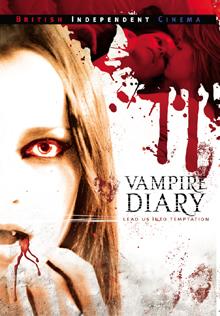
Vampire Diary

Directors: Mark James, Phil O’Shea
Writer: Phil O’Shea
Producer: Michael Riley
Cast: Morven Macbeth, Anna Walton, Keith-Lee Castle
Country: UK
Year of release: 2007
Reviewed from: screener disc

Lesbian vampires - it’s a surprisingly extensive but unsurprisingly disreputable cinematic subgenre. It all dates back to J Sheridan LeFanu’s classic tale ‘Carmilla’ of course; then you have Hammer’s ‘Karnstein trilogy’, all loosely based on ‘Carmilla’. You have pretty much everything Jean Rollin has ever done and a number of Jess Franco films and Daughters of Darkness and Vampyres and the list goes ever on, eventually disappearing into a murky mass of ultra-low budget crap starring Misty Mundae and chums.

It’s a sort of lowest common denominator movie which simply can’t lose. You get two or three reasonably attractive young women, strip ‘em naked, give ‘em some plastic fangs bought from the local joke-shop and then film them licking and stroking each other. Edit it together into about an hour of softcore footage, tag on ten minutes of opening and closing credits so that it just reaches that magical, Blockbuster-friendly seventy minutes - and hey presto. There is someone, somewhere who will buy that crap. Over and over again.

Vampire Diary, while it is admittedly shot on video and is indeed about two lesbians, one of whom happens to be a vampire, is about as far from the typical ‘lesbian vampire film’ as it is possible to get.

Holly (Morven Macbeth) is a (straight, non-goth) video maker shooting a documentary about ‘weekend vampires’, four friends who are part of the goth/fetish scene and who actually like to pretend they are vampires, with little fake fangs and everything. It’s mostly all in fun, a bit of dress-up that goes just a little further than the normal leather, latex, eyeliner and mascara, although some of the ‘weekend vampires take it a little further still by ‘exchanging’ - cutting themselves for others to drink their blood. Weirdos, the lot of them.

The contrast between ‘vampire’ sub-culture - all Anne Rice novels and Sandman tattoos - and real vampires has been explored before in Jake West’s Razor Blade Smile and in ‘Vampirology’, the best-remembered episode of horror anthology Urban Gothic. As it happens, the lead character in ‘Vampirology’ was played by Keith-Lee Castle who is also Eddie, one of the weekend vampires in this movie. He must have a thing for such roles because he plays Count Dracula, the main character’s father, in BBC kidcom Young Dracula. And he was in a vampire-themed episode of bonkers Canadian-German SF series Lexx, although he only got to play Renfield in that one.

Eddie is a DJ and a bit of a poser, the others are jack-the-lad Brad (Justin McDonald, who was in an episode of Torchwood), sensitive Adam (Jamie King: The River King) and vivacious, voracious Haze (Kate Sissons). One night, when they’re having a little party at Holly’s flat, they are joined by a girl name Vicki (Anna Walton: The Mutant Chronicles, Hellboy 2). Not quite as goth as the others, she seems to have arrived with Eddie but is actually new to the area, as Holly discovers when she reluctantly allows Vicki to crash over.

Over time, Holly’s defences break down. After Eddie is found murdered, she shrugs off Vicki’s hand-on-shoulder with, “Are you trying to console me or fuck me?” - but not long afterwards the two become lovers.

There is a sex scene, actually I think there are two in the film, but they’re very tasteful and while the sight of two young ladies making love cannot help but be arousing, if you’re looking for a lesbo movie to get your rocks off, this ain’t it. The sex scene is also where one of the movie’s conventions breaks down somewhat, which is that everything is seen through the eye of a video camera.

Holly carries her camcorder around with her wherever she goes and there are lots of elements that try to make this look like ‘real footage’: blurred or badly framed shots, wobbly shots that end with the camera being placed on a table, crazy movement as Holly runs. Vicki, for reasons which are never explained, also carries a camcorder and there are some conversations between the two when they stand facing each other, camcorder in hand, and we cut between them like a lesbian horror version of Peep Show.

Although this post-Blair Witch conceit is maintained for the bulk of the film, there are some sequences when we just have to let it go and the sex scene is one. A single, locked-off, left-the-camera-running shot would not have worked so we get a montage of angles and close-ups and just have to accept that it’s what it would have looked like if the ladies had been nimble enough to control several cameras and a live edit suite while they were enjoying the delights of sapphos.

Holly wonders where Vicki goes, late at night - and when Brad goes missing, she starts to suspect. What surprised me was that the revelation of Vicki’s vampiric heritage is not the climax of the film but merely a development about halfway through.

Vicki, we learn, is a real vampire. She has no fangs - they were removed at the age of nine and she casts a reflection and can walk in daylight. Vampires are biological entities, not supernatural beings. They live on the fringes of society, feeding on the lonely and dispossessed. And they need human blood to survive.

In a particularly clever twist, Vicki’s preferred method of despatching her chosen victim is a bolt-gun of the sort used to kill animals in slaughterhouses. I like that idea: it’s a quick, clean kill which allows her to then feed at leisure rather than trying to fight someone, and it requires no ammunition.

Because Holly is now in love with Vicki, she seeks to help her rather than hand her over to the cops and gradually the two begin a downward spiral of destruction with further developments only making their life harder. The relationship and situation are both beautifully observed and we completely accept Vicki’s story - because we’re watching a vampire film. It’s only near the end that the prospect is raised: has Holly - have we the audience - been suckered into believing vampires are real by the charismatic lies of a simple psycho with a taste for blood?

Vampire Diary (shot under the title Vampire Video Diary) is a moving, thought-provoking, occasionally gruesome horror film. That it has a gay relationship at its centre is almost incidental. This would work (although not as well, I suspect) if it was just a Thelma and Louise-style friendship. To be honest, you would need to be an extreme homophobe to not enjoy this is you’re a fan of gritty British horror.

While many films have a director who shares writing credit, this one has a writer who shares directing credit. It’s not clear how Mark James and Phil O’Shea shared out the helming chores but only O’Shea (who wrote Spirit Trap and episodes of Ivanhoe: Dark Knight) gets a writing credit. James’ previous credits seem to all be documentaries, including one about Vincent Van Gogh. Executive producer Margaret Matheson has overseen everything from Sid and Nancy to Space Island One; the other ex.prods are Robert Bevan and Keith Hayley who both worked with Julian Richards on Summer Scars.

Robbie Drake, whose credits include Max Headroom and Nightbreed, provides the prosthetic effects while all the goth hair and make-up was designed by Janine Murphy Franklin. The small amount of CGI blood and stuff was provided by Nick Forshaw (Captain Eager, Jeb's Jobs). Also in the cast are Rupert Baker (London’s Burning) and none other than Hardware/Dust Devil director Richard Stanley who appears in a flashback. (I thought that might be the IMDB up to its old tricks but the producer of Vampire Diary assured me it's the guy.)

The movie premiered in March 2007 at the London Lesbian and Gay Film Festival and has been released in the UK by Peccadillo Pictures who specialise (albeit not exclusively) in gay-themed films including an obvious companion piece to this one, gay werewolf chiller The Wolves of Kromer.

MJS rating: B+

Review originally posted 4th June 2007

Monday, 5 May 2014

Wamego Strikes Back

Producer: Steve Balderson
Cast: Steve Balderson, Clark Balderson, Eric Sherman
Country: USA
Year of release: 2007
Reviewed from: screener DVD
Website: www.dikenga.com

Wamego Strikes Back starts with the Star Wars theme music (not the original version, obviously) and a text crawl that spoofs the opening of each of the Star Wars films. It’s a little affectation which we can allow Steve Balderson before he plunges headlong into the sequel to his earlier Making Of feature on Firecracker, his second feature film proper.

And just think for a moment how odd this is: a sequel to a documentary. Who has ever heard of a documentary having a sequel? Who has ever heard of a movie having two feature length documentaries made about it, each of which is released on a separate DVD? But then, young Mr Balderson is not someone who does things ‘the normal way’. Tucked away in a corner of Kansas, he is about as independent as independent film-makers get.

Wamego: Making Movies Anywhere told the story of how Firecracker was conceived, cast and produced. Wamego Strikes Back picks up the story with the film’s world premiere at Raindance in London and tells of how it was distributed - or not, as the case may be. Making movies, as anyone who dips a toe into this ridiculous industry rapidly discovers, is only half the battle. Once you’ve made a film, you’ve got to find a way for people to see it. Sure, you can send it to film festivals, but only a very small percentage of the movie-going population ever attend a film festival and to some extent every festival acts primarily as a shop window for (a) distributors and (b) other film festivals.

So for eighty minutes we watch Steve and his producer/father Clark struggle with distributors, seeing the film that they slaved over turned down again and again for increasingly ridiculous reasons which all basically translate as: “Though we like to think we’re edgy and independent, in actual fact we are as conservative as the Townswomen’s Guild’s cake-and-jam stall at a village fete and we dare not touch anything that doesn’t look like everything else that we and our sheeplike competitors are buying at the moment.”

It’s not like Firecracker doesn’t come with a seal of approval. Roger Ebert no less praised it to the skies in one of the best-written film reviews I’ve ever read. It picked up a truckload of nominations and awards at festivals around the world. But no, no-one wanted to distribute it. And you know, you can make your own movie in Kansas but if you want people to see it, you’ve got to work with the Hollywood system. They control the horizontal and the vertical. There is no alternative.

Bollocks to that said Steve (or would have done, had he been making films in Market Drasen instead of Wamego). Inspired by the travelling carnival in the movie, he took a 35mm print of Firecracker out on a roadshow tour of the USA, proving that there is a way to let people see your work. Suddenly, distributors came sniffing but as we see in a series of scenes featuring an increasingly exasperated Clark, Hollywood is just naturally structured to screw the little man. So huge corporations for whom anything under a million dollars is small change are months late in making payments of fifty or sixty thousand dollars.

While Clark struggles with the financial chicanery surrounding Firecracker, Steve tries to drum up investment for his putative third feature, Wilbert Brummett, a character ensemble piece loosely based on his own family. By the end of this movie, Wilbert Brummett is consigned to a shelf as Steve realises he can’t just make one film every six or seven years. Instead, he sits at his desk and makes his offbeat documentary/installation Phone Sex for pretty much nothing at all (as he points out, he didn’t even have to pay for long distance phone calls because people were calling him).

On this basis he decides that he can go completely outside ‘the system’, making the films that he wants, when and where he wants, rather than slaving for years to make one specific film. That doesn’t in any way take away from the extraordinary achievement that is Firecracker (or indeed Pep Squad) but Steve wants to move on and explore new avenues - and well he should.

Although similar in presentation to the first film, Wamego Strikes Back suffers slightly from having a less visually interesting topic. Making a film involves building things and painting things and cameras and actors and sets and extras and props and, you know, stuff that’s interesting to watch and look at. Distributing a movie involves endless meetings (where a video camera can’t go) and phone conversations or even e-mails. There is a head-bangingly bizarre moment when Clark reads out an e-mail exchange wherein both the sales rep trying to sell Firecracker and the person he thinks might buy it consistently refer to the film as Fireworks.

You might think: how can someone sell a product that they don’t even know what it’s called? But frankly, the title is the last thing that any distributor worries about. We saw that with Pep Squad which was released in the UK as I’ve Been Watching You 2, an ersatz ‘sequel’ to high school vampire thriller I’ve Been Watching You which was itself a retitling of David DeCoteau’s The Brotherhood!

Among the talking heads and other footage, Wamego Strikes Back repeatedly cuts to a fellow named Eric Sherman who, according to his website, is an ‘author and film industry consultant’ (and whose father Vincent directed The Return of Dr Rx!). I can see why Steve gets on with Sherman because he comes across as a no-bullshit guy and there aren’t many of them in Hollywood.

According to Sherman there are 500 people in the American film industry calling themselves sales reps or producer’s reps; in other words, their role is to connect film-makers with distributors. Sherman says he has met and spoken with every single one and that there are only fifteen who won’t charge an upfront fee. Like any reputable agent, those fifteen make their money by taking a percentage of the deals that they broker. The other 485 have to be paid in advance with absolutely no guarantee whatsoever that they will achieve anything - or even try to do anything. That’s like paying a builder a wad of cash just to come to your house and give you a quote on a new kitchen. It’s bizarre.

How can the market survive like that? Why doesn’t everyone use the fifteen honorable reps? I would imagine that, because of how they work, they can pick and choose the very best films to represent. After all, they can only have so many titles on their books at any one time. So every other film, even if it’s an award-winner, has to go through one of the 485 shysters. Okay, so why doesn’t any one of those shysters think: “If I took a percentage instead of charging an upfront fee, I too could have my pick of the best films”?

Because they don’t need to, that’s why. People bring them films and pay them money, people who have worked their guts out on a movie and are desperate to get it distributed, so there is no need for those 485 reps to adjust their business model. The whole thing is extraordinary.

There are lots of Making Of documentaries but Wamego Strikes Back could very well be the world’s first Distributing Of documentary. It’s a story rarely told and a salutary lesson for all would-be film-makers. It features loud aunts, Kansans getting lost in London and cheekily appropriated YouTube clips of Lily Tomlin screaming obscenities on the set of I Heart Huckabees. Throughout it all is an overwhelming sense of ruthless honesty. Because Steve is ploughing his own furrow, determined not to battle through this nonsense again, he has no qualms about naming names; not individuals but the companies he is dealing with, the ones who pay his father sixty thousand dollars four months late.

There is nothing coy here, nothing diplomatic. Steve and Clark are dealing with people and companies who are either idiots or bastards or both and the men from Kansas call it like they see it. In that sense, this is an even more interesting, important and essential film than its predecessor.

So why is it curiously unsatisfying? What is it about Wamego Strikes Back that is just slightly off, that prevents it from coalescing into a robust and substantial whole?

About five minutes from the end of this film, a thought struck me, one of those moments of critical clarity that just comes along occasionally. I realised that Wamego Strikes Back doesn’t just ape the title and opening of The Empire Strikes Back, this film actually is The Empire Strikes Back. I don’t mean it has Taun-Tauns and Wompas and AT-ATs and the like. I mean that the big problem with this movie is exactly the same big problem that Empire has and since Empire is a magnificent cinematic achievement, its triumphs rendering its big problem irrelevant, we can likewise simply and safely ignore that problem when it arises in the North East corner of Kansas.

Let me explain. Most Star Wars fans will tell you that The Empire Strikes Back is the best film in the series, although I personally prefer the first one. True, Empire has terrific action sequences, wonderful special effects, breathtaking art direction, a thrilling, entertaining and literate script and more characterisation than the other two (in fact, five) Star Wars films put together. But it does not have a conventional cinematic structure.

Empire’s big problem is that, although it has three acts - a beginning, a middle and an end - they are not in the right order. Think about it: the movie starts with the battle for Hoth, pitching us right into a massive, climactic battle scene, full of action and heroics. That should be at the end of the film. The middle bit is people doing stuff - character and plot development - which is all well and good. And then the film ends when our various main characters split up to undertake their individual quests in the pursuit of a common goal. That should be at the start.

The Empire Strikes Back is a wonderful film but it is back-to-front, it’s arse-about-face, the hero’s journey is travelled in reverse gear. Whereas the original Star Wars has its beginning, middle and end in the correct order and so is - for me - more satisfying.

And so it is with the Wamego duology.

Wamego: Making Movies Anywhere tells a story from start to finish. It has a conventional beginning, middle and end in its reasonably linear documentation of development, pre-production and production. It starts with ambition and culminates in achievement. It goes forwards. But Wamego Strikes Back, which I at first found almost random and disjointed, actually plays in reverse. It opens with a triumphant world premiere, which one would expect to find at the climax of a film-making narrative. Then there’s a bunch of people doing stuff (or in the case of producer’s reps, getting paid for not doing stuff) and the film finishes with our hero Steve deciding on what he wants to do and how he wants to do it, which in a classical narrative would be our first act.

Just like its sci-fi namesake, Wamego Strikes Back has a beginning, a middle and an end - but not necessarily in the right order.

But you know what? That didn’t matter with Empire and it doesn’t matter here. I’m going to knock a grade off this film for its structural problems and then stick it right back on again because that’s not the point. The point is to watch, in sometimes painful detail, quite how hellish life can be for an independent film-maker.

However, as Clark points out, in a few years digital downloading will be the norm and film-makers will be able to distribute their wares in the same way that musicians can now. And then Hollywood had better watch out because their tentative hold on Steve Balderson and his kind will be lost forever.

(Oh, and one more thing. Does Steve Balderson only have one shirt? He wears the same blue check shirt in almost every scene throughout the combined three-hour running time of these two films, which together document nine years of his life. For God’s sake, buy the man’s DVDs so he can afford some new clothes.)

MJS rating: A-

[And two years later, Steve was back with... Wamego: Ultimatum - MJS]

Friday, 2 May 2014

Wrestlemaniac

Director: Jesse Baget
Writer: Jesse Baget
Producers: Chris Moore, Jake Schmidt
Cast: Jeremy Radin, Adam Huss, Leyla Milani
Country: USA
Year of release: 2007
Reviewed from: UK DVD (Revolver)

Filmed as The Mexican Porn Massacre, retitled El Mascarado Massacre and eventually released as Wrestlemaniac (possibly an attempt to dupe unwary WWE fans used to buying Wrestlemania DVDs), this is yet another of those unkillable-Mexican-wrestler-tears-faces-off-amateur-pornographers-in-ghost-town movies.

For Heaven’s sake, when will these people think up something original?

Whatever you want to call it, this is actually really good fun and makes a nice change from yet another masked psycho hunting ‘teenagers’. Even though the guy does wear a mask. There are some lapses and leaps in the logic - and the make-up, truth be told, isn’t great - but the central conceit is enjoyable, the location is adroitly used and the characters are likeable.

Moustachioed, stetson-wearing, loud slimeball Alphonse (Adam Huss: Demon Slayer) and tubby, camera-toting, enthusiastic Steve (Jeremy Radin) - who is of Mexican descent but born and raised in Seattle - are on their way into Mexico to shoot some amateur porn, starring two blonde ‘actresses’. The girls’ names - in a wonderful gag that passed me by until the end credits - are Debbie and Dallas (Margaret Scarborough and WWE ‘diva’ Leyla Milani, who is a regular on the US version of Deal or No Deal). Also along for the ride are Jimbo (Zack Bennett) and his sister Daisy (Catherine Wreford: Dead Boyz Don’t Scream), stoner siblings whose presence is explained as being solely because Jimbo owns the camper van they’re using.

Characterisation is this movie’s strong point. Alphonse, Steve, Debbie and Dallas could have come across as simply ‘greasy git, fat kid and two bimbos’ but all four are rounded characters for whom we feel both empathy if not necessarily sympathy. So it’s ironic and a real shame that Jimbo and Daisy neither do nor say anything at all of any consequence and are, in narrative terms, simply there to be killed. The story requires us to understand the danger that our quartet are in before any of them actually die and since they’re in a deserted ghost town this has been achieved by bringing along two extra bodies as psycho-fodder.

The entire film only runs 73 minutes (including five minutes of end credits) so there was plenty of scope for giving the stoners something to do or at least letting us get to know them better.

The idea of Americans travelling to Mexico to shoot what they themselves call ‘amateur porn’ is not one I can claim to understand but I’m prepared to cut this film some slack. Actually, the more I think about the basic set-up, the dafter and less believable it seems, but I can forgive almost any film which features masked Mexican wrestlers - and this one starts with a title sequence full of genuine, vintage, black and white lucha libre footage.

Stopping at a gas station in the middle of nowhere, the gang encounter a creepy old guy who seems to have stepped straight out of a Scooby-Doo episode (he’s played by Irwin Keyes, whose many credits include The Exterminator and its sequel, Oblivion and its sequel, Death Wish 4, the Flintstones movie, David Lynch’s weird sitcom On the Air, House of 1,000 Corpses and the monster in Frankenstein General Hospital). He tells them that they are close to La Sangre de Dios (which Steve translates as ‘the blood of Christ’), a long-deserted ghost town. This is where Steve’s Mexican heritage comes into play because he knows the legend of El Mascarado; in fact he’s such a lucha fan that he carries a mask of his own in his back pocket.

El Mascarado’s back story is a bit confusing because we are told that he appeared on the Mexican wrestling scene from nowhere (at the same time that several top wrestlers disappeared) and also that he was the scientific creation of the Mexican government. He seems to have been some sort of Frankenstein-ian creation given life in the hope that Mexico would win the wrestling gold in the 1984 Olympics. (Of course, this is slightly ludicrous because Olympic wrestling is Greco-Roman wrestling, a genuine grappling contest between athletes, not the violent-but-fake, costume-clad showbiz spectacle that Mexican and other audiences enjoy.) Apparently El Mascarado was a very successful wrestler but was in the habit of killing his opponents so he was spirited away to an old ghost town many years ago. And he has apparently been there ever since.

Anyway, the van makes it to just a few yards outside La Sangre de Dios before the slightly-stoned Alphonse drives over a rock and wrecks the transmission. Exploring the town, they find an old bar and the three ladies get down to some very tame lesbian antics before Daisy - whose cotton camisole does little to disguise her generally un-porn-star-like figure - rushes off to be sick. And so the separations and deaths begin.

Steve apparently stands the best chance of survival because of his knowledge of all things lucha. He surmises from some reel-to-reel audio tapes(!) which he listens to on a functioning tape machine(!!) that El Mascarado survived several attempts to kill him and that his only weakness is that he must obey the rules of wrestling (it has rules?) - so he celebrates any success by ripping his opponent’s mask off, but he can be defeated if his own mask is removed. And if an opponent isn’t wearing a mask, El Mascarado simply rips his or her face off instead.

This is where the film’s make-up lets the side down, I’m afraid. The people we see with ‘face ripped off’ simply look like their faces are covered in blood. When we do see someone whose face actually is covered in blood they look just the same. Special effects make-up artists JP Pettersen (Crazy Animal, Risen) and Brandon Reininger (who worked on The Passion of the Christ and Day of the Dead 2: Contagium) have attempted to create faces of muscle and fat but they just don’t work. The actual face-ripping shots are great, but the skinless faces, on-screen, just resemble an accident in a ketchup factory.

What Wrestlemaniac does have going for it is a terrific villain/monster. El Mascarado is a heavy, hulking, non-speaking, mindlessly violent killer and frankly I think there’s a lot of mileage in him. If Wrestlemaniac is enough of a hit to justify a sequel, I think we could have a whole franchise here. He’s not going to trouble Freddy or Jason, but in a world where there are six Leprechaun films, I think there’s definitely room for another one or two El Mascarado pictures. Rey Misterio Sr, a genuine Mexican wrestling champ, is the man in the mask and boots.

Wrestlemaniac is the debut feature from writer/director/editor/co-producer Jesse Baget. Production designer Dan Adams (Parasomnia) does a grand job with the ghost town location - which was actually in California - and cinematographer Tabbert Filler does good work in both bright sunlight and night scenes. Jim Lang (Body Bags, In the Mouth of Madness) provides the original score, supplemented with plenty of traditional Mexican stuff.

The Wrestlemaniac script manages to be well-crafted in terms of believable dialogue while nevertheless having a core story that makes no blooming sense whatsoever. But I’m prepared to forgive much of the silliness, and even to let the director have fun with gratuitously extended shots of the lead actresses’ shapely arses, because Wrestlemaniac is simple, unpretentious, cleverly original horror fun. That’s what matters.

MJS rating: B

Monday, 21 April 2014

Time of My Life

Director: Christopher Douglas-Olen Ray
Writer: Harmoni McGlothlin
Producer: Robyn Ray
Cast: Josh Williams, Tony Williams
Country: USA
Year of release: 2007
Reviewed from: DVD

Christopher Douglas-Olen Ray? Could he be any relation to Sir Frederick Olen Ray, the auteur behind Hollywood Chainsaw Hookers, Evil Toons, The Phantom Empire etc? Yes indeed, this is Fred’s eldest who has been shadowing his father for most of his twenty eight years, working as Second AD, Production Assistant and other crew roles, sometimes in front of the camera too, on FOR movies such as Cyclone, Terminal Force, Hybrid and Biohazard. Let’s face it, what better education could there be?

Well now young Christopher is itching to make his own first feature but rather than simply doing the B-movie equivalent of asking Dad to borrow the car, or assuming that he knows it all now and charging ahead. he has very sensibly started with a simple but effective short film, which functions as both practice for him and a calling card for the rest of us to watch.

Four actors, one set. Tony Williams is Gator, a Florida fisherman who supplements his income by running drugs for gangland boss Thomas (Josh Williams). Thomas’ goons Bob (Bill Lambert) and Jackson (David Ramirez) have trussed up Gator in a warehouse where his screams won’t be heard so that Thomas can politely enquire what has happened to the quarter-million dollars’ worth of dope that the fisherman was supposed to deliver.

It’s not a new set-up: how many short films are there which consist primarily of a sharp-suited gangster interrogating some poor sod? Lots. In the years immediately following the release of Reservoir Dogs, it was practically the only story that any aspiring film-maker seemed to know. But Ray makes his film work by keeping things simple. Crisp black and white photography by Lance Mitchell (who was assistant camera operator on titles like Gary Graver’s Veronica 2030 and Jim Wynorski’s Lost Treasure) gives the film style and hence gravitas and the director frames his shots with a sharp eye. The opening shot of the gangsters walking in is terrific: everything in the sunlight is bleached into non-existence, making it seem as if the men are strolling from a great cosmic emptiness into the monochrome claustrophobia of the lock-up. There’s another memorable two-shot in which drifting cigar smoke makes a point that would probably have been done with complex CGI in an equivalent scene in a Hollywood blockbuster.

Anyway, the gist of the plot is that Gator is knocked about until he explains where the dope has gone. But Thomas doesn’t believe his series of stories and counters them with brutal twist-tales of his own, illustrated with cut-aways, also in black and white. Eventually Gator turns the tables, to some extent, by admitting where the drugs have really gone.

It’s a smart little script, telling us just as much as we need to know about these two characters - neither of them exactly sympathetic - so that we care what happens to them in the end. Time of My Life is exactly what a short film should be: a concisely told, adroitly constructed snippet of someone’s life, a moment in time that illuminates, for a moment, a larger, unseen story somewhere.

The director also handled the editing (as Chris Ray). Writer Harmoni McGlothlin is not, as I first assumed, a pseudonym but a real person. Producer Robyn Ray (Chris’ missus) is, I believe, not the casting director of that name. Brian Bellamy, who has worked with Lance Mitchell since they were Best Boy and Best Boy Electric on Femalien II nine years ago, is credited as First Assistant Camera.

The special effects make-up is by Ron Karoska (Wishmaster III and IV, Dead and Rotting, 2001 Maniacs, Candy Stripers) and the special effects props by Carl Soto, who worked with Mr Ray Senior on Hybrid. Former pro wrestler Ric Draisin was stunt co-ordinator.

You need two things to make any film - skill and talent - and this little gem ably demonstrates both. Copies of Time of My Life are available from the director for ten bucks plus shipping, with whatever funds this raises being put towards his first feature. It’s good to see a young filmmaker showing such entrepreneurship (especially when he could surely rely simply on the goodwill that his family name brings) so I recommend chancing a tenner on this film to support the next generation of independent Hollywood talent.

MJS rating: B+

Sunday, 6 April 2014

The Zombie Diaries

Directors: Michael Bartlett, Kevin Gates
Writers: Michael Bartlett, Kevin Gates
Producers: Michael Bartlett, Kevin Gates
Cast: Russell Jones, Craig Stovin, Imogen Church
Country: UK
Year of release: 2007
Reviewed from: screener disc (Revolver)
Website: www.zombiediaries.com

It’s eight years since The Blair Witch Project was inflicted on the world and still the vogue for movies constructed from faux camcorder footage continues. Just last month I found myself reviewing Vampire Diary and now here comes The Zombie Diaries. Next month expect a review of Video Journal of Dr Jekyll and after that probably Frankenstein’s Blog.

Of course the one problem with this subgenre is that it requires the viewer to accept the conceit that, whatever happens, the person with the camcorder never drops it. Sure, you can have the odd crazy-shaky sequence of them running but really, any sensible person would just throw the damn camcorder away and run like bloody hell.

The Zombie Diaries actually has three diaries, the first being filmed by a member of a four-person TV news crew who drive out of London to interview a farmer in a Home Counties village. The background to the film is that a ‘virus’ is spreading from Asia across Europe in a clear parallel with avian flu. In fact there are some vox pops of people which left me wondering whether they were indeed talking about bird flu.

Anyway, the TV crew get out of London just as parts of it are sealed off and find the village deserted. Breaking into the farmhouse, they find a dead body and a blood-caked, cadaverous figure standing over it.

Now zombies used to be zombies. They were dead, they got buried, they came back to life, they crawled out of the ground and they shuffled towards you, possibly moaning “Bwaaains!” But since 28 Days Later zombies are infected living people too and it’s not really obvious from the film which these are. There’s all this talk about a disease but there is also talk about “dead things”, though no usage of the Z-word. The film’s publicity says that when people die from the virus they come back to life as zombies but this isn’t clear from the film itself.

The second diary is three people on a scavenging expedition to a village, breaking into shops looking for food and other useful items while trying to avoid the shuffling hordes. Then the third and longest video diary concerns a group of survivors holed up in a farmhouse, regularly blasting zombies as they approach and occasionally going off to forage for food. By this point the whole infrastructure of the country has collapsed, including the National Grid, and everything that happens after dark does so by candlelight. Which does make one wonder how the video camera is able to continue working, but maybe the guy who carries it collected a huge supply of batteries from somewhere.

It also makes you wonder who he thinks is ever going to watch his footage, and on what.

We’re allowed to get to know these characters more than the others but where the film gets really interesting is when we realise that the three diaries are starting to cross over. In fact there are sort of four because there was a prologue about some soldiers. It is a well-established fact that all great British horror movies feature squaddies. The film’s denouement is really rather shocking; it has little to do with zombies and more to do with people and that’s the only hint I’ll give you because I don’t want to spoil the film for you. I will say that I found it effective and consistent.

Michael Bartlett and Kevin Gates shared not only writing and directing duties but producing and editing too. Gates studied film-making at college and has produced and directed a range of notable indie genre efforts including Earthbound, Shattered Lands, The Unseen and the Svankmajer-esque Insect Noir. Michael Bartlett is not the scriptwriter of that name whose credits include Jackanory Playhouse, Dramarama and The Archers. This Michael Bartlett is an enterprising young chap who, starting from scratch - no experience of film-making whatsoever - has documented his progress towards making a feature film. Since November 2001 he has been documenting his progress on his website Makingthefilm.com. For him, The Zombie Diaries is the culmination of six years of hard work.

The cast, most of whom acquit themselves with commendably naturalistic acting (some of it improvised), include Jonnie Hurn (Penetration Angst, The Sick House), James Fisher (Hellbride), Russell Jones (who was in an episode of Torchwood), Craig Stovin (The Unseen), Anna Blades (who was in the shorts The Demon Within and Speak No Evil), Sophia Ellis (who had a bit part in Alien Autopsy), Jonathan Ball (not the recently deceased American actor, despite what the Inaccurate Movie Database thinks), Kyle Sparks (who was in a Doctor Who fanfilm), Victoria Nalder (who has since moved to LA and reinvented herself as Victoria Summer) and Ralph Mondi (who played Peter Townsend in a TV drama about Princess Margaret). Leonard Fenton (Dr Legg from EastEnders) appears as the TV news producer at the start of the first diary; he was also in Morons from Outer Space, Hammer's The Devil-Ship Pirates and dodgy British martial arts flick Underground.

The somewhat guerilla nature of the production means there aren’t too many crew credits. Special effects are credited to Mike Peel (The Unseen, Dead Wood, The Scar Crow and contributions to Casino Royale, V for Vendetta and Evil Aliens), Scott Orr and Cesar Alonso.

The nature of the film means that there’s not really scope for explanation, showing us what is happening, which is why using the standard Romero-esque zombie plague was probably a good idea. There’s a cinematic shorthand here: we know what zombies do, we know how to kill them, we don’t need to be told. But what is really interesting is that The Zombie Diaries is not the only cinema non-vérité movie using Romero-esque zombies. Romero is making one himself!

As yet unreleased as I type this, Diary of the Dead is Romero’s follow-up to Land of the Dead. But whereas the existing four films in the series are sequential (if not actually sequels), this new one will go back to the timeframe of the original Night of the Living Dead, with the zombies just starting to become a threat.

Zombie Diaries (as it was slightly retitled for its US release) has been in development long enough that it cannot be considered a rip-off of Romero’s film, although I fear that may be how it is viewed in years to come by people who don’t bother to check exact release dates. This would seem to be a simple case of parallel development. As observed at the top of the review, faux video diaries are still very much in vogue and it was only a matter of time before somebody applied this technique to the always popular zombie subgenre.

I don’t know what Diary of the Dead will be like - no-one has seen it yet - but The Zombie Diaries is a well-made, interesting and enjoyable slab of serious zombie horror and well worth seeking out.

MJS rating: B+

Review originally posted 23rd July 2007

Saturday, 22 March 2014

NyMpha

Director: Ivan Zuccon
Writer: Ivo Gazzarrini
Producer: Ivan Zuccon
Cast: Tiffany Shepis, Allan McKenna, Caroline De Cristofaro
Country: Italy
Year of release: 2007
Reviewed from: screener DVD
Website: www.ivanzuccon.com

It’s fair to say that Ivan Zuccon is one of my favourite film-makers. This is his fifth feature and I have not yet seen one that I have rated less than A-. One day he may trip up and make a duff film, but it hasn’t happened yet because NyMpha is another great movie.

If you have seen previous Zuccon pictures, you’ll have some idea what to expect. A principal location in an old building where the paint is flaking and the plaster is crumbling; carefully composed lighting which makes the shadows as important within the mise-en-scene as the walls they fall across; time periods or realities which flow into one another, bringing together characters who are worlds apart; and a heavy dose of Catholic iconography. NyMpha is so drenched in Catholic guilt that it made me want to confess - and I’m an Anglican agnostic.

Although the cast includes some of Ivan’s regular repertory company, this is the first Zuccon film with an international star (it also has international funding with some of the budget coming from Epix Media in Germany). I related in my review of The Darkness Beyond how it was through Tiffany Shepis that I first met Ivan at the 2000 Cannes Film Festival. Since then, Shepis has made more than 30 films, almost all of them indie horrors. She was in a biopic of Ted Bundy, the Lance Henriksen-starring bigfoot picture Abominable, Donald Farmer’s Dorm of the Dead, a sci-fi short called Man vs Woman that looks like the best thing ever made - and seven films for Rolfe Kanefsky (which is ironic because it was that meeting with Tiffany which required me to leave a screening of Rolfe’s Midnight 5 early and to this day I don’t know how it ends).

Shepis is much more than a ‘scream queen’ (a term which has become horribly over-used). She’s a fine actress and a savvy businesswoman who has carefully guided her career (she’s hot too, but that should go without saying). To the uninitiated, her filmography might look like a bottom-of-the-pile, I’ll-do-anything, scramble for cheap T&A roles: 40 films in ten years with titles like Bloody Murder 2, Delta Delta Die! and National Lampoon’s Boobies and characters occasionally identified as just ‘Girl Groupie’, ‘Biker Chick’ and ‘BDSM Freak in Bed’. But when you know and understand the independent horror scene, when you fully understand how much lower the bottom of the pile is and how limited the higher reaches of the pile are, you can see, if not a pattern in Shepis’ career at least an intent, a deliberation in choosing roles and pictures.

What it boils down to is this: she has credibility. There are some actresses who will appear in pretty much anything, basically riffing on themselves (or rather, their horror movie convention personas) and who add nothing to a project except the most limited amount of name value imaginable. But Tiffany Shepis in a cast list suggests that there’s something about the film that makes it a cut above the rest. NyMpha is, I believe, Tiffany’s first European movie since Shampoo Horns, a Spanish arthouse flick that she made back near the start of her career. I suspect - and hope - that this film will seriously enhance the professional standing and critical appreciation of both Tiffany and Ivan.

Getting down to the specifics of plot, Shepis plays Sarah, an American initiate who arrives at a creepy Italian convent ruled by a stern Mother Superior (Alessandra Guerzoni, a familiar face on Chilean TV, apparently). For most of the film, the impression given is that there are only two nuns in the convent (Caterina Zanca, who was in The Darkness Beyond and Ivan's short film Degenerazione, plays the other) but the final scenes show us eight or nine so the others are probably off praying for most of the time.

Over the course of the film, Sarah undergoes four excruciating tortures at the hands of the Mother Superior and alcoholic physician Dr Rinaldi (Giuseppe Gobbato, also in both the Beyond films). These are designed to allow her to hear God only with her soul, see God only with her soul, touch God only with her soul and speak to God only with her soul. They provide a significant part of the film’s gore, with make-up provided by creaFX, the Florence-based team responsible for the mutant-zombie-vampire-things in Alessandro Izzo and Guglielmo Favilla’s short Last Blood.

Relieving Sarah’s agonising pain is a connection she establishes across the years with Ninfa, a former inhabitant of the house before it became a convent. Sarah hears and sees episodes from Ninfa’s life from her birth and childhood (the little moppet who plays her is Zuccon’s own daughter) to her married life. Netherlands-based Italian actress/model Caroline De Cristofaro plays the adult Ninfa and does a magnificent job, opposite a typically strong performance by Michael Segal (The Darkness Beyond, Unknown Beyond, The Shunned House) as her husband Marco. But the dominant man in Ninfa’s life is her grandfather Geremia, played by British actor Allan McKenna whose previous screen roles include an executioner in a Discovery Channel programme about the Tower of London, a Victorian doctor in Michael Winterbottom’s Jude and Lord Salisbury in a Japanese TV show about Jack the Ripper.

Geremia is on the one hand a kindly, doting grandfather, raising Ninfa single-handed after her mother (also played by Alessandra Guerzoni) dies very messily in childbirth. On the other hand, he is a religiously obsessed psychopath who imprisons in the attic (which may or may not already have an inhabitant) anyone who crosses his path, including his neighbour (Federico D’Anneo) and the local doctor (Franceso Primavera, who was in another recent Italian horror, Maurizio Gambini’s Weekend). Geremia’s influence hangs heavy on Ninfa and permeates the bricks and mortar of the house-turned-convent; through the building the memories of Ninfa and Geremia (and Marco) affect Sarah, the shared suffering of the two women bringing them together (literally, in one scene).

As portrayed by De Cristofaro, Ninfa has grown into a confident young woman but shadows of fear lurk in her past; memories of Geremia and his bloody, painful death. Marco is Ninfa’s rock, providing the stability that she needs, having lost both her mother and her grandfather. The mystery of Ninfa’s father’s identity is not difficult to fathom - in fact one line of dialogue makes it plain - but the Ninfa storyline climaxes with a shocking scene that makes Marco much more (or much less) than just a supportive husband. And this scene explains much of what has happened to Sarah and also what will, or may happen.

An intense, powerful, sometimes beautiful horror film, NyMpha pulls no punches in either the physical or psychological horror. Shepis is superb, bringing a suffering and a humanity to a character about whose background we know virtually nothing. She does get naked within the first ten minutes, but in a decidedly non-erotic way, although there is a lesbian scene later on which is surprisingly tasteful and sensual (and certainly not gratuitous). NyMpha confirms what many of us have long known: that Tiffany Shepis, given a great role that she can really get her teeth into, is a terrific actress.

The rest of the cast aquit themselves too, the weak point being McKenna who sadly doesn’t give Geremia the intensity that the character deserves. Perhaps he is trying to play the old man as a frighteningly calm psychopath but he comes across in some scenes as flat, rather than level (it's a subtle distinction but an important one). That’s a shame but it’s only a minor criticism of what is otherwise a thoroughly solid production.

Ivan shot his first two features in Italian, his third in English and his most recent, Bad Brains, in Italian again. For NyMpha he has used both languages. Conversations between Sarah and the Mother Superior are in English; Geremia, Ninfa and Marco also speak English. But other scenes and characters are in subtitled Italian. This is a laudable choice which makes the film accessible to English-speaking audiences without losing its distinctively Italian flavour.

As usual, Ivan did his own cinematography and editing, with his regular collaborator Massimo Storari providing the visual effects which are impressive without overwhelming the story or characters. Other Zuccon regulars behind the camera include executive producer/set designer Valerio Zuccon, costume designer Donatella Ravagnini and First AD Eugenia Serravalli. Singling out any individual for praise would be unfair because everyone has done marvellous work and the combination of their efforts is greater than the sum of its parts. Another international aspect of the film is the score by Richard Band (Troll, Puppet Master, Prehysteria).

The screenplay, which is complex but not difficult to follow, was written by horror author Ivo Gazzarrini. He also wrote Bad Brains and Colour from the Dark, the Lovecraft adaptation which Zuccon and Shepis were planning to make after Brains but sidelined in favour of this movie. The origins of NyMpha however predate Zuccon's collaboration with Gazzarrini, going back to his short film The Last Supper and two unfilmed scripts, The Cross and New Order.

Which really just leaves one question: what does the title mean? Ivan says it's just the Latin form of the Greek 'nymph' but there's a great deal more to it than that. Apart from the phonetic similarity to ‘Ninfa’, this would seem to be an allusion to an early Christian martyr. Here’s what I found through a little Googling:

Nympha was a virgin from Palermo who was put to death for the Faith at the beginning of the fourth century. According to other versions of the legend, when the Goths invaded Sicily she fled from Palermo to the Italian mainland and died in the sixth century at Savona. The feast of her translation is observed at Palermo on 19th August. Some believe that there were two saints of this name.

The word has two other meanings, one sexual (either of the two labia minora, near the vulva) and one entomological (an alternative term for a butterfly’s chrysalis). Either of these could be seen as obliquely relevant to this story. As for the oddly placed capital M - that’s something we’ll have to ask Ivan about.

I thought Nympha was wonderful. It’s Zuccon’s most thoughtful and mature film to date; the violence is limited and controlled, the characters are fascinating and fully rounded, the oppressive air of religious fervour is cloying and grim. Powerful, powerful stuff.

MJS rating: A