Showing posts with label 1982. Show all posts

Friday, 27 May 2016

Scarab

Director: Steven-Charles Jaffe
Writer: Steven-Charles Jaffe, Robert Jaffe, Ned Miller, Jim Block
Producer: Luis Calvo
Cast: Rip Torn, Robert Ginty, Cristina Hachuel
Year of release: 1982
Country: Spain
Reviewed from: UK video (Xtasy)

Long before he was Zed in Men in Black or Artie in The Larry Sanders Show, a very young-looking Rip Torn starred in this bizarre Spanish film (shot in English) as Professor Manz, an Egyptologist who summons and assumes the powers of the Egyptian scarab god Khepera. Robert Ginty (The Exterminator, and now director of shows like Charmed and Xena) is Murphy, an American reporter who spots something odd going on when the French Prime Minister, mid-speech, grabs a gun, shoots at his audience then commits suicide.

Murphy follows a nurse with mysterious psychic powers, Elena (Cristina Hachuel aka Cristina Sanchez Pascuel) whom he saw retrieving a scarab beetle from the dead man. His investigations bring him trouble as a mysterious man (who can vanish at will) causes explosions, gunfire and accidents around him.

Turns out Elena is Manz’s daughter. She and Murphy infiltrate the castle where ‘Khepera’ and his followers are holding a sacrificial ritual. Murphy is captured and placed in a sarcophagus and Elena is hypnotised into stabbing him, but remembers when she was forced to commit the same act against her own brother (something you stand no chance of realising unless you read it on the video sleeve) and stabs Khepera instead.

It’s an odd film, that’s for sure. The script is reasonable and Murphy is a likable character if not a terribly competent one (we’re introduced to him when the Swedish Ambassador catches his wife in bed with Murphy at a diplomatic reception!). Hachuel looks a bit like Sally Phillips from Smack the Pony. Khepera’s followers dance wildly in a mixture of masks and body paint while waving flaming torches, in scenes reminiscent of the later Darklands. And Donald Pickering (Zulu Dawn, Executive Stress) has a completely inexplicable role as, well, your guess is as good as mine. Curiously, Torn appears to have been filmed separately as he is never in the same shot as anyone else unless he is wearing a mask or has his back to camera - until the last ten minutes when he’s on screen with both the other leads and twenty extras.

Scarab (Escarabajos Asesinos in its home country) isn’t terribly bad or terribly good. It’s competently made and quite exciting if somewhat incomprehensible in places. Stephen Jones’ Essential Monster Movie Guide (there are no monsters in Scarab) says it has “plenty of naked women” but he’s seen a different movie to me because this just has a few body-painted topless dancers.

This was the only directorial credit for Steven-Charles Jaffe, who had been Associate Producer on Time After Time and Demon Seed (written by his brother and co-writer here, Robert, who also wrote and produced Nightflyers) and who went on to produce the likes of Ghost, Strange Days and Star Trek VI!

MJS rating: C+
Review originally posted 16th January 2005

Wednesday, 19 November 2014

Thor the Conqueror

Director: Tonino Ricci as “Anthony Richmond”
Writer: Tito Carpi
Producers: Roberto Poggi, Marcello Romeo
Cast: Conrad Nichols, Christopher Holm, Maria Romano
Year of release: 1982
Country: Italy
Reviewed from: UK video (Apex)

One of the cheaper, more obscure examples of the sword’n’sorcery genre which flourished in Italy in the 1980s, Thor il Conquistatore starts with five minutes of warrior, wife and wizard walking across the hills to the strains of hugely inappropriate martial music. Eventually, the wife (Malisa Longo: Reactor) gives birth to a baby, the wizard holds it aloft to show the gods - and an arrow goes ‘thunk!’ right into it! It’s a hilarious, pythonesque scene.

Bad guy Gnut (Raf Baldassarre, who was in a whole string of pepla, spaghetti westerns and gialli from the mid-1950s to the mid-1980s) kills warrior and wife but wizard escapes with baby, which apparently is only wounded. Warrior’s sword turns into snake and slithers away.

Fast forward 25 years and we find the baby all grown up in the shape of Thor (Luigi Mezzanotte), destined to be the mightiest leader ever - just not in this film. He’s all rippling six-pack, fur boots and Neanderthal grunts. The wizard is apparently Etna the bird-man, who can transform himself into an owl, and who wears six-foot shoulder-pads in his human guise. Rather curiously, Etna narrates the ensuing story from within the scene, in the past tense, like a dark ages Rod Serling.

Thor goes on a quest to find his father’s sword. Along the way he fights and kills various primitive tribes, sparing only the warrior virgin Ina (Maria Romano: Women’s Prison Massacre), whom he first enslaves then falls in love with. By the end of the film, she has born him a son, he has found his father’s sword, and Gnut is dead.

One for Italophile completists only, this is neither exciting enough nor bad enough to generate any interest. Only Etna’s outrageous shoulder-pads raise a smile. The fights are limp, and the plot is barely there at all.

Writer Tito Carpi was also the man behind the ‘scripts’ of Ultimo Mondo Cannibale, Tentacles , a bunch of Sartana/Django flicks and the deliriously bizarre The Atlantis Interceptors. Cinematographer Giovanni Bergamini also lit Cannibal Ferox and was camera operator on the original Django, The Humanoid and Exterminators from the Year 3000, while make-up artist Pietro Tenoglio’s other credits include Anthropophagous, Stagefright, Frankenstein all’Italia and Stuart Gordon’s The Pit and the Pendulum and Castle Freak.

MJS rating: D

Thursday, 17 April 2014

The Three Knights

Director: Mark Baker
Writer: Mark Baker
Producer: Mark Baker
Country: UK
Year of release: 1982
Reviewed from: theatrical screening

Any thought that this might be a simple cartoon for little kids is rapidly despatched when the heroic trio of the title ride to the rescue of a young woman being burned at the stake as a witch. First, she is actually being burned at the stake, with flames dancing around her, and second, the two unidentified inidividuals performing the witch-burning are swiftly decapitated and their heads stuck on sharpened wooden sticks.

A terrific piece of cel animation running just shy of a quarter of an hour, The Three Knights is a wordless medieval romp following the adventures of a tall, skinny knight (on a tall skinny horse), a fat knight (on a fat horse) and a little knight (on a little horse). After rescuing the young woman, they ride off and so miss seeing her transmogrify into a green-faced old hag in a black pointy hat.

Over the course of the next ten minutes or so they slay a giant, meet Rapunzel and, in a hilarious sight gag, re-stand a leaning building. Each time, as they ride off, they are oblivious to the consequences and they are unaware of the gradually expanding group of disgruntled folk pursuing them in a manner reminiscent of old Benny Hill Shows (but not speeded up). In the climax, the witch turns herself into a three-headed dragon - not overly dissimilar to Ghidorah - to battle the knights.

Clean of line and perfect of timing, The Three Knights is a mini-masterpiece. It was produced as a student project at the West Surrey College of Art and Design (which also brought us two-thirds of the Nightmares quasi-anthology) and a print is currently available from the BFI. Animation legend Bob Godfrey is generally credited as co-writer but in fact he only receives a non-specific ‘thank you’ credit.

Any opportunity to see this film should be grasped by all fans of British animation.

MJS rating: A+

Thursday, 20 March 2014

Ninja Wars

Director: Mitsumasa Saito
Writer: Ei Ogawa
Producers: Masao Sato, Izumi Toyoshima
Cast: Henry Sanada, Sonny Chiba, Noriko Watanabe
Year of release: 1982
Country: Japan
Reviewed from: UK VHS (VTC)

I had heard bad things about Ninja Wars (aka Black Magic Wars aka Iga Ninpo-cho), but surely they were mistaken. While the word ‘ninja’ in a title doesn’t in and of itself signify an enjoyable film - and can in fact sometimes indicate absolute crap - this was a supernatural fantasy starring Sonny Chiba. Sonny Chiba! The man’s a legend!

But you know what? The word on the street was right. Ninja Wars is toss of the highest order. The plot is hopelessly confused and I’m buggered if I could follow what was happening, a situation not helped by two women who look very similar (may even have been twin sisters) having their heads cut off and then magically restored to each other’s shoulders. So is that Woman A with Woman B’s head, or Woman B with Woman A’s body? More to the point, who cares?

There’s some sort of magical aphrodisiac which the bad guy wants to create so that he can administer it to his enemy’s wife and turn her into a nymphomaniac, thus shaming her husband. Or something. And for this aphrodisiac to work it must be made from the tears of a raped virgin. Or something.

And there is a thing called ‘the Frog Kettle’ which is essential to the preparation of this aphrodisiac - a metal pot basically - though this seems to be a completely arbitrary McGuffin.

One thing I did spot is that Sonny Chiba is barely in this movie at all, and when he does turn up (as a mysterious ninja on horseback) he has a scarf over his face. He doesn’t even merit a mention in the cast list although he does receive a credit as ‘Action Co-ordinator’ - or at least, someone called Sony Chiba does! (This makes the movie's DVD release as part of 'The Sonny Chiba Collection' particularly misleading.)

I couldn’t follow who was who, what they were doing or why. And worse than that, I was bored. There’s not much action, not much magic and no tension. There’s a big set-piece halfway through when an army of monks from one temple attacks another temple mid-ceremony, burning it to the ground. I have no idea why; I couldn’t follow the reasons for this or the consequences of it and I had no idea which bunch of monks I should be cheering for during the hopelessly ill-directed fight scenes.

The dubbing is technically accurate - it matches the lip movements - which means that it is painful to listen to. Japanese is spoken in short sentences with pauses between, while English tends to be long sentences flowing into one another (unless it’s spoken by William Shatner). So the only. Way that the dialogue can. Match is. To be broken up like. This and for. Occasional. Meaningless pro. Nouncements like. But Still.

Director Mitsumasa Saito (credited as Kosei Saito on the sleeve) also directed the 1979 WW2/samurai epic Time Wars/Time Slip/GI Samurai which is high on my want-to-see list [And which I have subsequently seen - MJS], although after sitting through Ninja Wars it has slipped down a few places. Screenwriter Ei Ogawa also wrote Toho’s three western-influenced vampire films, Legacy of Dracula, Evil of Dracula and Lake of Dracula.

Among the cast are Hiroyuki Sanada - credited as Henry Sanada on screen and Duke Sanada on the sleeve - who was in Message from Space and Time Wars but is best known as Ryuji in Ring, Ring 2 and Rasen. Akira Nakao, who plays the villainous Lord Danjo, also has some genre credits: Legacy of Dracula and four Godzilla movies. Despite what the Inaccurate Movie Database claims, Jackie Chan is not in this film (or if he is, his role is even briefer and more hidden than Sonny Chiba’s...). Special effects are by Hideo Suzuki.

MJS rating: D

Saturday, 12 January 2013

Ator the Fighting Eagle

Director: ‘David Hills’
Writer: ‘David Hills’
Producer: Alex Susmann
Cast: Miles O’Keeffe, Sabrina Siani, Edmund Purdom
Country: Italy
Year of release: 1982
Reviewed from: UK VHS (Thorn EMI)


It’s been a while since I watched one of these sword-and-spaghetti sub-Conan fantasy frolics and frankly this is rather a good one. I don’t mean that it’s a particularly good film, but it’s one of the earlier examples of the subgenre and consequently one of the more professional and imaginative.

The pseudonymous writer/director of Ator l’Invincibile is actually old Joe D’Amato himself (Arristide Massaccesi to his mum) who also handled cinematography as ‘Frederick Slonisco’. According to the IMDB, Michele Soavi (Dellamorte Dellamore) has an uncredited hand in the script and that’s quite believable because there are one or two really rather good bits. There’s some dumb stuff too, of course.

The land of wherever-it-is is under the rule of the Spider, whatever that means. The top man is a character merely credited as High Priest of the Spider, played by the mono-monickered Dakkar (Zombie Holocaust), a bald, black, beardy bloke with a penchant for letting large spiders crawl over his arms and head. He also wears an extraordinary amount of gold eye-shadow.

The obligatory prophecy is that the mighty warrior Torin will be defeated by the forces of the Spider but that his son will succeed where Torin failed. Consequently, the black-garbed goons of the Spider are sent out a-Herod-ing, killing all newborn children. But baby Ator is saved by Griba (the redoubtable Edmund Purdom), a banished Priest of the Spider, who cunningly deposits him with a family in a village on the edge of the kingdom, who have just had a daughter of their own. Griba uses his magic (or possibly a dab of foundation) to cover up the ‘mark of Torin’ birthmark on the baby’s shoulder.

Of course, the baby grows up into Miles O’Keeffe, fresh from his screen debut as Tarzan. He wears big furry boots and a metal frisbee on his chest and has the most massive 1980s poodle hair which makes him look like the keyboard player out of Europe. His stepsister Sunya grows up to be shapely brunette Ritza Brown, to whom he gives that most precious of presents, a bear cub. (Brown went on to be an animation producer, her credits including a 1996 feature-length cartoon about Siegfried and Roy!)

A rather creepy bit of the film is the fact that Ator and Sunya fall in love and decide to get married before they discover that Ator is adopted. Fortunately, as soon as Ator tells their parents about their incestuous plans, they reveal the truth and the wedding can go ahead. But the celebrations are interrupted by the Spider’s men who slay all the villagers and carry off Sunya, which apart from anything else makes one wonder why they didn’t visit the village when they were looking for babies twenty years earlier. Ator and his bear cub decide to set off and rescue Sunya.

On the way he rescues blonde warrior babe Roon (Sabrina Siani, a familiar pair of legs from Mondo Cannibale, 2020 Texas Gladiators, Throne of Fire and Lucio Fulci's Conquest) from two rogues, only to discover that she was in fact the aggressor in the incident and she doesn’t want any help. Later, when he is captured by an all-female tribe who require a new leader to be conceived, Roon beats three other women in a decidedly crap girlie fight to win the honour of being impregnated by the prisoner. She agrees to free him but must then accompany him because the tribe will be after her too, so off they run. With the bear cub - who is actually really cute and easily the star of the film.

When they get separated, Ator hears Roon’s voice but it’s actually a trick played by the witch Indun (Black Emmanuel herself, Laura Gemser, best known to readers of this site as costume designer for Troll 2) who lures him into her surprisingly well-furnished cave and shows him a fake vision of Sunya snuggling up to the bald, black, beardy baddy. Roon rescues him just in time, having been rescued herself by the cub. Actually, that’s probably the funniest part of the film, with Roon trapped in a cave behind a rockfall. In response to her calls, the little cub - it’s maybe two feet long - paws away at the boulders and somehow shifts enough for Roon to get out. But she’s a strapping lass and uninjured: why doesn’t she just clear the rockfall from her side?

Indun has a magic mirror in her cave and when Ator removes the cloth which covers it, she catches sight of her own reflection and turns into a hideous hag. She swears revenge as Ator and Roon depart but in fact we never see her again.

The best part of the film comes when Roon and Ator retrieve a mystical shield which is essential to their quest. First they have to sneak through a cave where a squad of blind warriors are forging swords and axes, then they descend a hole into a cave where the shield lies and it is there that Ator is forced to fight his own shadow. This is a terrifically well directed sequence which uses no special effects, just clever lighting and imaginative fight choreography. Quite possibly the best thing ever in a crap Italian fantasy film.

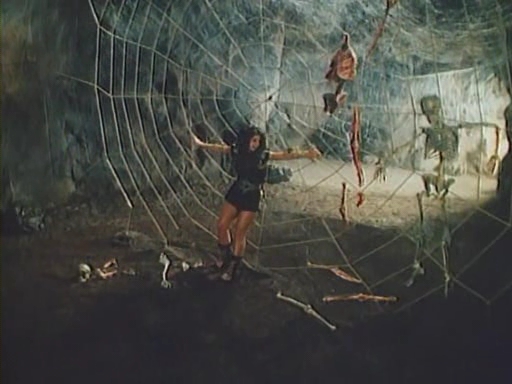
When they finally confront the Spider soldiers, Roon sacrifices herself while Ator rescues Sunya from a giant web, rather obviously made out of rope (she’s even tied to it). But stap me if there isn’t an actual giant spider glimpsed in the background, waving its legs around. And when Ator battles the High Priest atop a set of stone steps, there is another giant spider (could be the same one but looks to be a bigger and better puppet). Ator uses the shield to make the High Priest explode, or something.

Oh and Griba, who pops up occasionally to offer advice or wipe Ator’s shoulder, revealing a birthmark which everyone immediately identifies as ‘the mark of Torin’, turns out to have his own agenda. Being a banished priest, he was merely using Ator to defeat the current High Priest in an attempt to usurp power within the whole Spider set-up. But he gets his come-uppance. I should also mentioned Purdom’s hair, a long, greasy, flat-cut affair which, frankly, looks like he bought a deluxe Merseybeat wig but it was a size too big.

O’Keeffe returned to the character of Ator (or at least, a character called Ator), two years later in a sequel for D’Amato which was released in English as The Blade Master and then, after wielding a more English weapon as Sir Gawain in Sword of the Valiant, was Ator a third and final time in Alfonso Brescia’s Iron Warrior in 1987. He went on to appear as Dracula in Waxwork and as John Smith in a 1995 version of Pocahontas. Eric Allan Kramer took over the character in 1990’s Quest for the Mighty Sword, once again directed by D’Amato.

Edmund Purdom, remarkably, is still alive and is about to celebrate his 82nd birthday as I type this in December 2006. Acting since the early 1950s, his genre credentials include Herod in Herod the Great, Rasputin in The Night They Killed Rasputin, the American President in 2019: After the Fall of New York, Dracula in Fraccia contro Dracula, plus Dr Frankenstein’s Castle of Freaks, Airport '79 rip-off The Concorde Affair, Jesus Franco’s Sinister Eyes of Dr Orloff, City of the Walking Dead, Anthropophagous 2, Endgame and, most recently in 2001, a voice in Titanic: The Animated Movie.

Also in the cast are Nella Pazzafini (as ‘Nat William’) whose 200 or so credits include a slew of pepla, a fistful of spaghetti westerns and a bunch of Bond rip-offs plus The Long Hair of Death, Amazons Against Supermen, Puma Man, Endgame, The Ironmaster and Ator 2 (as a different character). Producer Alex Susmann is like many of the other credits, a pseudonym which was only ever used on this film and its sequel, in this case disguising executive producer Helen Sarlui who gets a ‘...presents’ credit on this print. Her other ex.prod. credits include Alien Predator (which was released in the UK as Mutant 2), Monster Dog, Avi Nesher’s version of She and, oddly, Killer Klowns from Outer Space. The music is by Carlo Maria Cordio (Troll 2 and several other unrelated sequels to American films) with Simona Pirone providing the uncredited song over the end titles. Chris Trainor (another pseudonym) is credited as associate producer.

A poster that I found on the web, which just calls the film Ator and was used for the Danish video sleeve, features a three-balled mace and a sabre-toothed tiger - which, if they were in the film, I promise you I would have mentioned. It credits O’Keeffe, Siani, Warren Hillman, Brooke Hart, Ron Carter “and introducing”(!) Edmund Purdom. This lists two executive producers (Susmann and Ron Phillips), two associate producers (Trainor and Joseph Russel) and one common or garden producer (Patrick Murphy) and credits the music to John Beck.

This first Ator film has a few imaginative touches, such as the shadow fight, but mostly it scores over other films in the same genre by simply not cutting corners with cheap locations. No drainpipes or handrails in any of these ancient ruins. O’Keeffe is pleasant if wooden and everyone else has fun overacting, plus I can’t really criticise any film that features Sabrina Siani’s pins.

MJS rating: B
Review originally posted 17th December 2006