Showing posts with label 2014. Show all posts

Saturday, 10 December 2016

It Came for Friendship, But Found Food

Director: Guy Gilray
Writer: Guy Gilray
Producer: Guy Gilray
Cast: John Varesio, Catherine Johnson, Angelo Varesio
Country:USA
Year of release: 2014
Reviewed from: Cult Movies app

I recently invested in an Amazon Firestick – and it has opened up a whole new world of watching for me. As I sit in my man-cave, while Mrs S watches Great British Menu in the living room and TF Simpson watches Cinema Sins on YouTube in his bedroom, I was previously reliant on watching things on my laptop, except for DVDs which got viewed through the TV.

Well, now I have the Firestick, which means when I want to watch shows on catch-up, like Pointless, University Challenge and… well, that’s about it, to be honest; I don’t watch much telly… I can view them on my TV. But there’s so much more. I’m not bothered about Amazon Prime or Netflix or any of that bollocks. I’m not bloody paying to watch television, bugger off. No, it’s all the free apps that are on there which excite me.

For instance, I have found a 24 hours a day, seven days a week, non-stop shark channel. Nothing but shark documentaries, all the time, for ever, for free. Tell me why, in a world where this exists, does anybody ever bother to watch anything else at all? Close down the BBC. Tell Sky to pull the plug. There are 24-hour shark docus available at the touch of a button.

Or, if and when I ever do get bored of watching programmes about sharks, how about a channel which broadcasts nothing but music videos and comedy clips by ‘Weird Al’ Yankovic? It’s a thing. All Weird Al, all the time. I take back everything I have said about the modern world. Life is great and it’s going to be a happy Xmas after all. Plus there is an app that has a massive archive of old 1950s US TV shows. Despite not actually being either (a) American or (b) from the 1950s, this is like manna for me. I’m actually watching Jack Benny and Burns and Allen and The Adventures of Ozzie and Harriet and even You Bet Your Life. Some of these even have the adverts in them. LSMFT: Lucky Strike means fine tobacco!

As well as sharks and Weird Al and Jack Benny, there are also apps with free access to all manner of weird and wonderful (and sometimes deeply crap) movies. Indie stuff, public domain staples, borderline cases. Just so many movies to watch. And I started with this very, very strange indie sci-fi effort from just a few years ago.

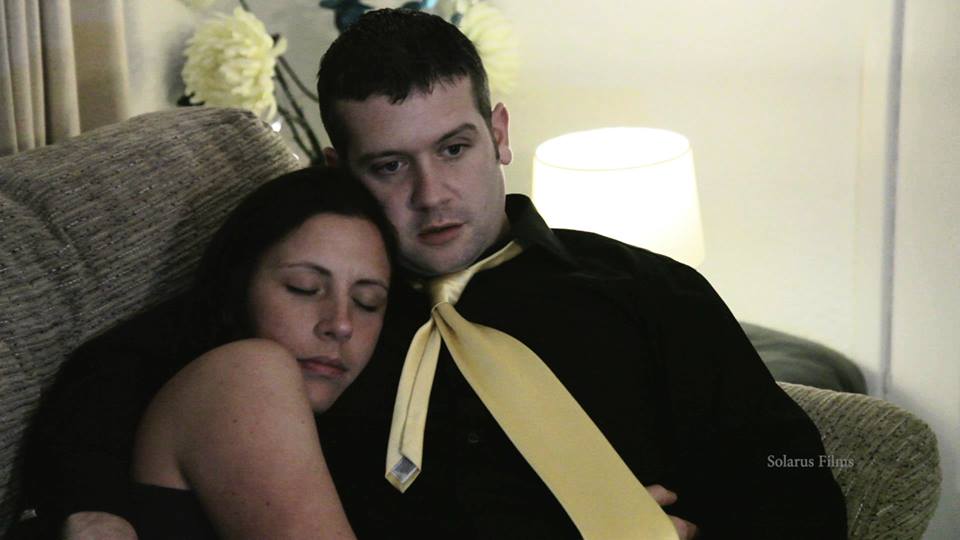
Paul (John Varesio) is a middle-aged, unemployed guy who lives with his wife Svina (Catherine Johnson: Gabby’s Wish, Purple Mind) and grown-up son Kenny (Angelo Varesio, who has notably different coloured skin to the actors playing his parents). When Paul receives a parcel addressed to the house’s previous occupant, Tim Brown, he opens it and finds a bunch of oak leaves and a cocoon. Overnight, something breaks out of the cocoon: a weird creature like a cross between a beetle and a snail. Paul corners this and traps it in a glass jar in his garage, after which the thing starts communicating with him telepathically.

Svina and Kenny have been away up till now, visiting Paul’s mother. There is a whole load of stuff about how Paul was given up for adoption as a baby and only traced his real mother when he was 24, none of which seem to have any bearing on either character or plot. Once his family are back home, Paul keeps the door to the garage locked, claiming he’s working on a secret project.

What his family don’t know is that he has, on the instructions of the alien insect thing, been to the woods where he met a humanoid alien (called ‘Shelia’ although it sounds like ‘Sheila’!) that we previously saw in an unconnected splash-panel prologue. This addressed him as ‘Tim Brown’ (intended recipient of the parcel) and that is the alias Paul now adopts in finding victims for the aliens.

Initially he picks up a hooker (Vicky Anderson: Deep Dark); later he poses as a film producer, persuading two stoners to accompany him to a film shoot that needs extras. Where he’s actually taking these people is to a ‘hive’, a huge termite-mound-like structure in the depths of the forest where six-foot versions of the snail-beetle thing fly around (without wings) and prey on unwary humans. Later Paul takes Kenny fishing and returns home alone, telling Svina he dropped their son off at a friend’s.

Here’s where it starts to get really strange. Svina has become suspicious so has smashed the padlock on the garage door. However she doesn’t find the alien bug. Instead she finds a fairly large rock (about the size of a football) which she takes into the forest and throws from a bridge. Paul is furious when he discovers this because that rock was in some way special to him. Suddenly the two of them are magically in the clearing beside the hive where Svina is attacked and Paul runs away, bumping into a young hiker. We previously saw this lad and his girlfriend on a trek through the trees, discovering a giant cocoon which, when sliced open, disgorged a bloodied human corpse. The boy was so shocked that he fell over a log and hurt his back; the girl went for help.

There’s no real conclusion to ICFFBFF. It just sorts of ends while the viewer is wondering what all that bollocks about a rock was in aid of. An epilogue has Kenny returning home – seems Paul did indeed drop him at a friend’s house rather than offering up his only son with a cry of, “I for one welcome our alien overlords.” The family cat Cloudy, who has featured in a surprisingly large number of cutaway shot over the past 95 minutes, has got into the garage, knocked over the glass jar and partially eaten the bug within, which Kenny then flushes down the toilet. To what extent that might stop the giant bugs and their bipedal herald from taking over the world isn’t clear.

It Came... is tosh. Ambitious, sincere tosh, but tosh nonetheless. Surprisingly, neither the one-dimensional characters nor the rambling, unsatisfactory plot constitutes the film’s biggest problem. Nor indeed is the budget CGI used to create the aliens a stumbling block. No, the biggest problem here is that the film has absolutely no idea what decade it’s set in.

This seems to be the 1950s. It’s all shot in black and white. Paul drives a classic car. No-one has a mobile phone. The phone in the house is a traditional Bakelite, rotary dial model and the TV set (on which both Paul and Svina separately watch a movie called It Came for Friendship, But Found Food) is a small cathode ray tube television. When we first meet Paul he is typing up his memoirs, using a reel-to-reel audio recorder and a manual typewriter.

I’d love it if this all took place in the 1950s, the era of You Bet Your Life and The Jack Benny Program. But… the dialogue includes references to Keanu Reeves and Leonardo DiCaprio, and to something that happened “back in the seventies”. (Plus Svina drives a modern car.)

Before we see Paul typing his memoirs we have a brief scene of him looking at a bridge, dictating into the reel-to-reel recorder a note that his grandfather died in an accident while constructing the bridge in 1912. Let’s work out how that could be true if this 2010 film is set in 2010. Paul has a grown son so he’s probably about 45-50. For his grandfather to have died in 1912, even if the intermediate parent was a newborn at the time, said parent would have had to be about 50 when Paul was born. Which is possible but unlikely. A date of late 1950s or early 1960s makes much more sense.

This could well have been shot over a period of months or even years, but as the creation of a single film-maker, you would think that it would at least have been consistent in its setting. Either you’re making a retro, historical picture or you’re telling a story in the present day. Make up your mind.

That one-man-band film-maker is Oregon-based Guy Gilray, whose only other movie is 2006 feature Scream of the Sasquatch (which shares several cast with this). He’s primarily a painter, having exhibited with some success at galleries in Portland in the 1990s. Specialising in ‘nocturnal urban landscapes’, he eventually got fed up of painting the same thing so turned his talents in other directions, thus: “First I made two independent feature films, losing about $17,000 in the process and eliciting many negative comments from the people who have actually seen them.” This was followed by an attempt to create digital illustrations for science fiction book covers and six CDs of instrumental music, neither of which projects could be accurately described as ‘successful’. Now he’s back painting again. I admire both his tenacity and his honesty.

Produced in 2010, It Came… was posted onto Archive.com in October 2014 and has had 18,000 views to date. Two years later it was posted on a YouTube channel called Watch Public Domain Movies; this has been watched about 320 times so far. There are two other versions on YouTube which between them have generated 40 views. Which is not great but still 38 more people than bought the poor bloke’s CDs.

MJS rating: C-

Friday, 15 April 2016

Flowerman

Director: Rob Burrows
Writer: Rob Burrows
Producer: Denise Wakefield
Cast: Amy Ornston, Jason Savin, Ian Stewart Robinson
Country: UK
Year of release: 2014
Reviewed from: online (TubiTV)
Website: www.facebook.com/flowermanmovie

This suprisingly nasty psychothriller starts out inoccuously enough, introducing us to Amy Ormston as Sarah and Ian Stewart Robinson as her husband Andrew. They’re blissfully happy, married with two kids (Mark Burrows and Ellie Ormston) who love their parents as much as the parents love each other. The first 10-15 minutes really lets us know how warm and loving and supportive and happy this family is. To be honest, it makes you sick.

But we signed up to watch a horror movie, so it ain’t gonna last. So that's alright.

Sarah works in a flower shop where one of her regular customers is Nigel (Jason Savin) who couldn’t be more obviously villainous if he twirled a waxed moustache and said, “I’ll get you, my lovely!” Still, there are people who look villainous and then there are stone-cold sociopathic sadist nutjobs. And that’s Nigel.

First he breaks into Sarah and Andrew’s home and steals a few personal items, making sure to dress entirely in disposable overalls and overshoes. Very careful and methodical this one. Then he kidnaps Sarah and whisks her off to his farm outside town where he chains her up, cuts off her clothes and forcibly tattoos her with his name and the name he thinks she should have: ‘Wendy’.

Over the course of the film, Sarah will be abused and humiliated by this psycho, who flips between hammy explanation and brief surges of savage anger. It’s an interesting performance by Savin, reined in just this side of pantomime villain and all the more scary for it. But what really sells the film – especially given that some of the supporting cast are, well, not great – is Ormston as Sarah.

We really feel her terror and her pain, her loneliness and her broken will. It’s a belter of a performance, it really is: utterly credible and utterly pathetic in the truest sense of the term. But where many films about men torturing and abusing women are misogynist trash, Flowerman is much more sensitive and astute. This is a film about the suffering of the victim, not the power of the abuser.

And abuse of power is definitely the theme here. Nigel has warped plans to force Sarah to marry him. He sends texts from her phone to Andrew, saying she has left him. They even get as far as a solicitor. Nigel has Sarah’s passport from that earlier robbery, and she is so under his control by then that she can only meekly agree to his promptings.

Even when, later on, she does manage to effect an escape, Sarah is still terrified of Nigel and convinced, as abuse victims often are, that it is somehow her fault. So although she makes it as far as the house of a helpful Polish prostitute (Luiza Stefanova), she doesn’t call the police. Some commenters find this action unbelievable. They need to learn a bit more about manipulative abusers: not every woman is Sarah Connor.

What of Andrew? He is sure that Sarah would never leave him but the two coppers investigating the case (writer-director-DP-editor Rob Burrows and Emma Marshall) think it’s just a domestic disagreement and that Sarah has simply walked out on him. This idea is supported by a neighbour (Denise Burrows) who is convinced that Andrew is having an affair with a work colleague, Jenny (Faye Ormston). The irony is that he wasn’t - but he is now. Jenny has been carrying a torch for Andrew for some time and swiftly makes her move, becoming a surrogate mother to the kids. Nevertheless, Andrew still loves Sarah and is convinced all is not right.

By the third act, three people have been brutally murdered by Nigel and he plans to destroy Sarah’s will even further by making her watch as he kills her family. Clearly by this point he has crossed a line – I mean a line much further along than the one he crossed by initially kidnapping and abusing Sarah. Something will stop him, sooner or later. The resolution, when it comes, is somewhat out of nowhere but not completely deus ex machina and the film just about gets away with it.

Flowerman is one of those movies that begins unpromisingly but picks up when it starts getting very nasty, not because of any salacious appeal of gender-based violence but because Sarah represents abused women everywhere. It’s not her actual husband abusing her, but it’s a man who thinks he is her ersatz husband and can become her real one. Nigel's obsession manifests itself first in stalking – he has a wall of photos he has taken of Sarah – and then in a belief that he can force her to love, honour and obey him through violence and intimidation. She, as far as he is concerned, belongs to him, body and soul. Thematically therefore this sits with The House of Him and The Devil’s Vice in the ‘domestic abuse as horror’ subgenre.

The movie is not without its faults, principally some wooden acting (it’s never a good sign when so many of the cast share surnames) plus it’s too long at 97 minutes. We don’t need the top’n’tail scenes of Sarah writing the story longhand in a book, and a subplot about Nigel’s brother (Richard Batey) goes nowhere and serves no real purpose that I could see.

The other problem is the accents. Every single character speaks with a really strong Northeastern accent (it's actually set in Durham, according to the on-screen police cars) and there were several moments when I literally had not a clue what was being said. The only exception is Stefanova, but her Polish accent is just as thick! The version I watched (on TubiTV, free but with adverts) had close captioning but it was out of synch with the image by about a minute so not really much help.

Flowerman won two awards at the Tenerife International Film Festival in July 2015 and also played Milan in November of that year, with an R2 DVD in December. The actual first release was across various VOD platforms in March 2014. This was Burrows’ third feature after Dead Frequency and Entwinement, and he has since made a fourth, Temporal. Several of the cast were in those other films, as well as Warren Speed’s Coulrophobia and also The Legend of the Chained Oak, a half-hour horror short from Mark Mooney and George Watts.

Powerful enough to overcome its shortcomings and with some genuinely horrific moments, yet rooted in solidly British domesticity, Flowerman is certainly worth a watch.

MJS rating: B

Sunday, 20 March 2016

She’s Dead

Director: Nik Box
Writers: Alexander Lewis, Nik Box
Producers: Alexander Lewis, Matt Stuart, Nik Box
Cast: Alexander Lewis, Julian Lee Seager, Jamie Smith, Serena Chloe Gardner
Country: UK
Year of release: 2014
Reviewed from: online
Website: deadgoodfilmslike.weebly.com

This hour-long blackly comic horror is well-made and entertaining but doesn’t quite deliver what it promises.

The first act’s great. Writer/producer Alexander Lewis is Ben, a young man who has woken up after a night on the tiles to find an unknown, dead chick next to him. After wrapping the whole room in plastic sheeting and an ineffectual attempt to remove her arm with a saw, he has called in a fixer, Mr Clean (Julian Seager: Welcome to Essex, Welcome to Curiosity, Scareycrows) to help him dispose of the body before his parents get home. Seager plays Mr Clean as a pragmatic professional while Ben is understandably out of his depth and these scenes work well.

Act two introduces us to Barry (Jamie Smith), an idiot friend of Ben’s who was the first person he called but initially wasn’t able to help. Mr Clean can see that Barry is more problem than he’s worth but once he has seen the body, he’s part of the situation. There’s quite a long scene of Barry, who obviously doesn’t get to meet many women, alone with the corpse. This monologue is drawn-out and goes on too long. More problematically, after Ben and Mr Clean return and then a short conversation between the three, the other two leave again and we get basically a repeat of what we’ve just seen.

And then in the third act this turns into a completely different film. I won’t tell you the twist and I won’t include the tag on this review that would give it away. You may guess it. It’s more entertaining than the overlong ‘Barry the perv’ middle act but it’s not what we’re expecting. What we’re expecting – well, I was; you won’t be after reading this review – was development of that first act’s black comedy. Attempts at resolution frustrated; additional complications arising; character conflict as the clock ticks down. But there's none of that.

There is literally a ticking clock in this film as occasional captions tell us not only the time but also how long till Ben’s parents arrive. Despite this, despite having less than an hour to dismember the corpse, dispose of the pieces, take down all the plastic and restore the house to its normal state, none of our three characters seem to be in a hurry. The film’s pace could reasonably be described as ‘placid’. One would expect Ben to become increasingly frantic but he really doesn’t seem bothered (which is sort of explained at the end, but not in a way that actually justifies his actions and attitude).

Having said that, I did really dig the minimalist approach of the film which is mostly filmed in quite long, static shots. A picture this talkie would normally be all shot/reverse-shot but a deliberate, appropriate and clever decision has been made here, so that on the one or two occasions when we do cut to a close-up from a different angle, it feels odd and uncomfortable. Plus it has just four actors and was shot in four days in a single location. Effective use of minimal resources.

There are a couple of musical sequences as the camera pans up and down the underwear-clad body. Serena Chloe Gardner (Banjo) does a magnificent job of remaining completely still – and unresponsive when being groped by Barry. These musical interludes do rather seem like padding to reach a one-hour running time but they also break up the otherwise largely talkie scenes so I didn’t mind them. And the justification is that these happen when the living characters are out of the room, allowing the story to unfold in real time – which brings us back to the ticking clock.

She’s Dead is the first film work I have watched from Dead Good Films Like, a production company which Nik Box set up in 2004. So far as I can tell this has no connection with The Dead Good Film Company which was Adam Trotman’s and Thomas Lawes’ prodco in the late ‘90s, responsible for such classics as Rhino Bitch and Demagogue (the latter of which got me my first ever credit in Fangoria).

Over the years DGFL have made a number of shorts and sub-feature-length films with exploitation titles like Mr Rape’s First Date and Dracula vs the Ninja on the Moon. She’s Dead was released on DVD in January 2014 (available through the DGFL website) also given a legitimate US release the following month as part of a four-film, two-disc set. Under the umbrella title 21st Century Grindhouse, this also included Wrath of the Violent Vicar, Terror of the Blood Demon and Brutal Jesus and the House of Wasted Youth. The film screened at the Movie Days/Dark Zone festival in 2013 where it picked up an award for Best English Film.

MJS rating: B

Tuesday, 24 November 2015

Spiritual Contact the Movie

Director: Emerson Pinheiro
Writers: Emerson Pinheiro
Producer: Emerson Pinheiro
Cast: Adam Wilson, Nick Quye, Lousa Leal
Country: UK
Year of release: 2014
Reviewed from: YouTube
Website: www.atalaiafilms.com

In an infinite universe, there’s room for everything. MindFlesh was a Buddhist British horror movie. It’s a Wonderful Afterlife was a Hindu British horror movie. Spiritual Contact the Movie is a Spiritualist British horror movie. I doubt if it’s the only Spiritualist horror movie ever made – there’s probably quite a few come out of Nollywood over the years. But it’s probably the only one ever made in London.

Adam Wilson (Gordon in Mr Selfridge, more recently in Broadchurch) turns in a solid, mature performance as Jeremiah, an 11-year-old lad who starts seeing mysterious, dark-robed, non-corporeal figures. He lives in a suburban semi with his English, disabled dad John (Nick Quye, who was a zombie victim in Devil’s Playground), his Brazilian mum Helena (Lousa Leal) and his two elder siblings, Chris (Prentice Garces) and Jennifer (Alana Boden, who was Gordon’s sister Beatrice Selfridge)

John and Helena are decent, God-fearing folk who have brought their kids up right, although Chris is showing signs of dangerous teenage rebellion fuelled by his interest in what Rev. Lovejoy would recognise as “rock and/or roll”. Jeremiah’s visions start after he uses a voodoo doll to take revenge on a neighbour who was mean to his mother, although this is never followed up.

The young lad starts attending a nearby church with a schoolfriend, which strikes me as a bit odd. His parents are at first wary of letting him attend evening services that finish at 9.00pm, but later when John gives Jeremiah a lift it transpires that they don’t actually know where this church is. Anyway, the pastor (Andy Douglas) gives Jeremiah some advice, as does a friend’s grandmother (Andrea Francis). His father gives him “the best present anyone can receive” – a Bible. Concerned about their younger son’s mental condition, John and Helena send him to a psychiatrist (Luca Della Valle, who was a security guard in the Man from UNCLE film) where Jeremiah discloses that he can see the guy’s guilt over a sexual assault. But as with the voodoo doll, this is an isolated idea which doesn’t seem to relate to anything else in the film.

Towards the end of this short feature (running just 66 minutes), Jeremiah reads a couple of scripture passages out loud, and the film ends with a quote from writer-director-producer Emerson Pinheiro (who also plays the spirits in the effects shots).

Pinheiro based this on his own childhood experiences in the mid-1990s, and who am I to doubt either his religious beliefs or his genuine belief that these events happened to him? That’s not really my concern: I’m interested in how this functions as a horror film. And ‘surprisingly well’ is the answer. The spirit effects are creepy, and there’s one particularly effective dream sequence when Jeremiah is physically yanked from his bed by a cowled spirit which grabs him by the ankle, pulls him onto the floor and then threatens him with a machete.

The acting varies considerably but none of it is truly awful. The photography, shared between Pinheiro and Dave Moyle (whose own shorts include The Supernatural Event, on which Pinheiro helped out), is basic but functional, and the sound is good. All the dialogue is subtitled in Brazilian Portuguese (except for one short scene where two characters speak that language and the subtitles are English) - another way in which this film is unique among the 600 or so horror films made and released in this country in the past 15 years.

Given that there’s not a huge amount of plot, the script by Pinheiro, Moyle and Neville Crabe is surprisingly coherent and well-structured. There are a few too many scenes of people just arriving or leaving places which aren’t needed, without which this would probably run dead on an hour (give or take) but that’s not an egregious problem.

Interestingly, although Adam Wilson is himself devoutly religious, he’s not a Spiritualist, he’s a Mormon – which, for the benefit of the Godless, heathen hordes among you, is a completely different thing. Lamin Tamba (The Devil Went Down to Islington) and Priscila Gomes play the neighbours; Claire Greasley (Death Walks, Rock Band vs Vampires) and Chris Cowlin (Woman in Black 2, May I Kill U?, The Seasoning House, Scar Tissue) are among the congregation. Shot in 2012, the film premiered at the Phoenix Cinema in East Finchley in January 2013 and also screened at the Portobello Film Festival in September that year. In November 2014 Pinheiro posted the entire movie onto YouTube. Since shooting this feature he has made several shorts in different genres.

Horror fans relish something new and different, and Spiritual Contact the Movie is certainly that. It’s religious but neither preachy nor evangelical. It’s clearly been made for a religious audience, or at least approached from a religious perspective, but that’s not a problem. Followers of the Spiritual Church movement believe in the absolute existence of spirits and the paranormal. Fans of horror movies enjoy tales about spirits and the paranormal. It’s a perfect match.

MJS rating: B+

Sunday, 22 November 2015

WebKam

Director: James D Layton
Writer: James D Layton
Producer: James D Layton
Cast: Eleanor James, Joanne Gale, Kim Sønderholm
Country: UK
Year of release: 2014
Reviewed from: YouTube

I was always a big fan of Eleanor James.  Between 2005 and 2012 she appeared in more than 30 films, mostly British horrors but also some overseas stuff like Karl the Butcher vs Axe and Colour from the Dark. Whether it was something well-crafted and entertaining like Hellbride or Bordello Death Tales, or a piece of forgettable nonsense like Le Fear 2, or just a cameo like the spoof advert in Harold’s Going Stiff, Ella always brought a real sense of class to a production. She was a good actress, sympathetic to genre and budget level, with a good scream and unafraid to either add blood or remove clothes. She has been retired these three years gone by. Don’t know what she’s doing now but I hope she’s happy and settled and doesn’t regret her not insignificant contribution to 21st century British horror cinema.

Because these things can take time, quite a lot of Eleanor James’ roles didn’t appear until after her retirement from acting. David VG Davies’ Monitor was finally released a couple of weeks ago. Three’s a Shroud is due out next year. Forest of the Damned 2 and Chinese Burns remain in limbo. I had WebKam down for a similar fate but, to my surprise, it has actually been released.

Way back in August 2008 James D Layton (who at the time was using the name Ibraheem James Layton, for some reason) sent me some stills from WebKam, which he had just shot (in Birmingham, over a single week). Nothing happened for a very long time and the film seemed to be a lost one. Then in August 2013 a trailer appeared on YouTube (since removed) suggesting that a release was imminent.

It turns out that the whole film was posted on YouTube in December 2014, although it took me eleven months to notice it (in which time it accrued 2,800 views). The YouTube account, on which this is the sole video, is called Boneyard Models but it seems to be official because that’s the same photo of Layton and his girlfriend that’s on his Amazon page (he now writes romantic fantasy novels).

So, after a mere seven years, I finally sat down to watch WebKam. Was it worth the wait?

Sadly, no. WebKam turns out to be a load of cheap, dull, amateur, misogynist torture porn. Not even the delightful Miss James can save this one. Damn.

Eleanor is Victoria and Joanne Gale (When Evil Calls, Survivors) is her friend Lilly. Victoria, who has recently split up with her boyfriend Matt and has also quit her job, finds that her PC has somehow logged itself onto a site with pictures of a creepy clown-masked figure called Kam. Leaving Lilly on the computer, Victoria has a nap, after which she finds that Lilly has gone and left a note. It then transpires that Kam has kidnapped Lilly.

The bulk of the film is Kam, leaning over Lilly, who is tied to a chair, ordering Victoria to do certain awful things to ostensible save her friend. Nominally connected to the seven deadly sins, these include extracting one of her own teeth, carving a word into her forearm, cutting her hair, drinking a glass of petrol, removing her panties and carving a lump of flesh out of her thigh.

The actual set-up is a bit vague to be honest, not helped by this version (which runs exactly one hour) apparently missing some scenes. So although Victoria has one hour to ‘save Lilly’ (and in fact sets a kitchen timer to this effect!) it’s not clear what will happen at the end of that hour. Will Kam just let Lilly go? We also seem to be missing the bit where Kam introduces himself to Victoria at the start, and the ‘drinking petrol’ bit seems to come out of nowhere. But even if those extra bits were included, this wouldn’t work. It’s basically a first draft script based around the loose, unpleasant idea of a psycho in a mask forcing an attractive, lone woman to injure and humiliate herself. If you get your rocks off on movies like that, please go read somebody else’s website. I’m not a prude and I’ve certainly never been PC, but pointless sadism like this is just boring.

The one and only bit of character development comes when Lilly, who gets her ear cut off at one point, tells Victoria that she slept with Matt. At the end there’s a ‘twist’ which is completely predictable and obvious and serves only to reinforce how desperately short of imagination this whole film is.

Technically it’s not much to write home about either, being shot almost entirely in one kitchen (presumably Layton’s own). The webcam footage of Kam and Lilly is, according to the dialogue, in a concrete room underneath a lake. Except it’s plainly just a garden shed, quite possibly the one we’ve seen outside in Victoria/Layton’s own back garden. Craig Whyte’s camera-work is shaky and the lighting is flat (is this the same Craig Whyte who directed sci-fi short Hypersleep and now makes documentaries about mental health?). The sound isn’t great and Kam’s voice is so electronically distorted that you can barely make out what he’s saying. (Kam is played by Danish actor/film-maker Kim Sønderholm whose UK horror credits include Sam Walker’s Tag and James Kennedy’s Dead City, plus David Noel Bourke’s thriller No Right Turn, a trying-too-hard Canadian thing called Zombie Werewolves Attack!, lots of shorts and feature lash-ups and his own 2008 horror-thriller Craig.)

The YouTube version of WebKam rather cruelly only credits James and Sønderholm on screen – plus Layton himself of course, who also edited – but not Gale (who, like Ella, gives a performance that’s way better than the material deserves). Neither does DP Whyte get a credit, nor Aimee Long who provided costumes and make-up (including the surprisingly effective leg-carving effect). She now does beauty/wedding make-up. Stills photographer Suzanne Cook is the only other name on the IMDB or EOFFTV pages.

Layton’s production company name was originally ‘Oh Gosh! Productions’ but the finished version, which carries a 2014 copyright date, is credited to ‘Crowmarsh Studios’. (The Inaccurate Movie Database has this down as a 2010 film, which is two years after it was made and four years before it was released.)

In 2011 James D Layton was attached to a mooted found footage horror called Hayze which fell apart before it could reach production, and since then he has been concentrating on his books. It’s good to finally be able to take WebKam off the list of MIA 21st century British horrors, but I can see why it was never properly finished. Its release on YouTube adds another piece to the jigsaw puzzle, but its absence was no great loss to cinema and there’s no reason to watch it unless you’re a British horror completest and/or a serious Eleanor James fan.

MJS rating: C-

Sunday, 18 October 2015

The Stomach

Director: Ben Steiner
Writer: Ben Steiner
Producer: Dan Dixon
Cast: Ben Bishop, Simon Meacock, Peter Marinker
Country: UK
Year of release: 2015
Reviewed from: screening (Fantastiq) and online screener
Wesite: www.fumefilms.com

It has taken me a ridiculously long time to review this 15-minute masterpiece of British horror. But I wanted to do it justice.

The Stomach premiered at Fantastic Fest in the States in September 2014. I saw it at Fantastiq in Derby the following May. In August 2015, Ben Steiner was kind enough to send me a screener, at about the same time that the film appeared on iTunes. All this time it has been touring the genre and mainstream festivals of the world, playing well over a hundred gigs, amassing more than 20 awards and impressing all who see it. Meanwhile, a major project at the University kept me working evenings and weekends (and exhausted when I wasn’t working) so that it is only in October 2015, five months after first seeing the film, that I have been able to find the time to watch and review it.

Please understand, folks, that a quarter-hour film doesn’t take a quarter of an hour to review. And frankly, in this house, just finding a quarter of an hour of uninterrupted viewing time can be a bleeding miracle. But I’m not here to write about my home life. I’m here to write about The Stomach. To explain why it’s one of the very best British horror shorts of recent years, why it has been such a popular choice at festivals, and why you should take the trouble to watch it.

The Stomach is a beautifully original idea. Not for Steiner and his Fume Films partner Dan Dixon the standard tropes of zombies, ghosts, psychos, vampires and so on. This is a tale of mediumship gone awry, of communing with the dead. So it’s a supernatural tale, but it also ticks the ‘body horror’ box because of the unique way that brothers Tom (Ben Bishop: Whitechapel and the 1999 Doomwatch TV  movie) and Frank (Simon Meacock: Slash Hive, Pirates of the Caribbean 2, lots of TV including Poldark, Outlander and MI High) do that communing – via Frank’s torso. A customer provides an item relating to the deceased. Lying in bed, stomach bare, Frank takes this, and then puts a wide tube into his mouth. His belly distends. The customer can then commune with the deceased by speaking into the tube in Frank’s mouth while listening to his stomach through a stethoscope.

It’s a disturbing, even repugnant vision, made all the more unpleasant by the shabby bedroom in which Frank lies, straggly of beard and pale of face. You have to wonder, first, what sort of sick mind comes up with a cinematic idea like this, and second, how Frank and Tom discovered this ability…

Tom, dressed like a seedy working men’s club compere in a velvet jacket that adds nothing but irony to their situation, is the organiser and the money man. The brothers are close; there’s no suggestion that Tom is ripping off or using his brother, though clearly he is the dominant partner while passive, prostrate Frank is the one suffering through these gastric séances. There is also no suggestion that anything is fake. This is genuine communion with the dead.

Most of their customers are rather sad old ladies like Mrs Bird (Jennie Lathan: Gangsters, Guns and Zombies, The House of Silence) who visits regularly to chat with her late friend. The problem arises with the arrival of Mr Pope (Peter Marinker: The Martian Chronicles, Nightbreed, Judge Dredd, Event Horizon and numerous voice dubs including Ben in Star Fleet!), an unsavoury, criminal character looking to contact his younger brother. There is more to Pope than meets the eye.

To say more would be to spoil a film which is at once startling, revolting, fascinating and thought-provoking. Steiner’s script is a fine, self-contained slice of horror which tells us everything we need to know about these people and this world. He has then directed the story with an eye for detail - the fish tank, the coughed-up blood – that makes this more reality than metaphor. What I really, really loved about this film – even above the script, the direction, the superb sound design (by the enigmatically named ‘Z No’)  and the terrific acting by all concerned – is Nicola Wake’s production design.

The combination of Wake’s design with Dominic Bartels’ cracking cinematography creates a seedy, working class, very British world. It’s not the stereotypical world of geezer gangsters (despite Pope’s dodgy motivation) but instead it’s the world of kitchen sink drama, more A Taste of Honey than A Day of Violence. It’s a prosaic (under)world of old bed-linen and peeling paint. This is exactly the sort of horror-meets-social-realism film which exemplifies the strengths and distinctiveness of the British Horror Revival.

Britishness is also key. It’s hard to think of any other country where this would work in the same way. Maybe Germany or Scandinavia, but that would be a different film. This is probably unintentional but it occurred to me that, in combining spiritualism with crime, The Stomach harks back to one of the forgotten bedrocks of British horror cinema. That’s At the Villa Rose, the AEW Mason novel which was written in 1910 and filmed (with extraordinary regularity) in 1920, 1930 and 1940. What goes around comes around.

The fine cast is rounded out by Kiki Kendrick (Grave Tales) and Neil Newbon, whose pop culture immortality is guaranteed by having played the waiter in the original Goodness Gracious Me ‘Going Out for an English’ sketch! Editing is jointly credited to producer Dixon and Jacob Proctor (The Borderlands, The Scar Crow, um, MasterChef). Jon Revell (Belly of the Bulldog, The Forgotten, Scintilla) designed the costumes; Dicken Marshall composed the effective music; Jodi Cope designed the make-up. The prosthetic effects on which the whole story rests were supplied by Dan Martin (Sightseers, In Fear, The Sleeping Room, The Devil’s Chair, Salvage, F, Isle of Dogs, Little Deaths, The Devil’s Business, Nina Forever, Ibiza Undead…) and damn good they are too.

Steiner and Dixon’s previous short was The Flea, an eight-minute vampire film which played Frightfest in 2008 and is now available on YouTube. Before that. Steiner made one segment of 2008 half-hour mini-anthology HorrorShow. Both of those also starred Meakin. Dixon’s day-job in visual effects has garnered him credits on a number of blockbusters including Pirates of the Caribbean 4, Godzilla and Avengers: Age of Ultron. The pair are now developing a slate of four Fume Films features including an expanded version of The Stomach.

Wasting neither a second of screen-time nor a pixel of screen, The Stomach is a little slice of horror perfection. A film you must see and, having seen, will not easily forget and will want to see again.

MJS rating: A+

Wednesday, 14 October 2015

Rebound

Director: Megan Freels Johnston
Writer: Megan Freels Johnston
Producers: Megan Freels Johnston, Debra Trevino
Cast: Ashley James, Mark Schelbmeir, Wes O’Lee
Country: USA
Year of release: 2014
Website: www.reboundthriller.com

This horror-thriller has its pros and cons but the balance sheet leans towards the former so I’m going to recommend it to you, albeit with caveats.

Ashley James (also an executive producer) turns in an absolutely cracking central performance as Claire, who is leaving LA after becoming disillusioned with (a) her inability to make it as an actress, but mostly (b) her cheating arsehole of a boyfriend. The credits play under footage of her discovery of Eric (co-producer Brett Johnston) doing the nasty with a never-named hussy. (Ali Williams is the Other Woman. Though it’s just a brief, wordless, flashback role she absolutely nails it, revelling in her adulterous victory and looking almost demonic in some shots. Of course, this is Claire’s memory of the moment so it’s an exaggeration.)

So anyway, Claire packs up her belongings, says goodbye to her friend (Julia Beth Stern: Killer Holiday) and sets off home to her parents’ house in Chicago.

Though it plays out as very much prosaic reality, the premise of Rebound is distinctively American and to a British viewer (or reviewer) it’s an alien world that’s mysterious and unknown from the off. Chicago, we are told, is three days’ drive away. That’s just unfathomable, living in a country where no journey takes more than a couple of days max. If you lived near Land’s End and wanted to visit your friend in John O’Groats, you could get there by road in under 16 hours. But like the saying goes: Americans think 100 years is a long time and the British think 100 miles is a long way. The USA is a nation built on two inventions: cars and guns. Both feature in this film.

So I’m thinking: if you want to get from LA to Chicago, why would you not just go by air? But I’m not American. To Claire, a three-day drive along the interstate is just a normal thing to do. On the first day, she manages to lose her cellphone at a rest stop. Then, after dark, her car breaks down. That’s okay. There’s an old screenwriting maxim: it’s fine for a coincidence to get your character into trouble, it’s not acceptable for a coincidence to get them out.

Passing motorist Gus (Wes O’Lee, who also contributed some of the songs on the soundtrack) gives Claire a ride into the nearest town: never-named, but it’s the sort of place where there’s one motel and one car mechanic. That mechanic is Eddie (Mark Schelbmeir), who collects Claire’s car but tells her she’ll have to stay overnight as he needs to get a part.

Balking at the unexpected cost, Claire pleads with Eddie to knock a few bucks off, which could be considered sweet-talking, which could be significant. Claire then goes to the town’s only bar where, among creepy you-ain’t-from-round-here locals, she unwisely knocks back a couple of stiff ones, while chatting with Eddie.

…And at the halfway point in the movie, she wakes up tied to a chair.

It has to be said that Claire’s behaviour is not terribly sensible. Since she doesn’t want to interact with anyone in this nowheresville place, why does she go to the bar? If you just want to get drunk after the day from hell, why not buy a bottle of wine from the 7-11 and then drink it while watching cable in your motel room? That’s what I’d do.

Eddie, it turns out, is a psycho. Hence we are treated to about 20 minutes of really very nasty abuse which, with the best will in the world, is basically misogynist torture porn. This does raise an interesting question, in whether a film made by a woman can be misogynist. I don’t see why not. I’m a person and a card-carrying, person-hating misanthropist (which is why drinking wine alone in a strange motel sounds so inviting…) so there’s a sort of precedent there.

What really concerns me is that this ‘middle act’ doesn’t really develop anything. I can see what writer-director Megan Freels Johnston is trying to do (at least in retrospect, having seen the whole movie) but the little hints of subtext are lost beneath a sequence of “Oh God, no!” sadistically abusive actions. In the final 20 minutes or so, matters do start to develop and the film raises some interesting ideas, but too little too late. And while the very final scene is bound to prompt debate among viewers, I personally didn’t find it very satisfying.

There’s a lot to like in Rebound. Strong performances from the cast, very effective music from Michael Boateng (helped by fine sound-mixing by Clint Allday) and some absolutely terrific cinematography from Stephen Tringali. Johnston directs with an assured hand and ensures that the whole film is driven by characters. Except that, well, there’s not really much character to Eddie. There’s a brief mention of an abusive father, and a reference to previous victims, but really he’s an off-the-shelf cinematic psycho who just wants to hurt pretty women. Which isn’t very interesting.

There is a sort of feminist subtext underlying all this, an area I'm going to leave to theorists with too much time on their hands. I'll just note that, although Claire becomes stronger through her experience, it takes the intervention of a man to help her achieve that - and violent, abusive intervention at that. There's a thesis ti be written here.

Structurally, this falls into a trap that I’ve seen many times before, of putting the big turn-around at the midway point, which means that the film is unbalanced. Act 1 takes up half the running time, leaving Acts 2 and 3 not enough space to develop and fully explore the situation which Act 1 has created. While the combination of direction and acting ensures that the first half of the film doesn’t drag, the fact remains that really Claire should be in that chair after 30 minutes, not 47, so that we can spend another 25-30 minutes witnessing her terrible situation - ideally with a series of twists and turns that keep us glued to our seats - then a final half-hour of false hope and things getting even worse before eventual redemption (or not, as the case may be).

I wish Megan Freels Johnston had spent more time – more pages – exploring the very good premise that underpins this story, and less time building up to it before a metaphorical swift jog through what the film is actually about. Which is, I guess, male dominance and female empowerment. Or something.

But look, this is me being picky. If you want a finely crafted horror-thriller about a lone woman in a strange town full of sinister-seeming locals, Rebound is a good choice. It's a solid directorial debut by Johnstion who has been producing since 2009. Her first film was Sparks, a half-hour short starring Carla Gugino and Eric Stoltz, directed by Joseph Gordon-Levitt. That was based on a story by Elmore Leonard, who was Freels' grandfather - which must have made for some interesting bedtime stories...

The cast also includes Liz Bauer (who was in Jeff Brookshire’s Awaken the Dead) as a homeless woman and Kevin Bulla (Joyful Noise) as a disconcerting barman. Joanne Adolfo provided the (limited) effects make-up.

MJS rating: B+

Wednesday, 12 August 2015

Crazy Bitches

Director: Jane Clark
Writer: Jane Clark
Producers: Jane Clark, John W McLoughlin, Tara Carbajal
Cast: Vicoria Profeta, Cathe DeBuono, Andy Gala
Country: USA
Year of release: 2014
Reviewed from: online screener
Website: www.thecrazybitchesmovie.com

Crazy Bitches is an enjoyably mature and well-made take on the slasher subgenre, substituting for the traditional college airheads a bunch of friends who have settled down and grown up a bit since they were students together. It has a nice streak of dark humour and characters who are well-defined and distinctive without being caricatures or stereotypes. It does take a long time to get going, and the ending is undeniably talkie, but there’s enough here to more than justify your time.

Thus we have stable cornerstone, wife and mother Alice (Victoria Profeta); uptight virgin (still?) Taylor (Samantha Colburn); rational cancer survivor TBG Dorry (Nayo Wallace: the voice of Harmony Bear in the current incarnation of Care Bears); manly lesbian Cassie (Cathy DeBuono: dabo girl M’Pella from Deep Space Nine); prissy princess, um, Princess (Scottish born Mary Jane Wells, who reads the Downton Abbey audiobooks); Alice’s sister, dippy new age vegan Minnie (Liz McGeever); neurotic actress Belinda (Guinevere Turner: writer of American Psycho and Bloodrayne!); and communal gay friend BJ (Andy Gala). These eight have rented a vacation home on a ranch to catch up with each other.

Over the first hour we explore the various relationships: sexual, romantic and otherwise. More than one person seems to have slept with Alice’s husband Eddie (David Fumero from One Life to Live). Cassie wouldn’t say no to any of her friends, given the chance, but is constantly disappointed by responses both positive and negative. (“Straight girls!” she angrily mutters on more than one occasion.) Princess gets it on with scrawny local Gareth (Blake Berris from Days of Our Lives) who also has his eye on Taylor.

BJ has his own online TV show about spooky and mysterious stuff, as a result of which he is familiar with the story of how seven young girls were brutally murdered in this place, their murderer never found. In the first act he carries a camera around with him videoing his friends but this idea fades away.

Despite BJ’s atmospheric recounting of the location’s unpleasant history, despite a brief scene with a Ouija board (a cliché that the film really doesn’t need), indeed despite a couple of actual murders, there’s very little really happening for much of the film. It’s more relationship comedy-drama than horror. No-one is aware that anyone has been murdered, so there’s no tension. It’s all very well written, directed and acted, don’t get me wrong, but it leaves the viewer champing at the bit for more than an hour, until eventually things turn nasty and the remaining characters realise that they are in mortal danger. The final act makes up for what has gone before by having plenty of action, plenty of blood and lots of twisty-turny plot stuff as suspects are considered, accused and discounted.

The final reveal of who is killing the friends (and why) didn’t work completely for me. There seemed to be two unrelated rationales behind the killer’s behaviour, one that made sense and one that relied too heavily on flashbacks and revelations about who was who and what was what. The latter really wasn’t necessary and just muddied the waters somewhat. There’s a couple of intriguing semi-twist hints right at the end that raise questions likely to provoke much post-screening discussion, which is a good thing.

One thing that did catch me off-guard was the setting. With no working transport, the group will have to trek 20 miles to the gate. What? At one earlier point they drive into the nearest town for a meal so that must be, what, 25 or 30 miles. Just for dinner? That’s outside of my understanding. Because we don’t have ranches in the UK, I simply had no concept of how cut off they were. In any similar situation over here, the walk to the gate would be maybe a mile and half tops. Like the old saying goes: the difference between Britain and the USA is that Americans think 100 years is a long time and Britons think 100 miles is a long way.

Expanding on this transatlantic unfamiliarity, I’m uncertain whether there were any other properties on this vast ranch. Also whether Gareth and his possibly special needs brother Gardner (John W McLoughlin, also one of three producers) own this place or are just employees.  I’m not saying this should have been clearer, just highlighting the problems of culturally specific mental real estate.

On the plus side, there are llamas on the ranch. Also horses and at least one awesome pig. When the transport options ran out, I was kind of disappointed that no-one suggested trying to ride a llama, but I guess that’s a different film. Candis Cayne (Dirty Sexy Money) appears in a splash panel prologue which seems entirely unrelated until right at the end of the film.

This is the second feature from writer-director-producer Jane Clark, following a drama called Meth Head which used several of the same actors. She is currently working on a sequel, Crazier Bitches. Clark is a former actor who was a nurse in Chicago Hope. If the IMDB is accurate, she was also in Vista Street sequel Witchcraft VI and William Mesa’s awesome Brigitte Nielsen cheese-fest Terminal Force (which I totally must track down and rewatch). On the other hand, there’s probably a lot of people out there called Jane Clark…

What I liked about Crazy Bitches was mainly the things it didn't do. I liked that it didn't fill the cast with twentysomething teenagers. I like that the characters weren't drunk, stoned or perpetually horny. I liked that they didn't play unfunny practical jokes on each other. I particularly appreciated the absence of cat scares. (A few times characters are startled by an unexpected knock at the door etc. - that's fine, that's acceptable.) I liked that the film was about characters and relationships, I just could have done with a bit more fear and fright. But on the whole, Crazy Bitches is as fine an indie slasher as you'll see this year.

MJS rating: B+

Monday, 20 July 2015

The Dead 2: India

Director: Howard J Ford
Producer: Howard J Ford
Writers: Howard J Ford, Jon Ford
Cast: Joseph Millson, Anand Gopal, Meenu
Country: UK
Year of release: 2014
Reviewed from: screener

I saw The Dead at the Fifth UK Festival of Zombie Culture in Leicester back in November 2011, and it blew me away. I’m not sure why I didn’t review it – sometimes I’m just too busy with other stuff. Nevertheless, since then I’ve been telling anyone who will listen that, as far as I’m concerned, it’s one of the very best zombie films ever made.

Zombie films should be scary – that’s a given.  They can be action-packed, or funny, or intense and broody. Or just bleak and depressing – that’s my favourite sort. The genre’s ur-text, Night of the Living Dead, is bleak and depressing. It is also riven with social and political subtext, and for me that’s the icing on the cake of any zombie film. The Dead has social and political subtext in spades. It can’t help having subtext. I don’t know to what extent the Ford Brothers wanted to explore ideas of racism, colonialism and globalism – but that’s what the film is about. You simply cannot show a white guy shooting a succession of shuffling, blank-eyed black folk without there being some sort of racial subtext.

The Dead also did what most zombie films fail to do, which is take the genre in a new direction. In one sense, that was as high concept as ‘zombies in Africa’ but it was much more than that. It was taking the standard global zombie apocalypse out of its traditional urban environment and placing it in a desolate, empty landscape. The sort of place where you can see the zombies when they’re still a mile away.

These are traditional, shuffling, shambling zombies – killed by existing zombies then reanimating themselves. There’s no running, no moaning for “Bwains!” They’re actually really easy to avoid, provided that you don’t let yourself get surrounded or trapped in a corner. But there’s just so many of them, and they’re everywhere, and all they have to do is get one bite in and you’re doomed. Much like the Terminator, they cannot be reasoned with, they cannot be bargained with and they absolutely will not stop.

Hell, as someone once pointed out, is other people. As a card-carrying misanthropist, I take that as my sermon almost every day. And that’s what a fine zombie picture like The Dead uses as its underlying premise. The zombies are us. Sometimes literally: recognisable friends and family. Sometimes generically. These are not vampires or werewolves or extra-terrestrials or killer robots: not ‘the alien other’. Zombies are people. (Which is not the same as saying that a zombie is a person – though sometimes that’s true also.) It’s the anonymity of the zombie hordes that makes them so powerful and effective in exploring socio-political ideas. A shuffling crowd of zombies is a riot happening in slow motion, but happening nonetheless.

Sometimes a film gets it just right. The Dead got it just right. I remain both puzzled and disappointed that it didn’t receive more acclaim (although 72% on Rotten Tomatoes isn’t bad).

The first film premiered at the 2010 Frightfest; three years later the world premiere of the sequel, which transposed the action to India, was the opening movie at the same event. It has taken a couple of years to subsequently appear on UK DVD but the wait has been worth it because this is another terrific zombie feature. It repeats the success of the first film while also doing something new – always the biggest challenge for a sequel.

British actor Joseph Millson (SNUB, Dead of the Nite, The Sarah Jane Adventures) effects a convincing accent to play American engineer Nicholas Burton, working on wind farm installations in Rajasthan. Meenu Mishra (credited as just ‘Meenu’) is Ishani, the girl he has fallen in love with. She lives with her parents (Sandip Datta Gupta and Poonham Mathur) in Mumbai, 300 miles away. Her father distrusts the American, wants his daughter to marry a good Indian boy, and isn’t likely to react well if/when he finds out she’s pregnant.

A slightly clunky scene at the start in the dockyards of Mumbai justifies the arrival of the zombie infection in the subcontinent. Before too long, violence and fear are working their way through the city streets and into the countryside. US citizens are evacuated but Burton sets off across country to find Ishani.

India is a very different place to Africa. The first film traded on the empty desolation of its locales. The Dead 2 has some open landscapes but more urban and suburban scenes, including Ishani and her family, locked inside their house, trying to stay away from the chaos outside. Where Africa was presented as simple, basic and largely featureless, India is shown to be a complex country: a mix of cultures, politics, industry and tradition. It also has a very large and well-organised army, who are swiftly deployed to deal with the situation. It’s not like there isn’t already civil strife and unrest in Indie. “It’s probably just another Hindus vs Sikhs things,” opines Burton’s voice-on-the-phone colleague Max (Holby City’s Hari Dhillon).

Where the first film dwelt on themes of humanity and understanding, played out against a tapestry of historical and modern colonialism, the principal theme in The Dead 2 is parenthood. Ishani is indeed expecting Burton’s baby, and her relationship with her father has shades and tones. “He is a good man,” her sick (bitten) mother assures Ishani. “He provides for us.” Burton himself becomes an ersatz parent when he teams up with a young orphan named Javed (brilliantly played by Anand Gopal, whom the IMDB thinks is Wall Street Journal correspondent Anand Goyal!). Each needs the other to survive: ‘Mr Nicholas’ can drive, ride a motorbike and fire a gun, but Javed knows the countryside, the routes, the locations which might provide further transport or ammunition.

There are other ways that the parenthood theme emerges, including an agonisingly painful scene near a train track which I won’t spoil for you. There’s even a lovely moment when Javed and Burton’s path is crossed by a troupe of langurs, one of them carrying a baby. That’s almost certainly entirely coincidental, but that doesn’t stop it from being part of the mise-en-scene and thus worthy of critical notice.

Although a journey from Rajasthan to Mumbai could have been a mere picaresque, there is much more to The Dead 2 than that. The relationship between Javed and Burton develops magnificently, both in the action scenes where they fight or escape the undead and in the more talkie bits inbetween where they tell each other about their respective pasts. At the same time, there are the familial relationships between Ishani and her parents. And behind all this we see the outbreak spreading. We don’t really see the breakdown of society as one might expect; rather the establishment of martial law as the army sets up roadblocks, calmly despatching the undead and searching for victims who have been bitten but not yet turned. Beyond a few brief phone conversations with Max, we have no real concept of the bigger picture – as nor do any of our characters.

I’ve never been to India (though I do live in Leicester: largest Indian population in the UK by percentage; biggest Diwali celebrations outside India itself; best damn curries anywhere – and of course I’m not just a fan of Bollywood films, I’ve also been in one). The Dead 2 is a long, long, lo-o-ong way from Bollywood, but my point is that I can only judge its depiction of India – the countryside, the cities, the people – on the basis of what I know at this remove. Although most of the cast and crew were local, this is perforce an outsider’s interpretation of India. But hey, so was Slumdog Millionaire and that won eight Academy Awards.

In fact there’s probably a great degree thesis to be written sometime by someone comparing Danny Boyle’s unavoidably westernised version of India with that of the Ford Brothers (or indeed with other western cinematic depictions of the country such as Sabu the Elephant Boy or – my all-time favourite film ever – The Man Who Would Be King).

There are actual Indian zombie features. Last year’s Leicester zombie fest screened Krishna DK and Raj Nidimoru’s Goa Goa Gone which was tremendous fun. There’s also Devaki Singh and Luke Kenny’s Rise of the Zombie which was an unofficial remake of Andrew Parkinson's 1998 indie I, Zombie! A third movie which attempted to become ‘India’s first zombie film', Navdeep Singh’s zom-com Rock the Shaadi, fell apart during post-production and has disappeared into limbo.

Goa Goa Gone was an Indian spin on the established western zombie genre – and I suspect the other two films are too – but not actually a film about India. In that respect, it’s very, very different to The Dead 2 which is more interested in exploring its characters, its setting, and its relationships – especially the post-colonial relationship that Burton has with the country – than in simply putting new or recycled zombie gags into an Indian setting. You could actually argue that The Dead 2: India is a more Indian film than many actual Indian films. Colonialism and post-colonialism are part of India’s culture and history and the Ford Brothers explore them here in fascinating and powerful ways in this feature.

Howard J Ford is credited as producer and director (also editor), Jon Ford as DoP and co-director, with ‘Screenplay by The Ford Brothers’.  Darkest Day director Dan Rickard provided the ‘special and visual effects’, as he did for the first film, while Stuart Browne (A Day of Violence) and Max Van De Banks (The Dead, Soul Searcher, Harmony’s Requiem, Siren Song) were responsible for the ‘special make-up FX’. All are excellent. The score is once again by Imran Ahmad (whose other credits include the BBC Radio 4 version of The Martian Chronicles). The three executive producers are Brighton-based chartered accountant Amir Moallemi, plus Miles Ketley and Josephine Rose (former Head of Acquisitions and Development at Goldcrest, who recently co-produced In the Dark Half) both of media law firm Wiggin.

After its festival run, The Dead 2: India was released in the States in September 2014 as just The Dead 2. Curiously, the July 2015 UK release carries the variant title The Dead 2: In India on the sleeve, although the original title is on screen. Slightly disappointing is the absence of a Making Of, something which would have been much more interesting for this film than for many of the production-line pictures that do bother with a bland featurette. But no matter: I review films, not DVDs.

Both The Dead films are absolutely top-notch: serious, powerful, thought-provoking, thoughtful movies that really use the zombie genre instead of just playing with it. You should watch both.

MJS rating: A