Showing posts with label clowns. Show all posts

Tuesday, 21 June 2016

Cleaver: Rise of the Killer Clown

Director: MJ Dixon
Writers: MJ Dixon, Jason Harlow
Producer: Anna McCarthy
Cast: Stephanie Price, Andrew M Greenwood, Jimi Nix
Country: UK
Year of release: 2016
Reviewed from: online screener
Website: www.mycho.co.uk

MCU? MCU? Never mind the Marvel Cinematic Universe – here’s the Mycho Cinematic Universe!

Director MJ Dixon and producer Anna McCarthy burst onto the scene in 2013 with the stylish (if occasionally formulaic) Slasher House. The always terrific Eleanor James was Red, a young woman being chased around a mysterious prison by three hulking cartoon psychos: a psycho with huge swords, a psycho with power tools and a clown psycho.

Big-swords-psycho got his own prequel the following year: the very entertaining and ambitiously structured Legacy of Thorn. Now two other characters have also got their own films, released simultaneously in August 2016. The young man who helps Red stars in Hollower (which I will watch and review shortly [And which turns out not to be about the Power Tools Psycho as I originally assumed - MJS]) but first here comes Cleaver: Rise of the Killer Clown.

Whereas Legacy of Thorn was Mycho’s homage to Friday the 13th, this movie openly references Halloween. In a small American town, on 31st October 1995, student Carley Lewis (Stephanie Price) misses out on a Halloween party in favour of a babysitting gig because she needs the money to pay her course fees. Carley offers to take her young charge Mary-Beth (Holly-Anne Dodkins) trick-or-treating but Mary-Beth’s parents say no – because of a recent murder.

In a terrific prologue we saw another college student, Sara Allen (Kylie Slevin: Plastic Toys) getting brutally murdered by a clown-psycho. Her boyfriend Danny Jackson (Lewis Cooper) had just left – well actually he’s somebody else’s boyfriend which is why he sneaked out without being seen. Now he has disappeared and so he’s the prime suspect for the murder.

Sheriff Hatcher (Jimi Nix, a spear-carrier in The Hollow Crown) is on the case, assisted by his two deputies (Georgie Smibert and Gary Baxter). He thinks the killer could be Carlton Layton, a mentally unstable guy who became a children’s entertainer after he was laid off, then came home one day to find his wife being unfaithful. Well, of course it is Layton. He is Cleaver. And he is out for blood tonight.

Like Dixon’s two previous released features (I don’t think we’ll ever get to see his debut Creepsville), Cleaver is drenched in almost Bava-esque colour - reds and oranges and greens - making every scene a painting. It’s a distinctive, attractive style which doesn’t distract from the storytelling. In fact, I think it adds to the film not just aesthetically but in heightening the unreality of what we’re seeing.

Because although this is set in the USA, it was filmed in England. And although Dixon and McCarthy do a sterling job of trying to convince us it’s the USA (and the cast generally manage pretty good accents; Price actually is American) the fact remains that it’s not the USA, we know it’s not the USA, we can see it’s not the USA. What it is instead is a cartoon USA, a slightly exaggerated, slightly hyper-real version of small town America. So yes, it’s a give-away every time we see a front door with a letterbox; yes, it’s a clue when shots of the Sheriff’s car are actually extreme close-ups of a dinky toy. But That Doesn’t Matter. This is not being presented as the real world, any more than Legacy of Thorn or Slasher House were.

There is clearly some justification for setting this story in the States, although I’m not sure why it’s 1995. (Legacy of Thorn was variously set in 2008 and 2012). Again, I’m quite happy to say that It Doesn’t Matter.

Structurally this is less complex than Legacy of Thorn, limiting itself to flashbacks of Carlton Layton’s cuckolding – although all is not as it seems, even here. What appears at first to be a straightforward coulrophobic slasher turns out to have layers that are revealed in the third act. Not everyone is who we assume they are, or doing what we assume they’re doing. Plus of course there’s plenty of blood, decapitation and screaming. Interestingly, MJ doesn’t feel the need to play too much on Cleaver’s appearance. Where other clown-slashers might feel the need to show as much of their villain as possible, Cleaver lurks in the shadows. The prologue in particular is a very effective use of keeping clown imagery in the background and thereby actually increasing the horror.

Andrew M Greenwood, who played Cleaver in Slasher House, reprises the role here. The solid cast also includes Pat Higgins regular Cy Henty as Mary-Beth’s dad (in an impressive comedy Frankenstein outfit) and Emma Wilde as her mom, plus Vicki Glover (Killersaurus) as Carley’s room-mate. Dean Sills (The Railway Carriage), Chan Walrus (Terror Telly) and the mighty Jason Impey are among a small battalion of associate producers and co-producers.

Although I probably enjoyed Legacy of Thorn slightly more, I think Cleaver is a more mature picture, with MJ honing his craft as his career progresses. It's certainly a cut above what the basic premise - nutter dressed as clown stalks town on Halloween - would suggest. Onwards and upwards now to Hollower and, after that, Slasher House 2.

MJS rating: B+

Wednesday, 30 April 2014

The Witches Hammer

Director: James Eaves
Writer: James Eaves
Producers: James Eaves, Laura Tennant
Cast: Claudia Caulter, Jonathan Sidgwick, Stephanie Beacham
Country: UK
Year of release: 2006
Reviewed from: screener DVD
Official website: www.amberpictures.co.uk

It’s always a thrill and an honour to be the first reviewer of a film but it’s also a worry. What if I’m completely out-of-step with everyone else? How honest should I be about stuff that I don’t like? How do I write a review which will be as relevant when it is first read - by people who, naturally, know nothing about the film - as it is when it is read later by people who have read other reviews or seen marketing material? It’s a responsibility, that’s for sure.

In the case of this thoroughly enjoyable British indie horror movie, my natural reaction is to pre-empt what other critics are going to say: Blah blah blah Blade blah blah blah Underworld blah blah blah low budget blah blah blah. The main character is a vampire who hunts other vampires, a sexy woman in a tight, leather costume who uses martial arts in an ongoing supernatural conflict. It’s impossible not to make such comparisons, however lazy they may be, so let’s get them out of the way now.

I should also get out of the way any concerns about the apparently ungrammatical title by directing you to my interview with writer/director/producer James Eaves (Sanitarium, Hellbreeder). And now, on with the review...

Claudia Caulter (who was in a sci-fi short called Frozen and also in an Oasis video) stars as Rebecca, a ‘genetically created vampire’ who is resurrected by the shady ‘Project 571’, injected with blue goop and then trained as an assassin. This early part of the movie is terrific, helped by suitably poker-faced performances from Andrew Cullem and Liza Keast as the project’s overseers and a powerful (and decidedly icky) scene where Rebecca, still unaware of what is happening, is forced to choose between a glass of water and a glass of blood.

Trained up by the project’s martial arts instructor (Adrian Johnson, who is female despite her name), Rebecca learns to use her increased strength and agility but she also learns that she cannot go back to her husband and young son. Eaves was also editor on the film and really uses the edit suite as a creative tool. There are lots of flash-cuts, especially in these early scenes, sometimes jumping around in time and space in a way that could be disorienting but isn’t. I found the sequence where Rebecca is told she can see her family briefly particularly moving because of the editing which only allows us to understand quite what is happening and what the words we hear really mean right at the end.

Having established Rebecca’s situation and prowess, partially through a hostage situation which goes awry, the story moves on when the staff of Project 571 are murdered and Rebecca finds herself ambushed by a bunch of vampires. The fights in this film were choreographed by Kris Tanaka (fifth degree black belt, who also appears as a vampire later on) and they’re very good. All the protagonists clearly know their stuff and, while the fights are naturally slightly stylised, they don’t come across as artificial or posed. The martial arts moves are complemented by appropriate direction and editing, something which many big budget films forget when it comes to action sequences.

Rebecca finds herself roped into Project 572, which seems to have even fewer staff than 571. To wit: Madeline (Stephanie Beacham) and Edward (Jonathan Sidgwick: Man Who Sold the World). Madeline is a high-ranking witch and Beacham (whose surprisingly long list of genre credits includes Dracula AD1972, The Nightcomers, Tam Lin, And Now the Screaming Starts, Schizo, House of Mortal Sin, Inseminoid, The Wolves of Willoughby Chase, the first season of seaQuest DSV and episodes of UFO, Star Trek TNG and Hammer House of Mystery and Suspense) plays her splendidly with a debonair superiority and a supercilious insouciance which puts one in mind at times of a supernatural Ann Robinson. Edward on the other hand is an occult scholar, played with an ambiguous mixture of nervousness and confidence.

We are introduced at this point to the movie’s McGuffin, an ancient book called Mallues Maleficarum or The Witches Hammer which contains the spells required to defeat the great vampire Hugo Renoir (Tom Dover), who is plotting world domination with the help of his chief assassin Victor (Miguel Ruz). (Hmmm... ‘Victor Hugo’? I don’t think it means anything.) Although the A-plot is Rebecca and Edward’s quest to defeat Hugo, the movie’s greatest strength lies, to be honest, in its subplot about two vampires who are on the trail of the book.

Jason Tompkins, who plays Oscar (and was apparently in a game show called Beat the Cyborgs), is not the first short actor to play a vampire but Sally Reeve (“a voluptuous comedy blonde” - Time Out), as Charlotte Apone, is certainly the fattest actress in the history of cinematic bloodsuckers. We meet the tiny man and the huge woman at a circus where we establish not only their sanguinary tastes but also their arch and mannered passion for each other. Every single line of dialogue between them ends with ‘sweetheart’ or ‘honeybun’ or ‘angel’ or some similar affectation of affection, even as they calmly discuss the violence and bloody gore which they leave in their wake.

These two are a terrific double act, Apone raising the interesting question of how do you kill a vampire so rotund that no stake could get anywhere near her heart? Actually, the film does take the trouble early on to explain to us - by explaining to Rebecca - the ground rules for the vampires in this film: severing the head kills them, puncturing the heart kills them, sunlight burns them (Rebecca keeps her motorcycle leathers on during the day and makes a lengthy train journey in a coffin).

Eaves has a penchant for flashbacks and we get four during the course of the film. Madeline explains how the Mallues Maleficarum came to be written by Kitanya (Magda Rodriguez: Castell de Ferro), a peasant girl in Medieval Russia who was ‘the first witch’ (and who is seen despatching the priest who wronged her using a bloody great hammer). Edward explains how he was recruited by Madeline, how arch assassin Victor became a vampire and how Apone was turned. This last flashback takes place in the late 19th century and is presented as a black and white, silent film with intertitles. Like all the Apone/Oscar scenes it’s laugh-out-loud funny, although The Witches Hammer, while it’s directed with a light touch, is certainly not a comedy. Rare indeed is the comic relief which manages to not only be genuinely comic but also provide effective relief from the main story without detracting or undermining it, but this film proves that it can be done.

The finale, which takes place in a suitably gothic castle (God knows where that is - this was filmed in Southampton!) has some plot twists, some revelations, the resurrection of Kitanya and some more fighting, including a casual beheading of a deliberately irritating character which should have audiences grinning and quite possibly cheering. The whole thing ties in somehow to three Grim Reaper-style ‘souls of the damned’ whom Hugo is attempting to control for his own ends.

Overall, The Witches Hammer is enormous fun. It doesn’t try to be any more than it is. By not being overly ambitious, the film works wonderfully on its own level and constantly impresses; anyone who loves independent horror movies will get a kick out of this one. The acting varies somewhat and there are some sequences which don’t really make complete sense but get away with it by being stylish and clever, notably a fight in a (swiftly emptied) pub between Rebecca and some sort of supernatural ninja. There’s not a whole lot of plot but there’s some nicely drawn characters, some kick-ass fights and some surprising laughs including a Carrie reference and an audaciously silly Citizen Kane gag. The film also looks great thanks to top-notch cinematography by John Raggett (Forest of the Damned, Nature Morte, Nightmares) using 35mm stock; I don’t care how good digital video gets, there’s still a sense of cinema that you get from 35mm footage which you just can’t get any other way.

Dark Raven Digital (Kingdom, Warrior Sisters) provided the visual effects, including vampire deaths which are surprisingly similar to those in Kaew Kon Lek. Nemesis CGI, React Films (With Evil Intent) and Poppy Effects are also credited for specific sequences. The Demon Within director Harold Gasnier, who gets a ‘special thanks’ credit rather than ‘executive producer’ as listed in some places, has several small roles, all of which end unpleasantly and one of which is a gag reference to his role in Hellbreeder. An all-girl band called the Lillettes play a number in the pub before it empties for the Rebecca-vs-ninja fight.

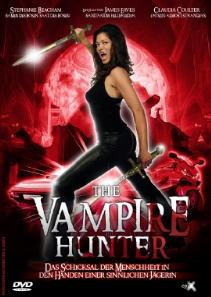
The Witches Hammer (which was retitled The Vampire Hunter for its German release and Dark Evolution in Japan) is a corking horror/action movie which oozes professionalism. Deftly directed and carefully paced to balance action sequences with slower, character-based scenes, this is a highly commendable addition to the continuing British horror boom of the early 21st century.

MJS rating: A-

Review originally posted 14th April 2006

Tuesday, 29 April 2014

Lock In

Director: Mark J Howard
Writer: Mark J Howard
Producers: Mark J Howard, Stephen Greenhalgh
Cast: Jessica Cunningham, Roy Basnett, Stephen Greenhalgh
Country: UK
Year: 2014
Reviewed from: online screener
Website: www.lockinthemovie.co.uk

The publicity for Lock In calls it a ‘psychological thriller’ which is about as far from accurate as it’s possible to get without calling it a musical. It’s a slasher, pure and simple. Not a great one, not a truly terrible one either. But a slasher nonetheless. It’s about a maniac in a clown outfit who stalks through an almost empty office building one night, offing late-staying staff and security guards in a variety of brutal and potentially amusing ways. So yes, it is about a psycho. But you could never accuse it of being a logical thriller.

Jessica Cunningham (model and proprietor of the Famous Frocks website) stars as Jenny, an account executive in an advertising agency run by unsympathetic, take-no-shit owner John (radio presenter Roy Basnett, match day host of Widnes Vikings RFC). There are about half a dozen other staff, some of whom have characters, some of whom are background. The company (the name of which is never mentioned so far as I can tell) is based in a building on some anonymous business estate. Presumably other companies share the same large building.

Six months earlier, as seen in a splash panel prologue, Jenny was raped in a pub toilet by a guy in fancy dress while attending what seems to have been a ‘zombies and clowns’ night. As the story proper starts, she is late into work after her neighbour vandalised her car (something which is mentioned briefly then forgotten about). She is also fending off the unwanted attentions of creepy cleaner Jenkinson (producer Stephen Greenhalgh, who was a stuntman in Zombie Diaries 2) whose acid-scarred face and one eye have earned him the nickname Cyclops. She’s also getting bawled out by John although not without some justification. Having turned up late, the first thing she does is go back outside for a fag break...

Jenny has to work late, getting a publicity pack ready for a press conference the next day relaunching a circus. Also staying after hours is the unnamed Building Supervisor (Simon Entwhistle), in an office presumably some distance from the ad agency office, who can’t leave until a replacement cleaner turns up after he fires Jenkinson. Two less-than-fit security guards, Colin (James Thompson) and George (Tim Paley: Tash Force) make a good double act and compensate for the generally unlikeable characters populating most of the rest of the cast.

Lock In’s most obvious problem is that it takes forever to get going. We are fully 35 minutes into the 80-minute picture before we actually get the first sight of the clown or indeed any other indication that there is something amiss. And while one gets the impression that we are supposed to think this is Jenkinson – whom we now know to be a violent ex-con – back for revenge, a swift count of the clown’s eyes easily eliminates him from the short list of suspects.

In fact it’s an incredibly short list, so short that the clown - assuming it is one of the other characters under that make-up - could only possibly be one person, making this the least mysterious mystery since we all had to guess who was the monster in Hammer’s The Gorgon.

Three other characters arrive at the building during the clown’s killing spree, increasing the number of potential victims, and I certainly won’t spoil the film by saying who lives or dies. The individual deaths are generally pretty good and will please the gore-hounds among you. Bizarrely, one scene takes place in a room where we see the various victims propped up, but this does not include all the victims so far and does include at least one person whom we never saw murdered and wasn’t even staying late (although, thinking about it, there is an earlier line of dialogue that ties in there, so I’ll give them that).

While the clown’s identity is obvious, his motivations are far from clear, even after the film wraps up. The basic premise is fine – clown-costumed psycho stalks late-night offices – and the individual bits are fine, if spaced somewhat too far apart. But the actual plot makes not a shred of sense and frankly doesn’t look like it’s even trying. A clichéd twist right at the end provides a get-out clause but creates its own problems – when you’ve seen it and thought about it, you’ll understand what I mean.

Low-budget slashers are not a genre renowned for good stories, rounded characters or coherent plots so for its target audience none of this should be a problem – although that target audience are apt to not even watch the film if it’s marketed as a psychological thriller! It’s no Halloween, that’s for sure, but this week I’ve also sat through Head Cheerleader Dead Cheerleader, a salient reminder of just how barrel-scraping these things can be and an experience which has helped me appreciate Lock In for its strengths, such as they are.

Those strengths are mostly technical – generally good photography, editing and sound, and good make-up effects too. The acting is decidedly variable but works best when the dialogue leans towards humorous, and let’s leave it at that. What’s most egregiously missing is any real sense of tension. The pre-clown scene-setting/character-building goes on far too long and even once the clown starts prowling the corridors, the pace never really shifts past ‘sedate’. The whole movie could stand to lose about ten minutes, not from any particular scene but lots of little shavings here and there to get to the meat quicker and then pick up the pace once the violence begins.

Also worth noting is that at no point is anyone ever ‘locked in’. And in fact one character gets access to the building, appearing out of nowhere without explanation, who definitely should not have a swipe card for the front door.

Jeff Downs turns in a good performance as the daytime security guard while Rachel Dargie (The 9th) and Holly Chadwick are Jenny’s principal co-workers. Craig Read, Jen Walker and David Mohammadi of Funstorm Industries supplied the make-up effects for the clown, Cyclops and the various victims. Manchester band Dead Kestrels provide some songs on the soundtrack.

Lock In is a valiant attempt at a first feature by Mark J Howard whose eclectic previous career has included a stint at Cosgrove Hall animation, freelance rock photographer and managing Peter Kay’s official website. It doesn’t quite succeed but it passes a reasonable 80 minutes (and would pass an even more reasonable 70). Its root problems, as so often with micro-budget first features, lie with the script which simply wasn’t ready to be filmed. Nevertheless, British slasher fans will want to seek this out. From my point of view, on the other hand, this is most interesting as another title in the burgeoning subgenre of British corporate horror alongside the likes of Stalled, Severance and Fired.

Premiering at Horror-on-Sea in January 2014, Lock In was made available on VOD two months later through VHX – see the website at www.lockinthemovie.co.uk for details. [In 2017 Lock In was released on DVD on both sides of the Atlantic under the new title Clown Kill - MJS]

MJS rating: B-

Thursday, 5 December 2013

Is My Palm Read

Director: Dave Fleischer
Producer: Max Fleischer
Cast: Betty Boop, Koko the Clown, Bimbo
Country: USA
Year of release: 1933
Reviewed from: UK DVD

I recently picked up a DVD (volume one of two) of original Betty Boop cartoons, released in the UK by Delta. And what a delight to reacquaint myself with the little minx. Betty is one of those characters who is sufficiently iconic that everyone recognises her, but when did you last actually sit down and watch an original 1930s Betty Boop cartoon?

Produced by Fleischer Studios, who were serious rivals to Disney in those pre-Snow White days, the Betty Boop cartoons were usually deeply surreal, with inanimate objects coming to life temporarily and people and things changing shape and context almost on a whim. As well as the sheer sexuality and sassiness of the main character, there’s a joy in the possibilities of animation as a medium and, inherent in that (I feel) is a hint of darkness and danger. And sometimes, as in this instance, these little films are just plain weird.

Is My Palm Read, apart from being a corking title, is a great little early sound cartoon. It co-stars, as do many Betty Boop cartoons, two other Fleischer characters, an anthropomorphic pup named Bimbo (of course, Betty was a canine herself in her earliest appearances) and the redoubtable Koko the Clown. We see these two, in the opening sequence, bowing down before some unidentifiable shadows on a curtain. They are inside a building with a huge neon sign outside advertising the mysterious psychic powers of ‘Professor Bimbo: sees past, present, future’.

Betty arrives, looking surprisingly demure for this stage in her career, in a long dress and wide-brimmed hat. The doorbell consists of a cat with his tail through a hole in the wall who yells when his tail is pulled. Koko checks the visitor through a peephole which he has to move around the wall several times before finding her. He sticks his head through his legs and announces “Miss Betty Boop!” This is the cue for Bimbo to don a turban and fake beard.

Outside, an entrance hall unfurls down the front of the featureless wall and when Betty steps inside it turns into an elevator (although, as we have seen, Bimbo and Koko are also on the ground floor). She then enters by means of a Betty-shaped hole in the wall which is torn open by the doorbell cat.

We are about 45 seconds in and already this is bonkers.

Bimbo has a crystal ball in which we see an ocean liner being tossed and thrown at sea, eventually turned upside down by two waves-as-hands. All the passengers fall out and one becomes separated, adrift in a lifebelt. We zoom in to see that it is Betty. She makes it to an island where she quickly dons a halter top and hula skirt and sings ‘All by Myself in the Moonlight’.

There is a straw hut on the island, with two palm trees which lean over to grab our heroine and throw her into the hut, which is home to a bunch of ghosts (one has a bone in his hair, one wears a top hat, several have buck teeth). A spider spins bars across the window so Betty writes ‘help’ on a piece of wood, but one of the ghosts grabs it and throws it onto the log fire. (Why would you have a blazing log fire on a tropical island?)

Fortunately, this causes the smoke rising from the chimney to spell out ‘help’ which is seen by Bimbo, passing by on a mule (with the ‘Sailor’s Hornpipe’ on the soundtrack). He rescues Betty and they race off through the jungle, eventually making their escape in a small, squirrel-powered paddle-boat.

Back in what passes for reality, Betty says, “My hero!” Bimbo throws off his beard and turban and says, “Betty!” and with delight and surprise she responds “Bimbo!” (so I guess she missed that huge neon sign). A ghost promptly appears from under the crystal ball and chimes in “Bunko!”(?). He rips off Betty’s hat and dress, and underneath she has the hula skirt ensemble.

Bimbo and Betty race off as more ghosts swarm out from where the crystal ball was. Koko is entirely forgotten by this point as they are back in the jungle, making one wonder whether these scenes were originally intended to follow on directly from the previous chase. The ghosts get pelted with cocoanuts from a rebounding palm tree (the flexibility of palm trees seems to be the basis for quite a few gags, in fact) and eventually they all pile through a hollow log which leads out over a chasm, with Bimbo and Betty scrambling to safety and the ghosts all plummeting out of harm’s way. The end.

Absolutely insane. Had this been made 30 years later, people would be hailing it as a drugged out classic. (Mind you, there was an awful lot of drugs going around Hollywood in the 1930s...) The five minutes of Is My Palm Read (like I say, a great title, although come to think of it, no palm-reading actually occurs) are jam-packed with inventive visual gags which leave one in no doubt that this isn’t the real world. A fair amount of these gags involve violence inflicted by non-living or inanimate objects such as trees and waves. And thinking about it a bit more, although Bimbo never reads Betty’s palm, their adventures on the tropical island certainly do involve a lot of palm trees.

According to a synopsis on the Big Cartoon Database (which cites an alternative title of Professor Bimbo) there are three risqué gags missing from this print - although curiously this runs to the exact 5’12” quoted by the BCDB. And indeed there do, on closer inspection, seem to be three slight jumps in the action where the following things should be: when Betty first enters the room, the lights are arranged so that her silhouette shows through her (atypically demure) dress, marking out Bimbo as a sly rogue; before the crystal ball reveals the ship, it shows Betty as a young girl, naked in the bath; and when Betty arrives at the island, she removes her soaking dress before constructing her own hula skirt.

Even with these snips, this is a wildly entertaining short and I will certainly be adding some more of Betty’s more fantastical adventures to the site in the future.

Apart from the Fleischer brothers, the only other credits are for animators David Tendlar and William Henning.

MJS rating: B+

review originally posted 26th November 2005

Sunday, 3 March 2013

Cry for Bobo

Director: David Cairns
Writer: David Cairns
Producer: Nigel Smith
Cast: Mark McDonnell, Steven McNicoll, Tracey Roberts
Year of release: 2001
Country: UK
Reviewed from: UK TV screening


This hilarious and wonderfully original, ten-minute, near-silent comedy was made as part of a BBC Scotland scheme called ‘Tartan Shorts’. It went on to win all these awards including the extremely prestigious Royal Television Society’s award for Best Regional Programme, the jury for which described it as "sensational, sophisticated, imaginative and visionary." And they weren’t wrong.

In a Victorian-esque fantasy Britain where clowns are second-class citizens, Bobo and Koko try to break out of their poverty trap by robbing a bank. They manage this - despite their enormous shoes, baggy trousers, etc. - but the plan comes unstuck when they get into their getaway car and the doors all fall off.

Stuck in prison, Bobo learns that his wife and child - also clowns of course with the full make-up and costume - are despairing of their miserable life and considering running away to join the civil service. With the aid of his friend Koko, Bobo stages a break-out from jail to get his family back.

Bobo’s bizarre world is beautifully realised thanks to production designer Tom Sayer and the photography of Scott Ward. And the special effects are both brilliantly simple and wonderfully effective, especially the jailbreak, shot using simple miniatures, a sort of forced perspective and excellent timing. But it’s the attention to detail which really makes this film special, like the anti-clown posters on the walls and (on screen so briefly it’s nigh on impossible to read) a homeless clown at a train station selling a magazine called The Big Shoe!

The performances are uniformly excellent: I’m not sure who plays who under all that make-up, but Steven McNicoll (Bobo? Koko?) was in Atletico Partick, Mark McDonnell (Koko? Bobo?) is Alby Brook on the Big Finish Dalek Empire CDs, and both were in a BBC Scotland comedy sketch series called Velvet Soup. Also watch out for James Bryce (Petrie in The Insidious Dr Fu Manchu) as a shopkeeper.

Cry for Bobo is beautifully written, directed and produced and works on every level, as knockabout silliness, as a serious satire on racial intolerance, and as a visually sumptuous, technically perfect short film. This is an absolute must-see.

MJS rating: A+

review originally posted before November 2004