Showing posts with label barbarians. Show all posts

Wednesday, 19 November 2014

Thor the Conqueror

Director: Tonino Ricci as “Anthony Richmond”
Writer: Tito Carpi
Producers: Roberto Poggi, Marcello Romeo
Cast: Conrad Nichols, Christopher Holm, Maria Romano
Year of release: 1982
Country: Italy
Reviewed from: UK video (Apex)

One of the cheaper, more obscure examples of the sword’n’sorcery genre which flourished in Italy in the 1980s, Thor il Conquistatore starts with five minutes of warrior, wife and wizard walking across the hills to the strains of hugely inappropriate martial music. Eventually, the wife (Malisa Longo: Reactor) gives birth to a baby, the wizard holds it aloft to show the gods - and an arrow goes ‘thunk!’ right into it! It’s a hilarious, pythonesque scene.

Bad guy Gnut (Raf Baldassarre, who was in a whole string of pepla, spaghetti westerns and gialli from the mid-1950s to the mid-1980s) kills warrior and wife but wizard escapes with baby, which apparently is only wounded. Warrior’s sword turns into snake and slithers away.

Fast forward 25 years and we find the baby all grown up in the shape of Thor (Luigi Mezzanotte), destined to be the mightiest leader ever - just not in this film. He’s all rippling six-pack, fur boots and Neanderthal grunts. The wizard is apparently Etna the bird-man, who can transform himself into an owl, and who wears six-foot shoulder-pads in his human guise. Rather curiously, Etna narrates the ensuing story from within the scene, in the past tense, like a dark ages Rod Serling.

Thor goes on a quest to find his father’s sword. Along the way he fights and kills various primitive tribes, sparing only the warrior virgin Ina (Maria Romano: Women’s Prison Massacre), whom he first enslaves then falls in love with. By the end of the film, she has born him a son, he has found his father’s sword, and Gnut is dead.

One for Italophile completists only, this is neither exciting enough nor bad enough to generate any interest. Only Etna’s outrageous shoulder-pads raise a smile. The fights are limp, and the plot is barely there at all.

Writer Tito Carpi was also the man behind the ‘scripts’ of Ultimo Mondo Cannibale, Tentacles , a bunch of Sartana/Django flicks and the deliriously bizarre The Atlantis Interceptors. Cinematographer Giovanni Bergamini also lit Cannibal Ferox and was camera operator on the original Django, The Humanoid and Exterminators from the Year 3000, while make-up artist Pietro Tenoglio’s other credits include Anthropophagous, Stagefright, Frankenstein all’Italia and Stuart Gordon’s The Pit and the Pendulum and Castle Freak.

MJS rating: D

Monday, 21 April 2014

Throne of Fire

Director: Franco Prosperi
Writer: Nino Marino
Producer: Ettore Spagnuolo
Cast: Sabrina Siani, ‘Peter McCoy’ (Pietro Torrisi), Harrison Muller
Year of release: 1983
Country: Italy
Reviewed from: UK VHS (Mr Video)

More tedious early 1980s Italian sword and sorcery crap. How many of these bloody films did they make?

A witch called Azeera gets raped by Belial (Harrison Muller from Avi Nesher’s She) who is ‘the Devil’s messenger’ and wants a son to rule the world. She gives birth on a stormy night to a hideous mutant thing which grows up to be handsome but cruel Morak (Muller again). Born at the same time is Siegfried who grows up to be Pietro Torrisi from Werewolf Woman and Django the Bastard.

The land is ruled by King Agon the Wise who sits on the titular throne of fire, which was forged by Odin (apparently). If Morak can kill Agon and marry his daughter Princess Valkari (Sabrina Siani: Black Cobra, Ator the Fighting Eagle, Mondo Cannibale) he can sit on the throne and rule to his evil heart’s content. But he must do this before sundown on ‘the day of the night in the day.’

Well, killing Agon proves no problem. Morak has a whole army of black-garbed bad guys and we eventually see a flashback to the king’s demise. But Valkari escapes. Eventually captured, she is rescued by Siegfried. And when he is captured, she rescues him. There‘s a lot of very ho-hum to-ing and fro-ing and much running around a castle which, in the manner of these things, has iron handrails on the steps and modern guttering.

At one point, Morak shows how villainous he is by offering to free the villagers he captured along with Valkari, letting them run one by one towards the door only to be shot in the back with his arrows. Later, Siegfried is thrown into the Well of Madness which proves to be an underground cave system where he faces hallucinations including a panther, a floating head and a python which he drapes round his neck and pretends to wrestle with. It seems to be real and live but drugged up to the eyeballs. From the Well of Madness he breaks into a cell where he finds his father Antar (as you do) who turns out to be a magician and grants him a one-time spell of invisibility while also making him invulnerable to everything except fire.

But that rotten old Morak overhears this and fires a flaming arrow at Siegfried when he tries to escape with Valkari. Morak’s problem, you see, is that only legitimate rulers can safely sit on the throne, and he will only be legitimate if he marries the late king’s daughter. He demonstrates what will happen otherwise by asking a doubting courtier to sit on the throne. Up come the flames and the guy burns to a nasty death.

Eventually it all comes down to a fight in the throne room between Morak (who is still a mutant-demon-thing at heart) and Siegfried... just as a total eclipse is happening. At the moment of full eclipse - ‘the day of the night in the day’ - Siegfried pushes Morak onto the throne where he roasts, on account of not being married to Valkari presumably. It all ends happily with Siegfried and Queen Valkari cheered by a small group of villagers, all of whom were murdered by Morak about fifty minutes earlier.

Even by the low standards of this dodgy subgenre, Throne of Fire (Il Trono di Fuoco) is rubbish. There’s not even a mad narrator with giant shoulder pads to relieve the tedium of the threadbare plot. Plentiful shots of Morak’s hordes attacking villages (well, the same village from different angles) are scattered throughout the film for no good reason. Some shots were overcranked so they can play in slow motion but one has been accidentally speeded up so that villagers skitter around like extras in a Benny Hill sketch for a couple of seconds.

Among the cast are Benny Cardoso (not ‘Beny’ as some sources claim, though her real name is apparently Beni Cardosi) from Vampyros Lesbos, She Killed in Ecstasy and Sumuru; Isarco Ravaioli, finishing off a career that began in 1953 and included The Vampire and the Ballerina, Wild Wild Planet, Three Graves for a Winchester, Danger Diabolik and Achtung! The Desert Tigers; and Roberto Lattanzio - now an assistant editor in Hollywood!

Franco Prosperi directed Hercules in the Haunted World back in 1961 and a bunch of other great-sounding flicks of which the one I most want to see is a 1967 low-rent Bond spoof called Dick Smart 2007. Producer Spagnuolo’s most notable credit was Fulci’s Aenigma in 1987.

Interestingly, the artwork on the British video sleeve is identical to that used for the Spanish poster for another Spagnuolo production, Sword of the Barbarians - as La Espada Salvaje de Krotar - even though it is clearly more relevant to this film (it features a throne of fire, for one thing). Sword and Throne both starred Sabrina Siani and ‘Peter McCoy’ but ironically the bloke in the painting looks less like Pietro Torrisi than I do!

There are a few brief shots of quite nasty, bloody wounds, courtesy of make-up man Giuseppe Ferranti (The Bird with the Crystal Plumage, Cat o’Nine Tails, Cannibal Ferox, Monster Shark, Rats: Night of Terror). Special effects (such as they are) are credited to Paolo Ricci (The Sexorcist, Mountain of the Cannibal God, Eaten Alive, The Atlantis Interceptors, 2019: After the Fall of New York). Silvio Laurenzo (The Case of the Bloody Iris) designed the costumes, which must have taken all morning, and the art director was Franco Cuppini who was set decorator on Argento’s Inferno and assistant set decorator on Juliet of the Spirits!

The only watchable thing in the film is Siani (real name Sabrina Seggiani, also variously credited as Sabrina Sellers and Diana Roy) who was nineteen when she shot this and not only looks good in her suede bikini but can actually wield a sword. She puts far more effort into her performance than this shoddy film deserves.

This was one of several sword’n’spaghetti flicks made/released by Cannon in 1983-85, the others being Thor the Conqueror, Hercules, She, Sword of the Barbarians, The Adventures of Hercules and The Seven Magnificent Gladiators.

MJS rating: D

Thursday, 5 December 2013

Iron Warrior

Director: Alfonso Brescia as “Al Bradley”
Writer: Steven Luotti, Al Bradley
Producer: Sam Sill
Cast: Miles O’Keefe, Savina Gersak, Elisabeth Kaza, Iris Peynado
Year of release: 1987
Country: Italy
Reviewed from: UK rental video (Rank)

More bonkers Italian sword and sorcery - I can’t get enough of this crap and yet I’ve no idea why. As usual, Miles O’Keefe is a warrior named Ator, and as usual this one (Ator il Guerrireo di Ferro) has nothing to do with any of the other Ators in other movies. Much like Maciste and Samson in peplum films, and Django and Sartana in spaghetti westerns, Ator was a handy, generic name. Sometime Tarzan O’Keefe also ‘played him’ in Ator the Fighting Eagle (1983) and The Blade Master (1984).

The battle between good and evil is personified by two witches: beautiful, olive-skinned Deeva (Iris Peynado: The New Barbarians) and wizened, flame-haired old crone Phaedra (Elisabeth Kaza: Castle Freak). The brothers Ator and Trogar are destined to do great things so Phaedra steals Trogar and for this is banished for 18 years. Deeva mentions in passing that she has granted the king a daughter.

Fast forward to the eighteenth birthday of Princess Janna (Savina Gersak from, erm, Curse II: The Bite), which is interrupted by the arrival of Phaedra, followed by her warrior Trogar. As it says on the video sleeve, he is: ‘Born of evil sorcery. Half man, half spirit. Total exterminator.’ What he actually is - is a total Darth Vader rip-off. The boots, the gauntlets, the cloak, the shoulder-pads, the sword - right down to the asthmatic breathing! But instead of Vader’s black helmet, Trogar wears a shiny chrome skull and a red neck-scarf. (The man behind the mask in this instance is Franco Daddi who was second unit stunt co-ordinator on Bill and Ted's Excellent Adventure!)

The bulk of the film has, as one might expect if one has seen plenty of these things (and I have!) no discernible plot. Ator and Janna do a lot of journeying, occasionally defeating some nameless, faceless soldiers, presumably under the command of Phaedra, and occasionally facing off against Trogar himself. There are a few attempts at a story, with Phaedra transforming herself into a young woman, and an impostor claiming to be Janna’s royal father. Eventually Ator and Janna track down Deeva, who sends them to an island that has risen from the waves (a decent model, to be fair). There they must locate a gold chest, but Phaedra tricks, imprisons and impersonates Deeva.

It all ends up with the good guys winning, sort of, somehow. But it’s all complete nonsense. The film makes full use of its locations on Malta and Gozo and gives good views of those islands’ cliffs, caves and ruins - even if one of the ‘ancient castles’ has metal steps and railings for tourists! Very disappointingly, although the video sleeve painting is mostly accurate, nothing even faintly resembling the dragon depicted ever appears. Boo.

Bradley/Brescia’s gloriously psychotronic career stretched from latter-day pepla such as Revolt of the Praetorians (1964) through westerns (The Colt is My Law, 1966) and war movies (Kill Rommel!, 1969) to sci-fi hoopla like Battle of the Stars (1977) and Reactor (1978) - plus bona fide trash classic Amazons Against Supermen aka Superuomini, Superdonne, Superbotte (1975). He died in 2001.

But Iron Warrior is most notable for being (apparently) the only narrative feature film cinematography credit for the charmingly named special effects cameraman Wally Gentleman. Born in Britain in 1926, Gentleman started work as a camera assistant in 1943 and later emigrated to Canada where he died in 2001. And 2001 is his most famous work: he collaborated closely with both Clarke and Kubrick, who sought him out after being impressed with his work on a 1960 National Film Board of Canada documentary called Universe.

Gentleman is regarded by cinematographers as the father of special effects photography, his other credits including Black Narcissus, Great Expectations, Oliver Twist and The Red Shoes. Quite how he ended up behind the camera on a piece of tat like this, God only knows. His only other Italian credit is Chi Sei?/Behind the Door in 1974.

Iron Warrior is utterly disposable rubbish, but with a certain naive charm. Truly it is written: they don’t make them like this any more.

MJS rating: C-
review originally posted 30th May 2005

Saturday, 12 January 2013

Ator the Fighting Eagle

Director: ‘David Hills’
Writer: ‘David Hills’
Producer: Alex Susmann
Cast: Miles O’Keeffe, Sabrina Siani, Edmund Purdom
Country: Italy
Year of release: 1982
Reviewed from: UK VHS (Thorn EMI)


It’s been a while since I watched one of these sword-and-spaghetti sub-Conan fantasy frolics and frankly this is rather a good one. I don’t mean that it’s a particularly good film, but it’s one of the earlier examples of the subgenre and consequently one of the more professional and imaginative.

The pseudonymous writer/director of Ator l’Invincibile is actually old Joe D’Amato himself (Arristide Massaccesi to his mum) who also handled cinematography as ‘Frederick Slonisco’. According to the IMDB, Michele Soavi (Dellamorte Dellamore) has an uncredited hand in the script and that’s quite believable because there are one or two really rather good bits. There’s some dumb stuff too, of course.

The land of wherever-it-is is under the rule of the Spider, whatever that means. The top man is a character merely credited as High Priest of the Spider, played by the mono-monickered Dakkar (Zombie Holocaust), a bald, black, beardy bloke with a penchant for letting large spiders crawl over his arms and head. He also wears an extraordinary amount of gold eye-shadow.

The obligatory prophecy is that the mighty warrior Torin will be defeated by the forces of the Spider but that his son will succeed where Torin failed. Consequently, the black-garbed goons of the Spider are sent out a-Herod-ing, killing all newborn children. But baby Ator is saved by Griba (the redoubtable Edmund Purdom), a banished Priest of the Spider, who cunningly deposits him with a family in a village on the edge of the kingdom, who have just had a daughter of their own. Griba uses his magic (or possibly a dab of foundation) to cover up the ‘mark of Torin’ birthmark on the baby’s shoulder.

Of course, the baby grows up into Miles O’Keeffe, fresh from his screen debut as Tarzan. He wears big furry boots and a metal frisbee on his chest and has the most massive 1980s poodle hair which makes him look like the keyboard player out of Europe. His stepsister Sunya grows up to be shapely brunette Ritza Brown, to whom he gives that most precious of presents, a bear cub. (Brown went on to be an animation producer, her credits including a 1996 feature-length cartoon about Siegfried and Roy!)

A rather creepy bit of the film is the fact that Ator and Sunya fall in love and decide to get married before they discover that Ator is adopted. Fortunately, as soon as Ator tells their parents about their incestuous plans, they reveal the truth and the wedding can go ahead. But the celebrations are interrupted by the Spider’s men who slay all the villagers and carry off Sunya, which apart from anything else makes one wonder why they didn’t visit the village when they were looking for babies twenty years earlier. Ator and his bear cub decide to set off and rescue Sunya.

On the way he rescues blonde warrior babe Roon (Sabrina Siani, a familiar pair of legs from Mondo Cannibale, 2020 Texas Gladiators, Throne of Fire and Lucio Fulci's Conquest) from two rogues, only to discover that she was in fact the aggressor in the incident and she doesn’t want any help. Later, when he is captured by an all-female tribe who require a new leader to be conceived, Roon beats three other women in a decidedly crap girlie fight to win the honour of being impregnated by the prisoner. She agrees to free him but must then accompany him because the tribe will be after her too, so off they run. With the bear cub - who is actually really cute and easily the star of the film.

When they get separated, Ator hears Roon’s voice but it’s actually a trick played by the witch Indun (Black Emmanuel herself, Laura Gemser, best known to readers of this site as costume designer for Troll 2) who lures him into her surprisingly well-furnished cave and shows him a fake vision of Sunya snuggling up to the bald, black, beardy baddy. Roon rescues him just in time, having been rescued herself by the cub. Actually, that’s probably the funniest part of the film, with Roon trapped in a cave behind a rockfall. In response to her calls, the little cub - it’s maybe two feet long - paws away at the boulders and somehow shifts enough for Roon to get out. But she’s a strapping lass and uninjured: why doesn’t she just clear the rockfall from her side?

Indun has a magic mirror in her cave and when Ator removes the cloth which covers it, she catches sight of her own reflection and turns into a hideous hag. She swears revenge as Ator and Roon depart but in fact we never see her again.

The best part of the film comes when Roon and Ator retrieve a mystical shield which is essential to their quest. First they have to sneak through a cave where a squad of blind warriors are forging swords and axes, then they descend a hole into a cave where the shield lies and it is there that Ator is forced to fight his own shadow. This is a terrifically well directed sequence which uses no special effects, just clever lighting and imaginative fight choreography. Quite possibly the best thing ever in a crap Italian fantasy film.

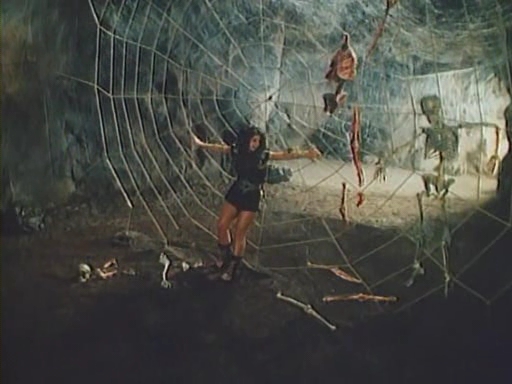
When they finally confront the Spider soldiers, Roon sacrifices herself while Ator rescues Sunya from a giant web, rather obviously made out of rope (she’s even tied to it). But stap me if there isn’t an actual giant spider glimpsed in the background, waving its legs around. And when Ator battles the High Priest atop a set of stone steps, there is another giant spider (could be the same one but looks to be a bigger and better puppet). Ator uses the shield to make the High Priest explode, or something.

Oh and Griba, who pops up occasionally to offer advice or wipe Ator’s shoulder, revealing a birthmark which everyone immediately identifies as ‘the mark of Torin’, turns out to have his own agenda. Being a banished priest, he was merely using Ator to defeat the current High Priest in an attempt to usurp power within the whole Spider set-up. But he gets his come-uppance. I should also mentioned Purdom’s hair, a long, greasy, flat-cut affair which, frankly, looks like he bought a deluxe Merseybeat wig but it was a size too big.

O’Keeffe returned to the character of Ator (or at least, a character called Ator), two years later in a sequel for D’Amato which was released in English as The Blade Master and then, after wielding a more English weapon as Sir Gawain in Sword of the Valiant, was Ator a third and final time in Alfonso Brescia’s Iron Warrior in 1987. He went on to appear as Dracula in Waxwork and as John Smith in a 1995 version of Pocahontas. Eric Allan Kramer took over the character in 1990’s Quest for the Mighty Sword, once again directed by D’Amato.

Edmund Purdom, remarkably, is still alive and is about to celebrate his 82nd birthday as I type this in December 2006. Acting since the early 1950s, his genre credentials include Herod in Herod the Great, Rasputin in The Night They Killed Rasputin, the American President in 2019: After the Fall of New York, Dracula in Fraccia contro Dracula, plus Dr Frankenstein’s Castle of Freaks, Airport '79 rip-off The Concorde Affair, Jesus Franco’s Sinister Eyes of Dr Orloff, City of the Walking Dead, Anthropophagous 2, Endgame and, most recently in 2001, a voice in Titanic: The Animated Movie.

Also in the cast are Nella Pazzafini (as ‘Nat William’) whose 200 or so credits include a slew of pepla, a fistful of spaghetti westerns and a bunch of Bond rip-offs plus The Long Hair of Death, Amazons Against Supermen, Puma Man, Endgame, The Ironmaster and Ator 2 (as a different character). Producer Alex Susmann is like many of the other credits, a pseudonym which was only ever used on this film and its sequel, in this case disguising executive producer Helen Sarlui who gets a ‘...presents’ credit on this print. Her other ex.prod. credits include Alien Predator (which was released in the UK as Mutant 2), Monster Dog, Avi Nesher’s version of She and, oddly, Killer Klowns from Outer Space. The music is by Carlo Maria Cordio (Troll 2 and several other unrelated sequels to American films) with Simona Pirone providing the uncredited song over the end titles. Chris Trainor (another pseudonym) is credited as associate producer.

A poster that I found on the web, which just calls the film Ator and was used for the Danish video sleeve, features a three-balled mace and a sabre-toothed tiger - which, if they were in the film, I promise you I would have mentioned. It credits O’Keeffe, Siani, Warren Hillman, Brooke Hart, Ron Carter “and introducing”(!) Edmund Purdom. This lists two executive producers (Susmann and Ron Phillips), two associate producers (Trainor and Joseph Russel) and one common or garden producer (Patrick Murphy) and credits the music to John Beck.

This first Ator film has a few imaginative touches, such as the shadow fight, but mostly it scores over other films in the same genre by simply not cutting corners with cheap locations. No drainpipes or handrails in any of these ancient ruins. O’Keeffe is pleasant if wooden and everyone else has fun overacting, plus I can’t really criticise any film that features Sabrina Siani’s pins.

MJS rating: B
Review originally posted 17th December 2006