Showing posts with label witches. Show all posts

Thursday, 15 June 2017

The Autopsy of Jane Doe

Director: André Øvredal
Writers: Ian B Goldberg, Richard Naing
Producers: Rory Aitken, Fred Berger, Eric Garcia, Ben Pugh
Cast: Brian Cox, Emile Hirsch, Olwen Kelly
Country: UK/USA
Year of release: 2017
Reviewed from: DVD screener

The Autopsy of Jane Doe was directed by a Norwegian and is set in the USA, but most sources – including the US distributor – list it as a British film. The IMDb disagrees and says it’s a UK/US co-production, while Wikipedia describes it as fully American (as do, interestingly, the BBFC).

It is a joint gig between two production companies. The minimalist and Adamsian 42 is certainly a British company, based in London, comprised of producers Eric Garcia and Ben Pugh. They were also involved in the production of Monsters: Dark Continent and The Other Side of the Door. Impostor Pictures is based in LA so yes, this is an Anglo-American feature. Should I include it in my British horror master list? Well, I think it feels more British than American – possibly because of the European director – so I’ll consider it a British film made with some American investment rather than the other way round. Plus it was shot over here and it stars veteran Scottish actor Brian Cox. Sold!

With all that malarkey out of the way, what is it about?

Tommy Tindell (Cox) and his son Austin (Emile Hirsch) run a family crematorium/morgue/autopsy service from the converted basement of their house. Is this a thing? Are there places like this in America? Over here, any autopsy is going to be done in an NHS hospital and crematoria are usually managed by the church. But apparently in the States the two are combined in a business that runs effectively out of somebody’s parlour.

The local Sheriff (Irish actor Michael McElhatton: The Hallow, Ripper Street) brings in an unidentified body. She was found naked, half-buried in the basement of a house, the occupants of which have died in gruesome ways, with no sign of forced entry. Bereft of distinguishing features and with no fingerprint match, this Jane Doe body is the best clue as to what happened, and the Sheriff would like cause of death determined tonight so that he can face the press tomorrow (a premise which doesn’t exactly sound believable; murder investigations take as long as they take).

So autopsy technician pere et fils set to examining the body, taking us through the four stages of clinical autopsy: external examination; heart and lungs; digestive system; brain. What they find makes no sense. The woman hasn’t a scratch on her, yet she has some horrific and bizarre internal injuries, as well as certain foreign bodies inserted into her.

While they’re doing this, spooky things start happening. Which get spookier and scarier and more violent and dangerous and swiftly pass the point where they can be dismissed as anything other than supernatural. These phenomena must relate in some way to the mysterious dead body, but how and why? I won’t go into any detail, just say that the revelation of what is happening is quite clever and original, albeit kind of a spin on a very old horror trope.

Though I enjoyed the film, I have a problem with it, which is this. All the spooky, scary stuff is kind of random. There are indistinct figures in reflections, doors open by themselves, strange noises. There’s no pattern and it’s all just general spooky weirdness which doesn’t specifically relate to anything either on screen or subsequently resolved. In short, it’s impossible to tell from what’s going on… what’s going on. It’s all done a lot better than, say, The Haunting of Radcliffe House which was just daft. But I would have liked to have seen a pattern, something which gave us and/or the Tindells a clue as to what is actually happening.

It’s not a spoiler to say that the Tindells do eventually work out what’s actually happening, although I’m not sure there wasn’t something of a leap of logic there. Plus some of their actions are less than logical. At one stage they start a fire. This gets quite scary because of the supernatural stuff that happens to the flames but there didn’t seem to be any justification for starting the fire in the first place. When you’re in an enclosed, underground environment, a fire is the last thing you want.

That said, the script (by two guys who wrote episodes of The Sarah Connor Chronicles and Once Upon a Time) and direction (by the guy who made Troll Hunter) are both pretty good. The father and son relationship is well-handled by both script and the two actors, although an early bit about Austin talking with his girlfriend (Ophelia Lovibond: Guardians of the Galaxy) about wanting to leave home rather than continue the business goes precisely nowhere and has no effect on the narrative. I spy the stump of an excised subplot.

Brian Cox is very good, as one would expect. His genre CV goes all the way back to The Year of the Sex Olympics and takes in Hammer House of Horror, The Ring, X-Men 2, The Water Horse: Legend of the Deep, Trick ‘r Treat, the 2009 Day of the Triffids, Rise of the Planet of the Apes, Pixels and of course the original Hannibal Lecktor (sic) in Manhunter. He played Sydney Newman in Doctor Who drama An Adventure in Space and Time, he narrated The Colour of Magic, and he was Daphne’s father in a couple of episodes of Frasier.

Emile Hirsch starred in the swiftly forgotten 2008 Speed Racer movie and has been in a bunch of other stuff including, at the start of his career, episodes of Kindred: The Embraced, Sabrina the Teenage Witch and Third Rock from the Sun. Video game voice artist Jane Perry and Parker Sawyers (Monsters: Dark Continent) play supporting cop roles.

But the break-out star, as it were, is Irish actress Olwen Kelly who plays the naked body on the table, remaining utterly motionless throughout every shot. Apparently she drew on her experience of yoga and meditation. She is now making Dom Lenoir’s serial killer thriller Winter Ridge. As the autopsy progresses, a mixture of astute camera angles and superb prosthetics by special effects supervisor Scott McIntyre (Tank 432, Estranged, White Settlers, The Quiet Ones... Pudsey the Dog: The Movie), presumably assisted  by some digital doodaddery from VFX supervisor Stephen Coren (Ghost Machine, 28 Weeks Later), enables us to see Ms Kelly opened up on the table.

With production design by Matt Gant (Life on Mars, Ashes to Ashes) and cinematography by Roman Osin (The Rezort).

After a premiere at Toronto in September 2016, The Autopsy of Jane Doe was theatrically released in the States (and Latvia, apparently!) in December. In March 2017 there was a one-night only UK release co-ordinated by Frightfest. DVDs appeared on both sides of the Atlantic three months later.

I enjoyed the film but possibly the effusive praise it received from festival screenings may have raised my hopes too high. As for some of the comments warning of how visceral and gory this is, one does have to wonder whether some critics have seen any horror films before. Nevertheless this is an original and enjoyable 80-odd minutes of supernatural horror, worth a watch.

MJS rating: B+

Sunday, 18 September 2016

Scaremonger

Director: Aman Chang
Writer: Lee Kwing Kai
Producer: Bee Chan
Cast: Sam Lee, Jerry Lam, Myolie Wu, Angela Tong
Year of release: 2001
Country: Hong Kong
Reviewed from: Hong Kong VCD (Universe)

iLoopy Hong Kong horror comedy nonsense doesn’t come much loopier than this. Skinny geek Joe (Sam Lee: Gen X Cops) is a journalist and wannabe screenwriter who shares a flat with his fat geek friend Herpes (Jerry Lam). No, honestly - the character’s called Herpes. They’re investigating a femme fatale (Angela Tong, the Canadian born actress who voices Dee Dee in Dexter’s Laboratory - I kid you not!) who is luring men to her flat and killing them in nasty, supernatural ways.

Joe seeks help from a mysterious internet source on the mainland who sends over his daughter, the gorgeous Yan (Myolie Wu). Both Joe and Herpes fall for her, the former quite sweetly, the latter more crudely, but neither stands a chance. She wants a man like her favourite romantic novelist, who clearly understands women - but oh, irony, that’s Joe under a pseudonym. How can he convince her?

Meanwhile, Herpes becomes surrogate mother to a baby spirit brought over by Yan to help out, who quickly grows to an adult, in body at least. Only Herpes can see him and, in a really gross plot twist, has to develop magical breasts so he can suckle him.

The climax of Jing Sheng Jian Jiao is a desperate fight against the witch (or whatever the hell she is) and the zombie thing she’s been feeding her murder victims to. The ‘plot’ wanders all over the shop and the whole thing is played for knockabout laughs and features comic mugging that would make Three Stooges fans say, “Goodness me, that’s a bit unsubtle.”

It’s okay in a desperately silly sort of way but there’s no aspect of it you could actually commend. Fortunately, the great thing about VCDs - this one has the usual mangled English subtitles - is that they’re dirt cheap (about five to eight quid in London) so you’re not investing much money and therefore not expecting much return. Which is handy.

MJS rating: C
Review originally posted 13th April 2009

Tuesday, 2 August 2016

The Sisterhood

Director: Cirio H Santiago
Writer: Thomas Mckelvey Cleaver
Producer: Cirio H Santiago
Cast: Rebecca Holden, Chuck Wagner, Lynn-Holly Johnson
Year of release: 1987
Country: Philippines/USA
Reviewed from: UK rental VHS (Pearl Communications)

Cirio H Santiago - your mark of quality when it comes to Filipino movies. And I’m not being cynical - the production values here are a whole notch above many of the man’s contemporaries.

This is yet another post-holocaust adventure that would like to be Mad Max 2 but isn’t, but it does at least have an original premise. The world (well, North America) has reverted to an entirely patriarchal society and women are subjugated - except for a semi-legendary band of femme outlaws called ‘the Sisterhood’ who are said to be witches. In fact, they have various powers derived from the mutational after-effects of the bomb, which manifest themselves at puberty. Or something.

We meet two of these, Alee (Rebecca Holden: Knight Rider, Lycanthrope) and Vera (Barbara Hooper: The Wizard of Speed and Time) as they run up against the gang of thugs led by bearded Mikal (Automan himself, Chuck Wagner). One of the girls has healing powers and one has telekinetic ability, but to be honest I can’t remember which is which. Anyway, they kick Mikal’s arse and send him and his gang on their way in their crudely customised motor vehicles.

In a nearby settlement lives 18-year-old Marya (Lynn-Holly Johnson: Mutant 2, Hyper Space) and her younger brother Gil (Tom McNeeley). Marya has some form of psychic link with her hawk Lady Shri, which her master, Lord Newfield, accepts because it’s useful. But the lord is away and others in the settlement are calling her a witch. Mikal and his engine-revving mates attack the settlement and, before she escapes, Marya sees her brother cut down by Mikal himself. (For some reason, although motor vehicles still exist in this world, no guns have survived so all fighting is done with swords and bows.)

When Marya seeks shelter at a tavern, she meets and befriends Alee and Vera, who are reluctant to accept her into the Sisterhood until they discover her affinity with Lady Shri. Camped for the night, Vera is snatched by Mikal and much of the rest of the movie is Alee and Marya trying to get her back. Mikal at first joins forces with fey, hare-lipped Lord Barak (Robert Dryer: Cyborg 2, Spaceship, Revenge of the Zombie) but that ends unhappily so he teams up instead with Lord Jak (Anthony East: Bloodfist II) to journey through the Forbidden Zone to Calcara, ‘the city of ultimate pleasure.’

The Forbidden Zone, you will not be surprised to hear, is home to various unpleasant mutated folks who chase Alee and Marya into a cave network, wherein they find a whole bunch of pre-holocaust stuff - including loads and loads of rifles and some handy armoured personnel carriers which they are of course able to drive straight away. With this they head for Calcara, which is ruled by loud, jovial Lord Kragg (Kenneth Peerless: Bloodfist) but frankly for a city of ultimate pleasure it seems rather devoid of bars and whores.

Lord Kragg receives Mikal’s gift of a witch but, wouldn’t you know it, he’s already got some! A whole room full of captured Sisterhood members in manacles. When Marya and Alee break in and rescue Vera (and kill lots of guards) some sort of spectral goddess appears and all the manacles fall off the Sisterhood who magically fade away. Eh?

I’ve got a soft spot for this movie (which was just called Sisterhood for its UK DVD release, possibly to avoid confusion with the similarly titled David DeCoteau picture), mainly because it isn’t just a clone of Mad Max 2 or Escape from New York (1980s Italian producers, are you listening?). The cinematography by Ricardo Remias (She Devils in Chains, The Muthers, Vampire Hookers, Anak Ng Bulkan) is good and the fights and stunts are well-handled; Ronald Asinas (Terminal Virus), Day Guerrero (Robo Warriors) and Fred Esplana (Raw Target) are credited as stunt choreographers.

Sure, there are plenty of cliches and some silly bits but it’s more enjoyable than many other films in this genre. The mere fact that I’ve watched it twice is evidence of that. The acting is better than one would expect, and if Johnson is a little wooden occasionally she is also very good at playing up her character’s vulnerability.

Also in the cast are Henry Strzalkowski (Desert Warrior, Equalizer 2000, Angel of Destruction, also credited as casting assistant), David Light (Cobra Mission, Future Hunters), Jim Moss (Robo Warriors, Future War, Zombie Flesh Eaters 3) and Peter Shilton (Future Hunters, Equalizer 2000 but not - despite what the Inaccurate Movie Database reckons - the former goalkeeper for Nottingham Forest and England!). Composer Jun Latonio (Fast Gun, Killer Instinct) is anglicised to ‘Jim Latison’ on the sleeve. Ronnie Cruz was the art director, Teresa Mercader did the make-up and Elvia Santos was in charge of wardrobe, while special effects are credited to Juan Marbella Jr - Santiago veterans all.

It’s a Cirio H Santiago movie and, let’s face it, the man’s a cinema legend, having helmed more than fifty films from Filipino Wonder Woman series entry Darna and the Tree Monster to one-boy-and-his-pterodactyl remake Anak Ng Bulkan/Vulcan, as well as producing such WIP classics as Jack Hill’s The Big Doll House and The Big Bird Cage. I’m not ashamed to say that I will always happily watch any movie with Santiago’s name in the credits.

MJS rating: B

Review originally posted 19th April 2008.

Wednesday, 29 July 2015

Conjuring the Dead

Director: Andrew Jones
Writer: Andrew Jones
Producer: Andrew Jones
Cast: Rachel Howells, Alison Lenihan, Lee Bane
Country: UK
Year of release: 2015
Reviewed from: online screener
Website: www.facebook.com/NorthBankEntertainment

It’s been a few years since I watched an Andrew Jones movie. Back in 2007 I reviewed his second feature The Feral Generation, a bleak drama about homelessness. At the time he was attached to a mooted remake of Driller Killer, and he wrote an unproduced remake of Beyond the Door for Ovidio Assonitis. He then teamed up with James Plumb to make three new entries in public domain franchises: Night of the Living Dead: Resurrection and Silent Night, Bloody Night: The Homecoming (both directed by James) and The Amityville Asylum (directed by Andrew).

In the past two years, Jones’ production company North Bank Entertainment has become a veritable film factory, pumping out a new low-budget horror every few months. And because Andrew is a reliable source of material, he’s having no problem finding distribution. In 2013 he shot The Midnight Horror Show (aka Theatre of Fear) in October and Valley of the Witch in November. In 2014 he shot The Last House on Cemetery Lane in April, Poltergeist Activity in September and A Haunting at the Rectory in November. All five of these are now available on DVD. Already this year, Andrew has shot Robert the Doll in February (out on DVD next month as just Robert), thriller Kill Kane in April and The Exorcism of Anna Ecklund in June!

Conjuring the Dead is actually a retitling of Valley of the Witch for its VOD release through the ever-reliable TheHorrorShow.tv. Announced for an October 2014 DVD release through 4Digital Media under its original title, that disc was evidently pulled, retitled and rescheduled for early August, making this July VOD release the film’s UK debut. (Hanover House released it in the States in January.)

Anyway…

Rachel Howells (who was in Jones’ first film, Teenage Wasteland) stars as recently divorced Londoner Kristen Matthews who takes the opportunity of inheriting a house from her aunt to leave the city and move to the small Welsh town of Cwmgwrach. This is a real place, whose name translates as 'Valley of the Witch' and which has assorted legends attached, although I can’t find any record online of the historical part of this film’s plot. Incidentally, Aussie Prime Minister Julia Gillard was born in Cwmgwrach – although her PR people generally claim she’s from Barry!

Kristen befriends her neighbour Barbara (Alison Lenihan, variously a radio presenter, a cabaret artiste and a Cher tribute act) although she’s slightly freaked out to discover that Barb is a practising Wiccan who belongs to a small coven of white witches. Although Rachel is nominally the film’s central character, the picture’s heart lies in a magnificently subtle performance by North Bank regular Lee Bane (who has been in all of the company’s films since NOTLD: Resurrection) as Jim Eckhart, the local plod. Three suicides in swift succession, apparently unconnected and all allegedly happy individuals, suggests something strange is going on.

Among a succession of flashbacks, dream sequences and other interstitial elements which help to pad the slender story out to feature length – some of them featuring colour distortion effects of an intensity rarely seen outside of 1970s Top of the Pops – we learn of how three witches were crucified and burned in 1614. The leader of the three cursed the village in the traditional manner of horror movie witches – and evidently this relates to what is happening now.

Kristen is attacked in her own home by a maniac in a hood and manages to stab him – but when PC Jim arrives, the body has disappeared and there’s not even any sign of a struggle. Truth be told, the ‘spooky’ things which happen throughout the film are somewhat random and don’t fit together in any way, leaving assorted flapping plot strands, not least the suicides which don’t seem to relate to anything else.

It is all, as one might expect, connected to the 17th century witch burning and certain people being direct descendants of certain other people. A family tree website is used to identify people’s ancestors although that doesn’t stand up to close scrutiny. All we see on each occasion is a name and a late 16th century birthdate, but only one of those names has any obvious meaning. More to the point, even at a conservative estimate of, say 33 years per generation, at a remove of four centuries each of us has about 4,000 direct ancestors. It’s unlikely they’d all be listed on a family tree website, but nevertheless characters do seem to somehow go straight to a specific name and we are left to infer that this particular ancestor was involved in some way in the witch burning.

Nor could it truthfully be said that the film’s final scene makes total sense; it’s unclear why this is happening and why the person doing it is doing it. On the plus side this scene, which is shot silent and in slow motion so that we see – but don’t hear – people shouting and screaming, is extraordinarily effective. Solid evidence, if any were needed, of how confident Andrew Jones is in his craft and his niche.

Jones does a good job overall in capturing the spirit of the small town, with its local copper, local priest and local shop for local people. Furthermore the film is remarkably well cast. Jared Morgan plays the priest. (God almighty – it’s the guy who was ‘interviewed’ by Uri Geller in the footage Jo Roberts and Jim Eaves shot when they turned Diagnosis into Sanitarium! Also in Footsteps and an obscure 2004 semi-documentary version of Journey to the Centre of the Earth.) Rachael Jones, Patricia Ford and Jessica Ann Bonner (Devil’s Tower, Serial Kaller, Christmas Slay) are the three witches, and the legend that is Kenton Hall (A Dozen Summers, KillerSaurus) clearly has a ball in his brief appearance as the Witchfinder General.

DP Ryan Owen Eddleston also shot Theatre of Fear and The Last House on Cemetery Lane for Jones and is currently prepping his own documentary entitled I am Dracula. Make-up effects are by Harriet Rogers who also worked on Amityville Asylum and SJ Evans' Dead of the Nite. In fact most of the crew have multiple North Bank Entertainment credits and/or have worked on other features and shorts produced as part of the 21st century Welsh horror boom.

Under either title, Valley/Conjuring is a solidly crafted, very watchable slice of serious low-budget horror that hits its targets. Many film-makers have talked in the past of establishing their own film factory to produce a catalogue of horror films, often citing some mythical version of Hammer as their model. In today’s marketplace, it looks like that’s a real possibility and Andrew Jones’ North Bank Entertainment has achieved something like that. I really should watch some more of his pictures…

MJS rating: B+

Tuesday, 19 May 2015

Spooky Bats and Scaredy Cats

Director: Nathan Smith
Writers: Nathan Smith, Bryan Allen
Producer: Clifford A Miles
Cast: Ken Sansom, R Chase O’Neil, C Brock Holman
Country: USA
Year of release: 2008
Reviewed from: UK DVD (Porchlight)

Who doesn’t love a good monsterfest, a film that gathers together a whole bunch of classic monsters in one story? This specific subgenre can trace its origins back to the final three films in Universal’s Frankenstein series in the 1940s. House of Frankenstein went one better on the previous Frankenstein Meets the Wolf Man by tossing Dracula into the mix. This formula was repeated in House of Dracula then spoofed in Abbott and Costello Meet Frankenstein which also threw a Vincent Price-voiced Invisible Man in as a final gag.

The other two well-known monsterfests are The Munsters (in all its many variants) and Fred Dekker’s wonderful The Monster Squad. Van Helsing falls into the category too as does a 1990s TV mini-series which appropriated the House of Frankenstein title. And then there are the animated monsterfests. Series such as The Drak Pack, The Groovy Ghoulies and Gravedale High took advantage of the freedom which animation offered, where a monster character costs no more than a human one. But probably the two best animated monsterfests are the brace that were produced by the famous Rankin-Bass Studio: the stop-motion Mad Monster Party? (with its completely inexplicable titular question mark) and the lesser-known, cel-animated Mad Mad Mad Monsters.

Well, now here’s another one. Produced in 2007 and released onto DVD in time for Halloween 2008, this is a half-hour stop-motion film so packed with classic monsters that it’s difficult to find a subgenre that it doesn’t tread on. It’s not a great film in terms of script or characters but TF seems to like it and he’s the target audience much more than an old monster-geek like me.

Spooky Bats and Scaredy Cats concerns two children out trick-or-treating. Makean looks to be about seven or eight and is wearing a quite good vampire costume, which just about shoves this into the vampire subgenre because, oddly, that’s the one type of classic monster which is not included. Makean’s name is pronounced ‘Mac -KEE -an’. His sister Katie is about twelve and is dressed as a cat, complete with ears, tail, furry cuffs and ankles and a wide, 1960s-style belt that puts one unavoidably in mind of the very different (or maybe not so different) cat-suits worn by Emma Peel.

After Makean is scared by a mouse and a scarecrow in a cornfield (the mouse is wearing a puritan outfit for some reason), he and his sister walk into the village where they meet an elderly fellow called the Candleman. He has a wide-brimmed hat covered with lit candles and also a pet fish called Brunswick which floats in the air and is towing a small cart along the ground.

Here’s what you need to understand this film. Spooky Bats and Scaredy Cats is the second in a projected series of seven such tales under the banner Evergreen Holiday Classics. The first film in the series was called The Light Before Christmas and there is a trailer for both that one and this on the Spooky Bats DVD. This is why we are neither introduced to Katie and Makean (which is no real narrative problem as they’re generic kids) nor to the Candleman himself. This latter situation is a problem because the Candleman is entirely an invented character with no basis in legend or fiction so we have no references. Katie and Makean evidently know him but how, and who the jiminy is he? And, er, why does he have a pet fish that can fly? Presumably there is some background in The Light Before Christmas but the film-makers have forgotten that people who buy this disc won’t necessarily have seen the previous one (which is still available in the UK but seems to have been deleted in the States).

Also important to know is that the characters and settings are based on the work of James C Christensen, a Hugo- and Chesley-winning artist whose speciality is heavily-clothed figures in whimsical settings, often with a spiritual or religious element. And whose trademark is a fish, swimming through the air. I didn’t know any of this when I watched the DVD.

The Candleman asks the two children if they will deliver some invitations to his Halloween party, to which they agree, hoping to collect some candy along the way. And this is where all the monsters come in...

Among the recipients of invitations are a mummy (inside an Egyptian tomb), a werewolf, a plant-creature who is to all intents and purposes Swamp Thing, a zombie (we only see the cadaverous arm reaching from the grave), a family of ghosts, some giant carnivorous plants, the Grim Reaper, an old witch and finally ‘Frank’ - and we can all guess who that turns out to be. Along the way, the sceptical Katie who doesn’t believe in ‘spooks’ (the M-word is never used) comes round to her more paranoid brother’s way of thinking. The quest ends at the home of the ‘fire-headed pumpkin demon’ (or somesuch) with a selection of the ghouls advancing towards the two terrified children.

But... it turns out that this is actually the Candleman’s home and the ghouls are of course his friends, come for the party. So is the message that we should conquer our fears or that there is nothing to be afraid of? Is the message that spooks and monsters are real but friendly or that they’re not real? This isn’t the first animated special I’ve come across where, despite a general moral tone, the actual moral itself is rather fuzzy.

There are some very nice touches. In handing the invitation to the mummy, Katie accidentally rips his arm off and he picks this up to wave bye-bye (or rather “Bmm-bmm” - there’s a lovely gag at the end where Frankenstein complains to the werewolf that he can’t understand a word that the mummy says). Also, the scene with the ghosts has Katie repeatedly trying to hand over the invitation only for it to fall through the recipient's non-corporeal hand.

Where the film falls down is in its own uncertainty about whether it’s set in the real world or some magical fairyland. Katie and Makean’s costumes suggest that they are contemporary characters, especially as they collect their treats in plastic, pumpkin-shaped baskets. Their speech is contemporary too, as is the older sibling’s dismissive attitude towards her brother’s childish belief in the supernatural which is finally dispelled when the witch lends them two flying broomsticks to carry them to ‘Frank’s place’.

But the village that we see is straight out of the Brothers Grimm via Hollywood, a mittel-European-influenced, 18th century hamlet. There is even a brief glimpse of the lower half of a giant, also out trick-or-treating. When the Candleman (who is very obviously a magical character, even before we notice his fish) sends the kids off on their errand, he summons an old-fashioned carriage without horses or driver, of which Katie blithely comments, “This must be one of those new steam-powered carriages.”

You see the problem? The film’s core is the acceptance by modern, cynical Katie that magic and the supernatural are real, yet she and her brother evidently already live in a quasi-historical world riven with magic and fantasy. This robs the film of its essential dichotomy. Not that five-year-olds like TF are going to mind.

The animation is very good although there is something about the alternate heads of the Candleman figure which means that his mouth movements don’t exactly match his words. I don’t know if this is a problem with the bar-sheeting (see, I know my technical animation terms!) or whether some of the dialogue was changed after the animation had been done. Nevertheless, the designs, the sets, the costumes are all impressive and where digital effects are used they are effectively integrated into the story, such as creating the mist-covered swamp.

Another five Evergreen Holiday Classics are planned: A Cozy Valentine, Shamrocks Leprechauns and Shillelaghs (for St Patrick’s Day), Independence - What a Day! and films based around Easter and Thanksgiving. These are all summarised on the series’ website although it’s notable that the synopsis of the Halloween film is different to what we see here. In November 2008, just after Spooky Bats was released on DVD, The Light Before Christmas opened theatrically in some IMAX theatres.

The company behind the Evergreen Holiday Classics is Tandem Motion Picture Studios, a Utah-based animation studio run by brothers Chris and Nathan Smith. Nathan Smith directed Spooky Bats and wrote it in collaboration with Bryan Allen although curiously Chris Smith doesn’t seem to be credited anywhere. Allen, Smith, producer Clifford A Miles, executive producer Michael R Todd and James C Christensen share the ‘story’ credit and Christensen also gets ‘based upon characters created by’ which seems fair enough. I’m guessing that Todd uses his middle initial to differentiate himself from the Barnsley-born animator who was technical director on Ratatouille, The Incredibles and Wall-E, although I suppose that they could be the same bloke as his bio says he has also working on Disney’s aborted Snow Queen feature (as well as Shark Tale, Reign of Fire and Spider-Man).

Cliff Miles, who also handled voice direction, has worked on a wide range of other projects include the world’s largest dinosaur museum (very rich in fossils, Utah). And in that vein it looks like Tandem’s next film isn’t another Candleman short but a feature called Pangea which will be the first film ever to mix dinosaurs with elves! It’s all about a ‘water elf’ called Nemonie who teams up with a dinosaur called Gobi to search for treasure on the prehistoric supercontinent (Nemonie is also the title used on a trailer on the Tandem Studios website).

Argentinean production designer Nebel Luccion was responsible for translating Christensen’s distinctive style into 3D with the assistance of wardrobe designer Patricia Walton. Visual effects supervisor Mathew Judd has worked on the likes of Lake Placid, Deep Blue Sea, The World is Not Enough, Minority Report and Mission: Impossible II as well as a large number of games and some military training simulation programmes.

Leading the voice cast is Ken Sansom as the Candleman. He has been the voice of Rabbit in Winnie the Pooh films and TV series since the late 1980s; his other credits include Herbie Rides Again, 1983 TV pilot The Invisible Woman and the voice of Hound in the Transformers TV series. R Chase O’Neil (Katie) was born in March 1993 (not October as the IMDB has it) and started her career in 2000 with a small part in a TV movie based on the JonBenet Ramsey case, progressing to war drama Saints and Soldiers and ice skating film Go Figure. C Brock Holman (Makean) was in a 2003 production called A Pioneer Miracle which was directed by cinematographer TC Christensen (I don’t know if he’s related to James C).

The werewolf, the witch and Frankenstein are voiced respectively by Joel Bishop (who was also in Saints and Soldiers and that JonBenet telemovie as well as Stalking Santa and Cyber Sleuths), Mary Parker Williams (Don’t Look Under the Bed, Firestarter 2) and Christopher Miller (who could be one of several actors of that name).

The other element of note is the music by Lisle Moore, who has previously scored trailers such as The Missing, Haunted Mansion and Cold Mountain as well as various Playstation games. Specifically, there is a song midway through the film as Katie and Makean fly on the broomsticks which is an utterly shameless rip-off of The Nightmare Before Christmas (complete with “Halloween! Halloween!” chorus). The aping of Danny Elfman’s music is so blatant that it frankly spoils and cheapens the production as a whole, which is a shame.

One final point to note is the running time which according to the DVD sleeve is 65 minutes. In fact, Spooky Bats and Scaredy Cats runs only half an hour, the rest being padded out with the two trailers, a short (but surprisingly good) look behind the scenes of the production... and half a dozen public domain Casper the Friendly Ghost cartoons. That’s a bit naughty, although we should blame the distributor, not the producers.

While it has its faults, mainly in the story department, Spooky Bats and Scaredy Cats is a nicely produced little special which has enough fun for its target audience and enough monsters gathered in one place to get adult fans excited.

MJS rating: B+
Review originally posted 7th December 2008.

Sunday, 1 March 2015

Devil Makes Work

Director: Guy Soulsby
Writer: Guy Soulsby
Producer: Pete Ryan
Cast: Shaun Dooley
Country: UK
Year of release: 2015
Reviewed from: online screener
Website: www.devilmakeswork.com

If you have ever sent me a screener and then waited for ever while I got round to reviewing it… well, that’s my life. Guy Soulsby sent me a copy of his short film Devil Makes Work, which is precisely seven minutes and ten seconds long. And it still took me more than two weeks to get a review written.

Partly it’s finding the time. I work all day, spend a lot of time looking after TF Simpson, have other writing commitments (not least my monthly Devil’s Porridge blog for Hemlock Books) and always have a backlog of screeners waiting to be viewed. More than the overall pressures of work, it is literally ‘finding the time’, which sometimes means the middle of the night when The Wife and The Boy have both gone to bed but I’m too tired to think straight.

Case in point: two weeks after receiving the screener, I sat down in my office to watch Guy’s film. Just seven minutes and ten seconds. And less than two minutes in there was a voice at the door. “Da-a-ad!”

God damn. I love you. I love you more than life itself, but leave me a-freaking-lone once in a while. Just for seven minutes and ten goddamn seconds, can’t you?

And so, quite late at night, I tried again. And the next morning, sat down to write the review.

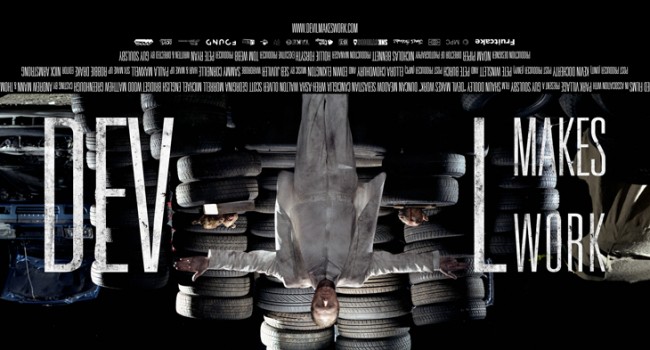
Devil Makes Work is an astounding short film. A lot of time, effort and money has gone into making it look like even more time, effort and money has gone into this. In an age when feature-length films often have credit rolls so minimalist that you could hold the cast and crew screening in the front room of a terraced house, about a hundred people contributed to this production. The effects, the make-up, the design, the sound, the whole shebang. It’s a tremendous showcase for everyone’s work.

But it is essentially a showcase, which makes it hard for me to review, because what the hell can I say about it? Basically it’s Shaun Dooley playing Old Nick as a sort of Satanic geezer gangster, sat on a throne of old tyres, pontificating on the nature of good and evil while we see a succession of figures: Sisyphus pushing his rock uphill, Jesus carrying his cross, a demon, a witch, a voodoo priestess, a rioter, a pimp and a prostitute. Shorn of the opening titles and closing credits, the whole thing lasts less than five minutes.

Visually, it’s hugely impressive. There’s no denying that. There’s a bunch of stuff on the website showing designs and inspiration and props and behind-the-scenes stuff and VFX and grading and whathaveyou and whatnot. The punishing four-day schedule of the actual shoot included one ‘day’ that last for 35 hours. Seriously, you cannot fault the hard work and dedication (and skill and talent) that has gone into this little picture, from Soulsby and everyone else. And all that hard work and dedication (and skill and talent) is evident on screen.

Devil Makes Work has screened at several high-profile festivals and will no doubt show at more. If you’re at a festival and it’s showing, take the trouble to see it. It looked great on my laptop so I expect it will look awesome on the big screen. Or, if you’re reading this review in the future, after the film has gone online, have a quick google and be impressed.

Soulsby is an experienced director of commercials and has worked for many leading international brands. Devil Makes Work is sort of a commercial for himself. But the thing is this. He says he set out to make Devil Makes Work look like a feature film, and … here’s where I pull my honesty trousers on … I’m not sure that it does. What it looks like is a music video. Only without a song.

It’s a great showcase for the director and, frankly, if I was looking for someone to direct a big budget music video, I’d be knocking on his door. We can see that Soulsby has a very strong visual sense, that he has a masterful camera eye, that he has a strong worth ethic and that he has the organisational skills to lead a team of a hundred people and craft something amazing. But can’t we see that from some of the big-name commercials on his own website?

A feature film is more than a succession of stylish images. At least, a good one is. There is certainly a trend in Hollywood to make awful, empty movies that are rammed to the gills with vast amounts of special effects: all style and no substance, all sizzle and no sausage. Films that jump from one set piece explosion or alien spaceship or car chase to the next without any concern for making sense or appealing to anything but the most visceral emotions. Films that are like watching somebody else play Grand Theft Auto or Call of Duty. Films which cost obscene amounts of money and, let’s face it, sometimes make obscene amounts of money back. Maybe that’s the gig that Guy Soulsby is pitching for here.

But films – good films – are about stories. And characters. And relationships. Devil Makes Work is a beautifully shot and edited sequence of vignettes but it’s not a narrative piece. And neither is a 60-second commercial for Nike or whoever.

My advice – not that anyone ever listens to me, and God help your career if you do – would be for Guy Soulsby to now make a second film which bears no relation or comparison whatsoever to Devil Makes Work. A simple film: one or two locations, handful of characters, no fancy-dancy effects, no bombastic, cod-Biblical motifs or themes. Just a simple story, told through the interaction of believable, sympathetic characters. A film that shows Soulsby can tell a narrative, that he can define a character, that he understands the importance of character relationships.

We need to see a man climb a tree, the same man fall out of the tree, and then, well, it’s up to Soulsby whether the guy is alive (comedy) or dead (drama). That’s the three-act structure, and it’s what defines a story. It’s something we can’t get from seven minutes and ten seconds of what is effectively just a tree on fire.

Watching Devil Makes Work, I was reminded of a story I heard many years ago about a wannabe comics artist who sent a portfolio of drawings to Marvel or 2000AD or whoever and was offered some work. When the lad asked why, out of all the submissions the publisher must receive, his had stood out and been chosen, this is what he was told. Ninety-nine per cent of the artwork submitted was muscular superheroes clad in spandex flying and fighting. But this particular artist had submitted drawings of real people in real poses, showing that he understood the basics of comic artwork; that it’s about people, not superhero caricatures.

In crafting Devil Makes Work, Guy Soulsby has shown that he can draw superheroes. But can he draw real people? If he can make a simple narrative film that is as impressive in its own way as this one, but for entirely different reasons, then potentially Hollywood is his.

Of course, he didn’t do this alone, as noted above. The film was produced by Pete Ryan who started out as a video operator and projectionist before moving into production as a lowly runner nine years ago – and now has his own production facility where high-end stuff like this can be shot. The cinematographer was Nicholas Bennett, the editor Nick Armstrong, both highly experienced in commercials. Production designer Noam Piper has designed a couple of drama features I haven’t heard of and was stand-by art director on Paddington. Robbie Drake (Evil Calls, Zombie Resurrection etc) designed the demon make-up. Other make-up was provided by Rebecca Hall (The Eschatrilogy, The Sleeping Room, Ibiza Undead, Soldiers of the Damned) and Paula Maxwell. Seb Juviler composed the music.

Shaun Dooley, who makes an effective and charismatic Satan, isn’t a name that springs to mind in terms of British horror but a perusal of the IMDB shows he has actually amassed a considerable number of genre credits including Eden Lake, Salvage, The Awakening, The Woman in Black and as yet unreleased werewolf western Blood Moon – plus extensive TV work in things like Wolfblood, Red Riding, Broadchurch, Misfits etc. Of the other actors, only Duncan Meadows (Sisyphus) has more than the odd credit. His muscles have had bit parts in Dark Shadows, Merlin and Skyfall, and he’s in upcoming British horror K-Shop.

It’s really, really difficult reviewing something like Devil Makes Work, because it doesn’t have any of the things I look for in a movie, If this was actually a feature film I would trash it for having no characters and no plot. If it was even a narrative short film, I would level the same accusations. But it’s not intended to have characters or plot, it’s intended to be an impressive succession of images that conveys or promotes a feeling. As such it has more in common with a music video or a commercial.

Technically and artistically this is awesome. It does what it sets out to do, with what it has available, to an extraordinarily successful degree. But is it a film? Make us a film now, Mr Soulsby. Make us a movie.

MJS rating: A

Friday, 12 December 2014

Unknown Beyond

Director: Ivan Zuccon
Writer: Enrico Saletti
Producer: Valerio Zuccon
Cast: Emanuele Cerman, Giorgia Bassano, Robert Marrelli
Year of release: 2001
Country: Italy
Reviewed from: VHS screener
Official website: www.ivanzuccon.com

Italian horror cinema has a long and proud history. In no other country has horror been such an intrinsic part of national cinema. Not fantasy (there’s plenty of that too but it’s best left alone) or science fiction (again, best avoided) but genuine, scary, bloody horror. Italian horror movies date back to the silent era but really came of age in the 1950s, just as horror was also coming to the fore in the UK and on the seedier side of Hollywood. Argento, Fulci, Bava pere et fils, Michele Soavi, even trash barons like Ruggero Deodato or good old Joe D’Amato - what other country has produced so many iconic scare merchants over the years?

I say let’s add Ivan Zuccon to that list. And let’s add him up there at the better end with Fulci, Argento (when he was good) et al. Because Unknown Beyond confirms that The Darkness Beyond was no flash in the pan. Zuccon is a major horror talent and he’s here to stay (for further proof, check out his third feature, The Shunned House).

Darkness was written by Ivan himself but this semi-sequel was scripted by Enrico Saletti so there’s something of a change in tone, though it’s still unashamedly Lovecraft-ian. It’s a more complex story, with more characters - there’s more action and more interaction. Also a whole heap of religious iconography, stirring up that whole Catholic guilt thing that underlines some of the best Italian horror. The opening sequence is amazing as a stumbling soldier comes across a crucified man and, at his feet, a pram containing a crying baby which, on inspection, turns out to be a reel-to-reel tape recorder. Blood drips from the sky, then rises back to Heaven. What the jiminy is going on?

One thing which Unknown Beyond definitely shares with its predecessor is a dreamlike structure which plays fast and loose with causality and the sequence of events, indeed with reality itself. The Old Ones-engineered supernatural apocalypse that we glimpsed in the first film has enveloped the world, but now we are a generation on and Captain Ian Hicks (the ever reliable Emanuele Cerman) leads a small band of survivors hiding out in some catacombs.

Cerman was Private Randolph Carter in The Darkness Beyond - and Hicks is having dreams in which he is called by that name. Is he the same character? Who knows? Locked up in a cell in the catacombs is a painted-face witch, Keziah (Roberta Marrelli, who was Elena in the first film), who serves the Old Ones and seeks to seduce Hicks. Meanwhile two members of the group, Valerie (Liliana Letterese) and Pickman (Alessio Pascuti - Private Walker in Darkness) have gone missing.

Walker turns up, transformed into a mad demon but roped and held by two of the soldiers. For a moment the film looks remarkably like the scene with the captive zombie in 28 Days Later but I’m sure that’s coincidental as it’s unlikely that Alex Garland or Danny Boyle would have seen Ivan’s film. Walker is locked up in another cell.

Valerie, wandering across the desert at night, is gripped by hands from under the sand and raped by something unseen. She subsequently slakes her thirst at a river of blood, from which she fills her canteen. A day or so later she is back with the main group.

Hicks has translated some surviving parchments (possibly the ones created by Al-Caleb in the first film’s prologue) and knows that the only way to defeat the Old Ones is to find the Necronomicon. He sets out with two comrades, Alan (Piergiorgio Schiona) and Boris (Francesco Malaspina - Darkness Beyond’s Sgt Clark). Back in the catacombs, the swiftly pregnant Valerie gives birth to an ultra-fast growing cocoon from which emerges, only minutes later, a full-grown man. Played by Michael Segal, the first film’s Lieutenant Salgari, this character is credited as ‘il figlio dell’Altrove’ - ‘son of the beyond.’ Indeed, the Italian title of this film is Maelstrom: Il Figlio dell’Altrove (the working English title was Call of the Beyond). He proceeds to bloodily slaughter his way through the cast.

What the film is leading up to, via some quite startling imagery, is a three-way battle between Segal’s character and the unborn children carried by sole survivor Anouk (Giorgia Bassano - that’s not a spoiler by the way as she’s not identified by name until late in the film) and Keziah. Three will be conceived, the prophecy states, but only one will survive to become heir to the Old Ones...

With an extra twenty minutes’ running time over the first film, Unknown Beyond can cram more in and that may be why it seems slightly less languorous (or more hurried, depending on how you look at it). The main characters are well-defined and we care about what happens to them - although I’m still not certain about Keziah the witch. Marrelli comes close to overacting sometimes in a role which is, I think, a difficult one for foreign audiences to grasp.

There are some amazing setpieces, including a whole field of tortured souls on cross-frames, and also more action with some well-choreographed fight sequences. This film is more obviously shot on video than Ivan’s first movie, and is almost entirely set at night: a couple of scenes about 50-60 minutes in are the only daylight exteriors in the whole film. Sometimes initially confusing, the plot does unravel well, revealing hidden motivations: “Deception has always been evil’s stock-in-trade,” says one character, observantly. Although this film shares numerous cast and crew with The Darkness Beyond the actual plot connections are tangential and watching the first film is not necessary to enjoy this one. Though I would of course heartily recommend watching both just because they’re so good! (A tip of the hat also to Nicola Morali whose music perfectly creates the spooky, unnerving mood that the film requires. Nicola kindly sent me a CD of the Unknown Beyond soundtrack a while back and it’s a truly excellent piece of work.)

There was a time when Italian horror cinema was the finest in the world. But the last spaghetti scarer to really achieve international acclaim with critics and audiences was Michele Soavi’s superb Dellamorte Dellamore and that was nine years ago. Since then, what have we had? Pupi Avati’s obscure The Arcane Sorcerer, Sergio Stivalleti subbing for the late Fulci on Wax Mask, Massimiliano Cerchi’s laughably inept Creatures from the Abyss and Satan Claus, Argento treading water with The Stendhal Syndrome, Phantom of the Opera and Nonhosonno - and let’s not even mention the justifiably derided Fatal Frames. The genre needs a shot in the arm - and here it is.

Unknown Beyond confirms the arrival of a startling new talent. Ivan Zuccon is the best thing to happen to Italian horror, arguably to horror cinema in general, in a long, long time.

MJS rating: A-

Review originally posted 5th December 2004

Troll

Director: John Carl Buechler
Writer: Ed Naha
Producer: Albert Band
Cast: Noah Hathaway, Michael Moriarty, Jenny Beck, June Lockhart
Year of release: 1985
Country: USA/Italy
Reviewed from: UK rental tape (Entertainment in Video, 1986)

I can’t believe that this incredible movie has been sitting in my to-be-watched pile for years (despite my having interviewed both writer and director back in my SFX days).

SEE! Sonny Bono mutate into a giant maggot! COUNT! The stars from Battlestar Galactica, Lost in Space, Charlie’s Angels and V! HEAR! One of Hollywood’s top short actors recite The Faerie Queen! OGLE! A pre-Seinfeld Julia Louis-Dreyfus running around clad only in a few vine leaves! WATCH! A woman turn into her own daughter! STARE! At a short, fat, ugly, hairy monster reading Fangoria!

And to give it that extra sheen of retrospective surrealism, the young boy who saves the world from the powers of darkness is called... Harry Potter! Extraordinary!

The story starts with the Potter family moving into a San Francisco apartment building. Michael Moriarty (from the superb Q the Winged Serpent, and later in Law and Order and Psi Factor) is book-reviewer dad Harry Sr; sometime Angel Shelley Hack is mum Anne; 14-year-old Noah Hathaway (yes, Boxey from Battlestar) is son Harry Jr; and eleven-year-old Jenny Beck (young Elizabeth in V) is daughter Wendy, who wanders into the building’s basement, where she is zapped by a troll with a magic ring.

The troll is played by little person Phil Fondacaro (who has been in everything - Ghoulies II, Return of the Jedi, Decadent Evil - but whose most memorable role was possibly the tiny Dracula in The Creeps) in a full-body suit with a range of replaceable animatronic heads, each with a basic expression (smile, roar, etc) and a lot of additional movement. This was all created by director (and legendary special effects man) John Carl Buechler (it’s interesting to spot Howard Berger’s name in the credits too, years before he became the B in KNB FX). However, the troll transforms into a clone of Wendy which gives Beck full license to scream, growl, throw stuff around and contrast the mayhem nicely with the sweet, blonde thing she’s supposed to be. (There are many far worse child actors than Beck, who seems to have disappeared after about 1991 - wonder where she is now?)

Also in the building are lounge lizard Peter Dickinson (Sonny Bono: post-singer, pre-mayor), wannabe hunter Barry Taybor (daytime soap star Gary Sandy), actress Jeanette Cooper (Louis-Dreyfus, looking exactly like she did in Seinfeld), bone cancer-suffering literature professor Malcolm Malory (Fondacaro again, out of costume) and spooky old landlady Eunice St Clair (Lost in Space’s Lockhart). The troll, disguised as Wendy, infiltrates their apartments and takes them over: Dickinson becomes a disgusting giant maggot which then cracks open to reveal a dozen or so smaller troll-like beasties (vocalised by voice legend Frank Welker), Cooper becomes a wood-nymph, etc.

Young Harry Potter befriends Miss St Clair, who turns out to be a witch, protecting the world from the global domination plans of the fairies, as led by her former lover Tauroc, transformed into the troll. Unfortunately, the Potters moved into the building on Walpurgis Night, thereby setting Tauroc free. (St Clair has a strange mushroom-with-a-face called Galwyn and a painting of John Carl Buechler on her wall!) Transforming into a younger version of herself (played, in a simple yet brilliant bit of casting, by Lockhart’s daughter Anne), Miss St Clair goes up against Tauroc but is turned into a talking tree-stump. It’s up to Harry Potter to defeat the troll, rescue his sister and return the world to normal.

Troll was an original idea by Buechler, but the script was rewritten by former Fangoria editor Naha who receives sole credit. Harry has a poster for Buechler’s The Dungeonmaster on his wall and the troll/Wendy reads Fango in bed! The movie was made (over five and a half weeks, in Rome) by Empire Pictures, the straight-to-video company run by Albert and Charles Band before Charlie (credited here as executive producer) set up Full Moon. Watch for Band Jr and Sr in a couple of spoof clips from Pod People from the Planet Mars which Harry watches on TV.

This certainly isn’t the terrible picture that some people paint it, and if you’re a fan of prosthetic effects it’s a veritable smorgasbord - the troll costume itself is excellent. It’s good fun for kids, has some nice touches for adults, but mostly, it’s just bizarre, with the story giving the impression of having been pulled in various directions by different hands. It’s also a relic of a bygone era (17 or 18 years ago!) when this sort of movie could get made. If this is in your to-be-watched pile, slap it into your VCR tonight! (But beware the dire Italian rip-off Troll 2 which has no connection with this film.)

MJS rating: B

(This UK rental copy, incidentally, has barnstorming trailers for the utterly bonkers Eliminators, the deeply silly TerrorVision and the gobsmacking Starchaser: The Legend of Orin. Starchaser was of course the only feature-length animation ever released in true 3D - I saw a stereoscopic print at the NFT once and it was great! This trailer quotes a review which calls the film “better than Rainbow Brite and The Black Cauldron combined”!)

Wednesday, 11 June 2014

Virgin Witch

Director: Ray Austin
Writer: ‘Klaus Vogel’
Producer: Ralph Solomons
Cast: Vicki Michelle, Anne Michelle, Patricia Haines
Year of release: 1971
Country: UK
Reviewed from: UK VHS (Salvation)

Real life sisters Vicki and Anne Michelle play screen sisters Betty and Christine in this entry in the ‘home counties witchcraft’ subgenre which flourished in Britain in the late 1960s and early 1970s. The early entries into the field, such as The Sorcerers, had diversified into superior historicals (Witchfinder General, Blood on Satan’s Claw) and rather tacky contemporary pictures such as this one.

Betty and Christine, innocents both, travel to London with a view to finding modelling work, accepting a lift from passing motorist Johnny (Keith Buckley: Dr Phibes Rises Again, Excalibur), who falls for the younger Betty while Christine is ‘auditioning’ at the offices of lesbian agent Sybil Waite (Patricia Haines). Sybil whisks Christine off to Wychwold, the country estate of her friend Dr Gerald Amberley (Neil Hallett: X the Unknown, Ghost Squad), ostensibly to shoot an ad campaign for cider, with Betty along as chaperone. (It is only when we see the name written down quite some time later that we realise people haven’t been talking about some satanic amusement park called Witchworld.)

The house and grounds are home to some creepy people, but photographer Peter (James Chase) seems nice enough. In fact, the whole thing is a front for a coven of witches, into which Christine is initiated at night, waking up the next morning in bed with Sybil and subsequently acting much more self-confident and mature. Revelling in the release of her latent magical powers, she plans to oust Sybil as High Priestess of the coven during Betty’s initiation the following night, but Johnny is on his way down to Wychwold to rescue Betty.

What starts off as a pretty crappy movie picks up towards the end, leaning more towards - though never reaching - the sort of unnerving, slightly too serious atmosphere of menace that characterised the best witchcraft films (The Devil Rides Out, for example). The idea of a modelling agency recruiting young girls for supernatural purposes is a tad too close to the nonsensical story in the second half of The Night Caller (in which Patricia Haines was the victim, not the abductor) although it seems slightly more credible as a witch’s plan than that of an alien from a moon of Jupiter. Nevertheless, once the movie settles down to a battle of psychic wills between Christine and Sybil, it becomes much more watchable and a lot more tense.

The script, bizarrely, is by producer Beryl Vertue (under a pseudonym) who went on to produce The House in Nightmare Park but is best known now as the matriarchal figure behind such hit sitcoms as Men Behaving Badly and Coupling (written by her son-in-law Steven Moffat). Vertue was an agent for Associated London Scripts (Galton and Simpson, Spike Milligan, Eric Sykes) but this script (and her own novelisation of it) seem to be her only professional writing credits - and she keeps very quiet about them!

However the major selling point for the film back in the 1970s was the copious amount of full nudity from Vicki and especially from Anne. In fact, pretty much everybody gets naked in the climactic ritual, including some older members of the cast who undoubtedly add authenticity to the scene but dampen the sexual allure. The nudity in earlier scenes, such as Christine’s ‘audition’ for Sybil during which the older women touches her up under the pretence of taking her measurements, is often tacky, but in the scenes of black magic it is not only relevant but actually adds to the air of menace.

Vicki Michelle, two years older than her sister but here playing on her fresh-faced appearance as the younger sibling, went on to appear in Queen Kong and an episode of Space: 1999 before finding fame as Yvette in Allo Allo in the 1980s. Ann (credited on-screen as Anne Michelle) actually acquired a bunch of genre credits including Psychomania, House of Whipcord and the 1979 US production Haunted - in which she played, of all things, a native American - before disappearing from the screen to concentrate on stage work.

Peter Halliday (A for Andromeda, Madhouse) plays a nightclub manager while the coven members include Garth Watkins (Twins of Evil), Prudence Drage (A Clockwork Orange), Sheila Sands (Year of the Sex Olympics) and Steve Peters (Lead Roboman in Daleks: Invasion Earth 2150AD!). Cinematographer Gerald Moss had shot second unit on Village of the Damned, while the very effective music is by Ted Dicks, whose other horror credit is the title song to Carry On Screaming!

MJS rating: B-

Wednesday, 30 April 2014

The Witches Hammer

Director: James Eaves
Writer: James Eaves
Producers: James Eaves, Laura Tennant
Cast: Claudia Caulter, Jonathan Sidgwick, Stephanie Beacham
Country: UK
Year of release: 2006
Reviewed from: screener DVD
Official website: www.amberpictures.co.uk

It’s always a thrill and an honour to be the first reviewer of a film but it’s also a worry. What if I’m completely out-of-step with everyone else? How honest should I be about stuff that I don’t like? How do I write a review which will be as relevant when it is first read - by people who, naturally, know nothing about the film - as it is when it is read later by people who have read other reviews or seen marketing material? It’s a responsibility, that’s for sure.

In the case of this thoroughly enjoyable British indie horror movie, my natural reaction is to pre-empt what other critics are going to say: Blah blah blah Blade blah blah blah Underworld blah blah blah low budget blah blah blah. The main character is a vampire who hunts other vampires, a sexy woman in a tight, leather costume who uses martial arts in an ongoing supernatural conflict. It’s impossible not to make such comparisons, however lazy they may be, so let’s get them out of the way now.

I should also get out of the way any concerns about the apparently ungrammatical title by directing you to my interview with writer/director/producer James Eaves (Sanitarium, Hellbreeder). And now, on with the review...

Claudia Caulter (who was in a sci-fi short called Frozen and also in an Oasis video) stars as Rebecca, a ‘genetically created vampire’ who is resurrected by the shady ‘Project 571’, injected with blue goop and then trained as an assassin. This early part of the movie is terrific, helped by suitably poker-faced performances from Andrew Cullem and Liza Keast as the project’s overseers and a powerful (and decidedly icky) scene where Rebecca, still unaware of what is happening, is forced to choose between a glass of water and a glass of blood.

Trained up by the project’s martial arts instructor (Adrian Johnson, who is female despite her name), Rebecca learns to use her increased strength and agility but she also learns that she cannot go back to her husband and young son. Eaves was also editor on the film and really uses the edit suite as a creative tool. There are lots of flash-cuts, especially in these early scenes, sometimes jumping around in time and space in a way that could be disorienting but isn’t. I found the sequence where Rebecca is told she can see her family briefly particularly moving because of the editing which only allows us to understand quite what is happening and what the words we hear really mean right at the end.

Having established Rebecca’s situation and prowess, partially through a hostage situation which goes awry, the story moves on when the staff of Project 571 are murdered and Rebecca finds herself ambushed by a bunch of vampires. The fights in this film were choreographed by Kris Tanaka (fifth degree black belt, who also appears as a vampire later on) and they’re very good. All the protagonists clearly know their stuff and, while the fights are naturally slightly stylised, they don’t come across as artificial or posed. The martial arts moves are complemented by appropriate direction and editing, something which many big budget films forget when it comes to action sequences.

Rebecca finds herself roped into Project 572, which seems to have even fewer staff than 571. To wit: Madeline (Stephanie Beacham) and Edward (Jonathan Sidgwick: Man Who Sold the World). Madeline is a high-ranking witch and Beacham (whose surprisingly long list of genre credits includes Dracula AD1972, The Nightcomers, Tam Lin, And Now the Screaming Starts, Schizo, House of Mortal Sin, Inseminoid, The Wolves of Willoughby Chase, the first season of seaQuest DSV and episodes of UFO, Star Trek TNG and Hammer House of Mystery and Suspense) plays her splendidly with a debonair superiority and a supercilious insouciance which puts one in mind at times of a supernatural Ann Robinson. Edward on the other hand is an occult scholar, played with an ambiguous mixture of nervousness and confidence.

We are introduced at this point to the movie’s McGuffin, an ancient book called Mallues Maleficarum or The Witches Hammer which contains the spells required to defeat the great vampire Hugo Renoir (Tom Dover), who is plotting world domination with the help of his chief assassin Victor (Miguel Ruz). (Hmmm... ‘Victor Hugo’? I don’t think it means anything.) Although the A-plot is Rebecca and Edward’s quest to defeat Hugo, the movie’s greatest strength lies, to be honest, in its subplot about two vampires who are on the trail of the book.

Jason Tompkins, who plays Oscar (and was apparently in a game show called Beat the Cyborgs), is not the first short actor to play a vampire but Sally Reeve (“a voluptuous comedy blonde” - Time Out), as Charlotte Apone, is certainly the fattest actress in the history of cinematic bloodsuckers. We meet the tiny man and the huge woman at a circus where we establish not only their sanguinary tastes but also their arch and mannered passion for each other. Every single line of dialogue between them ends with ‘sweetheart’ or ‘honeybun’ or ‘angel’ or some similar affectation of affection, even as they calmly discuss the violence and bloody gore which they leave in their wake.

These two are a terrific double act, Apone raising the interesting question of how do you kill a vampire so rotund that no stake could get anywhere near her heart? Actually, the film does take the trouble early on to explain to us - by explaining to Rebecca - the ground rules for the vampires in this film: severing the head kills them, puncturing the heart kills them, sunlight burns them (Rebecca keeps her motorcycle leathers on during the day and makes a lengthy train journey in a coffin).

Eaves has a penchant for flashbacks and we get four during the course of the film. Madeline explains how the Mallues Maleficarum came to be written by Kitanya (Magda Rodriguez: Castell de Ferro), a peasant girl in Medieval Russia who was ‘the first witch’ (and who is seen despatching the priest who wronged her using a bloody great hammer). Edward explains how he was recruited by Madeline, how arch assassin Victor became a vampire and how Apone was turned. This last flashback takes place in the late 19th century and is presented as a black and white, silent film with intertitles. Like all the Apone/Oscar scenes it’s laugh-out-loud funny, although The Witches Hammer, while it’s directed with a light touch, is certainly not a comedy. Rare indeed is the comic relief which manages to not only be genuinely comic but also provide effective relief from the main story without detracting or undermining it, but this film proves that it can be done.

The finale, which takes place in a suitably gothic castle (God knows where that is - this was filmed in Southampton!) has some plot twists, some revelations, the resurrection of Kitanya and some more fighting, including a casual beheading of a deliberately irritating character which should have audiences grinning and quite possibly cheering. The whole thing ties in somehow to three Grim Reaper-style ‘souls of the damned’ whom Hugo is attempting to control for his own ends.

Overall, The Witches Hammer is enormous fun. It doesn’t try to be any more than it is. By not being overly ambitious, the film works wonderfully on its own level and constantly impresses; anyone who loves independent horror movies will get a kick out of this one. The acting varies somewhat and there are some sequences which don’t really make complete sense but get away with it by being stylish and clever, notably a fight in a (swiftly emptied) pub between Rebecca and some sort of supernatural ninja. There’s not a whole lot of plot but there’s some nicely drawn characters, some kick-ass fights and some surprising laughs including a Carrie reference and an audaciously silly Citizen Kane gag. The film also looks great thanks to top-notch cinematography by John Raggett (Forest of the Damned, Nature Morte, Nightmares) using 35mm stock; I don’t care how good digital video gets, there’s still a sense of cinema that you get from 35mm footage which you just can’t get any other way.

Dark Raven Digital (Kingdom, Warrior Sisters) provided the visual effects, including vampire deaths which are surprisingly similar to those in Kaew Kon Lek. Nemesis CGI, React Films (With Evil Intent) and Poppy Effects are also credited for specific sequences. The Demon Within director Harold Gasnier, who gets a ‘special thanks’ credit rather than ‘executive producer’ as listed in some places, has several small roles, all of which end unpleasantly and one of which is a gag reference to his role in Hellbreeder. An all-girl band called the Lillettes play a number in the pub before it empties for the Rebecca-vs-ninja fight.

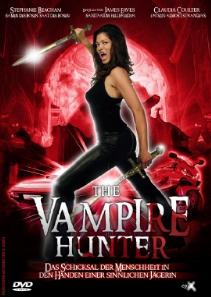
The Witches Hammer (which was retitled The Vampire Hunter for its German release and Dark Evolution in Japan) is a corking horror/action movie which oozes professionalism. Deftly directed and carefully paced to balance action sequences with slower, character-based scenes, this is a highly commendable addition to the continuing British horror boom of the early 21st century.

MJS rating: A-

Review originally posted 14th April 2006