Showing posts with label satanism. Show all posts

Sunday, 18 June 2017

Grave Tales

Director: Don Fearney
Writers: John Hamilton, Mike Murphy
Producer: Don Fearney
Cast: Brian Murphy, Edward de Souza, Damien Thomas
Country: UK
Year of release: 2013
Reviewed from: DVD

“This British, feature-length, anthology horror film is the first one of its kind in over twenty years” says the DVD blurb of this exercise in cinematic nostalgia, which obviously isn’t true. Shot in 2011, copyrighted 2012, released (sort of) in 2013, this was preceded (albeit not by much admittedly) by Bordello Death Tales, Nazi Zombie Death Tales and Little Deaths. Even if Don Fearney wasn’t aware of those movies, and assuming that he had no knowledge of the work of Jason Impey, Kemal Yildirim or Tom Rutter (not many folk do, to be fair) he has still contrived to pretend that Cradle of Fear doesn’t exist.

What this tells us is that this is a film made by – and for – people whose knowledge of British horror movies kind of peters out after To the Devil a Daughter. Which is fair enough, I suppose. Know your audience and all that. But it does contrive to make Grave Tales a curiously anachronistic film of very limited appeal.

There are four stories, plus a linking tale in which a young woman (Heather Darcy: Till Sunset) exploring a graveyard meets an aged gravedigger (or is he? da-da-dum!) played by the somehow still living legend that is George Roper, the one and only Brian Murphy. Murphy was 79 when he made this and he shows no sign of slowing down. His actual horror credits are pretty much limited to a small role in The Devils and, um, this… although the feature film version of Man About the House was a Hammer production of course (and remains one of the most enjoyable sitcom spin-off features of the 1970s). More recently Murphy was in the brilliant, long-gestating Room 36, which shares several cast and crew with this film. He is a national institution and we love him and why isn’t he at least an OBE?

Anyway, the gravedigger tells the young woman the stories behind four nearby graves. The first of these, 'One Man’s Meat', stars the sadly missed Frank Scantori (Witchcraft X, Kill Keith, May I Kill U?, Room 36) at his oleaginous best. He plays Norman Elliot, an alcoholic butcher who accidentally murders a homeless girl (Johanna Stanton: Nightmare Box). Riven with guilt, he disposes of the body in the obvious way, putting down to the booze the vampire fangs which seem to appear briefly in the girl’s mouth as he chops her up.

A family who bought this meat – who seem to be his only ever customers – come back for more, but they have become infected and want something a little rarer. Miles Gallant (who does a one-man show about Stan Laurel), Darby Hawker (Stardust, Room 36) and Chloe Ann Withey play the family, and Clifford Allison (Landis’ Burke and Hare) is a doctor from a local institution who comes looking for the girl, an escaped patient who believed she was a vampire.

There is simply too much crammed into these 20 minutes for the story to work, despite Frank’s sterling performance. It would have been better without the doctor, who delivers no useful info and basically just bleats on the same “Have you seen her?” schtick for five minutes. But Frank is great because Frank was Frank, and the neck wound after the first cleaver chop is an impressive prosthetic.

The second story (and they’re none of them particularly memorable so it’s a good job I made notes) is called 'Callistro’s Mirror'. Damien Thomas (Twins of Evil, Sinbad and the Eye of the Tiger) stars as Mr Baxter, a collector who spots a mirror in an antique shop, instantly identifying it as having once belonged to a notable sorcerer, four centuries earlier. It’s not for sale so he kills the shopkeeper (Edward de Souza: The Phantom of the Opera, Kiss of the Vampire) and sneaks back to his flat where he discovers – quelle surprise – that he can see something in the mirror.

What he sees is a bald guy (Ric Truman) being pawed by two topless lovelies (Katie Langford and blogger/poet Jade Moira Lawrence). Baxter is pulled into the mirror and, after some tussle, the previous incumbent escapes, taking over Baxter’s body, leaving the poor bloke to face centuries of torment at the hands of the two young ladies (who are vampires, apparently, possibly because there were some spare teeth left over from the first story).

It’s another pretty obvious and basic story, which is at least in keeping with the Amicus tradition towards which Grave Tales aspires. There’s some irrelevant stuff about Baxter’s late wife, and Don Fearney himself plays a tramp outside the shop. The highlight of this story – and arguably the whole film – is Kiki Kendrick (Sanitarium, The Stomach) having a ball as Baxter’s blousy landlady. It’s a rare moment of enjoyable characterisation in a film which is for the most part pedestrian and prosaic. More Kiki Kendrick in stuff, that’s what we need.

Tale number three, 'The Hand', is slightly shorter than the others, giving the whole film a running time of 75 minutes. Porn actor Mark Sloan (who also played a barman in the first story) is Stanton, a prisoner on the run who has legged it while handcuffed to another jailbird, Duggan (composer/pianist Marc Forde). Peter Irving (moderator of the Kiss of the Vampire DVD commentary) is a nightwatchman – though it’s not clear what he’s actually nightwatching – among whose equipment Stanton finds an axe. And when the handcuffs prove impermeable to the axe blade, an alternative solution presents itself.

Stanton heads off through some woods and hides in a small lake, for some reason. Four police officers (one of whom looks about 12) spot him from a summer house, but he goes underwater and doesn’t come up. Subsequent investigation by a police frogman finds Stanton’s drowned body chained to Duggan’s hand. Is it gripping that underwater branch, or just wedged? (It’s gripping the branch. There’s nothing subtle here.) For the record, the coppers are played by Marcus Taylor, Russell Barnett (Whatever Happened to Pete Blaggit?), Adrian Annis  (Dark Rage, Survivors, My Guardian Angel) and Josh Parris; the frogman is Ross Ericson (writer of The Unknown Soldier, a play which was a  big hit at Edinburgh in 2016).

The final segment is 'Dead Kittens', starring British horror favourite Marysia Kay (who gets an ‘And…’ in the opening credits). She plays Vicky, who is (without explanation) selected to be the new lead singer of pop trio the Dead Kittens. Louise Houghton (Wilby Park) and Nieve Hearity (whose name is spelled wrong in the credits) are the other two. Celia Carron (who sidelines as a Pilates coach) is record producer Sadie and Aubrey Wakeling (apparently now in the States making things like Jurassic Wars(?)) is Mr Varley, the talent scout – or manager or something – who finds Vicky.

After a quick bash in the recording studio, they all head off to Varley’s massive country house to shoot a pop video, directed by none other than dear old Norman J Warren, helmer of Satan’s Slave, Prey etc. Rhiannon Ellison Sayer (who had a bit part in Burton’s Sweeney Todd) is Varley’s posh daughter, who tries to warn Vicky that something is up. The video involves Vicky lying down on a stone altar while everyone else pretends to be Satanists. Wait a minute…

A coda suggests it was all a plot to sell more records because dead pop stars shift units. Which doesn’t make sense because Vicky hasn’t had a chance to become a pop star, has she? Marysia turns in her usual reliable performance but, like most of the actors in this movie, she doesn’t exactly have a lot to work with. Scripter John Hamilton is one of the Satanists, along with George Hilton (Beyond the Rave, Cockneys vs Zombies), Moyb Ullah and Tom Levin.

One of the strengths of 21st century British horror is its diversity and the scope for every sort of movie, however unlikely. So I suppose it’s only fair that there should be a movie which tries to recreate the days of old. But that’s the film’s biggest problem: it is a recreation. It’s not an old 1970s Amicus anthology, just a pastiche of one. Technically it’s competent, though the sound recording (also credited to John Hamilton) isn’t consistently brilliant. But there’s nothing special here, nothing celebratory, nothing to impress (unless you’re enough of an oldtime Brit horror fanboy to just get wet at the thought of a new Edward de Souza movie – there are people like that). Grave Tales is the cinematic equivalent of a pub band playing 1960s covers, featuring a guy who used to be in Herman’s Hermits.

Don Fearney, the motive force behind this film (as well as producing and directing, he is also credited as production designer) is a name in Hammer fan circles. He has organised numerous fan events and also produced several DVD documentaries, often narrated by de Souza. The script is jointly credited to Mike Murphy (editor of the excellent Dark Terrors Hammer fanzine back in the 1990s) and John Hamilton, author of such hugely impressive horror history tomes as Beasts in the Cellar: The Exploitation Films of Tony Tenser and X-Cert: The British Independent Horror Film 1951-1970. Murphy wrote the first tale, Hamilton wrote the other three plus the framing story.

Except that’s not strictly true, is it?

'One Man’s Meat', 'Callistro’s Mirror' and 'The Hand' all started life as Van Helsing’s Terror Tales, the back-up comic strip that ran in most issues of House of Hammer magazine in the 1970s, a fact which goes completely unacknowledged in the credits of Grave Tales. Which is odd, because the very specific audience this is aimed at – ageing Hammer fanboys – are precisely the sort of people likely to own old copies of House of Hammer, and quite possibly have an encyclopaedic knowledge of the magazine’s content. If you don’t have any old copies of House of Hammer lying around, fear not. You can find digitised versions of all 30 issues on archive.org. 'One Man’s Meat', written and drawn by Martin Asbury, was published in issue 5. 'Malvoisin’s Mirror', written by Chris Lowder, art by Brian Lewis, was in issue 6. 'The Hand of Fate', written by Parkhouse, art by Goudenzi, was in issue 22. The settings and other details are different, but the basic stories are identical.

Whatever else one might say about the strengths or shortcomings of this film, for Fearney, Murphy and Hamilton (all of whom I believe to be honest gents) to simply lift someone else’s creative work wholesale and base their own on it without any hint of acknowledgement is reprehensible.

Martin Asbury drew strips for TV Century 21, Countdown, Look-In and TV Comic, and took over Garth in the Daily Mirror after Frank Bellamy died in 1976, drawing and occasionally writing that strip until it ended in 1997 (the current version, running since 2012, is a reprint of Asbury’s strips). Nowadays he is one of the UK’s top storyboarders with credits that include Bonds, Potters and Batmans. I wonder whether he has any idea that his IMDB page should also list a ‘story by’ credit on this obscure indie flick.

Chris Lowder wrote for Action, Tornado, Starlord and 2000AD under various pseudonyms. He also edited several anthologies of dark fiction and even wrote some Sexton Blake stories. Nowadays he’s a freelance editor/writer/bibliographer and seems happy pottering about in amateur theatricals and running his local parish council. Again, I wonder if he knows anything about this film and his uncredited contribution to it.

Parkhouse is Steve Parkhouse, another prolific name in British comics with extensive credits in 2000AD and Doctor Who Comic, for whom he wrote Fourth, Fifth and Sixth Doctor adventures. He has also worked for Marvel and, slightly bizarrely, wrote a graphic novel about the Sex Pistols. It’s probably safe to assume he is likewise in the dark about one of his old stories having been adapted for film.

Given the minuscule budget of Grave Tales and the nature of British comics – which, historically, paid writers and artists a flat fee with no rights and fuck you – I’m not for a moment suggesting that any of the above three writers have been ripped off and should have been recompensed. Who knows who owns the rights to the original comic-strip content from House of Hammer? If indeed anyone does. But it does seem very remiss not to acknowledge the source material and the original writers. (Slightly complicating matters, there was a short-lived horror anthology comic called Grave Tales in the early 1990s, published by Hamilton Comics. However that was Bruce Hamilton, not John, and has no connection with this film.)

Among those whose contributions do get acknowledged on screen are editor Jim Groom (director of Revenge of Billy the Kid, Room 36 and various Hammer DVD extras), composer Scott Benzie (Room 36, Soul Searcher, Ten Dead Men, Fear Eats the Seoul) and DP Jon Nash. Make-up is credited to Gemma Sutton, now one of the top wedding make-up artists in the UK, with ‘special FX make-up’ by Ben Brown. Richard Dudley and Don Fearney are listed as executive producers in the credit block but only Dudley gets name-checked on screen.

Grave Tales was first screened at the Cine Lumiere in South Kensington just before Halloween 2010 and had an official festival premiere at Southend-on-Sea the following April. At both those screenings, there was a clip of Christopher Lee (as himself) included in 'Dead Kittens' but this was removed before the film appeared on (uncertificated) DVD.

In June 2013 Grave Tales was made available from Hemlock Books, where I was employed as a monthly blogger. I bought a copy with part of my pay-cheque but have only just got round to watching it.

It’s just a curio really, of principal interest for its ageing cast list (and a nice role for the late Mr Scantori), but loses a point for not crediting Asbury, Lowder, Parkhouse and House of Hammer.

MJS rating: B-

Monday, 26 September 2016

Satan's Blood

Director: Carlos Puerto
Writer: Carlos Puerto
Producer: Juan Piquer Simon
Cast: Mariana Karr, Jose Maria Guillen, Sandra Alberti
Country: Spain
Year of release: 1978
Reviewed from: UK DVD (Redemption)

The latest release from Redemption is this 1970s Spanish offering which is one of those Dennis Wheatley-esque, middle-class Satanism films where the orgies look about as interesting and inviting as the dinner parties.

Young professionals Ana (Argentinean soap actress Mariana Karr making one of her very few big screen appearances) and Andres (Jose Maria Guillen, who was in a 1964 Spanish TV version of The Canterville Ghost) are out for a drive round Madrid with their Alsatian Blackie when they meet Bruno (Angel Aranda: Planet of the Vampires) and his wife Berta (Sandra Alberti, who has a face like a man). Bruno is adamant that he went to school with Andres but Andres doesn’t remember him and their memories of the school seem to differ.

Nevertheless, A&A accept an offer to go to B&B’s place for dinner and drinks, although this turns out to be a very large house, behind a high wall, in the middle of nowhere over an hour’s drive from the city. Further claims of shared schooldays between the two men continue to seem flawed but the visitors don’t want to be rude to their hosts. They are persuaded to join in a Ouija board session which reveals that Ana may still have the hots for Andres’ brother Juan and that Bruno will die by suicide.

And ever onwards, things get weirder, leading to A&A - persuaded to stay over - venturing downstairs in the middle of the night to find their hosts naked in a pentagram, which leads to a four-way romp that fails to be even slightly erotic. Andres’ car is tampered with, Blackie is found dead and strung up in the pantry, Bruno is shot (offscreen) and when Berta calls a doctor he all but accuses Andres of murder. Berta tries to commit suicide, someone unidentified tries to rape Ana, etc etc etc.

There are some interesting ideas but they’re never developed and nothing is ever explained. Things perk up briefly about ten minutes from the end when the whole house becomes embroiled in supernatural strangeness but the film swiftly falls flat when it descends into illogical, inconsistent, inexplicable, gratuitous weirdness, before juddering to a halt with a ‘twist’ that we have been expecting since the film started. (I forgot to mention the pointless pre-credit sequence in which a woman is ceremonially raped on an altar by a beardy bloke.) I know it’s meant to be like a nightmare but it’s also meant to be a conspiracy and in respect of the latter it just doesn’t add up.

The highlight - such as it is - is a sequence when Ana awakes to find a large, porcelain-headed doll (featured prominently in the background of earlier scenes) walking into her room, followed by a knife-wielding Berta clad in a diaphanous shift, intent on sapphic seduction. This swiftly turns out to be a dream but it is at least imaginative. For the most part, Satan’s Blood is simply rather dull.

There have been some good Spanish horror films and some bad ones. This is not as unwatchable as much of Jess Franco’s oeuvre but it’s not nearly as enjoyable as a Paul Naschy monsterfest. The direction is competent but that’s all. There’s not much actual horror - it’s all one long build-up which doesn’t really know what to do when it reaches the pay-off. And far, far too much of it is unexplained or inexplicable or both.

Writer-director Carlos Puerto’s best known credit, apart from this, is scripting the 1976 Journey to the Centre of the Earth starring Kenneth More. The director of that film, which shares numerous cast and crew with this one, was Juan Piquer Simon. Executive producer on this picture, his other credits include Supersonic Man, Extraterrestrial Visitors and Pieces.

The only recognisable name in the cast is Luis Barboo (credited here as ‘Luis Bar-Boo’) whose 120+ films include A Fistful of Dollars (and numerous other paella westerns), Daughter of Dracula, The Erotic Rites of Frankenstein, Dracula - Prisoner of Frankenstein, A Virgin Among the Living Dead, The Loreley’s Grasp, Night of the Werewolf and the aforementioned Journey to the Centre of the Earth.

Redemption’s usual lucky dip of extras includes ten stills, presented almost full-frame, and two unrelated trailers: an un-narrated English one for Requiem for a Vampire (also on the Night of the Bloody Apes disc) and a deliriously awful one for British sex-comedy Au Pair Girls, one of Val Guest’s less noteworthy efforts (I doubt if Gabrielle Drake puts it prominently on her CV either). “They’re here to help us - and Gawd help us!” intones the voice-over, which also points out guest appearances by John Le Mesurier and Rosalie Crutchley. To be honest, this one trailer is more entertaining than the whole of Satan’s Blood. There are also sampler tracks from 15 albums released on Redemption’s two music labels, some of which are unlistenable and most of which have titles and artist names so clicheed that one wonders whether they’re a spoof. The only one I was able to suffer for more than ten seconds was ‘Webcam Girl’ by the Courtesans which sounds like the Primitives or the Darling Buds. [Just realised, many years later - that's Eileen Daly's band! - MS]

The sleeve says that “this rare film has been remastered for this DVD from a new hi-def master and looks stunning!” Well, I don’t have an HD TV so neither know nor care about that side of things. The subtitled print looks good in terms of colour and contrast and the only noticeable imperfections are some flicks and flecks at reel ends. However “84 mins approx” is a bit cheeky as this runs 79’40”. There are no obvious cuts so this may just be the 82-minute version, available elsewhere, time-compressed for PAL. The sleeve also claims that the film dates from 1971 which might be believable, given the fashions and hairstyles on show, were it not for a huge Star Wars poster clearly visible about five minutes in.

(The film’s original title, Escalofrio, was also the Spanish title for both the Bill Paxton-directed horror-thriller Frailty and Larry Fessenden’s snowbound monster flick Wendigo.)

MJS rating: C+
Review originally posted 17th June 2007

Sunday, 2 August 2015

Evil Souls

Directors: Roberto and Maurizio Del Piccolo
Writers: Roberto and Maurizio Del Piccolo
Producers: Roberto Del Piccolo, Lisa Marrs
Cast: Holli Dillon, Peter Cosgrove, Julian Boote
Country: UK/Italy
Year of release 2015
Reviewed from: online screener

Evil Souls is as fine a slice of Anglo-Italian Satanic torture-porn as you are likely to encounter anywhere. The first act builds atmosphere, the second develops plot and character, and the last half-hour is an intensification which grips the viewer even as it occasionally pauses for some awesome visuals. I’m not entirely sure it makes a whole heap of sense – but when did Italian horror ever make much sense?

This is the second feature from brothers Roberto and Maurizio Del Piccolo, who previously brought us The Hounds. Shot in Italy in English, with an Anglo-Italian cast, it’s a production of their London-based company Moviedel with involvement from their Milan-based company Moviedel Italia. The IMDB lists this as a UK film but it’s clearly an international co-production.

Holli Dillon (who was in horror shorts Needles and Night of the Loving Dead) plays Jess Taylor, who comes home one evening to find her son missing and the baby-sitter very murdered indeed. Knocked unconscious, she comes around chained up in the lair of stone-cold nutjob Valentine, gloriously overacted by Peter Cosgrove (also in George Clarke’s Splash Area). With his long hair, short beard and foppish taste for 18th century frock-coats, Valentine sees himself as a disciple of the Marquis de Sade, although he actually looks like Sam Rockwell in the Hitchhiker’s Guide movie.

Also chained up, and wondering where her (somewhat delinquent) son has gone, is Susan Papworth (Paolo Maciadi). When Susan and Jess realise that they were childhood friends, they also realise that their captor is not a random sociopath but has singled them out for some reason connected with their past.

Meanwhile, two other childhood pals whose paths long ago diverged become reacquainted when Father Albert (Julian Boote: Dead Room, KillerSaurus) finds wasted whore Maddie (Lisa Holsappel-Marrs, also executive producer along with Roberto) on the steps of his church. Gradually, the pieces of the mystery start to fit together, although for every revelation there’s something else thrown into the mix that’s never explained (for example, Valentine and Jess both have visions of being in a vineyard).

Valentine takes great delight in taunting and mistreating the women, occasionally resorting to Saw-style torture devices, but actually I was being unfair at the top of the review when I called this ‘torture porn’ because Evil Souls is well beyond that past-its-sell-by-date subgenre.

Boote’s priest is the cement binding the story together as he investigates the pasts of his former friends and uncovers some sort of demonic prophecy (or something) that relates to Susan’s and Jess’ sons (in some way). It was probably not necessary to tie this into historical figures of evil (including Hitler, of course); that angle gives the story no more gravitas and slightly cheapens what is otherwise a solidly crafted and undeniably impressive low-budget horror.

The film certainly doesn’t skimp on the gore with numerous characters subjected to genuinely horrific injuries, depicted by well executed make-up effects from Nicole Rossin and Serena Caiani. The whole thing is well-photographed by Tommaso Borgstrom who also shot The Hounds; many years ago he was camera assistant on Frankenstein Unbound! The screenplay is credited to Roberto based on a story by both brothers; Maurizio cut the picture. Paolo Bernardini provided the score which effectively supports the visual horrors.

Stage actress Irina Lorandi makes a fine impression in her one brief scene as a prostitute; the cast also includes Catherine Brookes (The Hounds), Federico Rossi (who was in a 2012 post-apocalyptic feature called New Order), Sean James Sutton (Spidarlings) and Roberto di Stano (who is in an Italian Rocky Horror performance group!) as a homeless guy.

The picture was shot in the town of Muzzana del Turgnano (inbetween Udine and Trieste) in January 2014 (with pick-ups in October) and premiered at the Fantafestival in Rome in June 2015.

Is this British enough to count as part of the BHR? I think so, subject to further investigation (the poster calls it ‘A MovieDel UK Production. Associate Producer MovieDel Italy’). It seems to strike a good balance between the realism of the British Horror Revival and the fantasy of the Italian Horror Revival, and fans of either national cinema (or both) will enjoy it.

MJS rating: B+

Sunday, 1 March 2015

Devil Makes Work

Director: Guy Soulsby
Writer: Guy Soulsby
Producer: Pete Ryan
Cast: Shaun Dooley
Country: UK
Year of release: 2015
Reviewed from: online screener
Website: www.devilmakeswork.com

If you have ever sent me a screener and then waited for ever while I got round to reviewing it… well, that’s my life. Guy Soulsby sent me a copy of his short film Devil Makes Work, which is precisely seven minutes and ten seconds long. And it still took me more than two weeks to get a review written.

Partly it’s finding the time. I work all day, spend a lot of time looking after TF Simpson, have other writing commitments (not least my monthly Devil’s Porridge blog for Hemlock Books) and always have a backlog of screeners waiting to be viewed. More than the overall pressures of work, it is literally ‘finding the time’, which sometimes means the middle of the night when The Wife and The Boy have both gone to bed but I’m too tired to think straight.

Case in point: two weeks after receiving the screener, I sat down in my office to watch Guy’s film. Just seven minutes and ten seconds. And less than two minutes in there was a voice at the door. “Da-a-ad!”

God damn. I love you. I love you more than life itself, but leave me a-freaking-lone once in a while. Just for seven minutes and ten goddamn seconds, can’t you?

And so, quite late at night, I tried again. And the next morning, sat down to write the review.

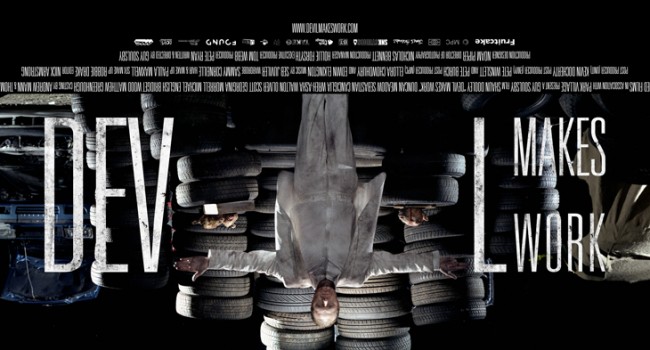
Devil Makes Work is an astounding short film. A lot of time, effort and money has gone into making it look like even more time, effort and money has gone into this. In an age when feature-length films often have credit rolls so minimalist that you could hold the cast and crew screening in the front room of a terraced house, about a hundred people contributed to this production. The effects, the make-up, the design, the sound, the whole shebang. It’s a tremendous showcase for everyone’s work.

But it is essentially a showcase, which makes it hard for me to review, because what the hell can I say about it? Basically it’s Shaun Dooley playing Old Nick as a sort of Satanic geezer gangster, sat on a throne of old tyres, pontificating on the nature of good and evil while we see a succession of figures: Sisyphus pushing his rock uphill, Jesus carrying his cross, a demon, a witch, a voodoo priestess, a rioter, a pimp and a prostitute. Shorn of the opening titles and closing credits, the whole thing lasts less than five minutes.

Visually, it’s hugely impressive. There’s no denying that. There’s a bunch of stuff on the website showing designs and inspiration and props and behind-the-scenes stuff and VFX and grading and whathaveyou and whatnot. The punishing four-day schedule of the actual shoot included one ‘day’ that last for 35 hours. Seriously, you cannot fault the hard work and dedication (and skill and talent) that has gone into this little picture, from Soulsby and everyone else. And all that hard work and dedication (and skill and talent) is evident on screen.

Devil Makes Work has screened at several high-profile festivals and will no doubt show at more. If you’re at a festival and it’s showing, take the trouble to see it. It looked great on my laptop so I expect it will look awesome on the big screen. Or, if you’re reading this review in the future, after the film has gone online, have a quick google and be impressed.

Soulsby is an experienced director of commercials and has worked for many leading international brands. Devil Makes Work is sort of a commercial for himself. But the thing is this. He says he set out to make Devil Makes Work look like a feature film, and … here’s where I pull my honesty trousers on … I’m not sure that it does. What it looks like is a music video. Only without a song.

It’s a great showcase for the director and, frankly, if I was looking for someone to direct a big budget music video, I’d be knocking on his door. We can see that Soulsby has a very strong visual sense, that he has a masterful camera eye, that he has a strong worth ethic and that he has the organisational skills to lead a team of a hundred people and craft something amazing. But can’t we see that from some of the big-name commercials on his own website?

A feature film is more than a succession of stylish images. At least, a good one is. There is certainly a trend in Hollywood to make awful, empty movies that are rammed to the gills with vast amounts of special effects: all style and no substance, all sizzle and no sausage. Films that jump from one set piece explosion or alien spaceship or car chase to the next without any concern for making sense or appealing to anything but the most visceral emotions. Films that are like watching somebody else play Grand Theft Auto or Call of Duty. Films which cost obscene amounts of money and, let’s face it, sometimes make obscene amounts of money back. Maybe that’s the gig that Guy Soulsby is pitching for here.

But films – good films – are about stories. And characters. And relationships. Devil Makes Work is a beautifully shot and edited sequence of vignettes but it’s not a narrative piece. And neither is a 60-second commercial for Nike or whoever.

My advice – not that anyone ever listens to me, and God help your career if you do – would be for Guy Soulsby to now make a second film which bears no relation or comparison whatsoever to Devil Makes Work. A simple film: one or two locations, handful of characters, no fancy-dancy effects, no bombastic, cod-Biblical motifs or themes. Just a simple story, told through the interaction of believable, sympathetic characters. A film that shows Soulsby can tell a narrative, that he can define a character, that he understands the importance of character relationships.

We need to see a man climb a tree, the same man fall out of the tree, and then, well, it’s up to Soulsby whether the guy is alive (comedy) or dead (drama). That’s the three-act structure, and it’s what defines a story. It’s something we can’t get from seven minutes and ten seconds of what is effectively just a tree on fire.

Watching Devil Makes Work, I was reminded of a story I heard many years ago about a wannabe comics artist who sent a portfolio of drawings to Marvel or 2000AD or whoever and was offered some work. When the lad asked why, out of all the submissions the publisher must receive, his had stood out and been chosen, this is what he was told. Ninety-nine per cent of the artwork submitted was muscular superheroes clad in spandex flying and fighting. But this particular artist had submitted drawings of real people in real poses, showing that he understood the basics of comic artwork; that it’s about people, not superhero caricatures.

In crafting Devil Makes Work, Guy Soulsby has shown that he can draw superheroes. But can he draw real people? If he can make a simple narrative film that is as impressive in its own way as this one, but for entirely different reasons, then potentially Hollywood is his.

Of course, he didn’t do this alone, as noted above. The film was produced by Pete Ryan who started out as a video operator and projectionist before moving into production as a lowly runner nine years ago – and now has his own production facility where high-end stuff like this can be shot. The cinematographer was Nicholas Bennett, the editor Nick Armstrong, both highly experienced in commercials. Production designer Noam Piper has designed a couple of drama features I haven’t heard of and was stand-by art director on Paddington. Robbie Drake (Evil Calls, Zombie Resurrection etc) designed the demon make-up. Other make-up was provided by Rebecca Hall (The Eschatrilogy, The Sleeping Room, Ibiza Undead, Soldiers of the Damned) and Paula Maxwell. Seb Juviler composed the music.

Shaun Dooley, who makes an effective and charismatic Satan, isn’t a name that springs to mind in terms of British horror but a perusal of the IMDB shows he has actually amassed a considerable number of genre credits including Eden Lake, Salvage, The Awakening, The Woman in Black and as yet unreleased werewolf western Blood Moon – plus extensive TV work in things like Wolfblood, Red Riding, Broadchurch, Misfits etc. Of the other actors, only Duncan Meadows (Sisyphus) has more than the odd credit. His muscles have had bit parts in Dark Shadows, Merlin and Skyfall, and he’s in upcoming British horror K-Shop.

It’s really, really difficult reviewing something like Devil Makes Work, because it doesn’t have any of the things I look for in a movie, If this was actually a feature film I would trash it for having no characters and no plot. If it was even a narrative short film, I would level the same accusations. But it’s not intended to have characters or plot, it’s intended to be an impressive succession of images that conveys or promotes a feeling. As such it has more in common with a music video or a commercial.

Technically and artistically this is awesome. It does what it sets out to do, with what it has available, to an extraordinarily successful degree. But is it a film? Make us a film now, Mr Soulsby. Make us a movie.

MJS rating: A

Monday, 24 November 2014

The Slayers: Portrait of a Dismembered Family

Director: Alex Poray
Writer: Alex Poray
Producer: Alex Poray
Cast: 'Lexray', David Poulter, Donna Beeching
Country: UK
Year of release: 2014
Reviewed from: Viewster
Website: www.facebook.com/theslayers666

The Slayers has an original and intriguing premise with lots of potential, almost all of which is squandered by a combination of poor acting, lacklustre direction, threadbare production values and a script within which both plot and characterisation could be most generously described as sparse. Above all, it is hobbled by its own desperately low ambitions, apparently believing that simply ticking the boxes marked ‘violence’, ‘drugs’ and ‘satanism’ doth an effective horror film make.

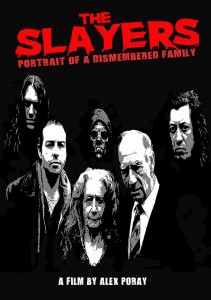
The patriarch of the eponymous clan is the Rt. Hon. Stanley Slayer (David Poulter – not the organist!), whose honorific technically means he’s a serving member of the Privy Council and therefore a Peer or a current or previous MP, although no mention is made of any political allegiance or Government position and I suspect ‘Rt. Hon.’ has been used here just to make him sound posh. He has a wife and four adult sons of whom Patrick Slayer (director Alex Poray under the nom de screen ‘Lexray’) is the black sheep.

The premise is that Patrick claims his family abducted and murdered a young woman named Anna Thompson, indulging in a spot of witchcraft and cannibalism on the side, and that there have been other (unnamed, non-specific) murders since. Stanley maintains that Patrick is a drug addict with mental health issues and is consequently delusional. Apart from anything else, the police have no record of a missing person named Anna Thompson. Patrick in return maintains that his father is such a powerful man that he has been able to impose a high-level cover-up. Patrick actually has footage which he himself shot, showing his brothers kidnapping Anna (Donna Beeching) and then his father sacrificing her to Satan. Stanley says that this is a fictional horror film which the family made for a lark, at Patrick’s suggestion.

The resultant mockumentary combines Patrick’s footage with interviews with both men (but not Mrs Slayer or any of the other sons). A film like this has the potential to be thought-provoking meta-fiction, questioning the audience’s values and morality by raising the spectre of the difference between fake footage claiming to be real and real footage claiming to be fake, all within an overall cinematic package which we know (or at least, assume) to be fake even though it presents itself as real.

I’d pay to see that. But that, sadly, is not what we get here.

The Slayers does not get off to a promising start with no fewer than eleven on-screen captions (“Reading,” as they say over on Cinema Sins). There are further captions throughout the film and at the end, including a few grammatical/punctuation errors. Most of the first half is Patrick responding to questions from an unseen interviewer while sitting in an armchair. For some reason he is wearing a pig mask (a motif seen also in White Settlers and Piggy – there’s a subgenre right there). Intercut with this are clips of Patrick and/or his family, including footage of Patrick performing, with a godawful rock band, a song with the melodic refrain “Kill the bitch.” Plus some home movie footage of Patrick as a child, and some candid shots of Patrick taking drugs between interview stints. There are also, rather randomly, some vox pops with members of the public saying whether they think the Slayer family are guilty or not. Some of these are costumed attendees at a Comic Con including a guy dressed as Deadpool and a girl in a terrific Tank Girl costume complete with missile-bra!

The problem is, there’s no reason at all to believe Patrick’s version of events. He’s clearly a drug addict, and the captions tell us he has an agent securing him a book deal. Then the second half of the film is Patrick’s footage in which he and his three brothers abduct, torture and humiliate Anna Thompson, who then suffers a drawn-out death as she is dismembered and disemboweled by Stanley Slayer, before the family settle down to a meal of her body parts.

We are supposed to question whether this is real or just a low-budget horror movie, but because this is a low-budget horror movie, the footage just looks like, well, a low-budget horror movie. If there was any doubt about its (fictional) verisimilitude, that is shot to pieces by scenes being filmed in multiple takes from different angles. All of which, within the narrative conceit, only gives added weight to Stanley Slayer’s version of events. Never for one moment do we doubt that this is all just a scam by a smack-addled idiot hungry for D-list celebrity status.

At no point do we get any real characterisation. Patrick, who talks with a weird, distorted voice for no obvious reason (it’s not like he’s trying to hide his identity) is a bland, unpleasant, greedy drug addict. His father is a somewhat more rounded character and to be fair to Poulter the actor does his best with his rather stilted dialogue, trying to convey genuine paternal concern for his mentally disturbed son, but there’s no more depth to Stanley Slayer than Patrick. And of course we never see the two together (except in the fake ‘murder’ footage) so there’s no opportunity for character conflict. Beeching does a good job of screaming and struggling but is called on to do little else. Kudos to her however for coping with a ‘burial alive’ scene which is really the one genuinely horrific and interesting moment in the film.

Julian Poulter, Marek Gruszczynski and Matt Lemon are Patrick’s brothers and there’s a hint of sibling conflict between them in a couple of shots but not enough to be interesting. Georgina Richmond as Olga Slayer does nothing except pull faces like an embarrassing, drunk auntie. And then there’s Alicia Newton as Monica Reed, the unseen interviewer. Whose. Wooden. Readings. Of. Her. Questions. Are. Painful. In. The. Ex. Treme.

It’s clear that Poray has aimed for ambiguity but he has missed it completely with a misfiring script of leaden, prosaic description and (in the second half) gratuitous cut-price nastiness that rapidly becomes boring. With what is presented to us on screen there is absolutely no reason to doubt that Slayer Jr is lying (and consequently that Slayer Sr is telling the truth). There’s no mystery, and without mystery why should we care?

The Slayers is feature length at 72 minutes and was brought in for under three grand. Shot in and around Barnstaple in April 2014, the film premiered in September that year on the Viewster website. Of passing interest is an interaction with police on the last day of the shoot. Some-one spotted Beeching being bundled into the back of the brothers’ vehicle (for no apparent reason, an old ambulance) and called the Old Bill. The cops flagged down the ambulance and apparently had a tactical firearms unit on the way. Cheekily, a brief shot of this incident, shot covertly from inside the director’s car, is included in the actual film. Sadly, this is about as meta as The Slayers gets.

MJS rating: D

Saturday, 28 June 2014

Stalking Hand

Director: Lou Vockell
Writer: Lou Vockell
Producer: Lou Vockell
Cast: Dustin Gilroy, Lori Morsch, Leslie Levine
Country: USA
Year of release: 2006
Reviewed from: screener DVD
Website: www.onemanfilmindustry.com

Two things you should know, right off the bat. Although subtitled A Scary Movie, Stalking Hand is an out and out comedy and not actually scary at all. That is, I suppose, the joke. Also, the extraordinary and quite unique image on the front of the DVD sleeve is actually in the movie. It doesn’t make any sense but it’s a very cool make-up effect which has certainly never before been done so the hell with story and the laws of physics, let’s stick it in there.

A prologue finds two young folks making out in a car. Johnny (Bill Randolph: not the guy from Friday the 13th Part 2) wants a “just a kiss” (yeah, right) but uptight minister’s daughter Mary Joe (Emily Arner) doesn’t want to be touched. When he accidentally rips open her blouse, she runs home to Daddy. From this, we cut to a crime scene where the cops are investigating three dead bodies: the young man died from loss of blood after his hand was cut off, the young woman and her father were both strangled. And the odd thing is that the hand in question is missing...

But never mind all that because it’s time to meet our main characters: dumb jocks Derek and Kenneth (Kevin King and Chris Jenkins) and their girlfriends, cynical brunette Cassandra (Lori Morsch) and blonde bimbo Kiki (Danielle Krull). Bored with watching the guys play basketball, the girls demand that they do something special and a plan is hatched to hold a Halloween party. Part of the deal is that Derek and Kenneth will find a date for Cassandra’s spooky goth chick cousin (Leslie Levine) who calls herself Morgana and speaks with a dubbed, bass voice. The guys pick local spod Charles Drelman (Dustin Gilroy) but warn him that he and the goth must keep out of their way.

To get the girls ‘in the mood’, Drelman is persuaded to recount the story of Johnny and Mary Joe which happened exactly one year ago. A lengthy flashback sequence begins with a repeat of the two-minute prologue (which probably wasn’t necessary) and then the subsequent events. Mary Joe (who isn’t wearing a bra and never bothers to refasten her blouse) runs to her daddy (Doug Palmer) who gets a chainsaw, much to the consternation of his wife (Lena Miller). The mad minister is determined to take revenge on the boy for daring to lay his hands on Mary Joe so he revs up the saw and cuts Johnny’s hand off, resulting in copious quantities of fake blood squirting everywhere.

As the ‘party’ progresses, Drelman and Morgana find themselves locked out of the way in the basement. However, Morgana has only to make a call to Satan on her cellphone to conjure up the ... dah, dah, dah! ... stalking hand, which proceeds to wreak bloody vengeance on the cool kids upstairs. This includes a bathtub electrocution and a hilarious death-by-cigarette-lighter.

The situation is resolved by the arrival of two cops whom we have previously met, one of whom (played by Russ Hurley) looks vaguely like Elvis and tells everyone who will listen that he is the only true son of the King of rock’n’roll. The Elvis connection becomes more significant at the film’s climax. (The other cop is played by Levine’s father Art, while the make-up effects are handled by her brother David.)

Stalking Hand (which dropped The from the title somewhere during production) is good, harmless fun. It has been shot cheaply on video and the effects are distinctly budget-priced, with the ‘severed hand’ mostly represented by simply framing it so that we can’t see beyond the wrist. However, there are a few shots where the hand’s owner has been removed by green-screen or some other technique and these are surprisingly effective. The cast are mostly good and the weaker ones get away with it because of the broad burlesque nature of the script. Characters are fairly simplistic but there is a nice gag in understated homo-eroticism of the relationship between Kenny and Derek. It’s not quite Brokeback Mountain, but it’s leaning that way... There is also a truly weird interlude with a couple next door to the party house, the wife being an uncredited actor in drag with huge balloon fake bosoms.

Cheap and cheerful, the movie doesn’t outstay its welcome and never becomes self-indulgent. Lou Vockell, self-styled ‘one man film industry’ has previously produced and directed softcore erotica with SF/horror leanings, including Killer Sex Queens from Cyberspace, Hookers in a Haunted House and Planet of the Erotic Ape. Stalking Hand is his first attempt at making an actual horror movie without any T&A.

However, the oddest thing about Stalking Hand is the sound effects. I was surprised to find (although you won’t be, having read this review), that Vockell has peppered the entire film with cartoon-like foley work. Almost every movement is accompanied by a rattle, gurgle, squeak or similar noise. It’s a bit like watching the film with a couple of friends who stopped off on the way to the cinema at The Swannee Whistle Shop and Snare Drums R Us. This is a little overdone, to be fair, but it never becomes distracting and it certainly leaves one under no illusions about how seriously this ‘scary movie’ should be taken.

MJS rating: B+

Sunday, 15 June 2014

Dark Vision

Director: Darren Flaxstone
Writers: Darren Flaxstone, Bernie Hodges
Producers: Darren Flaxstone, Bernie Hodges, Chris Broughton
Cast: Bernie Hodges, Suzie Latham, Judith Haley
Country: UK
Year: 2014
Reviewed from: online screener
Website: www.darkvision-movie.com

A combination of good acting, fine cinematography and interesting characters marks out Dark Vision as one of the better British horror indies of recent years. Admittedly, the premise is hardly original for a modern British fright-flick: a TV show about the paranormal reporting live from a supposedly haunted location. See also Steve Stone’s The Entity, Kevin Gates and Michael Bartlett’s Paranormal Diaries: Clophill, Steven M Smith’s Haunted and Simon Pearce’s Judas Ghost, to name just a few. But the characterisation and presentation on show in Dark Vision make up for the somewhat hackneyed plot.

Producer/co-writer Bernie Hodges (recently in Andy Bourne’s sci-fi short Two Extra Days) stars as Spencer Knights, the vain, self-important, oleaginous host of a paranormal TV show who turns up in his van, with a small crew, at an isolated building called Baylock’s Folly. His principal help is sensible, pragmatic Jo (Suzie Latham), who is reteaming with Knights for the first time in three years, although it is never made clear why they split up their professional partnership or why she is back helping him. The camera is touted by a young lad named Kev who is played by… Simon Pearce, director of that very same aforementioned Judas Ghost! There is also techie Xan (Oliver Park) who has already set up multiple cameras around their chosen location and, for reasons that remain obtuse, hypnotised actress/model Marva (Alicia Ancel: Kebab Killer).

Baylock’s Folly is an 18th/19th century castellated building, home to an enigmatic old lady named Clem (a belter of a performance from Judith Haley, also in Amityville Asylum) who has a taste for the sauce and layers of insight that will be peeled back as the story progresses. ‘William Baylock’ himself clearly didn’t construct the building named after him as he was, we are told, a plague doctor in the time of the Black Death. Most of the action takes place in caves beneath (and accessible via) the folly where Baylock is said to have conducted Satanic rituals involving child sacrifice. Or something. (I can’t find anything about Baylock online and so assume he’s purely fictional, which makes it a bizarre coincidence that this film was produced at exactly the same time as Anthony M Winson used the unusual name in his ghost feature The Haunting of Baylock Residence.)

One of Dark Vision’s strengths is that it does not rely on the ‘found footage’ tropes that other similarly themed films have used. Some shots are presented POV from Xan’s webcams, Kev’s video camera or little cameras held/worn by various people, but these are used sparingly within a conventionally shot and structured narrative film. That said, since some shots clearly are ‘TV footage’ it would have been helpful to have distinguished those in some way; a change in picture quality perhaps, or just a little red dot. As it stands, we don’t know whether what we’re seeing is viewed through a Xan-cam or just the director’s vision, although the lighting always seem to imply the latter, even when the angle/view implies the former. It’s ironic that, although the film has great photography (by Mark Whatmore, whose previous credits are documentaries on Simon Callow, Jacques Tati and lions) the overall movie might have improved a tadge if the photography had actually been (or had appeared to be) less impressive.

Parts of Dark Vision are overly talky, but not excessively so. Once it gets going, however, it’s suitably spooky with Baylock appearing in his plague doctor guise - or is that Kev in a costume provided by Spencer? Quite what Spencer is trying to do, and why, is never entirely clear. He constructs a pentagram of flames, having evidently carried vast numbers of tea-lights down to the caverns. We all know how fiddly it can be to light just one of those fuckers – it must have taken him ages to set this up. Jo keeps finding tiny, antique dolls, the significance of which is not clear but it must relate to the children that Baylock killed. And Clem comes into her own as Spencer starts to realise quite how out of his depth he has got.

Interspersed with all this are some captions from something called the ‘Dark Vision Hub’ which seem to indicate that Spencer’s show is one of five competing for some sort of prize, the sequential captions telling us as each rival show is knocked out of the competition. This is referenced once in the dialogue, but it’s really a distraction (and quite a confusing one). It adds nothing to the plot, is not necessary to provide a reason for Spencer and co. to be where they are, doing what they’re doing, and never gives any indication of how/why these various rival TV shows are eliminated (or why Spencer’s survives). The whole ‘Dark Vision Hub’ thing has the feel of something which was significant in an early draft of the script but has been whittled away to a stump of an idea which now serves no real narrative purpose.

Two other aspects of Dark Vision which were unnecessary and could have been dispensed with are a post-production video effect and the music. The generally good and atmospheric score by Al Lethbridge (whose many TV documentary credits include Marcus de Sautoy’s BBC4 series Precision: The Measure of All Things and the 2009 Children in Need Around the World in 80 Days challenge) makes the common mistake of thinking that something spooky on screen is made spookier by a music sting, whereas in fact the opposite is true. For example, there’s one shot where a wine bottle, untouched by human hand, moves across a table. And the music goes, “Brahm!” as this happens. If the bottle moved silently, unacknowledged by the score, the audience response would be: “Oh my God! Did I just see that? Did that just happen?” With the addition of the music sting, the audience is hammered over the head: “Look! Look at this spooky thing! Watch it happening! Make sure you don’t miss it!”

The post-production effect is essentially the same thing that irritated me about Hungerford, which is the extraordinary idea that video cameras, when switched on or off, go “Bzzzzt!” and make the image break up and shake about. I’m no technie but I’m pretty damn sure that cameras don’t do this in 2014, if indeed they ever did. I think this idea stems from a pre-digital age, back when video meant analogue tape. Film-makers imagining what video footage might look like in the future applied Quantel effects to make it look a bit different and futuristic. Well, the future's here and digital video cameras work just fine, thank you. Or the other place this might have come from is the idea of video transmission; this sort of audio/video break-up has been used many times as a form of interference, implying that a video feed from someone (usually on an alien planet or aboard a doomed spaceship) is only just able to make contact through the galactic static. But that simply doesn’t apply to modern technology – although, to be fair, a couple of channels on our Virgin Media package do go like that when someone answers the phone…

The above minor distractions notwithstanding, Dark Vision is a solid and enjoyable little horror movie. It doesn’t quite know when to finish and there are several endings, but most of them are genuinely creepy and scary. I enjoyed the film, which is well acted, well directed, well produced and glosses over its sometimes obtuse story in favour of style, spookiness and very effective characterisation.

Glenn Lewis and Olaus Roe are credited with the visual effects, which are very good, and Debbie Hampson (who was a trainee on The Hollow Crown) provided the effective and sometimes gory make-up. This is Darren Flaxstone’s third feature after Release, a drama about a priest accused of paedophilia, and Buffering, a “raunchy” sex comedy. By trade he is an editor (he cut Dark Vision himself) with a stack of credits including Ocean Odyssey, The Unseen Alistair Cooke and Bill Bailey’s Jungle Hero. Dark Vision is an impressive first stab at horror and I’m keen to see what else Flaxstone, Hodges and co. can bring us in the future.

Shot in 2013, the film carries a 2013 copyright date and was first screened in Bristol in October that year although the official premiere was at the Coventry Film Festival in June 2014.

MJS rating: B+

Friday, 8 March 2013

Caesar and Otto’s Deadly Xmas

Director: Dave Campfield
Writers: Dave Campfield, Joe Randazzo
Producers: Dave Campfield, Joe Randazzo, Robin Ritter, Richard G Calderon
Cast: Dave Campfield, Paul Chomicki and more stars than there are in Heaven
Country: USA
Year of release: 2013
Reviewed from: online screener
Website:
www.caesarandotto.com 

Three years after their Summer Camp Massacre, half-brothers Caesar and Otto Denovio are back in their third feature, Caesar and Otto’s Deadly Xmas. It’s actually their fifth film as there have been a couple of shorts in the meantime: C&O in the House of Dracula and C&O Meet Dracula’s Lawyer. (The duo also pop up in Dave Campfield’s recent political satire short The Perfect Candidate.)

By now Campfield and Paul Chomicki have their double act down pat and it is a joy to behold. Caesar and Otto are a wonderful pairing. Like Stan and Ollie, like Eric and Ernie, like Albert and Harold, like Jay and Silent Bob - they are effectively married to each other. They can’t stand each other but they know deep down, even if they won’t admit it, that they need each other and they’re stronger together.

Otto is sweetly pathetic. He’s a slob, but an innocent slob. He just wants a little peace, a little happiness and warmth. In this tale he’s tracking down a girl he had a crush on in high school (multi-divorced Allison, played by the unfeasibly cute Summer Ferguson). It’s difficult not to love Otto, especially given what he puts up with from Caesar.

Caesar has a different kind of pathos. Hyperactive, insecure, egotistic - and paranoid if he isn’t the centre of attention. Caesar is the epitome of that thing we call ‘an actor’. But we can tell that he has a good heart, that he does in fact love his half-brother and that his tantrums and bitchy comments are really all a show, disguising the vulnerable, lonely man inside.

There are depths to these two characters which make us want to spend time with them: ninety minutes every three years just isn’t enough.

The surprisingly complex plot of Deadly Xmas involves a Satanic cult founded in California in the late 19th century, plus Caesar’s latent fear of Santa Claus (or anyone dressed as him). Also the burgeoning Otto-Allison romance, their father’s usual nefarious shenanigans, a squeaky-clean company expanding into slasher movie production and of course a serial killer. A smart script and pinpoint direction careen through the story taking no prisoners, with lots of knowing winks and nods to the B-movie-ness of it all.

Not least of these is a star-packed cast which makes this the It’s a Mad, Mad, Mad, Mad World of second-tier Hollywood. Debbie Rochon! Brinke Stevens! Linnea Quigley! Felissa Rose! Joe Estevez! Robert Z-Dar! And of course, dear old Uncle Lloyd! A quick check on the IMDB reveals that between them these seven fine folk have an incredible 1,100 credits, and even if we allow for duplication in that list there must be about a thousand films with one or other of them in the cast. This is the bedrock of low-budget independent cinema right here folks, step up and take a seat.

But all of this would be so much self-indulgent nonsense if it wasn’t for one crucial fact. Caesar and Otto’s Deadly Xmas is howlingly, gutbustingly funny. Every gag hits the mark, every comic turn, every pause, every double-take, every slapstick, everything. Comedy gold, that’s what this is. Comedy gold.

Also in the cast are: Shawn C Phillips, who has amassed more than 60 IMDB credits himself by appearing in stuff with titles like Sasquatch Assault, Zombie Babies, Kung Fu and Titties, Girls Gone Dead and Fat Planet; Victoria Vertuga, who made another seasonal horror feature the same year, something called Merry F@#$ing Christmas; Aaron Miller, who played ‘Manson victim’ in Dahmer vs Gacy(!); Paul Guay, who wrote Jim Carrey vehicle Liar Liar but, more significantly, was in Don Glut’s Countess Dracula’s Orgy of Blood; Keith Bush, who played Orson Welles on TV a few years back; and Ken MacFarlane, who was in a 2004 Golem movie. Plus producer Robin Ritter and producer/designer/FX guy Richard Calderon.

I loved, loved, loved Caesar and Otto’s Deadly Xmas. It’s clever, it’s knowing, it’s silly, above all it’s joyous. The subgenre of Christmas horror B-movies is not a distinguished one, populated by such crap as Psycho Santa and Satan Claus, but the half-brothers Denovio are the boys to put the sparkle back into festive frights. It doesn’t matter what month it is right now - this is great at any time of the year.

MJS rating: A

Friday, 18 January 2013

Belcebu

Director: Sergio Blasco
Writer: Sergio Blasco
Producer: Sergio Blasco
Cast: Oscar Pastor, Mapi Romero, Ricardo Jordan
Country: Spain
Year of release: 2005
Reviewed from: UK DVD (Redemption)


Every few years, Spain produces a cracking horror movie - something like The Day of the Beast or Fausto 5.0. Belcebu, alas, does not continue this tradition.

Now I need to be completely upfront and admit that there are 16 minutes in the middle of this film which I haven’t seen and it’s possible that everything I need to know for the movie to make perfect sense is contained in those 16 minutes. But given that the preceding 17 minutes made precious little sense and the ensuing 44 minutes made no sense at all, I’m inclined to believe that the ‘doesn’t make sense’ thing is endemic to the film as a whole.

Redemption were kind enough to send me a screener but when I watched it, the English subtitles disappeared about 17 minutes in. I continued watching for a while, wondering (as you do) whether this was some deliberate artistic ploy, but eventually realised that I had a duff disc so I had to abandon the film and watch something else instead.

Redemption were kind enough to send me a replacement disc and - Madre de Dios! - it happened again in the same place. I skipped ahead to the next chapter (there are only six) and the subtitles were back but something else was up with the disc now, which didn’t want to rewind. So I just carried on watching, picking up what I could. I don’t think I missed anything crucial.

Here is Redemption’s summary of the plot, from the DVD sleeve and attendant publicity:

"Satan, personified as a lustful lesbian rock chick, seduces satanic rock idol Belcebu, who through his lyrics regularly encourages his fans to commit suicide. Satan offers him eternal life as a rock star… however his voluptuous ex is determined to stop him on his quest for world domination."

Really? Unless that all happens in Chapter 2 and is never referred to again, that sounds like a different film to what I saw. Maybe that’s the film that Sergio Blasco was trying to make, because I can’t believe anyone deliberately set out to make this mishmash.

Our central character seems to be Mani (at least at the start), a junkie prostitute who helps her boyfriend to rob a shop, a plan that goes awry when it transpires that one of the customers being held at gunpoint is the boyfriend’s mother. They escape in a stolen car, the police shoot and the car crashes (as cars do) and explodes (as cars don’t, except in silly movies). The boyfriend dies and Mani goes to prison. When she is released a few years later she is swiftly back on the street and before too long she’s back on the smack too.

None of this prologue with the boyfriend seems to have anything to do with anything. Mani is looking for her sister and we learn in a flashback that said sister disappeared after the two girls were part of a post-gig party thrown by dodgy death metal band Belcebu (lead singer - Toni Belcebu) which ended early when the police busted the party in a drugs raid.

Belcebu are now a big act whose fans occasionally commit suicide. While Toni is in the bath he is visited by a hideous demon, capable of transmogrifying into a beautiful woman, who tells the frightened singer that they have some sort of deal in place, although it is never made clear what.

Our third protagonist is Angel, an unassuming young fellow with some video camera skills who finds himself employed to shoot hardcore porn. He’s not overly happy at first but it’s relatively easy money and gradually he becomes immune to the perverted filth he has to view through his lens every day. Angel lives next door to Mani.

There are also a couple of comic relief businessmen but I never understood who they were or what they did. You can see that three and a half plot strands in 77 minutes means that there simply isn’t time to fully explore these characters, especially when the first ten minutes or so was all about Mani’s subsequently deceased and irrelevant ex-boyfriend.

After a whole load of stuff that I couldn’t follow (and not just because I’d had to skip most of Chapter 2), the film culminates at some sort of Satanic ceremony, overseen by Toni Belcebu. Mani, who has become less and less central as the film progresses, is one of several prostitutes lined up for sacrifice while Angel has been hired to film proceedings. There are lots of people in dodgy goth gear, a scar-faced henchman in the employ of Toni, the two comic relief businessmen (stripped to their pants and tied to chairs) and someone dressed as a clown.

When the police raid the place all Hell is let loose, literally. Toni mutates into a demon with an enormous schlong; the henchman runs around with a six-foot-long, pointed pole, ramming it through and up people; little flying demons flutter around everywhere; and people explode for no reason at all. This sequence, which is completely inexplicable, just drags on and on and on and on. It’s just one long, overblown effects showreel - except that hamfisted editing means that many of the effects can’t be seen properly. But, given the low budget, that may be a blessing.

God alone knows what Belcebu is about or what Blasco, a former FX guy, was trying to achieve. It’s just an unholy mess and, while I suspect he was aiming for the ‘unholy’ part, the rest is just a jumble of uninteresting, sketchy characters wandering from one childishly shocking set piece to another. The whole film feels like it started life as a checklist: “Hola, Sergio! What can we show in this film that will make people gasp?” Naked woman about to have sex with a dog? Check. Naked woman speared through the vagina so violently that the spike protrudes from the top of her head? Check. Car blowing up? Check.

If all you want is death metal, naked chicks and cut-price gore effects, Belcebu could be the film for you. Presumably somebody at Redemption liked it but really this is awful, possibly worse than Sacred Flesh. It’s all over the place, like the writer-director just made it up as he went along.

Blasco’s earlier shorts are: Litio (Lithium), about a heroine addict; Sorpresa Desagradable, about a man spotting his wife on TV; Mas Carnaza, about a guy going on a gun rampage as he searches for his ex-girlfriend; and Burrp!, about a virus turning people into zombie-like maniacs. He started work on Belcebu in 1999 and finally finished it in 2005 although it’s not his first feature: in 2001 he made Nena Dame Bakalao, about a man looking for sex and drugs in a car park, for Blue Rain, a porn video company for whom he had been providing special effects.

Nobody else involved with the film seems to have been in anything that I’ve ever heard of - and if I’ve never heard of this stuff, you lot sure as hell haven’t.

Belcebu is apparently a Spanish form of the name Beelzebub and the film’s full title translates as Belcebu: Take Me, I’m Your Whore from Hell. Redemption’s disc includes a seven-minute, subtitled Making Of, a trailer, a music video, nine stills and three posters, plus some trailers for other Redemption films which, sadly and typically, are more interesting than the main feature. Oh, and all the usual samples from their range of CDs. There are at least three different Redemption sleeve designs floating around the web - the one they’ve plumped for is the crucified woman with the pentagram on her chest - an image which is not in the film unless it’s in those 16 minutes.

In the USA the film has been given the subtitle Diablos Lesbos but, despite this and what it says in the Redemption sleeve blurb, there’s no lesbianism in this film. Unless... oh man, I should have watched Chapter 2, shouldn’t I?

Ultimately, this is a film which looks like it was more fun to make than to watch - and to be honest it doesn’t look like it was much fun to make.

MJS rating: D+
Review originally posted 29th July 2007