Showing posts with label war. Show all posts

Monday, 31 August 2015

Fallen Soldiers

Director: Bill Thomas
Writers: Bill Thomas, Ian Thomas
Producers: Bill Thomas, Jason Emery
Cast: Matthew Neal, Eve Pearson, Jon Lee Pellet
Country: UK
Year of release: 2015
Reviewed from: online screener
Website: http://fallensoldiers.savagemedia.co.uk

Fallen Soldiers managed to get all the way through development, production and post-production without appearing on my radar so that the first I knew about it was when I spotted it on Amazon. I posted a piece about the film on my British Horror Revival blog which was spotted by a colleague at work – who said she knew the film-makers (and indeed, her other half is actually in the film). By this unexpected route I was able to get my hands on a screener

The subgenre of ‘historical zombie films’ is very small. If we remove the two sub-subgenres of ‘historical zombie films set during World War II’ and ‘historical zombie films set in the Wild West’ we’re left with very few indeed. Off the top of my head there’s this feature and two shorts: Mathew Butler’s E’gad, Zombies! and Ross Shepherd’s Victorian Undead. The big advantage of historical zombie pictures, of course, is that the characters come to the zombie threat without any baggage. In a contemporary zombie film, either the characters have to work out which established zombie tropes apply to these particular living dead, or else you have to set the story in some sort of alternative universe where the post-Romero cinematic zombie simply doesn’t exist. But in anything set before 1968, the whole thing simply becomes ‘a disease’ – which is how it is referred to here.

Bill Thomas’ debut feature, co-written with his brother Ian, is set in Belgium just a few days before the Battle of Waterloo. Napoleon, escaped from exile on Elba, has marched North through France, gathering his army about him. The British and the Prussians are racing to try and stop him.

Matthew Neal (who played ‘Freeway Killer’ Randy Steven Kraft in a TV docudrama directed by Thomas) stars as John Cross, a British soldier who hitches a ride in the carriage of Belgian noblewoman Celine (Eve Pearson). Most of the film is a sequence of flashbacks as Cross explains where he has come from and why he needs to get back through the French lines to Wellington’s army.

The story he tells is of how he and a colleague, Hardy (Jon Lee Pellet) unsuccessfully tried to rescue some British hostages from French prison wagons. Instead, the pair find themselves locked up in one of the wagons with Cross’ friend Piper (Zachary Street). When they are given the last rites and a savage, animalistic peasant girl is thrown into the confined space, snapping and scratching at them, they realise that they are more than just prisoners of war.

Long story short, the Froggies have somehow got their hands on a zombie virus. Their grand plan is to use it to reanimate the ‘Old Guard’ elite who died on the retreat from Moscow. This is a great idea but… it basically just remains an idea. It doesn’t fully explain why they are infecting Belgian peasants and British prisoners. And of course reanimating frozen corpses that died three years ago isn’t the same as simply spreading a contagion. The plan seems to be: once a prisoner/patient is infected, their blood is collected and can be used to reanimate an Old Guard soldier. But if that’s so, why all the complications? If you want to reanimate 200 Old Guard, why not just round up 200 Belgian peasants and slaughter them? It’s not like Napoleon ever had any qualms about that sort of thing. The man was a monster.

Matters are additionally complicated by the introduction of another British prisoner whom Cross recognises and who, confusingly, looks like the now-deceased (?) Hardy. It took me a while to work out what was happening. There are secondary flashbacks – within the main flashbacks from Cross and Celine in the carriage – explaining where the zombie virus came from and how it got to Europe. In the third act Cross finally makes it to British lines where we meet a new character who proves very significant and some of the things we’ve only just managed to work out are pulled away from under us as characters reveal different intentions and motivations to the previously established ones.

It all gets a bit confusing, to be honest, a situation not helped by this particular zombie virus have a very significant difference from what we normally expect, which renders it both more and less of a threat.

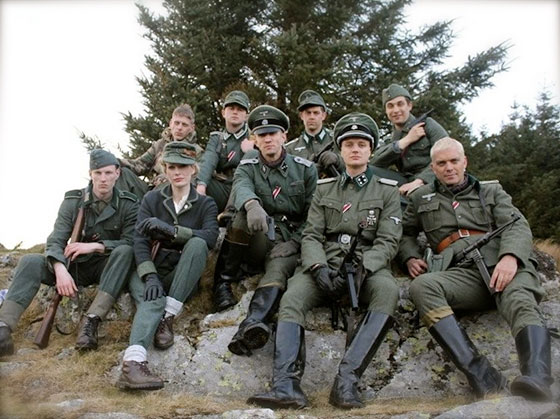
There’s a lot to commend in Fallen Soldiers. The acting is generally good (barring a few Allo Allo accents), so is the production design. The camera-work is excellent, combining with top-notch sound mixing to really put us into the heat of the action – and effectively disguising any corners cut when shooting a historical on a tight budget. I have to assume that the uniforms and arms are accurate for 1815, and unlike Soldiers of the Damned these clothes at least look lived in. There are a couple of unfortunate anachronisms in the dialogue, both of them in an early scene where Celine’s carriage is stopped at a check-point. A character lets slip the 20th century term ‘okay’ and there is also a reference to ‘saboteurs’. Despite the popular belief that the term comes from French Luddites hurling their clogs or ‘sabots’ into machinery, in fact that word is not recorded until the 1920s (the root ‘sabotage’ dates from the 1890s). Yes, I’m being picky, but these things are worth checking.

More problematic is the very limited number of zombies. We only ever encounter one at a time, and in a confined space usually. Thus there’s no sense of approaching danger, no attempt at evasion. I once described all zombie films as “either a siege or a chase (which is a siege with a vector)”. But Fallen Soldiers is neither of those. It’s a sequence of flashback scenes, some of which involve close combat with a zombie: either a recognisably human one like the peasant girl introduced to the prison wagon, or a barely human reanimated corpse. The very limited nature of these attacks means that the setting becomes largely irrelevant. Any of those scenes could happen in a contemporary zombie tale and all that would change is the clothes.

What we don’t get is what the DVD sleeve promises, which is the living dead in military uniforms. There are no military battles in Fallen Soldiers, no massed ranks, and certainly no zombies in redcoats. Now, to be fair, this is far from being the first or only horror film to grossly exaggerate its content in its marketing to the point of downright deception. That sort of thing goes with the territory, I guess. It is nevertheless disappointing that in a film (actually the only film) about zombies set during the Napoleonic Wars, where most of the characters are military personnel, there’s not a single actual ‘zombie soldier’ (apart from one reanimated Old Guard whose uniform is in no better condition than his skin) and no actual warfare (beyond an artillery bombardment from unseen cannon). There are a number of French soldiers wearing iron face masks which render them conveniently anonymous but they’re just armed goons, like Napoleonic Imperial Stormtroopers. We don’t see them in action.

I must commend Bill Thomas not only on his imagination and originality but also on his ability to use re-enactors and their materiel to create a realistic early 19th century setting. However, I do think he’s been overly ambitious, creating a story which must perforce be largely told in flashbacks and where the really impressive spectacle happens off-screen or only hypothetically. Fallen Soldiers is very, very talkie, especially the climax where characters endlessly explain things to each other. There’s a bit of a fist-fight near the end, but you couldn’t call it an action-packed third act.

More problematical is the way that Thomas has played with the basic core ideas of the zombie genre. It would have been quite enough to set this tale in this previously unexplored place and time. There was no need to add a unique aspect to this particular zombie contagion which makes it actually a completely different thing from what we are familiar with (and which doesn’t, in all honestly, tie in particularly well with the underlying ‘reanimating the Old Guard’ plot).

As the credits rolled and I started thinking about what I had just watched, I can’t say I was disappointed, but I did feel curiously unsatisfied. Fallen Soldiers doesn’t seem to make anything out of its setting. Yes, the eve-of-Waterloo scenario informs the basic premise that is eventually revealed to us, and yes it creates interesting window-dressing in the sets and costumes. But on the level between those two – the actual, you know, story – there’s not much to gets one’s teeth into. After some rumination, it occurred to me that there wasn’t a single memorable image in the film. Just one glimpse of a massed rank of British or French zombie-soldiers lurching across a battlefield, unfazed by musketry hurtling around them, would have been a money-shot par excellence, even if it was just a dream. But there’s nothing like that – or any other sort of arresting and startling visual spectacle. (Frustratingly, the film has been graded throughout to almost monotone, so that even Cross' scarlet jacket is rendered colourless and dull, however bright it may appear in publicity shots.)

Bill Thomas’ day-job is providing props and models for blockbusters like Guardians of the Galaxy, Clash of the Titans, The Force Awakens and assorted Harry Potters. Back in 2009 he directed a short called Butchers Blossom (sic) about a plague in Victorian times but it’s not clear whether that was also a zombie picture.

Fallen Soldiers was shot over ten days in July 2011 as Grist for the Mill (with a few pick-ups later in the year). After lengthy post-production, there was a one-off screening in February 2014 and the film finally made it to DVD in July 2015.

MJS rating: B

Wednesday, 19 August 2015

Soldiers of the Damned

Director: Mark Nuttall
Writer: Nigel Horne
Producers: Stephen Rigg, Nigel Horne
Cast: Gil Darnell, Miriam Cooke, Lucas Hansen
Country: UK
Year of release: 2015
Reviewed from: online screener
Website: www.soldiersofthedamned.com

Any British movie where the majority of characters are not English-speakers faces a three-way choice. Do you do the whole thing in the characters’ real language(s), subtitled? Do you have the actors speak English with the appropriate accent? Or do you just have the actors use their regular accents? Obviously the first option is artistically preferable, but it requires actors fluent in that language and it can be a tricky sell to both distributors and audiences. So we’re left with two alternatives. Every character in this film is German (except for a small number of Russian soldiers): should they use German accents or not?

As a film-maker, you’re damned if you do, damned if you don’t. I’m firmly in the pro-accents camp. I can believe that they’re German better if they at least sound German and not like they’re from Hampstead or Barnsley. But I know there are other people who hold the opposite view: that if the words aren’t German it’s ridiculous to use a German accent. I think it perhaps boils down to the quality of the actor. It takes skill to provide enough of an accent that we believe the character’s nationality without sounding like a comedy routine.

Bizarrely, one of the actors in Soldiers of the Damned does use a German accent (he’s not actually German – I checked). Also odd is that the actors playing Russian soldiers do use Russian accents when speaking English (which is presumably supposed to be German), while their Russian dialogue is actually in Russian but subtitled. Which I suppose does at least let us know when they’re speaking which language. But still consistent use of accents would have benefitted this movie.

But that’s not the film’s big problem.

Historical accuracy is hard, and gets harder the smaller your budget. I’m not a military history nerd and I can’t tell you whether the uniforms and weapons in this film are accurate for a group of German soldiers in Romania in 1944. I did spot one thing. An SS Officer who has an almost obsessive pride in the importance of the SS uniform wears his hat wrong. He wears his dress cap jauntily on the back of his head. The whole point of the low peak on a hat like that is that it comes down in front of your eyes and forces you to hold your head stiffly upright if you want to see anything. It was an idea developed by the Germans in the 1930s and, like so many sartorial/practical aspects of Nazi military uniform, is widely copied today around the world. Any SS soldier wearing his hat like this guy would have been given a serious dressing down, no matter his seniority.

There are some other oddities that I noticed. At one point a character writes a message on his forearm. But… how? You can’t write on your skin with a pencil or a fountain pen. The ball-point pen was only invented in 1938 and was an expensive, specialised piece of equipment. RAF bomber crews carried them because the ink wouldn’t freeze at high altitude, but an ordinary German soldier wouldn’t have anything like that.

The film begins with an entirely unnecessary – and frankly inane – narration over a map of Europe: "World War II was in its fifth vicious year of conflict. The German war machine, controlled by Adolf Hitler and the Nazi Party, had a stranglehold over much of Europe, from the Atlantic coast of France to the Russian Urals. Reichsfuhrer Heinrich Himmler was head of an armed Division called the Waffen SS.”

Leaving aside the fact that the SS was actually a wing of the army consisting of 38 Divisions, do we really need to be told that Adolf Hitler was in charge of Germany? While we hear this, a blood red stain spreads from Germany across Europe, including neutral countries like Spain and Switzerland. Although I only noticed that inaccuracy second time around as I was initially distracted by the presence on this map of countries like Slovakia and the Czech Republic which didn’t exist until the 1990s. Talk about spoiling the ship for a hap’orth of tar. How difficult could it be to get a public domain 1940s map of Europe? Wikipedia’s crawling with ‘em!

The main purpose of the narration is to (a) imply that regular German soldiers weren’t Nazis and hated the SS, which is a gross over-simplification, and (b) explain that Himmler oversaw an organisation called the Ahnenerbe which investigated occult ideas. But the plot of this film is a squad being sent on a mysterious mission without explanation, so that could have waited until much later in the film when one character tells another what the Ahnenerbe is.

What might have been worth narration is a description of the situation in Romania in early 1944 which certainly wasn’t as simple as the Russians advancing and the Germans retreating. Romania was a Nazi ally whose troops had been instrumental in the invasion of the Soviet Union. By 1944, with the RAF bombing their previously untouched cities and the Red Army advancing across the countryside, the Romanian population were turning against their Fascist leader Antonescu and were ready to switch sides, which they did in August 1944 after King Michael staged a royalist coup.

So in the spring of that year, there was little enthusiasm for fighting from the Romanian troops but the Germans were using every power and threat they had to keep the Romanians fighting. Because Germany desperately needed the Romanian oil fields; as soon as they were lost, the war was effectively over because there would be no fuel for tanks and planes. However, in spring 1944, with the Atlantic wall unbreached and the Allied forces in Italy bogged down at Monte Casino, there was still every expectation of German victory. The weary desire among German troops that the war would just be over soon, espoused by one of the characters in this film, was still some months off.

Okay, so maybe I am a bit of a military history nerd.

Fascinating as the situation in Romania in spring 1944 was, it’s not actually germane to this story. We neither see nor hear mention of any Romanian troops and there’s nothing about the oil fields or anything like that. So, to be honest, the film could have skipped its anachronistic map and patronising narration and just started with a caption reading ‘Romania, 1944’.

But that’s not the film’s big problem either.

There are in fact three quite big problems with this film, and one really big problem. But first, let me tell you what it’s about.

A small squad of German soldiers, accompanied by two SS Officers, are charged with escorting a female academic into a forest, some 20 miles or so behind enemy lines. They are told only that they have to get her to a certain place, then get her out of there. These orders come direct from Himmler.

A common problem with films about soldiers is distinguishing between the characters, and it was quite some time before enough of the squad had been killed that I could actually identify all the remaining individuals. The CO is Major Kurt Fleischer (Gil Darnell: Blood Moon) who (in)conveniently is a former lover of their charge, Professor Anna Kappel (model turned archaeologist turned TV presenter turned actress Miriam Cooke). With Fleischer are Lieutenant Eric Fuchs (Tom Sawyer: FestEvil, Little Deaths) who carries a Native American throwing axe around with him for reasons that are explained towards the end, and Private Dieter Baum (Jason Kennedy, who was in a Morrison’s ad), who is initially presented as a bit mentally challenged although that is fairly swiftly forgotten.

Lucas Hansen (Bloodlust, Psoro, The Human Centipede II) is Major Heinrich Metzger, the SS Officer assigned to accompany them, along with another SS soldier, Lieutenant Sven Jung (Nicholas Keith, who was in a couple of episodes of the 2013 Dracula TV series). Metzger (the one who wears his hat wrong) is like a slightly less camp Herr Flick while Jung is a psycho. There are some other soldiers but they made even less impression on me than the main players. Mark Fountain, Matthew John Morley (Victor Frankenstein) and Nicky Bell (When the Lights Went Out) round out the squad. The cast also includes Alan French (Before Dawn), Andrea Zayats (Frankenstein’s Army), Stuart Adams (Hobgoblyn, Zombie Women of Satan 2), Sam Hampson (Dense Fear Bloodline) and onetime X-Factor contestant Craig Davies.

After sneaking past literally the Red Army’s worst sentry ever (he stands with his back to the view and can’t hear a dozen people passing about five feet away from him), the Krauts spend the rest of the film walking through deciduous woodland. But there’s no sense of a journey. There are no landmarks in this forest and no-one ever consults a map or a compass.

Considering that they are well behind enemy lines and there are Russian patrols in the forest (which they occasionally encounter) the Germans seem surprisingly unbothered about caution: letting off guns, shouting to each other, at one point being surprised by a lone loony who attacks them. Sometimes they walk as a group, at other times two of them are alone. Which serves a narrative purpose, because the script wants to include a duologue, but leaves the question of why the group has split up and how they could possibly find each other again. No thought has been given to the practicalities of a long-range mission in enemy-occupied territory; it’s just a set-up for the plot.

The plot, such as it is, is that this forest is haunted or ‘possessed’ in some way. Well, in several ways actually. Like so many horror scriptwriters before him, Nigel Horne has simple included a range of ‘spooky and creepy things’ without any overarching structure or coherent rationale. Sometimes people glimpse glowing faerie-folk running among the trees. Sometimes characters encounter white-faced, black-eyed children who may possibly be the ghosts of Jewish victims of SS atrocities. Or possibly not. There are various instances of, or references to, people being many years older than they could possibly be, and also people and things falling from an improbably great height. Some people hear voices, others don’t. None of this fits together in any satisfying way.

Also people burn up in seconds, leaving small piles of white ash. Eventually we discover that when this happens the person who has burned up finds himself in another part of the wood (or possibly the same part at a different time – there are all sorts of random time-loop ideas thrown into the mix too). Now alone, the person then meets a nasty end; an idea not dissimilar to what happens in KillerKiller (and also reminiscent of The Devil’s Chair). The problem is: we don’t really care about any of this. We don’t care when the person burns up, once we realise they’ll still be alive somewhere else – and we don’t care when they finally meet their end because they are effectively already dead.

Underlying all this random spookiness is the idea that these woods are inhabited by some sort of mythical ‘godmen’ who are the ancestors of the Aryan race (or something). The McGuffin for which Professor Kappel is searching is a device that will allow contact with these godmen, represented by an unseen glowing item in a rucksack, unavoidably reminiscent of the briefcase in Pulp Fiction and the car boot in Repo Man. Eventually the remains of the expedition reach some sort of ancient stone temple where matters resolve themselves to some extent.

I would be lying if I said that Soldiers of the Damned kept my attention. I frequently paused the screener to make a cup of tea, or go to the loo, or check the weather on the BBC website, or a number of other reasons. At no point was I engrossed in the film. And this – yes, this – is the film’s big problem. Its really big problem (I’ll come to the three other less big problems in a moment). I never at any time felt involved. I really didn’t care about any of the characters. Horne’s script tries to give them personalities but there’s no real depth to any of them. They’re on a mission that most of them don’t know any details of, in a featureless woodland, occasionally jumping backwards and forwards in time, or something, while a mixed buffet of weirdness happens to them, around them, or in anecdotes which they tell each other.

Yes, there’s antipathy between the SS and the regulars. Yes there’s a romantic history between Fleischer and Kappel. So what? I never cared what happened to anyone. I wasn’t worried about what might happen; I didn’t feel any emotion once we found out what had happened; and often it was entirely unclear what was actually happening – while it was actually happening. Mark Nuttall’s direction is competent, but there’s nothing to work with here.

Possibly the root problem is that there simply isn’t a clear antagonist. Except for a few brief occasions, our protagonists are not actually being shot at by Russians. They are in denial of the spookiness they encounter until very near the end of the film. The tensions within the group are never explored in any depth. What exactly are they meant to be up against? Who or what are they trying to overcome?

The acting is distinctly variable. Although, to be fair to the cast, most of whom do seem to be very good actors at some point or other in the film, I think this is a problem with the script, not the performances. You could cast this film entirely with players from the RSC and parts of it would still sound wooden. You can write this stuff, George, but you sure can’t say it. Ironically, I think this is a problem which could have been alleviated by the use of German accents. With an accent, the mannered, almost leaden dialogue would seem less stilted and artificial.

The script is one of the three not quite so big problems. The others are the photography and the production design.

My beef with the photography is this. Despite all the talk of the forest being a creepy, spooky, ‘possessed’ place, it never seems even slightly unnerving – because almost the entire movie is shot in bright daylight. In purely practical terms, if the squad was behind enemy lines wouldn’t they move mostly at night? I bloody would! At one point we have the always cheesy line: “It will be dark in a couple of hours.” No it won’t! We can see the sun beating down almost vertically on you from a cloudless sky! Jeez, if you must have a line that clichéd, at least wait until the end of the day to get that shot.

There is one day-for-night scene of the squad bedding down which is as unrealistic and unbelievable as every single other day-for-night scene ever shot in the entire history of motion pictures. I think this may have been the same scene where, alarmed by spooky voices, the squad run away a short distance and then, collecting themselves, set off into the forest again – without bothering to return for their blankets (which there is no sign of them carrying in other scenes anyway). James Martin is clearly a competent cinematographer and has photographed a lot of short films over the past few years, but he completely fails to instil any atmosphere or invoke any sense of dread, fear or even apprehension. The soldiers look like they’re going on a nature hike.

And then there’s the production design. Seriously, I’m not enough of a military history nerd to spot the wrong mark of machine gun or say, “That type of tank wasn’t deployed in Romania.” Maps and pens aside, there’s nothing obviously anachronistic or wrong here, and I’ll leave it to the real nerds to point out any pedantic mistakes. The film has as its ‘military advisor’ a gentleman named Ronnie Papaleo who has been involved in lots of big budget war productions, mostly credited as vehicles co-ordinator or similar. To judge from the site for his own in-development feature The Ice Cream Man, he actually is a serious military history nerd himself. Good for him.

Papaleo evidently has, or at least has access to, large amounts of original or authentically recreated materiel: uniforms, helmets, weapons, vehicles etc. Nowadays, a combination of re-enactment groups and CGI make it eminently possible to create a very believable wartime setting for a film, even on a low budget (as was recently proven by Allies). But here’s the problem. Everything is simply too clean. Re-enactors, collectors and costumiers like to keep their uniforms in good condition, but in the real world, in wartime, soldiers wear the same clothes for weeks at a time without ever washing them. Clothes and other personal items get covered in mud and blood, get ripped and patched. Fleischer and his men look like they’ve just stepped off the parade ground, even after spending several days and nights in the forest. I could maybe accept the SS duo starting off smart and clean, but even they are sleeping rough.

What gore effects exist in Soldiers of the Damned are largely kept away from clothes, while bullet hits and knives send cascades of CGI blood spurting into the digital realm. But throughout, the uniforms remain clean and neat. (Rebecca Hall is credited with the SFX make-up. Her other BHR gigs include The Eschatrilogy, Devil Makes Work, The Sleeping Room, The Vicious Dead, Ibiza Undead and Dark Signal. Shrewd Ape was the VFX company.) Also, despite walking for several days, all the men remain completely clean-shaven. Which to my mind is even spookier than black-eyed ghost children.

Thus we find that, despite the undoubted sincerity and hard work of the cast and crew, a perfect storm of problems – some of them, frankly, avoidable – combine to make Soldiers of the Damned a joyless, dull, poorly executed picture. It’s precisely because the film is dull – characters we don’t care about on a mission they don’t know about with no clearly defined antagonist to defeat – that the other problems are so noticeable. A killer script and taut direction might have distracted from pristine uniforms, clean-shaven chins, sunny forest days, and maps that are out by half a century. In fact pretty much the only time I enjoyed the film was when I shouldn’t have, in that a few scenes are so bad they’re actually funny. If you don’t laugh out loud when the tank appears, you’re made of stronger stuff than me (they show it twice, and it’s even funnier when you know what’s coming!). But I don’t think any part of this film is intended as comedy.

What a shame. Soldiers of the Damned had a lot of potential and I was really looking forward to it. But ultimately it joins the ranks of unsuccessful British war-horror crossovers, alongside Deathwatch, The Lost and Nazi Zombie Death Tales. Only The Bunker came anywhere close to succeeding in this subgenre. Basically, these sort of films would all like to be The Keep (Soldiers… even casts one of The Keep’s actors, Renny Krupinski, as the Colonel who gives Fleischer his orders). But The Keep has already been made. Make something new.

And it’s not impossible to have weird things tormenting soldiers in a low budget horror movie. I was reminded of how effective Ivan Zuccon’s debut The Darkness Beyond is. Ivan managed it, but sadly Nutall and Horne don’t, despite undoubtedly valiant effort. Too many things don’t work. Yes, some of my comments are pedantic nitpicking. Really, does it matter how Major Metzger wears his hat? Of course not. But does it matter that the viewer feels no empathy for these characters? Does it matter that the supposedly spooky forest is devoid of atmosphere? Does it matter that characters who have been sleeping rough look like they just got dressed for parade? Does it matter that the dialogue is dull and lifeless? Yes. Yes it does matter, I’m afraid. That’s the essence of film-making. Sorry.

For the record, director Mark Nuttall is a former TV graphics guy who has directed music videos, documentaries, ads and episodes of The Chuckle Brothers. Writer-producer Nigel Horne made a comedy called The Wedding Tackle back in 2000 and is now Managing Director of Safecracker Pictures, who released Soldiers of the Damned on UK DVD in August 2015. Shot in the Lake District over five weeks in April/May 2013 (with a few pick-ups in September), the film was trade screened at the AFM in November 2014 and officially premiered at a one-off screening in Manchester a couple of weeks before the disc hit shelves.

MJS rating: C

Friday, 31 October 2014

Allies

Director: Dominic Burns
Writers: Jeremy Sheldon, Dominic Burns
Producers: Andy Thompson, Tim Major, Tom George, Dominic Burns
Cast: Julian Ovenden, Chris Reilly, Frank Laboeuf
Country: UK
Year of release: 2014
Reviewed from: online screener

There aren’t many proper war films made nowadays. Sure, there’s the occasional one but it’s hardly a genre the way it used to be. All through the 1950s and 1960s and into the early 1970s, war films were big business. Mainly because there was so much hardware left over from World War II that enormous production value could be had pretty much at the drop of a tin hat. But eventually that resource dried up, the average movie-goer was too young to remember the War, and everyone became interested in robots and aliens and spaceships and shit.

Nowadays, a new war movie is a bit of an event, a new British war movie even more so. A new low-budget independent British war movie – almost unheard of. There have been a handful of war-themed entries in the British horror revival: The Bunker, and Stuart Brennan’s The Lost and I suppose Nazi Zombie Death Tales, but those were all horror movies with a WW2 setting. That’s something different.

Dominic Burns has his own share of horror/sci-fi credits including Cut, Airborne and UFO, as well as acting gigs in The Reverend, Kill Keith, Strippers vs Werewolves and Cockneys vs Zombies, plus a producer credit on Devil’s Tower. But put all thoughts of escapist fantasy aside because with Allies Burns shows that he doesn’t need aliens or psychos or monsters to prop up his movies. This is an honest-to-goodness, completely serious, down-the-line war movie: a great British war movie of the sort that they simply don’t make them like any more.

In 1944, as the Germans gather their forces to counter-attack in what would become known as the Battle of the Bulge, a close-knit team of four British Commandos are sent behind enemy lines, under the command of an American Officer. Their mission: capture some vital German maps and get back behind Allied lines. How they get back – and how many of them get back – is the plot in a nutshell. To say more would be to spoil a wonderful, powerful film.

Julian Ovenden (Foyle’s War, Downton Abbey) is the Yank, despite being British; Chris Reilly (Suspects) is McBain, the gruff, Scottish Sergeant who takes an instant dislike to him. Matt Willis (from Busted!), Edmund (son of Sir Ben) Kingsley and Leon Vickers (Reverb) make up the rest of the squad. All are excellent in their roles and there is a real sense of camaraderie among the British, complemented by distrust and antagonism (to varying degrees) towards their new American CO.

The strength of Burns’ script and film lies in the way that it successfully combines powerful, war-is-hell, human drama with Boy’s Own sock-it-to-the-Nazis excitement. Characters we care about do get killed, and there are unflinching images of both British and Germans agonisingly injured during the fight scenes. This is no cheesy glorification of war, yet for all that, it’s still a rollicking adventure. That is the dichotomy of war that the best war films capture and reflect. The Germans here are vicious, sadistic brutes – except the ones that aren’t. The French Resistance are brave freedom fighters, but also callous and cold-blooded. The British are chipper and loyal, but that’s no protection against a bullet.

Shot on an obviously low budget, Allies nevertheless punches vastly above its weight in terms of on-screen production value. Judicious use of re-enactor groups to provide extras, costumes, props and vehicles (up to and including at least one tank) means that we are never distracted by the film-making itself. I’m no military history nerd (well, I am – just not a massive nerd) but this all looks right to me. The haircuts look right, the dialogue sounds right. The Derbyshire countryside does a great job of standing in for France and I didn’t spot any TV aerials or burglar alarms anywhere; some combination of careful framing and/or digital removal keeps all the buildings looking like rural Europe in the 1940s.

If there’s a misstep, it’s the ending and the resolution of a sub-plot, back in Blighty, about a traitor. The revelation of the traitor’s identity simply isn’t believable at all and I would have preferred a bleaker, more open-ended resolution in which we simply never find out who it is so our protagonists have no way to know if such treachery will happen again. The above notwithstanding, the film as a whole is so well-constructed and presented that the plot is carried across this brief lack of credibility and anyway we’re soon back in France with one of our heroes racing across the fields on a motorbike.

A fine cast includes Erich Redman, who has made a career out of playing German soldiers in films like U-571, Charlotte Gray, Two Men Went to War and Captain America: The First Avenger. He was also in Elisar Cabrera’s Demonsoul, if anyone’s keeping score. Werner Daehn, by contrast has mostly worked in his native Germany although that hasn’t prevented him from racking up a number of war credits including not only Valkyrie but also a 2004 TV movie on exactly the same subject, Operation Valkyrie. Other Germans are played by Allistair McNab (Green Street 3, Devil’s Tower, The Last Showing), Jason Thomas Brown (Wasteland) and Dean William (Soul Searcher, Left for Dead, The Silencer). Recognisable faces/voices on the British side include Thomas the Tank Engine narrator Mark Moraghan, The Bill’s Steven Hartley and busy character actor Paul Ridley whose credits stretch back to Blake’s 7, The Tripods and, ironically, two bit-parts as Germans in Secret Army. Jessica Messenger (Dark Watchers: The Women in Black) pops up as a nurse at the end.

The Resistance cell is led by former Chelsea/France centre back Frank Laboeuf and the love interest is provided by Emmanuelle Bouaziz from Chante, a sort of contemporary French version of Fame marketed internationally as Studio 24. David Sterne, who plays her grandfather, is a veteran actor with five decades of great credits including Sinbad and the Eye of the Tiger, Talos the Mummy, A Knight’s Tale, Harry Potter 4, Pirates of the Caribbean 2 and the Jack Black Gulliver’s Travels, as well as BHR entries Blood Moon, Dorian Gray and Truth or Dare.

Burns co-wrote the script with Jeremy Sheldon, a former script-reader for Miramax and others who now teaches screenwriting at Birkbeck. The two share story credit with James Crow whose own debut feature The Witching Tree is currently in post. My old mate Jake West directed Second Unit and Tower Block helmer James Nunn was 1st AD on some pick-up shots. Emma Biggins, producer of The Harsh Light of Day, served as production manager. DP Luke Bryant (Kill Keith, UFO) and colourist David Tatchell (Feed the Devil) do a grand job, draining much of the colour and muting the tones to the sort of grey-ish, dull-ish, brown-ish feel that we associate (rightly or wrongly) with the period. Tatchell also provided more than a hundred VFX shots including a parachute drop from a Dakota.

Even more crucial to making us believe this is 1944 France is the production design of Richard Touch whose credits are mostly historical documentaries, including Nazi Megastructures. (Has this been broadcast? How have I not seen this?) He is supported by his regular art director Stuart Chambers and costume designer Georgina Napier (Kill Keith, Look Around You and, in the dim and distant past, wardrobe assistant on Long Time Dead and Kannibal). Binding everything together is a suitably sweeping orchestral score by London-based French composer Philippe Jakko.

A belter of a film, Allies ably demonstrates that the independent film scene in the UK is capable of moving beyond the exploitable horrors, thrillers and action films which comprise the bulk of its output and into serious, powerful dramas. Without losing the excitement, tension and audience-pleasing edge that marks out the indie sector from the often so tiresome bombast of ‘mainstream’ British cinema. Does this mark the start of the British War Film Revival? Perhaps…

MJS rating: A-

Saturday, 5 April 2014

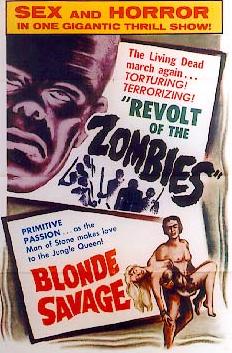
Revolt of the Zombies

Director: Victor Halperin
Writers: Victor Halperin, Rollo Lloyd, Howard Higgin
Producer: Edward Halperin
Cast: Dean Jagger, Dorothy Stone, Robert Noland
Country: USA
Year of release: 1936
Reviewed from: DVD (Classic Entertainment)

Everybody knows White Zombie. I mean, seriously, I can forgive you if you haven’t seen Bride of Frankenstein or Creature from the Black Lagoon or Dracula has Risen from the Grave but really, there’s no excuse for not having seen White Zombie. It’s a public domain film that has been released about five thousand times. Look, if you’ve never seen it, stop reading now, go off and get a copy, watch it, then come back.

Right, now have we all seen White Zombie?

This film has no narrative connection with the 1932 classic White Zombie. But it was made by the same people and released four years later, making it only the third ever zombie film (Michael Curtiz’s 1934 voodoo picture Ouanga popped up inbetween them). What makes Revolt of the Zombies particularly odd is that it is set not in Haiti, not even in the Southern USA - but in Cambodia.

Actually, a lengthy prologue is set in France during World War One, making this (I believe) the first war/horror crossover picture. There have been many, many war/horror films since - off the top of my head: The Keep, Deathwatch, The Bunker and on this site the likes of Hellraiser III, Night Wars and The Darkness Beyond - but this must surely be the first.

Twenty years before he worked for Hammer on X - The Unknown, Dean Jagger stars as Armand Louque, a translator in the French army, newly arrived at Cambrai (or somewhere on the western front, at any rate) with a Cambodian priest named Tsiang (according to the IMDB although it sounds like ‘Neo’ on the soundtrack). The Priest (William Crowell, who is about as Cambodian as I am) knows the secret of creating ‘zombies’ - not reanimated corpses but hypnotised men who will follow orders unquestioningly and who are impervious to pain. The French High Command wants none of this but Tsiang creates his zombie army anyway and there is a terrific sequence of unblinking soldiers advancing on a German trench, not even flinching as the terrified Bosch unload bullets into them. If the whole film stayed like this - or was even just about this - it would be a bona fide classic.

But a representative of ‘the Central European Powers’ appeals to the French High Command about this terrible weapon and the Frogs, assuring the Kraut that this attack was unauthorised, decide to lock up Tsiang where he can cause no more trouble. Two things strike me about this great prologue. The first is that the zombies, while they’re pretty much invincible, are only armed with regular guns so they don’t seem a particularly unfair weapon (compared with, say, mustard gas) and it’s difficult to believe that any army would agree to stop using an effective weapon because the enemy said it wasn’t fair. That’s not how war works, is it?

The other thing of note is that the slave-soldiers are referred to not only as ‘zombies’ but also as ‘robots’, a word which was coined only 16 years before this film and which had evidently still not settled down to meaning only a mechanical man but was capable of being applied to any non-human worker. Of course, a word coined in 1920 (in Karel Capek’s famous play RUR) is somewhat anachronistic when repeatedly used in scenes set during the 1914-1918 war.

So anyway, the priest is placed in solitary confinement where he is stabbed by an arm reaching out from behind a statue of Shiva (who’s going to notice one more arm?). This arm belongs to Colonel Mazovia (Roy D’Arcy, who for a cheap laugh I will point out was in both The Gay Deceiver and The Gay Buckaroo) who seems to be semi-oriental in terms of his goateed, quasi-demonic, sub-Fu Manchu appearance. Basically he looks very much like Bela Lugosi did as Murder Legendre in White Zombie.

Let’s just pause here to observe that Murder Legendre is absolutely the best character name in the history of cinema.

There’s no real explanation of who Colonel Mazovia is or why he is attached to the French army, but then there’s not much explanation of anything. For some reason it is decided among the various officers at this particular HQ that after the war they will all go on an expedition to Cambodia to discover the secret of zombification.

So we jump forward a few years to a back-projected photograph of a Cambodian temple. Louque is here along with another junior officer, his friend Clifford Grayson (Robert Noland - who seems to have done nothing else ever). There’s bluff General Duval (George Cleveland, who had a bit part in The Ape and played Gramps in the 1950s Lassie TV series), wiry Dr Trevissant (E Alyn ‘Fred’ Warren, who was in The Devil Doll the same year), Duval’s daughter Claire (Dorothy Stone) and the diabolical - but apparently completely unsuspicious - Colonel Mazovia. Plus a few other chaps. Louque, a shy, retiring chap, has the hots for Claire and they get engaged but she becomes enamoured of the more outgoing Grayson, which is ironic as he was the one who persuaded Louque that faint heart never won fair lady.

Somehow Louque discovers the secret of zombification. ‘Somehow’ in the sense that there is a carving that Mazovia has a drawing of (which he stole from the priest before he killed him) and Louque finds a photograph of this carving which leads him to a series of tunnels where he spots Mazovia up to no good and... it’s no use, this part of the plot is all over the shop. Anyway, the important thing is that Louque, consumed with jealousy, experiments with various substances until he creates the magic smoke that can turn men into zombies, which he tests by blowing it into the face of his servant Buna (Japanese actor Teru Shimada: The Snow Creature, You Only Live Twice).

Buna is now completely under the control of Louque who he is so delighted with this that he not only creates an army of native zombies, he also somehow enslaves General Duval and his associates. Quite how he does either of these things, given that the process seems to involve blowing magic smoke into someone’s face, is not explained. He also enslaves Grayson but he can’t bring himself to enslave Claire, the woman he loves.

Nevertheless, we see thousands - well, hundreds - well, scores of natives, marching in silent obedience to Louque’s will. We can tell when someone is under Louque’s power (the word ‘zombie’ has long since disappeared from the script by this point) because a pair of hypnotic eyes are superimposed on screen. Back in 1936, I imagine audiences accepted these as Louque’s eyes but watching this on DVD decades later with a background knowledge of classic horror, we can instantly spot that this is exactly the same shot of Lugosi’s eyes which was used when Murder Legendre imposed his will on his enslaved servants in White Zombie.

See, that’s why you had to watch that film first.

And isn’t Murder Legendre a great name? I wish I was called Murder Legendre.

Eventually Claire agrees to marry the now clearly bonkers Louque instead of Grayson if he will release all his zombie slaves. But when he does this, Buna immediately sets about leading the ex-zombie army to find and destroy the man who enslaved them. What is completely brilliant about this is that the shots of the ex-zombies advancing on Louque’s home are exactly the same shots that were used when these extras were zombies, just with ‘rabble noises’ dubbed over the top.

Buna and his friends break into the place and kill Louque and everyone else lives happily ever after. Or something.

I quiet enjoyed Revolt of the Zombies, which has ‘guilty pleasure’ written all the way through it like a stick of rock. The acting’s no great shakes but for the era it’s okay. Production design isn’t up to much but how many of this film’s intended audience would have any idea what Cambodia looked like. The climactic action sequence is pretty good as Buna and his comrades smash their way into the building and, as mentioned, the scenes of zombified troops advancing across No Man’s Land are actually very effective indeed.

But to be honest the only reason this film is remembered at all is because it has the word ‘zombies’ in the title in an age when zombie films were almost unknown and long, long before George Romero invented the cinematic zombie as we know it today. Revolt of the Zombies is no worse than many other independent horror films from the 1930s but it has the good fortune (or misfortune, depending on how you view it) to be made by the Halperin bothers - director Victor and producer Edward - who had a few years earlier struck gold with White Zombie, possibly the finest independent horror film of the decade and still regarded as a classic today. Revolt simply pales by comparison.

Also in the cast are Carl Stockdale (The Vampire Bat, Intolerance), Adolph Millard (the 1929 version of Bulldog Drummond), Selmer Jackson (The Atomic Submarine, The Ape, Mighty Joe Young) and Sana Rayya (who was in the 1936 Flash Gordon serial) as a dancer. The uncredited script is generally accepted as having been a three-way collaboration between Victor Halperin, Howard Higgin (The Invisible Ray) and actor Rollo Loyd who allegedly had a hand in the screenplay for Bride of Frankenstein!

Director of photography Arthur Martinelli (White Zombie, The Devil Bat and a 1921 sci-fi obscurity called A Message from Mars) was assisted by ‘operative cameraman’ J Arthur Feindel who later handled photography on Day the World Ended. Special effects (such as they are) were provided by Ray Mercer who worked for thirty years on pictures such as Blake of Scotland Yard, The New Adventures of Tarzan, Return of the Ape Man, Strange Holiday, White Pongo, The Feathered Serpent and Mesa of Lost Women).

Very little is known about the Halperin brothers, independent cinema of this era being less than assiduously chronicled in contemporary publications. Victor made at least two dozen pictures from the early 1920s to the early 1940s of which his brother Edward collaborated on about half, but it’s really only their four horror films for which they’re known - and truthfully that’s three because who has ever heard of 1939’s Torture Ship (in which Edward apparently had no hand)? White Zombie of course is famous as one of Lugosi’s finest movies from the early 1930s when he was a horror icon almost without peer (that’s ‘almost’, Karloff fans). In just four years or so after Dracula, Bela made Murders in the Rue Morgue, Island of Lost Souls, Chandu the Magician, The Black Cat - and White Zombie. In none of those other films did he have a character name as cool as Murder Legendre.

Supernatural, produced one year later, is less well-known but the presence of Carole Lombard and Randolph Scott assures it a place in Hollywood history, while the titular notoriety of Revolt of the Zombies is something I have already touched on. The most detailed biography of the Halperins is, I believe, included in Gary Don Rhodes’ book White Zombie: Anatomy of a Horror Film (McFarland, 2001) but even that is apparently patchy. Yet, frustratingly, Victor Halperin died as recently as 1983.

Revolt of the Zombies is a mixed bag: mostly corny but with occasional bursts of brilliance. It is deservedly more obscure that its predecessor - and would undoubtedly have been vastly improved by the presence of Lugosi as more than a pair of stock footage eyes - but it’s still worth watching if you’ve never seen it. (The Classic Entertainment triple bill partners Revolt with Attack of the Giant Leeches and The Amazing Transparent Man.)

MJS rating: C

Thursday, 20 March 2014

Night Wars

Director: David A Prior
Writer: David A Prior
Producer: Fritz Matthews
Cast: Dan Haggerty, Brian O’Connor, Steve Horton, Cameron Smith
Year of release: 1987
Country: USA
Reviewed from: UK rental VHS (Screen Entertainment)

I picked up this ex-rental VHS tape because (a) it was 50p and (b) it had a truly dreadful painting on the front. It turned out to be one of those double-sided sleeves so if you don’t want the awful painting you can see a ghastly, slightly out-of-focus photograph instead.

Trent Matthews (Brian O’Connor: Encounter at Raven’s Gate) and Jim Lowery (Cameron Smith), who calls Matthews ‘Sarge’, are Vietnam veterans. They were held captive by the enemy and tortured by a traitor from their own platoon, the clearly insane McGregor (Steve Horton). Somehow they managed to escape, taking with them their comrade Johnny (Chet Hood: Time Burst: The Final Alliance) - the end credits spell it ‘Jhonny’! - who was being held in a pit.

But Johnny/Jhonny was shot and they had to leave him, though he begged them not to. Since then they have been experiencing pangs of guilt and even nightmares, which are becoming more real. While test-driving a secondhand car (the insincere salesman is Jack Ott from Spiders), Matthews sees Johnny drive past and chases him - but of course it’s a complete stranger who looks nothing like Johnny.

Later, Matthews dreams that he, Lowery and the rest of the platoon are back in 'Nam, but if it’s a dream, how has he got a shrapnel wound in his hand when he wakes up? Things get worse: he imagines McGregor in the car next to him, jumps out and finds himself back in 'Nam again, where he sustains a cut to his neck while trying to rescue Johnny, who loses a finger to a Vietcong machete.

Matthews’ wife Susanne (Jill Foor: Moonstalker) is upset about her husband’s state of mind, about the unexplained injuries he is suffering - and about the finger she finds in their car! She takes this to family friend Dr Mike Campbell played by Grizzly Adams himself, top-billed Dan Haggerty. (Haggerty was also in Terror Night and a 1978 TV movie called Revenge of the Savage Bees, and he is the voice of Terl in the Battlefield Earth cartoon). Haggerty has the fing- wait a minute, there’s a Battlefield Earth cartoon? Ye gods! - has the fingerprint checked and it turns out to be Johnny’s.

What has happened is that time has somehow got twisted because Matthews and Lowery came home without Johnny, who they believe is still held prisoner by the Vietnamese and is contacting them through their dreams. The impression given is that Johnny is still there now, but he looks no older and has apparently been kept in the same hole in the ground for the past 15 years or so. McGregor is out to get the two men, and what they do in their sleep affects what happens in 'Nam, as when a dreaming Matthews runs out of ammo so the watching Lowery hands him a fresh clip in LA - and he suddenly has a fresh clip in Vietnam.

They buy $2,000 of weaponry from an arms dealer (Mike Hickam) who sells from the boot of his car. Dr Campbell initially tries to stop them, believing they’ve both gone loopy, but is convinced when he calls Susanne to tell her he has her husband under sedation and she says no, he’s right here. Of course it’s not Matthews. He looks like Matthews but after he has raped Susanne she sees it’s McGregor, who then stabs her violently. Dr Campbell rushes over but is too late to save Susanne from her invisible (to him) attacker.

Matthews seems entirely unfazed by the news that his wife is dead, and Campbell doesn’t even bother to explain the frankly unusual way in which she met her end. Instead he helps Matthews and Lowery to rescue Johnny. The two men suit up, black up and arm themselves with plentiful weaponry, then lie down on a double bed and go to sleep (the homo-erotic subtext is of course completely ignored!).

They somehow manage to rescue Johnny but bullets rake the bedroom and the doctor is (I think) killed. It ends with three sweaty men dressed in camo gear lying in each other’s arms on a plush double bed - and still there’s no hint of a gay subtext in any but the most jaundiced minds!

What a daft load of nonsense this all is. It’s basically Hamburger Hill meets A Nightmare on Elm Street and though it’s done sincerely enough it doesn’t exactly hang together, albeit the mixing between reality and dreams is adroitly handled. On the other hand, the pyrotechnics are dreadful (special effects by Chuck Whitton who has no other credits of any sort whatsoever it seems, unless the credits spell his name wrong too). All the explosions in the war scenes are clearly little thunderflashes which send up a shower of sparks but conspicuously fail to move even a handful of actual earth the way that real rockets and shells do.

Of course it goes without saying that all the Vietcong soldiers are lousy shots who can’t hit GIs standing in plain sight only a few yards away, whereas the Yanks can hit obscured targets, shooting from the hip while somersaulting. Speaking of which there is also a plethora of extras leaping in the air and flipping through 180 degrees as the feeble explosions go off behind them, very reminiscent of the two stuntmen employed on Space Mutiny.

The reasonable make-up is by Robin Slater (Severed Ties, Love Bites, the 1989 Masque of the Red Death) - the painted video sleeve tries to make it look like there are zombies in the movie but there aren’t. Cinematographer Stephen Ashley Blake also photographed the far more entertaining Sorority Babes in the Slimeball Bowl-O-Rama. The anonymous GIs include among their number Troy Fromin (Class of Nuke ‘Em High II and III) and none other than Joe Lara, a couple of years before he first donned the loin-cloth in Tarzan in Manhattan.

Writer/director David A Prior is a self-taught Alabama-based film-maker with nearly 30 feature films - almost all of which have two word titles - to his credit, including Death Chase, Future Force, Raw Nerve, Mutant Species and Codename: Silencer (aka Body Count). The original story for this is credited to Prior, his brother Ted (who served as art director) and casting director William Zipp

When it comes to Vietnam War/supernatural horror crossgenre pics, give me House any time.

MJS rating: D+

Saturday, 22 February 2014

Nazi Zombie Death Tales

Directors: James Eaves, Alan Ronald, Pat Higgins
Writers: James Eaves, Alan Ronald, Pat Higgins
Producers: James Eaves, Alan Ronald, Pat Higgins, Laura Tennant, Debbie Attwell
Cast: Tina Barnes, Lara Lemon, Jess-Luisa Flynn
Country: UK
Year of release: 2012
Reviewed from: unfinished screener (Safecracker Pictures)


[I have been asked by one of the film-makers to point out that this is (as usual) a detailed review which may contain spoilers. - MJS]

As I write this review, the web is full of negative comments about Ridley Scott’s Prometheus, released just a few days ago. Not because it’s bad, but because it doesn’t (and could never) live up to the ridiculously high expectations that people have built up for it.

My cinematic tastes and interests are, as you may have gathered if you’re a regular reader, somewhat different to most people’s. So although I’ll probably go and see Prometheus, I’m not really too arsed about it. On the other hand, I can sympathise with these people because I feel very much the same way about the motion picture formerly known as Battlefield Death Tales. If you were to stop me at random any time in the past few years and ask which films I was most looking forward to, high on my list would be (a) the next Jim Eaves movie, (b) the next Pat Higgins film, and (c) whatever the next thing is that escapes from inside Al Ronald’s mind.

These three gentlemen previously collaborated on Bordello Death Tales, one of the first in the current vogue for horror anthologies and a corking trilogy of tales which was even better than the sum of its parts. Separately, Jim made The Witches Hammer and Bane; Pat made TrashHouse, KillerKiller, HellBride and The Devil’s Music; and Al made Jesus vs the Messiah. Having enjoyed their initial collaboration, they decided to switch from the horrors of sex to the horrors of war and set to making three new half-hour shorts that could be bolted together. Unlike Bordello DT, there is no framing story, although there is a very brief narrative cross-over between Al’s tale and Pat’s. I like a framing story in an anthology personally, and one of the previous film’s strengths was that Madam Raven was actually relevant to all three tales rather than being just a detached narrator. But for Battlefield DT, each story is separate and complete and the only connection is a Second World War setting.

We kick off with Jim’s Medal of Horror, which starts with British Captain George (David Wayman: Death, The Dead Inside) in a bar watching burlesque fan-dancer Daisy (Jeanie Wishes). Clever editing moves the story forward through his seduction of the young woman and her receipt of a letter confirming Captain George’s death. Starting the film with a full five minutes of dialogue-free narrative is a brave move, rendered even braver by the subsequent scene of Captain George, very much alive, reporting to a US Army Major (Paul Kelleher: Spirits of the Fall, The Demon Within, Simon and Emily). What follows is ten minutes of two men in a room, one sitting, one standing, just talking. Some casual viewers might turn off after a while, wondering when we’ll get to any Nazi zombies, and I’m not sure that Medal of Horror wouldn’t be better as the middle segment.

The major does introduce the Z-word in an apparently unrelated anecdote about a dead US soldier who returned to base and took a great deal of effort to subdue. But mainly he is castigating George for being a shit by sending a fake condolence letter to Daisy, who turns out to be the Major’s daughter. And who has been captured, for no obvious reason, by the Germans. Specifically by “Hitler’s high priestess of the occult” Jezebel (Tina Barnes: A Day of Violence, Bane, F).

George sets off on what is effectively a suicide mission to rescue Daisy and on the way has some rather random encounters including a German soldier in a dark blue greatcoat who exemplifies one of the films’ main problems: costumes. With a big budget, a film can afford to hire lots of historically accurate WW2 uniforms and create/adapt any additional ones required. But when shooting on a shoestring, you take what you can get. I’m no military historian but none of the uniforms on show in any of the segments really convinced me. George’s greatcoat for example has no Captain’s pips. Jezebel, when we meet her, is wearing black leggings below her smart, black SS jacket. Some of the background British soldiers seem to be wearing outfits that are distinctly post-WW2. And this particular German soldier has a coat that might pass for a French uniform in World War 1 but doesn’t look like anything warn by any German troops ever.

This sort of historical inaccuracy takes one out of the film, as do a number of very obviously modern locations. But it really is all down to budget. At this level of film-making, beggars can’t be choosers and if you know someone with a military-looking outfit that might pass muster if the viewers don’t look to closely and have never seen Where Eagles Dare, or a hall big enough to film in that’s empty for a few days, you say thanks very much. Those of us who love B-movies have to rely on the energy, originality, enthusiasm, excitement and generally daft scary fun of the movie to gloss over such things, as they assuredly do. But it would be remiss of me not to note their existence.

Anyway, George’s most random encounter is with the zombified Red Baron. He comes across a crashed scarlet triplane in the woods; a frankly dodgy model shot to which, honestly, my initial reaction was: “What is a radio-controlled model aircraft doing in a 1940s-set story?” Once again we must asume/hope that the viewers have not even rudimentary knowledge of military history, because of course Manfred von Richtofen was not shot down in a wood, and both his plane and his body were recovered. However, in this alternate history, the bright red Fokker Dr.1 has somehow remained undiscovered, and in extremely good condition, for more than 20 years.

As George stares at this, the Red Baron himself (Eaves regular Sam Smith) leaps up from the ground, although it’s not clear whether he has just been hiding there or whether he too has lain undisturbed since the last war. Clad in a red flying outfit that matches his plane, even down to a red eye-patch, and bearing absolutely no resemblance whatsoever to the real von Richtofen (or indeed any German pilot!), this is very much a cartoon character. We must regard him as a character called ‘the Red Baron’, inspired extremely loosely by the legend, rather than the actual Red Baron himself.

But because a cartoon zombie WW1 flying ace isn’t weird enough, a karate-kicking Japanese zombie then appears and fights the German zombie, with both seeking to attack George if the other will let them. Quite what a Japanese soldier, living or dead, is doing in Northern Europe defeats me. Although it is worth noting that if this zombie is also meant to be a WW1 veteran then his fight against the Kraut is valid because the Japanese were on the Allied side during the 1914-18 war. On the other hand, his headband suggests he perhaps is supposed to be a kamikaze pilot, which would make him a WW2 airman and hence part of the Axis forces. While the two colourful undead tussle among the ferns, George makes his getaway through the woods and this utterly random weirdness is left behind.

In a bunker, he finally locates Jezebel and a single extraordinary German robot soldier, plus Daisy herself. Tina Barnes hams it up in her SS uniform and clearly had an absolute blast filming her extended death scene, although I can’t honestly say that I was convinced by her accent, whch at times seemed closer to Melbourne than Munich.

Medal of Horror runs about 35 minutes and, like the two stories which follow it, seems somewhat constrained by the format. I don’t know if there’s a feature here but it just doesn’t seem to fit the half-hour(-ish) restriction, especially given how slow most of the first half is. It seems a curiously disjointed tale. Fun, undeniably, but not totally satisfying.

Alan Ronald has the ‘golfing story’ slot with his tongue-in-cheek Harriet’s War which is completely different to the announced story. When the three plot synopses were revealed in January 2012, Al’s tale was called Monsters of the 4th Reich and went like this:

“Harriet Price tracks down monsters for the British Government. Armed with an array of inventions and contraptions she deals with everything from ghosts, demons, werewolves, vampires and once, she claims, even Churchill's Black Dog. But, along with her newly assigned partner; the cross dressing gunslinger 'Trixie Antoinette', this latest investigation will bring her face to face with the greatest monster of all... Hitler himself.”

The title may have been changed to avoid confusion with forthcoming British Nazi-zombie film The 4th Reich, but that’s just cosmetic. In fact, all that remains of this synopsis is Harriet Price herself, beautifully played by Lara Lemon in a costume to die for. She was in Al’s as-yet unreleased second feature Chinese Burns, which was written by and stars Julian Lamoral-Roberts - who was in Al’s Bordello DT story Stitchgirl and here plays the local vicar. Cy Henty turns up as the befuddled local copper, wearing an extraordinary policeman’s helmet and an even more extraordinary moustache.

Harriet Price is some sort of Government operative who visits the cosy little village of Chapelton to investigate a mysterious death, reporting to her superiors via a glorious sort of steampunk dictaphone. A young man has been found, dead and with multiple swastikas carved into his skin, while his girlfriend has disappeared (but later turns up in a similar condition). We saw in a prologue that they were killed by an apparently supernatural, German soldier with similar scars and a swastika blindfold

This is probably the simplest and most coherent of the three tales, let down only by the revelation of what is really going on, when Harriet suddenly proclaims to the plod and the priest, on the basis of no evidence whatsoever, the name of the only other significant character. Nevertheless, I think this is my favourite and it has that mannered surrealism that we have come to expect from Al’s work. Still, one can’t help wondering whatever happened to cross dressing gunslinger Trixie Antoinette...

Finally we have Pat’s tale Devils of the Blitz. This is the least comprehensible of the three stories and, truth be told, without having read the synopsis I don’t think I would have had a clue what was going on. Jess-Luisa Flynn (Adele in The Devil’s Music) plays the sister of a serving soldier with Liza Keast (The Witches Hammer) as her concerned mother and Geoffrey Sleight (also in The Devil’s Music) as her intolerant, rationalist grandfather. There are some sort of monsters in their house, grandly portrayed by rubbery puppet things instead of that modern CGI nonsense, and there is a subplot about the brother/son (Paul Cousins) being seriously injured which must have some connection to the main story but I couldn’t work out what.

As with Medal of Horror, this feels like it has been compressed to fit the format at the expense of explanation. It also suffers from being set during the Second World War’s quitest, gentlest air raid. Although we are told that the bombs are dropping outside, little can be heard and the house never shakes; a curious repetition of the silent off-screen gun-battle in HellBride.

Battlefield Death Tales is a fun little film but it’s not, in my opinion, as good as its predecessor. However, I’m in two minds about whether I’m being objective in this assessment (in a subjective way) or whether my disappointment is coloured by my high expectations. In one sense, I got exactly what I expected, because once again the segments are individualistic and identifiable. With a Jim Eaves film I expect action and startling imagery. In a Pat Higgins picture I expect strong characters and relationships. And when Al Ronald sits in the director’s chair I expect off-beat ideas and that thing I have mentioned before: mannered surrealism. And hey, I got all this from Battlefield DT. Never, in the field of indie horror movies, has so much scary fun been created by so few.

What I didn’t get was neat little vignettes of horror - and that’s what people expect in an anthology like this. Each of the tales in Bordello DT was ‘high concept’ but the stories here are more complex and none of them really succeed completely in what they set out to do.

There is also the question of the title. When the film was picked up for UK distribution by Safecracker, who had recently released Bordello DT, it was renamed Zombie Death Tales, with Amazon and other etailers mistaking promotional artwork for a finished DVD sleeve and listing it as The Red Baron in Zombie Death Tales. I can see that ‘zombie’ in a title has more marketing cachet than ‘battlefield’, and this matches the similar retitlng of US B-movie Horrors of War as Zombies of War by UK distributor Point Blank a couple of years ago. But of course, all zombie films are ‘death tales’ so that title didn’t really work and it was swiftly amended to Nazi Zombie Death Tales, which is what was on my screener. [The film was subsequently released in the USA as Angry Nazi Zombies and in Germany(!) as Nazi Zombie Battleground, meaning it now has more titles than the average Jess Franco flick. - MJS]

But here’s the problem. So far as I can tell, there are no Nazi zombies in this film. There are Nazis, and there are zombies, but no actual Nazi zombies. And truth be told, both Nazis and zombies are in short supply. Nazi-wise, there’s Tina Barnes as a sort of latter day Ilsa, there’s that briefly seen soldier in the blue coat, and there’s one more character who provides the explanation for the blindfold thing in Harriet’s War. There are no zombies at all in Al’s and Pat’s stories and although there is one zombie bite that sets up the climax of Medal of Horror, the only other possibly undead characters are those two bizarre figures who fight in the forest.

These two feature on Safecracker’s sleeve alongside the Nazi robot thing, and they have cheekily photoshopped a swastika badge onto the ribbon around the Red Baron’s neck. But in the film that ribbon supports an Iron Cross and the character is devoid of swastikas because of course he is a remnant from the First World War.

Nazi Zombie Death Tales isn’t really a zombie film, unless you’re ultra-completist. And while putting ‘zombie’ in the title may shift more units, I can’t help feeling it will shift them to people who will be pissed off when they find that they have bought a film with few if any zombies in it. Mind you, none of the stories are set on a battlefield either...

MJS rating: B+
review originally posted 7th August 2012

Postscript. I did go and see Prometheus. It was shit.