Director: Gary Jones
Writer: Stephen Brooks
Producers: Boaz Davidson, Danny Lerner
Cast: Lana Parrilla, Josh Green, Mark Phelan
Year of release: 2000
Country: USA
Reviewed from: Festival screening (Cannes 2000)
Spiders holds a special meaning for me, as it was seeing this Nu Image movie at Cannes 2000 that led to my two interviews on British breakfast TV that week. It’s a very enjoyable giant bug romp and let’s face it, you simply cannot go wrong with giant bug movies. Even the bad ones are good and Spiders is actually a pretty decent movie.
Intriguingly, the publicity fliers distributed at Cannes carried a synopsis for a story entirely unrelated to the finished film, all about an Incan mummy and a ‘proton interferometer’. What actually happens is that a space shuttle crashes near a military base, releasing a spider which was being used in orbital experiments but has become mutated. The title Spiders is, incidentally, a bit of a misnomer as there’s only ever one spider - well, one at a time.
Lana Parrilla (Spin City) and Josh Green (Curse of the Puppet Master) are the young people investigating what’s going on, while Mark Phelan (who has a healthy career playing cops, doctors and security guards in the likes of MANTIS, Doctor Mordrid and 12:01) is the government agent opposing them. Some of the spider effects are, frankly, embarrassing, as hapless actors struggle with largely inanimate puppets like a 1950s Tarzan wrestling a rubber alligator. But stick with the movie, because once the spider becomes large enough to render in CGI it’s absolutely awesome! The giant arachnid rampages through the town, crushing cars and knocking down lamp-posts - that’s what we want to see!
Spiders has a decent script by Stephen Brooks (a former Visual Effects Supervisor who also wrote the otherwise unconnected Spiders 2) and is smoothly directed by Gary Jones, helmer of Mosquito (another giant bug romp), Crocodile 2 (another Nu Image nature-amok flick) and various Hercules and Xena episodes. Cinematographer Jack Cooperman was responsible for the underwater footage in Star Trek IV and also worked on Hill Street Blues. Also in the cast are Billy Maddox (Deep Freeze), Jack Ott (Night Wars) and Jonathan Breck who played the title role in Jeepers Creepers and its sequel.
The US DVD sleeve image has no discernible connection with what happens in this film.
MJS rating: B+
Review originally posted 22nd May 2005.
MJ Simpson presents: the longest-running single-author film site on the web, est.2002.
Showing posts with label spiders. Show all posts
Monday, 1 February 2016
Spiders 2
Director: Sam Firstenberg
Writer: Stephen Brooks
Producers: Boaz Davidson, Danny Lerner, David Varod
Cast: Stephanie Niznik, Greg Cromer, Daniel Quinn, Richard Moll
Year of release: 2001
Country: USA
Reviewed from: VHS screener
This has no discernible connection with Spiders. On the other hand, unlike the first film, the story is roughly the one on the publicity fliers.
Our protagonists are Alex and Jason Paulsen (Stephanie Niznik: Star Trek: Insurrection; and Greg Cromer), a young couple whose yacht is wrecked mid-Pacific in a storm but who are rescued by a passing cargo boat, among whose crew are the slimy Captain Bigelow (Daniel Quinn: Scanner Cop I and II) and the sinister Dr Grbac (cult favourite Richard Moll, from House, Metalstorm: The Destruction of Jared-Syn and other memorable pictures).
Jason discovers that the radio isn’t broken, as the Captain claims, that the containers on deck are empty, that the ship is sailing in circles - and that there are dead people on meathooks in the freezer. Alex puts this down to hallucinations brought on by the constant antibiotic injections administered by Dr Grbac.
In fact, Grbac is conducting experiments in increased human immunity by combining human and spider DNA. He does this using unwilling victims kidnapped from passing boats by Bigelow and his crew; the victims are forcefully injected by the ovipositor of a giant (three metres or so) spider, and are then kept in sleep capsules until a baby (18 inches or so) spider bursts from their abdomen. This scientific side doesn’t actually make a lot of sense and is really just an excuse for some gruesome scenes and some cool giant spider shots. There’s no explanation of where the giant spiders originated - possibly they are descended in some way from the beastie in the first film, although that seems unlikely.
Spiders II (released in the USA as Spiders II: Breeding Ground) is an ambitious film which uses its limited budget well, especially with regards to depicting the mid-Pacific, given that the whole thing was shot in landlocked Bulgaria! The CGI spider effects by Scott Coulter, Chris Manabe and others are very good - more so than the puppet spiders - and the monsters are sensibly restricted to glimpses and partially hidden shots until the all-out arachnofest finale. Apart from a few crewmen, there are really only four characters, all of whom are well-acted, though Moll’s doctor is rather stereotypical (he even has an Igor-like assistant!). South African director Sam Firstenberg (Cyborg Cop I and II, whose second unit work on Crocodile got him this gig) keeps the pace going and builds tension, even though - apart from a pre-credits teaser - we don’t actually see any spiders until more than halfway through.
The mostly Bulgarian cast also includes Peter Antonov (a terrorist in Octopus), Dimiter Kuzov (a tugboat captain in Octopus 2) and Gerald Henderson, whose scenes in King Cobra were deleted - which many would consider a lucky escape. Special effects supervisor Willie Botha also worked on both Octopus films and cinematographer Peter Belcher lit the second one.
A fun romp this one, with some thrills, some shocks and plenty of eight-legged horrors.
MJS rating: B
Review originally posted 22nd May 2005.
Sunday, 2 March 2014
Missile to the Moon
Director: Richard E Cunha
Writers: HE Barrie, Vincent Fotre
Producer: Marc Frederic
Country: USA
Year of release: 1959
Reviewed from: UK DVD (Classic Entertainment)
Produced a year or so after Sputnik but a couple of years before Gagarin, Missile to the Moon opened in theatres two months after the Russian Luna 2 probe became the first manmade object to reach the Moon. So either its timing was perfect or it was rushed through production. Possibly both.
Richard Travis (Mesa of Lost Women) stars as Steve Dayton, who has been helping rocketry engineer Dirk Green (Michael Whalen - The Phantom from 10,000 Leagues - in possibly the worst toupee ever seen in a sci-fi movie) with a project to design, build and test a manned space rocket capable of reaching the Moon. On an evening when a senior military officer (Henry Hunter: Secret Agent X-9) has called to tell them that private space exploration is not allowed and the government will be taking over the project from now on, they are also visited by the local sheriff (Lee Roberts, topping off a career consisting of about a hundred westerns) out hunting for two escaped convicts.
Young, blond Lon (Gary Clarke: the teenage werewolf in How to Make a Monster) is a good guy who was six months away from release and regrets the robbery which landed him inside; short, pugnacious Gary (cartoon voice artist Tommy Cook - the character is identified as 'Gene Fennell' on the Inaccurate Movie Database for some reason) persuaded Lon to join his breakout and they are now hiding in the rocket. Searching the launch site with the sheriff, Dirk spots the two escapees but doesn't alert the law, although he does lock them inside. He later returns and asks them to help him launch the 'missile', which obviously doesn't require a great deal of training. Just before blast-off (stock footage of a captured V2 being tested by NASA, which looks nothing at all like the model rocket seen through the window of Dirk's office), Steve and his fiancee June (Cathy Downs: The Phantom from 10,000 Leagues, The She-Creature, The Amazing Colossal Man) climb aboard to find out what is going on.
The surprisingly swift journey through space sees Gary making a crude play for June and Dirk being fatally injured by a falling battery during a meteor storm. Just before breathing his last, he says something which sounds like 'leader' and gives Steve a medallion containing a big diamond while exhorting him to make sure the rocket lands in the location for which all the controls have been set.
This turns out to be Bronson Canyon, home to 90 per cent of all sci-fi movies, horror pictures and westerns ever filmed in Hollywood.
The quartet go exploring and encounter some absolutely hilarious rubber-suited 'rock-men' from whom they escape, though it is not clear in what way the aliens present a threat. They move at the glacial speed of the average mummy and seem entirely devoid of claws, jaws, weapons or anything else dangerous. The costumes are basically large, squarish chunks with slots to create arms and legs and while that is quite a neat design idea - standing still each rock-man becomes a seemingly solid slab - it is also really, really unthreatening. I don't like to mock low-budget special effects, so I will instead extend plaudits to whoever was inside these costumes and discovered a way to walk in them without falling over. Escaping into a cave, the gang discover that there is oxygen aplenty (somehow) and remove their aviators' face-masks.
At this point the film lurches into one of those tiny sub-subgenres that we all know and love: the matriarchal space-babe society. As far as I know, said subgenre consists of this film, Cat-Women from the Moon and Zsa-Zsa vamping it up in Queen of Outer Space. There are about a dozen or so hottish chicks living on the Moon, lead by a leader named the Lido (daytime soap regular KT Stevens) - which is what Dirk was saying before he died. Three others are named: scheming Alpha (Nina Bara: Tonga in Space Patrol, who, like several others in this cast, seems to have given up acting after this film, and you can understand why), gentle Zema (Marjorie Hellen: The Giant Spider Invasion, The Manchurian Candidate) and got-a-few-lines Lambda (Laurie Mitchell: Attack of the Puppet People, Queen of Outer Space).
All the others are played by beauty queens from the USA or abroad, including two girls who were also in Queen of Outer Space the same year, playing such similar non-speaking roles that it was hardly worth their getting changed. Remarkably, every one of these ladies seems to have accrued at least a few other credits: others were in The Ghost of Dragstrip Hollow, The Giant Gila Monster, Dr Goldfoot and the Bikini Machine, Abbott and Costello Go to Mars and episodes of Burke's Law and The Beverley Hillbillies.
Well, it seems that old Dirk was actually the Lido's husband and constructed his rocket-ship not to explore the Moon but to get back to his Missus. However, as none of the Moon-babes recall much about what he looked like and Steve now wears that diamond medallion, he is assumed to be Dirk. There is a network of caves beyond the women's exotically decorated rooms in which can be found lots of huge diamonds and a giant spider-thing played by a giant spider-thing-puppet.
Long story short, Alpha murders the Lido, proclaims herself the new Lido and arranges to 'marry' Steve (who, they have determined, isn't really Dirk). The women all have some sort of psychic power so that whatever the Lido says, all the others have to accept and obey, even if it basically boils down to: "I'm the new Lido and I didn't kill the old Lido who is lying here next to the throne with a dagger sticking out from between her shoulder blades." There are also some weird little bombs and a vague plan to leave the Moon and colonise Earth.
Good old Zema, who has rather fallen for Lon (and he for her) helps the two ex-cons to escape then blows up the throne room, bringing Steve out of his Alpha-induced trance but leaving herself trapped under the wreckage. The three lads rescue June from where she has been shackled up as a Kong-style offering to the giant spider-thing and head off back to the ship. Unfortunately for avaricious Gary, who is lagging behind the others, carrying two heavy bags of oversized diamonds, he gets cornered by a couple of rock-men. Backing away from them, he steps into direct sunlight which, as we all know, is far more deadly on the Moon than it is on Earth. Before you can say 'Dracula' his space-suit burns away leaving only a skeleton.
Steve, June and Lon make it back to the rocket-ship which successfully blasts off by superimposing that old V2 footage over a shot of Bronson Canyon and hoping nobody will notice the launch gantry. There is some desperately weak, sexist joke at the end that seems to have been tacked on to satisfy some sort of union regulation, and then it just stops.
Director Richard E Cunha had a brief but notable career. After learning his trade as a newsreel cameraman for the US Air Force he shot some largely forgotten TV shows before lunging into fantastique movies in partnership with producer Marc Frederic. Together they made Giant from the Unknown, She Demons, Frankenstein's Daughter and this picture - all within about a year of each other! Cunha shot a couple more non-genre pictures before disappearing.
Cinematographer Meredith Nicholson (who also lit The Amazing Transparent Man) went on to a busy TV career, working on such memorable shows as M*A*S*H, Batman, The Invaders and Mork and Mindy. Special effects are credited to Ira Anderson whose career extended from Rocky Jones, Space Ranger through a brace of Tarzan pictures to the likes of The Deep and Damien: Omen II.
Missile to the Moon is cheesy 1950s B-movie sci-fi at not only its cheesiest but also its B-movie-ist and frankly its 1950s-ist. It stems from an age when the idea of launching things into space had become viable but was still sufficiently outrageous that any old nonsense could be applied to it. And an age when having the Moon populated by a dozen young ladies, a bunch of sentient rocks and a single giant spider-thing was a cinematic possibility. Bless it.
The version on this triple bill DVD is very odd. The first reel (a reel is about twenty minutes long) is a lovely crisp image with only a few minor scratches, but the first few minutes of the second reel are not just scratchy but tatty, with both image and sound jumping and massive gashes appearing on screen. After that, the print is all over the place, sometimes too dark, sometimes heavily scratched, sometimes completely out of focus! And yet sometimes nice and crisp and clear again. I've never seen anything like it.
MJS rating: C-
Writers: HE Barrie, Vincent Fotre
Producer: Marc Frederic
Country: USA
Year of release: 1959
Reviewed from: UK DVD (Classic Entertainment)
Produced a year or so after Sputnik but a couple of years before Gagarin, Missile to the Moon opened in theatres two months after the Russian Luna 2 probe became the first manmade object to reach the Moon. So either its timing was perfect or it was rushed through production. Possibly both.
Richard Travis (Mesa of Lost Women) stars as Steve Dayton, who has been helping rocketry engineer Dirk Green (Michael Whalen - The Phantom from 10,000 Leagues - in possibly the worst toupee ever seen in a sci-fi movie) with a project to design, build and test a manned space rocket capable of reaching the Moon. On an evening when a senior military officer (Henry Hunter: Secret Agent X-9) has called to tell them that private space exploration is not allowed and the government will be taking over the project from now on, they are also visited by the local sheriff (Lee Roberts, topping off a career consisting of about a hundred westerns) out hunting for two escaped convicts.
Young, blond Lon (Gary Clarke: the teenage werewolf in How to Make a Monster) is a good guy who was six months away from release and regrets the robbery which landed him inside; short, pugnacious Gary (cartoon voice artist Tommy Cook - the character is identified as 'Gene Fennell' on the Inaccurate Movie Database for some reason) persuaded Lon to join his breakout and they are now hiding in the rocket. Searching the launch site with the sheriff, Dirk spots the two escapees but doesn't alert the law, although he does lock them inside. He later returns and asks them to help him launch the 'missile', which obviously doesn't require a great deal of training. Just before blast-off (stock footage of a captured V2 being tested by NASA, which looks nothing at all like the model rocket seen through the window of Dirk's office), Steve and his fiancee June (Cathy Downs: The Phantom from 10,000 Leagues, The She-Creature, The Amazing Colossal Man) climb aboard to find out what is going on.
This turns out to be Bronson Canyon, home to 90 per cent of all sci-fi movies, horror pictures and westerns ever filmed in Hollywood.
The quartet go exploring and encounter some absolutely hilarious rubber-suited 'rock-men' from whom they escape, though it is not clear in what way the aliens present a threat. They move at the glacial speed of the average mummy and seem entirely devoid of claws, jaws, weapons or anything else dangerous. The costumes are basically large, squarish chunks with slots to create arms and legs and while that is quite a neat design idea - standing still each rock-man becomes a seemingly solid slab - it is also really, really unthreatening. I don't like to mock low-budget special effects, so I will instead extend plaudits to whoever was inside these costumes and discovered a way to walk in them without falling over. Escaping into a cave, the gang discover that there is oxygen aplenty (somehow) and remove their aviators' face-masks.
At this point the film lurches into one of those tiny sub-subgenres that we all know and love: the matriarchal space-babe society. As far as I know, said subgenre consists of this film, Cat-Women from the Moon and Zsa-Zsa vamping it up in Queen of Outer Space. There are about a dozen or so hottish chicks living on the Moon, lead by a leader named the Lido (daytime soap regular KT Stevens) - which is what Dirk was saying before he died. Three others are named: scheming Alpha (Nina Bara: Tonga in Space Patrol, who, like several others in this cast, seems to have given up acting after this film, and you can understand why), gentle Zema (Marjorie Hellen: The Giant Spider Invasion, The Manchurian Candidate) and got-a-few-lines Lambda (Laurie Mitchell: Attack of the Puppet People, Queen of Outer Space).
All the others are played by beauty queens from the USA or abroad, including two girls who were also in Queen of Outer Space the same year, playing such similar non-speaking roles that it was hardly worth their getting changed. Remarkably, every one of these ladies seems to have accrued at least a few other credits: others were in The Ghost of Dragstrip Hollow, The Giant Gila Monster, Dr Goldfoot and the Bikini Machine, Abbott and Costello Go to Mars and episodes of Burke's Law and The Beverley Hillbillies.Well, it seems that old Dirk was actually the Lido's husband and constructed his rocket-ship not to explore the Moon but to get back to his Missus. However, as none of the Moon-babes recall much about what he looked like and Steve now wears that diamond medallion, he is assumed to be Dirk. There is a network of caves beyond the women's exotically decorated rooms in which can be found lots of huge diamonds and a giant spider-thing played by a giant spider-thing-puppet.
Long story short, Alpha murders the Lido, proclaims herself the new Lido and arranges to 'marry' Steve (who, they have determined, isn't really Dirk). The women all have some sort of psychic power so that whatever the Lido says, all the others have to accept and obey, even if it basically boils down to: "I'm the new Lido and I didn't kill the old Lido who is lying here next to the throne with a dagger sticking out from between her shoulder blades." There are also some weird little bombs and a vague plan to leave the Moon and colonise Earth.
Good old Zema, who has rather fallen for Lon (and he for her) helps the two ex-cons to escape then blows up the throne room, bringing Steve out of his Alpha-induced trance but leaving herself trapped under the wreckage. The three lads rescue June from where she has been shackled up as a Kong-style offering to the giant spider-thing and head off back to the ship. Unfortunately for avaricious Gary, who is lagging behind the others, carrying two heavy bags of oversized diamonds, he gets cornered by a couple of rock-men. Backing away from them, he steps into direct sunlight which, as we all know, is far more deadly on the Moon than it is on Earth. Before you can say 'Dracula' his space-suit burns away leaving only a skeleton.Steve, June and Lon make it back to the rocket-ship which successfully blasts off by superimposing that old V2 footage over a shot of Bronson Canyon and hoping nobody will notice the launch gantry. There is some desperately weak, sexist joke at the end that seems to have been tacked on to satisfy some sort of union regulation, and then it just stops.
Director Richard E Cunha had a brief but notable career. After learning his trade as a newsreel cameraman for the US Air Force he shot some largely forgotten TV shows before lunging into fantastique movies in partnership with producer Marc Frederic. Together they made Giant from the Unknown, She Demons, Frankenstein's Daughter and this picture - all within about a year of each other! Cunha shot a couple more non-genre pictures before disappearing.
Cinematographer Meredith Nicholson (who also lit The Amazing Transparent Man) went on to a busy TV career, working on such memorable shows as M*A*S*H, Batman, The Invaders and Mork and Mindy. Special effects are credited to Ira Anderson whose career extended from Rocky Jones, Space Ranger through a brace of Tarzan pictures to the likes of The Deep and Damien: Omen II.
Missile to the Moon is cheesy 1950s B-movie sci-fi at not only its cheesiest but also its B-movie-ist and frankly its 1950s-ist. It stems from an age when the idea of launching things into space had become viable but was still sufficiently outrageous that any old nonsense could be applied to it. And an age when having the Moon populated by a dozen young ladies, a bunch of sentient rocks and a single giant spider-thing was a cinematic possibility. Bless it.
The version on this triple bill DVD is very odd. The first reel (a reel is about twenty minutes long) is a lovely crisp image with only a few minor scratches, but the first few minutes of the second reel are not just scratchy but tatty, with both image and sound jumping and massive gashes appearing on screen. After that, the print is all over the place, sometimes too dark, sometimes heavily scratched, sometimes completely out of focus! And yet sometimes nice and crisp and clear again. I've never seen anything like it.MJS rating: C-
review originally posted 27th April 2005
Thursday, 5 December 2013
Is My Palm Read
Director: Dave Fleischer
Producer: Max Fleischer
Cast: Betty Boop, Koko the Clown, Bimbo
Country: USA
Year of release: 1933
Reviewed from: UK DVD
I recently picked up a DVD (volume one of two) of original Betty Boop cartoons, released in the UK by Delta. And what a delight to reacquaint myself with the little minx. Betty is one of those characters who is sufficiently iconic that everyone recognises her, but when did you last actually sit down and watch an original 1930s Betty Boop cartoon?
Produced by Fleischer Studios, who were serious rivals to Disney in those pre-Snow White days, the Betty Boop cartoons were usually deeply surreal, with inanimate objects coming to life temporarily and people and things changing shape and context almost on a whim. As well as the sheer sexuality and sassiness of the main character, there’s a joy in the possibilities of animation as a medium and, inherent in that (I feel) is a hint of darkness and danger. And sometimes, as in this instance, these little films are just plain weird.
Is My Palm Read, apart from being a corking title, is a great little early sound cartoon. It co-stars, as do many Betty Boop cartoons, two other Fleischer characters, an anthropomorphic pup named Bimbo (of course, Betty was a canine herself in her earliest appearances) and the redoubtable Koko the Clown. We see these two, in the opening sequence, bowing down before some unidentifiable shadows on a curtain. They are inside a building with a huge neon sign outside advertising the mysterious psychic powers of ‘Professor Bimbo: sees past, present, future’.
Betty arrives, looking surprisingly demure for this stage in her career, in a long dress and wide-brimmed hat. The doorbell consists of a cat with his tail through a hole in the wall who yells when his tail is pulled. Koko checks the visitor through a peephole which he has to move around the wall several times before finding her. He sticks his head through his legs and announces “Miss Betty Boop!” This is the cue for Bimbo to don a turban and fake beard.
Outside, an entrance hall unfurls down the front of the featureless wall and when Betty steps inside it turns into an elevator (although, as we have seen, Bimbo and Koko are also on the ground floor). She then enters by means of a Betty-shaped hole in the wall which is torn open by the doorbell cat.
We are about 45 seconds in and already this is bonkers.
Bimbo has a crystal ball in which we see an ocean liner being tossed and thrown at sea, eventually turned upside down by two waves-as-hands. All the passengers fall out and one becomes separated, adrift in a lifebelt. We zoom in to see that it is Betty. She makes it to an island where she quickly dons a halter top and hula skirt and sings ‘All by Myself in the Moonlight’.
There is a straw hut on the island, with two palm trees which lean over to grab our heroine and throw her into the hut, which is home to a bunch of ghosts (one has a bone in his hair, one wears a top hat, several have buck teeth). A spider spins bars across the window so Betty writes ‘help’ on a piece of wood, but one of the ghosts grabs it and throws it onto the log fire. (Why would you have a blazing log fire on a tropical island?)
Fortunately, this causes the smoke rising from the chimney to spell out ‘help’ which is seen by Bimbo, passing by on a mule (with the ‘Sailor’s Hornpipe’ on the soundtrack). He rescues Betty and they race off through the jungle, eventually making their escape in a small, squirrel-powered paddle-boat.
Back in what passes for reality, Betty says, “My hero!” Bimbo throws off his beard and turban and says, “Betty!” and with delight and surprise she responds “Bimbo!” (so I guess she missed that huge neon sign). A ghost promptly appears from under the crystal ball and chimes in “Bunko!”(?). He rips off Betty’s hat and dress, and underneath she has the hula skirt ensemble.
Bimbo and Betty race off as more ghosts swarm out from where the crystal ball was. Koko is entirely forgotten by this point as they are back in the jungle, making one wonder whether these scenes were originally intended to follow on directly from the previous chase. The ghosts get pelted with cocoanuts from a rebounding palm tree (the flexibility of palm trees seems to be the basis for quite a few gags, in fact) and eventually they all pile through a hollow log which leads out over a chasm, with Bimbo and Betty scrambling to safety and the ghosts all plummeting out of harm’s way. The end.
Absolutely insane. Had this been made 30 years later, people would be hailing it as a drugged out classic. (Mind you, there was an awful lot of drugs going around Hollywood in the 1930s...) The five minutes of Is My Palm Read (like I say, a great title, although come to think of it, no palm-reading actually occurs) are jam-packed with inventive visual gags which leave one in no doubt that this isn’t the real world. A fair amount of these gags involve violence inflicted by non-living or inanimate objects such as trees and waves. And thinking about it a bit more, although Bimbo never reads Betty’s palm, their adventures on the tropical island certainly do involve a lot of palm trees.
According to a synopsis on the Big Cartoon Database (which cites an alternative title of Professor Bimbo) there are three risqué gags missing from this print - although curiously this runs to the exact 5’12” quoted by the BCDB. And indeed there do, on closer inspection, seem to be three slight jumps in the action where the following things should be: when Betty first enters the room, the lights are arranged so that her silhouette shows through her (atypically demure) dress, marking out Bimbo as a sly rogue; before the crystal ball reveals the ship, it shows Betty as a young girl, naked in the bath; and when Betty arrives at the island, she removes her soaking dress before constructing her own hula skirt.
Even with these snips, this is a wildly entertaining short and I will certainly be adding some more of Betty’s more fantastical adventures to the site in the future.
Apart from the Fleischer brothers, the only other credits are for animators David Tendlar and William Henning.
MJS rating: B+
Producer: Max Fleischer
Cast: Betty Boop, Koko the Clown, Bimbo
Country: USA
Year of release: 1933
Reviewed from: UK DVD
I recently picked up a DVD (volume one of two) of original Betty Boop cartoons, released in the UK by Delta. And what a delight to reacquaint myself with the little minx. Betty is one of those characters who is sufficiently iconic that everyone recognises her, but when did you last actually sit down and watch an original 1930s Betty Boop cartoon?
Produced by Fleischer Studios, who were serious rivals to Disney in those pre-Snow White days, the Betty Boop cartoons were usually deeply surreal, with inanimate objects coming to life temporarily and people and things changing shape and context almost on a whim. As well as the sheer sexuality and sassiness of the main character, there’s a joy in the possibilities of animation as a medium and, inherent in that (I feel) is a hint of darkness and danger. And sometimes, as in this instance, these little films are just plain weird.
Is My Palm Read, apart from being a corking title, is a great little early sound cartoon. It co-stars, as do many Betty Boop cartoons, two other Fleischer characters, an anthropomorphic pup named Bimbo (of course, Betty was a canine herself in her earliest appearances) and the redoubtable Koko the Clown. We see these two, in the opening sequence, bowing down before some unidentifiable shadows on a curtain. They are inside a building with a huge neon sign outside advertising the mysterious psychic powers of ‘Professor Bimbo: sees past, present, future’.
Betty arrives, looking surprisingly demure for this stage in her career, in a long dress and wide-brimmed hat. The doorbell consists of a cat with his tail through a hole in the wall who yells when his tail is pulled. Koko checks the visitor through a peephole which he has to move around the wall several times before finding her. He sticks his head through his legs and announces “Miss Betty Boop!” This is the cue for Bimbo to don a turban and fake beard.
Outside, an entrance hall unfurls down the front of the featureless wall and when Betty steps inside it turns into an elevator (although, as we have seen, Bimbo and Koko are also on the ground floor). She then enters by means of a Betty-shaped hole in the wall which is torn open by the doorbell cat.
We are about 45 seconds in and already this is bonkers.
Bimbo has a crystal ball in which we see an ocean liner being tossed and thrown at sea, eventually turned upside down by two waves-as-hands. All the passengers fall out and one becomes separated, adrift in a lifebelt. We zoom in to see that it is Betty. She makes it to an island where she quickly dons a halter top and hula skirt and sings ‘All by Myself in the Moonlight’.There is a straw hut on the island, with two palm trees which lean over to grab our heroine and throw her into the hut, which is home to a bunch of ghosts (one has a bone in his hair, one wears a top hat, several have buck teeth). A spider spins bars across the window so Betty writes ‘help’ on a piece of wood, but one of the ghosts grabs it and throws it onto the log fire. (Why would you have a blazing log fire on a tropical island?)
Fortunately, this causes the smoke rising from the chimney to spell out ‘help’ which is seen by Bimbo, passing by on a mule (with the ‘Sailor’s Hornpipe’ on the soundtrack). He rescues Betty and they race off through the jungle, eventually making their escape in a small, squirrel-powered paddle-boat.
Back in what passes for reality, Betty says, “My hero!” Bimbo throws off his beard and turban and says, “Betty!” and with delight and surprise she responds “Bimbo!” (so I guess she missed that huge neon sign). A ghost promptly appears from under the crystal ball and chimes in “Bunko!”(?). He rips off Betty’s hat and dress, and underneath she has the hula skirt ensemble.
Bimbo and Betty race off as more ghosts swarm out from where the crystal ball was. Koko is entirely forgotten by this point as they are back in the jungle, making one wonder whether these scenes were originally intended to follow on directly from the previous chase. The ghosts get pelted with cocoanuts from a rebounding palm tree (the flexibility of palm trees seems to be the basis for quite a few gags, in fact) and eventually they all pile through a hollow log which leads out over a chasm, with Bimbo and Betty scrambling to safety and the ghosts all plummeting out of harm’s way. The end.
Absolutely insane. Had this been made 30 years later, people would be hailing it as a drugged out classic. (Mind you, there was an awful lot of drugs going around Hollywood in the 1930s...) The five minutes of Is My Palm Read (like I say, a great title, although come to think of it, no palm-reading actually occurs) are jam-packed with inventive visual gags which leave one in no doubt that this isn’t the real world. A fair amount of these gags involve violence inflicted by non-living or inanimate objects such as trees and waves. And thinking about it a bit more, although Bimbo never reads Betty’s palm, their adventures on the tropical island certainly do involve a lot of palm trees.
According to a synopsis on the Big Cartoon Database (which cites an alternative title of Professor Bimbo) there are three risqué gags missing from this print - although curiously this runs to the exact 5’12” quoted by the BCDB. And indeed there do, on closer inspection, seem to be three slight jumps in the action where the following things should be: when Betty first enters the room, the lights are arranged so that her silhouette shows through her (atypically demure) dress, marking out Bimbo as a sly rogue; before the crystal ball reveals the ship, it shows Betty as a young girl, naked in the bath; and when Betty arrives at the island, she removes her soaking dress before constructing her own hula skirt.
Even with these snips, this is a wildly entertaining short and I will certainly be adding some more of Betty’s more fantastical adventures to the site in the future.Apart from the Fleischer brothers, the only other credits are for animators David Tendlar and William Henning.
MJS rating: B+
review originally posted 26th November 2005
Saturday, 20 April 2013
Earth vs The Spider
Director: Bert I Gordon
Writers: Bert I Gordon, Laszlo Gorog, George Worthing Yates
Producers: Bert I Gordon, Samuel Z Arkoff, James H Nicholson
Cast: Gene Persson, June Kenney, Ed Kemmer
Year of release: 1958
Country: USA
Reviewed from: UK (Region 0) DVD (Direct Video Distribution)
You can’t really go wrong with a giant spider movie. From Tarantula to Eight-Legged Freaks via Spiders and, um, Spiders 2, big things with eight jointed legs are a horror staple.
In this AIP production, high school students Mike (Gene Persson, later a Broadway producer!) and Carol (June Kenney: The Viking Women and the Sea Serpent, Attack of the Puppet People) go looking for her father when he doesn’t return home from a business trip; they find his crashed car on a deserted highway near a length of strange, sticky ‘rope’ and wonder if he sought shelter in a nearby cave. Inside they find various skeletons, Carol’s dead father - and a giant spider, about fifty feet across. (Persson and Kenney were paired again three years later in Bloodlust.)
The sceptical sheriff (Gene Roth: a staple of serials whose credits go back to the 1923 Hunchback of Notre Dame and who played another sheriff-threatened-by-oversize-invertebrates the following year in Attack of the Giant Leeches) nevertheless rounds up a posse who investigate the cave, confront the spider and kill it with vast amounts of DDT. Mike and Carol’s science teacher Mr Kingman (Ed Kemmer: Giant from the Unknown) realises that such a unique specimen deserves study and the arachnid's carcass is transported (somehow!) back to town and stored in - where else? - the school hall.
The prom is imminent so a truly lame seven-piece rock and roll band (featuring comedy ‘fat bass player’ Skip Young from The Adventures of Ozzie and Harriet) get past school janitor Hugo (Hank Patterson, also in Tarantula) and start rehearsing on stage, and the passing drama club just have to cut a rug to the happening sounds, man. At which point the spider wakes up and goes on the rampage!
The longer title of this film, Earth vs the Spider, is used on the print and on the disc itself although the sleeve just calls it The Spider. Of course Earth doesn’t come into it as all the action is restricted to the little town of River Falls, where the local cinema (managed by Mike’s dad) is showing two other AIP movies: War of the Colossal Beast and Attack of the Puppet People (which also has Hank Patterson as a janitor) - a little bit of canny cross-promotion there. Among those specifically targeted by the monster, in the way of these things, is Kingman’s wife (Sally Fraser: War of the Colossal Beast, It Conquered the World).
The spider returns to its cave and the entrance is dynamited to keep it in there. Mickey Finn is astoundingly wooden as construction foreman Haskel who oversees the operation and one can see why most of his characters (in movies like Robin and the Seven Hoods and Taras Bulba) had no names. But wait, it’s not that simple. Mike and Carol were in the cave looking for a dropped brooch, so now the Sheriff, their parents, Kingman and the rest of them have to dig down into the cave to (a) rescue the kids and (b) kill the spider once and for all using mains electricity.
Giant things (or giant people) was a speciality of Bert I Gordon, whose apposite initials have oft been commented upon. In Beginning of the End he famously created the effect of giant locusts scrambling up a skyscraper by having normal-size locusts walk on a photograph, and the same technique is evident here, though not obviously so. A tarantula portrays the titular menace - though it does seem to change species a few times. However, this is combined with some decent matte work to surprisingly reasonable effect (sometimes the spider is matted in, sometimes the people). On the other hand, the use of photographic mattes to give foreground detail to the cave scenes results in geological features of a two-dimensionality unseen since the days of Georges Melies. When required to interact directly, there is a large prop spider leg which is waved from off-screen.
Cinematographer Jack Marta shot scores of westerns as well as SOS Tidal Wave and the 1960s Batman TV series while screenwriter Laszlo Gorog (The Mole People, The Land Unknown) was - here’s trivia for you! - the grandfather of the actor who provides the voice of Commander Nebula in Buzz Lightyear of Star Command! And watch out for a copy of Famous Monsters of Filmland in one scene.
The Spider is one of the first releases from DVD Ltd’s ‘Arkoff Film Library’ and is a nice, crisp print though full-screen. Like all the other titles in the initial batch, it includes a 50-minute audio recording of Arkoff interviewed at the NFT plus trailers for nine AIP flicks: War of the Clossal Beast, Voodoo Woman, Blood of Dracula, Day the World Ended, The Brain Eaters, How to Make a Monster, The She-Creature, The Undead and this film. The trailer uses the on-screen title The Spider and is in much worse shape than the film, not only very scratchy but so dark that little can be seen in places. Also included is a set of nine postcards reproducing the posters of all nine films, which form the basis for the sleeve artwork of the respective titles. (The NFT interview is a good, clear recording and plays over a repeated gallery of five photos of Arkoff on stage.)
For fans of 1950s B-movies, this is a smashing release of an archetypal movie in a very attractive version - and at a bargaintastic price of only a tenner. The Spider is a not a great film by any stretch of the imagination but it’s a great example of its type of film. DVD Ltd have the rights to 35 Arkoff titles and if they all look this good it’s going to cost me 350 quid!
But what really endeared me to this film is the revelation, about fifty minutes in, that Mike’s surname is Simpson - I have a movie namesake!
MJS rating: B+
review originally posted before November 2004
Writers: Bert I Gordon, Laszlo Gorog, George Worthing Yates
Producers: Bert I Gordon, Samuel Z Arkoff, James H Nicholson
Cast: Gene Persson, June Kenney, Ed Kemmer
Year of release: 1958
Country: USA
Reviewed from: UK (Region 0) DVD (Direct Video Distribution)
You can’t really go wrong with a giant spider movie. From Tarantula to Eight-Legged Freaks via Spiders and, um, Spiders 2, big things with eight jointed legs are a horror staple.
In this AIP production, high school students Mike (Gene Persson, later a Broadway producer!) and Carol (June Kenney: The Viking Women and the Sea Serpent, Attack of the Puppet People) go looking for her father when he doesn’t return home from a business trip; they find his crashed car on a deserted highway near a length of strange, sticky ‘rope’ and wonder if he sought shelter in a nearby cave. Inside they find various skeletons, Carol’s dead father - and a giant spider, about fifty feet across. (Persson and Kenney were paired again three years later in Bloodlust.)
The sceptical sheriff (Gene Roth: a staple of serials whose credits go back to the 1923 Hunchback of Notre Dame and who played another sheriff-threatened-by-oversize-invertebrates the following year in Attack of the Giant Leeches) nevertheless rounds up a posse who investigate the cave, confront the spider and kill it with vast amounts of DDT. Mike and Carol’s science teacher Mr Kingman (Ed Kemmer: Giant from the Unknown) realises that such a unique specimen deserves study and the arachnid's carcass is transported (somehow!) back to town and stored in - where else? - the school hall.
The prom is imminent so a truly lame seven-piece rock and roll band (featuring comedy ‘fat bass player’ Skip Young from The Adventures of Ozzie and Harriet) get past school janitor Hugo (Hank Patterson, also in Tarantula) and start rehearsing on stage, and the passing drama club just have to cut a rug to the happening sounds, man. At which point the spider wakes up and goes on the rampage!
The longer title of this film, Earth vs the Spider, is used on the print and on the disc itself although the sleeve just calls it The Spider. Of course Earth doesn’t come into it as all the action is restricted to the little town of River Falls, where the local cinema (managed by Mike’s dad) is showing two other AIP movies: War of the Colossal Beast and Attack of the Puppet People (which also has Hank Patterson as a janitor) - a little bit of canny cross-promotion there. Among those specifically targeted by the monster, in the way of these things, is Kingman’s wife (Sally Fraser: War of the Colossal Beast, It Conquered the World).
The spider returns to its cave and the entrance is dynamited to keep it in there. Mickey Finn is astoundingly wooden as construction foreman Haskel who oversees the operation and one can see why most of his characters (in movies like Robin and the Seven Hoods and Taras Bulba) had no names. But wait, it’s not that simple. Mike and Carol were in the cave looking for a dropped brooch, so now the Sheriff, their parents, Kingman and the rest of them have to dig down into the cave to (a) rescue the kids and (b) kill the spider once and for all using mains electricity.Giant things (or giant people) was a speciality of Bert I Gordon, whose apposite initials have oft been commented upon. In Beginning of the End he famously created the effect of giant locusts scrambling up a skyscraper by having normal-size locusts walk on a photograph, and the same technique is evident here, though not obviously so. A tarantula portrays the titular menace - though it does seem to change species a few times. However, this is combined with some decent matte work to surprisingly reasonable effect (sometimes the spider is matted in, sometimes the people). On the other hand, the use of photographic mattes to give foreground detail to the cave scenes results in geological features of a two-dimensionality unseen since the days of Georges Melies. When required to interact directly, there is a large prop spider leg which is waved from off-screen.
Cinematographer Jack Marta shot scores of westerns as well as SOS Tidal Wave and the 1960s Batman TV series while screenwriter Laszlo Gorog (The Mole People, The Land Unknown) was - here’s trivia for you! - the grandfather of the actor who provides the voice of Commander Nebula in Buzz Lightyear of Star Command! And watch out for a copy of Famous Monsters of Filmland in one scene.
The Spider is one of the first releases from DVD Ltd’s ‘Arkoff Film Library’ and is a nice, crisp print though full-screen. Like all the other titles in the initial batch, it includes a 50-minute audio recording of Arkoff interviewed at the NFT plus trailers for nine AIP flicks: War of the Clossal Beast, Voodoo Woman, Blood of Dracula, Day the World Ended, The Brain Eaters, How to Make a Monster, The She-Creature, The Undead and this film. The trailer uses the on-screen title The Spider and is in much worse shape than the film, not only very scratchy but so dark that little can be seen in places. Also included is a set of nine postcards reproducing the posters of all nine films, which form the basis for the sleeve artwork of the respective titles. (The NFT interview is a good, clear recording and plays over a repeated gallery of five photos of Arkoff on stage.)For fans of 1950s B-movies, this is a smashing release of an archetypal movie in a very attractive version - and at a bargaintastic price of only a tenner. The Spider is a not a great film by any stretch of the imagination but it’s a great example of its type of film. DVD Ltd have the rights to 35 Arkoff titles and if they all look this good it’s going to cost me 350 quid!
But what really endeared me to this film is the revelation, about fifty minutes in, that Mike’s surname is Simpson - I have a movie namesake!
MJS rating: B+
review originally posted before November 2004
Saturday, 12 January 2013
Ator the Fighting Eagle
Director: ‘David Hills’
Writer: ‘David Hills’
Producer: Alex Susmann
Cast: Miles O’Keeffe, Sabrina Siani, Edmund Purdom
Country: Italy
Year of release: 1982
Reviewed from: UK VHS (Thorn EMI)
It’s been a while since I watched one of these sword-and-spaghetti sub-Conan fantasy frolics and frankly this is rather a good one. I don’t mean that it’s a particularly good film, but it’s one of the earlier examples of the subgenre and consequently one of the more professional and imaginative.
The pseudonymous writer/director of Ator l’Invincibile is actually old Joe D’Amato himself (Arristide Massaccesi to his mum) who also handled cinematography as ‘Frederick Slonisco’. According to the IMDB, Michele Soavi (Dellamorte Dellamore) has an uncredited hand in the script and that’s quite believable because there are one or two really rather good bits. There’s some dumb stuff too, of course.
The land of wherever-it-is is under the rule of the Spider, whatever that means. The top man is a character merely credited as High Priest of the Spider, played by the mono-monickered Dakkar (Zombie Holocaust), a bald, black, beardy bloke with a penchant for letting large spiders crawl over his arms and head. He also wears an extraordinary amount of gold eye-shadow.
The obligatory prophecy is that the mighty warrior Torin will be defeated by the forces of the Spider but that his son will succeed where Torin failed. Consequently, the black-garbed goons of the Spider are sent out a-Herod-ing, killing all newborn children. But baby Ator is saved by Griba (the redoubtable Edmund Purdom), a banished Priest of the Spider, who cunningly deposits him with a family in a village on the edge of the kingdom, who have just had a daughter of their own. Griba uses his magic (or possibly a dab of foundation) to cover up the ‘mark of Torin’ birthmark on the baby’s shoulder.
Of course, the baby grows up into Miles O’Keeffe, fresh from his screen debut as Tarzan. He wears big furry boots and a metal frisbee on his chest and has the most massive 1980s poodle hair which makes him look like the keyboard player out of Europe. His stepsister Sunya grows up to be shapely brunette Ritza Brown, to whom he gives that most precious of presents, a bear cub. (Brown went on to be an animation producer, her credits including a 1996 feature-length cartoon about Siegfried and Roy!)
A rather creepy bit of the film is the fact that Ator and Sunya fall in love and decide to get married before they discover that Ator is adopted. Fortunately, as soon as Ator tells their parents about their incestuous plans, they reveal the truth and the wedding can go ahead. But the celebrations are interrupted by the Spider’s men who slay all the villagers and carry off Sunya, which apart from anything else makes one wonder why they didn’t visit the village when they were looking for babies twenty years earlier. Ator and his bear cub decide to set off and rescue Sunya.
On the way he rescues blonde warrior babe Roon (Sabrina Siani, a familiar pair of legs from Mondo Cannibale, 2020 Texas Gladiators, Throne of Fire and Lucio Fulci's Conquest) from two rogues, only to discover that she was in fact the aggressor in the incident and she doesn’t want any help. Later, when he is captured by an all-female tribe who require a new leader to be conceived, Roon beats three other women in a decidedly crap girlie fight to win the honour of being impregnated by the prisoner. She agrees to free him but must then accompany him because the tribe will be after her too, so off they run. With the bear cub - who is actually really cute and easily the star of the film.
When they get separated, Ator hears Roon’s voice but it’s actually a trick played by the witch Indun (Black Emmanuel herself, Laura Gemser, best known to readers of this site as costume designer for Troll 2) who lures him into her surprisingly well-furnished cave and shows him a fake vision of Sunya snuggling up to the bald, black, beardy baddy. Roon rescues him just in time, having been rescued herself by the cub. Actually, that’s probably the funniest part of the film, with Roon trapped in a cave behind a rockfall. In response to her calls, the little cub - it’s maybe two feet long - paws away at the boulders and somehow shifts enough for Roon to get out. But she’s a strapping lass and uninjured: why doesn’t she just clear the rockfall from her side?
Indun has a magic mirror in her cave and when Ator removes the cloth which covers it, she catches sight of her own reflection and turns into a hideous hag. She swears revenge as Ator and Roon depart but in fact we never see her again.
The best part of the film comes when Roon and Ator retrieve a mystical shield which is essential to their quest. First they have to sneak through a cave where a squad of blind warriors are forging swords and axes, then they descend a hole into a cave where the shield lies and it is there that Ator is forced to fight his own shadow. This is a terrifically well directed sequence which uses no special effects, just clever lighting and imaginative fight choreography. Quite possibly the best thing ever in a crap Italian fantasy film.
When they finally confront the Spider soldiers, Roon sacrifices herself while Ator rescues Sunya from a giant web, rather obviously made out of rope (she’s even tied to it). But stap me if there isn’t an actual giant spider glimpsed in the background, waving its legs around. And when Ator battles the High Priest atop a set of stone steps, there is another giant spider (could be the same one but looks to be a bigger and better puppet). Ator uses the shield to make the High Priest explode, or something.
Oh and Griba, who pops up occasionally to offer advice or wipe Ator’s shoulder, revealing a birthmark which everyone immediately identifies as ‘the mark of Torin’, turns out to have his own agenda. Being a banished priest, he was merely using Ator to defeat the current High Priest in an attempt to usurp power within the whole Spider set-up. But he gets his come-uppance. I should also mentioned Purdom’s hair, a long, greasy, flat-cut affair which, frankly, looks like he bought a deluxe Merseybeat wig but it was a size too big.
O’Keeffe returned to the character of Ator (or at least, a character called Ator), two years later in a sequel for D’Amato which was released in English as The Blade Master and then, after wielding a more English weapon as Sir Gawain in Sword of the Valiant, was Ator a third and final time in Alfonso Brescia’s Iron Warrior in 1987. He went on to appear as Dracula in Waxwork and as John Smith in a 1995 version of Pocahontas. Eric Allan Kramer took over the character in 1990’s Quest for the Mighty Sword, once again directed by D’Amato.
Edmund Purdom, remarkably, is still alive and is about to celebrate his 82nd birthday as I type this in December 2006. Acting since the early 1950s, his genre credentials include Herod in Herod the Great, Rasputin in The Night They Killed Rasputin, the American President in 2019: After the Fall of New York, Dracula in Fraccia contro Dracula, plus Dr Frankenstein’s Castle of Freaks, Airport '79 rip-off The Concorde Affair, Jesus Franco’s Sinister Eyes of Dr Orloff, City of the Walking Dead, Anthropophagous 2, Endgame and, most recently in 2001, a voice in Titanic: The Animated Movie.
Also in the cast are Nella Pazzafini (as ‘Nat William’) whose 200 or so credits include a slew of pepla, a fistful of spaghetti westerns and a bunch of Bond rip-offs plus The Long Hair of Death, Amazons Against Supermen, Puma Man, Endgame, The Ironmaster and Ator 2 (as a different character). Producer Alex Susmann is like many of the other credits, a pseudonym which was only ever used on this film and its sequel, in this case disguising executive producer Helen Sarlui who gets a ‘...presents’ credit on this print. Her other ex.prod. credits include Alien Predator (which was released in the UK as Mutant 2), Monster Dog, Avi Nesher’s version of She and, oddly, Killer Klowns from Outer Space. The music is by Carlo Maria Cordio (Troll 2 and several other unrelated sequels to American films) with Simona Pirone providing the uncredited song over the end titles. Chris Trainor (another pseudonym) is credited as associate producer.
A poster that I found on the web, which just calls the film Ator and was used for the Danish video sleeve, features a three-balled mace and a sabre-toothed tiger - which, if they were in the film, I promise you I would have mentioned. It credits O’Keeffe, Siani, Warren Hillman, Brooke Hart, Ron Carter “and introducing”(!) Edmund Purdom. This lists two executive producers (Susmann and Ron Phillips), two associate producers (Trainor and Joseph Russel) and one common or garden producer (Patrick Murphy) and credits the music to John Beck.
This first Ator film has a few imaginative touches, such as the shadow fight, but mostly it scores over other films in the same genre by simply not cutting corners with cheap locations. No drainpipes or handrails in any of these ancient ruins. O’Keeffe is pleasant if wooden and everyone else has fun overacting, plus I can’t really criticise any film that features Sabrina Siani’s pins.
MJS rating: B
Review originally posted 17th December 2006
Writer: ‘David Hills’
Producer: Alex Susmann
Cast: Miles O’Keeffe, Sabrina Siani, Edmund Purdom
Country: Italy
Year of release: 1982
Reviewed from: UK VHS (Thorn EMI)
It’s been a while since I watched one of these sword-and-spaghetti sub-Conan fantasy frolics and frankly this is rather a good one. I don’t mean that it’s a particularly good film, but it’s one of the earlier examples of the subgenre and consequently one of the more professional and imaginative.
The pseudonymous writer/director of Ator l’Invincibile is actually old Joe D’Amato himself (Arristide Massaccesi to his mum) who also handled cinematography as ‘Frederick Slonisco’. According to the IMDB, Michele Soavi (Dellamorte Dellamore) has an uncredited hand in the script and that’s quite believable because there are one or two really rather good bits. There’s some dumb stuff too, of course.
The land of wherever-it-is is under the rule of the Spider, whatever that means. The top man is a character merely credited as High Priest of the Spider, played by the mono-monickered Dakkar (Zombie Holocaust), a bald, black, beardy bloke with a penchant for letting large spiders crawl over his arms and head. He also wears an extraordinary amount of gold eye-shadow.
The obligatory prophecy is that the mighty warrior Torin will be defeated by the forces of the Spider but that his son will succeed where Torin failed. Consequently, the black-garbed goons of the Spider are sent out a-Herod-ing, killing all newborn children. But baby Ator is saved by Griba (the redoubtable Edmund Purdom), a banished Priest of the Spider, who cunningly deposits him with a family in a village on the edge of the kingdom, who have just had a daughter of their own. Griba uses his magic (or possibly a dab of foundation) to cover up the ‘mark of Torin’ birthmark on the baby’s shoulder.
Of course, the baby grows up into Miles O’Keeffe, fresh from his screen debut as Tarzan. He wears big furry boots and a metal frisbee on his chest and has the most massive 1980s poodle hair which makes him look like the keyboard player out of Europe. His stepsister Sunya grows up to be shapely brunette Ritza Brown, to whom he gives that most precious of presents, a bear cub. (Brown went on to be an animation producer, her credits including a 1996 feature-length cartoon about Siegfried and Roy!)A rather creepy bit of the film is the fact that Ator and Sunya fall in love and decide to get married before they discover that Ator is adopted. Fortunately, as soon as Ator tells their parents about their incestuous plans, they reveal the truth and the wedding can go ahead. But the celebrations are interrupted by the Spider’s men who slay all the villagers and carry off Sunya, which apart from anything else makes one wonder why they didn’t visit the village when they were looking for babies twenty years earlier. Ator and his bear cub decide to set off and rescue Sunya.
On the way he rescues blonde warrior babe Roon (Sabrina Siani, a familiar pair of legs from Mondo Cannibale, 2020 Texas Gladiators, Throne of Fire and Lucio Fulci's Conquest) from two rogues, only to discover that she was in fact the aggressor in the incident and she doesn’t want any help. Later, when he is captured by an all-female tribe who require a new leader to be conceived, Roon beats three other women in a decidedly crap girlie fight to win the honour of being impregnated by the prisoner. She agrees to free him but must then accompany him because the tribe will be after her too, so off they run. With the bear cub - who is actually really cute and easily the star of the film.
When they get separated, Ator hears Roon’s voice but it’s actually a trick played by the witch Indun (Black Emmanuel herself, Laura Gemser, best known to readers of this site as costume designer for Troll 2) who lures him into her surprisingly well-furnished cave and shows him a fake vision of Sunya snuggling up to the bald, black, beardy baddy. Roon rescues him just in time, having been rescued herself by the cub. Actually, that’s probably the funniest part of the film, with Roon trapped in a cave behind a rockfall. In response to her calls, the little cub - it’s maybe two feet long - paws away at the boulders and somehow shifts enough for Roon to get out. But she’s a strapping lass and uninjured: why doesn’t she just clear the rockfall from her side?
Indun has a magic mirror in her cave and when Ator removes the cloth which covers it, she catches sight of her own reflection and turns into a hideous hag. She swears revenge as Ator and Roon depart but in fact we never see her again.The best part of the film comes when Roon and Ator retrieve a mystical shield which is essential to their quest. First they have to sneak through a cave where a squad of blind warriors are forging swords and axes, then they descend a hole into a cave where the shield lies and it is there that Ator is forced to fight his own shadow. This is a terrifically well directed sequence which uses no special effects, just clever lighting and imaginative fight choreography. Quite possibly the best thing ever in a crap Italian fantasy film.
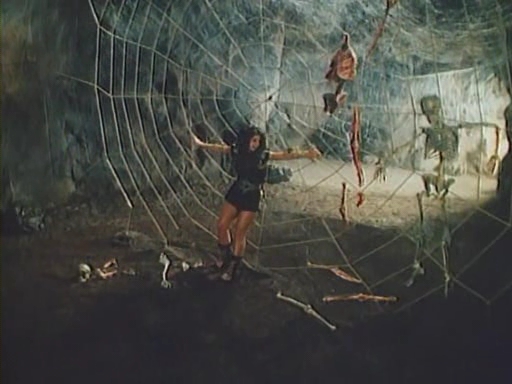
When they finally confront the Spider soldiers, Roon sacrifices herself while Ator rescues Sunya from a giant web, rather obviously made out of rope (she’s even tied to it). But stap me if there isn’t an actual giant spider glimpsed in the background, waving its legs around. And when Ator battles the High Priest atop a set of stone steps, there is another giant spider (could be the same one but looks to be a bigger and better puppet). Ator uses the shield to make the High Priest explode, or something.
Oh and Griba, who pops up occasionally to offer advice or wipe Ator’s shoulder, revealing a birthmark which everyone immediately identifies as ‘the mark of Torin’, turns out to have his own agenda. Being a banished priest, he was merely using Ator to defeat the current High Priest in an attempt to usurp power within the whole Spider set-up. But he gets his come-uppance. I should also mentioned Purdom’s hair, a long, greasy, flat-cut affair which, frankly, looks like he bought a deluxe Merseybeat wig but it was a size too big.
O’Keeffe returned to the character of Ator (or at least, a character called Ator), two years later in a sequel for D’Amato which was released in English as The Blade Master and then, after wielding a more English weapon as Sir Gawain in Sword of the Valiant, was Ator a third and final time in Alfonso Brescia’s Iron Warrior in 1987. He went on to appear as Dracula in Waxwork and as John Smith in a 1995 version of Pocahontas. Eric Allan Kramer took over the character in 1990’s Quest for the Mighty Sword, once again directed by D’Amato.Edmund Purdom, remarkably, is still alive and is about to celebrate his 82nd birthday as I type this in December 2006. Acting since the early 1950s, his genre credentials include Herod in Herod the Great, Rasputin in The Night They Killed Rasputin, the American President in 2019: After the Fall of New York, Dracula in Fraccia contro Dracula, plus Dr Frankenstein’s Castle of Freaks, Airport '79 rip-off The Concorde Affair, Jesus Franco’s Sinister Eyes of Dr Orloff, City of the Walking Dead, Anthropophagous 2, Endgame and, most recently in 2001, a voice in Titanic: The Animated Movie.
Also in the cast are Nella Pazzafini (as ‘Nat William’) whose 200 or so credits include a slew of pepla, a fistful of spaghetti westerns and a bunch of Bond rip-offs plus The Long Hair of Death, Amazons Against Supermen, Puma Man, Endgame, The Ironmaster and Ator 2 (as a different character). Producer Alex Susmann is like many of the other credits, a pseudonym which was only ever used on this film and its sequel, in this case disguising executive producer Helen Sarlui who gets a ‘...presents’ credit on this print. Her other ex.prod. credits include Alien Predator (which was released in the UK as Mutant 2), Monster Dog, Avi Nesher’s version of She and, oddly, Killer Klowns from Outer Space. The music is by Carlo Maria Cordio (Troll 2 and several other unrelated sequels to American films) with Simona Pirone providing the uncredited song over the end titles. Chris Trainor (another pseudonym) is credited as associate producer.
A poster that I found on the web, which just calls the film Ator and was used for the Danish video sleeve, features a three-balled mace and a sabre-toothed tiger - which, if they were in the film, I promise you I would have mentioned. It credits O’Keeffe, Siani, Warren Hillman, Brooke Hart, Ron Carter “and introducing”(!) Edmund Purdom. This lists two executive producers (Susmann and Ron Phillips), two associate producers (Trainor and Joseph Russel) and one common or garden producer (Patrick Murphy) and credits the music to John Beck.This first Ator film has a few imaginative touches, such as the shadow fight, but mostly it scores over other films in the same genre by simply not cutting corners with cheap locations. No drainpipes or handrails in any of these ancient ruins. O’Keeffe is pleasant if wooden and everyone else has fun overacting, plus I can’t really criticise any film that features Sabrina Siani’s pins.
MJS rating: B
Review originally posted 17th December 2006
Subscribe to:
Posts (Atom)