Sunday, 12 October 2014

Quest for the Seven Cities

Director: Mark L Lester
Writer: 'Sue Donem'
Producer: Alfredo Leone
Cast: Bo Svenson, Anita Ekberg, Donald Pleasence
Year of release: 1979
Country: USA
Reviewed from: UK VHS (Scan Euro Video, 1987)

In today’s media world, there is no stigma to being a TV movie. Telemovies are often better than the films we see in the cinema, with top stars, excellent scripts, big budgets and talented directors. But there was a time, not so long ago, when telemovies were almost guaranteed to be pisspoor with slumming has-beens, hopeless wannabes and non-existent budgets.

One such is this late 1970s piece of nonsense, the quality of which can be accurately judged by the way that the writer has disguised his/her name with a staggeringly lame nom-de-plume. It seems that even Alan Smithee wouldn’t own up to Quest for the Seven Cities.

Originally released as Gold of the Amazon Women, the movie stars Bo Svenson (Wizards of the Lost Kingdom, Curse II, Kill Bill Vol.2 and the monster in the faithful but dull Victor Frankenstein), who looks like a sort of cut-price Rutger Hauer, as explorer Tom Jensen. On his way to the ‘Discoverers Club’ in New York, he is watched from the rooftops by two young women dressed in animal skins and carrying bows and arrows. A staggeringly wooden receptionist tells him that a man has been calling for him and this turns out to be elderly explorer Frederick Reynolds (Carl Low), believed dead in the jungles of South America. Reynolds has discovered the legendary seven cities of El Dorado but a man named Blasko plans to steal all the gold and use it to dominate the world drugs market. Or something.

Reynolds gives Jensen a map before being hit by two arrows from the young ladies, who then shoot each other as a form of double suicide.

At Reynolds’ wake, Jensen finds himself chatting with Luis Escobar (Richard Romanus: The Couch Trip and a recurring role in The Sopranos), a camping supplies store-owner who has never been further then upstate New York. “Was he really that famous?” asks Escobar, to which Jensen replies, “If Frederick Reynolds had lived in the 16th century they probably would have named a country after him. But he didn’t.” When their dining companion is poisoned by a man disguised as a waiter, Tom decides to go to South America to find the cities and Luis decides to go with him. It is never explained who the pseudo-waiter was or why he killed their companion, but then lots of things in this film are not explained.

Watching from a passing limo is Clarence Blasko, played by Donald Pleasence, who didn’t half make some crap films in among the good ones.

After the first ad break, Tom and Luis are in Brazil where a monk gives them a copy of a map because the original was stolen a few weeks ago. This suggests that Blasko stole it but then why is he (as we will discover) desperate to get Tom’s map? And why does Tom need the monk’s map when he has the one that Reynolds gave him? Never mind because in their hotel room Tom finds a ridiculously rubber snake in his suitcase, which is all that is needed for him and Luis to jump off their balcony into the shrubbery, climb into their landrover and drive off as Blasko and two leggy lovelies shoot at them.

The rest of the film takes place in the Amazon jungle although no attempt is made at continuity as the amount and type of vegetation varies from one shot to the next and it all looks about as lush and tropical as my back garden in Leicester. And for unexplored jungle, it doesn’t half have some parts that are easy to drive along.

In a native village (populated by people with remarkably varied skin colour for one isolated tribe) they dine on monkey stew and Tom dances with a fur bikini-clad young lady before getting into a fight with her strapping black boyfriend. The next morning, as they prepare to drive off, the big chap from last night climbs into the jeep to go with them. His name is Noboro, he is played by stuntman Robert Minor, and he gets killed off about ten minutes later. Specifically what happens is:

  • Blasko and his girls shoot at the jeep from a helicopter;
  • The three men jump from the jeep which then blows up;
  • They trek through the ‘jungle’ for a bit;
  • Luis gets bitten by some poisonous ants;
  • Noboro gets bitten by a deadly snake while finding an ant-antidote for Luis.

The Noboro character serves no purpose whatsoever except to fill a bit of time and it really wasn’t worth the actor turning up, especially when one considers Bob Minor’s amazing list of credits. These include a stack of blaxploitation classics - Blacula, Coffy, Cleopatra Jones, Foxy Brown - as well as Live and Let Die, Rollerball, Escape from New York, Maniac Cop 2 and 3, National Treasure and, um, Team Knight Rider.

The next day, Tom and Luis are captured by a small tribe of ‘Amazon women’. In actual fact all the women are lovely young things in their twenties who are about as Amazonian as children’s TV presenters. They wear a variety of skimpy animal skin costumes, they carry spears and bows, they have fair skin, they speak English, they’re played by a couple of stuntwomen and a whole load of ‘actresses’ who were never in anything else - and some of them have crimped hair, which must be tricky to achieve in the jungle. The only exception to this is their Queen, 48-year-old Anita Ekberg who is the only member of the tribe to have ever visited the seven cities and who is mutton dressed as lamb in this movie, no mistake. The star of La Dolce Vita was at a real high point in her career in 1979, having recently completed that sensitive exploration of religion and mortality Killer Nun...

Tom and Luis are put in a wooden cage with an English guy, a German guy and an old man who is, we are assured, only 35. They are held prisoner by the Amazons purely to provide the tribe with (female) babies, a theory which doesn’t really hold up as the Englishman claims to have been there six years and there are clearly no children under six - or any children at all - running around the small village (which is obviously the previously seen native village redressed to save money).

Two girls fight over the new arrivals on a raft in a shallow river and when one falls in Tom rescues her from a rubber alligator, then he and Luis spend the night with the two young ladies, (Maggie Jean Smith and Bond Gideon). Blasko and his girls (who are renegade Amazons and, being both over six feet, actually look the part) arrive in their helicopter, drop gas bombs on the village, steal the map from Tom’s pocket and then torch the huts. The queen then leads her girls (and boys) through the ‘jungle’ to one of the seven cities, which fortunately is the one that Blasko is heading for too (along with a servant carrying his table, chair and picnic basket).

The ‘city’ turns out to be a really badly done forced perspective model where Blasko and the girls are warned away by a miniature man who says, “I was once normal size but I was shrunk alive by the...” - it sounds like ‘hebiles’. The three baddies are captured by a tribe of primitive men who also attack the women when they arrive. But Tom shows that the wee guy is an optical illusion (or as we sometimes call them, a bad special effect) and the men are repulsed by the women, who then take Blasko and his girls to the nearest town (it’s only 60 miles away!) to hand them over to the authorities.

Tom and Luis say goodbye to the ladies - who are apparently returning to the jungle (a) despite having no village left and (b) by bus - and fly off in a plane. There are no end credits on this video version (so nothing to tell us that the music is by Gil Melle who also composed for Night Gallery, Frankenstein: The True Story, The Ultimate Warrior, Kolchak: The Night Stalker and masses of other films and TV shows).

Quest for the Seven Cities is dreadful in every respect. It was clearly shot for about twenty dollars and no thought has been given towards how the tribes might exist in reality, yet this isn’t funny enough to be a spoof, surely? It’s light-hearted but it’s hardly a comedy. Among the cast only Pleasence stands out, but then his cultured criminal is about the only role with even a hint of characterisation.

The ‘Sue Donem’-ous script is the work of executive producer Stanley Ralph Ross, a major force behind the Wonder Woman TV series and also a writer on Batman, The Man from UNCLE and The Monkees. It’s full of bits that sound like they might work - Amazons prowling New York rooftops, a bite from a deadly snake, etc - but which are ineptly handled and which certainly don’t make a cohesive whole. There’s no reasoning behind anything, no clear plan of what any of the characters are ultimately aiming to do or how they will do it.

Director Mark L Lester scored a few hits in the early ‘80s - Commando, Firestarter, Class of 1984 - before returning to a career helming things you’ve never heard of. Italian producer Alfredo Leone had previously written, produced and directed Lisa and the Devil/House of Exorcism. And cinematographer David Quaid had actually worked on Santa Claus Conquers the Martians and was a camera operator on Exorcist II, so this is only the third worst film he ever made.

MJS rating: D

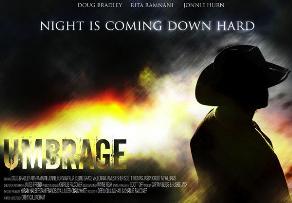
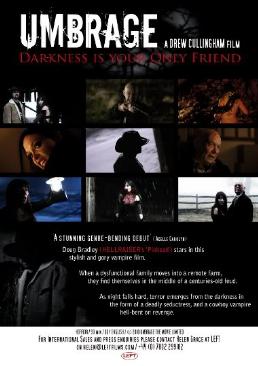
Umbrage: The First Vampire

Director: Drew Cullingham
Writer: Drew Cullingham
Producers: Drew Cullingham, Charlie Falconer
Cast: Doug Bradley, Rita Ramnani, Jonnie Hurn
Country: UK
Year of release: 2011
Reviewed from: screener (Left Films)

‘Umbrage’ is a great word, isn’t it? It stems from the Latin ‘umbra’ meaning ‘shadow’, from whence we also derive such brilliant words as ‘penumbra’, ‘adumbrate’ and, of course, ‘umbrella.’ Its only previous significant artistic use that I know of was ‘Takin’ Umbrage’ by The Federation, a 1988 comedy single which spoofed The Archers.

Now here comes Umbrage: The First Vampire; no relation to Blood: The Last Vampire and the vampire here isn’t called Umbrage, although there is some talk of shadows. It was shot as just Umbrage.

First: confession time. I was really looking forward to watching Umbrage, which has a cool-looking trailer and some reliable people in front of and behind the camera. But despite my best efforts to enjoy the film, I found it disappointing, frustrating and ultimately unsatisfying. Which is a real shame, because it’s trying to do something different and in many respects does it well.

It is, for example, a good-looking movie. Any time I see James Friend’s name in the credits I know I’m in for a visual treat. For my money, he’s one of the best cinematographers working in British indie films. The production design by Charlie Falconer is also good and Scott Orr (The Zombie Diaries) provides a small number of decent gore effects.

Where the film falls down, as so often, is in the script. Drew Cullingham was writer, director, producer (with Falconer) and editor. When a single individual has that much input into a film, there’s potential for a pure, unsullied, personal vision to shine through - but there’s equal potential for major problems to be glossed over or ignored.

The threat here is ill-defined, and that’s a serious problem in a horror movie. It’s never clear what sort of danger our characters are in or why, so it’s difficult to feel any tension or indeed empathy. The threat is vampiric, but the vampire’s motivation is not clear and, in fact, that’s the greater problem right there. None of the characters have a clear motivation for their actions and as a result their actions don’t make sense.

Everything that every character does in a film has to be for a reason. It has to serve a purpose. Actually two purposes. It has to serve a narrative purpose, either progressing the plot or revealing the character (or both) but it must also serve a purpose within the reality of the story. It has to be exactly the sort of thing which that character would do in that situation. And if it’s strange or odd or unlikely or very different to what most people would do in a similar situation, then that difference must be justified and explained, whether at the time or retrospectively.

For example, imagine that you are a husband with a heavily pregnant wife expecting your first child. Would you, only days before the baby is due, in the middle of winter, move into an isolated 17th century farmhouse 20 miles from the nearest town which has no telephone connection and no mobile signal?

Or perhaps you’re going camping in the woods with your mate. (Actually, does anyone outside of horror films realy go camping in the woods? Everyone I’ve ever known who likes camping pitches their tent in fields, or maybe on moorland, or maybe (if they’ve got any sense) on a campsite. Or if they’ve really got sense, they stay in a hotel. But who camps in a wood?)

Anyway, you and your mate have pitched your tent amid the trees and necked a bottle or two of wine when a softly-spoken, attractive young woman appears, not wearing any sort of outdoor gear, claiming to be a birdwatcher looking for owls. After a few minutes, she leads your horny friend off into the darkness and shortly afterwards you hear him scream in terror. You find him, trouserless, face and crotch both full of blood, his dismembered member a few feet away. The girl, who is calm and bloodless and gives every impression of being on drugs, tells you that “the shadows came alive.”

Would you leave your critically injured mate there to die, not even bothering to offer him any comfort, and leg it through the trees with the apparently stoned girl? Really? Why would you do that when the most likely explanation is that your friend was attacked by either her or an accomplice?

Now go back to pretending you’re the expectant father. In the middle of the night, two strangers bang on your farmhouse door. One is in a panic and has obviously been drinking heavily, the other appears to be blissed out. The panicky one reckons that the silent, smily one told him that “the shadows came alive” and that’s why you must let them in because they’re in terrible danger.

I realise that you, in this role-play, cannot call the cops because you have no phone (though you do at least own a shotgun). Nevertheless, would you just invite this drunkard and his junkie girlfriend into your house to sit down next to your already stressed, heavily pregnant wife?

Do you see what I’m getting at here? One more for good luck. Our dad-to-be (played, did I mention, by Doug Bradley) is an antiques dealer and he has come into possession, somehow, of a large Babylonian obsidian mirror (obsidian is a kind of black, volcanic glass). I’m not sure the Babylonians made mirrors from obsidian (though the Aztecs did). Anyway, this thing is absolutely priceless, the oldest known example, in perfect condition - so why would you have it delivered by courier to an uninhabited farmhouse with instructions to just leave it in the barn? And why, having taken it out of its rather rudimentary packaging, would you be careful to remove the cardboard and paper from the barn but leave this 5,000-year-old, irreplaceable artefact propped up on a hay-bale where it could easily get scratched, knocked or broken?

All of these actions (and others) serve a purpose in progressing the plot but serve no purpose within the reality of the film. Time after time, characters behave in a way which is illogical, inexplicable or just downright nonsensical - but expedient. These are all the sorts of problems which should have been sorted out before the film got anywhere near even pre-production. This is why you do multiple drafts of scripts. And at every stage, the writer (or the director or producer - except here they’re all the same guy) should ask the questions that viewers and reviewers will ask. Why is he doing that? Why did she go there? What is the reason behind this decision that nobody in their right mind would make?

Let me give you a practical example, to prove that I’m not just blowing smoke rings here. I was recently doing some writing-for-hire on a script about a Victorian dentist whose schtick is that he makes the best dentures in London. He manufactures false teeth that are better and more realistic than even the finest porcelain, so that none of his competitors can work out how he does it. The dentist’s secret is that he steals teeth from orphans (the rotter!) and then has them polished to perfection by a colony of captive tooth fairies (the swine!).

All well and good, but if I was reviewing a film like that I would ask three pertinent questions (as, I’m sure, would you). (1) Why don’t the other dentists just assume that these perfect false teeth are made from real teeth? That’s kind of the obvious explanation, isn’t it? (2) How would this work, given that children’s teeth are significantly smaller than adult teeth? And would get even smaller if you polished them? (3) Why does he need the tooth fairies? Any fool with a magnifying glass can polish a tooth.

One Sunday morning I was lying in bed, turning things over in my mind, and came up with the following.

The only way to make false adult teeth from children’s teeth is to use three or four child teeth for each adult one, carefully cut and shaped into perfect building blocks. Such precision dental engineering, and the polishing of cracks between blocks to the point of invisibility, is the sort of thing that would be virtually impossible for even the most careful person - but not for tooth fairies. And because small children’s milk teeth have a different structure and slightly different chemical composition to adult teeth, when the other dentists examine these gnashers they can see that they are plainly not just polished human teeth, but they can’t work out what they are.

All three problems solved in one fell swoop. If that film gets made (and if they use anything from my draft) we won’t have audiences asking those three obvious questions.

So, Umbrage-makers, this is what should have been done here. A coherent, credible reason needed to be found for the antiques dealer to cut his family off from civilisation just before the baby is due; for the camper to abandon his gruesomely injured, dying friend without so much as a backwards glance; for the obsidian mirror to be in the barn; and all the rest of the script’s improbable unlikelihoods.

Jacob (Bradley) and his wife Lauren (Grace Vallorani: The Last Seven) are accompanied by Rachel (Rita Ramnani: Jack Says, Just for the Record, Strippers vs Werewolves), his resentful 18-year-old goth stepdaughter from a previous marriage which ended with Rachel’s mother’s suicide just a year ago. So crikey, he wasted no time, did he? Jacob and Rachel share a secret which, when we learn it towards the end of the film, actually shows that they are both terrible people, but at about the same time their characters clumsily change, especially Rachel’s, so that we are apparently supposed to like them and empathise with them even more.

Camping pals Stanley (James Fisher: Hellbride, The Devil’s Music) and Travis (Scott Thomas, also in The Devil’s Music) would seem to be significant among this small cast and we spend quite a lot of time with them but, in retrospect, it can be seen that they are entirely irrelevant to the actual plot. There is no indication of why the girl Lilith (Natalie Celino, who was in unreleased 2008 action-horror pic Furor: Rage of the Innocent) kills Travis, nor of why she doesn’t kill Stanley.

Lilith is, of course, a vampire. She’s actually the mother of all vampires, the woman who, according to some ancient Jewish legends, was Adam’s first wife before Eve was created from one of his ribs, who was later seduced by the archangel Sammael, an analog of Satan. A prologue set in the old west has tall, fit cowboy Phelan (Jonnie Hurn, who was the wheelchair-bound stepfather in Penetration Angst and also in both Zombie Diaries pictures) hunting down stout cowboy Sammaelson (AJ Williams or, as the IMDB has it, Aj Williams) but being attacked by Lilith who bites a chunk from his neck. This, I suppose, is how he becomes The First Vampire.

Sammaelson is, therefore, either the devil or the son of the devil, but this sort of thing can only be gleaned from the Making Of, not the feature itself, where it is explained by ‘AJ Williams’ under his real name of Drew Cullingham.

This prologue and a subsequent, largely incomprehensible flashback, were shot on 35mm in the fake western town of Laredo, Kent, which I think is where a certain 3D comedy horror western musical was filmed. Everything else was shot on the Red camera. Thing is, the 35mm wild west scenes have then been tinted sepia, thus completely negating James Friend’s cinematographic skills. What’s the point of that?

Phelan turns up in Jacob’s barn 120 years later, still wearing a stetson but otherwise dressed in 21st century cowboy casual. He has been searching for Lilith all that time to take his revenge. I’m not sure what part the obsidian mirror plays in all this but at the end the two supernatural beings somehow disappear into the stygian reflector and reappear in Chiselhurst Caves.

Just in case we weren’t sure that this is the quasi-Biblical Lilith, there is also a flashback to, good grief, the Garden of Eden. Wait, is this a creationist horror film? Lilith is naked and so is Adam (Jason Croot, writer-director of horror mockumentary Le Fear) who is portrayed as a sort of Cro-Magnon caveman so maybe it’s not creationist after all.

NB. All my knowledge of Lilith was gained from her entry in Wikipedia and it’s quite possible that this was where Cullingham did his research too, as her appearance in the caves is obviously modelled on the 1892 John Collier painting at the top of her Wiki-page (complete with very large, very real snake draped around Ms Ramnani’s curvaceous, naked frame).

As for the shadows, I’m really not sure what’s going on there. At one point Stanley and Rachel are both attacked, quite savagely, by something invisible while they’re outside but Lilith sits placidly indoors. What are these ‘shadows’? What connection do they have to Lilith? And why did anyone think it would be scary in any way to have characters attacked by invisible things in the dark?

Umbrage is a mishmash of ideas that hasn’t been properly worked out. I’m all for horror westerns: Cowboys and Zombies was terrific. I’ve nothing against British westerns, not that’s there’s many to choose from. But trying to combine vampirism with the wild west and ancient Talmadic myths, all in a contemporary rural setting, centred on a dysfunctional family is a step too far, especially when there’s no real thought given to coherent motivation for any of the characters.

I feel a bit bad knocking the film like this because clearly Cullingham and his cast and crew worked very hard. The Making Of reveals a host of problems from malfunctioning generators on night shoots to Celino suffering an injury during a fight. A massive snow-fall halfway through production had to be incorporated into continuity and some of the shooting days lasted for more than 24 hours solid.

But this Making Of fails even more than the feature, skirting around what sounds like a real struggle against the odds to concentrate on amateurish shaky-cam interviews with clearly distracted cast and crew, of the sadly traditional “What are you doing now?”/”Can you describe your character?” type. Special sympathy for Scott Orr who graciously tries to answer the single most inane question ever included in a Making Of featurette: “So what’s it like being a Scottish special effects artist?”

Interwoven with these uninformative, uninteresting soundbites is a pretentiously black and white sit-down interview, post-completion, with Cullingham in what looks like a fancy restaurant or bar. While he is able to offer some insight into aspects of the film that don’t come across, he sounds smug, self-satisfied and complacent. Extraordinarily, the on-screen interviewer, ‘Making-of documentary director Ian Manson’, captions himself not just once but three times - in a film which is only about 20 minutes long! No offence, mate, but not only did we see the caption the first time, but also: we really don’t care.

Given the troubles and travails of the production, this Making Of is a huge missed opportunity for a sort of low-rent Lost in La Mancha. Consider what Anthony Pedone managed with Camp Casserole despite the film under scrutiny running smoothly without a single problem, what could a really good director have made of The Making of Umbrage? In fact, this could have been one of those rare situations where a DVD is recommended on the basis of an okay film accompanied by excellent extras, But instead we just get 20 minutes of dad-can-I-borrow-the-camcorder interview clips with bored, tired cast and crew who have nothing to say, plus the black and white Ian Manson show.

I was disappointed with Umbrage because it wasn’t the film I was looking forward to, but I was really disappointed with the Making Of because it wasn’t the film it so obviously could have been. Also on the disc are a trailer, a music video (for the song in the trailer) and the full version of the Doug Bradley interview from the Making Of, in which he starts by patiently explaining that he’s best known for playing Pinhead in Hellraiser. Doug’s a pro and he’s used to this sort of thing by now. Since I last saw him on the set of Pumpkinhead 3, he has appeared in (or provided a voice for) a range of UK and US features including The Cottage, Ten Dead Men, Jack Falls, The Infliction and most recently The Reverend.

Mention should be made of the Umbrage soundtrack which features a range of interesting ‘new country’ tracks that give the film a very unusual feel. In many ways, the music is the best part: strikingly original, well-chosen, integrated with the action but never dominating. And often toe-tappingly good - yeeha! The actual music credit is ‘Captain Bliss and Huskie Jack’, two musos who have, very impressively, toured as part of John Mayall’s band!

On the aural downside, whenever character voices are distorted in spooky, demonic ways, they become nigh on impossible to understand. Victoria Broom (Zombie Women of Satan, Dead Cert, Forest of the Damned 2) is credited with ‘special FX voices’.

James Friend’s other recent credits include Stalker, Dead Cert, Jack Falls and Ghosted. Scott Orr worked on Evil Aliens and A Day of Violence while make-up artist Pippa Woods has a CV that includes The Reeds, Stalker, Doghouse and Elfie Hopkins. Cullingham and Falconer have also worked (as DP/co-writer and production designer) on Tim Biddiscombe’s thriller NightDragon (also with Fisher and Thomas in the cast). A significant number of the cast and crew worked on The Zombie Diaries or its sequel and that film’s Michael Bartlett gets a curious credit here as ‘guest director’.

If you want a British vampire western, this is probably the best you can pick. Doug Bradley buckles down to his usual reliable performance, some of the other acting is also good (some less so) and there are some clever moments. But Umbrage - which was retitled A Vampire's Tale in the States -  could have been so much better and its problems stem not from any unexpected snowfall or malfunctioning generator but from a poor script which was nowhere near ready to shoot.

MJS rating: C+

Review originally posted 17th September 2011

Thursday, 9 October 2014

Legacy of Thorn

Director: MJ Dixon
Writer: MJ Dixon
Producers: MJ Dixon, Anna McCarthy, Mem Ferda
Cast: Jade Wallis, Craig Canning, Paris Rivers, Jane Haslehurst
Year of release: 2014
Country: UK
Website: www.mycho.co.uk
Reviewed from: online screener

Legacy of Thorn is a prequel to MJ Dixon’s previous feature Slasher House, though you don’t need to have seen that movie and the only direct connection is a fun little epilogue. Slasher House saw Eleanor James terrorised by three hulking supernatural psychos; Legacy of Thorn features one of those in his own movie.

Thorn (who is never named) is a tall, big-built monster with a silver mask on his face and a pair of machetes somewhat smaller than the impractical, anime-inspired things he wielded in the previous film, although you still wouldn’t want to get in their – or his – way. He comes very much from the zombie/mummy/Frankenstein school of horror chasers in that no matter how fast you run, he’ll catch up with you at a steady walking pace. And then he’ll hack you to bits without any display of emotion.

Really, Legacy of Thorn wants to be a Friday the 13th movie. And there’s nothing wrong with that. On the face of it, the plot is fairly simple: a sequence of people being hacked up by Thorn, their attempts to fight back or escape largely ineffectual. But actually there’s much more going on here, both structurally and narratively.

Four young people manage to subdue Thorn (through the first of several electrocution scenes, all of them rendered somewhat unbelievable due to the guy’s thick-soled rubber goth-boots), remove his mask and chain him up. There’s blonde Jess (Jade Wallis, a model/actress who was in Danny Cotton’s short Revenge of Death), around whom the plot revolves; busty brunette Alice (rising horror starlet Jane Haslehurst who was in Philip Gardiner’s Exorcist Chronicles and Dead Walkers: Rise of the 4th Reich, as were several other cast members), muscular black guy Eric (Paris Rivers) and skinny white guy Clark (Craig Canning, also in those two Philip Gardiner pictures). The two fellas were respectively boyfriend and brother of one of Thorn’s previous victims. Once the monster is restrained – and humanised – the previously clear-cut morality of killing him becomes a little fuzzier, leading to some splendid scenes of character conflict.

This all takes place on 29th February 2012. Intercut with the 2012 story is a series of scenes that occurred exactly four years earlier, on the previous Leap Year Day, involving the same characters plus others. It took me some while to realise – and I felt greatly rewarded when I did realise this – that in an audacious conceit Dixon is presenting the 2008 scenes in reverse order. So that, as one strand of the narrative progresses forward, the other gradually peels back layers, showing us how our characters came to be in the situation in which we first meet them. Eventually, the 2008 story will roll back far enough to reveal the truth behind what’s going on. Or at least hint at it.

In 2008 the characters are 16 and, somewhat bizarrely, seem to be at an American high school – where the girls are cheerleaders and the guys are jocks – even though all the characters are British. That’s an obviously deliberate disconnect which heightens the unreality of this far from realist film. We meet Clark’s sister Becca (Stephanie Jezard, also in ‘psychological urban western’ The Profesional [sic]) and queen bitch school bully Sally (a cracking performance from Strasberg-trained Evie Constanti) plus arsehole jocks Zach (Aaron Jeffcoate: Molly Crows) and Tommy (Anas Belarbi). But because of the reversed chronology, we generally meet people as they die, and then discover how they came to be where they were. It shouldn’t work, but it does.

On top of all that, there are a number of scenes of police squads attempting to take down Thorn, and a few brief hints at some sort of secret cult, identifiable via tattoos, acting on Thorn’s behalf. That might be a story which is explored further in the promised follow-up, Wrath of Thorn.

Dixon, who likes to be credited as ‘Mj Dixon’ is largely a one-man band, handling cinematography, editing, music, design and multiple other chores. In some areas he was assisted by producer Anna McCarthy, 1st AD Daniel Busby, VFX supervisor/gaffer John ‘Bam’ Goodall (who plays a creepy janitor) and helping hand Paul Malcolm Swindells in various combinations. Despite this, a clear idea of the communal, everyone-pitch-in-together nature of the production is evident in the preponderance of cast names among the crew credits, often en masse. Craig Canning is credited with stunt co-ordination and Mita Patel (Zombie Run, The Fall of Rothan) with make-up.

When ‘Mj’ made Slasher House, he went for a red/green aesthetic so extreme it could be mistaken for two-strip Technicolor. On this film, blue is the predominant colour, with splashes of orange. It’s a more effective colour scheme but doesn’t diminish the stylish look of the photography which is a step above many similar (or at least, similarly budgeted films). This is actually Dixon’s third feature, including the still unreleased Creepsville; before that he made a few shorts including Thorn, a 2009 pre-feature try-out which won a competition at scaryordie.com and which has effectively been remade as the first part of the 2012 story here. There is a clear progression from Slasher House to Legacy of Thorn as the director builds on his own experience and hones his craft while establishing an idiosyncratic style which marks him out as One To Watch in British horror cinema.

If there’s a mis-step here – and I’m being picky – it’s the decision to frame this in a rather extreme ratio which doesn’t benefit the picture. This isn’t a film of wide landscapes or even Kubrick-ian corridor shots, it’s teenagers running away from a seven-foot psycho-demon and too often heads or legs are unhelpfully truncated. Also, in all honesty, some of the ADR is less successful than others. For example there’s a scene at the end by a river, clearly filmed on a very windy day, and the looping is so obvious it threatens to distract from the actual words being looped.

Nevertheless, I would be lying if I said that I didn’t enjoy Legacy of Thorn very much. It’s full of action, blood, violence and tension without sacrificing character or story, a tricky balance to pull off, especially when also lighting every scene like the bastard son of Mario Bava.

A solid cast includes Sam Cullingworth (from Eileen Daly’s ghost-hunting trilogy), Lee Bibby (from Antoni McVay’s horror shorts), Simon Craig (The Last Zombi Hunter, Dense Fear Bloodline, Zombie Women of Satan 2), Nikki Webster (the alien thing in Dark Watchers: The Women in Black) and Eschatrilogy director Damien Morter as coppers; plus Nathan Head (Tuck Bushman and the Legend of Piddledown Dale, Mark Macready and the Archangel Murders, Theatre of Fear) and Melissa Hollett (Dead Cert, Apparition of Evil) as Jess’s parents.

Thorn himself (a character conceived by Dixon as a reaction to the watering down of Jason Vorhees and Michael Myers in later sequels) is played by Richard Daniel Thomas Holloran who was the Demon in Slasher House (where Thorn was played by a different actor). Mem Ferda (Experiment, Revolver, Ill Manors) as a detective - also a producer - provides the closest thing to name value. Legacy of Thorn is dedicated to actor/photographer Dave Laurie who has a significant role as the mysterious Isaac but who passed away before the film was completed.

Shot over 18 days of production in Oldham and Preston in 2013/14, Legacy of Thorn premiered at The Living Dead Con in Liverpool in October 2014 a week or two before its DVD/VOD release. Impressive, ambitious and largely successful, not to mention unashamedly entertaining for all gorehounds – especially those looking for something with both style and substance – Legacy of Thorn is definitely worth seeking out.

MJS rating: B+


Saturday, 4 October 2014

interview: Gabriel Thomson

Gabriel Thomson played the title role in The New Adventures of Pinocchio, though he has since become better known for playing the younger son in BBC sitcom My Family. I interviewed him on the Luxembourg set of The New Adventures in May 1999, and part of this interview appeared in the children’s section of The Sunday Times!


How old are you, and how long have you been acting?

“I’m 12 and I’ve been doing amateur acting for a long time, in different plays. I used to go to Devon every year, which is like our family’s second home, and we did plays called Golliards, but they’ve finished now. They were great fun; I did that since I was about four.”

Do you come from an acting family?
“My dad was an actor and he’s now become a drama teacher in the Guildford School of Acting, and my mum’s a choreographer.”

Is this your first feature film?
“Yes. I did Great Expectations on the BBC, but this is the first cinema film I’ve ever done.”

How did you land that role?
“When I was younger, we knew the casting director of a film called Painted Lady, and the casting director said, ‘Come along, it’s a really small role but it’ll be some fun. Just a couple of hours’ work.’ And I did the couple of hours’ work and the director liked me so, however long after, he called me back and asked me to audition for Great Expectations. So I did, and I was recalled and recalled again and I got that part.”


How did you get this role?

“They just asked. They said, ‘We saw Great Expectations, and would you like to be in it?’ At first I said no, because I’m hoping to audition for a film called About a Boy by Nick Hornby. I really wanted to audition for that. Then my agent, who I signed up with after Great Expectations - he asked if I wanted an agent and I said yes - said, ‘It’s going to be done by this company called New Line or something, so it’ll be big and it’ll be good.’ So I said ‘Yes, okay, I’ll do it.’ I also found out that I could possibly send a video of Great Expectations to the director of About a Boy, see if he liked it or whatever, and then go to a recall.”

How much time are you yourself on screen, and how much time is the character a puppet?
“It’s different in this film. In the first, he’s a puppet most of the time, but in this I only spend two or three scenes as a puppet, and then we go on to do whatever we do. I did the voice-overs in about half an hour in a studio yesterday actually, so it didn’t taken long.”

Have you seen the puppet of yourself?
“I haven’t seen it in action yet, but I’ve seen bits of it and it looks amazing. The one I’ve seen has eight motors in its head to do each expression, and the one that’s going to do all the close-ups is going to have 22 expressions. I’ve seen Geppetto’s version of the 22-motor one, and that looks amazing, but I’ve only seen the eight-motor one of mine. I’ve only worked with Geppetto’s so far.”

How have you found Martin Landau to work with?
“Martin Landau’s brilliant, he’s really good. The classic example of an actor is all: ‘Oh, I can’t do that, oh no.’ Martin Landau has done so many films, and yet he’s still really down to Earth and really nice. I really like him.”


When you turn from boy into puppet, how are they doing the effects?

“I think some of it’s going to be done by graphics. If we get round to it, we’re doing it today. I believe it’s going to be me drinking an elixir, then they’re going to do something with graphics, then I’m going to have a latex mask they’re going to put over my face and they’re going to glue it down. So it will be the puppet’s face and look wooden-ish, but I’ll still be my size. Then they’ll do some more graphics as I turn into the puppet, and then it will be the puppet shot.”

Are you keeping up your education?
“Yes, I’ve got a tutor, who also did Gemma and Gregory, who are playing Blue and Isabella, and Ben Ridgeway who’s playing Lampwick. She’s really nice, and she’ll take me out or we’ll stay at the hotel and do some lessons, learn about Luxembourg. We did some Aesop’s fables, and really good, fun stuff. It’s more fun than school, except you don’t get to see your friends which is pity.”

What do your schoolmates think of your career?
“Most of them are really happy for me. Some of my less close friends can be a bit nasty, but most of them are really nice. My good friends are really supportive of it, which is good.”

Do you want to keep doing this when you grow up?
“When I grow up, yes. What I’m trying to do is do as many films as I can possibly get in a short time,and then leave a huge gap, doing school. Then, once it comes to a time when I’m older, I can go to drama college. I can pay my own way through drama college, so I’m trying to get some parts now, so I can pay for it.”

Have you tried to keep the character the same as played by Jonathan Taylor Thomas in the first film?
“I saw the first one, but because it was so short with Jonathan Taylor Thomas, mostly it was just his voice. So it’s quite a lot different. Even continuity: like he has blue eyes in the first one. They made a huge point of it, saying, ‘We’re going to paint his eyes blue like the sky.’ And I’ve got brown eyes! So it’s things like that. I’ve tried to be the sweet character that Pinocchio is.”


Is all the money going into a trust fund for you?

“I’m going to take some of it and put it in my bank, just a small percentage of it, and then I’m going to put the rest of it in a building society and let interest build up, so then I’ll have more money when I’m older.”

What would you like to do eventually? What great roles would you like to play?
“No specific great roles, just challenging roles that are great fun. And I’m desperate: I’m going to have to try to get into an audition for Anakin Skywalker in Episode Two! I was just looking through magazines with Anakin Skywalker in, and thinking, ‘I even look like him! Ah! Why?’ So I’m trying to work up for that. That would be brilliant.”

interview: Jonathan Sothcott

In a very short time, Jonathan Sothcott has established himself as a major player on the UK indie film scene, producing a range of genre pictures through his production company Black and Blue Films. He kindly answered a few questions for me in August 2010 around the time of Dead Cert’s premiere at Frightfest.


Can you sum up how your previous career has led you to your current work as a film producer?
“Since seeing Jaws on Betamax as a very small boy I always loved films, and genre films in particular. Growing up on a diet of Hammer Horror, 007 and Doctor Who defined my tastes clearly, but living in the country with no connection at all to 'the media' I didn't realise till quite late that I wanted to be a film-maker and wouldn't have known where to start anyway. But I wanted to be involved with film... so became a film journalist. An obvious part of that was studying how films are and were made, so I had a bit of an advantage.

“I also worked in TV as a buyer, so had a certain understanding of the commercial realities of the business. Eventually, aged 26, I decided that making my own films was the way forward. Four years on and five films down I seem to be getting away with it!”

How much are you developing a rep company and how much are you just tapping into an existing group of London actors who all seem to keep appearing together on screen?
“There are two sides to this - reading your (excellent - and very fair) review of Just for the Record, I noticed you picked up on the fact that I used a lot of the cast from Football Factory and Rise of the Footsoldier. Why? Because between them they have sold over two million DVDs in the UK - and I think people enjoy familiar faces in genre films, which is one of the reasons we love Hammer movies.

“As a rep company, though, its a fuckin' great one - Steven Berkoff, Sean Pertwee, Craig Fairbrass, Colin Salmon, Phil Davis, Billy Murray - these are all world class screen actors! And then look at the girls - Jane March, Lisa McAllister, Jaime Murray, MyAnna Buring - again, brilliant talents all of whom audiences like. And we even get wild cards like Victoria Silvstedt who paid her own flights to come and do JFTR as a favour for me. We're very blessed.”


The character of Derek La Farge in Just for the Record, played by Danny Dyer, is specifically stated in the credits as being based on you: to what extent is it an accurate depiction?
“Welllllllllllllllllll it is and it isn't. Ha. Danny is one of my best mates, he's brilliant and when we looked at the script he said, ‘I'm going to play this as you.’ ‘Oh,’ I said, preening excitedly at the prospect of screen immortality, ‘how do you mean?’ He then did his impression of me which was pretty funny and it went from there - he wore my ties in the film too (and in Dead Cert).

“You know, the biggest wasted opportunity on JFTR (which is a dreadful film but has some nice performances) is that we finally had an opportunity to do something different with Danny and we squandered it on a crap film. Danny is one of the most talented screen actors in the country and has a very real range - for my money he's my generation's Michael Caine - and I'm slightly ashamed that JFTR wasn't a good enough showcase for that. But wait till you see him in Devil's Playground - a quality film featuring a brilliant performance from DD.”

The problem for British independent films has always been one of distribution: how are you overcoming this?
“That's not the problem - I have great relationships with ever major distributor - Momentum, E1, Lionsgate, Sony, Revolver, the lot. If you make a commercial product, distribution isn't the issue. The issue is making it in the first place - ie. funding - it's so hard to fund indie films in this country. The private sector is riddled with wankers and bullshitters who actually don't have any money and don't realise that they're fucking with people's lives. The Film Council (good riddance) was no help to my kind of films either - we weren't trendy enough and didn't wear sandals - and I hope somebody comes up with a realistic, commercially-driven alternative so that film making in this country can become a real business like it is in the States or France.”

Why do you think that Black and Blue films has been able to establish itself as something of a movie factory when others have made grandiose announcements and promoted ambitious production slates then disappeared? What are you doing right?
“Well I hope we're doing okay. I think we are making solid genre films at a price, which is really the secret of independent film making. We also use quality talent on both sides of the camera (with the odd blip!) and you have to remember I'm not just in this game to make money. I'm a genre buff too, I go and buy this stuff in HMV like everyone else and I guess I'm trying to make the films that I'd like as a punter.”

I gather that the remake of Exposé has a very different story and now may not even end up being called Exposé, so in what sense is it a remake? [It was eventually made as Stalker - MJS]
“Going back a few years it was a good jumping off point - there are similarities, but ours is a cleverer, more sophisticated movie - in a lot of ways it’s more like those ‘60s Hammer psycho-thrillers like Taste of Fear and Paranoiac. It’s a really smart, fun little movie with some great performances, brilliantly directed, and I think people will like it.”

As executive producer, what was your involvement with Wishbaby and what are your views on the film?
“Parsons and Sprackling are both old mates of mine and I came in late and was really only involved in the financing. I think it was an intelligent, well-made art house horror movie that should have done much, much better business. But you know, sometimes movies just fall through the cracks - the time isn't right for them - and are rediscovered 20 years later when they find an audience. I'm proud to have been involved with Wishbaby though.”


What do you think Dead Cert brings to the vampire genre that hasn't been done before?

“Cockney gangsters! Haha. No, it really was conceived as a homage to films like Dracula AD 1972 and Count Yorga, by way of Fright Night and Vamp. It’s a fun romp with some great performances - Craig is by far the best and most credible action man in British cinema, Lisa's a born movie star who it’s almost impossible not to fall in love with, Billy and Berkoff are towering thesps giving a real gothic feel to the proceedings and Danny's cameo at the end - which he came and did as a favour - is a lot of fun - that got a huge round of applause at Frightfest last night.”

Website: www.richwaterfilms.com