Director: Carlos Puerto
Writer: Carlos Puerto
Producer: Juan Piquer Simon
Cast: Mariana Karr, Jose Maria Guillen, Sandra Alberti
Country: Spain
Year of release: 1978
Reviewed from: UK DVD (Redemption)
The latest release from Redemption is this 1970s Spanish offering which is one of those Dennis Wheatley-esque, middle-class Satanism films where the orgies look about as interesting and inviting as the dinner parties.
Young professionals Ana (Argentinean soap actress Mariana Karr making one of her very few big screen appearances) and Andres (Jose Maria Guillen, who was in a 1964 Spanish TV version of The Canterville Ghost) are out for a drive round Madrid with their Alsatian Blackie when they meet Bruno (Angel Aranda: Planet of the Vampires) and his wife Berta (Sandra Alberti, who has a face like a man). Bruno is adamant that he went to school with Andres but Andres doesn’t remember him and their memories of the school seem to differ.
Nevertheless, A&A accept an offer to go to B&B’s place for dinner and drinks, although this turns out to be a very large house, behind a high wall, in the middle of nowhere over an hour’s drive from the city. Further claims of shared schooldays between the two men continue to seem flawed but the visitors don’t want to be rude to their hosts. They are persuaded to join in a Ouija board session which reveals that Ana may still have the hots for Andres’ brother Juan and that Bruno will die by suicide.
And ever onwards, things get weirder, leading to A&A - persuaded to stay over - venturing downstairs in the middle of the night to find their hosts naked in a pentagram, which leads to a four-way romp that fails to be even slightly erotic. Andres’ car is tampered with, Blackie is found dead and strung up in the pantry, Bruno is shot (offscreen) and when Berta calls a doctor he all but accuses Andres of murder. Berta tries to commit suicide, someone unidentified tries to rape Ana, etc etc etc.
There are some interesting ideas but they’re never developed and nothing is ever explained. Things perk up briefly about ten minutes from the end when the whole house becomes embroiled in supernatural strangeness but the film swiftly falls flat when it descends into illogical, inconsistent, inexplicable, gratuitous weirdness, before juddering to a halt with a ‘twist’ that we have been expecting since the film started. (I forgot to mention the pointless pre-credit sequence in which a woman is ceremonially raped on an altar by a beardy bloke.) I know it’s meant to be like a nightmare but it’s also meant to be a conspiracy and in respect of the latter it just doesn’t add up.
The highlight - such as it is - is a sequence when Ana awakes to find a large, porcelain-headed doll (featured prominently in the background of earlier scenes) walking into her room, followed by a knife-wielding Berta clad in a diaphanous shift, intent on sapphic seduction. This swiftly turns out to be a dream but it is at least imaginative. For the most part, Satan’s Blood is simply rather dull.
There have been some good Spanish horror films and some bad ones. This is not as unwatchable as much of Jess Franco’s oeuvre but it’s not nearly as enjoyable as a Paul Naschy monsterfest. The direction is competent but that’s all. There’s not much actual horror - it’s all one long build-up which doesn’t really know what to do when it reaches the pay-off. And far, far too much of it is unexplained or inexplicable or both.
Writer-director Carlos Puerto’s best known credit, apart from this, is scripting the 1976 Journey to the Centre of the Earth starring Kenneth More. The director of that film, which shares numerous cast and crew with this one, was Juan Piquer Simon. Executive producer on this picture, his other credits include Supersonic Man, Extraterrestrial Visitors and Pieces.
The only recognisable name in the cast is Luis Barboo (credited here as ‘Luis Bar-Boo’) whose 120+ films include A Fistful of Dollars (and numerous other paella westerns), Daughter of Dracula, The Erotic Rites of Frankenstein, Dracula - Prisoner of Frankenstein, A Virgin Among the Living Dead, The Loreley’s Grasp, Night of the Werewolf and the aforementioned Journey to the Centre of the Earth.
Redemption’s usual lucky dip of extras includes ten stills, presented almost full-frame, and two unrelated trailers: an un-narrated English one for Requiem for a Vampire (also on the Night of the Bloody Apes disc) and a deliriously awful one for British sex-comedy Au Pair Girls, one of Val Guest’s less noteworthy efforts (I doubt if Gabrielle Drake puts it prominently on her CV either). “They’re here to help us - and Gawd help us!” intones the voice-over, which also points out guest appearances by John Le Mesurier and Rosalie Crutchley. To be honest, this one trailer is more entertaining than the whole of Satan’s Blood. There are also sampler tracks from 15 albums released on Redemption’s two music labels, some of which are unlistenable and most of which have titles and artist names so clicheed that one wonders whether they’re a spoof. The only one I was able to suffer for more than ten seconds was ‘Webcam Girl’ by the Courtesans which sounds like the Primitives or the Darling Buds. [Just realised, many years later - that's Eileen Daly's band! - MS]
The sleeve says that “this rare film has been remastered for this DVD from a new hi-def master and looks stunning!” Well, I don’t have an HD TV so neither know nor care about that side of things. The subtitled print looks good in terms of colour and contrast and the only noticeable imperfections are some flicks and flecks at reel ends. However “84 mins approx” is a bit cheeky as this runs 79’40”. There are no obvious cuts so this may just be the 82-minute version, available elsewhere, time-compressed for PAL. The sleeve also claims that the film dates from 1971 which might be believable, given the fashions and hairstyles on show, were it not for a huge Star Wars poster clearly visible about five minutes in.
(The film’s original title, Escalofrio, was also the Spanish title for both the Bill Paxton-directed horror-thriller Frailty and Larry Fessenden’s snowbound monster flick Wendigo.)
MJS rating: C+
Review originally posted 17th June 2007
MJ Simpson presents: the longest-running single-author film site on the web, est.2002.
Showing posts with label 1978. Show all posts
Monday, 26 September 2016
Wednesday, 19 November 2014
Reactor
Director: ‘Al Bradly’ (Alfonso Brescia)
Writers: ‘Al Bradly and Alan Rawton’ (Alfonso Brescia and Aldo Crudo)
Producer: ‘Lewis Allenby’ (Luigi Alessi)
Cast: Antonio Sabato, Yanti Somer, ‘Melissa Long’ (Malisa Longo)
Year of release: 1978
Country: Italy
Reviewed from: UK VHS (Mogul)
Reactor is unrepentant rubbish from start to finish. Even by the standards of Italian late 1970s sci-fi movies - which are not high - this is bobbins. The normally reliable Delirium magazine recommended this as so-bad-it’s-good but let me assure you, it ain’t. I laughed a few times at the sheer ineptitude, but mostly I was shouting at my TV, “For God’s sake, please make it stop!”
Some idea of how cut-price this piece of dreck is can be gleaned from the following fact: the spaceship is called the Trissi, so all the crew have the word ‘Trissi’ on their spacesuits - this is actually because the ‘spacesuits’ are ski-suits loaned by a company called Trissi Sportswear. If the producers had spent a bit more, the action could have taken place on the starship Adidas!
Professor Carr and his glamorous lab assistant Lois (‘Melissa Long’, ie. Malisa Longo: Salon Kitty, Nightmare Concert, Thor the Conqueror), who are constantly referred to as a sort of gestalt entity - ProfessorCarrandhisassistantLois - even by their closest friends, are kidnapped by aliens. “A gang of aliens has kidnapped ProfessorCarrandhisassistantLois,” says a co-worker, “I actually saw it happen.” It’s amazing how a film so laden with clunky exposition can nevertheless make not the slightest bit of sense.
The aliens all wear silver costumes and have bad gold wigs, and head off in a flying saucer. Unfortunately, the Prof’s latest experiment - something to do with creating life - involves a nuclear reactor (hence the English title) and no-one except the Prof knows how to switch it off! Unless he can be rescued, the reactor will explode, destroying the entire city in eight days, fourteen hours and three minutes (they’re very precise about this).
The spaceship Trissi sets off, commanded by Captain John Boyd (Antonio Sabato: Bronx Warriors 2) who is enamoured of ‘HisassistantLois’ and oblivious to the torch carried for him by one of his crew, Julia (Yanti Somer: Battle of the Stars). Repairing a defence satellite knocked out by the aliens, Boyd determines the location of their home planet, which is: “North Pole Earth, ninety degrees west and eight-ten North.” Whether the dialogue was as inept in the original Italian is not something I can comment on. At least, not politely.
Also on board is a chap with a blond bubble perm whose character name is never mentioned but who seems to be second in command. He is supposedly from Texas which is quite a shock as the dubbing actor has the most extraordinary accent. It’s as if a Texan accent has been written phonetically and then read out loud by someone who has never even heard of Texas.
The Trissi lands on the planet Azar where the exploratory party are attacked by some barbarian-types with gold skin and leather hoods over their heads. The hoods cover bizarre bulbous eyes, but fortunately the only barbarian with dialogue, the leader named Kuza, has a normal face and is simply a bald, gold bloke. “As you see,” he tells Boyd, “we are a race of humanoids but we are different from you.”
The humans escape and fight off a bunch of the original, gold-wigged aliens who are apparently from the planet Anthor. They have discovered the secret of eternal life but can only survive by transplanting organs from a lesser race, the inhabitants of Azar. It’s very clear that, although this film was made to cash in on Star Wars fever, the biggest influence in terms of both story and design is the TV series UFO, which was very popular in Italy.
With Kuza’s help, the Trissi heads to Anthor where they swiftly find ProfessorCarr operating a giant computer, but he summons Anthor guards who capture our heroes and parade them before the Empress, who turns out to be, unsurprisingly, HisassistantLois. There then follows lots of running down corridors and double-crossing until eventually everyone is back on board the Trissi, including ProfessorCarrandhisassistantLois, and heading for Earth. The Prof is under sedation, wakes up, kills the ship’s doctor and tries to escape, but is shot by an unseen assailant. It’s Lois, who is a bad’un after all and has somehow smuggled a whole squad of Anthorian goons on board.
Control of the ship is wrested back to Boyd and his crew but Lois escapes out the airlock to one of the pursuing fleet of Anthorian ships, commanded by a minor character called (I am not making this up) General Gonad. The last quarter of an hour or so is one of cinema’s dullest spaceship battles which culminates in Boyd having to make a choice between Lois and Julia. (Oh, the reactor - remember that? - is deactivated successfully despite the death of Prof. Carr because Kuva picked up a datachip while on Anthor which turns out to be the Prof’s notes...)
Christ, this is cut-price movie-making. And yet, the situation was such in the late 1970s, with Star Wars fever riding high and the video market exploding, that any old shit with a spaceship in it could turn a profit. Alfonso Brescia (Iron Warrior, Amazons Against Supermen) must have been making money at this sort of thing - he made five of them! Starting with Anno Zero, Guerra nello Spazio aka War in Space in 1977, then this fella (La Guerra dei Robot - oh yes, I almost forgot, the Anthorians turn out to be robots!) and Battaglie negli Spazi Stellari aka Battle of the Stars aka War of the Planets in 1978, and finishing with La Bestia nello Spazio and Sette Uomini d’Oro nello Spazio aka Captive Planet in 1979. The films weren’t sequels but some of the same cast and crew were used, along with sets, costumes, props and not-very-special effects. I have seen Battle of the Stars and, though it is rubbish, it is nowhere near as bad as Reactor. Of course the best known Italian SF film from this period is Luigi Cozzi’s Starcrash; let me assure you that, if you thought that was a bit pants, it is The Magnificent Ambersons compared to Brescia’s work.
Words cannot describe how cheaply and quickly this has been thrown together, bearing in mind that this is a professionally made motion picture, not some amateur production. Some stuff is sheer costcutting: all the characters, whether human or Anthorian, use exactly the same small, plastic, toy ray-guns; and spacewalk sequences always show the character on the far right of the screen, their feet just off screen - in other words, they eschewed wires in favour of simply turning the camera on its side. Other defects fall more under the heading of sheer carelessness: much of the film is out of focus, and during the final fight for control of the Trissi, someone forgot to add any sound effects!
Reactor is available on a Region 1 double-bill with War of the Planets under its US title, War of the Robots, a package which rather cheekily pinches an iconic illustration of Caroline Munro in her skimpy Starcrash costume. Rest assured that Hisassistantlois doesn't wear anything quite so sexy...
My full-screen British video (probably from the 1980s) has English language titles so most of the Italian names have been cunningly converted into English. Brescia is usually credited as ‘Al Bradley’ but here is ‘Al Bradly’ on screen and on the packaging. The cast includes ‘special appearances by’ Jacques Herlein (whose amazing CV includes The Whip and the Body, Goliath and the Sins of Babylon, Tower of Screaming Virgins, Shaft in Africa, Frankenstein’s Aunt, The Messenger: The Story of Joan of Arc, The Ironmaster and The Winds of War!) and ‘Mickey Pilgrim’ (presumably this is Ines Pellegrini from Salo or 120 Days of Sodom). The ‘special effects’ are by ‘Allan Forsyth’ who is actually Aldo Frollini. His earliest credit (that I can find) is a 1968 spaghetti western, he has worked with everyone from Argento to Fellini, and he now runs his own effects company in Rome, providing live video effects for plays and operas as well as some movie work.
Avoid like the plague.
MJS rating: D-
Writers: ‘Al Bradly and Alan Rawton’ (Alfonso Brescia and Aldo Crudo)
Producer: ‘Lewis Allenby’ (Luigi Alessi)
Cast: Antonio Sabato, Yanti Somer, ‘Melissa Long’ (Malisa Longo)
Year of release: 1978
Country: Italy
Reviewed from: UK VHS (Mogul)
Reactor is unrepentant rubbish from start to finish. Even by the standards of Italian late 1970s sci-fi movies - which are not high - this is bobbins. The normally reliable Delirium magazine recommended this as so-bad-it’s-good but let me assure you, it ain’t. I laughed a few times at the sheer ineptitude, but mostly I was shouting at my TV, “For God’s sake, please make it stop!”
Some idea of how cut-price this piece of dreck is can be gleaned from the following fact: the spaceship is called the Trissi, so all the crew have the word ‘Trissi’ on their spacesuits - this is actually because the ‘spacesuits’ are ski-suits loaned by a company called Trissi Sportswear. If the producers had spent a bit more, the action could have taken place on the starship Adidas!
Professor Carr and his glamorous lab assistant Lois (‘Melissa Long’, ie. Malisa Longo: Salon Kitty, Nightmare Concert, Thor the Conqueror), who are constantly referred to as a sort of gestalt entity - ProfessorCarrandhisassistantLois - even by their closest friends, are kidnapped by aliens. “A gang of aliens has kidnapped ProfessorCarrandhisassistantLois,” says a co-worker, “I actually saw it happen.” It’s amazing how a film so laden with clunky exposition can nevertheless make not the slightest bit of sense.
The aliens all wear silver costumes and have bad gold wigs, and head off in a flying saucer. Unfortunately, the Prof’s latest experiment - something to do with creating life - involves a nuclear reactor (hence the English title) and no-one except the Prof knows how to switch it off! Unless he can be rescued, the reactor will explode, destroying the entire city in eight days, fourteen hours and three minutes (they’re very precise about this).
The spaceship Trissi sets off, commanded by Captain John Boyd (Antonio Sabato: Bronx Warriors 2) who is enamoured of ‘HisassistantLois’ and oblivious to the torch carried for him by one of his crew, Julia (Yanti Somer: Battle of the Stars). Repairing a defence satellite knocked out by the aliens, Boyd determines the location of their home planet, which is: “North Pole Earth, ninety degrees west and eight-ten North.” Whether the dialogue was as inept in the original Italian is not something I can comment on. At least, not politely.
Also on board is a chap with a blond bubble perm whose character name is never mentioned but who seems to be second in command. He is supposedly from Texas which is quite a shock as the dubbing actor has the most extraordinary accent. It’s as if a Texan accent has been written phonetically and then read out loud by someone who has never even heard of Texas.
The Trissi lands on the planet Azar where the exploratory party are attacked by some barbarian-types with gold skin and leather hoods over their heads. The hoods cover bizarre bulbous eyes, but fortunately the only barbarian with dialogue, the leader named Kuza, has a normal face and is simply a bald, gold bloke. “As you see,” he tells Boyd, “we are a race of humanoids but we are different from you.”
The humans escape and fight off a bunch of the original, gold-wigged aliens who are apparently from the planet Anthor. They have discovered the secret of eternal life but can only survive by transplanting organs from a lesser race, the inhabitants of Azar. It’s very clear that, although this film was made to cash in on Star Wars fever, the biggest influence in terms of both story and design is the TV series UFO, which was very popular in Italy.
With Kuza’s help, the Trissi heads to Anthor where they swiftly find ProfessorCarr operating a giant computer, but he summons Anthor guards who capture our heroes and parade them before the Empress, who turns out to be, unsurprisingly, HisassistantLois. There then follows lots of running down corridors and double-crossing until eventually everyone is back on board the Trissi, including ProfessorCarrandhisassistantLois, and heading for Earth. The Prof is under sedation, wakes up, kills the ship’s doctor and tries to escape, but is shot by an unseen assailant. It’s Lois, who is a bad’un after all and has somehow smuggled a whole squad of Anthorian goons on board.
Control of the ship is wrested back to Boyd and his crew but Lois escapes out the airlock to one of the pursuing fleet of Anthorian ships, commanded by a minor character called (I am not making this up) General Gonad. The last quarter of an hour or so is one of cinema’s dullest spaceship battles which culminates in Boyd having to make a choice between Lois and Julia. (Oh, the reactor - remember that? - is deactivated successfully despite the death of Prof. Carr because Kuva picked up a datachip while on Anthor which turns out to be the Prof’s notes...)
Christ, this is cut-price movie-making. And yet, the situation was such in the late 1970s, with Star Wars fever riding high and the video market exploding, that any old shit with a spaceship in it could turn a profit. Alfonso Brescia (Iron Warrior, Amazons Against Supermen) must have been making money at this sort of thing - he made five of them! Starting with Anno Zero, Guerra nello Spazio aka War in Space in 1977, then this fella (La Guerra dei Robot - oh yes, I almost forgot, the Anthorians turn out to be robots!) and Battaglie negli Spazi Stellari aka Battle of the Stars aka War of the Planets in 1978, and finishing with La Bestia nello Spazio and Sette Uomini d’Oro nello Spazio aka Captive Planet in 1979. The films weren’t sequels but some of the same cast and crew were used, along with sets, costumes, props and not-very-special effects. I have seen Battle of the Stars and, though it is rubbish, it is nowhere near as bad as Reactor. Of course the best known Italian SF film from this period is Luigi Cozzi’s Starcrash; let me assure you that, if you thought that was a bit pants, it is The Magnificent Ambersons compared to Brescia’s work.
Words cannot describe how cheaply and quickly this has been thrown together, bearing in mind that this is a professionally made motion picture, not some amateur production. Some stuff is sheer costcutting: all the characters, whether human or Anthorian, use exactly the same small, plastic, toy ray-guns; and spacewalk sequences always show the character on the far right of the screen, their feet just off screen - in other words, they eschewed wires in favour of simply turning the camera on its side. Other defects fall more under the heading of sheer carelessness: much of the film is out of focus, and during the final fight for control of the Trissi, someone forgot to add any sound effects!
Reactor is available on a Region 1 double-bill with War of the Planets under its US title, War of the Robots, a package which rather cheekily pinches an iconic illustration of Caroline Munro in her skimpy Starcrash costume. Rest assured that Hisassistantlois doesn't wear anything quite so sexy...
My full-screen British video (probably from the 1980s) has English language titles so most of the Italian names have been cunningly converted into English. Brescia is usually credited as ‘Al Bradley’ but here is ‘Al Bradly’ on screen and on the packaging. The cast includes ‘special appearances by’ Jacques Herlein (whose amazing CV includes The Whip and the Body, Goliath and the Sins of Babylon, Tower of Screaming Virgins, Shaft in Africa, Frankenstein’s Aunt, The Messenger: The Story of Joan of Arc, The Ironmaster and The Winds of War!) and ‘Mickey Pilgrim’ (presumably this is Ines Pellegrini from Salo or 120 Days of Sodom). The ‘special effects’ are by ‘Allan Forsyth’ who is actually Aldo Frollini. His earliest credit (that I can find) is a 1968 spaghetti western, he has worked with everyone from Argento to Fellini, and he now runs his own effects company in Rome, providing live video effects for plays and operas as well as some movie work.
Avoid like the plague.
MJS rating: D-
Thursday, 17 April 2014
The Return of the Bionic Boy
Director: Bobby A Suarez
Writers: Ken Metcalfe, Joe Zucchero
Producer: Bobby A Suarez
Cast: Marrie Lee, Master Johnson Yap, Joe Zucchero
Country: Philippines
Year of release: 1978
Reviewed from: UK VHS
Herewith a short history of bionics. The word was invented by Jack E Steel, a medical doctor and former US Air Force Colonel in 1958. It was given literary credibility by Martin Caidin in his 1972 novel Cyborg which was adapted the following year into a TV movie - The Six Million Dollar Man, starring Lee Majors as US Air Force Colonel Steve Austin.
The telemovie was a big hit, pushed the term ‘bionic’ into the public consciousness and was followed (I didn’t know this - thanks Wikipedia!) by two more Movies of the Week about Steve Austin: Wine, Women and War and Solid Gold Kidnapping.
A weekly TV series of The Six Million Dollar Man started in January 1974 and ran for four years, totalling 100 episodes. The show was a massive hit, in those pre- and post-Star Wars days and it was inevitable that a distaff spin-off would be produced. The character of tennis player Jaime Sommers (Lindsay Wagner) was introduced in the second season of The Six Million Dollar Man in March 1975, returned at the start of season three and then The Bionic Woman ran simultaneously for three seasons, including a couple of two-part stories which stretched across both shows. This series, like its progenitor, was produced by Kenneth Johnson. Three reunion TV-movies followed in 1987, 1989 and as recently as 1994.
In November 1976, a possible third series was considered, aimed at a younger audience, and was trialled as a double-length episode of The Six Million Dollar Man called ‘The Bionic Boy’. But 15-year-old athlete Andy Sheffield (Vincent Van Patten) wasn’t as popular as Jaime Sommers and his spin-off never materialised. Fortunately neither was there any stand-alone televisual future for The Bionic Dog. No, honestly, they introduced a bionic dog.
Until Star Wars appeared, the two Bionic series were the biggest sci-fi hit around, hugely popular across the globe. Everywhere you looked, kids in playgrounds and comedians on TV were running in slow motion or punching each other slowly while making “Pow-ow-ow-ow...!” noises.
This came to the attention of the Philippines' greatest purveyor of popular cinema, Bobbie A Suarez. The first title from BAS Film Productions Inc, set up to produce exploitable action movies dubbed into English for international sale, was therefore The Bionic Boy, starring a nine-year-old (some sources say eight) tae kwon do prodigy named Master Johnson Yap who had been prominently featured in the Singapore press.
In The Bionic Boy, Yap played the son of an Interpol agent who took on a bunch of international gangsters in revenge for the death of his parents. The film was the last known work of director Leody M Diaz, who passed away after wrapping production but before the movie was released. Diaz also helmed the semi-mythical Filipino epic Batman Fights Dracula and worked as action director on several of the popular Darna series of superheroine pictures. The screenplay was written by Romeo N Galang from a story by Suarez; Galang also wrote and directed an even more mythical film, 1973’s Fight Batman Fight! To the best of my knowledge no-one has ever actually seen either Batman movie although vintage newspaper ads confirm their existence. If a copy of either ever surfaced, it would be a major find. Until then, we must content ourselves with that old VHS of James Batman.
“FIRST - it was The Six Million Dollar Man. THEN CAME - The Bionic Woman. NOW COMES - the ultimate in action thrills and suspense with Asia’s youngest master of martial arts.”
Combining the fad for bionic stuff with the 1970s vogue for chop-socky pictures was a smart move by Suarez and the film sold well. It was released in Pakistan (“He is more than a warrior... more than a super hero... he is the fighting fury of World War III.”) and Mexico (“Despues de El HOMBRE NUCLEAR y LA MUJER BIONICA, una nueva dimesion de aventuras y accion con un poderoso e indestructible personaje que le hara estremecer!!!”) and probably a bunch of other places. But not, so far as I can tell, the United States.
Suarez and Galang than reteamed for They Call Her... Cleopatra Wong starring the one and only Miss Marrie Lee. And when that was also a success, the obvious next step was to combine the two franchises. The result was Dynamite Johnson - and that’s the film we’re discussing here.
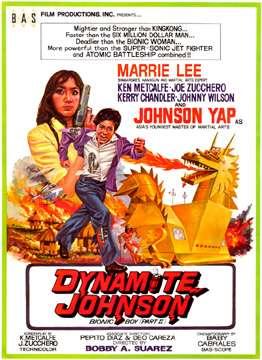
...ballyhooed the poster, which reused part of the artwork from the first film and subtitled the movie, in very small print ‘Bionic Boy (Part II)’. And that small print is what I find odd about all this because there is no other attempt in the publicity to link this to either of BAS Film Productions’ previous movies. Marrie Lee (‘Singapore’s handgun and martial arts expert’) is prominently featured but there is no mention of ‘Cleopatra Wong’ on the poster. And she is definitely playing the same character - a sexy, powerful chick composed in equal parts of legs, eye-shadow and attitude. Yap’s character calls her ‘Auntie Cleo’ and other characters refer to her specifically as ‘Cleopatra Wong’.
So why was the word ‘bionic’ so prominent in publicity for the first film but so hidden in the second? It could be that Suarez had got wind of legal arguments in the USA where some enterprising soul had decided to release the three-year-old Japanese monster flick Godzilla vs Mechagodzilla as Godzilla vs the Bionic Monster. Universal Studios, which made The Six Million Dollar Man, made loud, threatening noises and the posters were quickly amended to read Godzilla vs the Cosmic Monster.
Which makes it all the more bizarre that, while one film was losing the word ‘bionic’ from its title, this one was adding it in. Dynamite Johnson became The Return of the Bionic Boy, with the title rather obviously added as a still frame, interrupting the credit sequence of Master Johnson Yap doing his tae kwon do schtick.
Before the credits is a sequence of American mercenaries attacking some sort of industrial establishment who are interrupted by a robotic dragon. It’s a vehicle, togged up like a silver dragon, with a flame-thrower in its mouth and a machine gun in its tail. It’s goofy as all get-off but it’s an impressive, full-size, fully-functioning prop and the only thing that really lets the side down is that we have all seen Dr No at least seven times.
Master Johnson Yap plays a boy named ‘Sunny’ - presumably his surname is ‘Johnson’ - who arrives, in a wheelchair, in the Philippines from Singapore for surgery on his broken legs. For some reason, this surgery not only restores his ability to walk, it also greatly enhances his ability to do flying leaps and spin-kicks. And it raises his sight and hearing to superhuman levels too.
That’s surgery on his legs, folks.
Furthermore, no-one ever comments - not the good guys, not the bad guys - on Sunny’s amazing fighting ability.
Not having seen The Bionic Boy, I can’t say whether this film ties in to that at all but it seems unlikely that there is any narrative connection because Sunny isn’t actually bionic at the start of the film in which he ‘returns’. While recovering in hospital, his bionic ears overhear some bad guys talking in another room so he goes to investigate but when he tells the doctor and Auntie Cleo, no-one believes that he could have heard anything.
So he discharges himself from hospital (or sneaks out - I’m not sure) and tracks down some bad guys exchanging stuff at the docks. “Hey, what’s that kid doing here? Beat it!” says one, whereupon Sunny proceeds to defeat a whole bunch of chop-socky goons from both criminal gangs.
This sequence also introduces us to the least subtle, most stereotyped homosexual film character in cinematic history. Introduced here as the bad guy’s driver but later apparently some sort of second-in-command, this dark-skinned, skinny fellow wears an outfit that looks like one of Liberace’s cast-offs wrapped round a broomstick. He doesn’t just camp it up, he flounces, he pouts, he squeals like a little girl. In fact, he behaves in general like a little girl. It’s like the actor’s idea of homosexuality is ‘grown men who act like four-year-old girls’. On uppers.
He’s actually pretty funny - one of the film’s highlights - because he is so massively over-the-top he’s round the bend and back underneath. Comic relief that is, in its own way, actually comic, just not in any way that was intended. Honestly, next time you see an old clip of Are You Being Served you’ll think, ‘My word, that John Inman is essaying a sensitive and considered portrayal of a gay man.’ By comparison, at least.
Truth be told, after this it all gets a bit less interesting and, remarkably, Dynamite Johnson aka the Bionic Boy disappears from his own film for most of the running time as Cleopatra Wong takes centre stage. It’s some sort of smuggling operation of course, plutonium or something, I think. One thing is for sure: unlike the last Bobby Suarez/Marrie Lee film I saw, there’s no strawberry jam involved here.
Master Johnson Yap does get a sequence where he plays basketball with some kids, amazing them with his bionic b-ball skills before kicking the arses of some more chop-socky goons. There’s no doubt that the lad knows his moves and while he’s not outstandingly impressive, he’s not embarrassingly bad either. The last half-hour or so is, once again, a massive extended fight sequence, with our main characters joined by a couple of young blokes in black pullovers - don’t know who they are. The robot dragon reappears briefly. Finally, all the bad guys are beaten and our heroes fly off in an unexplained helicopter which comes to collect them.
One of the film’s problems is that it’s never sure whether it’s the Bionic Boy or Cleopatra Wong who is doing the returning. Although they do have some character scenes together, the movie seems to flip between the two for extended periods. But there is plenty of fighting, a reasonably coherent (if somewhat skimpy) plot, a great robot-dragon-machine and the campest fruit west of the Pacific.
The Return of the Bionic Boy finally made it to the UK in November 1986 courtesy of Cable 2 Video with a sleeve which assured any potential renters that this was ‘The First Bionic Boy’ and Marrie Lee’s name spelled wrong. The back of the sleeve, which features a staggeringly bad drawing of Master Johnson Yap, credits the director as ‘Bobby A Stuart’ although Suarez receives the correct credit on screen. It’s also worth reproducing the marvellous sleeve blurb from the UK release:
Which is stretching things a bit because really it’s an hour and a half of a little lad and a hot chick kicking the arses of production line martial arts goons. An interesting aspect is that Johnson’s ‘bionics’ are never commented upon (and certainly never shown). It’s really just an excuse to have the youngster beat grown-ups at kung fu. In that sense, it’s no different from the 1990s movies that would cast Billy Blanks or Don ‘The Dragon’ Wilson or whoever as a cyborg just so that the hero could justify being so much better than the anonymous stuntmen who queue up to jump away from him.
In fact, now I come to think of it., the hero of this film is actually a cyborg. It’s easy to miss that because cinematically, in a post-Terminator world, ‘cyborg’ is usually taken as a synonym for ‘robot’ or ‘android’, cheapjack film-makers failing to notice that Arnie had a layer of human skin and flesh covering his metal skeleton, rendering him a cybernetic organism. But Dynamite Johnson really is half-human, half-robot, yer actual cyborg (as indeed was Steve Austin of course).
All of which means that, unless someone can demonstrate evidence to the contrary, The Return of the Bionic Boy is officially the first ever KCM.
The screenplay is credited to Ken Metcalfe and Joe Zucchero who also play two of the lead roles, though I’m not sure who. Apart from master Yap and Miss Lee, I can’t actually identify any of the actors with their characters. No matter. The UK sleeve calls Metcalfe ‘Ken’ as writer but ‘Ron’ as actor. The two also wrote Bamboo Gods and Iron Men together. Metcalfe contributed to the script of the Roger Corman-produced TNT Jackson, a Cirio Santiago blaxploitationer which clearly inspired the title Dynamite Johnson - and which was allegedly released as Dynamite Wong and TNT Jackson in the Philippines. It’s easy to see how audiences might confuse that film’s Jeannie Bell with Pam Grier, both being about seven feet tall with a giant afro. In Dynamite Johnson, Marrie Lee also sports a Foxy Brown style wig and costume for one sequence but she would be harder to confuse with Grier, what with not actually being black and everything.
Ken ‘Ron’ Metcalfe’s other writing credits include Firecracker and Hell Hole for Santiago and American Commandoes and Warriors of the Apocalypse for Suarez. As an actor, he appeared in about 50 films between the late 1960s and the late 1990s including The Beast of the Yellow Night and Enter the Ninja. A sideline in casting local talent as extras got him credits on Hamburger Hill and Born on the Fourth of July!
Joe Zucchero wrote Final Mission, The Devastator and Eye of the Eagle for Ciro and Devil’s Angels for Bobby. As an actor he has about 30 credits, mostly (like Metcalfe) for the prolific Santiago. His sideline was in editing including both versions of Ciro Santiago’s boy-and-his-pteranodon classic, Vulcan and Anak ng Bulkan. (The Inaccurate Movie Database credits the script to Suarez and Romeo N Galang which is nonsense, although Suarez does take story credit.)
The cinematographer was Eduardo ‘Baby’ Cabrales whose CV includes Cleopatra Wong and the sixth entry in the long-running Shake Rattle and Roll Filipino horror anthology series. ‘Associate director’(?) Pepito Diaz worked on Delta Force 2, American Ninja and William Mesa’s enjoyable late-1990s monster flick DNA. Gene S Suarez was executive producer. The cast has some big-name (or at least, prolific) Filipino actors including Chito Guerrera (Fight Batman Fight, 7 Crazy Dragons), Joe Sison and Manny Tibayan.
Special effects are credited to Benny Macabale (One-Armed Executioner) with Margie Catro handling make-up and Nita Bayed as ‘costume caretaker’. Other credited crew include Isabelo Tatos (setting in-charge), Rolly Banta (special props), David Cheung (film editor), Bonnie Esquerra (production supervisor) and Willie Henson and Rolly Mercado (schedule masters). Alex Pecate is credited as both actor and stunt co-ordinator but the highlight of the credits, indeed of the opening titles, must surely be ‘P.I.S.S.’. This probably stands for Philippines International Stunt Squad or something but, dudes, it doesn’t matter what that stands for. Change your name!
Now comes the sad part. I had owned this VHS tape for quite a few years and planned to rewatch it (one of the few tapes I still own) in order to put a review on this site to complement my review of They Call Her Cleopatra Wong (which you will find under its UK video title of Female Big Boss). In December 2007, after I had posted that Cleopatra Wong review, Bobby Suarez himself became aware of it and sent me a very nice e-mail, telling me about all his plans to return to film-making.
Even though I don't do many interviews any more, I really wanted to interview Bobby Suarez. But not until I had rewatched The Return of the Bionic Boy. And that wasn’t going to happen until after I moved house because everything - DVDs, CDs, magazine, books and my handful of remaining video tapes - was packed up.
Well, we moved in December 2009 and in June 2010 I finally got round to putting The Return of the Bionic Boy into my surviving VHS machine. Both tape and player still worked fine and the movie was as gloriously bonkers as I remembered it. I set to writing this review.
And that was when I discovered that Bobby Suarez had died on 8th February 2010, aged 67. And that depressed me, not just because he joined Cirio Santiago on the list of Filipino directors I really wish I had interviewed, not just because the handful of e-mails I had exchanged with him showed Bobby to be an intelligent, friendly man, but also because nobody seemed to have noticed his death. It was listed on Wikipedia and the IMDB but I certainly didn’t see any discussion on any of the film boards where I occasionally chat or lurk.
So Bobby will never see this review. But his work lives on and maybe somebody will give his films a really good DVD release. In the meantime, I’ve posted, in lieu of the interview that I'll never get, that original e-mail which so delighted me when it appeared out of the blue on Boxing Day three years ago.
Rest in peace, Bobby.
MJS rating: B+
Writers: Ken Metcalfe, Joe Zucchero
Producer: Bobby A Suarez
Cast: Marrie Lee, Master Johnson Yap, Joe Zucchero
Country: Philippines
Year of release: 1978
Reviewed from: UK VHS
Herewith a short history of bionics. The word was invented by Jack E Steel, a medical doctor and former US Air Force Colonel in 1958. It was given literary credibility by Martin Caidin in his 1972 novel Cyborg which was adapted the following year into a TV movie - The Six Million Dollar Man, starring Lee Majors as US Air Force Colonel Steve Austin.
The telemovie was a big hit, pushed the term ‘bionic’ into the public consciousness and was followed (I didn’t know this - thanks Wikipedia!) by two more Movies of the Week about Steve Austin: Wine, Women and War and Solid Gold Kidnapping.
A weekly TV series of The Six Million Dollar Man started in January 1974 and ran for four years, totalling 100 episodes. The show was a massive hit, in those pre- and post-Star Wars days and it was inevitable that a distaff spin-off would be produced. The character of tennis player Jaime Sommers (Lindsay Wagner) was introduced in the second season of The Six Million Dollar Man in March 1975, returned at the start of season three and then The Bionic Woman ran simultaneously for three seasons, including a couple of two-part stories which stretched across both shows. This series, like its progenitor, was produced by Kenneth Johnson. Three reunion TV-movies followed in 1987, 1989 and as recently as 1994.
In November 1976, a possible third series was considered, aimed at a younger audience, and was trialled as a double-length episode of The Six Million Dollar Man called ‘The Bionic Boy’. But 15-year-old athlete Andy Sheffield (Vincent Van Patten) wasn’t as popular as Jaime Sommers and his spin-off never materialised. Fortunately neither was there any stand-alone televisual future for The Bionic Dog. No, honestly, they introduced a bionic dog.
Until Star Wars appeared, the two Bionic series were the biggest sci-fi hit around, hugely popular across the globe. Everywhere you looked, kids in playgrounds and comedians on TV were running in slow motion or punching each other slowly while making “Pow-ow-ow-ow...!” noises.
This came to the attention of the Philippines' greatest purveyor of popular cinema, Bobbie A Suarez. The first title from BAS Film Productions Inc, set up to produce exploitable action movies dubbed into English for international sale, was therefore The Bionic Boy, starring a nine-year-old (some sources say eight) tae kwon do prodigy named Master Johnson Yap who had been prominently featured in the Singapore press.In The Bionic Boy, Yap played the son of an Interpol agent who took on a bunch of international gangsters in revenge for the death of his parents. The film was the last known work of director Leody M Diaz, who passed away after wrapping production but before the movie was released. Diaz also helmed the semi-mythical Filipino epic Batman Fights Dracula and worked as action director on several of the popular Darna series of superheroine pictures. The screenplay was written by Romeo N Galang from a story by Suarez; Galang also wrote and directed an even more mythical film, 1973’s Fight Batman Fight! To the best of my knowledge no-one has ever actually seen either Batman movie although vintage newspaper ads confirm their existence. If a copy of either ever surfaced, it would be a major find. Until then, we must content ourselves with that old VHS of James Batman.
The Bionic Boy is generally dated to 1977 which would put it after the TV episode of the same name, but it might well have been in production before then. And of course, it’s an obvious spin to take on the concept (curiously no-one seems to have ever considered a bionic girl...). Certainly the publicity made no bones about the movie’s inspiration:
“FIRST - it was The Six Million Dollar Man. THEN CAME - The Bionic Woman. NOW COMES - the ultimate in action thrills and suspense with Asia’s youngest master of martial arts.”Combining the fad for bionic stuff with the 1970s vogue for chop-socky pictures was a smart move by Suarez and the film sold well. It was released in Pakistan (“He is more than a warrior... more than a super hero... he is the fighting fury of World War III.”) and Mexico (“Despues de El HOMBRE NUCLEAR y LA MUJER BIONICA, una nueva dimesion de aventuras y accion con un poderoso e indestructible personaje que le hara estremecer!!!”) and probably a bunch of other places. But not, so far as I can tell, the United States.
Suarez and Galang than reteamed for They Call Her... Cleopatra Wong starring the one and only Miss Marrie Lee. And when that was also a success, the obvious next step was to combine the two franchises. The result was Dynamite Johnson - and that’s the film we’re discussing here.
Mightier and Stronger than KINGKONG (sic)...
Faster the the SIX MILLION DOLLAR MAN...
Deadlier than the BIONIC WOMAN...
More powerful than the SUPER-SONIC JET FIGHTER and ATOMIC BATTLESHIP combined!!!
...ballyhooed the poster, which reused part of the artwork from the first film and subtitled the movie, in very small print ‘Bionic Boy (Part II)’. And that small print is what I find odd about all this because there is no other attempt in the publicity to link this to either of BAS Film Productions’ previous movies. Marrie Lee (‘Singapore’s handgun and martial arts expert’) is prominently featured but there is no mention of ‘Cleopatra Wong’ on the poster. And she is definitely playing the same character - a sexy, powerful chick composed in equal parts of legs, eye-shadow and attitude. Yap’s character calls her ‘Auntie Cleo’ and other characters refer to her specifically as ‘Cleopatra Wong’.
So why was the word ‘bionic’ so prominent in publicity for the first film but so hidden in the second? It could be that Suarez had got wind of legal arguments in the USA where some enterprising soul had decided to release the three-year-old Japanese monster flick Godzilla vs Mechagodzilla as Godzilla vs the Bionic Monster. Universal Studios, which made The Six Million Dollar Man, made loud, threatening noises and the posters were quickly amended to read Godzilla vs the Cosmic Monster.
Which makes it all the more bizarre that, while one film was losing the word ‘bionic’ from its title, this one was adding it in. Dynamite Johnson became The Return of the Bionic Boy, with the title rather obviously added as a still frame, interrupting the credit sequence of Master Johnson Yap doing his tae kwon do schtick.
Before the credits is a sequence of American mercenaries attacking some sort of industrial establishment who are interrupted by a robotic dragon. It’s a vehicle, togged up like a silver dragon, with a flame-thrower in its mouth and a machine gun in its tail. It’s goofy as all get-off but it’s an impressive, full-size, fully-functioning prop and the only thing that really lets the side down is that we have all seen Dr No at least seven times.
Master Johnson Yap plays a boy named ‘Sunny’ - presumably his surname is ‘Johnson’ - who arrives, in a wheelchair, in the Philippines from Singapore for surgery on his broken legs. For some reason, this surgery not only restores his ability to walk, it also greatly enhances his ability to do flying leaps and spin-kicks. And it raises his sight and hearing to superhuman levels too.
That’s surgery on his legs, folks.
Furthermore, no-one ever comments - not the good guys, not the bad guys - on Sunny’s amazing fighting ability.
Not having seen The Bionic Boy, I can’t say whether this film ties in to that at all but it seems unlikely that there is any narrative connection because Sunny isn’t actually bionic at the start of the film in which he ‘returns’. While recovering in hospital, his bionic ears overhear some bad guys talking in another room so he goes to investigate but when he tells the doctor and Auntie Cleo, no-one believes that he could have heard anything.
So he discharges himself from hospital (or sneaks out - I’m not sure) and tracks down some bad guys exchanging stuff at the docks. “Hey, what’s that kid doing here? Beat it!” says one, whereupon Sunny proceeds to defeat a whole bunch of chop-socky goons from both criminal gangs.
This sequence also introduces us to the least subtle, most stereotyped homosexual film character in cinematic history. Introduced here as the bad guy’s driver but later apparently some sort of second-in-command, this dark-skinned, skinny fellow wears an outfit that looks like one of Liberace’s cast-offs wrapped round a broomstick. He doesn’t just camp it up, he flounces, he pouts, he squeals like a little girl. In fact, he behaves in general like a little girl. It’s like the actor’s idea of homosexuality is ‘grown men who act like four-year-old girls’. On uppers.
He’s actually pretty funny - one of the film’s highlights - because he is so massively over-the-top he’s round the bend and back underneath. Comic relief that is, in its own way, actually comic, just not in any way that was intended. Honestly, next time you see an old clip of Are You Being Served you’ll think, ‘My word, that John Inman is essaying a sensitive and considered portrayal of a gay man.’ By comparison, at least.
Truth be told, after this it all gets a bit less interesting and, remarkably, Dynamite Johnson aka the Bionic Boy disappears from his own film for most of the running time as Cleopatra Wong takes centre stage. It’s some sort of smuggling operation of course, plutonium or something, I think. One thing is for sure: unlike the last Bobby Suarez/Marrie Lee film I saw, there’s no strawberry jam involved here.
Master Johnson Yap does get a sequence where he plays basketball with some kids, amazing them with his bionic b-ball skills before kicking the arses of some more chop-socky goons. There’s no doubt that the lad knows his moves and while he’s not outstandingly impressive, he’s not embarrassingly bad either. The last half-hour or so is, once again, a massive extended fight sequence, with our main characters joined by a couple of young blokes in black pullovers - don’t know who they are. The robot dragon reappears briefly. Finally, all the bad guys are beaten and our heroes fly off in an unexplained helicopter which comes to collect them.
One of the film’s problems is that it’s never sure whether it’s the Bionic Boy or Cleopatra Wong who is doing the returning. Although they do have some character scenes together, the movie seems to flip between the two for extended periods. But there is plenty of fighting, a reasonably coherent (if somewhat skimpy) plot, a great robot-dragon-machine and the campest fruit west of the Pacific.
The Return of the Bionic Boy finally made it to the UK in November 1986 courtesy of Cable 2 Video with a sleeve which assured any potential renters that this was ‘The First Bionic Boy’ and Marrie Lee’s name spelled wrong. The back of the sleeve, which features a staggeringly bad drawing of Master Johnson Yap, credits the director as ‘Bobby A Stuart’ although Suarez receives the correct credit on screen. It’s also worth reproducing the marvellous sleeve blurb from the UK release:
Fast, exciting Martial arts action with a pint-sized warrior. Almost a satire of the Bruce Lee classics with a touch of ‘BMX Bandits’ thrown in. A half-pint warrior with the added aid of bionics and an equally lethal aunt as his constant companion/guardian clean up around them.
Martial arts enthusiasts become unpopular when they cause havoc in the street, but become heroes when they capture criminals.
Lively action movie with unacceptable behaviour from a half-computerised boy followed by reformation and an old-fashioned moral for young teenagers.
Which is stretching things a bit because really it’s an hour and a half of a little lad and a hot chick kicking the arses of production line martial arts goons. An interesting aspect is that Johnson’s ‘bionics’ are never commented upon (and certainly never shown). It’s really just an excuse to have the youngster beat grown-ups at kung fu. In that sense, it’s no different from the 1990s movies that would cast Billy Blanks or Don ‘The Dragon’ Wilson or whoever as a cyborg just so that the hero could justify being so much better than the anonymous stuntmen who queue up to jump away from him.
In fact, now I come to think of it., the hero of this film is actually a cyborg. It’s easy to miss that because cinematically, in a post-Terminator world, ‘cyborg’ is usually taken as a synonym for ‘robot’ or ‘android’, cheapjack film-makers failing to notice that Arnie had a layer of human skin and flesh covering his metal skeleton, rendering him a cybernetic organism. But Dynamite Johnson really is half-human, half-robot, yer actual cyborg (as indeed was Steve Austin of course).
All of which means that, unless someone can demonstrate evidence to the contrary, The Return of the Bionic Boy is officially the first ever KCM.
The screenplay is credited to Ken Metcalfe and Joe Zucchero who also play two of the lead roles, though I’m not sure who. Apart from master Yap and Miss Lee, I can’t actually identify any of the actors with their characters. No matter. The UK sleeve calls Metcalfe ‘Ken’ as writer but ‘Ron’ as actor. The two also wrote Bamboo Gods and Iron Men together. Metcalfe contributed to the script of the Roger Corman-produced TNT Jackson, a Cirio Santiago blaxploitationer which clearly inspired the title Dynamite Johnson - and which was allegedly released as Dynamite Wong and TNT Jackson in the Philippines. It’s easy to see how audiences might confuse that film’s Jeannie Bell with Pam Grier, both being about seven feet tall with a giant afro. In Dynamite Johnson, Marrie Lee also sports a Foxy Brown style wig and costume for one sequence but she would be harder to confuse with Grier, what with not actually being black and everything.
Ken ‘Ron’ Metcalfe’s other writing credits include Firecracker and Hell Hole for Santiago and American Commandoes and Warriors of the Apocalypse for Suarez. As an actor, he appeared in about 50 films between the late 1960s and the late 1990s including The Beast of the Yellow Night and Enter the Ninja. A sideline in casting local talent as extras got him credits on Hamburger Hill and Born on the Fourth of July!
Joe Zucchero wrote Final Mission, The Devastator and Eye of the Eagle for Ciro and Devil’s Angels for Bobby. As an actor he has about 30 credits, mostly (like Metcalfe) for the prolific Santiago. His sideline was in editing including both versions of Ciro Santiago’s boy-and-his-pteranodon classic, Vulcan and Anak ng Bulkan. (The Inaccurate Movie Database credits the script to Suarez and Romeo N Galang which is nonsense, although Suarez does take story credit.)
The cinematographer was Eduardo ‘Baby’ Cabrales whose CV includes Cleopatra Wong and the sixth entry in the long-running Shake Rattle and Roll Filipino horror anthology series. ‘Associate director’(?) Pepito Diaz worked on Delta Force 2, American Ninja and William Mesa’s enjoyable late-1990s monster flick DNA. Gene S Suarez was executive producer. The cast has some big-name (or at least, prolific) Filipino actors including Chito Guerrera (Fight Batman Fight, 7 Crazy Dragons), Joe Sison and Manny Tibayan.
Special effects are credited to Benny Macabale (One-Armed Executioner) with Margie Catro handling make-up and Nita Bayed as ‘costume caretaker’. Other credited crew include Isabelo Tatos (setting in-charge), Rolly Banta (special props), David Cheung (film editor), Bonnie Esquerra (production supervisor) and Willie Henson and Rolly Mercado (schedule masters). Alex Pecate is credited as both actor and stunt co-ordinator but the highlight of the credits, indeed of the opening titles, must surely be ‘P.I.S.S.’. This probably stands for Philippines International Stunt Squad or something but, dudes, it doesn’t matter what that stands for. Change your name!
Now comes the sad part. I had owned this VHS tape for quite a few years and planned to rewatch it (one of the few tapes I still own) in order to put a review on this site to complement my review of They Call Her Cleopatra Wong (which you will find under its UK video title of Female Big Boss). In December 2007, after I had posted that Cleopatra Wong review, Bobby Suarez himself became aware of it and sent me a very nice e-mail, telling me about all his plans to return to film-making.
Even though I don't do many interviews any more, I really wanted to interview Bobby Suarez. But not until I had rewatched The Return of the Bionic Boy. And that wasn’t going to happen until after I moved house because everything - DVDs, CDs, magazine, books and my handful of remaining video tapes - was packed up.
Well, we moved in December 2009 and in June 2010 I finally got round to putting The Return of the Bionic Boy into my surviving VHS machine. Both tape and player still worked fine and the movie was as gloriously bonkers as I remembered it. I set to writing this review.
And that was when I discovered that Bobby Suarez had died on 8th February 2010, aged 67. And that depressed me, not just because he joined Cirio Santiago on the list of Filipino directors I really wish I had interviewed, not just because the handful of e-mails I had exchanged with him showed Bobby to be an intelligent, friendly man, but also because nobody seemed to have noticed his death. It was listed on Wikipedia and the IMDB but I certainly didn’t see any discussion on any of the film boards where I occasionally chat or lurk.
So Bobby will never see this review. But his work lives on and maybe somebody will give his films a really good DVD release. In the meantime, I’ve posted, in lieu of the interview that I'll never get, that original e-mail which so delighted me when it appeared out of the blue on Boxing Day three years ago.
Rest in peace, Bobby.
MJS rating: B+
Sunday, 5 May 2013
Female Big Boss
Director: ‘George Richardson’Writer: Romeo N Galang
Producer: Bobby A Suarez
Cast: Marrie Lee, George Estregan, Dante Varona
Country: Philippines/Singapore
Year of release: 1978
Reviewed from: UK VHS (Diamond Films)
Picked this knocked-about 1980s rental VHS up off Leicester market the other week, attracted by the title and the sleeve image, a drawing of a massively endowed woman unzipping her top. It was in with a pile of old Italian sex comedies but the presence of names like ‘Romeo N Galang’ in the credit block clued me in to the fact that this was some sort of Pacific Asian action movie, simply aping a well-known Bruce Lee title.
In fact the film was original titled They Call Her Cleopatra Wong, an homage not to Bruce but presumably to 1973 blaxploitation classic Cleopatra Jones, and it is the first Singapore movie I have reviewed for this site - although not, I expect, the last. (I initially had my doubts about that original title, thinking that it was just Cleopatra Wong as the advertising materials I saw suggested that ‘They call her...’ was mere poster copy. But a browse through contemporary trade press shows that the full five-word title was the original and it was simply shortened later. There was a vogue for They Call... titles in the 1970s including spaghetti westerns They Call Me Trinity and They Call Me Renegade, Swedish action-thriller They Call Her One Eye, Sidney Poitier-starring drama They Call Me Mister Tibbs! and Filipino martial arts knock-off They Call Him Chop-Suey - written by this film’s director Bobby A Suarez.)
‘And introducing Marrie Lee’ stars as the eponymous Interpol agent and the opening credits show her riding a motorbike, demonstrating top class marksmanship with both automatic pistol and longbow, kicking the collective arses of a half-dozen opponents at a martial arts demonstration and - hey! - partying till dawn in a classy international discotheque. On holiday in the Philippines, she is interrupted, mid-shag, by a phone call from her boss and has to fly back to Singapore where she is assigned to trace the source of some top-quality forged currency.
By conspicuously spending some of the fake dosh in a jewellery store, she attracts the attention of a local gangster who kidnaps her and takes her to his palatial villa, reachable by cable car. There she is thrown to the whims of three overweight wrestlers whose expressions when she whips off her skirt prior to fighting them are straight out of a Tex Avery film. The fatties having failed, the gangster calls in about thirty teenage boys who similarly prove no match for Cleo, who jumps over a 20-foot wall and escapes with the help of her moped-riding assistant.Somehow the trail leads her to Hong Kong, where an informer working at the docks recommends that she keeps an eye on a consignment of strawberry jam. She follows the crate and finds that this is how the money is being smuggled into Honkers - but where is it coming from?
Finally, she returns to the Philippines where she poses as a magazine photographer reporting on what one must presume is the legendary Filipino Strawberry Belt. Asking around, her questions provoke possibly the greatest line ever spoken in a dubbed action movie: “The biggest strawberry jam factory in this area is the Catholic monastery over the hill.” If I live to be a hundred I will never write a line that brilliant.
It seems that a bunch of gangsters with the most extraordinary range of dodgy international accents have locked all the nuns in the cellar, dressed up in habits and set up a printing press in the monastery, banging out forged currency for five different Asian countries, which they smuggle across borders by hiding rolls of notes in jars of the monastery’s famous strawberry jam. (It’s the whole strawberry thing that gets to me. If it was just generic jam, it wouldn’t be nearly as entertaining. There is a ‘thank you’ credit to ‘Strawberry House, Bagglio City’, wherever/whatever that is.)Cleo launches an assault on the monastery assisted by four male agents and the last half an hour or so consists almost entirely of fake nuns with machine guns running around and being gunned down. It’s completely brilliant. The real nuns are released from the cellar and led away to safety in a sequence that plays like a cross between Black Narcisus and The Wild Bunch. It’s just awesome. Eventually, Cleo collects her previously barely noticed motorbike and we find that it has rear-firing machine guns in the panniers. She also gets to demonstrate her archery skills, something forgotten entirely since the pre-credits sequence, by firing three arrows simultaneously and blowing up the bad guy’s helicopter.
Relentlessly brilliant, Female Big Boss/Cleopatra Wong turns out to be relatively well known and one of Quentin Tarantino’s favourite films, which should not really some as any surprise. However, it doesn’t seem to have been released on DVD so there’s an opportunity for someone there.
Marrie Lee’s real name was the rather less-exotic Doris Young and she was cast from a newspaper ad which asked: ‘Are you smart, sexy and seductive?’ Young was 18 and working as a receptionist in a nightclub on Shenton Way, one of the major roads in downtown Singapore, when she spotted the ad; she turned up to the audition in boots and miniskirt, assured the producers that she could ride a motorbike, and got the job just like that, beating 150 other applicants. The stage name was designed to fuel rumours that she was Bruce Lee’s sister, what with ‘Lee’ being such an unusual surname and all that.
According to a report in Screen International (20th July 1977), Marrie Lee is 5’7” and was 36-26-36 at the time. She had recently finished attending a Catholic high-school and had acted in school plays as well as taking bit roles in Hong Kong pictures that shot in Singapore. Shooting on Cleopatra Wong began in August 1977.
Filmed in Singapore, the Philippines and Hong Kong with post-production in Hollywood (it was filmed in English so the voices, though dubbed, match the lip movements), Cleopatra Wong is one of the very few independently produced Singapore feature films and was always aimed at the international market. Bobby A Suarez produced the film through his Filipino company BAS Films Productions Inc and also directed under the pseudonym ‘George Richardson’ (sometimes cited as ‘George N Richardson’). Suarez was raised in the Boys Town orphanage and started out as a janitor in the Filipino branch of Rank, rising to Assistant Sales Manager before establishing his own film company. His mentor at Rank was RLH Davidson who went on to become a senior figure with Warner Brothers. Suarez worked in Hong Kong in the 1970s before returning to the Philippines where he made The Bionic Boy and then this film. He has since gone on to win stacks of awards, becoming a major name in the local film industry.When Cleopatra Wong proved an instant success, Suarez decided to combine his two franchises into a joint sequel, Dynamite Johnson - which was released in the UK as The Return of the Bionic Boy (and has been sitting on my shelf for some years, so time to dust that one off, I think). Cleo returned for a third adventure called Pay or Die (aka Devil’s Three aka Mean Business) and would have starred in another Suarez production, Queen Cobra, if she had not left for the States at that time. She was actually signed up to a five-picture deal but The Vengeance of Cleopatra Wong, though announced, never materialised. ‘Marrie Lee’ apparently only made two other pictures: a Spanish/Mexican film called Target Scorpion and a Hong Kong movie called Showdown at the Equator. She subsequently ran a dance troupe for a few years, then a healthcare company. Suarez’s later works include such great-sounding titles as American Commandos, Warriors of the Apocalypse, Commander Firefox and One-Armed Executioner.
Romeo N Galang (Romy N Galang on the poster), who fashioned the script for this from Suarez’s story, seems at first glance to have no other credits apart from the screenplays for the two Bionic Boy movies and a 1968 picture, De Colores. But the Inaccurate Movie Database, as we know, is less than reliable and in fact he also had a career as a director which included a previously unknown 1971 movie called Fight, Batman, Fight! (an even more blatant rip-off than James Batman, by the looks of the poster). The IMDB and other sources credit him with the score for Cleopatra Wong but there is no music credit on the film itself.Speaking of IMDB discrepancies, there is the question of this film’s nationality. BAS Films Productions Inc was a Filipino company and is the only production company credited on screen but there seems to have been considerable involvement - and probably investment - in this film from Singapore. So I think it’s reasonable to consider this a Singapore/Filipino co-production. Some sources throw Hong Kong into the mix but I think that was just used as a location. It is noticeable that there are 31 credited actors plus another 12 listed separately as ‘in Singapore’ and another five ‘in Hong Kong’.
Chito Guerrero seems to be the only actor (apart from Marrie Lee) in all three Cleopatra Wong films, as well as several other Bobby Suarez pictures. Kerry Chandler and Alex Pecate (who gets an additional credit as ‘action director’) were also in Dynamite Johnson while Johnny Wilson and Danny Rojo (Lady Untouchable, Karate Fighters) were also in Pay or Die. (Wilson was also in Burning Power, Death Raiders and Suicide Force - boy, those Filipinos sure can come up with great titles.)
Also in the cast are George Estregan (legendary horror movie The Killing of Satan), Dante Varona (Cirio Santiago’s Dune Warriors), Philip Gamboa (They Call Him Bruce Lee, Biokids), Joaquin Fajardo (who was in The Omegans with Ingrid Pitt as well as Ninja Kids, Magnum Barracuda and Supermouse and the RoboRats), Joe Cunanan (The Impossible Kid), Clem Parsons (both Bionic Boy movies), Bobbie Greenwood, Jesse Lee, Vic Romero, Steve Havaro, Avel Morado, Bernie Bernado, Tony Castro, Joe Canlas, Mark Sherak, Romy Misa, Robert Mendez, Don Bell, Skip Kriegel, Bill James, Paul Mejares, Buddy Philipps, Robert Mallet, Mike Youngblood and John Stewart. There are also credits for the ‘Thunderboys Stuntmen' and the embarrassingly named ‘PIS Stuntmen’.
Cinematography is shared between David Hung and Eduardo ‘Baby’ Cabrales (on screen) aka Eduardo Cabrales Jr (on the poster) although initial reports credited Hung and Arnold Alvaro, a BAS Films regular who also worked on Balbakwa: The Invisible Man and Blood Ring 1 and 2. First Assistant Director Pepito Diaz went on to be 2nd AD on Platoon(!) and also worked on William Mesa’s sci-fi thriller DNA. The special effects are credited to Apolonio Abadeza whose name seems to have umpteen spellings and who worked on two Antonio Margheriti/David Warbeck films, The Last Hunter and Hunters of the Golden Cobra. There are separate credits for ‘special sets’ (Vicente Bonus, who was production designer on Terror is a Man!) and ‘special props’ (Jesse Sto.Domingo, who worked on Wonder Women and a whole bunch of Cirio Santiago movies).Back in 1977, when Suarez was selling The Bionic Boy to distributors around the world and preselling They Call Her Cleopatra Wong, his in-development projects included The Crime Busters, The Vengeance of Cleopatra Wong, Daughters of Satan and a Bionic Boy sequel to be called The 12-Million-Dollar Boy (which may or may not have mutated into Dynamite Johnson). The following spring, BAS Films took out a three-page ad in Screen International to promote their wares at Cannes. The page ballyhooing They Call Her Cleopatra Wong played up the sexy aspects: “She purrs like a kitten ... makes love like a siren ... fights like a panther. This side of the Pacific, she is the deadliest, meanest and sexiest secret agent!” This flies somewhat in the face of Suarez’s remarks to the press that his “adventures features are aimed at attracting family audiences and provide ample thrills to entertain both kids and adults.” The quote is more accurate than the poster copy - there’s very little sex or sexiness in Cleopatra Wong, except that Marrie Lee herself is undeniably sexy.
That issue of Screen International also carried a full-page ad for Dynamite Johnson: “Mightier and Stronger than KINGKONG (sic) ... Faster than the SIX MILLION DOLLAR MAN... Deadlier than the BIONIC WOMAN ... More powerful than the SUPER-SONIC JET FIGHTER and ATOMIC BATTLESHIP combined!!!” Both posters describe Marrie Lee parenthetically as “Singapore’s handgun and martial arts expert.” Then the third page of the BAS Films ad presents titles and logos of other ‘forthcoming productions’: Super Woman, The Destroyers, Queen Cobra, One-Armed Executioner, Queen Cobra Strikes Again, Computer Boy, The Professional Mercenaries, Computer Boy Part II, Seven Thorns in a Mother’s Heart, The 3 Magnificent Shaolin Disciples and, of course, The Vengeance of Cleopatra Wong.Keeping track of Bobby Suarez’s films is tricky with little to rely on except Google and the IMDB but his most recent credit as director seems be Obsessed in 1997 (he ostensibly retired in the late 1980s but that doesn't seem to have slowed him down at all). He was co-executive producer on Crying Ladies in 2003 and BAS Films produced Aishite Imasu (Mahal Kita) 1941 the following year. This last feature concerns the plight of a Filipino village under Japanese occupation; it has been shown at several festivals and is well-documented beyond the IMDB.
Googling around I came across Marrie Lee’s own webpage, an interesting (if slightly academic) treatise on Suarez’s work available as a PDF, and a blog by a Filipino critic which includes a lengthy post from Australian cult movies expert Andrew Leavold about his meetings with Filipino cinema legends including Lee and Suarez. The intriguing thing is, Bobby Suarez still has plans to make The Vengeance of Cleopatra Wong (with Marrie Lee in the title role). Whether this will come to anything, I don’t know. I’m not holding my breath. I also found a page which has a poster for a proposed Cleopatra Wong film, co-produced with BAS Films, called The Wandering Samurai.It is evident that there is a big cult following for Marrie Lee, Bobby Suarez and the Cleopatra Wong films. Who would have thought all this could be found by just buying a tape from Leicester market for a quid?
MJS rating: A-
review originally posted 30th June 2007
Subscribe to:
Posts (Atom)