Showing posts with label 1987. Show all posts

Tuesday, 2 August 2016

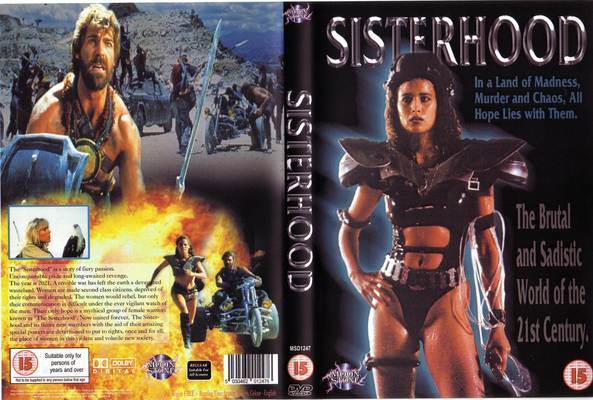
The Sisterhood

Director: Cirio H Santiago
Writer: Thomas Mckelvey Cleaver
Producer: Cirio H Santiago
Cast: Rebecca Holden, Chuck Wagner, Lynn-Holly Johnson
Year of release: 1987
Country: Philippines/USA
Reviewed from: UK rental VHS (Pearl Communications)

Cirio H Santiago - your mark of quality when it comes to Filipino movies. And I’m not being cynical - the production values here are a whole notch above many of the man’s contemporaries.

This is yet another post-holocaust adventure that would like to be Mad Max 2 but isn’t, but it does at least have an original premise. The world (well, North America) has reverted to an entirely patriarchal society and women are subjugated - except for a semi-legendary band of femme outlaws called ‘the Sisterhood’ who are said to be witches. In fact, they have various powers derived from the mutational after-effects of the bomb, which manifest themselves at puberty. Or something.

We meet two of these, Alee (Rebecca Holden: Knight Rider, Lycanthrope) and Vera (Barbara Hooper: The Wizard of Speed and Time) as they run up against the gang of thugs led by bearded Mikal (Automan himself, Chuck Wagner). One of the girls has healing powers and one has telekinetic ability, but to be honest I can’t remember which is which. Anyway, they kick Mikal’s arse and send him and his gang on their way in their crudely customised motor vehicles.

In a nearby settlement lives 18-year-old Marya (Lynn-Holly Johnson: Mutant 2, Hyper Space) and her younger brother Gil (Tom McNeeley). Marya has some form of psychic link with her hawk Lady Shri, which her master, Lord Newfield, accepts because it’s useful. But the lord is away and others in the settlement are calling her a witch. Mikal and his engine-revving mates attack the settlement and, before she escapes, Marya sees her brother cut down by Mikal himself. (For some reason, although motor vehicles still exist in this world, no guns have survived so all fighting is done with swords and bows.)

When Marya seeks shelter at a tavern, she meets and befriends Alee and Vera, who are reluctant to accept her into the Sisterhood until they discover her affinity with Lady Shri. Camped for the night, Vera is snatched by Mikal and much of the rest of the movie is Alee and Marya trying to get her back. Mikal at first joins forces with fey, hare-lipped Lord Barak (Robert Dryer: Cyborg 2, Spaceship, Revenge of the Zombie) but that ends unhappily so he teams up instead with Lord Jak (Anthony East: Bloodfist II) to journey through the Forbidden Zone to Calcara, ‘the city of ultimate pleasure.’

The Forbidden Zone, you will not be surprised to hear, is home to various unpleasant mutated folks who chase Alee and Marya into a cave network, wherein they find a whole bunch of pre-holocaust stuff - including loads and loads of rifles and some handy armoured personnel carriers which they are of course able to drive straight away. With this they head for Calcara, which is ruled by loud, jovial Lord Kragg (Kenneth Peerless: Bloodfist) but frankly for a city of ultimate pleasure it seems rather devoid of bars and whores.

Lord Kragg receives Mikal’s gift of a witch but, wouldn’t you know it, he’s already got some! A whole room full of captured Sisterhood members in manacles. When Marya and Alee break in and rescue Vera (and kill lots of guards) some sort of spectral goddess appears and all the manacles fall off the Sisterhood who magically fade away. Eh?

I’ve got a soft spot for this movie (which was just called Sisterhood for its UK DVD release, possibly to avoid confusion with the similarly titled David DeCoteau picture), mainly because it isn’t just a clone of Mad Max 2 or Escape from New York (1980s Italian producers, are you listening?). The cinematography by Ricardo Remias (She Devils in Chains, The Muthers, Vampire Hookers, Anak Ng Bulkan) is good and the fights and stunts are well-handled; Ronald Asinas (Terminal Virus), Day Guerrero (Robo Warriors) and Fred Esplana (Raw Target) are credited as stunt choreographers.

Sure, there are plenty of cliches and some silly bits but it’s more enjoyable than many other films in this genre. The mere fact that I’ve watched it twice is evidence of that. The acting is better than one would expect, and if Johnson is a little wooden occasionally she is also very good at playing up her character’s vulnerability.

Also in the cast are Henry Strzalkowski (Desert Warrior, Equalizer 2000, Angel of Destruction, also credited as casting assistant), David Light (Cobra Mission, Future Hunters), Jim Moss (Robo Warriors, Future War, Zombie Flesh Eaters 3) and Peter Shilton (Future Hunters, Equalizer 2000 but not - despite what the Inaccurate Movie Database reckons - the former goalkeeper for Nottingham Forest and England!). Composer Jun Latonio (Fast Gun, Killer Instinct) is anglicised to ‘Jim Latison’ on the sleeve. Ronnie Cruz was the art director, Teresa Mercader did the make-up and Elvia Santos was in charge of wardrobe, while special effects are credited to Juan Marbella Jr - Santiago veterans all.

It’s a Cirio H Santiago movie and, let’s face it, the man’s a cinema legend, having helmed more than fifty films from Filipino Wonder Woman series entry Darna and the Tree Monster to one-boy-and-his-pterodactyl remake Anak Ng Bulkan/Vulcan, as well as producing such WIP classics as Jack Hill’s The Big Doll House and The Big Bird Cage. I’m not ashamed to say that I will always happily watch any movie with Santiago’s name in the credits.

MJS rating: B

Review originally posted 19th April 2008.

Wednesday, 13 August 2014

The Uninvited

Director: Greydon Clark
Writer: Greydon Clark
Producer: Greydon Clark
Cast: Alex Cord, George Kennedy, Eric Larson
Year of release: 1987
Country: USA
Reviewed from: UK VHS (Braveworld)

One sure sign of a quality movie is that it’s not sure what its own title is: this is called The Uninvited on the front and back of the (3D!) video sleeve but just Uninvited on the spine and on screen. But could a film made by the creator of Without Warning, Wacko and Satan’s Cheerleaders really be all that bad?

Alex Cord (Airwolf) plays rich guy Walter Graham - twice on the cover of Forbes magazine but actually a crook - and George Kennedy (The Naked Gun, Demonwarp) is his partner Mike Harvey. They set off from Fort Lauderdale for the Cayman Islands and provided they can reach there in three days they can get their hands on vast amounts of cash (the details aren’t clear - it may be some money laundering scheme).

As a cover story, Walter invited aboard his luxury yacht a couple of bimbos, Bobbie (Clare Carey: Waxwork and the Johnny Mnemonic video game!) and Suzanne (Shari Shattock: Witch Bitch). They in turn invite three students: sports jock Lance (Beau Dremon: Frankenstein: The College Years), yuppie law major Corey (Rob Estes: Phantom of the Mall) and quiet biologist Martin (Eric Larson, who has been in episodes of Battlestar Galactica and Angel).

Suzanne also brings aboard a cat which she has rescued from a dockside trash can. Also on the boat is henchman Albert (Clu Gulager: Return of the Living Dead, Nightmare on Elm Street II) plus Rachel (Dirk Benedict’s then-wife Toni Hudson: Texas Chainsaw Massacre III), the boat’s captain whose father once owned the vessel.

Now, the key to all this is the cat. Back in the 1980s when I occasionally performed stand-up comedy, one of my routines involved demonstrating how Alien was actually a remake of Ten Little Indians and proving that the murderer was actually the cat. And on this ship - it actually is the cat! We know this because of a prologue at some scientific establishment where the cat escapes while being injected and then kills several people (the doctor in this scene is Greydon Clark himself).

The cat has some sort of deadly mutant creature inside it which climbs out of its mouth, but it takes a long time for even the audience to realise this because the effects are so hopelessly inconsistent. Is this thing just sticking its head out of the cat, or is it climbing out completely and then back in, or is the cat itself mutating when it attacks? In fact, the mutant thing does crawl out of the cat, yet somehow when it hurls itself on its victims moments later it’s twice the size of its host! A&A Special Effects are the people responsible for the hilarious hand-puppet which rips people’s throats out, apparently.

When the cat-thing attacks, it’s not only strong and vicious but also has poisonous saliva which contaminates the victim’s blood and causes them to break out in not-terribly-convincing bladder prosthetic effects (courtesy of the imaginatively named Makeup Effects Lab). Albert is first to go, then Mike, and gradually the crew is whittled down.

Meanwhile the engine has broken down (the cat’s doing of course!) and Walter has shot up the radio. The ending (and it’s not too difficult to spot which couple will survive) is a ridiculous let-down, and in an extraordinary editing cock-up, at one point there are two consecutive takes of the same dialogue!

This is not the worst monster-on-a-boat movie I’ve ever seen - that honour goes to Creatures from the Abyss - but it’s pretty bad. There’s no actual nudity though Bobbie and Suzanne do spend most of their time in tiny bikinis, and when they’re fully dressed it’s in the most awful 1980s fashions. In terms of wardrobe, this really is symptomatic of the Decade That Good Taste Forgot.

A film to be watched only late at night while very, very drunk. Unfortunately I saw it sober in the middle of the afternoon.

MJS rating: D+

Saturday, 29 March 2014

Princess from the Moon

Director: Kon Ichikawa
Writers: Shinya Hidaka, Mitsutoshi Ishigami, Ryuzo Kikushima
Producers: Hiroaki Fujii, Masaru Kakatani, Junichi Shinsaka
Cast: Toshiro Mifune, Yasuko Sawaguchi, Katsuo Nakamura
Year of release: 1987
Country: Japan
Reviewed from: UK DVD (Artsmagic)

In feudal Japan, poor bamboo weaver Taketori-no-Miyatsuko and his wife mourn the death (from illness) of their young daughter Kaya. One night, there is a massive light from the bamboo forest behind their house, and when Miyatsuko investigates he comes across a strange metal capsule, half-buried in the ground next to his daughter’s grave. A mysterious light flows between the two, then the capsule opens and out crawls a baby which grows, before his astonished eyes, into a little girl who is the double of Kaya.

Miyatsuko takes the girl home, where his overjoyed wife sees her as a gift from Heaven to replace their daughter. Meanwhile, other locals have discovered a huge, smoking pit in the middle of the forest. Miyatsuko sells a piece of the capsule and discovers that it is pure gold; shortly afterwards he and his wife return home to find that Kaya has grown into an elegant young woman.

Suddenly wealthy, the couple move from their shack to a huge house in the rich part of town, where all the men are bewitched by Kaya’s ethereal beauty. But the local Shogun hears tell of gold being traded in town and wonders where it has come from.

Kaya receives proposals of marriage from three suitors: two slimy old guys and a sincere young councillor. On the advice of a blind friend she sends the three men on impossible tasks. The two slimeballs apparently succeed but are shown to have cheated, while the youngest man, barely surviving his fruitless attempt, proves that his love for Kaya (or Kaguya as she has become known - meaning ‘shining lady’) is true.

But by this point, Kaya/Kaguya’s true origin has been discovered: she came from the Moon and must return at the next full moon. Squads of soldiers are posted around the family’s house but Kaguya is taken anyway, in a shaft of light, leaving behind her adopted parents, her blind friend and her suitor.

Princess from the Moon (Taketori Monogatari) looks fabulous, a terrific recreation of feudal Japan with amazing costumes (by Emi Wada: Ran, Akira Kurosawa’s Dreams) and great sets (by Shinobu Muraki: Ran and - blimey! - ESPY). Unfortunately it’s also very, very long and very, very slow. The Mona Lisa looks fabulous too - but you wouldn’t want to stare at it for 122 minutes. The great Toshira Mifune - looking a lot older than he did in Yojimbo! - is good as Miyatsuko, as are the rest of the cast. Miho Nakano, the girl who plays young Kaya - blank expression, pale blue contact lenses and all - is undoubtedly the creepiest child actor you’ll ever see. Adult Kaya/Kaguya is played by Yasuko Sawaguchi (Godzilla 1985, Godzilla Vs Biollante, Orochi the Eight-Headed Dragon).

There is one very brief sword-fight (not involving Mifune) and a fantastic giant sea-serpent which appears far too briefly - allegedly left over from the unmade Toho/Hammer co-production Nessie - but little else to get excited about for the first 100 minutes. (Special effects are by Teruyoshi Nakano, his last credit after a career at Toho which started with The Secret of the Telegian in 1960 and took in pretty much every SF, horror or monster movie after that, including Lake of Dracula, Evil of Dracula and 13 Godzilla films.) Princess from the Moon is a fairy tale, but is unfortunately presented as a soap opera with endless scenes of people talking - often in locked-off longshots which make it hard to tell, on the small screen, who is speaking at any given point.

Then in the last 20 minutes it turns into a full-blown special effects fantasia, with an alien spaceship straight out of Close Encounters accompanied by a faux John Williams score that also hints at Also Sprach Zarathustra! It’s a complete change (though still, it must be said, not terribly exciting) which sits oddly with all that has gone before. But there just seems to be no moral; there’s no sense of Kaya, in her short time on Earth, teaching people anything or learning anything about humanity. A fairy tale (a very long one) without a clear moral seems somewhat pointless, however beautifully designed and shot.

Also be warned that the end credits play under an unspeakably dire ballad (in English) by Peter Cetera.

Artsmagic’s anamorphic widescreen presentation, on their Shadow Warrior label, is a typically flawless transfer. Although there is a cast list - and biographical notes on Ichikawa (Seishun Kaidan, 47 Ronin etc) and Mifune (The Seven Samurai, The Hidden Fortress etc) - the disc lacks the cast portraits seen on some of the label’s other films, which is annoying as many of the characters are never actually named in the dialogue, rendering the cast list somewhat superfluous.

MJS rating: B-

Friday, 28 March 2014

Pinocchio and the Emperor of the Night

Director: Hal Sutherland
Writer: Robby London, Barry O’Brien, Dennis O’Flaherty
Producer: Lou Scheimer
Cast: Scott Grimes, Tom Bosley, Jonathan Harris
Country: USA
Year of release: 1987
Reviewed from: UK VHS


One always approaches with trepidation an old non-Disney animated feature, especially when it is an original sequel to a classic tale already filmed to great acclaim by the House of Mouse. Anyone who has ever suffered through Happily Ever After will know how bad such things can be. Which is why I was pleasantly surprised by this 1987 picture which features an engaging story, likeable characters, some genuine tension and horror, reasonable songs and some frankly terrific animation.

The story kicks off with Pinocchio (Scott Grimes: Critters I and II, Band of Brothers, American Dad) celebrating his first birthday - that is, the first anniversary of his becoming a real boy - when he is visited by his fairy godmother, referred to as such or as ‘the Good Fairy’ but never ‘the Blue Fairy’, despite her hue (she is voiced by singer Rickie Lee Jones). She reminds him that freedom, especially freedom of choice, is the most important thing, which I suppose ties in with the idea of not being somebody’s puppet. Geppetto (Happy Days star Tom Bosley, who played the same character in the 1985 Italian animated series The Adventures of Pinocchio and returned to the role in 2005 for the computer-animated prequel Geppetto’s Secret) has manufactured a beautiful jewel box for the local mayor, for a price of ten gold pieces, and gives his son the responsibility of delivering it.

But along the way, Pinocchio encounters con-artist ‘Professor Scalawag’ (Ed Asner, whose innumerable other voice credits include Gargoyles, Recess, Freakazoid!, Fish Police, Spider-Man, Olive the Other Reindeer and assorted Star Wars video games), a smooth-talking racoon with a monkey sidekick of indeterminate Middle Eastern origin named Igor (ubiquitous voice legend Frank Welker). These two effectively fulfil the fox/cat roles from the original story - unscrupulous and untrustworthy but not actually evil - and they persuade the boy to swap the jewel box for a large, fake ruby. Back home, Pinocchio is ashamed to have failed his father and resolves to avoid any repetition by running away.

He makes his way to a nearby travelling carnival which we saw, in a prologue, disembarking from a spooky-looking ship and setting itself up using dark magic. There he sees a pretty blonde puppet named Twinkle (Lana Beeson, whose recorded credits are limited to this film, the original All Dogs Go to Heaven, a He-Man/She-Ra Christmas Special and a 1985 TV version of Alice in Wonderland). Staying to the end of the show he is approached by the looming puppet master, Puppetino (William Windom: Escape from the Planet of the Apes, Children of the Corn IV), who somehow magically transforms Pinocchio back into a puppet and adds him to his collection.

Although Pinocchio escapes from Puppetino, he is forced to return, accompanied by Scalawag and Igor, to retrieve the jewel box which the two con-merchants had sold to the carnival proprietor. The carnival having upped sticks, they travel down the river in a small paddle-steamer and are eventually swallowed by the carnival’s dark steamer in a scene which evokes at one and the same time the tanker from Thunderball and the whale from the original Carlo Collodi story.

Inside, the puppet-turned-boy is introduced to ‘the land where dreams come true’, a place where children have unlimited toys and, in a particularly disturbing sequence, unlimited booze (it is never explicitly stated that the drink is alcoholic, but it leaves Pinocchio’s vision blurred and distorted). After living out his dream as a star (Scalawag and Igor drag up as dancing girls in an effort to rescue their friend), Pinocchio comes face to face with the towering Emperor of the Night, a huge, four-armed demon voiced by - who else? - James Earl Jones, who is apparently the Good Fairy’s nemesis. Every time someone gives up their freedom, the Good Fairy grows a little weaker and the Emperor grows a little stronger. He has, it turns out, captured Geppetto and shrunk him to bug size.

As it happens, a couple of real bugs are on Pinocchio’s trail in a subplot that fits neatly into the main one. Willikers (voiced by Mayberry’s finest, Don Knotts, who more recently added his vocal talents to Chicken Little) is a ‘glow-bug’, carved from wood by Pinocchio and given life by the Good Fairy as a birthday present to the boy. He is the equivalent of, maybe even a lampoon of, Jiminy Cricket who was of course a Disney invention. Willikers (who takes his name from Pinocchio’s expression of surprise, “Gee willikers!”) has teamed up with Lieutenant Grumblebee, a bluff-talking RAF-type bee, complete with flying helmet, handlebar moustache and devotion to his duties as a member of the ‘Royal Air Bugs’. Grumblebee is voiced, with impeccable English accent, by Dr Smith himself, Jonathan Harris.

The characters - good, bad and uncertain - all come together at the climax when the Emperor is defeated by Pinocchio’s realisation that he has the freedom to choose, leading to an exciting escape from the ship which goes into a meltdown remarkably similar to the one that Godzilla experienced a few years later! I’m sure it will come as no surprise to learn that it all ends with everyone living happily ever after, including a normal-sized Geppetto and both Pinocchio and Twinkle in human form.

You just can’t review animated features without making a comparison to Disney, especially when the story is a nominal sequel, but this Filmation offering stands up on its own very well. The character design isn’t quite as polished as one might hope for and some of the comedy is slapstick which is funny but could be timed better or more integrated into the main plot. But there are a lot of animated features far, far worse than Pinocchio and the Emperor of the Night. This is a children’s film where the funny bits are actually quite funny and the scary bits - and all good children’s films should have scary bits - are actually pretty scary. The Emperor in particular is a magnificent demon whose complexity suggests that he may actually have been partly rotoscoped (especially as there is a credit for a ‘motion control camera supervisor’).

The voice direction is fine, the background paintings are wonderful and there are some terrific fantasy sequences, notably Pinocchio’s big song and dance number when he believes he has become a star, which demonstrate a love of the more abstract and impressionist possibilities of animation. And all done with cels, mind you, no computers here (Basil the Great Mouse Detective, the first animated feature to use computers, was released the previous year).

Director Hal Sutherland and producer Lou Scheimer must have been on the staff at Filmation as they made episodes of many of the company’s TV series, including the animated versions of Star Trek and My Favorite Martian; they were also the team behind the 1974 animated feature Journey Back to Oz. Associate producer and art director John Grusd later worked on shows such as Bravestarr and Sonic the Hedgehog; the other two associate producers are screenwriter Robby London and Scheimer’s daughter Erika who was music supervisor on both this and Happily Ever After (and provided the voice of Marcia in the Brady Bunch cartoon spin-off The Brady Kids!).

London also co-wrote Happily Ever After but mainly works as a producer, his credits including the 1997 animated feature version of A Christmas Carol and a series that no-one was waiting for: Sherlock Holmes in the 22nd Century. Of his two colleagues, Barry O’Brien was a veteran of Happy Days so presumably already knew Tom Bosley, while Dennis O’Flaherty’s credits include Slimer and the Real Ghostbusters and Jayce and the Wheeled Warriors. Tom Tataranowicz, director of Bravestarr: The Legend, The Magic Paintbrush and urban festive special The Night B4 Christmas, is credited as ‘storyboard supervisor’ while Bruce Heller (All Dogs Go to Heaven, Atlantis: The Lost Empire, Treasure Planet) is ‘special effects animation supervisor.’

I really rather enjoyed this largely forgotten movie. The 1989 British video release was packaged in a special box with a raised, three-dimensional image of the main characters and tiny lights which illuminated when a ‘magic jewel’ was pressed. That no longer works on the copy I found in a charity shop and I suspect that finding one that was intact and working would be nigh on impossible today. Fortunately, the film was released on budget-price R2 disc only a few weeks after I saw it.

The Inaccurate Movie Database (and various sites which take their information from it) claims that Liza Minelli provides an unspecified voice for this film, which is pretty ludicrous even by the standards of the IMDB. I can only assume that this comes from somebody misreading the music credits: the song ‘Neon Cabaret’ is written and performed by Brian Banks and Anthony Marinelli. (Another song, ‘You’re a Star’, is by Kid Creole and the Coconuts.)

MJS rating: B+

The Pink Chiquitas

Director: Anthony Currie
Writer: Anthony Currie
Producer: Nicolas Stiliadis
Cast: Frank Stallone, Bruce Pirrie, Elizabeth Edwards
Year of release: 1987
Country: Canada
Reviewed from: UK VHS (Hi-Pressure Video)


While there was undoubtedly a great deal of crap made during the 1980s, there were one or two gems lurking within the mire. Some people thought that a cheesy title and a plastic spaceship was all that was needed to make a spoof of, or homage to, 1950s B-movies, but the films that worked best were the ones where the makers actually cared, crafting characters and storylines that we would care about in turn.

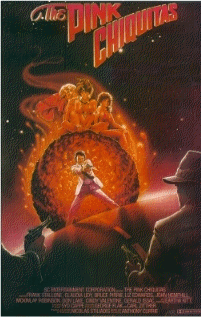
One thinks of Alan Arkin and Christopher Lee in The Return of Captain Invincible, or of Return of the Killer Tomatoes (well, I think of them anyway). Here’s another of my favourites, the unjustifiably obscure The Pink Chiquitas. Sly Stallone’s brother Frank, a singer/actor in his own right, stars as private dick Tony Morita Jr who drives a white ‘59 Cadillac convertible with enormous cow-horns on the bonnet. He’s hip, smart and cool, has a string of Olympic medals, and gets all the girls - in fact within a couple of minutes he’s receiving head from a bimbo hitch-hiker (Heather Smith, who may or may not have also been in Screwballs and/or Ozone) while being chased by mobsters!

Morita hides out at a drive-in (showing Zombie Beach Party III) in the hick town of Beansville where we are introduced to nerdy TV weatherman Clip Bacardi (Bruce Pirrie, who went on to direct a spoof paranormal investigation show called The Fifth Quadrant) and his date, librarian Mary Ann Dubrowski (singer/model Elizabeth Edwards) as well as Deputy Barney Drum (Don Lake: Bill’s dad in Bill and Ted’s Excellent Adventure, also in Terminator 2 and Short Circuit 2) who is in charge while the sheriff is away. A pink meteorite hurtles overhead and the drive-in empties as everyone drives off to look for it.

Clip finds a tiny fragment which he thinks is all that’s left after atmospheric burn-up, but the bulk of the meteorite is intact and is discovered by teenage intern Stella Dumbrowski (Cindy Valentine: Teen Witch) - who incurred Clip’s wrath for competently handling the weather reports at Channel 3 while he was on holiday - together with her date Dave (TJ Scott, a stuntman in the Police Academy movies) and their friends Anita and Ken. Stella and Anita become sexually rapacious and the next morning Ken and Dave’s bodies are discovered beside the now empty meteorite crater.

An Indian doctor (Harold Baehan) turns up along with a nurse who is Dave’s sister Helen (Claudia Udy: Edge of Sanity). Tony Morita sets out to investigate, helped by Deputy Barney but hindered by corrupt Mayor Ernie Bodine (John Hemphill) and haunted by his late father Tony Morita Sr (Stallone again). Mary Ann decides to run for Mayor opposite Bodine and this is just the first of a sequence of events which sees the women of the town gradually take over, both socially and sexually, led by the now glamorous Mary Ann and TV anchorwoman Trudy Jones (McKinlay Robinson). Outrageously gay cameraman Dwight Wright (Gerald Isaac) tries to join the women in drag but they discover him. Eventually all the men are wandering around like zombies and only Morita, Barney, Dwight and Helen are left to save the town.

The problem is the meteorite, now ensconced in an old mine, which is some sort of sentient being and is telepathically controlling the local women. Eartha Kitt is credited as the voice of the meteorite (called ‘Betty’ in various literature but never given a name on screen) but all she does is her famous purr, though she does duet with Stallone over the end credits. As the controlled women throw off the shackles of male domination, they all start to dress in pink - which was very big in the 1980s - and Tony’s investigations reveal that a similarly pink meteor was reported centuries ago by Spanish explorers, heading for the Amazon. Love interest Helen is kept immune by having transistor radios strapped over her ears.

The Pink Chiquitas is unpretentious, well-crafted silliness. It knows its limitations and never tries to exceed them, hence it works and works well. There’s no nudity, swearing or violence and the sexually liberated ladies of the town are portrayed cheasily but never cheaply. That’s a tricky balancing act but the film pulls it off.

Most of the unnamed ‘pink chiquitas’ are simply eye candy who never had any other credits, but among those with real careers are: Lolita Davidovich (Gods and Monsters), Topaz Hasfal (Cyberjack, Bordello of Blood), Susan Haskell (One Life to Live, JAG), Marcia Levine (Bionic Showdown), Jane Sowerby (who played Chrissy Hynde in a 2000 TV movie called The Linda McCartney Story!) and former Miss Canada Cynthia Kereluk. However, I’m not convinced that the ‘Sheryl Lee’ credited is the same one who was in John Carpenter’s Vampires and Twin Peaks. The cast of the entirely fictitious Zombie Beach Party III includes Nicholas Campbell (The Brood, The Dead Zone) and Sharolyn Sparrow (Death Wish V).

Producer Stiliadis (who was also the cinematographer) went on to make Gladiator Cop and Red Blooded American Girl I and II. Visual effects supervisor David Stipes had previously worked on Battlestar Galactica and Buck Rogers in the 25th Century, and went on to work on The Flash, Arena and all TV versions of Star Trek from The Next Generation onwards. But what of one-time writer/director Anthony Currie? What ever happened to him? Where is he now?

Well, the fact that this film received two Genie nominations (the Canadian equivalent of the Bafta) for sound and sound editing leads me to believe that he is actually top sound editor Tony Currie, among whose credits are the BeastMaster TV series and Cronenberg’s Spider and Naked Lunch. It’s a shame he never made another film as writer/director because he clearly knew what he was doing.

(The film’s American video packaging manages to not only place the action in ‘Beamsville’ instead of Beansville but also misspells the main character’s name as ‘Mareda’!)

MJS rating: B+

Saturday, 22 March 2014

Outerworld

Director: Philip J Cook
Writer: Philip J Cook
Producer: John R Ellis
Cast: Tracy Davis, Michael Mack, Hans Bachmann
Country: USA
Year of release: 1987/2004
Reviewed from: screener DVD
Official site: www.eaglefilms.com

It was rather a shock, on watching the 15-minute Making Of included on this DVD, to realise that I have had a poster for this film in my files for the past decade.

This first feature from writer/director/editor/cinematographer Philip Cook (Invader, Despiser) was filmed as Pentan (the name of the main character) and initially released as Beyond the Rising Moon before ending up as Star Quest: Beyond the Rising Moon. That’s the title on the one-sheet that I have, which I probably picked up at the AFM. Now it has become Outerworld, putting this picture into that select group of movies which can boast almost as many alternative titles as the average Jess Franco film.

But Outerworld is in many ways a different movie. The special effects have been completely revamped and Cook has used this as an opportunity to tighten up the story to the extent that this is, apparently, as much like Star Quest as Godzilla, King of the Monsters was like Gojira. (I should stress that I have never seen the previous version, I just have the poster. So I can’t make direct comparisons and can only go on what is self-evident on screen and what Cook and co say in the featurette.)

Pentan (Tracy Davis: Nemesis 2) is a genetically engineered woman constructed by the Kuriyama Corporation and trained in combat and other skills. I don’t recall any actual kickboxing and she’s not really a cyborg but this certainly leans towards KCM territory. In a clumsily scripted opening scene, corporation enforcer John Moesby (Michael Mack: Star Trek: Generations) informs head honcho Takashi Kuriyama (Ron Ikejiri) about recent Earth history, prefiguring his infodump speech with the dreaded “As you know...”

What Kuriyama-san does indeed know, but we have to be told, is that humanity has developed interstellar travel, among other things, from technology found in an alien spaceship. No other extraterrestrial artefact has ever been located, until now. A Norwegian company(!) has spotted another alien spaceship on a distant planet but has not actually landed. The first person to make planetfall will be able to claim salvage rights and will make a fortune from licensing all the new technological developments which this discovery will spawn. Naturally, Kuriyama and Moesby believe that the corporation should have that ship. (No-one at any point considers the possibility that the new spaceship will be the same as the old one and so won’t offer anything new.)

Moesby despatches Pentan to intercept two Norwegian agents and steal the briefcase containing the planet’s co-ordinates but for some reason, once she has this, she decides to make it on her own, leaving Moesby fuming on a monorail platform as Pentan waves goodbye from a carriage.

Before you can say "Millennium Falcon", Pentan finds and hires a jobbing spacefarer, Brickman (Hans Bachmann, who was in a 1985 Austrian sci-fi picture called Time Troopers) to take her where she wants to go. He is keen to depart because he is being threatened by the two most law-abiding hoodlums on the planet, who threaten that if he doesn’t come up with the money he owes them they will come and find him armed not with clubs, knives or guns but with someone from the authorities. Despite a last minute attempt by Moesby to stop them, Pentan and Brickman blast off in his nifty little red ship, the Rising Moon.

The complication in all this is that Pentan, having been artificially produced and therefore being the corporate property of Kuriyama Corp., has a doodad inside her head which Moesby has triggered which will kill her in a few days’ time. So before heading for the alien craft, she and Brickman stop off at the isolated, castle-like base of scientist Robert Thornton (Rick Foucheux: Invader) who originally created her. He somehow deactivates the doodad (rendering it a somewhat superfluous plot point). Apparently, in the original version Thornton survived after Brickman and Pentan left - but in this ‘special edition’ his castle gets blasted by Moesby and co, with him in it.

The alien spacecraft sits on a desolate plain on a distant planet. Brickman and Pentan make it first but they are swiftly followed by Moesby and Kuriyama in their impressively large craft the Promethean which carries eight small 'Tulwar' fighter craft. There is a stand-off on the surface and then a big old dogfight in space - I won’t go into too much detail. Nothing too unexpected happens - especially with two decades of other sci-fi movies inbetween this and the current state of the genre - but there is no point in my spoiling things for you folks.

At heart, Outerworld is a good, solid, unabashed slice of 1980s indie sci-fi with all the requisite whooshing spaceships and political intrigue - although noticeably there are neither aliens nor robots. And it is very 1980s, especially in the character of Pentan. With her ultra-tight jeans, ankle boots, wide-collared batwing blouse, short jacket and permed hair she looks like she stepped out of the slow bit of a Meat Loaf video.

And yet, this 1980s film now boasts 21st century special effects, giving it a frankly unique look. Wisely, Cook has retained the best of the original model effects - which are terrific - and used CGI for sequences which simply couldn’t be shot before, such as Thornton’s HQ blowing up or the climactic dogfights which originally took place in open space but now happen within the rings of a Saturn-like planet. Computers have also been used to matte newly shot moving figures into existing model shots which adds greatly to their believability and hence their integration into the live-action footage.

Without ever having seen the original version I can’t really comment on what changes have been made in the storyline and characterisation but the impression I get is that there have been a few and they’re all for the better. As for the effects, some of the CGI work does look ‘very CGI’ but it’s still pretty good for a movie made (or remade) on this sort of budget. The miniatures are superb - there are some behind the scenes shots of them in the Making Of featurette - and while it’s a shame that Cook has now apparently abandoned this technique in favour of CGI, you can’t really blame him when you consider the vast amount of work required to construct very large, very detailed miniatures.

Also in the cast are Norman Gagnon (Twilight of the Dogs, Mark Redfield’s Dr Jeckyll and Mr Hyde) who also has a bunch of behind-the-camera credits; Jon Trapnell (Ron Ford’s Alien Force and Hollywood Mortuary) and producer John Ellis whose extensive visual effects CV includes Don Dohler’s Nightbeast, JR Bookwalter’s The Dead Next Door, Subspecies IV, Witchouse, Totem, Retro Puppet Master, Voodoo Academy, Dave Parker’s The Dead Hate the Living, Python, Trancers VI and uncredited clean-up work on some big titles including Van Helsing, Daredevil and The Day After Tomorrow.

Outerworld is good fun and you can’t really ask more than that. The leads are likeable, the plot is internally consistent and there are some interesting quirks that make it stand out from the morass of the 1980s science fiction boom (I mean, why Norwegians?). Most importantly, Cook’s reworking of the film nearly 20 years later works to make it better, unlike a certain trilogy of big budget ‘special editions’ which seemed to just have new effects inserted at random irrespective of whether they added anything or not.

Cook has recently done a similar CGI update on Invader. All he needs now is a time machine to take Despiser back a few years and add some miniatures into it.

MJS rating: B

Thursday, 20 March 2014

Night Wars

Director: David A Prior
Writer: David A Prior
Producer: Fritz Matthews
Cast: Dan Haggerty, Brian O’Connor, Steve Horton, Cameron Smith
Year of release: 1987
Country: USA
Reviewed from: UK rental VHS (Screen Entertainment)

I picked up this ex-rental VHS tape because (a) it was 50p and (b) it had a truly dreadful painting on the front. It turned out to be one of those double-sided sleeves so if you don’t want the awful painting you can see a ghastly, slightly out-of-focus photograph instead.

Trent Matthews (Brian O’Connor: Encounter at Raven’s Gate) and Jim Lowery (Cameron Smith), who calls Matthews ‘Sarge’, are Vietnam veterans. They were held captive by the enemy and tortured by a traitor from their own platoon, the clearly insane McGregor (Steve Horton). Somehow they managed to escape, taking with them their comrade Johnny (Chet Hood: Time Burst: The Final Alliance) - the end credits spell it ‘Jhonny’! - who was being held in a pit.

But Johnny/Jhonny was shot and they had to leave him, though he begged them not to. Since then they have been experiencing pangs of guilt and even nightmares, which are becoming more real. While test-driving a secondhand car (the insincere salesman is Jack Ott from Spiders), Matthews sees Johnny drive past and chases him - but of course it’s a complete stranger who looks nothing like Johnny.

Later, Matthews dreams that he, Lowery and the rest of the platoon are back in 'Nam, but if it’s a dream, how has he got a shrapnel wound in his hand when he wakes up? Things get worse: he imagines McGregor in the car next to him, jumps out and finds himself back in 'Nam again, where he sustains a cut to his neck while trying to rescue Johnny, who loses a finger to a Vietcong machete.

Matthews’ wife Susanne (Jill Foor: Moonstalker) is upset about her husband’s state of mind, about the unexplained injuries he is suffering - and about the finger she finds in their car! She takes this to family friend Dr Mike Campbell played by Grizzly Adams himself, top-billed Dan Haggerty. (Haggerty was also in Terror Night and a 1978 TV movie called Revenge of the Savage Bees, and he is the voice of Terl in the Battlefield Earth cartoon). Haggerty has the fing- wait a minute, there’s a Battlefield Earth cartoon? Ye gods! - has the fingerprint checked and it turns out to be Johnny’s.

What has happened is that time has somehow got twisted because Matthews and Lowery came home without Johnny, who they believe is still held prisoner by the Vietnamese and is contacting them through their dreams. The impression given is that Johnny is still there now, but he looks no older and has apparently been kept in the same hole in the ground for the past 15 years or so. McGregor is out to get the two men, and what they do in their sleep affects what happens in 'Nam, as when a dreaming Matthews runs out of ammo so the watching Lowery hands him a fresh clip in LA - and he suddenly has a fresh clip in Vietnam.

They buy $2,000 of weaponry from an arms dealer (Mike Hickam) who sells from the boot of his car. Dr Campbell initially tries to stop them, believing they’ve both gone loopy, but is convinced when he calls Susanne to tell her he has her husband under sedation and she says no, he’s right here. Of course it’s not Matthews. He looks like Matthews but after he has raped Susanne she sees it’s McGregor, who then stabs her violently. Dr Campbell rushes over but is too late to save Susanne from her invisible (to him) attacker.

Matthews seems entirely unfazed by the news that his wife is dead, and Campbell doesn’t even bother to explain the frankly unusual way in which she met her end. Instead he helps Matthews and Lowery to rescue Johnny. The two men suit up, black up and arm themselves with plentiful weaponry, then lie down on a double bed and go to sleep (the homo-erotic subtext is of course completely ignored!).

They somehow manage to rescue Johnny but bullets rake the bedroom and the doctor is (I think) killed. It ends with three sweaty men dressed in camo gear lying in each other’s arms on a plush double bed - and still there’s no hint of a gay subtext in any but the most jaundiced minds!

What a daft load of nonsense this all is. It’s basically Hamburger Hill meets A Nightmare on Elm Street and though it’s done sincerely enough it doesn’t exactly hang together, albeit the mixing between reality and dreams is adroitly handled. On the other hand, the pyrotechnics are dreadful (special effects by Chuck Whitton who has no other credits of any sort whatsoever it seems, unless the credits spell his name wrong too). All the explosions in the war scenes are clearly little thunderflashes which send up a shower of sparks but conspicuously fail to move even a handful of actual earth the way that real rockets and shells do.

Of course it goes without saying that all the Vietcong soldiers are lousy shots who can’t hit GIs standing in plain sight only a few yards away, whereas the Yanks can hit obscured targets, shooting from the hip while somersaulting. Speaking of which there is also a plethora of extras leaping in the air and flipping through 180 degrees as the feeble explosions go off behind them, very reminiscent of the two stuntmen employed on Space Mutiny.

The reasonable make-up is by Robin Slater (Severed Ties, Love Bites, the 1989 Masque of the Red Death) - the painted video sleeve tries to make it look like there are zombies in the movie but there aren’t. Cinematographer Stephen Ashley Blake also photographed the far more entertaining Sorority Babes in the Slimeball Bowl-O-Rama. The anonymous GIs include among their number Troy Fromin (Class of Nuke ‘Em High II and III) and none other than Joe Lara, a couple of years before he first donned the loin-cloth in Tarzan in Manhattan.

Writer/director David A Prior is a self-taught Alabama-based film-maker with nearly 30 feature films - almost all of which have two word titles - to his credit, including Death Chase, Future Force, Raw Nerve, Mutant Species and Codename: Silencer (aka Body Count). The original story for this is credited to Prior, his brother Ted (who served as art director) and casting director William Zipp

When it comes to Vietnam War/supernatural horror crossgenre pics, give me House any time.

MJS rating: D+

Wednesday, 19 March 2014

Nightflyers

Director: 'TC Blake'
Writer: Robert Jaffe
Producer: Robert Jaffe
Cast: Catherine Mary Stewart, Michael Praed, John Standing
Country: USA
Year of release: 1987
Reviewed from UK VHS


Nightflyers is another one those films which is unsure of its own title. It's one word on screen but two - Night Flyers - on the sleeve of this ex-rental VHS. I shall use the former, not because of some Kim Newman-esque obsession with 'right' and 'wrong' titles but because it is shorter and involves less use of the shift key. Though I have probably undone any saving in that respect by typing this explanation.

This is a notoriously incomprehensible film. I didn't understand it when I first watched it about ten years ago and I didn't understand it when I rewatched it this week. Ostensibly it involves a search for some sort of semi-mythical meta-being called the Volkron which travels through the galaxy creating stars. A scientist named D'Brannin (John Standing: Torture Garden, The Eagle Has Landed, The Elephant Man, Pandaemonium) has assembled a team to help him locate the Volkron and has hired a spaceship called the Nightflyer (or possibly Night Flyer - we never see it written down) to take them there.

There's cryptologist Lilly Cant (Helene Udy: My Bloody Valentine, The Dead Zone, Witches of the Caribbean); linguist Audrey Zale (Lisa Blount: Dead and Buried, John Carpenter's Prince of Darkness); biologist Keelor (Glenn Withrow: Peggy Sue Got Married, Beverly Hills Cop II) whose bleached blonde hair, youthful visage and large spectacles make him look alarmingly like children's TV presenter Timmy Mallett; Darryl Fontane (James Avery: Will Smith's uncle in The Fresh Prince of Bel Air, also in Deadly Daphne's Revenge and Beastmaster II) who is aboard as 'visual documentarian' and chef; and 'class 10 telepath' Jon Winderman (singer/actor Michael Des Barres: Ghoulies, Lost in Time, The High Crusade) with his accompanying empath Eliza Scott (Annabel Brooks: Cherry 2000, The Witches). What function a telepath's empath might serve is just one of many things left unexplained. All these characters are introduced to us in voice-over by 'project co-ordinator' Miranda Dorlac (Catherine Mary Stewart: Night of the Comet, Weekend at Bernie's, Reaper) who also has limited telepathic abilities. Although a caption tells us the story is set in the 21st century, everything looks very 1980s and everyone wears plenty of hair mousse and eye-liner (except Darryl who doesn't need either, being both black and bald).

The Nightflyer is described as a freighter, and as such it has plenty of vast echoing chambers where the cast bed down in their futuristic sleeping bags. The main area is a luxurious lounge, with sunken sofas, coffee tables, a small kitchen to one side and, for some reason, a pipe organ. It looks like a bizarre amalgam of the sets from Blake's 7, The Abominable Dr Phibes, Ready Steady Cook and TV-am. There's no suggestion of anyone strapping themselves down for take-off or anything like that, nor is any sort of uniform on display, with everyone wearing their own individual, awful 1980s clothes which they all brought aboard in small shoulder bags.

But what of the ship itself? Do you recall that episode of Blackadder II when Tom Baker, as a mad ship's captain, explained that there were two schools of thought on the need for a crew: all the other captains said you needed one, and he said you didn't? Well, something similar seems to be in operation here. The captain is Royd Eris (Robin of Sherwood/Dynasty star Michael Praed) who appears to the passengers in the form of a hologram. He explains that the ship doesn't have a crew because the hologram technology allows him to be in two places at once. Well, yes I suppose so - but since the hologram can't operate any controls and in fact can't actually do anything except communicate with the passengers, it's not much more use than, say, a standard intercom. Or a telephone.

While some of the folk on board are very suspicious of this whole set-up - indeed, some of them suspecting that Royd is nothing more than an avatar created by the computer which is really flying the ship - Royd forms a friendship with Miranda (based on, well, nothing in particular) and explains to her what is really going on. His mother Adara owned the Nightflyer which she operated on her own, but she became lonely and so created him as a 'cross-sex clone'. However, she died just before he was 'born' from the jar where he was incubated so he was raised by the ship's computer. This means, apparently, that he is too weak to ever set foot on a planet and even the artificial gravity generated on the ship is agony to him. When we finally get to see Royd for real, he is lying recumbent in a sort of comfortable-looking and very streamlined coffin.

While Darryl is preparing dinner for everyone, there is an explosion in the kitchen which sends the whole team hurtling across the lounge amid a shockwave of candelabras and canapés and somehow tears off four of Darryl's fingers. There follows a hilarious medical room scene with D'Brannin using a computerised surgery system to reattached the digits. We see a graphic of a half-finger being moved towards a hand, magically joining at the knuckle - and then we see it for real! The missing part of the finger is carefully positioned next to the stump and then some sort of laser welds/cauterises the join. That might work if a finger was just a bone with some flesh around the outside, but aren't there, I don't know, nerves and blood vessels and things which might need aligning?

For reasons which, like much else in this film, are never clearly explained, Adara's body is still on board the ship, underneath a stone slab, but before she died she downloaded her mind/soul/spirit/consciousness/whatever into the ship's computer. Royd tells Miranda that when the mission is finished he wants to leave the ship, even though that would kill him, because he would rather spend five minutes as a human being on a real world than spend the rest of his life as he is. Adara becomes jealous of this and seeks to protect her baby by trying to kill the crew, initially by possessing Winderman (played by Des Barres with the sort of 'mockney' accent that sounds British to Americans but sounds like God knows what to British audiences).

Most of the second half of the film consists of the surviving crew members flying around inside and outside the spaceship (which has had its gravity turned off) in little personal vehicles that look like glass-topped dustbins, eventually joined by Royd in his coffin which can, of course, fly. Near the end, Winderman's semi-decapitated body is reanimated by Adara in an attempt to kill Miranda (who is now riding shotgun on Royd's flying coffin) and the final confrontation is between Royd and the reanimated body of his mother. (It's difficult to see, but as no actor is credited for Adara and bearing in mind that Royd is supposed to be a 'cross-sex clone', presumably that's Praed under the make-up facing off against himself.)

After all the science fiction hoopla the culmination is two immobile characters straining as they channel lightning-style energy bolts at each other. Oh great, it's Wizards of the Demon Sword in space. And we finish with the Nightflyer exploding, leaving Royd and Miranda to head off into the inky void in his (very cramped) coffin. Miranda's final voice-over discusses the Volkron again, even though that has barely been mentioned since the start of the movie and seems to have no connection with anything else at all.

What a load of old tat. This is the sort of quasi-philosophical, ideas-beyond-its-reach science fiction movie that might be acceptable if it had been made in the mid-1970s or if it was Russian or Polish, but as a US production from the late 1980s it just looks daft, not helped by the costumes and hairstyles. Once everyone climbs into their flying dustbins any semblance of structure disappears and of course we never again have any actual face-to-face scenes with more than one person - until we reach Royd and his mother doing their impression of the final scene in an Indonesian telemovie.

Nightflyers is based on a 1985 novella by George RR Martin, author of the Song of Fire and Ice series of novels. He was story editor on the Ron Perlman/Linda Hamilton TV series Beauty and the Beast and also wrote some episodes of the 1980s Twilight Zone as well as the feature-length pilot for the 1990s Outer Limits, but he seems to have had no direct connection with this movie, which is probably a good thing for him. The screenplay is credited to producer Robert Jaffe (Demon Seed, Motel Hell, Scarab). Director 'TC Blake' is actually Robert Collector trying to distance himself from the movie. He wrote and directed a 1985 thriller called Red Heat, starring the unlikely pairing of Silvia Kristel and Linda Blair, and also wrote another film with unlikely bedfellows in its credits, the John Carpenter/Chevy Chase collaboration Memoirs of an Invisible Man.

This was an early credit for DP Shelly Johnson, later on Quicksilver Highway, Jurassic Park III and the Shining mini-series, though its difficult to judge the cinematography from this rather ropy VHS. The film's biggest asset seems to be its production design, courtesy of John Muto who started out doing odd jobs on movies such as Battle Beyond the Stars and Strange Invaders and worked up to major credits on Species and the Terminator II 3-D theme park ride. Set decorator Anne Huntley-Ahrens had previously worked on House, Critters and A Nightmare on Elm Street and between them they came up with some impressive sets for Nightflyers. No fewer than 42 carpenters and 20 painters are credited and it's easy to see where the money went. It certainly didn't go on the script which was altered out of all recognition in a radical and inexplicable last-minute rewrite by the producer.

The special effects vary enormously, although praise must be given to the miniatures in the launch sequence. Those credited include Robert Short (Piranha, ET, Beetlejuice) and Roger George (whose career goes right back to The Amazing Transparent Man and Beyond the Time Barrier in the early 1960s through such notable films as Blacula, The Howling, Repo Man, The Terminator, Ghoulies, Munchies and Night of the Demons). The flying dustbin sequences which dominate the second half of the film were handled by Bob Wiesinger (Labyrinth, The Bride, The Adventures of Baron Munchausen, Judge Dredd, Cheap Rate Gravity) and Bob Harman (Superman, Time Bandits, Return of the Jedi, Arena, The Rocketeer).

Ultimately Nightflyers' biggest failing is that it is boring and completely unengaging. Since we have no idea what the hell these people are trying to do or what is preventing them from doing it, we don't care a jot whether they succeed or not. At present this movie is not available on DVD - but that's no great loss.

MJS rating: C-

Thursday, 5 December 2013

Iron Warrior

Director: Alfonso Brescia as “Al Bradley”
Writer: Steven Luotti, Al Bradley
Producer: Sam Sill
Cast: Miles O’Keefe, Savina Gersak, Elisabeth Kaza, Iris Peynado
Year of release: 1987
Country: Italy
Reviewed from: UK rental video (Rank)

More bonkers Italian sword and sorcery - I can’t get enough of this crap and yet I’ve no idea why. As usual, Miles O’Keefe is a warrior named Ator, and as usual this one (Ator il Guerrireo di Ferro) has nothing to do with any of the other Ators in other movies. Much like Maciste and Samson in peplum films, and Django and Sartana in spaghetti westerns, Ator was a handy, generic name. Sometime Tarzan O’Keefe also ‘played him’ in Ator the Fighting Eagle (1983) and The Blade Master (1984).

The battle between good and evil is personified by two witches: beautiful, olive-skinned Deeva (Iris Peynado: The New Barbarians) and wizened, flame-haired old crone Phaedra (Elisabeth Kaza: Castle Freak). The brothers Ator and Trogar are destined to do great things so Phaedra steals Trogar and for this is banished for 18 years. Deeva mentions in passing that she has granted the king a daughter.

Fast forward to the eighteenth birthday of Princess Janna (Savina Gersak from, erm, Curse II: The Bite), which is interrupted by the arrival of Phaedra, followed by her warrior Trogar. As it says on the video sleeve, he is: ‘Born of evil sorcery. Half man, half spirit. Total exterminator.’ What he actually is - is a total Darth Vader rip-off. The boots, the gauntlets, the cloak, the shoulder-pads, the sword - right down to the asthmatic breathing! But instead of Vader’s black helmet, Trogar wears a shiny chrome skull and a red neck-scarf. (The man behind the mask in this instance is Franco Daddi who was second unit stunt co-ordinator on Bill and Ted's Excellent Adventure!)

The bulk of the film has, as one might expect if one has seen plenty of these things (and I have!) no discernible plot. Ator and Janna do a lot of journeying, occasionally defeating some nameless, faceless soldiers, presumably under the command of Phaedra, and occasionally facing off against Trogar himself. There are a few attempts at a story, with Phaedra transforming herself into a young woman, and an impostor claiming to be Janna’s royal father. Eventually Ator and Janna track down Deeva, who sends them to an island that has risen from the waves (a decent model, to be fair). There they must locate a gold chest, but Phaedra tricks, imprisons and impersonates Deeva.

It all ends up with the good guys winning, sort of, somehow. But it’s all complete nonsense. The film makes full use of its locations on Malta and Gozo and gives good views of those islands’ cliffs, caves and ruins - even if one of the ‘ancient castles’ has metal steps and railings for tourists! Very disappointingly, although the video sleeve painting is mostly accurate, nothing even faintly resembling the dragon depicted ever appears. Boo.

Bradley/Brescia’s gloriously psychotronic career stretched from latter-day pepla such as Revolt of the Praetorians (1964) through westerns (The Colt is My Law, 1966) and war movies (Kill Rommel!, 1969) to sci-fi hoopla like Battle of the Stars (1977) and Reactor (1978) - plus bona fide trash classic Amazons Against Supermen aka Superuomini, Superdonne, Superbotte (1975). He died in 2001.

But Iron Warrior is most notable for being (apparently) the only narrative feature film cinematography credit for the charmingly named special effects cameraman Wally Gentleman. Born in Britain in 1926, Gentleman started work as a camera assistant in 1943 and later emigrated to Canada where he died in 2001. And 2001 is his most famous work: he collaborated closely with both Clarke and Kubrick, who sought him out after being impressed with his work on a 1960 National Film Board of Canada documentary called Universe.

Gentleman is regarded by cinematographers as the father of special effects photography, his other credits including Black Narcissus, Great Expectations, Oliver Twist and The Red Shoes. Quite how he ended up behind the camera on a piece of tat like this, God only knows. His only other Italian credit is Chi Sei?/Behind the Door in 1974.

Iron Warrior is utterly disposable rubbish, but with a certain naive charm. Truly it is written: they don’t make them like this any more.

MJS rating: C-
review originally posted 30th May 2005

Sunday, 24 March 2013

Death Code: Ninja

Director: Tommy Cheng
Writer: Frank Lewis
Producer: Tomas Tang
Cast: John Wilford, Mike Abbott, Kent Poon
Year of release: 1987
Country: Hong Kong
Reviewed from: UK video (HBL Video)


This movie was one of several apparently cobbled together by Tommy Cheng (sometimes spelled Cheung) and Tomas Tang in the late 1980s, including Ninja Death Squad, Ninja in Action, Ninja: American Warrior and Another Load of Old Crap with the Word Ninja in the Title.

Basically, what you have here is an unidentified Hong Kong action thriller from the late 1970s, topped and tailed with some piss-poor, unconnected ‘ninja sequences’ shot in HK several years later. The plot concerns a young married couple - hitman and hitwoman - known as ‘the Killer Couple’ who want to retire but find themselves mixed up in an affair centring around an incriminating list of mob bosses. When the husband is killed, the wife seeks revenge, hindered by the local cops.

It’s an okay HK crime movie with a certain amount of kung fu and some nifty swordwork. An early scene shows two mob bosses falling out over a deal involving a ‘strategic Star Wars map’, something which the video sleeve synopsis claims is central to the whole plot. As one boss makes his getaway, his car is attacked by black-clothed ninjas, who are in turn attacked by a white-garbed ninja, clearly played by a white guy. He eventually fools them by hurling his costume over a cliff while hiding, showing that ninjas wear boxers!

A sequence in the middle of the film has four KGB goons killed off by another white guy dressed as a ninja, in this case swathed in yellow. At least some attempt has been made to integrate this and the earlier sequence into the film, however hamfistedly. But the final showdown between the white and yellow ninjas comes right at the end, after the original 1970s story has finished, and has no connection with anything.

I’ve only bothered reviewing this (a) to show my amazement that such a piece of bastardised tat exists, and (b) to mention that the ninjas seems to have some sort of magical teleportation powers, appearing and disappearing in a puff of smoke. Tomas Tang had previously been associate producer on the dreadful Firefist of Incredible Dragon.

MJS rating: E
review originally posted before November 2004

Thursday, 7 March 2013

Cyclone

Director: Fred Olen Ray
Writer: Paul Garson
Producer: Paul Hertzberg
Cast: Heather Thomas, Jeffrey Combs, Martin Landau
Country: USA
Year of release: 1987
Reviewed from: UK VHS (Entertainment in Video)


Believe it or not, this is the first Fred Olen Ray film that I have reviewed on this site. Sad to say, this is not one of Fred’s best. Dear lord, no. This is one of those by-the-numbers high-tech McGuffin DTV titles which proliferated during the 1980s, substituting hairspray and shoulder pads for characterisation and plot. It singularly fails to deliver on anything that it promises, from the "awesome fighting force" of the titular machine to a ‘punk nightclub’ which has all the anti-establishment nihilism of a Debbie Gibson album.

“Jeffrey Combs, the mad professor from Re-Animator, is back with a new kind of killing machine.” proclaims the front of the UK sleeve, although Heather Thomas (Zapped!, Red Blooded American Girl) is the top-billed cast member and the focus of the US sleeve design. The young-looking Combs (Trancers II, Castle Freak, Deep Space Nine) is Rick Davenport, a scientist of some sort, working entirely alone in a remarkably small, sparsely equipped and extraordinarily clean workshop hidden behind a secret door in his house. Thomas is his girlfriend Teri, whom we meet while she is working out at the gym owned by her friend Carla (Ashley Ferrare: Revenge of the Ninja).

Rick enjoys classical music while Teri likes to rock, apparently. To celebrate the successful completion of the Cyclone project - a super-motorbike - he consents to accompany her to The Lava Club, a local ‘punk’ nightspot where thirty-year-olds with Bon Jovi hairstyles boogie gently to a novelty AOR band credited as Haunted Garage. While they dance, Rick is stabbed in the back by a creepy white-haired guy (stuntman Dar Robinson - Rollerball, Vamp, King Kong Lives - who died in an accident before the film was released) and Teri is attacked by a vaguely goth-looking woman (Ray regular Dawn Wildsmith, who was in Hollywood Chainsaw Hookers, Evil Spawn and a dozen more FOR movies) but survives.

Lieutenant Cutter of the LAPD (Bruce Fairbairn: Vampire Hookers) wants to interview Teri at the crime scene but his authority is over-ruled by the appearance of two FBI agents, Knowles (Count Yorga himself, Robert Quarry) and Waters (Sister Hyde herself, Martine Beswick) who send Teri home after she assures them that she knows nothing about any secret laboratory. Back in Rick’s secret laboratory, she finds a very long video message from him telling her how to operate Cyclone and that the only person in ‘the agency’ who can be trusted is a fellow named Bob Jenkins, to whom she must deliver the bike.

At this point we discover that the bike is not even a McGuffin. In actual fact, the real McGuffin is a wee box which is the bike’s power supply and is confusingly called a ‘transformer’. This produces limitless amounts of power by converting hydrogen into energy which sounds - although the phrase is never used - like cold fusion to me. Cyclone can run on conventional fuel but its weaponry - which includes rear-firing rockets - cannot operate unless the transformer is fitted into a slot on the bike. (There is also some sort of weapon incorporated into Rick’s high-tech helmet, which he uses to destroy a Yellow Pages for some reason, although it is not clear whether this counts as part of the bike or not.)

So let’s get this straight: the US government has been funding a single person to develop, in secret, a new fuel source which could have global repercussions, and not only has he managed to do this, but he has found the time to construct a revolutionary new type of motorcycle and the world’s most advanced skid-lid at the same time. Gosh.

Teri, who is a bit of a biker herself, arranges to meet Bob Jenkins (former teen heartthrob Troy Donahue: Rocket to the Moon, Omega Cop and The Godfather Part II!) but sees him shot down from in front by a bullet and from behind by a crossbow bolt, courtesy of the two weirdos from the nightclub (credited as Rolf and Hanna). Meanwhile, comedy double act Barrell (Tim Conway Jr: Beverly Hills Vamp) and McCordy (Ronald Reagan’s adopted son Michael!) were supposed to be watching Rick and Teri’s house for ‘the agency’ but have fallen asleep, much to the displeasure of Knowles and Waters.

Teri flees on Cyclone to Carla’s house where the bad guys track her down and she finds that there is almost no-one she can trust. Tied up in a warehouse, she refuses to reveal the whereabouts of the transformer and is eventually rescued by someone we have previously met (he said, trying to retain some degree of intrigue). This leads to a bog-standard car/bike chase through the streets of LA, culminating in a stand-off where Teri - finally - uses one of those completely unaimable rockets, the unspecified helmet weapon (which sets somebody on fire!) and a sort of explosion-causing ray-gun on the front of the bike.

In the end, she heads off into the sunset with Lieutenant Cutter, having first destroyed the transformer by tossing it lightly against a wall because it’s “trouble.”

Call me picky, but I expect a movie about a super-fast, heavily armed motorbike to actually centre on the bike itself and its out-of-this-world capabilities, not to just be a hunt for a small, black box. There are a few bike stunts and there is the rather arbitrary use of weapons in that one short scene at the end of the movie, but otherwise this is a routine thriller with nothing to grab the viewer’s interest apart from an amusing extended cameo by former Bowery Boy Huntz Hall as the proprietor of a motorbike repair shop. Martin Landau of all people (at a time when his career seemed to otherwise concentrate on TV series reunion telemovies) turns up in a couple of scenes as the enigmatic Mr Bosarian, Rolf and Hanna’s boss, who wants to get his hands on the transformer because he has agreed to sell it to an unnamed, shady, oriental gentleman (Sam Hiona: Phoenix 2, Terminal Force). The IMDB reckons that Russ Tamblyn has an uncredited part; I’m guessing he could be the old guy in shades mopping up (literally) Rick’s blood from the dancefloor. Michelle Bauer is allegedly one of the nude girls showering behind (clothed) Teri and Carla in a dressing room scene.

Fred Olen Ray, now the acknowledged king of this sort of movie (or rather, good versions of this sort of movie) had directed about nine or ten features prior to this, which was released the same year as Commando Squad, Evil Spawn and Deep Space. He has since directed another 80 or so and shows no sign of stopping.

Writer Paul Garson, working from a story by Ray, is actually a motorcycle journalist by trade and the author of Born to be Wild: A History of the American Biker and Bikes 1947-2002 - which makes it even sadder that Cyclone the film is not actually about Cyclone the motorbike. His only other film credit is Alienator. TL Lankford, who wrote (or contributed to) Storm Trooper, Hollywood Chainsaw Hookers, The Phantom Empire, Deep Space and Scalps, receives an ‘additional material’ credit.

The special effects are an early credit for Kevin Francis McCarthy who would later work on such cool movies as Phantasm III, Trancers II, Waxwork II and Project: Metalbeast. Bret Mixon, a rotoscoping specialist who has worked on Godzilla 1985, Return of the Living Dead, Tremors, Terminator 2, Freaked and The Passion of the Christ(!), is credited with ‘special effects animation’, presumably meaning the jagged lightning-beams emitted by the bike’s unspecified weaponry.

First AD Gary Bettman went on to produce the two Omega Code movies. Cinematographer Paul Elliott also lit Prison Ship Star Slammer, Friday the 13th Part VII, 976-EVIL and a 1997 pilot called The Van Helsing Chronicles. Hair and make-up artist Kathy Shorkey worked on two of the best-titled movies of all time: Spacehunter: Adventures in the Forbidden Zone and Don’t Tell Mom the Babysitter’s Dead.

It could be argued that I didn’t view Cyclone at its best. I watched an ancient, big-box rental VHS with a lousy picture and dodgy framing (a mike boom appears in one shot) plus the traditional batch of mismatched trailers, including Steele Justice, The Good Wife and animated sex comedy The Big Bang. But the problems with Cyclone are nothing to do with the image or the sound, they’re inherent in its failure to explore its central premise. You can’t necessarily hold the film-makers responsible for the way that a movie is marketed and, as I have observed elsewhere, it’s not the fault of 1980s film-makers that the decade was a nadir for hair, clothes and music (although some effort could surely have been made to create a ‘punk nightclub’ which wasn’t, frankly, twee). Nevertheless the fact remains that you could remove the super-bike from this film, or at least, substitute it for a normal motorbike, without substantially affecting the (not terribly exciting) plot.

MJS rating: C
review originally posted 3rd July 2006