Wednesday, 11 June 2014

Vespers

Director: David Lilley, Stephen Gray
Writer: David Lilley
Producer: David Lilley
Cast: Kevin Norcross, Georgia Blake
Country: UK
Year of release: 2008
Reviewed from: screener
Website: www.loonatikanddrinks.com

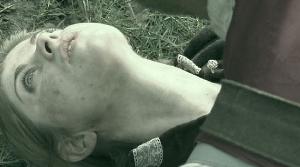
Vespers is a lovely little film. At just short of six minutes, it’s brief but not as brief as other Loonatik and Drinks shorts starring Mr McKinley or Lucy Spook. It’s not silent and not entirely wordless but you couldn’t really say there’s any dialogue. What there is - and it’s what we’ve come to expect from Messrs Lilley and Gray - is a stylish film with some superb visual effects that demonstrate what can be done for tuppence ha’penny on a home PC now.

Set in Bristol in 1880, this is a Victorian post-apocalyptic tale, something which I’ve certainly never seen before. In this sort of 19th century I am Legend, a solitary man (Kevin Norcross, normally employed as a graphic artist) wanders through the deserted city. Jackdaws and rats congregate around corpses in houses and in the streets, victims of a virulent plague which has wiped out humanity.

As the man searches for life, calling out in the desperate hope that he is not, in fact, the last man on Earth, he finds himself at the Clifton Suspension Bridge. The towers stand, the cable hangs between them and part of the span sticks out above the River Avon - but this is an engineering project never to be completed. This is a marvellous effect, shown from different angles in several shots, and is only marred slightly by the fact that the bridge was built in 1864.

Then - miracle - he sees a woman. They run to each other and both become victims, in their own way, of the cruellest of ironies. To say more would be to give away the brief plot.

Jointly directed and edited by Steve and Dave, Vespers looks simply magnificent, every angle chosen - and, where necessary, manipulated - to create a thoroughly believable deserted Victorian Bristol. Mr Lilley wrote and produced while Mr Gray handled photography - assisted by camera operator Simon Fretwell (DP on Close Your Eyes) - and visual effects. Together they have created a thing of beauty.

While it’s more than the single-gag 'plots' of the Mr McKinley or Lucy Spook shorts, the ‘story’ of Vespers is just a moment, albeit a crucial one. Actually, that’s not fair. The plot is just a moment but it’s constructed in such a way that the story is obviously much greater. In that respect it also scores over L&D’s last short, The Hand. But the frustrating thing about Loonatik and Drinks films to date is that they are so brief. I like to think that this is the guys practising their skills, ready for something meatier. Adaptations of Conan Doyle’s ‘The Horror of the Heights’ and Poe’s ‘The Pit and the Pendulum’ are promised and with such source material a more cohesive and satisfying plot is surely assured.

Georgia Blake plays the woman, credited only as ‘victim’ although Georgia’s CV reveals that the character’s name is Helen Winshaw! Rachel McWha (“creator of designer corsetry, costume and bridal couture”) was responsible for the costumes while the fantastically named Nikki Galan-Bamfield (Loyalty, The Return) handled hair and make-up. Kubilay Uner (The Hand) composed the music and Barry Parsons was the sound designer.

Vespers is an impressive, original, visually enthralling slice of retro-fantasy. More than that, it’s that rarest of things: a Victorian-set science fiction film which is neither a pastiche nor steampunk. All credit to those involved; now bring on the Conan Doyle and the Poe.

MJS rating: A-

Virgin Witch

Director: Ray Austin
Writer: ‘Klaus Vogel’
Producer: Ralph Solomons
Cast: Vicki Michelle, Anne Michelle, Patricia Haines
Year of release: 1971
Country: UK
Reviewed from: UK VHS (Salvation)

Real life sisters Vicki and Anne Michelle play screen sisters Betty and Christine in this entry in the ‘home counties witchcraft’ subgenre which flourished in Britain in the late 1960s and early 1970s. The early entries into the field, such as The Sorcerers, had diversified into superior historicals (Witchfinder General, Blood on Satan’s Claw) and rather tacky contemporary pictures such as this one.

Betty and Christine, innocents both, travel to London with a view to finding modelling work, accepting a lift from passing motorist Johnny (Keith Buckley: Dr Phibes Rises Again, Excalibur), who falls for the younger Betty while Christine is ‘auditioning’ at the offices of lesbian agent Sybil Waite (Patricia Haines). Sybil whisks Christine off to Wychwold, the country estate of her friend Dr Gerald Amberley (Neil Hallett: X the Unknown, Ghost Squad), ostensibly to shoot an ad campaign for cider, with Betty along as chaperone. (It is only when we see the name written down quite some time later that we realise people haven’t been talking about some satanic amusement park called Witchworld.)

The house and grounds are home to some creepy people, but photographer Peter (James Chase) seems nice enough. In fact, the whole thing is a front for a coven of witches, into which Christine is initiated at night, waking up the next morning in bed with Sybil and subsequently acting much more self-confident and mature. Revelling in the release of her latent magical powers, she plans to oust Sybil as High Priestess of the coven during Betty’s initiation the following night, but Johnny is on his way down to Wychwold to rescue Betty.

What starts off as a pretty crappy movie picks up towards the end, leaning more towards - though never reaching - the sort of unnerving, slightly too serious atmosphere of menace that characterised the best witchcraft films (The Devil Rides Out, for example). The idea of a modelling agency recruiting young girls for supernatural purposes is a tad too close to the nonsensical story in the second half of The Night Caller (in which Patricia Haines was the victim, not the abductor) although it seems slightly more credible as a witch’s plan than that of an alien from a moon of Jupiter. Nevertheless, once the movie settles down to a battle of psychic wills between Christine and Sybil, it becomes much more watchable and a lot more tense.

The script, bizarrely, is by producer Beryl Vertue (under a pseudonym) who went on to produce The House in Nightmare Park but is best known now as the matriarchal figure behind such hit sitcoms as Men Behaving Badly and Coupling (written by her son-in-law Steven Moffat). Vertue was an agent for Associated London Scripts (Galton and Simpson, Spike Milligan, Eric Sykes) but this script (and her own novelisation of it) seem to be her only professional writing credits - and she keeps very quiet about them!

However the major selling point for the film back in the 1970s was the copious amount of full nudity from Vicki and especially from Anne. In fact, pretty much everybody gets naked in the climactic ritual, including some older members of the cast who undoubtedly add authenticity to the scene but dampen the sexual allure. The nudity in earlier scenes, such as Christine’s ‘audition’ for Sybil during which the older women touches her up under the pretence of taking her measurements, is often tacky, but in the scenes of black magic it is not only relevant but actually adds to the air of menace.

Vicki Michelle, two years older than her sister but here playing on her fresh-faced appearance as the younger sibling, went on to appear in Queen Kong and an episode of Space: 1999 before finding fame as Yvette in Allo Allo in the 1980s. Ann (credited on-screen as Anne Michelle) actually acquired a bunch of genre credits including Psychomania, House of Whipcord and the 1979 US production Haunted - in which she played, of all things, a native American - before disappearing from the screen to concentrate on stage work.

Peter Halliday (A for Andromeda, Madhouse) plays a nightclub manager while the coven members include Garth Watkins (Twins of Evil), Prudence Drage (A Clockwork Orange), Sheila Sands (Year of the Sex Olympics) and Steve Peters (Lead Roboman in Daleks: Invasion Earth 2150AD!). Cinematographer Gerald Moss had shot second unit on Village of the Damned, while the very effective music is by Ted Dicks, whose other horror credit is the title song to Carry On Screaming!

MJS rating: B-

Wednesday, 4 June 2014

Hungerford


Director: Drew Casson
Writers: Drew Casson, Jesse Cleverly, Sarah Perugia, ‘The Cast’
Producers: Miles Bullough, Jesse Cleverly
Cast: Drew Casson, Georgia Bradley, Tom Scarlett, Sam Carter
Country: UK
Year: 2014
Reviewed from: online screener
website: www.hungerfordfilm.com

I made two notes while watching Hungerford. At about 32 minutes into this 79-minute feature I observed (and wrote down), “Well, I wasn’t expecting that.” At about 52 minutes I exclaimed (and wrote down), “Ooh, that’s nasty.” I think we can consider those points the act breaks.

Hungerford is a decent little horror-sci-fi movie made by a startlingly talented and capable young man, with some fine acting and good production values. Storywise, it’s hardly the most original or groundbeaking slice of cinematic entertainment but it’s not the story that makes this interesting. Small town, alien invasion takes over the populace, handful of survivors try to work out what’s going on and avoid the threat. It’s Invasion of the Body Snatchers by way of Dawn of the Dead, a scenario which has played out in endless movies, scores of novels and about three or four episodes per season of Goosebumps. There's a nice twist in the use of deodorant as a weapon, but that's about it as far as originality goes. No matter.

Writer-director Drew Casson stars as Cowen, a BTEC Media Studies student living with his best mate Adam (Tom Scarlett) and Adam’s sister Phil (Georgia Bradley); another mate Kip (Sam Carter) completes the household. Casson has Robert Plant hair but is only 19 meaning he’s not actually old enough to even remember the Page and Plant Unledded album, let alone any of the original Led Zep stuff. I bet he’s Googling this now to find out who Robert Plant is so that he can Twitter it on his iPhone to a Facebook Playstation meme LOL smiley face, ack!, haemorrhage!

Sorry, it’s young people.  What’s wrong with them? They should be bitter and twisted for having been born too late for things like punk, Sapphire and Steel, Star Wars without extra bits and Opal Fruits that had the proper name on the packet. Instead they swan about making ridiculously impressive and professional looking feature films. Do you know, our Student’s Union doesn’t even have a bar? It doesn’t have a bar! It has a fucking branch of Starbucks instead! That’s what’s wrong with the world, and I blame anybody 15 or more years younger than me.

Just pause the review for a bit while I go and have a lie down.

And we’re back.

As part of his college course, Cowen has to produce some sort of video diary so he sets about filming himself and his housemates. Adam is a bit of a loose cannon, prone to getting into fights and, we learn later, on probation for some unspecified offence. Phil is tolerant and supportive and, in a nicely subtle bit of characterisation, carries a torch for Cowen but is forced to keep it hidden as she lives deep in the friendzone. And Kip is a bit of a nerd who looks and sounds like Stephen Merchant.

Following a weird storm over the town, odd things start happening. During a party thrown by Cowen's crush Janine (Kitty Speed) at her parents’ house, a girl being chatted up by Adam starts throwing up blood. And Cowen spots Janine’s dad (Colin Stark) repeatedly knocking his bloody head against a window. All this is captured by Cowen on his camera.

The tipping point is an attack by an alien-possessed postman, and here’s where the film loses itself a bit as, having killed the man in self-defence, the panicked quartet debate what to do with the body, eventually deciding to hoick it downstairs and leave it in a handy skip. Adam’s probation aside, it’s not clear why they can’t call the police, especially as local plod Terry (Nigel Morgan) is a good mate of theirs. More importantly, why the jiminy heck would they film themselves disposing of the body? The dropped camera conveniently records the fight but then they actually video themselves debating the next move, wrapping the corpse in a blanket and disposing of it to hide the evidence, thereby actually creating more damning evidence than they had when there was just a dead postal worker in their flat. That’s the point at which the found footage conceit breaks down and when I realised that not only was it not adding anything to the film, it was actually creating problems. And that’s before we get to the traditional found footage clichés like blood spattering onto the lens or hanging onto the camera while running from someone/thing trying to kill you.

While certainly not enough to spoil what is a very watchable film (and a staggeringly impressive debut feature by a director barely old enough to get served in a pub), I just found myself wishing that Casson had demonstrated his undeniable film-making talent with a more conventionally formatted movie. Sometimes the conceit works, sometimes it doesn’t – but in the sequences in this film (and many like it) where it works, there is no reason why that could not have simply been shot as POV. That, I think, is what people sometimes forget. Standard cinematic techniques do not preclude placing a camera where a character is standing to show us what they are looking at. Quite the contrary, it’s a very, very common technique, and it has the advantage that you don’t have to find some narrative reason for the person to actually be pointing a camera at everything.

The other thing that occurred to me – and I fully appreciate that I might not think of this if I had recently been attacked by a Royal Mail employee under the control of an evil alien brain slug – is that however well one disposes of the body, it would take the police about half a morning to find out who killed Postie by simply following his delivery route, seeing who the last person was to receive a letter, then knocking next door with the handcuffs ready. In the event, of course, this is moot what with the alien invasion and the brain slugs and all, but nevertheless.

Casson’s script also ducks the matter of how the authorities might respond to the goings-on in Hungerford, with no cops on view apart from Terry, who does say much later in the film that all his colleagues are dead and that ‘special forces’ sent to deal with the situation had also disappeared. Realistically, vast numbers of uniformed forces – police and army – would be deployed, not to mention all the media who would circle. And this brings us, sort of, to the one thing that genuinely does disturb me about Hungerford – and that’s the title. To the generation before Casson’s (ie. me) the name ‘Hungerford’ has one, and only one connotation. It refers to the 1987 incident in which Michael Ryan went on a killing spree throughout the town, armed with several automatic weapons, randomly gunning down strangers before taking his own life.

It was one of the worst fire-arms incidents ever in the UK and led directly to massive changes in the laws around gun ownership. It was a defining incident in late 20th century British history, law and politics. Google ‘Hungerford’ and of the top five links, two are about the town, three are about the ‘Hungerford massacre’. Casson (and most of his cast and crew) are way too young to remember this, heck they weren’t even born, but I can’t believe that anyone who lives in the town of Hungerford isn’t fully aware of that terrible event.

Yes, the movie’s shot in Hungerford (tempting to say: so were more than 30 people) but it doesn’t have to be set there. It’s not like the town is recognisable or well-known for anything except this one incident. Most people don’t know what it looks like, couldn’t find it on a map; I don’t even know what county it’s in. But people know the name. They say: do you remember Hungerford? They say: this thing that has happened, it's like Hungerford, isn't it? 'Hungerford', like 'Dunblane', is a name that everyone in the UK above a certain age knows for one, and only one, horrific reason. Attaching that name to something which is also horror, but horror as entertainment, is at best self-defeating.  It will mean nothing outside the UK, of course (until interested punters google 'hungerford+horror' - oh my God...) and to Casson's generation the horrors of that day are as remote historically as Aberfan is to those of us born in the late 1960s. But why even bring it up? This film could be set in absolutely any generic, made-up English town. In fact, I think the name Hungerford is only mentioned once, when Adam points to the weird storm and says “Welcome to Hungerford!” – which is immediately followed by a whole load of bangs that sound... like gunfire.

I don’t want to come across like a prude, but even I think that the title and setting of the film is in (hopefully unintentional) poor taste. What's the basic theme here? The movie is about ordinary members of the public in fear for their lives in a quiet English market town where something terrible, inconceivable and appallingly violent is happening. And what's the movie called? It's called Hungerford, and it's filmed on the same streets where Michael Ryan gunned down neighbours and strangers. This is basically inviting conservative film critics (are there any other sort?) to hate it. My advice would be to seriously consider a change of title and to loop any mention of the town name. Not just to avoid causing offence, but also to avoid this basically irrelevant aspect of the film swamping its many admirable qualities. Surely Casson and co want this to be discussed as “that amazing sci-fi/horror film made for a few thousand quid by a British teenager that’s better than half the crap pumped out of Hollywood”; not as “that sick attempt to sell a trashy, cheap sci-fi/horror film by capitalising on one of the worst UK crimes in living memory”. (I know it’s not an attempt to sell the film, but that’s what they’ll say it is, and that’s what people will read. If you want a precedent, some newspapers trashed the superb Mum and Dad because they got it into their heads it was based on Fred and Rose West.)

That would be a real shame and distract from some terrific aspects of this film, not least the four main characters who, in double-barrelled defiance of convention are both sympathetic and believable. It’s a real pleasure to spend 80 minutes with this lot, even as they struggle to avoid the alien brain slugs and their zombified hosts, given how many films I sit through which are populated by cardboard cut-outs I just want to punch in the eye. It’s a combination of a good script and some superb performances. I was amazed to discover on the IMDB that none of the cast seem to have any previous credits outside of Drew Casson’s earlier shorts, presumably indicating that they are not professional actors but simply Drew’s mates. ‘The cast’ as a gestalt entity, get a script co-credit which indicates a certain amount of improvisation; Sarah Perugia, who also gets script credit, is the drama coach who worked with them before shooting.

As well as writing, directing and starring, Casson also handled the edit and the visual effects, which include some reasonable exploding heads as well as the storm and some stuff right at the end. It says a lot about the sort of film this is that, where bigger movies will have endless lists of names, a little project like Hungerford has a single name but then a great long list of still photos, effects shots – even a font - which have been been provided by other people, presumably under some sort of creative commons deal. This is an increasingly common phenomenon and allows a low-budget movie like Hungerford to really kick above its weight. One of the few names in the credits to have other BHR experience is dubbing mixer Jamie Ward who worked on Dead of the Nite and Dark Vision. Post-production manager Patsy Hayden pulled a similar gig on Bill Bailey’s TV documentary about Alfred Russell Wallace!

Casson isn’t the first teenage director to make a feature movie. Michael Ferns was only 17 when he made the jaw-droppingly poetic and powerful Kirk, which sadly and swiftly disappeared into limbo due to, I think, disagreements between certain parties. William Honeyball was a similar age when he directed Spring Heeled Jack. Liam Hooper and most of his cast and crew were still at school when they made Darkwood Manor in 2011 (and, being brutally honest, it shows). And I have long championed the works of teenage trash auteurs Jason Impey and Thomas Lee Rutter, both now older but no less maverick in their film-making. Nevertheless, Hungerford is genuinely important for what it represents, not so much in the director’s prodigious talent but in the way that the project has come together.

This is the first movie from Wildseed Studios, a content development company set up by Jesse Cleverly, a former BBC script reader, and Miles Bullough who previously worked at Absolutely Productions (including on Absolutely itself, a box set I have recently been rewatching with enormous enjoyment: “It’s vid-AY-o!”) and also at Aardman. Wildseed has been set up to produce exciting new content across whatever platform is appropriate on the sort of microbudget that can produce something like Hungerford. Bullough and Cleverly (who gets a script credit) spotted Casson’s home-made shorts on YouTube and worked with him to develop Hungerford (initially titled Hunger Ford for no reason that I can discern) as a web series. It was shot over nine days in July 2013 but, in the edit suite, it dawned on everyone that it might actually work as a feature film. A couple of days of pick-ups and presto, one 80-minute feature which, it has to be said, does not betray its serial origins.

(As an aside, I know of several BHR entries which are feature-length edits of existing web serials – Vampires: Brighter in Darkness, Blood and Bone China, Helsing: A Monster of a Documentary and, of course, that brace of brushed-under-the-carpet horrors from Ben Grass and the Pure Grass Films team: Johannes Roberts’ When Evil Calls and NuHammer’s red-headed stepchild Beyond the Rave. But I don’t know of any other films which were conceived as a web serial then mutated into a feature during post.)

Wildseed are already working with some recognisable BHR names including Ryan McDermott (Mark McReady and the Archangel Murders) and Johnny Kevorkian (The Disappeared) which bodes well for their future output. More importantly, they represent an acknowledgement of the power and potential of micro-budget film-making and home-grown talent (Casson has never been to film school, nor has he any need so to do). In the same way that Mum and Dad represented a breakthrough with Film London and EM-Media recognising that there was justification in funding films that only cost £100,000, so Wildseed’s funding of Hungerford knocks another zero off the figure of practical, viable feature budgets (what is more, they are investing as entrepreneurs with a genuine passion for genre movies, rather than as Lottery-funded State cash machines making a token exception from a steady output of serious, meaningful, unwatchably dull crap).

Mind, at 20 grand it’s still more than 400 times what Marc Price spent on Colin, and indeed well in excess of quite a few excellent British features reviewed elsewhere on this blog. But the good thing is that the money is visible on screen. This is a production which can afford to break furniture during a fight, simply because a fight in a living room that doesn’t cause any damage looks stupid. And while they can’t afford an actual car crash, they can at least afford to buy a car and turn it upside-down for a post-crash scene.

Hungerford premiered at SciFi London in May 2014 and, as I write this a few weeks later, the producers are deciding what to do with it. There’s talk of a possible theatrical release and, while every film-maker dreams of such a thing, I’m not sure that’s the route to go down.  It would be taking a movie that posits itself (possibly with justification) as the vanguard of a new film-making movement, and which builds (whether the film-makers know it or not) on a decade and a half of increasingly brilliant sub/urban British horror which long ago scrapped conventions and stuck two fingers up to the so-called ‘British film industry’ – and then shoe-horning that movie into an outmoded, antediluvian form of distribution which could actually damage its reputation. Cinemas are places for Hollywood blockbusters and weird foreign art-house stuff, not British indies. I know a lot of the BHR films reviewed here have had supposedly ‘theatrical releases’ but these are token screenings designed only to generate reviews and publicity for the DVD/VOD release which is where (a) most people will watch it and (b) most of the money will be made. And the downside of such a model is of course that it opens up your film to the mainstream press and their tediously predictable dislike of low-budget films (especially low-budget genre films (especially British low-budget genre films (how many brackets is that?))…one, two…). Sorted.

Wildseed ought to be able to do something better, something less predictable and strait-jacketed with Hungerford, though I don’t necessarily know what. Maybe roadshow it around universities like Freak Out, or give it a multiplatform release like A Field in England (or - though most people seem to have forgotten this, and I make no apologies for mentioning it a third time in this review - Mum and Dad). Distrify is where British cinema lives now, not the Odeon or the Showcase.

Hungerford needs to play to its strengths – cast, characters, direction, VFX, action, horror and just a soupçon of humour - and circumvent its weaknesses, chiefly the connotation of the title and the limitations of the found footage subgenre, which is so clichéed now that it automatically gets many people’s backs up and prejudices critics (pro and am) against a film. Don’t get me wrong: Hungerford plays the found footage card better than many comparable pictures, but neither the story nor the characters really justify the decision so it brings nothing to the film we haven’t seen before. Plus, and I’m being brutally honest here, Casson hasn’t quite got it right...

Too many shots are too nicely framed and too well lit to maintain the conceit of faux reality. He has taught himself too well and maybe needed to ‘unlearn’ some of what he knew about film direction. There is also a reliance on wobbly image and buzzy sound to indicate the camera being suddenly turned on or off (or something). I'm pretty sure that real cameras don't do that. Or anything like that. They're working or they're not. Plus there are a few scenes where footage is taken from a second camera, a Go-Pro strapped to someone's chest, visible in some shots. So in what way has this 'found footage' actually been found? Ironically, one of the most powerful moments in the film is 'genuine' found footage, a brief video message left on a phone by someone about to die. Although, while that's more believable than the old school method of people leaving messages on VHS tape, it still requires the finder (whose phone this isn't) to fortuitously go straight to this particular clip.

Interestingly, in a recent interview Casson said he could only name two other British found footage films but in fact it’s a prolific 21st century subgenre on these islands. Obviously there’s The Last Horror Movie, My Little Eye, Vampire Diary and The Zombie Diaries (and indeed The Zombie Diaries 2). To that list can be added Exhibit A, The Tapes, A Night in the Woods, Hollow, The Paranormal Diaries: Clophill, File Box, The Borderlands (Drew Casson actually had a bit part in that, so it must be one of the two!), The Big Finish, Dark Vision, The Mirror, The Ghosts of Crowley Hall, 'untitled' and, erm, Sex Tape Horror Film. Now I haven’t seen all of these (certainly not Sex Tape Horror Film) but that’s 18, and I bet there’s a few others. I’d be amazed if Jason Impey hasn’t done at least one or two.

And while I certainly wouldn’t expect Drew Casson or Jesse Cleverly or indeed anyone on the face of God’s Earth to be familiar with all of those, or even to have heard of them (I could only compile that list by looking back through my annual British Horror Revival Round-Up blogs over on the Hemlock Books site), it demonstrates how crowded the field is and how the format in and of itself has lost whatever novelty it may once have had.

The above notwithstanding, I’m genuinely pleased to have been invited to be one of the first people to watch and review Hungerford and I am very much looking forward to seeing what Drew Casson and/or Wildseed Studios can produce next. And let me finish this review by clearing up something from earlier. I don’t have any prejudice against young people. It’s people in general I can’t stand.

MJS rating: A-

Sunday, 1 June 2014

Call Me a Psycho (1990)

Directors: Peter Ward, Andrew Jones, Ian Paterson
Writers: Peter Ward, Andrew Jones, Ian Paterson
Producers: Peter Ward, Andrew Jones, Ian Paterson
Cast: Peter Ward, Andrew Jones, Ian Paterson
Country: UK
Year: 1990
Reviewed from: YouTube (link at bottom of review)

Despite being about a serial killer, and the title notwithstanding, Call Me a Psycho is not a horror film. Rather it is a cop comedy about a couple of likeable but not particularly efficient policemen tracking down an escaped homicidal lunatic.

What it also is, is a fascinating time capsule. Because this isn’t the 2008 film Call Me a Psycho - this was made in 1990. Turns out the 2008 film is a remake by the same guys, the ‘Superteam Productions’ trio of Peter Ward, Andrew Jones and Ian Paterson, who share three-way credits for writing and producing and directing this zero-budget epic.

When I say ‘zero budget’, let me put that in context. The early scenes of the psycho (played by Paterson) escaping from a mental hospital are shot in an anonymous corridor where the signs on the various cell doors are hand-written on bits of A4 paper. One of the reasons why this can’t be considered a horror movie, even a borderline one, is because there is not a drop of blood, simply because there wasn’t any money to pay for it. (Though there are some animated dripping-blood screen wipes.)

And yet, as sometimes happens with these things, the enthusiasm of the film-makers overcomes their limitations and I actually enjoyed the film. Some parts are genuinely funny, mostly the bits which divert into Zucker-Abrams-Zucker-style surrealism: an alarm clock that makes bizarre noises, or a scene of a character typing in which he has three hands.

Typing on a personal computer circa 1990, that is. This really is a fascinating window into a world a quarter of a century ago. The cars! The clothes! The haircuts! The telephones! Wikipedia lists fewer than 30 British films from 1990, among them a handful of remembered titles including Memphis Belle, Nuns on the Run, the Mel Gibson Hamlet, The Krays, The Witches and Truly Madly Deeply. That really was the doldrums of the British film industry, and yet Superteam Productions grabbed themselves a camcorder (probably quite a bulky one!) and shot a reasonably coherently plotted, genuinely amusing feature-length-ish (69 minutes) comedy police movie.

The film’s success rests on the chemistry between Ward (who looks like a young Peter Sellers) and Jones as Detective Inspector Ward and D.I. Jones. They are clearly useless at their job, but not in a bumbling way, nor in a cynical way, just in a natural, easy-going, trying to do it but not very good and easily distracted sort of way. Most of the supporting cast are predictably wooden but the back-garden nature of the film renders that less of a problem than it might be.

There’s not much by way of plot: the psycho escapes, the two cops try to track him down while he goes on a (largely off-screen) killing spree. Scenes were shot outside Feltham Police Station in West London and at a local video store, Terminal 5 Video, which has a Terminator 2 ad in the window. It’s the little background details like that which make this so fascinating. One character wears a Skid Row T-shirt, another is evidently a fan of Carter the Unstoppable Sex Machine. There is a trailer on TV for borderline mystical BBC sitcom Mulberry. And the soundtrack features a number of not-cleared for copyright songs including David Essex’s 1973 hit ‘Rock On’ and the Echo and the Bunnymen 1987 cover version of ‘People are Strange’.

Because this film is so obscure that it’s not even listed on the IMDB, it behoves me to list the cast which, in addition to the principal trio, consists of Tony Lloyd, Clinton North, Brian Da Silva, Barry Hutton, Margaret McEnechey, Steve Clarke, Darren Tyrel, Gidden Stratton, Maurette Cahill, Lee Burl, Richard Tyrell, Betty O'Brien, Gareth Burt, Kelly Bradford, Ryan O'Neil, Adrian O'Neil, Nicola Darge and Tanya Darge. Where are they now, eh? There are no other credits; basically Ward, Jones and Paterson did everything themselves.

The Superteam, erm, team went on to make several further shorts and features before returning, in 2008, to the Call Me a Psycho script and remaking the film, almost word for word, using some of the same sets and one of the same lead actors. Over the years their films have been available on DVD from their website although it’s not clear how this first version of Call Me a Psycho was distributed if at all. Fortunately for those of us who like to watch this sort of ultra obscurity, Paterson posted all the Superteam films to YouTube in February 2014, hence this review.

The rating below should not, of course, be taken as any indication that this is, in any way, a ‘good’ film but it’s far from a terrible film and I have to give the film-makers props for doing what they did (which was at least something) with what they had available (which was nothing).

MJS rating: B

Call Me a Psycho (2008)

Director: Ian Paterson
Writers: Ian Paterson
Producers: Ian Paterson, Peter Ward
Cast: Peter Ward, Tracy Redington, Dave Marley
Country: UK
Year: 2008
Reviewed from: YouTube (link at bottom of review)

For a couple of years now, Call Me a Psycho has just been a title in my BHR masterlist. It was originally made available on DVD through the Superteam Productions website in 2008; frustratingly I only discovered this after Urban Terrors had been published, placing this among the addenda to that critically acclaimed tome.

Having now seen it, I’m in two minds whether to remove it from the list because it’s not really a horror movie, despite the title. However, my criteria for inclusion are personal and flexible and one of my meta-criteria is that as a film becomes more obscure or interesting, so my criteria become more flexible. That was why, for example, I was prepared to consider Sentinels of Darkness British enough for inclusion – who the hell else is ever going to write about it? – but there was no point in similarly stretching the definition of British horror to include something like Resident Evil.

Call Me a Psycho, while not exactly horrific, is both very obscure and very interesting – because it’s a remake of itself.

Here’s the Reader’s Digest version. Way back in 1990 three mates – Ian Paterson, Peter Ward, Andrew Jones – made a comedy cop movie entitled Call Me a Psycho. Then they made a bunch of other stuff. Then, 18 years after the original, they remade Call Me a Psycho. And not a loose remake either but the same script, give or take a couple of extra scenes.

The original was jointly directed by Ward, Jones and Paterson, with Ward and Jones as the cops and Paterson as the psycho. Eighteen years down the line, Paterson restricts himself to directing solo (apart from a brief cameo as a corpse) with the psycho played instead by Dave Marley who, it must be said, is much more suited to the role. Skinny, young Paterson never convinced as a dangerous psychotic mass murderer, but Marley is very tall, very fat, and has a small moustache that pulls his face into a permanent sneer. He looks like he could and would kill you. But in a funny way.

Although there is no sign of Jones beyond a courtesy credit, Ward is back, looking 18 years older, 18 years chubbier and with 18 years less hair. Actually that’s unfair. He’s neither fat nor bald, but he no longer looks like a young Peter Sellers. Realistically, who among us does? His partner this time is a woman, Detective Reddington who is taller than Ward, rocking a trouser suit combo and spiky black hair (Tracy Reddington was in the even more obscure Box of the Dead aka Satan’s Box and also had uncredited bit parts in Quantum of Solace and The Fifth Element). That said, there isn’t quite the same chemistry between Ward and Reddington as we saw in the original film between Ward and Jones.

Most of the script is word for word identical. There are a few extra short scenes, but they just add a little context. The discrepancy in running time – the original was 69 minutes, this is 86 – is actually down to a massive 14 minutes of out-takes which run under the glacially slow credits. (I’ve always said: if you’re going to drag out the credits, at least run bloopers under them. Finally, someone listened!) Anyway, as the maths graduates among you can see, the remake is actually only about three minutes longer than the original.
We still have the psycho (here given a name: Cy Coe) murdering a fellow patient due for release and thus absconding from the loony bin where he has been incarcerated. A few more conversations between two doctors pad out this sequence and dupe us into thinking this won’t be an exact remake, but the first scene of Ward and Reddington in the car on a stake-out of a drugs den lets us know that this will be, fascinatingly, the exact same film made 18 years later. Furthermore, the location of the stake-out looks very much like the same street/house used in 1990 and throughout the film there are sequences which, if not shot in the original locations, match them pretty closely. Certainly the exterior of Feltham Police Station is back for more.

What was a scene in a video shop is now a scene in a shop that seems to concentrate more on second-hand computer games, although the dialogue still calls it a ‘video shop’. The final sequence, previously set in a derelict building, now happens in a deserted Spearmint Rhino club, although who knows, maybe that was built on the site of the original’s scene? A throwaway gag subplot about an old man who gets stranded on a roundabout (the road junction, not the playground equipment) is slightly fleshed out with more back story for the old man. A newsreader replaces the original’s captions (she looks familiar, and is: it’s Gabrielle Amies who was the ex-wife in Whatever Happened to Pete Blaggit).

So how does the 2008 version square up against the 1990 original? It’s better, of course, if only because it has a budget, microscopic though that may be. There are better locations (for some scenes), actual costumes (police uniforms!), actual props – the whole thing has moved up from a few mates larking about with a camera to a legitimate entry in the 21st century renaissance of British independent film-making (and arguably the BHR). The film-makers are more experienced now, and that shows: this is slicker and more professional (though still bargain basement on an absolute scale, of course). There is even, in lieu of copyrighted pop songs, a properly written theme song by a band called The New Assassins (who appear as themselves in one of the new scenes). The events and characters of the intervening Superteam productions are referenced in some new dialogue which seems to be trying to tie all their films together into one continuity.

There are casting links too. The legend that is Norman Lovett – he of Red Dwarf and Evil Aliens – appears in one scene as the psycho’s father, having previously starred in probably the best known Superteam film, retro-scifi-western-epic Roswell 1847 (also now available on YouTube, after what seems to have been some wrangling between interested parties). Lovett’s two daughters appear with him as passers-by, concerned that he is being harassed by the police.

Speaking of YouTube, distribution is the other huge change between 1990 and 2008. The original film would only have been viewable on VHS, and only made available to anyone who knew the Superteam trio personally, or possibly may have been advertised in fanzines back in the day when ‘cut and paste’ literally involved scissors and Prittstick. But by 2008 there was an interwebs and even a YouTube and Superteam Productions could have a web presence that made their reach global, rather than a five mile radius of Feltham Nick.

Although there are instances of film-makers remaking a short as a feature, there are very few features which have been remade by the original film-makers at a later date with a wee bit more money. The only one I can think of right now is Pete Jacelone’s Psycho Sisters (which shares with Call Me a Psycho the interesting situation that the remake is on the IMDB but the original isn’t). So if there are any film students out there looking for a subject on which to write their dissertation, with an interest in low-budget film-making, here is a golden opportunity. The same film, made 18 years apart, by the same people in the same place with the same script. It’s a study in contrast, and while I certainly don’t have the time to go through it with a fine tooth comb, comparing and contrasting every element, some enterprising undergraduate certainly could. [I just found another one: Chris Sivertson and Lucky McKee made All Cheerleaders Die in 2001 and remade it in 2013. - MJS]

Also in the cast, most of whom have been in other Superteam films and/or the related works of American executive producer William Cheney, are Ari Gill (director of short thriller The Briefcase), Neil Higham (Waiting for Dawn), Michelle Kernohan (The Good, the Bad and the Undead), Stephanie Montreux (who was in Get Him to the Greek, Sex and Drugs and Rock and Roll, and the 2006 Royal Variety Performance!), Rob Talbot (Jack Says, Peter Goddard’s Season of the Witch and Any Minute Now, The Butterfly Tattoo plus horror shorts Waste Disposal, Evil of the Vampires, Vampire Gang Origins and Attack of the Zombie Vampires), Marlon Williams (Stormhouse, Girl Number 9 and two episodes of Torchwood) and Susannah Todd (background roles in EastEnders, Holby City and Sherlock).

On close inspection, some of the minor characters are played by the same people, including (I'm fairly certain) the guy in the video store and one of the witnesses to a massacre in a McDonalds. Most fascinating of all, some of the out-takes under the credits show Peter Ward filming scenes with a male partner who I presume is Andrew Jones – what on Earth happened there?).

Although the remake is better than the original, the film-makers had more to work with – in terms of props, cast, experience, opportunities etc – and thus the rating, for what it’s worth, remains constant.

MJS rating: B