Saturday, 7 March 2015

interview: Dave Parker

Dave Parker directed The Dead Hate the Living, one of the most critically acclaimed films to come out of the Full Moon film factory in recent years. He was a guest at a Fangoria convention in New York on 16th January 2000, which is where I interviewed him. This interview has never been published.


Tell me how Full Moon works.
“Well, all the titles come from Charlie Band. He usually, at the beginning of every year, comes up with a title and he’ll have a sketch or a poster. And from that point he develops the script. He’ll show the poster art to a writer and they’ll come up with some story. So that’s how it usually works.”

How many films does Full Moon make each year?
“They have various labels, from erotic fantasy movies to kids’ movies to the horror/sci-fi stuff. Overall they average about 20 films a year.”

How did you become involved with them?
“I moved to Los Angeles in 1991 and worked on a bunch of low-budget films. Then I met and became friends with a guy who was Head of Promotions at Full Moon. And he was looking for an assistant, so that’s how I started. I worked my way up, working on trailers and Making of featurettes. When he left I became Head of Promotions and did that for a couple of years. During that time I was also bugging Charlie Band to let me direct a movie. A couple of projects we talked about came and went, then this one came, and another director talked to him and said, ‘If anyone should do it, you should have Dave direct this movie, because he’s totally into this.’”


Is this the first film you’ve directed?
“It’s the first feature I’ve directed. I’ve directed a couple of music videos for small bands. The main one was for this band called Penis Flytrap which is a horror punk band. We did a nine-minute mini-movie music video for a song they did called ‘Tears of Blood’. It was all based on Lucio Fulci: the song, and the music video. It was as many classic moments as we could find, and we tried to give it that sort of feel.”

Full Moon and Lucio Fulci are pretty different…
“I think Charlie knew pretty early on that I was not going to direct a typical Full Moon movie, that I was going to pick things that were much more of an influence on me. Charlie is not one to really impose a style; he’s happy as long as the movie turns out well. So I was really lucky: I came up with the story, wrote the script and directed the movie, and he really just let me go and do what I wanted to do. I think I was a rare case because I’d been with the company for so many years. So he knew me and could judge that even though it was my first time I wasn’t going to screw up. I think that’s how we managed.

"I don’t know if people will even look at it as a Full Moon movie if they just watch it. To me, it doesn’t have any of the trademark things that Full Moon movies have. It’s comic-book-ish in a way, which I guess is what Charlie wants, but there’s no little creatures in there, no lesbian shower scenes, no nudity at all. There wasn’t any nudity in the story and luckily they didn’t impose it on me, because it would have cheapened the movie. I don’t have any problem with nudity, as long as there’s a point to it.”


The Dead Hate the Living is about people making a horror movie. Does that mean it’s part of the post-modern, Scream-esque genre?
“I don’t know. I wrote what I knew and what I knew is my background, where I came from. I thought it would be kind of fun because it would allow me to do certain things. It was easier this time to write characters that I knew. The movie’s very autobiographical as far as certain situations. Not zombies or anything like that, but the lead character’s named David, the special effects guy is named Paul. Paul is a friend of mine who co-wrote the story part of it with me, and does special effects. So there’s a bunch of that sort of thing. I don’t know if it’s post-modern, or a lot of people have used the word ‘revisionist’... The way I work, I don’t usually get that cerebral with it. My whole thing was really trying to concentrate on a good story and involving characters.”

Other than the title, what instructions did Charles Band give you?
“He really didn’t give me any instructions. I just had to shoot it in ten days.”

Was it a case of: ‘Give me a movie, don’t care what it is as long as it’s called The Dead Hate the Living’?
“Yes, kind of. Originally there was a script; someone else had already written a screenplay for it. He said, ‘You should take a look at this, read it.’ I didn’t like the script at all. There were several problems. One was that it was a very by-the-numbers standard sort of thing. The second thing was that it was written more for shooting in Romania where Full Moon shoot a lot of their movies. That wasn’t going to happen; it was going to be made in LA. And it moved around a lot, to a lot of locations. We only had ten days to do it, so I had to have only one location. I came up with a new treatment, Charlie read it and said, ‘It’s good. I like it. Go for it.’

“Charlie knows horror movies - he knows who Lucio Fulci was - but not to the extent that I do. So I think some of the in-jokes might have gone over his head. Certain things we’ve done as homages to horror movies are shots, not written into the screenplay. I took a lot of influence not just from Fulci but Argento - his lighting style - and Romero. Creepshow was always a big influence on me as a kid. Return of the Living Dead was a huge influence on the movie - it’s my favourite zombie movie. I like the feel of it and the energy. And Phantasm too. The whole movie is in some ways a Valentine card to horror films. It’s made by horror fans about horror fans in a situation where there’s a lot of references to horror movies. Hopefully that’s what makes the movie enjoyable to watch.


"Does it have a huge crossover potential with the regular Joe in the audience? I don’t know. I think horror fans will definitely appreciate the movie and probably get more enjoyment out of it. Hopefully, if we’ve done our job right, we’ve made a movie that you can still enjoy without getting all the references. But I was conscious of that too because I put a character in there who doesn’t get any of the references, so the audience will feel, ‘Well, at least I’m not alone here. There's someone in the movie who doesn’t understand what they are either.’”

To shoot this in ten days, did you have to work long hours?
“We were in Los Angeles and so we were limited to 14 hours. And we went to 14 hours pretty much every single day.”

Were you limited in how many takes you could do?
“I wasn’t limited. Although in a way you are; you’re always limited because of time. A lot of the special effects shots, a lot of the make-up effects, we really had one take and that was it. Because we really didn’t have the time to clean up the set. So a lot of those were one-takers. Given the schedule and everything else, we got the best we could. There were a few times when it was really late at night, the end of the day and everyone was tired and you’re just not really getting it, and you have to settle for ‘It’s good enough’. Which is always frustrating, but you have to move on. We never got behind schedule.”

Are Full Moon pleased with the result?
“They seem very happy with it, and with me, because I’m still involved. I edited the movie, I did all the post-production. It was great because they let me cast all the actors, I got to write the movie, I directed it, I got to pick my director of photography and my special effects guy. Then they let me edit the movie; this is my cut of the movie. I picked the composer. Then I did a lot of the press. Full Moon’s been really behind it. The fact that they’re flying me out here for this convention shows that they’re supporting this one a little more than normal. They realise that they’ve got something which, even for a Full Moon movie, stands out a little. I think it’s more of a return to earlier Full Moon, when we were doing Dr Mordred and stuff like that, when we seemed to have a little more slickness in the stories and the acting was a little better. So yes, I think they are pleased with it.”

Will they let you direct another one?
“They’re talking about it. I don’t know if I will though, because I don’t want to direct another one in ten days! You do it once, and you get really lucky and the thing comes out well. The more times you keep trying to do it in that situation, the more times you leave yourself open to not getting lucky. I think I got incredibly lucky with this. I’m working on other projects; another script and things like that. It’s a little out of Full Moon’s range but hopefully it will be the next step up. It all depends. If they come to me with a situation and a story idea that I really like, there’s always that possibility. But at this point I don’t know.”

Interview originally posted before November 2004

Thursday, 5 March 2015

Blood Relative

Director: Miles Richardson
Writer: Rob Tizzard
Producer: Rob Tizzard
Cast: Thom Hutchinson, Rachel Powell, James Daniel Noble
Country: UK
Year of release: 2014
Reviewed from: YouTube (see link at end of review)

Everything turns up eventually. Everything. This amateur vampire feature was shot in 2004 and for the past 10 years has sat on my list of ‘unreleased British horror films.’ In March 2015, I came across an online version, posted onto YouTube in October 2014. I ticked it off my list. Well, to be accurate, I moved it from that list to the British Horror Revival master-list. The effect is the same.

This online version has been cut down to 60 minutes from the original 80 and carries a dual 2004/2014 copyright date, which doesn’t seem unreasonable. It was the only directorial credit for actor Miles ‘Son of Sir Ian’ Richardson, who provides the voice of a ‘vampire god’ portrayed as a shadow.

Just because something turns up after a decade, however, that doesn’t necessarily mean it was worth the wait. I was interested in watching this because I’m a BHR completist. If you’re a vampire film completist, you may also want to take a gander. For anyone else, it’s probably not worth your time. Sorry.

Our central trio of teenagers are Luke (Thom Hutchinson), his sister Deanna (Rachel Powell) and his best mate Ben (James Daniel Noble) who is enamoured of Deanna but stuck in what would later become known as the friend zone. Luke works at a cellar bar called The Dark Artery run by blousy Rebecca (assistant producer Jennie Rich); scenes of people smoking inside date the film instantly.

Ben purchases some drugs from a dealer who then injects him for some reason. This turns out to be vampire blood, which turns Ben sufficiently that he attacks a girl on the way home but the assault is interrupted pre-bite by a priest (Richard Foxon). Wearing a ‘dog collar’ which looks more like a white turtle neck sweater, Father Frosti injects Ben with some sort of antidote and explains what has happened.

Meanwhile, Luke is taken by Rebecca to the secret science lab she keeps at the back of her establishment, a set dressed with ‘equipment’ that looks like it came from a box labelled ‘My First Chemistry Set’. She injects Luke with vampire blood so now Ben is okay but Luke is a vampire. Or something.

The protagonist behind all this is a vampire named Matthew (writer/producer Rob Tizzard) who kidnaps Deanna at one point but then lets her go. Father Frosti then narrates a lengthy flashback about some weird ceremony 40 years earlier which involved him and Rebecca (they both have some sort of anti-ageing faculty somehow) plus Matthew and his love Leanne. This was Deanna and Luke’s grandmother, and a dead ringer for the former (hence also played by Powell). It all ends with some sort of ceremony at the same location (an old ruin which is surprisingly well lit) but I would be lying through my teeth if I suggested it is possible to work out what the jiminy heck is actually going on.

As happens depressingly often, an indie film-maker has created their own mythology and expected the audience to pick it up as we go along, which instead leaves us scratching our head. What's a 'vampire god'? What does Rebecca do in her secret lab? Why are people injecting other people with vampire blood? Damdifino. It’s possible that the excision of 20 minutes doesn’t help matters: possible but unlikely. Frankly Blood Relative is an absolute chore to sit through and another 20 minutes would only make it even worse.

Tizzard’s script is, not to put too fine a point on it, bloody awful: full of stilted dialogue that does not have any contractions within it. It is perhaps intended to sound portentous but in truth it is more pretentious. A situation which is not helped by a largely amateur cast whose thespian talents range from agonisingly bad all the way up to mediocre. Most never troubled the IMDB again (or beforehand).

Probably the best actor here is Gordon Ridout who has a small role as a homeless guy. It’s clear he can act and in fact he is a proper ac-tor with a bunch of theatre credits plus the title role(s) in a 2009 audio version of Dr Jekyll and Mr Hyde. Felicity Duncan as Ben’s mum is also easily identifiable as a real actor; she now does voices for kiddie cartoons like Florrie’s Dragons and The Small Giant. Finally there is Christian Serrtiello, who has a couple of lines as a punter in the cellar bar and has since had a busy career in assorted stuff I have mostly never heard of.

Tizzard is now a Document Controller (whatever that is?) at Crossrail, though he keeps his hand in, filming local theatre shows. As for Richardson, he started out as a child actor with the RSC and made his screen debut in a 1981 telecast of Benjamin Britten’s version of A Midsummer Night’s Dream then built up credits in episodes of Bulman, ‘Allo ‘Allo and (bizarrely) Highlander: The Raven. TV work since Blood Relative has included The Colour of Magic and Dirk Gently. Mostly though he’s a stage actor with an impressive roll-call of West End and rep credits. In fact, when he made this nonsense he was actually a serving member of the Royal Shakespeare Company, appearing in All’s Well That Ends Well with Judi Dench!

To genre fans, or at least hardcore Whovians, Miles Richardson will be a familiar name (and voice) as he was in some of those unofficial DTV spin-offs that people made in the 1990s and was also in some of the Big Finish audio dramas. Blood Relative is described on YouTube as a "follow on project to a Doctor Who acting Workshop Holiday by Next Stage Drama" which I'm not sure exactly what it means but there's some sort of Who connection there for those who bother about such things.

Joe Sowrey composed and produced the score, and is part of a band called Black Orchid who perform a number halfway through the film. As ‘Joseph Sowrey’ he’s still composing and you can find his stuff on SoundCloud, iTunes etc. Tizzard (whose brother plays a mugger) is additionally credited with ‘editing, sound design and fx’. The four executive producers are Richardson, his wife Beverley Cressman, Sarah Jane Olsen (who plays a fortune teller) and Robin Prichard. But the most interesting name is the cinematographer. It was Neil Oseman, shortly before he directed Soul Searcher! He does a good job considering the limitations, but the limitations are that this is a micro-budget production made in 2004 so it looks pretty flat, despite valiant use of coloured gels.

On the one hand, I'm delighted to finally add this lost movie to not just my list of released BHR films but also my list of BHR films I've actually seen. I can't in all honest say it was any good, but hey, why not judge for yourself:

MJS rating: C+

Sunday, 1 March 2015

Stuck!

Director: Steve Balderson
Writer: Frankie Krainz
Producer: Steve Balderson
Cast: Starina Johnson, Pleasant Gehman, Mink Stole
Country: USA
Year of release: 2009
Reviewed from: screener
Website: www.dikenga.com

I know some people think that my reviews are overlong so, for folks with short attention spans, here’s a capsule review of Steve Balderson’s women-in-prison flick Stuck!:

Stuck! is just as terrific as all of Steve’s previous films. Buy it, rent it, programme it in your film festival. The Balderson boy does not disappoint.

Now some more detail for those who want it.

Regular visitors to my site will know the name of Steve Balderson (who is actually a distant relative of 1930s Universal creature feature scripter John L Balderston). Steve has directed three previous narrative features: the impressive and darkly wry Pep Squad, the visually and narratively jaw-dropping small town epic Firecracker and the truly extraordinary, provocatively transgressive adaptation Watch Out. He has also directed four documentaries and one non-narrative film.

Steve Balderson is the best-kept secret in American independent cinema. He makes his own films - which are unfailingly brilliant - and the rest of the world very, very gradually catches up with him. Those of us who have discovered his work are a privileged few, though our numbers grow with each new film and through word of mouth.

One thing that distinguishes Steve’s work is variety; every new film is completely different to what has gone before (the Wamego documentary trilogy notwithstanding). With Steve, we can expect the unexpected but even I was surprised when he announced he was making a WIP film.

That’s Women In Prison. Here’s the Wikipedia entry in case your familiarity with the genre extends no further than Prisoner: Cell Block H. Note the line about obligatory elements - because Stuck! proves that none of those are obligatory.

They said it couldn’t be done but Steve Balderson has proved them wrong: he has made a non-exploitation WIP movie. It’s a drama, it’s a love story, it may even be a social polemic. But it’s not trash. It’s not even particularly camp, although it is played with an archness, a structured, measured hyper-reality which is one of the distinctive features of Steve’s work. There’s not even any nudity apart from one brief flash of Pleasant Gehman’s tits.

The very cute Starina Johnson (the pony-tailed babysitter in Watch Out) is Daisy, a never-been-kissed shop assistant whose life is dominated by caring for her ill mother (September Carter). When Mama, depressed, decides to take her own life, Daisy tries desperately to stop her - but fails. What is more, she is accused of matricide, found guilty and sentenced to hang.

On Death Row, she has four companions. Balderson regular Gehman is Dutch, Daisy’s new neighbour: a bisexual prostitute in fishnets, convicted of murdering the bent cop who was her John. Dutch’s cellmate is Bible-thumping evangelist Esther (John Waters alumnus Mink Stole whose many other credits include David DeCoteau’s Ring of Fire, Don Glut’s The Vampire Hunters Club and the 1995 Bucket of Blood remake) who gunned down several government agents in the name of the Lord when they came to arrest her for tax evasion. In the far cell are Meme (Susan Traylor: Firecracker, Lord of Illusions), a professional widow who poisoned four husbands before she got caught, and mentally retarded Princess (elfin pop goddess Jane Wiedlin, unchallenged as the official Coolest Woman in North America for yet another year) who drowned her baby and only ever speaks by repeating what Meme says. Meme and Princess have a weird, quasi-sexual, quasi-maternal relationship. Esther considers the three dykes around her to be blaspheming sinners and prays for their souls on a regular basis.

In a strong cast, the stand-out performance is Stacy Cunningham (Earthling, The Locker) as the Guard, nicknamed ‘Amazon’ by the inmates. She is fantastic, making the character both unrelentingly brutal and human at the same time. It would have been very easy for Amazon to have been a one-note role - heck, it would be easy to make any of these characters one-note. In fact, within the WIP genre, one-note roles are almost obligatory. It’s a tradition or an old charter or something. But there is a reality to ‘The Guard’, even as she torments and abuses the prisoners, that belies the character’s apparent sadistic monomania. Cunningham never goes over the top, never loses the reality of the character. She’s a very human monster.

It’s a corking cast, isn’t it? Six actresses who, despite limiting almost all their scenes to one set of three cells and a corridor, create a whole world on screen populated by characters we grow to appreciate, understand, maybe even care for. With superb precision, Balderson gives the five inmates one solitary, brief fantasy sequence in which the two couples dance - in beautiful dresses, in a beautiful room - to Esther’s charmingly empathetic piano. This is incidentally pretty much the only chance that Jane Wiedlin has to break away from her character’s naive intensity (and bad hair day) and it is obvious from this scene (and some behind the scenes footage - check out the unplugged version of ‘Our Lips are Sealed’) that she hasn’t aged a day since her scene-stealing role as the Communications Officer in Star Trek IV. Painting in the attic - that’s the only explanation.

At first, Daisy has difficulty adjusting to her new surroundings: the amorous attentions of Dutch, the holy fanaticism of Esther and the weird relationship in the end cage - not to mention the abusive swaggering of the Guard. But halfway through the 93-minute film an unexpected event shakes Daisy up and from then on things get heavier for all concerned, not least in the increasing camaraderie between the imprisoned quintet.

There’s violence, there’s tenderness, there’s powerful tension. There’s an incredible lesbian love scene between Daisy and Dutch which, against all known conventions, consists of nothing but two clothed women talking and eventually holding hands. Yet it manages to be not just passionate but borderline erotic: an astounding feat achieved through a combination of great dialogue, masterfully restrained direction and two stunningly powerful performances. It could be the best, most moving love scene you’ll see all year.

Contrasting with the prison scenes is a subplot about Daisy’s neighbour (Karen Black - don’t even try to pretend that you need me to tell you who Karen Black is, don’t make me come down there...) whose curtain-twitching testimony was integral to the young woman’s false conviction. This unnamed neighbour knows what she saw but, with what is presumably a nod to Dario Argento, did she actually see what she thought she saw? We know the truth but she is gradually worn down by stomach-twisting doubt. Has she inadvertently sentenced an innocent girl to death? Will her story cross with Daisy’s before the credits roll? Black drags every ounce of torture and tragedy out of this situation.

We never see any other inmates at this unnamed prison but we do see the warden, played by Betti O, who is the only performer to have appeared in all four of Steve Balderson’s narrative films. She sits in her dark office, watching events unfold on CCTV, and though she occasionally barks orders down the phone, we never hear her voice. It’s a typically Balderson-esque quirk which enhances, rather than limits, the actress’ fine performance. Jeff Dylan Graham (Watch Out, Beyond the Dunwich Horror, Dorm of the Dead) and voluptuous burlesque babe Lady Monster round out the principal cast.

The script was written by Frankie Krainz, unforgettable as the Desk Clerk in Watch Out. He was also in Rich Ambler’s serial killer biopic Raising Jeffrey Dahmer but he doesn’t appear on-screen in Stuck! (unless he’s an uncredited extra) because he’s primarily a writer. Krainz and Balderson met in Kansas City in 2007, got talking about WIP films and two weeks later Frankie presented Steve with a screenplay which, with relatively little modification, is what is on screen. And it must be said that the matching of Steve’s direction and Frankie’s words works perfectly.

One point that I have not yet mentioned - although it might be obvious from the stills on this page - is that Stuck! has been filmed in black and white, which makes an interesting contrast to the almost saturated colour of Firecracker (the non-monochrome parts of it, anyway). That said, although the photography is crisp and clean it seems to lack something. It felt more like watching a colour film on a black and white TV, unlike the monochrome richness that Firecracker DP John Torreano was able to wring from the non-carnival scenes in that film. This was an advance screener however and there may be more post-production tweaks up Steve Balderson’s sleeve.

Trying to put my finger on my dissatisfaction with the photography - which is an unbelievably minor matter but with films this good there only needs to be one fly in the ointment - I think the problem is that it is too crisp and clean. It needs roughing up in some indefinable way to reflect the subject matter. This is a grubby, scuzzy story about grubby, scuzzy people (in a slightly glam sort of way!) and the image doesn’t match the narrative ambience.

I’m not saying that the film-look needs ageing, because one unanswered question is when this is set. (In a more enlightened country, like this one, we could at least say well, it is definitely pre-1964. But this is the USA.) There’s a sort of late-1950s/early 1960s vibe to the clothes and the hairstyles but since most of the characters spend the entire film in prison duds or uniform, that’s not so helpful. The phones are bakelite; you can often date a film’s setting by the phones. But things like CCTV cameras and TV remote controls suggest later. It’s a timeless time in a placeless place, a when that is no more important than the where.

A quartet of co-producers include Beth and Elliott Dunwoody of Macon GA-based Bright Blue Sky Productions, Tony Long Jr (a massive Karen Black fan who runs the Macon GA Film Festival with his dad) and Steve’s Wamego neighbour, website designer Dan Holmgren. Although Frankie Krainz has the main screenplay credit, Steve and Jon Niccum are credited with ‘contributions’. Niccum played Mr Barrows in Watch Out, was one of the callers in Phone Sex and has written several short horror films for another Kansan director, Patrick Rea. Composer Rob Kleiner also did the score for Watch Out (and was also a Phone Sex caller) while another returnee from Steve’s last film is brilliantly named sound guy Tyrell Johnsrud.

Stuck! is an unexpectedly powerful, skilfully managed slice of women-in-prison drama that never teeters into camp even while it threatens to put its tongue in its cheek (or someone’s cheek at any rate). A slew of excellent performances embellish an absolutely terrific script and Steve B pulls it all together with the magnificently, practised touch of a film auteur who is secure in his environment.

It’s another belter. I can’t wait to see what he does next.

MJS rating: A

Review originally posted 18th August 2009

Stonehenge Apocalypse

Director: Paul Ziller
Writers: Paul Ziller, Brad Abraham
Producer: John Prince
Cast: Misha Collins, Peter Wingfield, Torri Higginson
Country: Canada
Year of release: 2010
Reviewed from: screener (Anchor Bay)

Stonehenge! Where the demons dwell
Where the banshees live and they do live well
Stonehenge! Where a man's a man
And the children dance to the Pipes of Pan

It is impossible to watch this film without thinking of that classic Spinal Tap song. Not just the obvious thematic connection but because Stonehenge Apocalypse is like that song turned into a feature-length movie. It is unbelievably crass and stupid, utterly without any sense of its own ridiculousness and completely divorced from any notion of what Stonehenge actually is.

The difference of course is that, with the song, all of that was done deliberately for laughs. With the movie, it’s serious.

Nevertheless Stonehenge Apocalypse does have one other thing in common with This is Spinal Tap. It is laugh-out-loud funny. This is one of the funniest films I have seen for quite some time, all the more so because it is not in any way or at any point intended to be funny. There’s not a shred of humour here, which just makes it funnier, right down to the pretentious, stupid title which wouldn’t have been out of place on a Tap B-side.

Here is a film with a script by an eight-year-old, directed by someone whose knowledge of science fiction cinema inexplicably ends in about 1956 and starring a cast of nobodies who are, without exception, the most embarrassed-looking actors ever to appear on screen. Is it ‘so bad it’s good’? Well, it really is unremittingly terrible. And the level and manner of its badness is such that it ends up being entertaining despite itself. Let me assure you, I wasn’t laughing with this film, I was laughing at it.

We start with a radio presenter telling his listeners that he is interested in ‘the strange’. The camera pans across a bunch of fake newspaper clippings, one of which manages to spell the word ‘calendar’ wrong in its headline. Then suddenly we’re in an archaeological dig ‘10,000 feet’ below Maine. Hang about - that’s nearly two miles. Whoever heard of archaeologists working at that depth (and in a very clean and well-lit tunnel to boot)?

There’s a young black guy in charge and his team have found a wall covered in Egyptian hieroglyphics. Because not only did the Ancient Egyptians often construct tombs 1.8 miles below ground level, they also did it in North America. In the centre of the hieroglyphics, which are carved rather than painted, is an ankh symbol. Our lead archaeologist measures this and it’s exactly the right size for something which proves his point. From a padded case he removes a golden ankh which magically flies out of his hand and attaches itself to the wall where the ankh-shape is carved.

Meanwhile, over at ‘Stonehenge, Salisbury Plain, South West England’ (which is accurate, to be fair) a tour guide is showing half a dozen tourists around Stonehenge, which as everyone knows has been inaccessible to the public for many years. Mind you, ‘Salisbury Plain’ is, in this context, a quite large field. And Stonehenge is variously represented by very artificial-looking polystyrene rocks or even worse-looking CGI.

Suddenly the group is startled by an Earth tremor (which we do get quite regularly here in England) and then - the circle of stones rotates! The giant stones, many of which are only upright because they have been set into cement bases at various times over previous decades, somehow circle around each other without tipping over and without any of the balanced cross-stones even wobbling. Blue CGI lightning flickers between the circle stones and the ‘altar stone’ in the middle. Only then do the tourists and their guide think to run away but some sort of something zaps them and they fizzle into into nothingness.

We are less than five minutes into the film and already it is seriously stupid. And very funny.

Our hero is that radio presenter whom we now finally get to see properly. He is Jacob Glaser (Misha Collins: Supernatural) and the film-makers don’t seem to have got much beyond the idea that he’s a radio presenter, like actually thinking how that might work. Glaser evidently broadcasts from his basement, taking questions from callers, which suggests he’s live on air, but when he wants to do something else he just says, “We’ll leave it there for a moment.” Way to lose your listeners, dude.

Is he meant to be a professional? An amateur? Is he broadcasting over the internet? If so, why does he use really archaic-looking equipment which seems to be only a few years past the valve era? In fact, the internet is kind of funny in this film because it is completely ignored apart from this one brief scene in Glaser’s basement studio. Everything that subsequently happens and is somehow kept hush-hush by the authorities would be impossible to keep hush-hush, it would be all over the web within seconds. This could have been set in some sort of alternative universe where the net doesn’t exist. But it isn’t.

Because when Glaser announces that he has picked up an ‘energy burst’ moving on ‘the Earth’s electromagnetic grid’ between Maine and England, a caller rings in to tell him that “Stonehenge moved!”. Glaser checks some websites - badly designed and poorly written, so actually very accurate for conspiracy theory sites - and finds stuff about how Stonehenge is now sealed off and under quarantine.

Glaser has a map on his wall showing this ‘electromagnetic grid’ with lines connecting various places, although the node in Britain where lines connect is conspicuously nowhere near ‘Salisbury Plain, South West England’ but somewhere in the vicinity of Cumberland.

Realising that this is ‘the strange’ that he’s interested in, Glaser takes a plane to the UK and arrives at Salisbury Plain in a London taxi! But by then the whole area has been cordoned off. Nevertheless, Glaser is able to sneak through the cordon by the clever trick of, er, just walking straight up to Stonehenge because there’s no actual cordon.

But we’re getting ahead of ourselves. A military-scientific command base has been set up in ‘Salisbury Plain Primary School’ which suggests that the bozos who made this think Salisbury Plain is some sort of town. This functional building is made to look like a school by having a few pictures on one wall. Butting heads in the team are straight, by-the-book Dr Trousdale (Cardiff-born Peter Wingfield: Highlander: Endgame, Catwoman, Baby Geniuses 2, Holby City, Highlander: The Source - my god, the poor man’s been in some shite, hasn’t he?) and the more intuitive and open-minded Dr Kaycee Leeds (Torri Higginson: Stargate: Atlantis, Tekwar). They are supported by various low-rent boffins in lab coats and assorted squaddies because, even though this is a Canadian film, it’s set in Britain and is therefore legally required to feature squaddies.

It’s in this school-turned-command base where much of the great dialogue occurs. Here’s a typical exchange:

“Looks like radio waves.”
“They are - and those particular waves are only between the stones.”
“They’re not part of the electromagnetic interference?”
“No, those wavelengths are structured.”

See how the writers are using words that they have heard on television without actually bothering to look them up in a dictionary - or even on Wikipedia. Throughout this film there is a massive over-reliance on the concept of electromagnetism as if it is something strange or fantastical rather than just, you know, ordinary electricity and ordinary magnetism. The writers have no idea what ‘electromagnetism’ actually means but it’s the longest word they know how to spell. There’s a great drinking game to be had here, every time anyone says ‘electromagnetic’ or ‘electromagnetism’. Trouble is, it’s difficult to drink while you’re writing down jaw-droppingly crappy dialogue and even harder to do it while you’re laughing so much.

From these amazing radio waves, represented by a simple, regular, unannotated sine wave on a computer screen, the techies somehow extract a digital read-out, starting at 37:01:56 - fortunately the audience don’t have to sit through another 37 hours of this crap.

Shortly before this. About two hours, 58 minutes and four seconds before this, the Stonehenge stones rearrange themselves again, there’s more blue lightning and, over on the Yucatan Peninsula in Mexico, an Aztec pyramid erupts like a volcano.

There follows a whole load of malarkey which must taken seven hours by the clock, although no-one gets tired, stops to eat or changes their clothes. The malarkey includes a helicopter lowering some sort of radar into the centre of the stone circle but the chopper goes the same way that the tourists did. Then when the readout reaches 30:00:00 there’s more movement of the stones and another pyramid erupts, this one in Java.

By now US General Forshaw (Michael Kopsa: Watchmen, Hollow Man 2, Fantastic Four, Carrie remake and the voice of Dr X in the Action Man cartoon) is on site and he is a no-nonsense guy, as shown in this response to a concerned lab coat:

“Oh my God, Indonesia has been flattened.”
“This ends the debate about whether or not Stonehenge is causing disasters.”

Their one hope, if only they realised, is Glaser, who has by now been captured by squaddies and imprisoned in a corridor of the primary school along with some never-explained other people. He knows what’s going on - and it’s all connected with the Antikythera Mechanism. As you probably know, this is a rusty lump of metal, about 2,000 years old, which appears to be a remnant of a sophisticated mechanical device. It resides in a museum in Greece although for the purposes of this film it’s in a museum in New York called the American Foundation for Archaeology.

Dr Leeds manages to smuggle Glaser out of the school, past all the guards, off to Heathrow, onto a transatlantic flight and before you know it they’re at this museum, which is represented by a large dark room with assorted, unlabelled statues scattered randomly about. It is, without a doubt, the least believable museum ever represented on film. It seems that the people who made this film had not only never been to Stonehenge but had never actually been in an archaeology museum either.

In the ‘museum’ there’s a gun-battle with the black archaeologist from the prologue who is an old mate of Glaser’s named Joseph Leshem (Hill Harper: CSI: New York, The Breed, The Skulls, Pumpkinhead 2). Leshem escapes with the Antikythera Mechanism which he needs to activate the ‘lost pyramid’ which he has discovered nearly two miles below Maine.

Glaser knows what’s really going on: the planet Earth is being terraformed. Erm, wouldn’t that leave it exactly as it is? Well no, it would cause the thing to start again from scratch. All these pyramids and other monuments, built at vastly different times by entirely unconnected civilisations, are part of some vast reset mechanism which will destroy humanity - except Leshem’s cult followers who will be safe within the buried pyramid.

Meanwhile, back at Salisbury Plain Primary School, General Forshaw explains his plans to Dr Trousdale:

“Stonehenge has become a destructive force. It is a security threat and must be treated as such.”
“General, we need to be certain of the properties of this anomaly before we take any further action.”
“I’ve spoken with world leaders who think otherwise. We’re going to demolish it.”

That’s right, they’re going to save the world by dropping a nuclear bomb on Stonehenge, but all the squaddies and lab coats will be safe because they’re going to retreat to a safe distance, the way you do.

Meanwhile, over in Maine, Dr Leeds and Glaser are driving around in a Humvee with a couple of random special ops guys trying to find the buried pyramid. To do this, Glaser uses his standard device - a simple meter measuring milligauss. Well, to be fair, that is the unit of electromagnetic flux, so the writers got one correct thing off Wikipedia. Quite how it will help you to detect a stone pyramid buried two miles underground I don’t know but apparently for it to function at all you need to lean right out of the window of a speeding Humvee.

Anyway, don’t worry because the buried pyramid now rises to the surface, blasting through the green grass of Maine and causing huge cracks in the roads which chase after Glaser’s Humvee but don’t quite catch it. The special ops guys then approach a very convenient door in the pyramid, armed with a riot shield, and go in, followed by the unarmed and unshielded Glaser and Leeds.

It all ends up somehow back at Stonehenge (after another conveniently unmentioned transatlantic flight) with a desperate battle between Glaser and a rogue lab coat who was actually, for some reason and in some way, working for Leshem. It’s a last-second struggle to place the Antikythera Mechanism on the Stonehenge altar stone and thereby somehow switch the whole thing off, although by then it’s too late for North Africa as the Pyramids of Giza have erupted (“Oh my God, the Mediterranean Sea is flooding into Egypt.”)

Good gravy, I’ve seen some bollocks in my life but this really takes the biscuit. It is, in every sense you can imagine, monumentally bad. The plot is insultingly stupid, the characters are paper-thin and the special effects seems to have been done using something with about the same computing power as my wristwatch.

There’s a long history of crappy SF/fantasy films about conspiracy theories but this seems more influenced by the National Treasure-style sub/post-Indiana Jones bollocks than all those awful 1970s TV movies about the Bermuda Triangle. It really seems like the film-makers cobbled some ideas together randomly and then called it a plot. Nothing makes a shred of sense, not one single character ever acts believably and the whole thing is presented with a po-faced sincerity which utterly belies the absolutely insulting stupidity of the whole thing.

Given how cheap transatlantic flights can be, you would have thought that at least one of the people involved would have come over to Stonehenge to take a look but no-one mentions this in the half-hour Making Of so we must assume that the nearest they came to Salisbury Plain was the Eastern side of Toronto. No, this whole thing has been cobbled together from some vague notion of what they think Stonehenge is, unfettered by any hint of reality. Little things like the fact that half the stones are now lying down and/or broken, like the additional rings of four-tonne ‘bluestones’ within the main ring of 50-tonne ‘sarsens’, like the circular earthworks around the monument.

Also, let me note here without contradiction that the stones in this version of Stonehenge (about 60% polystyrene, about 40% CGI according to the Making Of) are hopeless, weedy things that are utterly, utterly different from the massive , robust sarsens at the real monument.

That Making Of does in fact offer additional guffaws. For example, director Paul Ziller offers the traditional moron’s validation of a stupid story, which is: I’m either not clever enough or too lazy to do the absolutely minimal, simple research required to understand this so I think nobody understands it. Or as he puts it:

“It’s very possible that we’re not the first civilisation to occupy this planet. The planet’s been here for billions of years. That’s a really long time. We don’t know what happened billions of years ago. I’ve always been open to any plausible theory about what may have happened before we were here. This planet has gone through a lot of changes, a lot of geological transformations. I think we just don’t know who was here, and when, before us.”

Yes we do, Paul. We do know who was here before us. A combination of archaeology and Darwinian genetics enables us to know precisely who was here before us. And it wasn’t ocean-hopping Ancient Egyptians with a penchant for electromagnetism.

My other favourite comment in the Making Of comes from Peter Wingfield who gamely tries to make the script sound better than it is, or possibly he’s trying to apologise for the general shittiness of the film, by claiming that it’s full of technobabble. Except it very plainly isn’t.

“As an actor, the thing that I’m finding most challenging in this movie is the incredible amount of technical stuff. ‘The electromagnetic shockwave that a nuclear bomb creates is the only weapon we have capable enough (sic) of disrupting the magnetic forcefield protecting Stonehenge.’ And you’ve got to say that like it’s just tripping off your tongue because they’re words you just use every day.”

You know, Pete mate, pretty much all of those are words that lots of people do use on a regular basis. It’s hardly the sort of technobabble that we find in Doctor Who or Star Trek TNG, is it? Stop trying to pretend that this crap is some sort of intricately crafted slice of sci-fi, it’s just primary-school level make-it-up-as-we-go-along nonsense based on a script that is clearly slightly easier to read than a Mr Men book.

Among the actors trying desperately to get this job finished so they can go back to making real films which they can include on their resume are Lauro Chartrand (who was in the Michelangelo costume in the late 1990s TMNT series), Adrian Holmes (White Noise 2, Smallville), Nimet Kanji (Blood Ties), Colin Lawrence (Battlestar Galactica redux, Watchmen, Hollow Man 2, House of the Dead, Ripper 2), David Lewis (Wyvern, Day the Earth Stood Still remake, Beyond Loch Ness, Halloween: Resurrection, Lake Placid), Shaw Madson (Tron: Legacy, A-Team movie, The Skulls), Aaron Pearl (White Noise 2, Yeti: Curse of the Snow Demon, Black Christmas remake), Brent Stait (Omen IV, Andromeda, Troglodyte and Guy of Gisborne in a 2009 Robin Hood film) as a major who gets shot in the museum and Dolores Drake (Sanctimony) as the tour guide. I feel for all these people, I really do. Their pain and their shame is all very evident on screen. What were their agents thinking? It’s not like there’s no acting work in Canada, virtually everyone in the cast has been in assorted episodes of Highlander, Outer Limits redux, Stargate this or that and in a few cases Police Academy: The Series.

The principal blame for this atrocity must lie with Paul Ziller, a man who has made a good career out of this sort of Sci-Fi Channel DTV rubbish: Android Apocalypse, Snakehead Terror, Swarmed and several of the dodgier titles mentioned in the previous paragraph such as Yeti: Curse of the Snow Demon and Beyond Loch Ness. Good grief, if he can make a film like this without visiting Stonehenge it’s quite likely that he’s never been near Loch Ness either. On this evidence, he might have represented it as a large circular pond.

The thing is: there’s nothing intrinsically wrong with this sort of Sci-Fi Channel DTV rubbish. Some of it is very entertaining. I’m not belittling Stonehenge Apocalypse because of the type of movie it is, I’m belittling it because it’s infantile bollocks. The other credited writer is Brad Abraham who co-wrote the RoboCop: Prime Directives mini-series and also did an abandoned draft of the Black Christmas remake.

You might well be thinking: but Mike, you give good ratings and positive reviews to all sorts of shite. Why does Stonehenge Apocalypse get a kicking when you rave over rubbish like Mega-Shark vs Giant Octopus? Here’s the point: there’s a difference between silly and stupid. A big difference. They’re both versions of dumb but they’re very different types of dumbness. I’ve got nothing against dumb movies that are silly-dumb. Heck, I could watch them all day, but those are movies where people have at least made an effort.

Stonehenge Apocalypse is stupid-dumb. It could only be as bad as it is if the principal people behind it - writers, producers, director - really didn’t give a tinker’s cuss. It treats the audience like idiots. Silly-dumb is ‘this makes no sense and we don’t care because it’s fun’. Stupid-dumb is ‘this may or may not make sense and we neither know nor care’. It’s cynical, lazy film-making.

Let’s put it another way. Stonehenge Apocalypse turned up in the same package of screener discs as Sharktopus. This is a film which is more insultingly stupid than a story about hybridising a cartilaginous fish with a cephalopod. I don’t think I can make it any clearer than that.

That’s about it. I’m not going to list the various production crew heads; some of them have interesting credits but it wouldn’t be fair to link them to this crap. Instead, I’ll just leave you with another gem from a script which consists almost entirely of eminently quotable bad dialogue:

“General, I have to be honest. Nuking Stonehenge - there’s a chance it may backfire on us.”

MJS rating: D

Review originally posted 10th March 2011

Devil Makes Work

Director: Guy Soulsby
Writer: Guy Soulsby
Producer: Pete Ryan
Cast: Shaun Dooley
Country: UK
Year of release: 2015
Reviewed from: online screener
Website: www.devilmakeswork.com

If you have ever sent me a screener and then waited for ever while I got round to reviewing it… well, that’s my life. Guy Soulsby sent me a copy of his short film Devil Makes Work, which is precisely seven minutes and ten seconds long. And it still took me more than two weeks to get a review written.

Partly it’s finding the time. I work all day, spend a lot of time looking after TF Simpson, have other writing commitments (not least my monthly Devil’s Porridge blog for Hemlock Books) and always have a backlog of screeners waiting to be viewed. More than the overall pressures of work, it is literally ‘finding the time’, which sometimes means the middle of the night when The Wife and The Boy have both gone to bed but I’m too tired to think straight.

Case in point: two weeks after receiving the screener, I sat down in my office to watch Guy’s film. Just seven minutes and ten seconds. And less than two minutes in there was a voice at the door. “Da-a-ad!”

God damn. I love you. I love you more than life itself, but leave me a-freaking-lone once in a while. Just for seven minutes and ten goddamn seconds, can’t you?

And so, quite late at night, I tried again. And the next morning, sat down to write the review.

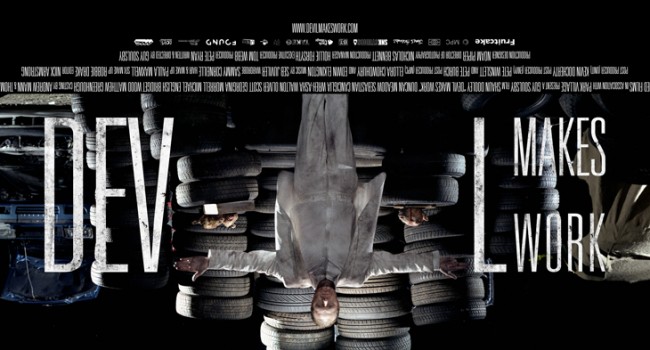
Devil Makes Work is an astounding short film. A lot of time, effort and money has gone into making it look like even more time, effort and money has gone into this. In an age when feature-length films often have credit rolls so minimalist that you could hold the cast and crew screening in the front room of a terraced house, about a hundred people contributed to this production. The effects, the make-up, the design, the sound, the whole shebang. It’s a tremendous showcase for everyone’s work.

But it is essentially a showcase, which makes it hard for me to review, because what the hell can I say about it? Basically it’s Shaun Dooley playing Old Nick as a sort of Satanic geezer gangster, sat on a throne of old tyres, pontificating on the nature of good and evil while we see a succession of figures: Sisyphus pushing his rock uphill, Jesus carrying his cross, a demon, a witch, a voodoo priestess, a rioter, a pimp and a prostitute. Shorn of the opening titles and closing credits, the whole thing lasts less than five minutes.

Visually, it’s hugely impressive. There’s no denying that. There’s a bunch of stuff on the website showing designs and inspiration and props and behind-the-scenes stuff and VFX and grading and whathaveyou and whatnot. The punishing four-day schedule of the actual shoot included one ‘day’ that last for 35 hours. Seriously, you cannot fault the hard work and dedication (and skill and talent) that has gone into this little picture, from Soulsby and everyone else. And all that hard work and dedication (and skill and talent) is evident on screen.

Devil Makes Work has screened at several high-profile festivals and will no doubt show at more. If you’re at a festival and it’s showing, take the trouble to see it. It looked great on my laptop so I expect it will look awesome on the big screen. Or, if you’re reading this review in the future, after the film has gone online, have a quick google and be impressed.

Soulsby is an experienced director of commercials and has worked for many leading international brands. Devil Makes Work is sort of a commercial for himself. But the thing is this. He says he set out to make Devil Makes Work look like a feature film, and … here’s where I pull my honesty trousers on … I’m not sure that it does. What it looks like is a music video. Only without a song.

It’s a great showcase for the director and, frankly, if I was looking for someone to direct a big budget music video, I’d be knocking on his door. We can see that Soulsby has a very strong visual sense, that he has a masterful camera eye, that he has a strong worth ethic and that he has the organisational skills to lead a team of a hundred people and craft something amazing. But can’t we see that from some of the big-name commercials on his own website?

A feature film is more than a succession of stylish images. At least, a good one is. There is certainly a trend in Hollywood to make awful, empty movies that are rammed to the gills with vast amounts of special effects: all style and no substance, all sizzle and no sausage. Films that jump from one set piece explosion or alien spaceship or car chase to the next without any concern for making sense or appealing to anything but the most visceral emotions. Films that are like watching somebody else play Grand Theft Auto or Call of Duty. Films which cost obscene amounts of money and, let’s face it, sometimes make obscene amounts of money back. Maybe that’s the gig that Guy Soulsby is pitching for here.

But films – good films – are about stories. And characters. And relationships. Devil Makes Work is a beautifully shot and edited sequence of vignettes but it’s not a narrative piece. And neither is a 60-second commercial for Nike or whoever.

My advice – not that anyone ever listens to me, and God help your career if you do – would be for Guy Soulsby to now make a second film which bears no relation or comparison whatsoever to Devil Makes Work. A simple film: one or two locations, handful of characters, no fancy-dancy effects, no bombastic, cod-Biblical motifs or themes. Just a simple story, told through the interaction of believable, sympathetic characters. A film that shows Soulsby can tell a narrative, that he can define a character, that he understands the importance of character relationships.

We need to see a man climb a tree, the same man fall out of the tree, and then, well, it’s up to Soulsby whether the guy is alive (comedy) or dead (drama). That’s the three-act structure, and it’s what defines a story. It’s something we can’t get from seven minutes and ten seconds of what is effectively just a tree on fire.

Watching Devil Makes Work, I was reminded of a story I heard many years ago about a wannabe comics artist who sent a portfolio of drawings to Marvel or 2000AD or whoever and was offered some work. When the lad asked why, out of all the submissions the publisher must receive, his had stood out and been chosen, this is what he was told. Ninety-nine per cent of the artwork submitted was muscular superheroes clad in spandex flying and fighting. But this particular artist had submitted drawings of real people in real poses, showing that he understood the basics of comic artwork; that it’s about people, not superhero caricatures.

In crafting Devil Makes Work, Guy Soulsby has shown that he can draw superheroes. But can he draw real people? If he can make a simple narrative film that is as impressive in its own way as this one, but for entirely different reasons, then potentially Hollywood is his.

Of course, he didn’t do this alone, as noted above. The film was produced by Pete Ryan who started out as a video operator and projectionist before moving into production as a lowly runner nine years ago – and now has his own production facility where high-end stuff like this can be shot. The cinematographer was Nicholas Bennett, the editor Nick Armstrong, both highly experienced in commercials. Production designer Noam Piper has designed a couple of drama features I haven’t heard of and was stand-by art director on Paddington. Robbie Drake (Evil Calls, Zombie Resurrection etc) designed the demon make-up. Other make-up was provided by Rebecca Hall (The Eschatrilogy, The Sleeping Room, Ibiza Undead, Soldiers of the Damned) and Paula Maxwell. Seb Juviler composed the music.

Shaun Dooley, who makes an effective and charismatic Satan, isn’t a name that springs to mind in terms of British horror but a perusal of the IMDB shows he has actually amassed a considerable number of genre credits including Eden Lake, Salvage, The Awakening, The Woman in Black and as yet unreleased werewolf western Blood Moon – plus extensive TV work in things like Wolfblood, Red Riding, Broadchurch, Misfits etc. Of the other actors, only Duncan Meadows (Sisyphus) has more than the odd credit. His muscles have had bit parts in Dark Shadows, Merlin and Skyfall, and he’s in upcoming British horror K-Shop.

It’s really, really difficult reviewing something like Devil Makes Work, because it doesn’t have any of the things I look for in a movie, If this was actually a feature film I would trash it for having no characters and no plot. If it was even a narrative short film, I would level the same accusations. But it’s not intended to have characters or plot, it’s intended to be an impressive succession of images that conveys or promotes a feeling. As such it has more in common with a music video or a commercial.

Technically and artistically this is awesome. It does what it sets out to do, with what it has available, to an extraordinarily successful degree. But is it a film? Make us a film now, Mr Soulsby. Make us a movie.

MJS rating: A