Director: xian vassie
Writer: xian vassie
Producer: Mark Collins-Cope, Joumana Jeffers, xian vassie
Cast: Manu Monade, Ellie Fairman, Antona Mirto
Year: 1997
Country: UK
Reviewed from: preview tape
Here’s something a bit odd - a review of a film that was never finished.
I have had this tape sitting my shelf for six years. I assume that it was sent through to me when I was working on SFX, possibly when I was also writing my ‘Independents Day’ column in the early days of Total Film. So one day I decided to sit down and see what I’d got.
What I’d got turned out to be about 30 minutes of disjointed scenes which promised a terrific little film. A search through the MJS archives also turned up a publicity brochure - which was handy as there were no credits on the film at all.
Here’s what I could work out. Snooty, wealthy Lizbeth Falahoun (Antona Mirto) has Professor Lipton (Bill Neenan, unseen) prisoner while she tries to track down the remaining pieces of the Talisman of Set, a powerful ancient Egyptian artefact. She sends two less-than-bright blokes, middle-aged Alf and young Fisty (sorry, don’t know the actors) to search the Professor’s house, where they come across French chef Jules (Manu Monade, a genuine chef who was hailed by The Sunday Times as baker of the best bread in London!) also looking for the Prof.
Jules has one of the pieces of the talisman, found in the soup of a restaurant customer who died at his table. Kidnapped by Alf and Fisty, Jules is nowhere to be seen when waitress Brigitte (Ellie Fairman), who has a crush on him, calls at his loft-flat. She assumes he has run away, consumed with guilt about the dead customer, and enlists the help of fat, jovial Porsche (Paul Tripp - not the one who composed Tubby the Tuba!) to search for him.
Meanwhile, Falahoun, served dinner by her manservant Petr (David Love), is visited by tall, supercilious Sir Luke Homers (Sean Brosnan) and his nervous lawyer Sophie (Carol Kentish). Homers has another piece of the talisman and offers Falahoun a contract which would give them joint control of the magical artefact (Homers’ company is named on the contract as Clearview Occult Investments, Trading and Unexplained Sciences - which gives it an interesting acronym!).
Handling the talisman fragment gives Jules hallucinations: he sees his carpet moving slightly and discovers underneath it a trapdoor, below which is a red-lit Egyptian temple. We also see him on a tube train, where he finds himself the only passenger, the train not stopping at any stations, and visited by ghostly twins (Rose and Sarah Kendall) whom we have seen in a painting, together with the talisman, in the Professor’s house. There is also a very effective scene when Jules opens the door to his flat to find all his furniture dancing around the room, a smashing stop-motion shot which would not have shamed Jiri Trnka.
And then the tape stopped. Some of the scenes had no soundtrack, and a shot of Jules rescuing Sophie from Falahoun’s mansion seemed oddly out of place, but I thought it was all just a dream sequence. It wasn’t - well, some of it might have been - it was a collection of disparate footage from various points in the story.
Basically, Jules is a chef who dreams of being a swashbuckling hero. There’s a still in the brochure from a scene not on the tape: Jules in a swordfight with a pirate named Ripper (Don Fearney), presumably a Walter Mitty-type daydream. He gets caught up in the situation after approaching phoney supernatural investigator Homers about the mysterious object found in the dead customer’s soup. Falahoun is apparently High Priestess of the Cult of Nephythys, who will have power over the ghosts of everyone who ever lived if she can piece the talisman back together...
On the evidence of this disjointed half-hour of footage, this would have been an entertaining, tongue-in-cheek romp. The brochure says that “shooting started in April 1997 and is scheduled to end in October ... post-production is due to be completed at the end of the year.” Just how far did this film get? Does it exist in any sort of finished form? I want to see more!
Apart from chef Monade (who was picked to add authenticity to the cooking scenes!), all the cast were professional actors. Ellie Fairman for example was a voice in the 2001 computer game Desperados: Wanted Dead or Alive and also starred in an award-winning audiobook adaptation of Anne of Green Gables. Antona Mirta has since appeared in another low-budget British film, the action thriller Red Mercury. Don Fearney now organises Hammer Horror fan events. Sean Brosnan is not, despite what the brochure claims, Pierce’s brother.
Carol Kentish, it turns out, I might actually have met! She was one of the actors who provided voices for the British dub of Gamera: Guardian of the Universe, a dubbing session which I visited on behalf of SFX. She was also in The Devil’s Harvest, another unreleased British fantasy movie [Eventually released in 2005 - MJS], starring Brian Blessed and Julie T Wallace (of which I saw some footage when I was visiting that same Gamera dubbing session). Her other films - which may or may not have been completed - are Instant Karma (Slice Films), Inciting Murder (Equator Films) and Living Down Here (We Should Be Ltd). She performs in a topical comedy revue in Brighton called The Treason Show which is actually available on CD from Doctor Who audio producers Big Finish!
Scouring the web reveals that cinematographer Roger Eaton shot an acclaimed documentary on the Spanish architect Gaudi; editor Bill Sneddon went on to work on comedy shows like Jam and Smack the Pony; and costume designer Sam Dightam fulfilled the same role on the Richard Alston Dance Company’s production of The Rite of Spring for the BBC TV series Masterworks in 2002.
And then there’s the writer/director/producer (and composer), the defiantly lower-case xian vassie. Being an adept journalist it took me no time at all to identify him as Christian Vassie, a composer of music for more than sixty film and TV productions including a number of wildlife documentaries and the 2001 BBC Raffles pilot starring Nigel Havers. Born in York, where he still lives, he was once Head Chorister in York Minster Choir. And what is Mr Vassie doing now? He’s representing the Lib-Dems on York City Council!
How far into production did Talisman get? Why was it never finished? Does Christian Vassie still have all the footage? Will any film starring the lovely Carol Kentish ever actually get shown anywhere? To answer these questions I contacted the director himself and received this reply.
MJS rating: It wouldn’t be fare to give this one a grade.
Showing posts with label 1997. Show all posts
Showing posts with label 1997. Show all posts
Friday, 12 December 2014

Friday, 21 February 2014
Little Bigfoot 2: The Journey Home

Writer: Richard Preston Jr
Producer: Raymon Khoury
Cast: Stephen Furst, Steve Eastin, Tom Bosley
Country: USA
Year of release: 1997
Reviewed from: R2 DVD
Stephen Furst from Babylon 5 and National Lampoon’s Animal House toplines this kiddie stravisnut as a divorced dad taking his son, daughter and son’s friend on a camping trip. Playing the character as what might reasonably be called ‘Woody Allen lite’, he is lumbered with dialogue exchanges like: “There is a dangerous wild animal loose in this area.” “My ex-wife is here?”
The story is hardly complex and, so far as I can tell, has no direct connection with the first Little Bigfoot film apart from the same costume and the same midget actor/stuntman inside it (Joseph S Griffo: Phantasm III, Magic Kid I and II, Freaked, T-Force, Monkeybone etc). Dad and kids go camping where the kids encounter an abandoned baby sasquatch (a prologue shows the little’un being separated from its parents by hunters), which they successfully hide from their father, even when they pack up camp and move into a motel. In a sequence obviously inspired by ET, Little Bigfoot (as they call their new friend) is dressed up and taken into town without anyone noticing.
The bad guy in all this is Cavendish (Steve Eastin: Night Warning, The Hidden I and II, Robot Wars, the When a Stranger Calls remake) who not only wants to catch himself a bigfoot but also owns land which rightfully belongs to a local Indian tribe but which cannot be claimed as long as there is no evidence of prior Native American settlement (so any Indian pottery found is smashed). He’s a thorough wrong’un with a squad of hunters/trackers whom he constantly berates and a tall Native American tracker who can sniff out a sasquatch at fifty paces.
 Despite being subtitled The Journey Home, this is no road movie with only the final act fitting that concept, when the kids let their dad in on the secret and they work together to return Little Bigfoot from whence he came - although this involves little more than driving him from the motel back to the campsite. Cavendish’s tracker refuses to shoot the little creature in a stand-off for which the adjective ‘climactic’ seems a little overgenerous. Instead, the Indian uses some mumbo-jumbo magic to revive the injured creature which is subsequently seen, without any real explanation, rejoining its pack/tribe/herd/flock - what is the collective noun for these things? Oh, and the bigfoot’s cave contains some pre-Columbian cave paintings which establish the true ownership of the land.
There is an enormous amount of tree-hugging nonsense in this film about how the Chinook ways were the best and they were at one with nature yada yada yada - the sort of stuff that will only mislead and confuse kids old enough to understand it, rather than pointing them towards a real understanding of ecology and social history.
The three child actors are okay - not great but I’ve seen far worse and two of them were already established TV stars when they made this film. Thirteen-year-old Taran Noah Smith was one of the kids on Home Improvement and played Tiny Tim in a 1995 modern day version of A Christmas Carol entitled Miracle at Christmas: Ebbie’s Story. The best friend is played by Michael Fishman who was DJ in Roseanne. However Melody Clarke, who plays the deliberately infuriating, vegetarian kid sister, seems to have rapidly disappeared from acting after an episode of Baywatch and a sitcom called Unhappily Ever After.
Happy Days’ Tom Bosley (the voice of Gepetto in Pinocchio and the Emperor of the Night) plays the kindly local ranger but doesn’t have much to do except warn Cavendish not to overstep the mark. Stephen Furst’s other genre credits include The Unseen and both Magic Kid movies. He was also, of course, the voice of Fanboy in Freakazoid! and Booster in Buzz Lightyear of Star Command.
Director and associate producer Art Camacho is, oddly, a fight choreographer with credits that range from The Master Demon in 1991, through Cyber-Tracker, Hologram Man and the Magic Kid movies, to Stephen Seagal’s 2002 opus Half Past Dead. Quite why he would have launched his own directorial career with a pair of kiddie monster movies - presumably shot back-to-back, as they were released within a few months of each other - is a mystery. Most of his other films are more likely fair including Soft Target, 13 Dead Men and Sci-Fighter.
Screenwriter Richard Preston Jr has left his name attached to some pretty dreadful straight-to-video movies including Dark Breed and Cyber-Tracker 2, as well as that swiftly forgotten fantasy series Mystic Knights of Tir Na Nog. This appears to be a sole cinematography credit for Jeffrey A Cook whom the Inaccurate Movie Database says is otherwise usually employed as a sparks or gaffer on films like Charlie’s Angels and The Ring 2.
 Special effects are credited to John Criswell (Project Vampire, Creepozoids) and Larry Finch. The bigfoot suit itself is little more than a black furry costume with a fairly immobile ape-like mask; curiously, it has black skin whereas the one on the sleeve is pink-skinned. Make-up artist Rela Martine has gone on to work on big TV shows such as The West Wing and CSI: New York, while second unit director Jerry P Jacobs also directed episodes of LA Heat and Mighty Morphin Power Rangers.
TF Simpson enjoyed Little Bigfoot 2 (which he calls Big Littlefoot) so if the intended audience was pre-schoolers then I suppose the film works. But despite Furst’s exasperated divorcee schtick, there’s nothing here for grown-ups.
MJS rating: C
review originally posted 1st july 2006
Saturday, 1 February 2014
Last Lives

Writer: Dan Duling
Producer: Steve Beswick
Cast: C Thomas Howell, Jennifer Rubin, Billy Wirth
Country: USA/Germany
Year of release: 1997
Reviewed from: UK rental VHS
I picked this up in a charity shop and fully expected it to be shite. As it turns out, while Last Lives is far from what you could call ‘good’, by the end I was actually quite interested and starting to enjoy it.
Judge Reinhold (Gremlins, Big Monster on Campus) plays a bonkers scientist on a parallel Earth who thinks he has found a way of transporting people between the two worlds - his and ours. Well, I say parallel (and so does he) but his world is a global totalitarian regime with technology impossibly far advanced from ours, so there’s not that much parallel about it. Reinhold’s character, incidentally, is named Merkhan which unfortunately sounds enough like ‘merkin’ to provide some juvenile humour.
For his test subject, the government provides him with a convicted rebel, Malakai (Billy Wirth: Body Snatchers, Space Marines) who wears his hair long and has two expressions: slightly moody and very moody (well, three if you include ‘blank’). He is suitable because he is obsessed with his deceased true love - another rebel who was killed when they were captured - and so has some sort of psychic link to her equivalent in our world. This turns out to be a woman named Adrienne, played by Jennifer Rubin (Screamers, Little Witches, Sanctimony) in a hairstyle that makes her look so much like Big Brother presenter Davina McCall that it is difficult to think of anything else when she is on screen.
 After an initial brief foray into Adrienne’s bedroom, Malakai breaks out of the massively spacious (but entirely unfurnished) high-tech cell which he shares with two psychopaths, Khafar and Benza (Robert Pentz - Cyborg - and David Lenthall - The Rage: Carrie 2 - who were both in The Stepford Husbands). These two never say a word but grin whenever they kill people (which they do, a lot). They can be distinguished because one of them is skinny with an automatic rifle and one is fat with a grenade launcher, but I’m not sure which is which.
Malakai and his two goons knock Merkhan unconscious and zap themselves from his massively spacious (but almost entirely unfurnished) laboratory to our world ... arriving outside a church just as Adrienne is inside getting married to Aaron (straight to video king C Thomas Howell). They knock out the congregation with some sort of gas bombs, stab the best man with a bloody great knife, knock out Adrienne with a sort of gas-mask thing and then shoot Aaron. Actually, the skinny psycho blasts away with his M16 (weapons technology being one of the few things in his world that is parallel, apparently), knocking chunks out of the pews behind which Aaron is ducking - and this is not a big church, so the range is about ten or twelve feet tops - without hitting him until he stands up.*
Grabbing the unconscious Adrienne, the three bad guys make their escape in the white stretch limo parked outside, just as Merkhan zaps himself into existence on the church steps.
Before he left his world, Merkhan took from an alcove a large cylinder with ten things wrapped round it that look like futuristic wristwatches. He puts one of these on Aaron and, hey presto, his wounds disappear and he returns to life. Merkhan tries the same trick with the best man but to no avail, apparently because he has been dead slightly longer. In the background, we see someone trying to stand up but it’s not clear whether this is the congregation coming round or just an extra who wasn’t paying attention. (We do later hear on a police radio that, “Everyone in the congregation is wandering around like zombies.” Which of course isn’t grammatically correct, but what are you going to do?)
Merkhan and Aaron set off in pursuit of the limo, using some sort of telepathy to determine its route, I think. Malakai is certainly a telepath, absorbing a knowledge of cars and driving skills by touching Adrienne’s temples. Anyway, Merkhan explains what these wristwatch doodads or ‘lifebands’ actually do, and this, I felt, was worth transcribing exactly because it is some of the most ring-a-ding technobabble I have ever come across:
 “Each lifeband is a muto-genetic cloning stimulator. I designed them to be activated by the biomechanisms of dying. Within a short span of time, depending on the severity of the damage, the body can be fully reanimated.”
Right...
The limo stops at ‘Stan’s Gas and Food’ to refill, where Khafar and Benza decided to kill everyone inside the diner for no apparent reason. Before leaving, they fire a grenade at Aaron’s rapidly approaching car which explodes but remains in one piece, smashing into the petrol pumps, which also explode, although not as much as one would expect. Incredibly, Aaron and Merkhan both survive intact although they are critically injured; Merkhan gives Aaron the remaining lifebands so that he can track down Malakai (who apparently presents a terrible threat because he will “kill everybody” though it’s not clear how or why).
There were originally ten lifebands but two were damaged (apparently) and Aaron has already used one. He slips the other seven onto his arm just before expiring, but his injuries then disappear (in quite a nice morphing shot) and he is whole again. His next problem is the cops who turn up, led by Lieutenant Parks (JC Quinn: Maximum Overdrive, CHUD, The Prophecy). When they arrive, Aaron has changed into the gas attendant’s overalls for no obvious reason (and they are suspiciously devoid of bloodstains). He tries to escape in a police car but is shot through the head (“Nice warning shot,” says Parks, drily) but one of the lifebands activates and brings him back to life, enabling him to drive off as the cops look on in amazement. (Thinking about it, he’s fortunate that all seven lifebands weren’t “activated by the biomechanisms of dying” as that would have blown his remaining lifelines.) The middle act of the film is then a long car chase between the limo and the police car.
What we have here is the idea of limited immortality: Aaron can cheat death six more times. He has seven lives and he has just used up his first one. Unfortunately, this means that not only do we know that any potentially fatal threat won’t harm him, but we are actually counting down the lives as they are used up and will know when the crunch comes. There is also no real link between the idea of an escaped convict from a parallel world and a wristband which can restore the dead to life. This feels like two movies which have been merged into one.
 Malakai, his goons and his hostage hole up in a large, deserted hunting lodge, to where Aaron tracks them. This final act perks up a lot (apart from a short, tasteful sex scene which starts as Adrienne dreaming about Aaron before jolting into reality when she wakes to find Malakai on top of her). Once Aaron is sure that he can’t be killed, he despatches the two goons by luring them, one at a time, into fatal situations then committing suicide. One of these tactics involves blowing himself up and there is a neat but loopy shot of a hand and arm melding back together. It’s loopy because we subsequently see that although his arm may have been blown to bits, his sleeve remained intact. And you have to wonder at his luck that the other arm, the one with the lifebands on it, did not become similarly detached and cause all the devices to fall off.
The ending, as cops surround the lodge, is not terribly surprising although it does contradict what it says in the video sleeve. There is a short epilogue, set a few years later, which presents a nice twist in a surprisingly clever way.
Despite my initial misgivings, this worked out okay. The first act is bollocks, admittedly, and the middle act car chase is singularly uninvolving, but the third act, as Aaron turns his defence mechanism into an offensive weapon, is not bad at all. None of the acting is spectacularly good but none is spectacularly bad, possibly because none of the characters are particularly deep or complex. The script makes sense within its own parameters and doesn’t try to cheat, although there is some decidedly dodgy dialogue. I particularly enjoyed Malakai’s description of his world as: “A world where war was constant, life was torture and dreaming was a punishable offence.” That’ll be Blair’s Britain then (little bit of politics...). And Parks has a corker of a line, even if it is meant ironically: “Don’t worry about any crazed killers speeding away from here. We’ll deal with them at the right time.”
Also in the cast are Richard Fullerton (who was also in The Stepford Husbands) as Merkhan’s boss, the extraordinary-looking John Bennes (The Night Flier, Children of the Corn II, Weekend at Bernie’s) as the minister at the wedding and writer Dan Duling (who has written plenty of other scripts but has no other produced credits) in a cameo as a cop.
Worth Keeter kicked off his directorial career with the straightforwardly titled lycanthrope picture Wolfman in 1979, taking in such stereoscopic classics as Tales from the Third Dimension, Rotweiler: Dogs of Hell and Hot Heir before settling down to a career making episode of Power Rangers and other less well-known Japan-derived Saban product (VR Troopers, Beetleborgs, Masked Rider).

MJS rating: B-
review originally posted 11th December 2005
* LJ Brooks of Kingston, Ontario informs me that this not in fact an M16 but "a gazed-up copy of a Sterling-Patchett 9 mm Submachine gun".
Wednesday, 4 December 2013
Invisible Mom

Writer: William C Martell
Producer: Fred Olen Ray
Cast: Dee Wallace Stone, Barry Livingston, Stella Stevens
Country: USA
Year of release: 1997
Reviewed from: UK disc (Boulevard Ent)
Often compared to Honey I Shrunk the Kids, Fred Olen Ray’s Invisible Mom certainly fits into the subgenre which that Disney film defined - the scientist dad whose invention causes problems when it affects his family. But given that this was made six years later in 1995 (and not released until two years after that) it can hardly be accused of cashing in on Honey. In any case this subgenre goes back at least as far as Digby, the Biggest Dog in the World, possibly earlier.
More to the point, the biggest influence on Ray’s film is very obviously the 1933 Invisible Man, including an explicit and respectful homage when the mom in question takes a cab ride dressed exactly like Claude Rains in the James Whale classic. Fred (who cameos as the cab driver) also throws in a line or two of dialogue from the original film. In that respect, and taking into account also the deliberately Universal-esque black and white opening titles and a not entirely successful attempt to give the film’s production design a sort of Norman Rockwell-lite timelessness, this stands comparison with Tim Burton’s short film Frankenweenie as a film-maker who is also a film fan having tremendous fun when he is given the chance to put his own spin on a classic tale.
As well as Ray - whose eclectic, busy career means he made this around the same time as Masseuse 2 and Hybrid - there is a star-studded cast and crew list here: Brinke Stevens! Gary Graver! Russ Tamblyn! Bill Martell! Stella Stevens! And of course Dee Wallace Stone, one of the great movie mothers. There must be something you have to sign when you start making films in Hollywood which says: ‘I solemnly swear that I will do my best to cast Dee Wallace Stone as the mom in at least some of my films. Unless it’s a serious drama, in which case I’ll use Dianne Wiest.’ Stone’s busy genre career started with the original Stepford Wives and progressed through ET (of course), Cujo, Critters, I’m Dangerous Tonight, Temptress, Boo, Abominable, Bone Dry, the Halloween remake and a 2005 short film about the Loch Ness monster.
 Fifteen year-old Trenton Knight already had an interesting collection of family fantasy films on his CV including Munchie Strikes Back, Charlie’s Ghost: The Story of Coronado and Andrew Stevens’ The Skateboard Kid 2 (where his mother was played by... Dee Wallace Stone!). Here he is Josh Griffin, put-upon son of government scientist Karl Griffin, played by Barry Livingston (Tremors 3) somewhere inbetween Rick Moranis and Chevy Chase.
While Josh suffers the low-level bullying of local hotshot Johnny Thomas (Giuseppe Andrews: 12:01, Prehysteria 2, Independence Day, 2001 Maniacs), his father is equally belittled by his boss Dr Woorter (Russ Tamblyn: West Side Story, War of the Gargantuas) who is in the habit of taking Karl’s inventions and claiming credit for them to military liaison Colonel Cutter (Christopher Stone: Cujo, The Howling - who died before the film was released). Mum (sorry: mom) Laura is exasperated with the pair of them. She tells Josh that if he is in the wrong he should back down but when he is in the right he must stand up for himself. It is obvious that she just wishes that his father would set an example.
Karl explains to Laura that whatever he invents at work belongs to the organisation that runs the lab so she suggests he works on something at home where he has a lab in the basement (complete with a skeleton wearing a hat). This he does and after some experimentation he comes up with a formula which he feeds to family pet Cosmo. The dog (played by director Ray’s own pooch) promptly turns invisible and has to be kept locked in the basement, leaving Josh to worry that the animal has run away.
Josh is an aspiring inventor himself and has rigged a bunch of ropes and pullies to automatically make his bed when he tugs a single cord. This leaves him time to do his homework while watching an old movie on TV (it’s Beast of the Yellow Night, starring John Ashley - who has a funny bit part as the long suffering husband of a nosy neighbour). But invisible dog Cosmo untidies the bed again and Josh is unfairly grounded for apparently lying to his mother.
 After Karl demonstrates that Cosmo is transparent - the dog is represented by a stiffened harness on wires - Josh and his friend Skeeter (Phillip Van Dyke: Halloweentown) decide for some reason that they want to use the invisibility potion on Billy’s pet lizard. Sneaking into the basement lab, they extract some potion from the bottle in a glass pipette but, when Laura discovers them, hastily dispose of the evidence into a half-empty bottle of cola - which Laura subsequently drinks. It’s a pretty contrived way of getting the character to actually ingest the stuff - and you do have to wonder (a) why there was a bottle of cola with no lid left lying around on a bench and (b) wouldn’t it be kind of flat and unpleasant?
Once invisible, Laura has to find ways to disguise herself, including a heavy face-pack smeared on her invisible skin when curtain-twitching Mrs Pringle, the previously mentioned neighbour (Stella Stevens - mother of producer Andrew - whose innumerable other genre films include Wacko, Glass Trap, The Matriarch and Monster in the Closet) comes round to investigate what is going on. But there is a positive side to Laura’s predicament as when Josh is once again hassled by Johnny Thomas who finds that an invisible force grabs his wrist and makes him slap himself.
Nevertheless, Karl heads into the government lab to attempt to find an antidote, using the lizard as his test subject, but that rotten old Dr Woorter has him fired, determined to claim the glory for himself. Just think of it: an army of invisible soldiers! But he has to demonstrate to Colonel Cutter that the invisibility formula is real and a cage with a little hamster wheel that rotates by itself isn’t sufficient proof. It could just be a trick (as, technically, it is).
 When Karl and Josh sneak back into the lab at the weekend, Woorter calls security. Karl is raving about invisibility so he is sent to a mental institution where the staff consists of The Aftermath director Steve Barkett and make-up artist Pam Phillips and the other patients include legendary cinematographer Gary Graver, briefly stepping out from behind the camera. (I say ‘include’ but the low budget nature of Invisible Mom means we don’t actually see anyone else.)
With his father locked up in a loony bin and his mother nowhere to be seen (as it were), Josh is sent to an orphanage where Beth Ulrich (Fugitive Rage) is the stern matriarch (all pinned back hair, thick-rimmed glasses and tweed two-piece). There is a really touching scene between Josh and an unnamed orphan girl (Vanessa Koman: Little Miss Magic, Boogie with the Undead) which manages the rare balancing trick of pathos without bathos. Laura visits Karl’s lab but is captured by Woorter and imprisoned in a wooden crate to be used as evidence.
The story culminates at a hearing to decide Karl’s sanity, overseen by none other than Brinke Stevens (The Naked Monster, Witchouse 3, Dr Horror’s Erotic House of Idiots etc). Naturally, Dr Woorter and Mrs Pringle give evidence against but Laura, who has escaped, sneaks into the courtroom and makes Woorter look ridiculous by tickling him and making him slap himself. She also gives rotten old Mrs Pringle a kick up the arse on the way out. Karl, who has given the expected impassioned speech about how much he loves his family, is declared compos mentis and, with Woorter off to the loony bin in his stead, is offered the senior lab position by Colonel Cutter.
That just leaves the tricky problem of Laura’s invisibility which is solved when Cosmo turns up, fully opaque. After trying all the possible things that the dog may have eaten - including dog food of course - it is eventually discovered that a potion in the basement lab has been knocked onto a plate of food, which the dog has consumed. Tastefully arranging herself under a blanket, Laura is restored to normal (an early line of dialogue acknowledged Josh’s disquiet that his mum is walking around nude).
 Running a full 90 minutes, Invisible Mom is both better and better value than the comparable kidflicks of Charlie Band’s Moonstone Entertainment. The script by the ever-reliable William C Martell (who has a cameo as a workman) is coherent, amusing and accessible, with characters that are simple without being simplistic. It’s a real family film, not just in terms of audience but also in terms of actually being about a family: mum, dad and son all carry equal weight. Though the morality is never laid on with a trowel, there is a lovely scene where Josh persuades his father to stand up against Woorter using the same arguments that he himself had been told by Laura. The supporting cast of characters all work well and the low budget rarely shows (one of the few exceptions being Mrs Pringle’s complaint about “that huge thing in your yard” which we never see).
The special effects are sometimes mechanical and sometimes managed through an effective blue screen technique designed specially for the film by Ray. No, they’re not as good as you would see in a big studio picture but that’s because this isn’t a big studio picture, it’s a straight-to-video B-movie. The effects are, in all honesty, considerably better than one would expect in a film of this scale.
Fred Olen Ray, who had nearly fifty films on his CV already, brings to the film a joy that is missing from some of the more cynically directed fantasy kidflicks out there and the cast all look like they’re having fun. Where the film disappoints slightly is in exploring its central premise. TF Simpson loved the slapstick scenes but they’re far too few and far between. Invisibility movies are a great opportunity for comedy but that’s largely absent in this film which is more of a light-hearted thriller. It’s enjoyable but it spends far too long before Laura becomes invisible and the comic potential of both an invisible mom and an invisible dog (not to mention an invisible lizard) is largely wasted.
That said, Ray did go on to helm three more films in this specific subgenre which I haven’t seen and those may have more of the potential for slapstick silliness which Invisible Mom merely dabbles in. The situation is, however, quite complicated...
Invisible Mom is one of a handful of family features directed by Ray for Stevens’ Royal Oaks Entertainment in the late 1990s, which also included Mom Can I Keep Her?, The Kid with X-Ray Eyes and Billy Frankenstein. This film was shot in ten days in 1995 for just under a quarter of a million dollars and was distributed domestically in 1997 through a deal that Royal Oaks had with Roger Corman’s Concorde-New Horizons. It was a big hit, topping the rental charts and it was also successful in foreign markets.
 When Corman checked his receipts he ordered up a sequel from Royal Oaks so Ray and Stevens got all three lead actors back together for a new story (written by Sean O’Bannon); Mary Woronov and Mickey Dolenz were thrown into the mix too. Unfortunately, the film couldn’t be called Invisible Mom 2 because Fred and Andrew - even more on the ball than Corman - had already used that title for an unrelated ‘invisible mother’ movie written by O’Bannon and with a cast including Ariauna Albright and Robert Quarry. So the direct sequel to Invisible Mom was called Mom’s Outta Sight (and Fred took the pseudonym ‘Peter Stewart’).
In Europe however there was no problem with opportunistic distributors retitling the direct sequel Invisible Mom 2. After all, the Ray/Martell collaboration variously known as Cyberzone or Droid Gunner has always been called Phoenix 2 on this side of the Atlantic. (Other notable examples of this practise include Steve Balderson’s Pep Squad which became I’ve Been Watching You 2, an ersatz sequel to David DeCoteau’s retitled The Brotherhood, and DeCoteau’s own Ancient Evil: Scream of the Mummy which became Bram Stoker’s Legend of the Mummy 2.) Which meant of course that the film shot as Invisible Mom 2 couldn’t be called that in those territories so it became... Mom’s Outta Sight! Filmography compilers have been trying to get their heads around this conundrum ever since.
Somewhere in the middle of all this came Invisible Dad, from a Steve Latshaw script and starring Karen Black (not as the dad, obviously). I’m not sure whether this has any direct connection with any of the other three films.
As well as a terrific name cast, Invisible Mom also boasts some legends behind the camera, not least the extraordinarily prolific and diverse Graver. Editor Peter Miller also cut Attack of the 60 Foot Centerfold, Cyberzone, Sorceress and Adventures in Dinosaur City while production designer Helen Harwell worked on Night Shade, Mystery Monsters, Hybrid, Totem and Planet Patrol. Jeffrey Walton (The Brotherhood I and II, Curse of the Puppet Master, The Werewolf Reborn!) provides a marvellously effective score.
‘Main title design and optical EFX’ are credited to David L Hewitt of Hollywood Optical Systems Inc (surely not the David L Hewitt who directed The Mighty Gorga?). Mark Rappaport of the Creature FX Shop is credited with ‘special effects’; he also worked on classics such as Tremors, Puppet Master I, II and III, Subspecies and Prehysteria but more recently has been forced to slum it on dodgy low-budget stuff like 300 and I am Legend.
 The Inaccurate Movie Database (and many sites deriving information therefrom) list someone named Rennie Piccolo as co-writer but there’s no such credit on screen. Fred’s son Christopher Olen-Ray is listed as ‘assistant co-ordinator’ although it’s not clear whether he assisted with co-ordinating or co-ordinated the assistants.
The sleeve of the R2 DVD released by Boulevard Entertainment in 2007 lists Fred Olen Ray and Andrew Stevens as joint directors and includes Justin Berfield, star of Invisible Mom 2, among the cast. Good grief.
Invisible Mom is a superior (and relatively late) example of the family fantasy pictures that proved so profitable when VHS was king. It’s entertaining without being stupid, it’s moral without being patronising and it’s well-crafted without being overblown.
MJS rating: B+
review originally posted 12th April 2008
Sunday, 10 November 2013
Horror
Director: Tim Hogg
Writer: Tim Hogg
Producer: Tim Hogg
Cast: Jon Davey, Patrick McNamara, Nik Green
Country: UK
Year of release: 1997
Reviewed from: screener VHS
Buried away at the back of various shelves in Simpson Towers are assorted VHS tapes that I was sent by indie film-makers in the late 1990s when I was writing for SFX and Total Film. I’ve kept them these ten years or more gone by in the hope that some of them might turn out to be rare early work by successful directors. Every so often I dust one off and take a look.
I don’t recall watching Horror before although I’ve seen it on my shelf plenty of times. The sleeve is plain white with the word ‘Horror’ on it - ironically distinctive amongst all the monsters and bloody carnage on most of the stuff in my collection. I don’t know why I didn’t watch this. It’s copyrighted 1997 so I may have received it in 1998 just as I was leaving Future Publishing. And it’s taken me ten years to get round to viewing it.
Horror is a half-hour mockumentary, proving that the subgenre was alive and well even then although interestingly it had less relevance. This was before every single tiny indie film came with a Making Of. Let us remember that 1997 was also before DVDs, before internet marketing - the web was only five years old and looked very, very different - and before all the desktop edit suites and suchlike malarkey which have completely changed the face of low-budget film-making. This was a time when ‘digital’ meant you operated it with your fingers.
I would love to report that Horror is a forgotten gem. A quick Google (a verb which didn’t exist in 1997!) reveals passing mentions on various sites of a few other short films directed by Tim Hogg but Horror seems completely undocumented. However it also turns out to be largely unmemorable (so perhaps I have watched it before!) and though there is a nice idea at its core, it just goes nowhere and does nothing.
Patrick McNamara and Jon Davey play brothers Patrick and Jon Jones who live in Bristol with their mum (seen only briefly from the neck down, played by Harry Davies!) and their Grandad (Mike Fortune). Their hobby is making low-budget B-movies, something which was not nearly as common in 1997 as it is in 2008. Nik Green and Mick Scott are Nick and Mick, two thirds (director and sound man) of a BBC documentary crew assigned to follow the Jones brothers around for a few days; the unseen, unheard camera is the third member of the team.
Apart from a prologue in which Grandad plays a plumber and Jon plays a vampire, disrupted when Grandad’s ‘decapitated’ head starts coughing, we never see any actual film-making. Instead Patrick explains the merits of various types of tomato as fake blood and demonstrates to the BBC guys how to achieve horror sound effects by hacking fruit and vegetables with an axe or hammer - which gets them all thrown out of their local greengrocers. On the way home they meet Jon who has been down the pub instead of writing the script, prompting Patrick to attack his brother with a hammer then run away when Nick and Mick restrain and disarm him. Jon seems unfazed by the whole affair.
A visit to Bristol Royal Infirmary in search of human body parts from the operating theatres turns instead into a search for medical equipment in an apparently deserted ward (Mike Fortune doubles up as a heavily bandaged patient; Claire Wright is the nurse who calls security). Outside, a rummage through the hospital bins leads to an argument between the horror director and the documentary director.
After a night of heavy drinking, they all visit a butcher’s in search of offal but are summarily thrown out when hungover vegetarian Nick vomits over some chicken breasts. Finally, after a gag about Patrick catching Jon wanking when he should have been writing, the brothers receive a visit from Deaner (director/writer/producer Tim Hogg), a morgue worker who supplies them with an arm and some kidneys in exchange for (presumably) drugs. These are put in the fridge where Mrs Jones discovers the severed arm and feints. After taking their mum to hospital, the Jones brothers return home to find that Grandad has cooked them a steak and kidney pie using the kidneys which he found in the fridge...
There is lots of potential for humour here but none of it is developed. Despite being evidently intended as a black comedy, Horror turns out to be entirely devoid of actual, well, comedy. I never laughed once. I never even smiled. Sorry. Everything was a jokoid, not a joke.
For some reason the film was shot in black and white with colour reserved for clips from previous epics such as Blonde Bimbos with Big Guns and its sequel Blonde Bimbos with Even Bigger Guns (Melissa Bishop is the actress in both clips). There is also black and white footage of an incident on a previous film when an actress (Lucy Waller) refuses to be covered in two buckets of pig’s blood - which of course completely destroys the conceit of this being all footage shot by Mick and Nick.
Making indie films was a lot harder in those days and God bless Tim Hogg and his pals for making Horror but it really doesn’t work. They needed to sharpen their script considerably (it doesn’t have the improvisational appearance of This is Spinal Tap) and make sure that it had genuinely funny bits, not just stuff that had the same shape as funny. The closest it comes to comedy is the prologue, with Grandad (although we don’t yet know he’s a relative - it’s just an old actor at this point) coughing as he sticks his head through a hole in a table. Patrick hurls abuse and obscenities at the poor old git who gives it one last go and just as Patrick calls “Action!” Grandad gives an almighty cough that actually knock the table over and prompts the director to scream “Oh, for fu-!”
That’s almost funny; there’s timing there. I think it’s significant that this is the only actual ‘film-making’ on show. Perhaps if the ‘documentary’ had actually been about a film getting made there would have been some scope for comedy. As it is, the BBC crew are filming these young film-makers during a period when they’re not making a film, which seems pointless - but no comment is made about this.
Judging by the blurb on the back of the VHS sleeve, I think this was originally intended as a black comedy about two brothers who make horror films but are actually psychos themselves. There’s the curious moment when Patrick attacks Jon with a hammer and they clearly have no qualms about accepting stolen human body parts (which raises the question of why they bothered visiting the hospital and the butcher’s). But if this was the narrative intention then it’s nowhere to be seen (except on the back of the video box). The BBC crew display no horror or shock, just mild - but increasing - irritation. The whole film gives the impression of not being what its makers thought it was going to be, as if they made it with no clear idea what was going to happen.
A minimalist crew consisted of Hogg (writer, director, producer, camera, editor, music), Green (camera, music, production assistant), McNamara (production assistant), Mick Scott (production manager, editor, camera) and Davey (camera, production assistant and - in defiance of what I wrote earlier - ‘digital editing and SPFX’). The effects in question are merely muzzle flashes from a gun but that would have been very impressive and quite groundbreaking back in the heady days of 1997). Scott, Davey, Green and McNamara all get ‘additional material’ credit. The cast also includes Clare Brett, Dave Blow, Jon Wisby (who now broadcasts on Bristol Community FM) and Jacky Pranski.
Tim Hogg’s other films as director include a couple of sci-fi shorts: Room Service (2001, seven minutes) and The Marvellous Handshake (2003, four minutes). Also in 2003, he and Patrick McNamara co-wrote a four-minute short called The Spirit Moved, which was directed by Neil McCann and Owen Martell. He has also worked at Aardmaan in the story department on Chicken Run, in the camera department on the Creature Comforts TV series and possibly other stuff too.
And that’s about it. Not a lot else to say really. I’ve recorded the existence of Horror as a film for future generations but I can’t in all honesty recommend it because while it’s not bad - in fact the acting and direction are both quite decent - it’s simply not funny. And I very much doubt it was funny in 1997 either. Sorry.
MJS rating: C-
Writer: Tim Hogg
Producer: Tim Hogg
Cast: Jon Davey, Patrick McNamara, Nik Green
Country: UK
Year of release: 1997
Reviewed from: screener VHS
Buried away at the back of various shelves in Simpson Towers are assorted VHS tapes that I was sent by indie film-makers in the late 1990s when I was writing for SFX and Total Film. I’ve kept them these ten years or more gone by in the hope that some of them might turn out to be rare early work by successful directors. Every so often I dust one off and take a look.
I don’t recall watching Horror before although I’ve seen it on my shelf plenty of times. The sleeve is plain white with the word ‘Horror’ on it - ironically distinctive amongst all the monsters and bloody carnage on most of the stuff in my collection. I don’t know why I didn’t watch this. It’s copyrighted 1997 so I may have received it in 1998 just as I was leaving Future Publishing. And it’s taken me ten years to get round to viewing it.
Horror is a half-hour mockumentary, proving that the subgenre was alive and well even then although interestingly it had less relevance. This was before every single tiny indie film came with a Making Of. Let us remember that 1997 was also before DVDs, before internet marketing - the web was only five years old and looked very, very different - and before all the desktop edit suites and suchlike malarkey which have completely changed the face of low-budget film-making. This was a time when ‘digital’ meant you operated it with your fingers.
I would love to report that Horror is a forgotten gem. A quick Google (a verb which didn’t exist in 1997!) reveals passing mentions on various sites of a few other short films directed by Tim Hogg but Horror seems completely undocumented. However it also turns out to be largely unmemorable (so perhaps I have watched it before!) and though there is a nice idea at its core, it just goes nowhere and does nothing.
Patrick McNamara and Jon Davey play brothers Patrick and Jon Jones who live in Bristol with their mum (seen only briefly from the neck down, played by Harry Davies!) and their Grandad (Mike Fortune). Their hobby is making low-budget B-movies, something which was not nearly as common in 1997 as it is in 2008. Nik Green and Mick Scott are Nick and Mick, two thirds (director and sound man) of a BBC documentary crew assigned to follow the Jones brothers around for a few days; the unseen, unheard camera is the third member of the team.
Apart from a prologue in which Grandad plays a plumber and Jon plays a vampire, disrupted when Grandad’s ‘decapitated’ head starts coughing, we never see any actual film-making. Instead Patrick explains the merits of various types of tomato as fake blood and demonstrates to the BBC guys how to achieve horror sound effects by hacking fruit and vegetables with an axe or hammer - which gets them all thrown out of their local greengrocers. On the way home they meet Jon who has been down the pub instead of writing the script, prompting Patrick to attack his brother with a hammer then run away when Nick and Mick restrain and disarm him. Jon seems unfazed by the whole affair.
A visit to Bristol Royal Infirmary in search of human body parts from the operating theatres turns instead into a search for medical equipment in an apparently deserted ward (Mike Fortune doubles up as a heavily bandaged patient; Claire Wright is the nurse who calls security). Outside, a rummage through the hospital bins leads to an argument between the horror director and the documentary director.
After a night of heavy drinking, they all visit a butcher’s in search of offal but are summarily thrown out when hungover vegetarian Nick vomits over some chicken breasts. Finally, after a gag about Patrick catching Jon wanking when he should have been writing, the brothers receive a visit from Deaner (director/writer/producer Tim Hogg), a morgue worker who supplies them with an arm and some kidneys in exchange for (presumably) drugs. These are put in the fridge where Mrs Jones discovers the severed arm and feints. After taking their mum to hospital, the Jones brothers return home to find that Grandad has cooked them a steak and kidney pie using the kidneys which he found in the fridge...
There is lots of potential for humour here but none of it is developed. Despite being evidently intended as a black comedy, Horror turns out to be entirely devoid of actual, well, comedy. I never laughed once. I never even smiled. Sorry. Everything was a jokoid, not a joke.
For some reason the film was shot in black and white with colour reserved for clips from previous epics such as Blonde Bimbos with Big Guns and its sequel Blonde Bimbos with Even Bigger Guns (Melissa Bishop is the actress in both clips). There is also black and white footage of an incident on a previous film when an actress (Lucy Waller) refuses to be covered in two buckets of pig’s blood - which of course completely destroys the conceit of this being all footage shot by Mick and Nick.
Making indie films was a lot harder in those days and God bless Tim Hogg and his pals for making Horror but it really doesn’t work. They needed to sharpen their script considerably (it doesn’t have the improvisational appearance of This is Spinal Tap) and make sure that it had genuinely funny bits, not just stuff that had the same shape as funny. The closest it comes to comedy is the prologue, with Grandad (although we don’t yet know he’s a relative - it’s just an old actor at this point) coughing as he sticks his head through a hole in a table. Patrick hurls abuse and obscenities at the poor old git who gives it one last go and just as Patrick calls “Action!” Grandad gives an almighty cough that actually knock the table over and prompts the director to scream “Oh, for fu-!”
That’s almost funny; there’s timing there. I think it’s significant that this is the only actual ‘film-making’ on show. Perhaps if the ‘documentary’ had actually been about a film getting made there would have been some scope for comedy. As it is, the BBC crew are filming these young film-makers during a period when they’re not making a film, which seems pointless - but no comment is made about this.
Judging by the blurb on the back of the VHS sleeve, I think this was originally intended as a black comedy about two brothers who make horror films but are actually psychos themselves. There’s the curious moment when Patrick attacks Jon with a hammer and they clearly have no qualms about accepting stolen human body parts (which raises the question of why they bothered visiting the hospital and the butcher’s). But if this was the narrative intention then it’s nowhere to be seen (except on the back of the video box). The BBC crew display no horror or shock, just mild - but increasing - irritation. The whole film gives the impression of not being what its makers thought it was going to be, as if they made it with no clear idea what was going to happen.
A minimalist crew consisted of Hogg (writer, director, producer, camera, editor, music), Green (camera, music, production assistant), McNamara (production assistant), Mick Scott (production manager, editor, camera) and Davey (camera, production assistant and - in defiance of what I wrote earlier - ‘digital editing and SPFX’). The effects in question are merely muzzle flashes from a gun but that would have been very impressive and quite groundbreaking back in the heady days of 1997). Scott, Davey, Green and McNamara all get ‘additional material’ credit. The cast also includes Clare Brett, Dave Blow, Jon Wisby (who now broadcasts on Bristol Community FM) and Jacky Pranski.
Tim Hogg’s other films as director include a couple of sci-fi shorts: Room Service (2001, seven minutes) and The Marvellous Handshake (2003, four minutes). Also in 2003, he and Patrick McNamara co-wrote a four-minute short called The Spirit Moved, which was directed by Neil McCann and Owen Martell. He has also worked at Aardmaan in the story department on Chicken Run, in the camera department on the Creature Comforts TV series and possibly other stuff too.
And that’s about it. Not a lot else to say really. I’ve recorded the existence of Horror as a film for future generations but I can’t in all honesty recommend it because while it’s not bad - in fact the acting and direction are both quite decent - it’s simply not funny. And I very much doubt it was funny in 1997 either. Sorry.
MJS rating: C-
review originally posted 21st August 2008
Friday, 17 May 2013
Full Metal Gokudo

Writer: Itaru Era
Producer: Fujio Matsushima
Cast: Tsuyoshi Ujiki, Ren Osugi, Tomorowo Taguchi, Shoko Nakahara
Year of release: 1997
Country: Japan
Reviewed from: R2 screener DVD (Artsmagic)
Takashi Miike is now very definitely the darling of Asian cinema fans in the west as more and more of his enormous and varied back catalogue receives an official release. After bringing us his 1996 film Fudoh: The New Generation, ArtsMagic move on to 1997’s Full Metal Gokudo. However, unlike Fudoh - or such recent, better known Miike flicks as Audition and Happiness of the Katakuris - this was one of the director’s DTV films. Consequently not only are production values relatively low, but also the script and direction are not as polished as in his later movies.
Geeky Ken Hagane has joined a yakuza family out of admiration for top gangster Tosa, whom he meets briefly before Tosa attacks a rival gang boss and then heads off to jail for seven years. During that time, Hagane attempts to rise through the ranks but we are shown that he is frankly rubbish at being a yakuza: attempts at extortion fail, his girl dumps him, and the final indignity is being beaten up by four teenage toughs.
When Tosa is released from prison, Hagane is one of the group there to greet him, but is the only person left with the boss in a trap set by rival yakuzas. Tosa and Hagane are both shot to pieces.
Hagane comes to in a strange lab, apparently still alive but with a body that makes whirring noises when he moves. He escapes (on a bicycle!) and bumps into the young toughs again, kicking their arses with his superhuman strength. Then it starts to rain and he short-circuits...
 Yes, Hagane has been rebuilt as a cyborg - by pervy Hiraga Kenpaku (“self-proclaimed genius scientist but others call me the Nutty Doctor”) who wears a PVC catsuit under a yellow teddy-boy coat and speaks Russian. Kenpaku bought both Hagane’s and Tosa’s bodies - the former’s brain was still alive and the latter’s heart was still working - and combined them into one being. It has Hagane’s face but Tosa’s massive dragon tattoo on its back - and Tosa’s massive dick (obscured by digitisation).
The rest of the movie is Hagane/Tosa’s revenge on various yakuzas, though it’s very difficult to follow, since there appear to be several gangs with various mergers and alliances in progress. Plus of course everybody blames someone else for the hit on Tosa when they see Hagane’s invulnerability: he is bullet-proof with massive strength, super hearing and X-ray vision (one of his eyes is detachable).
Hagane ends up living in a ramshackle tent/hut on the beach near a small cemetery which contains the Tosa family tomb, where he meets Yukari, the young woman who was with Tosa on the night when he attacked his rivals. Yukari and Hagane fall in love - she says he reminds her of Tosa - but he cannot bring himself to be intimate with her. “I am a monster with a metal body,” he says, showing her Tosa’s tattoo.
Yukari then disappears and attempts her own revenge on the yakuza who killed her lover but is captured and tortured. Shown a photo of Yukari in bondage, Hagane is forced to work for the yakuzas but then fakes his own death when they blow up his hut, leaving his detachable eye as proof. This is carried into the warehouse where Yukari is held, and so Hagane sees her gang-raped and then committing suicide in a particularly unpleasant manner.

Most western reviews of Full Metal Gokudo say that it is a spoof of RoboCop which is both lazy and inaccurate. Yes, both films involve someone being converted into a cyborg without their consent and then using their new-found power to fight criminals - but that’s an entire subgenre of which RoboCop is merely the best-known and biggest-budgeted example. Cyborg Cop, ROTOR, Steel and Lace, even The Six Million Dollar Man - all have a similar premise, as do many other B-movies and TV series. Hagane is not a cop, either before or after surgery, and there is none of the introspection or futuristic satire which characterised the Verhoeven film.
One thing that sets Full Metal Gokudo aside from similar films is that the cyborg is created from two people, and Tosa’s heart affects its actions as much as Hagane’s head. It’s not quite an All of Me situation, but ‘Hagane’ has flashbacks to aspects of Tosa’s life, and it is ironically highlighted in Yukari’s tearful goodbye letter to him, explaining that she cannot love two men at once.
There are plenty of guns in this film, but also loads of samurai swords, which are always much, much more interesting to watch. Plenty of blood and occasional decapitations are well-done, but there are also some CGI effects which are so badly matted in that they look like they’ve been done on a laptop.
 The widescreen transfer is as faultless as one expects from ArtsMagic, but reviewing this from an advance disc, I don’t know what extras they are planning to include. I’ve sent them bio/filmographies for Miike and the lead actors (not that I’m sure who plays who as the end titles aren’t translated on my disc). Principal players include Tsuyoshi Ujiki (Cure), Shoko Nakahara (Miike’s Visitor Q), Tomorowo/Tomo Taguchi (who starred in Tetsuo the Iron Man - which may also have influenced this film - and its sequel, as well as Android of Notre Dame, Tokyo Fist, Gamera 2 and 3, and DANGAN Runner) and the ubiquitous Ren Osugi (Sonatine, Hana-Bi, Brother, DANGAN Runner, Parasite Eve, Exte: Hair Extensions, Cure, Audition, Hypnosis, Uzumaki...).
Full Metal Gokudo (or Full Metal Yakuza, as it is called on this release) is an odd film, a mixture of violence, bonkers B-movie sci-fi and patches of unsubtle comedy (the actor playing Hagane tends to gurn when called on to play any extreme of emotion). Perhaps not the best movie to start your appreciation of Miike’s extraordinary oeuvre, but fans of Takashi Miike will need no encouragement to snap up this top quality release of one of his most interesting films.
MJS rating: B
review originally posted before November 2004
Tuesday, 22 January 2013
Bloodletting

Writer: Matthew Jason Walsh
Producer: Matthew Jason Walsh
Cast: Ariauna Albright, James L Edwards, Sasha Graham
Year of release: 1997
Country: USA
Reviewed from: R1 DVD (Tempe)
A couple who love each other even as they’re killing other people - it’s an old, old story. From Bonnie and Clyde to Natural Born Killers to Psychos in Love and all points inbetween, it’s been done different ways and to different standards. Bloodletting is how to do it properly.
Tempe regulars Ariauna Albright and James L Edwards (both also in Polymorph and The Sandman) play the couple. He, Butch Harlow, is a notorious serial killer, wanted by the police; she, Serena Stalin, is the young woman who tracks him down and says, “Teach me.” Gradually, suspicion becomes respect which becomes attraction. You know it’s going to end up horribly 89 minutes later, but you don’t know how or why, and writer-director Matthew Jason Walsh has a twist up his sleeve that’s as startling as it is brilliant.
Like the lead characters in Henry: Portrait of a Serial Killer or The Last Horror Movie, Butch is a matter-of-fact psychopath, not really deriving any pleasure (sexual or otherwise) from the killings. He describes it as “like masturbation - something I have to do occasionally.” On the other hand, Serena claims to be turned on by committing - or just watching - murder. By my count, nine or ten people are killed during the film, some of whom elicit little sympathy while others are entirely innocent. Serena’s violent, boorish ex-boyfriend (Randy Rupp) certainly has it coming.
 Where Bloodletting really scores is in the acting and the script, the two areas where so many low-budget films fall down. Edwards and Albright are veterans of this sort of thing and they’re terrific here, really sparking off each other, especially in the final scene. A generally terrific supporting cast includes Scooter McCrae (Shatter Dead, Original Sins) as a virgin stoner, Tina Krause (Witchouse 3: Demon Fire, Psycho Sisters) as a scatty goth-chick and Sasha Graham (Polymorph, Blood of the Werewolf) as a lesbian video store proprietor. All are well-served by Walsh’s witty and taut script, peppered with quotable one-liners that never come off as smart-arse. In many ways, this is the blackest of black comedies.
Every scene serves to either progress the plot or enhance characterisation, though some are a bit talky and static and could have done with some background or foreground action to complement the dialogue. Yes, it’s violent, with some gruesome deaths courtesy of Walsh’s own Digital Armageddon effects company, but these are not there for their own sake and are not lingered on, so do not distract from the story which they serve.
 A cracking, professional-looking feature, it’s great to have Bloodletting out on special edition DVD. You get a commentary by Albright, Edwards and Walsh, a half-hour Making Of featurette, three trailers and a couple of very brief ‘deleted scenes’ which are really little more than a couple of lines of extra dialogue and show up how well-written the script was to start with. There are about 60 or 70 production stills, a bunch of trailers for other Tempe product and a half-hour short called I’ve Killed Before which is an early version of the Bloodletting story (with commentary by producer Ron Bonk).
This is Matthew Jason Walsh’s only feature as director though he shot second unit on Ozone and Polymorph. His writing credits include Ancient Evil: Scream of the Mummy, The Sandman, Witchouse I and III, The Brotherhood I, II and III, Final Stab and Deep Freeze. Executive producer and Tempe head honcho JR Bookwalter handled editing duties, Psycho Sisters director Pete Jacelone’s name can be spotted in the credits, and Fangoria’s Michael Gingold has a cameo in the opening scene.
MJS rating: A-
Review originally posted before November 2004
Sunday, 20 January 2013
Bleak Future

Writers: Brian S O’Malley, Steven Darancette
Producer: Steve Darancette
Cast: Frank Kowal, Brad Rockhold, Wendie Newcomb
Country: USA
Year of release: 1997
Reviewed from: US DVD
Website: www.bleakfuture.com
The DVD of Bleak Future arrives bedecked with praise. “This movie is awesome,” says Aint It Cool News. Well, they say that about almost everything (although to be fair, the entire budget for this film was probably less than some studio publicists spend on promoting crappy blockbusters through Aint It Complete Nonsense).
“The energy and enthusiasm of Peter Jackson’s Bad Taste,” says Nathan Shumate at Cold Fusion Video Reviews. Well, I know Nathan slightly through discussion boards and I find his reviews to be accurate and insightful (and entertaining). I trust this guy’s judgement.
But hey, what’s this third quote? “Funniest sci-fi film in years,” says ‘Mike Simpson, SFX magazine’. What the heck does he know about anything?
Ah, I love DVDs that have quotes from me on the back! And I love even more films which, when rejigged and rejogged for a super-wicko DVD release actually include me in the ‘thank you’s at the end! I do recall reviewing Bleak Future when it was released on VHS in the UK by the old Screen Edge label in 1998. And I did indeed write that quote and, having watched the film again nine years later, I stand by every word of it (all five of ‘em). Bleak Future really is one of the funniest science fiction films of recent years. What is more, I’ll go further. This isn’t just comedy for comedy’s sake, this is actually one of the best post-apocalypse movies ever made.
It’s always tempting with post-apocalypse films to compare them to Mad Max (or Mad Max 2) but two titles jumped into my head while watching the Bleak Future DVD and they refused to go away. If I had to stop writing now and sum this film up in one sentence, I would say: ‘Bleak Future is Beneath the Planet of the Apes meets The Bed Sitting Room.’
 But I don’t have to stop writing now. I can go into some detail about why this movie is so damn good.
In a world of ruins and deserts, Slangman (Frank Kowal) wanders across the land. Possessor of a large dictionary, he makes his living by selling definitions of words (I particularly like the idea that the exchangeable currency in this world is batteries). Self-styled ‘most intelligent man in the known world’, Slangman is irritable, self-confident and often exasperated. Searching for the mythical ‘Source’, said to be a repository of knowledge from before the great cataclysm, he gathers around him a small coterie of acolytes. There’s Atlatl (Brad Rockhold), a mute Scottish warrior; Femme (Wendie Newcomb), a bimbo actress; and Brother Alfonze (Steven A Kowal - Frank’s brother) a hippy hermit.
Standing in his way are a range of ‘mutants’ including Doctor Obvious (Rob Cunningham) who also believes himself to be the smartest man in the world; King Malice (played by a guy credited only as Bones) and his mutant court; and the terrible Malathion Man (Tom Johnson) armed with what appears to be highly acidic urine.
As Slangman and co. stumble across the patchy desert towards the Source, we break off occasionally for documentary footage of what happened to the world. An era of unprecedented peace and prosperity led to the development of the Pangaea Project, an attempt to move the planet’s tectonic plates to create one super-continent without countries or borders. The film’s climax is both the end of Slangman’s journey and the culmination of the documentary, the latter explaining the circumstances of the former. In this respect it reminded me of a terrific SF novel I once read, The End of the World News by Anthony Burgess, which used a similar structure but with three narrative strands.
The thing about post-apocalypse movies is that, their setting generally being a featureless desert, it’s the characters that make them. And Bleak Future has great characters. It’s a wonderfully restrained film that doesn’t try to go overboard on ‘clever’ dialogue but instead lets us learn about the characters through their reactions to the world around them.
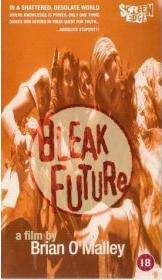
When I first saw Bleak Future on that Screen Edge VHS, in those far-off days when ‘DVD’ was still a sexually transmitted infection, it was a rough and ready thing. It was clearly a labour of love. Shot on Super-8, the grainy, sometimes wobbly image looked like a real, grown-up film. There was nothing digital in those days except watches and alarm clocks so you either shot on 16mm if you could afford it or Betacam if you couldn’t. The former looked polished and left you unfairly compared with the 35mm big boys, the latter invariably looked like a wedding video. But there was a grittiness to Bleak Future that marked it out as something special, something that somebody really, really cared about.
Well, God bless Brian O’Malley because he has managed to upgrade Bleak Future into a minor masterpiece - without losing that same rough and ready feel. For three years he used modern technology to make the old film look like it would have done when new if today’s technology had been available back then but had worked like the old technology did when the film was made. D’you see?
The film has been re-edited and digitally doodah-ed; tints and tones have been added; pick-up shots have been filmed in the same locations and seamlessly integrated; the entire dialogue track (so often the Achilles' heel of enthusiastic low-budget movies) has been recorded with all but one of the original cast looping their own lines. I no longer have that old VHS so I can’t make direct comparisons, not that I need to. The new version of Bleak Future is a thing of beauty - that’s all you need to know.
And what a package on the DVD: literally hundreds of stills, designs, pieces of artwork and publicity materials. Stacks of behind the scenes footage and commentaries which document the incredible story behind the film. The scenes with the stuck truck are priceless. This is one of the best value DVDs I have ever seen, packed with so much stuff it would take you weeks to get through it all. Sometimes a multiplicity of extras masks a shoddy feature but not in this case. On the Bleak Future DVD, the extras complement the feature magnificently, creating an all-round entertainment package that means you may never have to leave your armchair again.

In a way, the fact that Bleak Future has not been followed by a string of other indie movies makes this all the more special. O’Malley seems to have dedicated most of his life to Bleak Future in one form or another and it shows, the love shows, the passion shows. I mean, yes, the guy really needs to put this behind him now and get out of the house a bit more, maybe kick a ball about in the yard or something, but you can’t fault his dedication. This is the sort of feature film that you get to make only once, before you realise how much ridiculously hard work is involved - which is ironic because in a sense he has made it twice.
Are you getting the impression that I rate Bleak Future highly? You’re damn right I do. This was one of my favourite films even before O’Malley stuck my name in the end credits. A brilliant piece of fantasy storytelling, a hilarious comedy, a penetrating satire on the human condition - and that’s just the Making Of featurette. The movie itself is all this and more. In fact, this deserves something that I have almost never handed out in all the years I have been running this website. Brian Scott O’Malley, I award you...
MJS rating: A+
Review originally posted 16th April 2007
Subscribe to:
Posts (Atom)